Joo Yeon Cho
Helsinki University of Technology,
Department of Information and Computer Science, P.O. Box 5400, FI-02015 TKK, Finland
Abstract. PRESENT is a hardware-oriented block cipher suitable for resource con-strained environment. In this paper we analyze PRESENT by the multidimensional linear cryptanalysis method. We claim that our attack can recover the 80-bit secret key of PRESENT up to 25 rounds out of 31 rounds with around 262.4
data complex-ity. Furthermore, we showed that the 26-round version of PRESENT can be attacked faster than key exhaustive search with the 264
data complexity by an advanced key search technique. Our results are superior to all the previous attacks. We demon-strate our result by performing the linear attacks on reduced variants of PRESENT. Our results exemplify that the performance of the multidimensional linear attack is superior compared to the classical linear attack.
Keywords : Block Ciphers, Lightweight Cryptography, PRESENT, Multidimen-sional Linear Cryptanalysis.
1
Introduction
PRESENT [3] is a lightweight SPN block cipher proposed by Bogdanov et al. at CHES 2007. PRESENT is designed for resource restricted applications such as RFID and sensor networks. Due to the impressive hardware performance and the strong security, PRESENT has drawn a lot of attention from the lightweight cryptographic community.
On the other hand, the cryptanalysis on PRESENT has been also actively performed so far. In [15], Wang presented a differential cryptanalysis that could attack the 16-round variant with 264chosen texts and 265memory accesses. In [1], Albrecht et al. presented a differential attack using algebraic techniques that can recover a 80-bit key of the 16-round variant with similar complexity to [15] and a 128-bit key of the 19-round variant by 2113 computations.
In [4], Collard et al. presented a statistical saturation attack that can recover the key of the 24 round variant with 257 chosen texts and 257 time complexity under the condition that
the parts of plaintexts are fixed to a constant value. More recently, Ohkuma presented a linear attack on 24-round variant using weak keys with 263.5known texts [13].
In this paper, we analyze PRESENT by a multidimensional linear attack method. We ob-serve that PRESENT has a large number of linear approximations that hold with the same order of magnitude of correlations due to the simple structure of the round function 1.
As shown in [7], a multidimensional linear attack can be efficiently applied to such cipher. According to our analysis, the 25-round variant of PRESENT using the 80-bit key can be attacked faster than key exhaustive search with around 262.4data complexity. Furthermore,
an advanced key search technique enables us to attack the 26-round version of PRESENT with 264 data complexity. Our results are superior to all the previous attacks presented in
1
the open literature. We demonstrate our claim by performing the multidimensional linear attacks on reduced variants of PRESENT.
This paper is organized as follows. In Section 2, the structure of PRESENT is briefly de-scribed and the framework of multidimensional linear attack is presented. In Section 3, linear characteristics are derived and their capacities are computed. In Section 4, the attack algorithm using linear characteristics is described. In Section 5, our attacks are applied to re-duced variants of PRESENT and the experimental results are presented. Section 6 concludes this paper.
2
Preliminaries
2.1 Brief Description of PRESENT
PRESENT is a SPN block cipher that consists of 31 rounds. The encryption block length is 64 bits and the key lengths is 80 bits or 128 bits. Each of the 31 rounds consists of three layers: addRoundKey, SboxLayer and pLayer. The AddRoundKey is a 64-bit eXclusiveOR operation with a round key. The SboxLayer is a 64-bit nonlinear transform using a single S-box 16 times in parallel. The S-box is a nonlinear bijective mappingS :F42 7→F42 given
in Table 4. The pLayer is a bit-by-bit permutation P : F642 7→ F642 given in Table 5. The
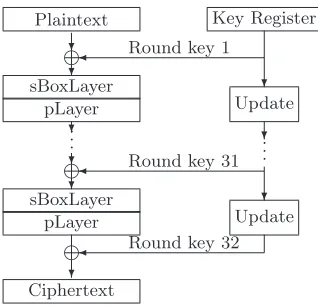
design idea of SboxLayer and pLayer is adapted from Serpent [2] and DES block cipher [10], respectively. The structure of PRESENT is illustrated in Figure 1.
The key scheduling algorithm has two versions depending on whether the key size is 80 bits or 128 bits. Since the key schedule is not directly relevant to out attack, we do not describe the key schedule algorithm here. For complete description of PRESENT we refer to the paper [3].
Plaintext
? f ?
Round key 1
Key Register
? Update
? sBoxLayer
pLayer ? .. .
? f
.. .
? Update Round key 31 ?
sBoxLayer pLayer
f ?
Round key 32
Ciphertext
Fig. 1.Overview of PRESENT
2.2 Multidimensional Linear Cryptanalysis usingχ2 Method
the log-likelihood ratio (LLR) and theχ2. We apply theχ2 statistic method to PRESENT
since the LLR method is not proper to PRESENT-like structure. The detailed explanation will be given in Section 4.4.
The brief framework of theχ2method is as follows. LetV
ndenote the space ofn-dimensional binary vectors. A functionf :Vn →Vmwithf = (f1,· · ·, fm) wherefi is a linear approxi-mation is called a vectorial linear approxiapproxi-mation of the dimensionm. The correlation of fi is defined asc(fi) = 2−n[#(fi(a) = 0)−#(fi(a) = 1)] wherea∈Vn.
Letpbe the probability distribution ofm-dimensional linear approximations. The capacity of p = (p0, . . . , p2m−1) is defined by Cp = P2
m−1 i=0
(pi−ui)2
ui where u = (u0, . . . , u2 m−1) is the uniform distribution. It is well known that theCp is equal to the sum of the square of correlations of all 2m−1 linear approximations.
Supposel is the length of the target key. For all values of k∈ [0,2l−1], one obtains the empirical probability distributionsQk = (qk,0, . . . , qk,2m−1) by measuring the frequency of
m-dimensional vectors which are Boolean values ofm linear independent approximations. Then the candidate keys are sorted according to theirχ2-statistics defined as
D(k) = 2m M
X
i=0
(qk,i−2−m)2, M = 2m−1 (1)
which represents thel2-distance of theQk from the uniform distribution.
If the right key is ranked in the position ofdfrom the top out of 2l key candidates, we say that the attack has the advantage of (l−log2d) [14]. The advantage of theχ2-method using
statistic (1) is derived in Theorem 1 in [8] by
advantage=(N Cp−4Φ
−2(2P
s−1))2
8M , Φ(x) =
Z x
−∞
1
√
2πe
−t2/2
dt (2)
wherePs is the success probability,N is the amount of data and Cis the capacity.
2.3 Notations
LetSidenote thei-th S-box in the SboxLayer andP denote the permutation in the pLayer. LetKrdenote ther-th round key andKr[i] denote thei-th bit of theKr. TheKr[i..j] denote the bit string from Kr[i] to Kr[j]. We use EK(X) for representing the average value of X over all possible values ofK. In our notation of the bit masks, we identifyF42withZ16. We
use the little endian for bit notation through the paper, that is, the least significant bit is counted at the rightmost.
3
Linear Characteristics of PRESENT
Definition 1. A single-bit linear trail is a linear trail where the input and output masks of linear approximations of all intermediate S-boxes are of Hamming weight one.
We call a single-bit linear trail as just a linear trail unless specified otherwise.
3.1 Single Bit Linear Trails
Let π(α, β) denote a linear approximation of S-box S where α, β ∈ F42 are an input and
output mask ofS, respectively. The correlation ofπ(α, β) is denoted byρ(α, β). We observe that the S-box has the following properties:
S1. Forα, β∈ {2,4,8},ρ(α, β) =±2−2 except thatρ(8,4) = 0;
S2. Forα∈ {1,2,4,8},ρ(α,1) =ρ(1, α) = 0.
According to Property S1 and S2, the S-box holds eight linear approximations which has a single active bit in both the input and output linear masks.
Let us defineS ={S5, S6, S7, S9, S10, S11, S13, S14, S15} andB={4i+ 1,4i+ 2,4i+ 3|0≤ i≤15, Si∈ S}. Then, the permutationP of the pLayer has the following properties:
P1. Ifx∈ B, thenP(x)∈ B;
P2. All the outputs ofS0, S4, S8andS12turn into the least significant bits of the inputs of
S-boxs next round by the permutation. Also, the outputs ofS1, S2 andS3turn into the
input ofS0, S4, S8 andS12 next round.
Due to Property S2 and P2, the linear trails passing any bit position that does not included inBdo not have correlations. Hence, by Property S1 and P1, anyr-round linear trail with an input maskαand an output maskβ takes the following path:
π(α,2v1)→π(2u2,2v2)→ · · · →π(2ur−1,2vr−1)→π(2ur, β)
whereui, vi∈ {1,2,3}and (ui, vi)6= (3,2) for 1≤i≤r.
3.2 n-Round Linear Characteristic
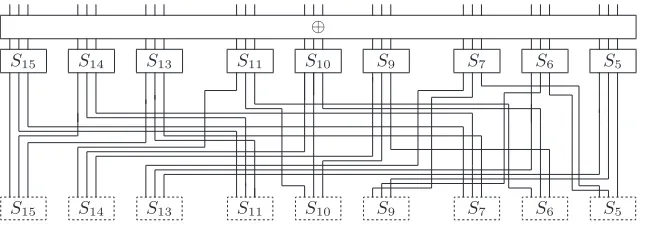
LetΩ(1) denote the 1-round linear characteristic which has all the single bit linear trails of
nine S-boxes ofS, as shown in Figure 2. Due to Property S1, theΩ(1) contains 9×8 = 72
linear trails, each of which has±2−2correlation. Sincex7→P(x) is an one-to-one mapping,
Property P1 implies that {P(x)|x ∈ B} =B. Hence, we can construct the n-round linear characteristic, which is denoted byΩ(n), by concatenatingΩ(1)iterativelyntimes as follows:
Ω(n)=Ω(1)◦ · · · ◦Ω(1)
| {z }
ntimes
.
We can expect that the number of linear trails grows exponentially according to the in-crement of the number of rounds. Letζ(r)(x, y) denote a bundle of linear trails which start
from thex-th bit of input and end up at they-th bit of output overΩ(r). Eachζ(r)(x, y) is
extended toζ(r+1)(x, ν) for someν ∈ Bvia two or three single-bit linear approximations of
⊕
S15 S14 S13 S11 S10 S9 S7 S6 S5
S15 S14 S13 S11 S10 S9 S7 S6 S5
Fig. 2.Linear trails in the 1-round linear characteristic
SupposeKis a user-supplied key. Letθ(r)(x, y;K) denote the correlation ofζ(r)(x, y), given K. The actual value ofθ(r)(x, y;K) depends on the round keys involved in each linear trail. For anyx, y∈ B, theθ(r)(x, y;K) is recursively expressed as
θ(r)(x, y;K) =
3 X
i=1
(−1)Kr[ν]ρ(2i,2P−
1(y) mod 4
)θ(r−1)(x, ν;K), ν= 4⌊P−1(y)/4⌋+i (3)
whereP−1is an inverse mapping ofP.
The average value ofθ(r)(x, y;K) over all possible values of K is recursively computed by
the following algorithm:
1. Initializeθ(0)(x, y) = 1 for allj∈B. Setr= 1.
2. For eachx, y∈ B,
(a) computeθ(r)(x, y;K) using (3) for all possible values ofK∈F27 2 ;
(b) assignθ(r)(x, y) =E
K(|θ(r)(x, y;K)|) = 2−27PK|θ(r)(x, y;K)|. 3. Repeat Step 2 forr= 2,3, . . . , n.
Above algorithm can be much simplified by the following theorem: (In this theorem, the correlation potential means the square of the correlation.)
Theorem 1. (Theorem 7.9.1 in ”Design of Rijndael” [6] and Fundamental Theorem by Nyberg [11]) The average correlation potential between an input and an output selection pattern is the sum of the correlation potentials of all linear trails between the input and output selection patterns.
By Theorem 1, the average value of (θ(n)(x, y))2 is obtained by summing the square values
of correlations of all linear trails in theζ(r)(x, y) for all x, y∈ B. Hence, the average value
of (θ(n)(x, y))2can be computed simply by the following algorithm:
1. Initializeθ(0)(x, y) = 1 for allx, y∈B. Setr= 1.
2. For eachx, y∈ B, compute
EK[(θ(r)(x, y;K))2] =
X
i=1,2,3
ρ(2i,2P−1(y) mod 4
)2EK[(θ(r−1)(x, ν;K))2], ν= 4⌊P−1(y)/4⌋+i
Theorem 1 concerns a single linear approximation that has multiple linear trails. For the multidimensional linear cryptanalysis, Theorem 1 can be extended as follows:
Proposition 1. The expected capacity of an m-dimensional linear approximation is the sum of the square of the expected correlations of all the linear trails that each of the2m−1
one-dimensional linear approximations are composed of.
3.3 (n+ 4)-Round Linear Characteristic
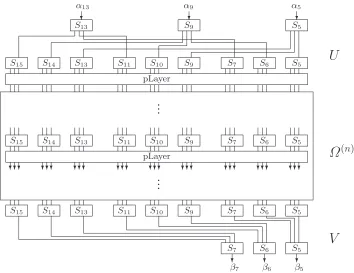
Let us define U as the 2-round characteristic which starts from S5, S9 and S13 and ends
with nine S-boxes of S. Each input S-box of U takes arbitrary value from 1 to 15 as the input mask and each output S-box takes a single-bit output mask only. We also define V
as the 2-round characteristic which starts from nine S-boxes of S and ends up at S5, S6
andS7. Each input S-box ofV takes a single-bit linear mask and each output S-box takes
arbitrary value from 1 to 15 as the output mask. For a positive integern, then+ 4 round linear characteristic is constructed by addingU and V to Ω(n)at the top and the bottom
respectively as shown in Figure 3.
.
.
.
.
.
.
Ω
(n)U
V
α13 α9 α5
? ? ?
S13 S9 S5
S15 S14 S13 S11 S10 S9 S7 S6 S5
pLayer
S15 S14 S13 S11 S10 S9 S7 S6 S5
pLayer
??? ??? ??? ???
??? ??? ???
??? ???
S15 S14 S13 S11 S10 S9 S7 S6 S5
S7 S6 S5
? ? ?
β5
β6
β7
Fig. 3.(n+ 4) rounds linear characteristic
Theorem 2. Let us assume that the round keys of PRESENT are statistically independent. For a positive integern, the expected capacity ofU◦Ω(n)◦V over the secret keyK is
2−8·EK
X
x∈B
X
y∈B
θ(n)(x, y;K)2
Proof. Let αi be an input mask ofSi ∈ {S5, S9, S13} of theU andβj be an output mask of Sj ∈ {S5, S6, S7} of the V. For a fixed αi, the U has nine linear trails holding with correlations ofρ(αi,2u)·2−2for someu∈ {1,2,3}. Similarly, for a fixedβj, theV has nine linear trails with the correlations of ρ(2v, β
j)·2−2 for some v ∈ {1,2,3}. We define B[αi] andB[βj] as the sets of input and output bit positions whereΩ(n) is linked with U andV for fixedαi andβj, respectively. Obviously, #B[αi] = #B[βj] = 9 for anyαi andβj. Letc(n+4)(α
i, βj) denote the correlation of the linear approximation with the input mask
αi and the output maskβj overU◦Ω(n)◦V. Then, for a fixed keyK, we can write
c(n+4)(αi, βj;K) =
X
x∈B1 X
y∈B2
(−1)k·ρ(αi,2u)·2−2·θ(n)(x, y;K)·2−2·ρ(2v, βj)
wherekdenotes a parity of the relevant round key bits. Since
EK(−1)ks(−1)kt=
(
1 ifs=t,
0 ifs6=t
under the assumption that the round key bits are statistically independent,2 we get
EK
c(n+4)(αi, βj;K)
2
=EK
2−8 X
x∈B1 X
y∈B2
ρ(αi,2u)2·
θ(n)(x, y;K)2·ρ(2v, βj)2
.
Parseval’s theorem says that P15αi=0ρ(αi,2u)2 = P15βj=0ρ(2v, βj)2 = 1 for any u, v ∈
{1,2,3}. Hence, the average value ofCp(n+4)(αi, βj;K) is obtained by computing
EK[Cp(n+4)(αi, βj;K)] =
15 X
αi=0
15 X
βj=0 EK
c(n+4)(αi, βj;K)
2
= 2−8·EK
X
x∈B1 X
y∈B2
θ(n)(x, y;K)2
.
The Cp(n+4)(K) is the sum of Cp(n+4)(αi, βj;K) for all pairwise combinations of {αi, βj} where αi ∈ {α5, α9, α13} and βj ∈ {β5, β6, β7}. Since B[α5]∪B[α9]∪B[α13] = B and B[β5]∪B[β6]∪B[β7] =B, we conclude that
EK[Cp(n+4)(K)] =
X
i∈{5,9,13}
X
j∈{5,6,7}
EK[Cp(n+4)(αi, βj;K)]
= 2−8·E
K
X
x∈B
X
y∈B
θ(n)(x, y;K)2
⊓ ⊔
2
Theorem 2 implies that the expected capacity of U◦Ω(n+4)◦V is the sum of the square
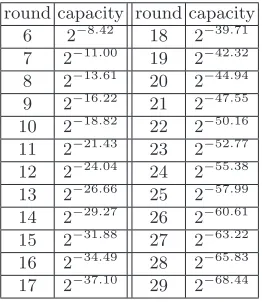
of correlations of all linear trails starting from the second round and ending to the second last round. We calculated the average capacities of (n+ 4)-round linear characteristics for 2≤n≤25 by Theorem 2. The results are displayed in Table 1.
In the next section, we present the multidimensional linear attacks using the (n+ 4)-round linear characteristics.
round capacity round capacity 6 2−8.42 18 2−39.71
7 2−11.00 19 2−42.32
8 2−13.61 20 2−44.94
9 2−16.22 21 2−47.55
10 2−18.82 22 2−50.16
11 2−21.43 23 2−52.77
12 2−24.04 24 2−55.38
13 2−26.66 25 2−57.99
14 2−29.27 26 2−60.61
15 2−31.88 27 2−63.22
16 2−34.49 28 2−65.83
17 2−37.10 29 2−68.44
Table 1.Evaluation of capacities ofn+ 4 round characteristics
4
Multidimensional Linear Attacks on PRESENT
4.1 Selection of linear independent approximations
Supposenis a positive integer. The dimension of input and output masks of theU◦Ω(n)◦V is
4×3 = 12 each. As mentioned before, the linear trails passing more than one S-boxes at each round have much less correlations than single-bit linear trails. Thus, it is sufficient to take nine linear characteristics individually, each of which has 8-dimensional linear characteristic with 4-bit input and 4-bit output. Then, the number of linear approximations spanned for our attack is 9×(28−1) in total.
We use eight unit vectors as the linear independent approximations. Even though each unit vector does not have any correlation, all linear approximations can be obtained by spanning these unit vectors. The merit of this approach is that the evaluation of Boolean values of linear approximations is not needed; The probability distribution of the linear approximations can be obtained by just measuring the frequencies of the concatenated value of input and output of the linear characteristic. Hence, the time complexity of the attack can be reduced by at least a factor ofmwheremis the dimension of the linear approximations.
4.2 Attack Algorithm
We target to attack then-round version of PRESENT. Our attack uses the (n−2)-round linear characteristicU◦Ω(n−6)◦V from the second round to (n−1)-th round and recovers
connected toS4, S5, S6 and S7 of the first round and the outputs of the V are connected
to S1, S5, S9 and S13 of the n-th round. Thus, we target to recover the 16 bits of the K1, which are K1[16..19]||K
[20..23]
1 ||K
[24..27]
1 ||K
[28..31]
1 , and the 16 bits of the Kn, which are
P(Kn[4..7])||P(Kn[20..23])||P(Kn[36..39])||P(Kn[52..55]).
Letke andkd be the targeted 16 bits ofK1 andKn, respectively. Then, we recover the ke andkd in the following way:
1. Prepare 9·232·28 counters and initialize them by zero.
2. CollectN plaintext-ciphertext pairs. 3. ForK= 0, . . . ,232−1,
(a) Partially encrypt each plaintext one round by the 16 bits of ke and decrypt the corresponding ciphertext one round by the 16 bits of kd where K=kd||ke.
(b) Extract three input valuesα5, α9, α13 ofU and three output valuesβ5, β6, β7 ofV.
(c) Obtain nine 8-bit values by pairwise concatenatingαi and βj for i = 5,9,13 and
j= 5,6,7.
(d) increment nine counters indicated byK and (αi||βj). 4. Repeat Step 3 for allN text pairs.
5. Compute l2 distance using (1) between the probability distribution for each K and
uniform distribution.
6. Sort out the candidate keys according to theirl2 distances.
7. Search the right key from the top of the sorted keys.
4.3 Attack Complexity
The amount of data required forχ2statistic method is obtained from (2) as follows:
N =padvantage·8·M+ 4Φ−2(2Ps−1)
/C(r)
where Ps is the success probability and C(r) is the capacity. Since the number of linear approximations available for the attack is 9×(28−1), the full advantage (32 bits) of
the attack with the success probability 0.95 is achieved by the data complexity of N =
p
32·8·9·(28−1) + 4Φ−2(2·0.95−1)/C(r)≈29.6/C(r).
According to the Step 3 and 4 of the attack algorithm, we needs to perform both 1-round encryption and decryption for each plaintext-ciphertext pair and each guessed key. A naive implementation of these steps requiresN·232operations. We can reduce the computational complexity greatly by removing the repeated computations.
Letxandybe a 16-bit plaintext and a 16-bit ciphertext used for our attack. The Step 3-(a) of the attack algorithm is to compute zk = (P(S(x⊕ke))||(S−1(P−1(y⊕kd))) where ke and kd denote the guessed 16-bit keys of the first round and the last round, respectively. Thus, the probability distributionQk ofzk is obtained by mapping (x⊕ke)||(y⊕kd)7→zk for allk= (ke||kd)∈F322 withN pairs of data. This step can be divided into two sub-steps
for efficient computations: First, the table Q∗ is obtained by measuring the frequency of
(x||y)∈ F322 . Next, the mapping (Q∗, k) 7→Qk can be done by 232 times access ofQ∗ for each candidatek. Hence, the Step 3 can be done by 232·232 operations in total. 3 Since
computing the l2 distance requires 9·28 operations for each candidate key, the total time
complexity of the attack is 264+ 9·28·232≈264. For the memory complexity, theQ∗needs
3
232·4 = 234bytes of memory and some additional memory is required for storing temporary
values of computations.
Without increasing the amount of data complexity, we can recover another 32 bits of the round key by changing the input S-boxes ofU and the output S-boxes ofV over the U◦ Ω(n)◦V; if the attack uses the linear characteristic starting with S
7, S11, S15 and ending
with S13, S14, S15, we recover theK1[48..63] and the K [12..15]
n , Kn[28..31], Kn[44..47], Kn[60..63]. In this manner, we can recover 32·2 bits of the round keys in the first and the last round key in total. The remaining 80−64 = 16 bits of key can be obtained by exhaustive key search. Hence, the time complexity of the attack is around 2·264+ 216≈265 in total.
Attack on 26-round PRESENT Our attack can be extended to 26-round version of PRESENT with the 24-round characteristic holding with the capacity of 2−55.38. If the
attack uses the full range of text pairs, which is 264, the theoretical advantage of attack
is expected to be 8 by (2). This means that the right key is possibly ranked within the position of 232−8= 224 out of 232 candidates with the probability of 0.95. Hence, we apply
the following attack scenario to the 26-round PRESENT: First, the multidimensional linear attack targeting 32 bits of the round key is performed with 264 text pairs. As a result, the
224 candidate keys are obtained. Second, the remained secret key bits (80−32 = 48) are
combined with the 224 candidate keys from the top in order and the key exhaustive search
is performed.
From this scenario, the secret key can be found within the time complexity of 264+ 248·
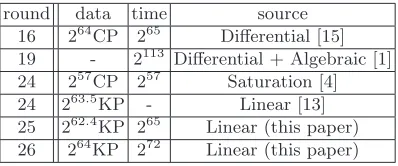
224≈272. Note that the theoretical estimation is always the lower bound since we use the correlations of only single linear trails. We compare our attacks with previous attacks against various rounds versions of PRESENT in Table 2.
round data time source 16 264
CP 265
Differential [15] 19 - 2113
Differential + Algebraic [1] 24 257
CP 257
Saturation [4] 24 263.5
KP - Linear [13] 25 262.4
KP 265
Linear (this paper) 26 264
KP 272
Linear (this paper)
Table 2.Comparison of data and time complexity of the attacks against PRESENT (CP: Chosen Plaintext, KP: Known Plaintext)
4.4 Discussion
masks have a single active bit, one can construct multiple single-bit linear trails over arbi-trary rounds. Note that this weakness does not appear in the linear transformation functions of Serpent [2] or AES [6] since any single output bit of the linear transformation is expressed as a boolean function of at least two input bits.
A simple remedy to prevent our attack is to revise the S-box in such a way that a single-bit linear approximations of S-box do not have significant correlations. However, we did not investigate how this remedy affects the other aspects of the security of PRESENT.
Correlation and Piling Up Lemma The designers of PRESENT proved in Theorem 2 of [3] that the maximum correlation of a linear approximation of four rounds of PRESENT is 2−6. As a result, the maximal correlation of a 28-round linear approximation was estimated
to be (2−6)7 = 2−42 by Piling Up lemma [3]. Thus, the linear attack using the 28-round
linear approximation would require more than 284data [3]. On the other hand, according to
our analysis, the capacity of the 28 round PRESENT is estimated to be around 2−65.8 by the correlation theorem [12] so that 30 round of PRESENT can be (theoretically) attacked by around 275 data.
The difference between the designers’ estimation and our result is originated from the fact that the designers considered a single linear approximation using a single linear trail holding with the strongest correlation, whereas our attack takes into account multiple linear ap-proximations, each of which has multiple linear trails holding with strong correlations. Due to the existence of large amount of linear trails in PRESENT, the data complexity of the attack is reduced significantly compared to the estimate by a correlation of a single linear approximation.
Theχ2 and LLR method Finally, we justify the reason why the LLR method is not used
for the attack on PRESENT even if the LLR method showed a better performance than the
χ2 method in the attacks on SERPENT [7]. As described in [7], the LLR method is more
advantageous compared to the χ2 method if the pre-computed profile of the probability
distribution is accurate. However, the distribution of linear approximations in PRESENT heavily depends on the key values so that the space for the profile of the probability distri-bution becomes too large. On the other hand, theχ2 method does not need to know the
distribution accurately; We only need to detect a large deviation of the probability distri-bution from the uniform distridistri-bution. It is an open problem whether there is a way to apply the LLR method efficiently for the attacks against PRESENT.
5
Experiments
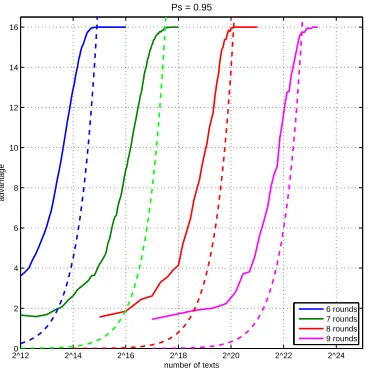
attack algorithm which recovers 32 bits of the round key of the r-round version by the (r−2)-round characteristic. However, based on our experimental results, we can conclude that our estimates of attack complexity against further rounds PRESENT are reasonable.
2^120 2^14 2^16 2^18 2^20 2^22 2^24 2
4 6 8 10 12 14 16
number of texts
advantage
Ps = 0.95
6 rounds 7 rounds 8 rounds 9 rounds
Fig. 4.Empirical evaluation of linear attacks on reduced variants of PRESENT
6
Conclusion
Modern block ciphers often prove the resistance of linear cryptanalysis by counting the minimum number of the active S-boxes involved in the best linear approximation. Even though PRESENT provides a provable security against linear cryptanalysis according to this rule, our attack shows that the resistance of the classical linear cryptanalysis does not always thwart the multidimensional linear attacks. Even though a simple, iterative structure of the cipher is desirable for the hardware-oriented block ciphers, such ciphers may have possibility to retain a large number of linear approximations by which a multidimensional linear attack can be applied efficiently. It is interesting to see that our attack can be applied to some other ciphers that have simple structures, like AES.
Acknowledgment
References
1. M. Albrecht and C. Cid,Algebraic techniques in differential cryptanalysis, Fast Software Encryp-tion, 16th International Workshop, FSE 2009, Leuven, Belgium, February 22-25, 2009, Revised Selected Papers, Lecture Notes in Computer Science, vol. 5665, Springer, 2009, pp. 193–208. 2. R. Anderson, E. Biham, and L. Knudsen, Serpent: A proposal for the Advanced Encryption
Standard, First Advanced Encryption Standard (AES) conference, 1998.
3. A. Bogdanov, L. R. Knudsen, G. Leander, C. Paar, A. Poschmann, M. J. B. Robshaw, Y. Seurin, and C. Vikkelsoe,PRESENT: An ultra-lightweight block cipher, Cryptographic Hardware and Embedded Systems - CHES 2007, 9th International Workshop, Vienna, Austria, September 10-13, 2007, Proceedings, Lecture Notes in Computer Science, vol. 4727, Springer, 2007, pp. 450– 466.
4. B. Collard and F. Standaert,A statistical saturation attack against the block cipher PRESENT, Available at http://www.dice.ucl.ac.be/ fstandae/PUBLIS/62.pdf, 2009.
5. B. Collard, F. Standaert, and J. Quisquater,Improving the time complexity of matsui’s linear cryptanalysis, Information Security and Cryptology - ICISC 2007, 10th International Confer-ence, Seoul, Korea, November 29-30, 2007, Proceedings, Lecture Notes in Computer SciConfer-ence, vol. 4817, Springer, 2007, pp. 77–88.
6. J. Daemen and V. Rijmen, The Design of Rijndael- AES, the Advanced Encryption Standard, Springer-Verlag, 2002.
7. M. Hermelin, J. Cho, and K. Nyberg, Multidimensional linear cryptanalysis of reduced round Serpent, Information Security and Privacy, 13th Australasian Conference, ACISP 2008, Wol-longong, Australia, July 7-9, 2008, Proceedings, Lecture Notes in Computer Science, vol. 5107, Springer, 2008, pp. 203–215.
8. M. Hermelin, J. Y. Cho, and K. Nyberg, Multidimensional extension of Matsui’s algorithm 2, Fast Software Encryption 2009, Lecture Notes in Computer Science, Springer, to appear. 9. M. Matsui, Linear cryptoanalysis method for DES cipher, Advances in Cryptology -
EURO-CRYPT ’93, Lecture Notes in Computer Science, vol. 765, Springer, 1993, pp. 386–397. 10. National Bureau of Standards, FIPS PUB 46-3: Data Encryption Standard (DES), National
Institute for Standards and Technology, January 1977.
11. K. Nyberg,Linear approximation of block ciphers, Advances in Cryptology - EUROCRYPT ’94, Workshop on the Theory and Application of Cryptographic Techniques, Perugia, Italy, May 9-12, 1994, Proceedings, Lecture Notes in Computer Science, vol. 950, Springer, 1994, pp. 439–444.
12. ,Correlation theorems in cryptanalysis, Discrete Applied Mathematics111(2001), 177– 188.
13. K. Ohkuma,Weak keys of reduced-round PRESENT for linear cryptanalysis, in preproceeding of SAC 2009, 2009.
14. A. Sel¸cuk,On probability of success in linear and differential cryptanalysis, Journal of Cryptol-ogy21(2008), no. 1, 131–147.
15. M. Wang, Differential cryptanalysis of reduced-round PRESENT, Progress in Cryptology -AFRICACRYPT 2008, First International Conference on Cryptology in Africa, Casablanca, Morocco, June 11-14, 2008. Proceedings, Lecture Notes in Computer Science, vol. 5023, 2008, pp. 40–49.
A
Correlation Table of S-box of PRESENT
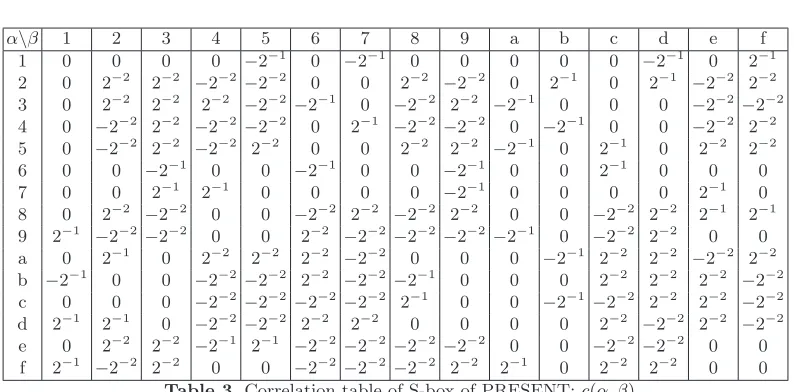
Given an input maskαand an output maskβ whereα, β∈F42, the correlation of the linear
approximationα·x⊕β·S(x) = 0 of the S-box is measured as follows:
c(α, β) = 2−4(#(α·x⊕β·S(x) = 0)−#(α·x⊕β·S(x) = 1))
α\β 1 2 3 4 5 6 7 8 9 a b c d e f 1 0 0 0 0 −2−1 0 −2−1 0 0 0 0 0 −2−1 0 2−1
2 0 2−2 2−2 −2−2 −2−2 0 0 2−2 −2−2 0 2−1 0 2−1 −2−2 2−2
3 0 2−2 2−2 2−2 −2−2 −2−1 0 −2−2 2−2 −2−1 0 0 0 −2−2 −2−2
4 0 −2−2 2−2 −2−2 −2−2 0 2−1 −2−2 −2−2 0 −2−1 0 0 −2−2 2−2
5 0 −2−2 2−2 −2−2 2−2 0 0 2−2 2−2 −2−1 0 2−1 0 2−2 2−2
6 0 0 −2−1 0 0 −2−1 0 0 −2−1 0 0 2−1 0 0 0
7 0 0 2−1 2−1 0 0 0 0 −2−1 0 0 0 0 2−1 0
8 0 2−2 −2−2 0 0 −2−2 2−2 −2−2 2−2 0 0 −2−2 2−2 2−1 2−1
9 2−1 −2−2 −2−2 0 0 2−2 −2−2 −2−2 −2−2 −2−1 0 −2−2 2−2 0 0
a 0 2−1 0 2−2 2−2 2−2 −2−2 0 0 0 −2−1 2−2 2−2 −2−2 2−2
b −2−1 0 0 −2−2 −2−2 2−2 −2−2 −2−1 0 0 0 2−2 2−2 2−2 −2−2
c 0 0 0 −2−2 −2−2 −2−2 −2−2 2−1 0 0 −2−1 −2−2 2−2 2−2 −2−2
d 2−1 2−1 0 −2−2 −2−2 2−2 2−2 0 0 0 0 2−2 −2−2 2−2 −2−2
e 0 2−2 2−2 −2−1 2−1 −2−2 −2−2 −2−2 −2−2 0 0 −2−2 −2−2 0 0
f 2−1 −2−2 2−2 0 0 −2−2 −2−2 −2−2 2−2 2−1 0 2−2 2−2 0 0
Table 3.Correlation table of S-box of PRESENT:c(α, β)
B
The S-box and Permutation tables of PRESENT
The S-box and the permutation tables of PRESENT are given in Table 4 and Table 5, respectively.
x 0 1 2 3 4 5 6 7 8 9 A B C D E F
S(x) C 5 6 B 9 0 A D 3 E F 8 4 7 1 2
Table 4.S-box table of PRESENT in hexadecimal notation
i 0 1 2 3 4 5 6 7 8 9 10 11 12 13 14 15
P(i) 0 16 32 48 1 17 33 49 2 18 34 50 3 19 35 51
i 16 17 18 19 20 21 22 23 24 25 26 27 28 29 30 31
P(i) 4 20 36 52 5 21 37 53 6 22 38 54 7 23 39 55
i 32 33 34 35 36 37 38 39 40 41 42 43 44 45 46 47
P(i) 8 24 40 56 9 25 41 57 10 26 42 58 11 27 43 59
i 48 49 50 51 52 53 54 55 56 57 58 59 60 61 62 63
P(i) 12 28 44 60 13 29 45 61 14 30 46 62 15 31 47 63