Jinmin Zhong and Xuejia Lai
Department of Computer Science and Engineering Shanghai Jiao Tong University
Shanghai, 200240 China [email protected]
DHA-256 (Double Hash Algorithm) was proposed at the Cryptographic Hash Workshop hosted by NIST in November 2005. DHA-256 is a dedicated hash function
with output length of 256 bits and 64 steps of operations designed to enhance SHA-256 security. In this paper, we show two attacks on reduced DHA-256. The first attack finds one-block second preimage and preimage of 26-step DHA-256 with time complexity of 2223.82 compression function operations and 232 x 9 words memory. The second attack
finds pseudo-preimage and preimage of 35-step DHA-256 with time complexity of 2239.63 and 2248.82 compression function operations, respectively, and 216 x 11 words memory. To the best of our knowledge, this is the first paper that analyzes second preimage resistance and preimage resistance of DHA-256.
Keywords: DHA-256, meet-in-the-middle, second preimage, preimage, hash function
1. INTRODUCTION
Hash function is an important cryptographic primitive. It is applied in many cryp-tographic applications, such as digital signature and message authentication. Since 2004, Wang et al. has made tremendous progress in the cryptanalysis of hash functions [24, 25, 26, 27] by showing theoretical attacks on SHA-1. NIST plans to replace SHA-1 with SHA-2 [1]. The competition for SHA-3 is due to recent advances in cryptanalysis of hash functions [22].
The meet-in-the-middle technique is used to construct preimage attacks on MD4 [4, 14], MD5 [4, 5, 17, 18], reduced RIPEMD [19, 23], HAVAL [5, 16], reduced SHA-0/1 [2] and reduced HAS-160 [20]. Constructing the second preimage using hash collision
was presented in [28]. Reversing the inversion problem and P3 graphs techniques are
43-step SHA-256 and 46-step SHA-512 was presented in [3, 9, 21].
DHA-256 was proposed in the first cryptographic hash workshop hosted by NIST in 2005 by Jesang Lee, et al. [12]. The compression function of DHA-256 has 64 step operations and outputs length 256 bits, and uses the two same message words to update two intermediate words every step. In order to enhance the security of SHA-256, the designers claimed that DHA-256 uses the same resource as SHA-2 for the message ex-pansion and step function, but it is more secure than SHA-2 against known attack meth-ods, especially Wang et al.’s attack [12]. IAIK Krypto Group presented a preliminary analysis on the message expansion of DHA-256 and gave a 9-step local collision for DHA-256 in 2005 [8]. So far, it is the only paper about the analysis of DHA-256.
Our Results. We show two preimage attacks on reduced DHA-256. A summary of
our results is shown in Table 1.
The first attack is a one-block preimage attack on 26-step DHA-256. This attack is based upon strategy of Isobe and Shibutani [11] and uses two-way message expansion technique proposed in [3, 9].
We present a 2-word initial structure with two message words, which is a variant of so-called initial structure technique shown in [3, 2, 18, 21] with only one message word in every step. We propose pseudo-preimage and preimage attack on 35-step DHA-256. This attack is based on the general framework proposed by Sasaki and Aoki and uses two-way message expansion and message compensation technique proposed in [3, 9].
In addition, we find that the matrix of the inverse function 1
1
σ− of SHA-2 showed in
[11] is not correct, and we provide a correct one and the corresponding program code in appendix B, A respectively.
Table 1. Preimage attacks on reduced DHA-256.
Attack Type Time Complexity Memory Complexity 26-step DHA-256
(one block) (Second)Preimage
223.82
2 232×9 words
Pseudo-preimage 2239.63
35-step DHA-256 Preimage 2248.82 216×11 words
2.1.Specification of DHA-256
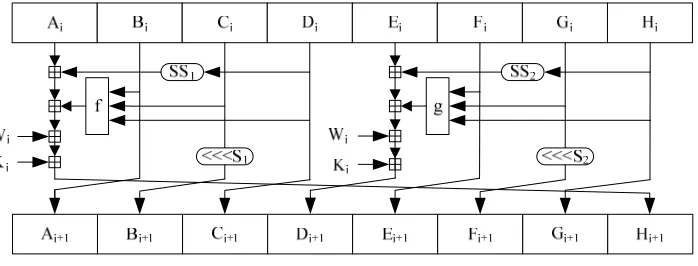
Fig. 1. Step Operation for DHA-256.
DHA-256 is a dedicated hash function. The structure of DHA-256 is similar to that of SHA-256. But their message expansion functions are different from each other. More-over, it is more important that the two same message words are used in the state update function of DHA-256, while the only one message word is used in that of SHA-256. So the hash function is called double hash algorithm (DHA) because of the two message words. The step operation for DHA-256 is depicted in Figure 1.
The initial values, the input block length,the padding rule and the constants of
DHA-256 are the same as those of SHA-256.
The Boolean functions of DHA-256 are as follows.
( , , ) ( ) ( )
( , , ) ( ) ( ) ( )
f x y z x y x z
g x y z x y y z x z
= ∧ ∨ ¬ ∧
= ∧ ∨ ∧ ∨ ∧
The shift rotations of DHA-256 are as follows.
1 2
1 2
( ) ( 11) ( 25), ( ) ( 19) ( 29)
( ) 17, ( ) 2
SS x x x x SS x x x x
S x x S x x
= ⊕ <<< ⊕ <<< = ⊕ <<< ⊕ <<< = <<< = <<<
We divide the 512 bits message block into 16 message words, M0||M1||…||M15. The
algorithm of message expansion is
1 1 9 2 15 16
, 0
( ) ( ) , 16 6
i i
i i i i
M i
W
W W W W i
σ − − σ − −
≤ ≤ ⎧
= ⎨ + + + ≤ ≤
⎩
15 3
1( )x x (x 7) (x 22), 2( )x x (x 13) (x 27)
σ = ⊕ <<< ⊕ <<< σ = ⊕ <<< ⊕ <<< .
1 1 1 1 1 2 , ,
1 1 2 1 1 1 , ,
(1) , (2) , (3) , (4) ( ) ( ) ,
(5) , (6) , (7) , (8) ( ) ( ) .
i i i i i i i i i i i i i
i i i i i i i i i i i i i
i
i
A B B C S C D D E SS H g F G H W K
E F F G S G H H A SS D f B C D W K
+ + + +
+ + + +
= = = = + + + +
= = = = + + + +
The output of the compression function of DHA-256 is
.
0 64 0 64 0 64 0 64 0 64 0 64 0 64 0 64
(A +A , B +B , C +C , D +D , E +E , F +F , G +G , H +H )
2.2.Related techniques
The following are some important techniques used to analyze the preimage resistance
of MD4-family, HAS-160 and DHA-256.
2.2.1. Meet-in-the-middle attack (MITM)
The meet-in-the-middle attack is a type of birthday attack and makes use of a space-time tradeoff. The balanced meet-in-the-middle attack appeared in [7], and the unbalanced one was proposed first in [13]. When it is applied to a hash function, the compression function computes forward to the given step and gets a set of results for intermediate chaining, and then compression function computes backward to the same given step and gets another set of results for the same intermediate chaining. The two sets of results are matched to find an equal value according to the birthday attack rule. So the two sets of results must be independent of each other in order to satisfy the birthday attack rule. The key issue for the meet-in-the-middle attack is to find the two message parts independent of each other.
2.2.2. Converting pseudo-preimage attack into preimage attack
The method of converting pseudo-preimage attack into preimage attack was pro-posed first in [13]. The initial chaining values of pseudo-preimage are not the fixed IV, so a message block is needed to hash and connect the fixed IV with the initial chaining value of pseudo-preimage. The method of the birthday attack is used to search the proper
message block. Assume that it takes 2k complexity to produce a pseudo-preimage. 2(n-k)/2
pseudo-preimages cost 2k x 2(n-k)/2 complexity. It needs 2(n+k)/2 complexity to compute the
hash values of 2(n+k)/2 one-block messages. Then, 2(n+k)/2 hash values are compared with
the initial chaining values of 2(n-k)/2 pseudo-preimages, and thus 2(n+k)/2+(n-k)/2 = 2n pairs are
compared. A pair will succeed in matching according to birthday attack rule with high
probability. The total complexity is 2k x 2(n-k)/2 + 2(n+k)/2 = 21+(n+k)/2. Thus, if k is less than
n-2, it will succeed in transforming pseudo-preimage attack into preimage attack.
2.2.3. Splice-and-cut technique
chaining values in the Davies-Meyer mode. Splice-and-cut technique proposed first in [4] regards the first step and the last step as consecutive steps. So the neutral words and in-dependent chunk can be searched in all of the range.
2.2.4. Partial-matching technique, Partial-fixing technique and
Indi-rect-partial-matching technique
The state update function only updates a chaining word for MD4-family hash function (updates two chaining words for SHA-2) and the corresponding chaining words of the next step equal to or are easy to compute based on other chaining words. For example, two words out of eight chaining words are updated every step in SHA-2 and other six chaining words equal to the corresponding words of the next step and one chaining word of the next step can be derived from the eight chaining words. If eight chaining words in the same step are known, seven chaining words in the next step will be known for SHA-2 while we do not need to know the corresponding message words. In a similar way, there is a chaining word that can be derived from eight words in each current step, in every step of the succeeding seven steps. So we only need to match the corresponding chaining words in the meet-in-the-middle attack, while we do not care about the seven message words. This property helps us to find the neutral words and independent chunks. The technique is so-called partial-matching technique proposed first in [4]. The state update function of SHA-2 is different from that of DHA-256. The main difference is that the state update function of DHA-256 includes two message words and updates two in-termediate words at the same time, while that of SHA-2 only includes one message word and updates two intermediate words. Thus, the partial-matching technique in DHA-256 can match at most three steps while that in SHA-2 can match up to seven steps.
The partial-fixing technique proposed first in [4] is essentially the partial-matching technique. The number of matched bits in the partial-matching technique is the number of bits in a chaining word at least, while the one in the partial-fixing technique can be several bits, and any bit. During the meet-in-the-middle attack, a chunk meets the oppo-site neutral word and has to stop computing the intermediate values. If the part values of the opposite neutral word are fixed and known, the chunk can continue to compute the intermediate values with the known part values of the opposite neutral word and thus we can attack more steps.
The computation of the match point can be decomposed the independent computation of the function of the two neutral words. Indirect-partial-matching makes use of the prop-erty so as to transfer the problem of the computation of the match point into the problem of the independent computation of the function of the two neutral words. Indi-rect-partial-matching can get two more steps for SHA-2.
2.2.5. Initial structure
If the two independent chunks overlap at the beginning of the meet-in-the-middle at-tack, we will meet the problem which is how to compute forward and backward in these overlapped steps, respectively. Initial structure proposed first in [18] is designed to solve this problem. Initial structure with deterministic way for SHA-0 introduced in [2] can
reduce the memory requirement by a factor of 232. The 4-step initial structure for SHA-2
proposed in [3, 9] consumes a lot of message freedom. Until now all of proposed initial structures only contain one message word every state update step.
2.2.6. Two-way expansion, Message modification and Message compensation
Any consecutive 16 message words can determine other message words for SHA-2 in two directions. This property helps to find the longer chunks independent of each other, and the neutral words. The two-way expansion proposed in [3, 9] makes use of the above property.
The message modification introduced in [11] is used to construct two independent chunks in the message expansion of SHA-2. Note that the message modification tech-nique is different from the one proposed in [24].
The message compensation proposed in [3, 9] is used to attain the goal that the change of the neutral words in an independent chunk does not affect the message words in an-other independent chunk. The message compensation is similar to the message modifica-tion.
2.2.7. Finding kernel and neutral words technique
3. ONE-BLOCK (SECOND) PREIMAGE ATTACK ON 26-STEP
DHA-256
A one-block preimage attack on 26-step DHA-256 is also a one-block second pre-image attack on 26-step DHA-256. We combine the strategy of analysis of SHA-2 in [11] with the two-way message expansion technique, and then apply them to DHA-256. Only the 24-step SHA-2 in [11] can be analyzed. If we use the same strategy in [11], only the 24-step DHA-256 can be analyzed. So we extend to the 26-step DHA-256 using the two-way expansion technique.
3.1.Construct two message chunks independent of each other
The values of message words Wi, i∈{0, 1, …, 15} determine those of Wj, j∈{16,
17, …, 25} according to the rule of message expansion of DHA-256.
W16←σ1(W15)+W7+const1 (const1←σ2(W1)+W0) (1)
(2)
17 1( 16) 8 2 ( 2 2( 2) 1)
W ←σ W +W +const const ←σ W +W
(3)
18 1( 17) 9 3 ( 3 2( 3) 2)
W ←σ W +W +const const ←σ W +W
(4)
19 1( 18) 10 4 ( 4 2( 4) 3)
W ←σ W +W +const const ←σ W +W
(5)
11
20 1( 19) 2( 5) 5 ( 5 4)
W ←σ W +σ W +const const ←W +W
1 20 12 2 6 5
21
W ← +
13
22 1 21
W ← +
14
23 1 22
W ← +
24
W ← +
25
W ← +
(W ) W (W) W
σ +σ +
6 )
) (
(W W σ W W
σ + +
7 )
) (
(W W σ W W
σ + +
1(W23) W σ (W) W8
σ + +
1(W24) W6 σ2(W10) W9
σ + +
(6)
(7)
2 7
(8)
2 8
(9)
15 2 9
(10) 1
The following description shows that the forward computation and the backward com-putation can produce the two sets of intermediate chaining values independent of each other to match using the rule of birthday attack.
The neutral word of forward computation is W11, which is used to compute W20 in
equation
(5)
and is not used in other expansion message words before step 26 ofDHA-256. So W20 will change with changes in W11. In order to keep W20 unchanged, we
use W4 to absorb the change of W11 using the message modification technique proposed
in [11], that is to say, the sum of W11 and W4 (const5), does not change. Hence the value
(4)
change of W3 in equation in a similar way. The same analysis is true for W1 and
W0.
The neutral word of backward computation is W25. The change of W25 is absorbed
by the change of W24 in equation
(10)
so that other message words do not change inequation
(10)
. The change of W21 can be absorbed by the change of W12 in equation(6)
as the same reason. W12 is not used in other expansion message words before step26, thereby the change of W12 will not affect other message words. Moreover, W12, W13
and W14 will be neglected through the partial-matching technique.
Because the initial values can be any value, this attack directly produces a one-block preimage and a one-block second preimage.
This attack is also easy to extend to a one-block (second) preimage attack on 27-step DHA-256, which needs to deal with the most significant bit of message word
W13 to satisfy the padding rule. The two message chunks independent of each other are
{W0, W1,…,W12} and {W13, W14,…,W26}, and the corresponding neutral words are W0
or W12 and W13 or W26.
We discuss the two-block preimage attack on 35-step DHA-256 in Section 4.
3.2. Attack procedure
1. Initialization
(a) Set the values of Wi, i∈{13, 14, 15} to satisfy the padding rule.
(b) Select the values of Wi, i∈{5, 6, 7, 8, 9, 10} randomly.
(c) Select the values of const1, const2, const3, const4 and const5 randomly.
(d) Compute the values of Wi, i∈{16, 17, 18, 19, 20} using equation (1)~(5),
respec-tively.
2. Forward Computation
For all possible value of W11 (32 free bits in total),
(a) Compute the following equations,
4 11 3 2 4 2
1 2 2 0 2 1
5 , 4 ( ), 3 ( ),
2 ( ), 1 ( )
W const W W const W W const W
W const W W const W
σ σ
σ σ
← − ← − ← −
← − ← −
2 3
(b) Compute pj+1←R p Wj( ,j j) for j=0, 1, ..., 11. Store the values of (p12, W11)
into the list L.
For all possible values of W25 (32 free bits in total),
(a) Compute the following equations (The program code about computing 1
1
σ− and the
value of 1 is in appendix A and C),
1 σ−
1 1
24 1 25 16 2 10 9 23 1 24 15 2 9 8
1 1
22 1 23 14 2 8 7 21 1 22 13 2 7 6
12 21 1 20 2 6 5
( ( ) ), ( ( )
( ( ) ), ( ( )
( ) ( )
W W W W W W W W W W
W W W W W W W W W W
W W W W W
σ σ σ σ
σ σ σ σ
σ σ
− −
− −
← − − − ← − − −
← − − − ← − − −
← − − −
), ),
)
(b) Compute 1
1
( ,
j j j j
p ←R− p+ W for j=25, 24, ..., 15. Compare D12, H12 in the list L with
A15>>>17, E15>>>2.
(c) If matched, compute p14 using p15 and W14. Compare C12, G12 in the list L with
A14>>>17, E14>>>2.
(d) If matched, compute p13 using p14 and W13. Compare B12, F12 in the list L with A13,
E13.
(e) If matched, compute p12 and W12. Compare A12, D12 in the list L with A12, E12.
(f) If matched, return (W0, W1, …, W15) preimage of 26-step DHA-256, otherwise,
re-peat the attack procedure.
4.
Complexity analysisThe complexity analysis of the one-block (second) preimage attack on 26-step DHA-256 is as follows.
1. The cost of initialization compared to that of other steps is negligible. (ME
repre-sents the computation of message expansion and CF reprerepre-sents the computation of com-pression function. We use the same notations hereafter.)
2. For forward computation, the complexity is about 32 2
26
2 i ME in step 2a. The
com-plexity is 32 12 CF in step 2b. The memory complexity is
26
2 i 232⋅9 words.
3. For backward computation, the complexity is 32 5
26
2 i ME in step 3a. The
complex-ity is 32 11
26
2 i CF in step 3b. The cost of comparison compared to that of other steps is
negligible. pairs will take part in comparison. The number of bits for
matching is 64 in total. If matched, pair remains, and thus, the complexity
is negligible in step 3c~3f. Hereto, the complexity is
64 32 32
2 ( 2= i2 )
0 64 64
2 ( 2= i2 )−
32 7 32 2 5
26 26 26
2 i ( 2= i( + ))ME
and 32 23 32 12 11
26 26 26
2 i ( 2= i( + ))CF in total. It is about 32 23 31.82
26
opera-tions. The rate of success to find a one-block preimage of 26-step DHA-256 is2−192( 2= 64i2−256). So it needs to repeat2192times.
)
Hence, the complexity for finding a one-block preimage of 26-step DHA-256 is
26-step DHA-256 operations. The memory complexity is words.
223.82 192 31.82
2 ( 2= i2 232⋅9
4. PREIMAGE ATTACK ON 35-STEP DHA-256
4.1.Construct two message chunks independent of each other
Wj-8, Wj-7, …, Wj+5, Wj+7
Wj-9
The second chunk Partial-fixing
Wj+22
Wj+6 , Wj+8, Wj+9, …, Wj+21
The first chunk
Partial-fixing
2-Word Initial Strunture
Partial-matching, Skip them: Wj-10, Wj-11, Wj-12
Backward computation Forward computation
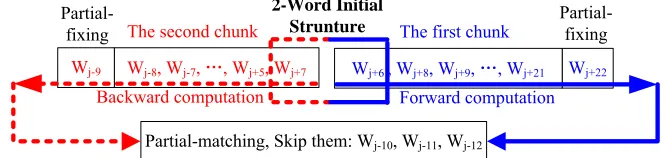
Fig. 2. The roles of message words in the meet-in-the-middle attack on 35-step DHA-256. How to find two independent message chunks is the key issue of meet-in-the-middle attack. The message expansion rule of DHA-256 is similar to that of SHA-2 and it is also a bijective mapping. The consecutive 16 message words out of 64 message words of DHA-256 can compute other message words determinately. This property allows us to use two-way message expansion technique proposed in [3, 9] to find the two
independ-ent message chunks with long steps. We select Wj+6 and Wj+7 as the neutral words by
our manual attempts, and thus the two independent message chunks are {Wj-7, Wj-6, …,
Wj+6} and {Wj+7, Wj+8, …, Wj+20}.
In order to extend the independent message chunks, we exchange the two neutral mes-sage words through a 2-word initial structure which will be explained in next subsection. This makes us to get 2 more steps. The two longer independent message chunks are
{Wj-8, Wj-7, …, Wj+7} and {Wj+6, Wj+8, …, Wj+21}, and the extended corresponding
mes-sage words are Wj-8 and Wj+21 respectively. But Wj+16 in equation
(11)
is derived fromWj+7 which is the neutral word. Then, the value of Wj+16 will be affected by Wj+7 when
the value of Wj+7 changes. Such will break the rule of meet-in-the-middle. We use
such that the change of Wj+7 can be absorbed by the corresponding change of Wj and will
not affect the value of Wj+16 in
(11)
. The change of Wj will not break the rule ofmeet-in-the-middle, because Wj is not a neutral word and is in the same message chunk
with Wj+7. The similar operations for Wj+6 and Wj+15 in another message chunk are
car-ried out for the same reason. Therefore, we make Wj+15 = Wj+6 in equation
(18)
.The first chunk {Wj+6,Wj+8,Wj+9, ...,Wj+21
) j
W
} is used to compute forward.
16 1( 15) j 7 2( 1) j ( j 7
j j W j W W
W+ =σ W+ + + +σ W+ + ⇒ = − + (11)
17 1( 16) 8 2( 2) 1
j j j j
W+ =σ W+ +W+ +σ W+ +Wj+ (12)
18 1( 17) 9 2( 3) 2
j j j j
W+ =σ W+ +W+ +σ W+ +Wj+ (13)
19 1( 18) 10 2( 4) 3
j j j j
W+ =σ W+ +W+ +σ W+ +Wj+ (14)
20 1( 19) 11 2( 5) 4
j j j j
W+ =σ W+ +W+ +σ W+ +Wj+ (15)
21 1( 20) 12 2( 6) 5
j j j j
W+ =σ W+ +W+ +σ W+ +Wj+ (16)
(17)
22 1( 21) 13 2( j 7) 6 ( )
j j j j
W+ =σ W+ +W+ +σ W+ W+ Partial− fixing
8
, , , ...,
+
7
The second chunk { Wj+5 Wj+4 Wj−
6)
} is used to compute backward. j
W+
1
1 15 1( 14) 6 2( ) ( 5
j j j j j Wj j
W− =W+ −σ W+ −W+ −σ W ⇒ + =W+ (18)
2 14 1( 13) 5 2(
j j j j j
W− =W+ −σ W+ −W+ −σ W−1) (19)
3 13 1( 12) 4 2(
j j j j j
W− =W+ −σ W+ −W+ −σ W−2) (20)
4 12 1( 11) 3 2(
j j j j j
W− =W+ −σ W+ −W+ −σ W−3) (21)
5 11 1( 10) 2 2(
j j j j j
W− =W+ −σ W+ −W+ −σ W−4) (22)
6 10 1( 9) 1 2(
j j j j j
W− =W+ −σ W+ −W+ −σ W−5) (23)
7 9 1( 8) 2(
j j j j j
W− =W+ −σ W+ −W −σ W−6) (24)
8 8 1( 7) 1 2(
j j j j j
W− =W+ −σ W+ −W− −σ W−7) (25)
9 7 1( 6) 2 2( 8) ( )
j j j j j
W− =W+ −σ W+ −W− −σ W− Partial−fixing (26)
10 6 1( 5) 3 2( 9) (
j j j j j
W− =W+ −σ W+ −W− −σ W− Partial matching− ) (27)
11 5 1( 4) 4 2( 10) (
j j j j j
W− =W+ −σ W+ −W− −σ W− Partial matching− ) (28)
12 4 1( 3) 5 2( 11) (
j j j j j
W− =W+ −σ W+ −W− −σ W− Partial matching− ) (29)
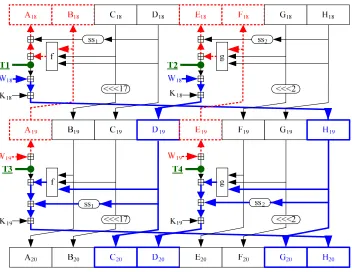
Fig. 3. Description of 2-word initial structure for 35-step DHA-256.
The section shows how to construct the 2-word initial structure.
The intention of the initial structure is to prevent the change of the opposed neutral word from the computation of the corresponding intermediate state values. For example,
the change of the neutral word W18 is not allowed to affect the computation of the
inter-mediate state values A18, B18, …, H18 (i.e. p18) shown in Figure 3 in order to carry out the
meet-in-the-middle attack. The neutral word W18 must be independent of p18. The neutral
word W19 should satisfy the same relation with p20.
The step update functions of MD5, SHA-0/1 and SHA-2 only use one message word to update one (or two) chaining values in every step, while that of DHA-256 uses two same message words to update two chaining values in every step. Thereby only one mes-sage word is needed to deal with in every step of the initial structure of MD5, SHA-0/1 and SHA-2. The 2-word initial structure for 35-step DHA-256 is depicted in Figure 3.
The points T1, T2, T3 and T4 in Figure 3 are set to four fixed values. A18 = T1 – f(B18,
C18 , D18) – SS1(D18)+ K18. Because T1 is fixed, the change of W18 does not affect A18.
fixed value of T1. The effect of T2, T3 and T4 is similar to that of T1.
4.3.Attack procedure
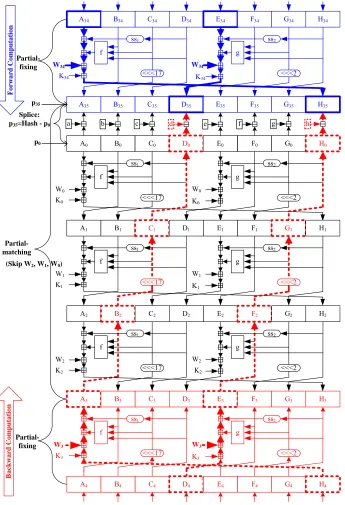
The attack procedure for 35-step DHA-256 includes initialization, forward
computa-tion, backward computation and comparison. The description of partial-fixing and par-tial-matching procedure is depicted in Figure 4.
1. Initialization
(a) Set the values of Wi, i=13,14,15 to satisfy the padding rule for a 2-block message.
(b) Select the values of T1, T2, T3, T4, C18, D18, G18 and H18 in the 2-word initial
struc-ture randomly. Let A20=B19=C18<<<17, C19=D18, B20=C19<<<17, E20=F19=G18<<<2,
G19=H18, F20=G19<<<2.
(c) Select the values of Wi, i∈{16, 17, 20, 21, 22, 23, 24, 25, 26}, const1and const2
randomly. Select the values from the 16th bit to the 31st bit of X (= ) and the values
from the 0th bit to the 15th bit of Y (= ) randomly.
1(W18) σ
2(W19
σ )
2. Forward Computation
For the free bits of X (= ) (from the 0th bit to the 15th), do the following,
1(W18) σ
(a) Compute W18 =σ1−1( )X . Let W27 = W18 + const2. Compute the values of W28, W29,
W30, W31, W32, W33 and the values from the 0th bit to the 15th bit of W34 using the values
from the 0th bit to the 15th bit of Y. ( ).
1 33 2
15 0 15 0
34
ALL
W Y
− −
5 18
(W ) W W
σ
= + + +
(b) Compute G20=H19=T1+W18+K18, C20=D19=T2+W18+K18, H20=T3+f(B19, C19,
D19)+SS1(D19)+K19, D20=T4+g(F19, G19, H19)+SS2(H19)+K19.
(c) Compute pj+1←R p Wj( ,j j)for j=28, 29, ..., 33. Compute p35 using p34 and W34,
then only get the values from the 0th bit to the 15th bit for D35 and H35, all the bit values
for other intermediate variables. Let31 17, 0(0 ) ( 15 035) 17,17 2 ( 15 035)
unused ALL ALL
m d D n h H
− − − −
2
= − <<< = − <<< .
Store the values of(p34,31 17 17 2m, n W, 18)
− −
into the list L. The memory requirement of the list L
is words. Note that because and , we can get the
equation . We can also get the equation
16
2 i11 A3=B2=C1<<<17 C1=D0= −d D35
17 2
3 ( 35)
A = =m d−D <<< E3= =n (h−H35)<<< in
a similar way. We store m and n, i.e. A3 and E3, into the list, instead of D0 and H0 due to
A34 B34 C34 D34 E34 F34 G34 H34 f ss1 <<<17 W34 K34 g ss2 <<<2 W34 K34
A0 B0 C0 D0 E0 F0 G0 H0
f ss1 <<<17 W0 K0 g ss2 <<<2 W0 K0
A1 B1 C1 D1 E1 F1 G1 H1
f ss1 <<<17 W1 K1 g ss2 <<<2 W1 K1
A2 B2 C2 D2 E2 F2 G2 H2
f ss1 <<<17 W2 K2 g ss2 <<<2 W2 K2
A3 B3 C3 D3 E3 F3 G3 H3
f ss1 <<<17 W3 K3 g ss2 <<<2 W3 K3
A4 B4 C4 D4 E4 F4 G4 H4
A35 B35 C35 D35 E35 F35 G35 H35
a b c d e f g h
Partial-fixing Partial-fixing Partial-matching Splice: p35=Hash - p0
F o rw a rd C o m p u ta ti o n p35 p0
(Skip W2, W1, W0)
Backward Co
mputation
3. Backward Computation and Comparison
For the free bits of Y (= ) (from the 16th bit to the 31st bit), do the following (The
program about computing 2(W19) σ
and the value of is in appendix A and D),
1 2
σ− 1
2 σ−
(a) Compute W19 = . Let W12 = const1-W19. Compute the values of W11, W10, …,
W4 and the values from the 16th bit to the 31st bit of W3 using the values from the 16th bit
to the 31st bit of X. ( ).
1 2 ( )Y σ−
1
31 16(2 ) 31 16
3 19 10 2
W
− −
= − ( 4)
ALL ALL ALL
W X −W −σ W
)
(b) Compute B18=A19=T3 – W19, F18=E19=T4 – W19, A18=T1-f(B18, C18, D18)-SS1(D18)
and E18=T2-g(F18, G18, H18)-SS2(H18).
(c) Compute 1
1
( ,
j j j j
p ←R− p+ W for j=17, 16, ..., 4. Compute A3 and E3 using p4 and
, then only get the values from the 16th bit to the 31st bit for A
3 and E3. Compare
in the list L with
1
31 16(2 )
3
W
−
1 1
31 16(2 ) 31 16(2 )
3 , 3
A E
− −
31 17 17 2 ,
m− n− respectively.
(d) If matched, compute W3 using the corresponding W18 in the list L and compute p3
using W3, then all bits of A3 and E3 are known. Compare
31 17 17 2 ,
m− n− in the list L with
3, 3 ALL ALL
A E respectively.
2 17
ALL ALL
m= −c A >>>
(e) If matched, compute W2 and p2 successively. Let ,
. Compare in the list L with respectively.
2 2
ALL ALL
n = −g E >>> DALL34,HALL34 ALLm,ALLn
(f) If matched, compute W1 and p1 successively. Let . Compare
in the list L with respectively.
1,
ALL ALL ALL ALL
m = −b A n = −f E1
0 34, 34
ALL ALL
C H ALLm >>>17,ALLn >>>2
(g) If matched, compute W0 and p0 successively. Let 0, . Compare
ALL ALL ALL ALL
m= −a A n = −e E
34, 34 ALL ALL
B F in the list L with , respectively.
ALL ALL
m n
34, 34 ALL ALL
A E
(h) If matched, compute W34 and compute using W34 and p35=Hash - p0.
Com-pare 34, 34
ALL ALL
A E 34, 34
ALL ALL
A E
in the list L with respectively.
(i) If matched, return (p0, W0, W1, …, W15) as a pseudo-preimage of 35-step DHA-256,
otherwise, repeat the attack procedure.
The complexity analysis of pseudo-preimage and preimage attack on 35-step DHA-256 is as follows.
1. The cost of initialization compared to that of other steps is negligible.
2. The number of the free bits for forward computation is 16. In step 2a, the complexity
for computing W18 and W27 is negligible. For others, the complexity is216⋅357 ME. In step
2b, the complexity is 16 1 CF. In step 2c, the complexity is
35
2 ⋅ 16 7
35
2 ⋅ CF. The memory
complexity is216⋅11words.
3. For backward computation and comparison, the number of the free bits is 16. In step
3a, we get two candidates of 31 16W3 for every
− 31 16
X
−
because of the two possible carried
number patterns from bit 15 to bit 16, so the complexity is 16 8 2
35 35
2 ⋅( + )ME and we get
pairs31 16W3 . In step 3b, the complexity is
− 31 16
3
A
−
CF. In step 3c, we obtain pairs
17
2 16 1
35
2 ⋅ 217
and31 16E3 −
, thus the complexity is 16 14 2
35 35
2 ⋅( + )CF before comparison. So pairs take
part in comparison. and match 16 bits in total. Therefore
pairs remain. The complexity for comparison is negligible compared
to other steps. In step 3d, the complexity for computing W3 is
16 17
2 i2
31 17 31 17
3
( m− , A− ) (17 16 17 16n , E3)
− −
17 16 17 16
2 ( 2= i2 i2 )−
17 1 35
2 ⋅ ME. The
complex-ity for computing p3 is 217⋅351 CF. matches 14 bits in total.
So pairs remain. Moreover, all of bit values of A3 and E3 are known, and
thus the carry from the 15th bit to the 16th bit for is known.
There-fore, pairs remain.
15 2 15 2 3 ( n,E )
− −
3 17 14
2 ( 2= i2 )−
1 1
31 16(2 ) 31 16(2 )
3 3
( A , E
− −
)
2 3 1
2 ( 2 2 )= i −
The cost in step 3e~3h is negligible compared to other steps. Hereto, the complexity is
16 19 16 7 8 2 17
35 35 35 35 35
2 i ( 2= i( + + ) 2+ i 1) ME and 16 27 16 1 7 1 14 2 17
35 35 35 35 35 35 35
2 i ( 2= i( + + + + ) 2+ i 1)CF.
It is about 16 27 15.63
35
2 i ≈2 35-step DHA-256 operations. It produces
matched pair. Thus, it needs to repeat times in step 3i to produce one matched pair.
224 16 16 256
2− ( 2= i2 i2− )
224 2
Hence, the complexity of pseudo-preimage is 35-step DHA-256
op-erations. The complexity of preimage is 35-step DHA-256 operations. The
mem-ory complexity is words in step 2c.
239.63 224 15.63
2 ( 2= + )
248.82 2
5. CONCLUSION
This paper proposes two attacks on reduced DHA-256. The first attack is one-block second preimage and preimage attack on 26-step DHA-256, and the second one is pre-image attack on 35-step DHA-256. We propose a 2-word initial structure which is a variant of initial structure. This first attack is based upon the strategy which is proposed by Isobe and Shibutani and uses two-way message expansion technique. The second attack is based on the general framework proposed by Sasaki and Aoki and combines two-way message expansion and message compensation techniques with 2-word initial
structure. We also point out the incorrect matrix of the inverse function 1
1
σ− of SHA-2
showed in [11] and show a correct one. This is the first analysis of second preimage re-sistance and preimage rere-sistance of DHA-256, as far as we know.
REFERENCES
1. National Institute of Standards and Technology (NIST), "FIPS-180-2: Secure Hash
Standard," August 2002, http://www.itl.nist.gov/fipspubs/.
2. K. Aoki and Y. Sasaki, "Meet-in-the-Middle Preimage Attacks Against Reduced
SHA-0 and SHA-1," CRYPTO 2009, Springer-Verlag.
3. Kazumaro Aoki, Jian Guo, Krystian Matusiewicz, Yu Sasaki and Lei Wang,
"Preimages for Step-Reduced SHA-2," ASIACRYPT 2009, Springer-Verlag.
4. Kazumaro Aoki and Yu Sasaki, "Preimage attacks on one-block MD4, 63-step MD5
and more," Liam Keliher Roberto Avanzi, and Francesco Sica, SAC 2008, pp.82-98.
5. Jean-Philippe Aumasson, Willi Meier and Florian Mendel, "Preimage attacks on 3-pass HAVAL and step-reduced MD5," Liam Keliher Roberto Avanzi, and Francesco
Sica, SAC 2008, pp.99 - 144.
6. C. De Canniere and C. Rechberger, "Preimages for reduced SHA-0 and SHA-1,"
David Wagner, CRYPTO 2008, Springer-Verlag, pp.179-202.
7. W. Diffie and M. Hellman (1977). "Exhaustive cryptanalysis of the NBS Data Encryption Standard." Computer(10(6)): 74 - 84.
8. IAIK Krypto Group, "Preliminary Analysis of DHA-256,"
http://eprint.iacr.org/2005/398.pdf.
Submission version for ASIACRYPT2009,
http://www1.spms.ntu.edu.sg/~guojian/doc/SHA2.pdf.
10. S Indesteege, F Mendel, B Preneel and C Rechberger, "Collisions and other
non-random properties for step-reduced SHA-256," SAC 2008.
11. T Isobe and K Shibutani, "Preimage Attacks on Reduced Tiger and SHA-2," FSE
2009, Springer-Verlag.
12. Jesang Lee, Donghoon Chang, Eunjin Lee Hyun Kim, Deukjo Hong, Jaechul Sung, Seokhie Hong and Sangjin Lee, "A New 256-bit Hash Function DHA-256: Enhancing
the Security of SHA-256," NIST, 2005 Cryptographic Hash Workshop.
13. Xuejia Lai and James L. Massey, "Hash Function Based on Block Ciphers,"
Eurocrypt 1992, Springer-Verlag, pp.55-70.
14. G. Leurent, "MD4 is Not One-Way," K. Nyberg, FSE 2008, Springer-Verlag,
pp.412-428.
15. SK Sanadhya and P Sarkar, "New collision attacks against up to 24-step SHA-2,"
D.R. Chowdhury, Rijmen, V., Das, A., INDOCRYPT 2008, Springer-Verlag, pp.91-103.
16. Y. Sasaki and K. Aoki, "Preimage Attacks on 3, 4, and 5-Pass HAVAL," Josef
Pieprzyk, Advances in Cryptology - Asiacrypt 2008, Springer-Verlag, pp.253-271.
17. Y. Sasaki and K. Aoki, "Preimage attacks on step-reduced MD5," Yi Mu and Willy
Susilo, ACISP2008, Springer-Verlag, pp.282-296.
18. Y. Sasaki and K. Aoki, "Finding Preimages in Full MD5 Faster Than Exhaustive
Search," Ronald Cramer, Advances in Cryptology - Eurocrypt 2009, Springer-Verlag,
pp.134-152.
19. Y. Sasaki and K. Aoki, "Meet-in-the-Middle Preimage Attacks on Double-Branch
Hash Functions: Application to RIPEMD and Others," ACISP 2009, pp.214-231.
20. Y. Sasaki and K. Aoki, "A Preimage Attack for 52-Step HAS-160," Pil Joong Lee and
Jung Hee Cheon, Information Security and Cryptology - ICISC 2008, Springer-Verlag,
pp.302-317.
21. Yu Sasaki, Lei Wang and Kazumaro Aoki, "Preimage Attacks on 41-Step SHA-256
and 46-Step SHA-512 ", http://eprint.iacr.org/2009/479.
22. National Institute of Standards and Technology (NIST) U.S. Department of Commerce, "Secure Hash Standard (SHS) (Federal Information Processing Standards
http://csrc.nist.gov/publications/fips/fips180-3/fips180-3_final.pdf.
23. G. L. Wang and S. H. Wang, "Preimage Attack on Hash Function RIPEMD," ISPEC
2009, Springer-Verlag, pp.274-284.
24. X Wang, X Lai, D Feng, H Chen and X Yu, "Cryptanalysis of the Hash Functions
MD4 and RIPEMD," Ronald Cramer, Advances in Cryptology - CEUROCRYPT 2005,
Springer-Verlag, pp.1-18.
25. X Wang, YL Yin and H Yu, "Finding collisions in the full SHA-1," CRYPTO 2005,
Springer-Verlag, pp.17–36.
26. X Wang and H Yu, "How to Break MD5 and Other Hash Functions," Ronald Cramer,
Advances in Cryptology - EUROCRYPT 2005, Springer-Verlag, pp.19-35.
27. X Wang, H Yu and YL Yin, "Efficient Collision Search Attacks on SHA-0," CRYPTO
2005, Springer-Verlag, pp.1-16.
28. H. B. Yu, G. L. Wang, G. Y. Zhang and X. Y. Wang, "The second-preimage attack on
Appendix A
The program codes for computing the inversion of the matrix of Sigma function of
SHA-256 and DHA-256
% The codes are written by MATLAB 7.1
%*******The Inversion of the matrix of Sigma-1 function of SHA-256*********
% The codes written using matlab are used to computer the matrix for the function
σ_1^{-1} % of sha-256.
%Y(X)=(X>>>17)^(X>>>19)^(X>>10) % gf() is used to operate the matrix in GF(2). a=gf(zeros(32, 32),1);
for i=1:32 %Note that the subscript in matrix is from 1 to 32. x= mod( i+17, 32);
if x==0 x=32; end a(i,x)=1;
y=mod( i+19, 32); if y==0
y=32; end a(i, y)=1;
z=i+10; if z <= 32 a(i, z)=1; end end
b=gf(zeros(32, 32),1);
% Let the first line in matrix is the 32th data line and left-msb. for i=1:32
for j=1:32
b(i,j)=a(32-i+1,32-j+1); end
end
c=gf(zeros(32, 32),1);
c=inv(b) % Get the inversion and c is the matrix which we seek.
%**********The Inversion of the matrix of Sigma-1 function of DHA-256********
a=gf(zeros(32, 32),1); for i=1:32
a(i,i)=1; % Deal with the operation X x= mod( i-7, 32); % Deal with the operation (X<<<7)
if x==0
x=32; end a(i,x)=1;
y=mod( i-22, 32); % Deal with the operation (X<<<22)
if y==0
y=32; end
a(i, y)=1;
end
b=gf(zeros(32, 32),1);
% Let the first line in matrix is the 32th data line and left-msb. for i=1:32
for j=1:32
b(i,j)=a(32-i+1,32-j+1); end
end
c=gf(zeros(32, 32),1);
c=inv(b) % Get the inversion and c is the matrix which we seek.
%*****The Inversion of the matrix of Sigma-2 function of DHA-256********
%Y(X)=X^(X<<<13)^(X<<<27)
a=gf(zeros(32, 32),1); for i=1:32
if x==0 x=32; end a(i,x)=1;
y=mod( i-27, 32); % Deal with the operation (X<<<27)
if y==0
y=32; end
a(i, y)=1;
end
b=gf(zeros(32, 32),1);
% Let the first line in matrix is the 32th data line and left-msb. for i=1:32
for j=1:32
b(i,j)=a(32-i+1,32-j+1); end
end
c=gf(zeros(32, 32),1);
Appendix B
The Inversion of the matrix of Sigma-1 function of SHA-256
1 1
1 0 1 1 0 1 1 1 1 1 1 1 1 1 1 1 1 1 1 1 0 0 1 1 0 0 1 1 0 1 0 0 1 1 1 0 1 1 0 0 0 0 0 0 0 0 0 0 0 0 0 0 1 0 1 0 1 0 1 0 1 1 1 0 0 1 1 1 0 1 1 0 0 0 0 0 0 0 0 0 0 0 0 0 0 1 0 1 0 1 0 1 0 1 1 1 0
Mσ− =
0 0 0 1 1 1 0 1 0 1 0 1 0 1 0 1 0 1 1 1 0 0 1 0 0 0 1 1 0 1 0 0 0 0 0 0 1 1 1 0 1 0 1 0 1 0 1 0 1 0 1 1 1 0 0 1 0 0 0 1 1 0 1 1 0 0 0 0 0 0 1 1 1 1 1 1 1 1 1 1 1 1 0 0 1 1 0 1 1 0 0 0 0 1 1 1 1 0 0 0 0 1 0 1 0 1 0 1 0 1 0 1 0 1 1 1 0 1 1 1 1 1 0 0 1 0 0 0 1 1 0 0 0 0 1 0 1 0 1 0 1 0 1 0 1 0 1 1 1 0 1 1 1 1 1 0 0 1 0 1 0 0 0 0 1 1 1 0 1 0 1 0 1 0 1 0 1 0 1 1 1 0 1 1 1 0 0 1 1 0 1 1 1 0 0 0 0 0 1 1 1 1 1 1 1 1 1 1 1 1 0 0 1 1 0 0 1 1 0 0 0 1 1 1 1 1 0 0 0 1 0 1 0 1 0 1 0 1 0 1 0 1 1 1 0 1 1 1 0 1 1 0 1 0 0 0 1 1 1 0 0 0 1 0 1 0 1 0 1 0 1 0 1 0 1 1 1 0 1 1 1 0 1 1 0 1 0 1 0 0 0 1 1 1 1 0 1 0 1 0 1 0 1 0 1 0 1 1 1 0 1 1 1 0 1 1 0 0 1 1 1 0 0 0 1 0 1 1 1 1 1 1 1 1 1 1 1 1 0 0 1 1 0 0 1 1 0 1 0 0 1 1 1 1 0 0 0 0 0 1 0 1 0 1 0 1 0 1 0 1 1 1 0 1 1 1 0 1 1 0 0 0 1 0 1 0 0 0 1 0 1 1 1 1 1 1 1 1 1 1 1 1 0 0 1 1 0 0 1 1 0 1 0 0 1 1 0 1 0 0 0 0 0 1 0 1 0 1 0 1 0 1 0 1 1 1 0 1 1 1 0 1 1 0 0 0 1 0 1 1 0 0 1 0 1 1 1 1 1 1 1 1 1 1 1 1 0 0 1 1 0 0 1 1 0 1 0 0 1 1 0 1 1 0 0 0 0 1 0 1 0 1 0 1 0 1 0 1 1 1 0 1 1 1 0 1 1 0 0 0 1 0 1 1 0 1 1 0 1 1 1 1 1 1 1 1 1 1 1 1 0 0 1 1 0 0 1 1 0 1 0 0 1 1 0 1 1 0 1 0 0 1 0 1 0 1 0 1 0 1 0 1 1 1 0 1 1 1 0 1 1 0 0 0 1 0 1 1 0 1 1 1 1 1 1 1 1 1 1 1 1 1 1 1 0 0 1 1 0 0 1 1 0 1 0 0 1 1 0 1 1 0 1 0 1 1 0 1 0 1 0 1 0 1 0 1 1 1 0 1 1 1 0 1 1 0 0 0 1 0 1 1 0 1 1 1 1 0 1 1 1 1 1 1 1 1 1 1 0 0 1 1 0 0 1 1 0 1 0 0 1 1 0 1 1 0 1 0 1 1 1 1 0 1 0 1 0 1 0 1 1 1 0 1 1 1 0 1 1 0 0 0 1 1 1 0 1 1 0 0 0 1 0 1 0 0 0 0 0 0 0 0 1 0 1 0 1 0 1 0 1 1 1 0 1 0 1 0 1 1 0 0 1 1 1 1 1 1 0 1 0 1 0 1 1 0 0 0 1 0 0 0 1 1 1 1 1 1 0 1 0 1 1 1 0 1 0 1 0 1 0 0 0 0 0 0 1 0 0 0 0 0 0 0 0 1 0 1 0 0 1 0 1 0 1 1 1 0 1 0 1 0 1 0 0 0 0 0 0 1 0 0 0 0 0 0 0 0 1 0 1 1 0 1 0 1 0 0 1 1 1 1 1 1 1 1 1 0 1 0 0 1 1 0 0 1 0 0 0 0 1 1 1 1 1 0 1 0 1 1 0 1 0 1 0 1 0 1 0 1 1 1 0 1 1 1 0 1 1 0 0 0 1 1 0 0 1 1 0 1 0 1 1 0 1 0 1 0 1 0 1 0 1 1 1 0 1 1 1 0 1 1 0 0 0 1 1
Appendix C
The Inversion of the matrix of Sigma-1 function of DHA-256
1 1
1 1 1 0 0 1 1 0 0 0 1 0 1 1 0 1 1 1 1 1 1 0 0 0 0 1 1 0 1 0 0 0 0 1 1 1 0 0 1 1 0 0 0 1 0 1 1 0 1 1 1 1 1 1 0 0 0 0 1 1 0 1 0 0 0 0 1 1 1 0 0 1 1 0 0 0 1 0 1 1 0 1 1 1 1 1 1 0 0 0 0 1 1 0 1 0 0
Mσ− =
0 0 1 1 1 0 0 1 1 0 0 0 1 0 1 1 0 1 1 1 1 1 1 0 0 0 0 1 1 0 1 1 0 0 0 1 1 1 0 0 1 1 0 0 0 1 0 1 1 0 1 1 1 1 1 1 0 0 0 0 1 1 0 0 1 0 0 0 1 1 1 0 0 1 1 0 0 0 1 0 1 1 0 1 1 1 1 1 1 0 0 0 0 1 1 1 0 1 0 0 0 1 1 1 0 0 1 1 0 0 0 1 0 1 1 0 1 1 1 1 1 1 0 0 0 0 1 1 1 0 1 0 0 0 1 1 1 0 0 1 1 0 0 0 1 0 1 1 0 1 1 1 1 1 1 0 0 0 0 0 1 1 0 1 0 0 0 1 1 1 0 0 1 1 0 0 0 1 0 1 1 0 1 1 1 1 1 1 0 0 0 0 0 1 1 0 1 0 0 0 1 1 1 0 0 1 1 0 0 0 1 0 1 1 0 1 1 1 1 1 1 0 0 0 0 0 1 1 0 1 0 0 0 1 1 1 0 0 1 1 0 0 0 1 0 1 1 0 1 1 1 1 1 1 0 0 0 0 0 1 1 0 1 0 0 0 1 1 1 0 0 1 1 0 0 0 1 0 1 1 0 1 1 1 1 1 1 1 0 0 0 0 1 1 0 1 0 0 0 1 1 1 0 0 1 1 0 0 0 1 0 1 1 0 1 1 1 1 1 1 1 0 0 0 0 1 1 0 1 0 0 0 1 1 1 0 0 1 1 0 0 0 1 0 1 1 0 1 1 1 1 1 1 1 0 0 0 0 1 1 0 1 0 0 0 1 1 1 0 0 1 1 0 0 0 1 0 1 1 0 1 1 1 1 1 1 1 0 0 0 0 1 1 0 1 0 0 0 1 1 1 0 0 1 1 0 0 0 1 0 1 1 0 1 1 1 1 1 1 1 0 0 0 0 1 1 0 1 0 0 0 1 1 1 0 0 1 1 0 0 0 1 0 1 1 0 1 1 1 1 1 1 1 0 0 0 0 1 1 0 1 0 0 0 1 1 1 0 0 1 1 0 0 0 1 0 1 1 0 0 1 1 1 1 1 1 0 0 0 0 1 1 0 1 0 0 0 1 1 1 0 0 1 1 0 0 0 1 0 1 1 1 0 1 1 1 1 1 1 0 0 0 0 1 1 0 1 0 0 0 1 1 1 0 0 1 1 0 0 0 1 0 1 1 1 0 1 1 1 1 1 1 0 0 0 0 1 1 0 1 0 0 0 1 1 1 0 0 1 1 0 0 0 1 0 0 1 1 0 1 1 1 1 1 1 0 0 0 0 1 1 0 1 0 0 0 1 1 1 0 0 1 1 0 0 0 1 1 0 1 1 0 1 1 1 1 1 1 0 0 0 0 1 1 0 1 0 0 0 1 1 1 0 0 1 1 0 0 0 0 1 0 1 1 0 1 1 1 1 1 1 0 0 0 0 1 1 0 1 0 0 0 1 1 1 0 0 1 1 0 0 0 0 1 0 1 1 0 1 1 1 1 1 1 0 0 0 0 1 1 0 1 0 0 0 1 1 1 0 0 1 1 0 0 0 0 1 0 1 1 0 1 1 1 1 1 1 0 0 0 0 1 1 0 1 0 0 0 1 1 1 0 0 1 1 1 0 0 0 1 0 1 1 0 1 1 1 1 1 1 0 0 0 0 1 1 0 1 0 0 0 1 1 1 0 0 1 1 1 0 0 0 1 0 1 1 0 1 1 1 1 1 1 0 0 0 0 1 1 0 1 0 0 0 1 1 1 0 0 0 1 1 0 0 0 1 0 1 1 0 1 1 1 1 1 1 0 0 0 0 1 1 0 1 0 0 0 1 1 1 0 0 0 1 1 0 0 0 1 0 1 1 0 1 1 1 1 1 1 0 0 0 0 1 1 0 1 0 0 0 1 1 1 1 0 0 1 1 0 0 0 1 0 1 1 0 1 1 1 1 1 1 0 0 0 0 1 1 0 1 0 0 0 1 1 1 1 0 0 1 1 0 0 0 1 0 1 1 0 1 1 1 1 1 1 0 0 0 0 1 1 0 1 0 0 0 1
Appendix D
The Inversion of the matrix of Sigma-2 function of DHA-256
1 2
1 0 1 1 1 1 0 0 1 0 0 0 0 1 1 1 0 1 0 1 0 1 0 1 1 0 0 0 1 1 0 1 1 1 0 1 1 1 1 0 0 1 0 0 0 0 1 1 1 0 1 0 1 0 1 0 1 1 0 0 0 1 1 0 0 1 1 0 1 1 1 1 0 0 1 0 0 0 0 1 1 1 0 1 0 1 0 1 0 1 1 0 0 0 1 1 1
Mσ− =
0 1 1 0 1 1 1 1 0 0 1 0 0 0 0 1 1 1 0 1 0 1 0 1 0 1 1 0 0 0 1 1 1 0 1 1 0 1 1 1 1 0 0 1 0 0 0 0 1 1 1 0 1 0 1 0 1 0 1 1 0 0 0 0 1 1 0 1 1 0 1 1 1 1 0 0 1 0 0 0 0 1 1 1 0 1 0 1 0 1 0 1 1 0 0 0 0 1 1 0 1 1 0 1 1 1 1 0 0 1 0 0 0 0 1 1 1 0 1 0 1 0 1 0 1 1 0 0 0 0 1 1 0 1 1 0 1 1 1 1 0 0 1 0 0 0 0 1 1 1 0 1 0 1 0 1 0 1 1 1 0 0 0 1 1 0 1 1 0 1 1 1 1 0 0 1 0 0 0 0 1 1 1 0 1 0 1 0 1 0 1 1 1 0 0 0 1 1 0 1 1 0 1 1 1 1 0 0 1 0 0 0 0 1 1 1 0 1 0 1 0 1 0 0 1 1 0 0 0 1 1 0 1 1 0 1 1 1 1 0 0 1 0 0 0 0 1 1 1 0 1 0 1 0 1 1 0 1 1 0 0 0 1 1 0 1 1 0 1 1 1 1 0 0 1 0 0 0 0 1 1 1 0 1 0 1 0 0 1 0 1 1 0 0 0 1 1 0 1 1 0 1 1 1 1 0 0 1 0 0 0 0 1 1 1 0 1 0 1 1 0 1 0 1 1 0 0 0 1 1 0 1 1 0 1 1 1 1 0 0 1 0 0 0 0 1 1 1 0 1 0 0 1 0 1 0 1 1 0 0 0 1 1 0 1 1 0 1 1 1 1 0 0 1 0 0 0 0 1 1 1 0 1 1 0 1 0 1 0 1 1 0 0 0 1 1 0 1 1 0 1 1 1 1 0 0 1 0 0 0 0 1 1 1 0 0 1 0 1 0 1 0 1 1 0 0 0 1 1 0 1 1 0 1 1 1 1 0 0 1 0 0 0 0 1 1 1 1 0 1 0 1 0 1 0 1 1 0 0 0 1 1 0 1 1 0 1 1 1 1 0 0 1 0 0 0 0 1 1 1 1 0 1 0 1 0 1 0 1 1 0 0 0 1 1 0 1 1 0 1 1 1 1 0 0 1 0 0 0 0 1 1 1 1 0 1 0 1 0 1 0 1 1 0 0 0 1 1 0 1 1 0 1 1 1 1 0 0 1 0 0 0 0 0 1 1 1 0 1 0 1 0 1 0 1 1 0 0 0 1 1 0 1 1 0 1 1 1 1 0 0 1 0 0 0 0 0 1 1 1 0 1 0 1 0 1 0 1 1 0 0 0 1 1 0 1 1 0 1 1 1 1 0 0 1 0 0 0 0 0 1 1 1 0 1 0 1 0 1 0 1 1 0 0 0 1 1 0 1 1 0 1 1 1 1 0 0 1 0 0 0 0 0 1 1 1 0 1 0 1 0 1 0 1 1 0 0 0 1 1 0 1 1 0 1 1 1 1 0 0 1 1 0 0 0 0 1 1 1 0 1 0 1 0 1 0 1 1 0 0 0 1 1 0 1 1 0 1 1 1 1 0 0 0 1 0 0 0 0 1 1 1 0 1 0 1 0 1 0 1 1 0 0 0 1 1 0 1 1 0 1 1 1 1 0 0 0 1 0 0 0 0 1 1 1 0 1 0 1 0 1 0 1 1 0 0 0 1 1 0 1 1 0 1 1 1 1 1 0 0 1 0 0 0 0 1 1 1 0 1 0 1 0 1 0 1 1 0 0 0 1 1 0 1 1 0 1 1 1 1 1 0 0 1 0 0 0 0 1 1 1 0 1 0 1 0 1 0 1 1 0 0 0 1 1 0 1 1 0 1 1 1 1 1 0 0 1 0 0 0 0 1 1 1 0 1 0 1 0 1 0 1 1 0 0 0 1 1 0 1 1 0 1 1 1 1 1 0 0 1 0 0 0 0 1 1 1 0 1 0 1 0 1 0 1 1 0 0 0 1 1 0 1 1 0 0 1 1 1 1 0 0 1 0 0 0 0 1 1 1 0 1 0 1 0 1 0 1 1 0 0 0 1 1 0 1 1