Fast Arithmetic on ATmega128 for Elliptic
Curve Cryptography
Anton Kargl and Stefan Pyka and Hermann Seuschek⋆
Siemens AG, Corporate Technology, Otto-Hahn-Ring 6, 81739 M¨unchen, Germany
{anton.kargl|stefan.pyka|hermann.seuschek}@siemens.com
Abstract. Authentication protocols are indispensable in wireless sensor networks. Commonly they are based on asymmetric cryptographic algo-rithms. In this paper we investigate all categories of finite fields suitable for elliptic curve cryptography on the ATmega128 microcontroller: Fp,
F2d, and F
pd. It turns out that binary fields enable the most efficient
implementations.
Key words:Optimal Extension Field, Binary Fields, Embedded Security.
1
Introduction
Elliptic curves are very attractive for cryptosystems implemented on constrained devices, because of their short key lengths, small system parameters, and high performance. Elliptic curve cryptosystems can be used for authentication, digital signatures, and public-key encryption [18]. In particular, authentication schemes based on elliptic curves enable public-key authentication on low-cost devices like RFIDs [7] or wireless sensor nodes [25].
Recently a lot of authors studied the efficiency of elliptic curve cryptosystems on microcontrollers which are used in wireless sensor motes. They focus on the TI MSP430 and the ATmega128 developed by Atmel. Gura et al. first reported the efficiency of elliptic curve cryptosystems defined over prime fields on the ATmega128 in [16]. They used curves published in the recommendations of SEC [8]. The execution time of one ECDSA signature generation is 810 ms at 8 MHz. Work by Uhsadel and Scott [22, 26] further improves speed results on the ATmega128.
Malan refers in [20] to an ECC implementation based on binary fields on the ATmega128 microcontroller. It was implemented using a C++ and Java library. The running times were quite slow, a complete point multiplication was executed in 34 seconds. Shi and Yan showed in [24], that a sophisticated implementation of the inversion algorithm enables an improvement for binary curves. Their run times for a scalar multiplication was 12.2 seconds. In 2005 Blaß and Zitterbart implemented finite fields of characteristic two on the ATmega128 [6] clocked at
⋆This work is being carried out in the context of the SMEPP project (Secure
7MHz, too. The elements of the finite field of degree 113 were represented by normal bases and the multiplication of a fixed base point took about 6.7 seconds. In 2008 Szczechowiak et al. and Seo et al. reported new speed records for elliptic curve realizations concerning binary fields [25, 23]. While Szczechowiak consumes 2.16 seconds for a scalar multiplication on a binary Koblitz curve, Shi and Yan applied the Frobenius endomorphism and they were able to decrease the run time to 1.13 seconds.
In this paper we will study the efficiency of optimal extension fields, prime fields as well as binary fields for the ATmega128. We will show, that the run times for a multiplication in GF(2167) takes less than 1 ms, if the memory accesses are decreased as much as possible. Furthermore we will take side channel attacks into account and measure the run times of elliptic curve scalar multiplication resistant to simple side channel attacks for several finite fields of different characteristic. It turns out, that binary fields are the optimal choice for elliptic curve cryptography if the Montgomery-Ladder can be used.
2
The Target Platform — ATmega128 Microcontroller
Depending on the requirements for computing power and peripheral interfaces, different types of microcontrollers are embedded into sensor nodes. The used microcontroller architectures range from low-cost 8-bit to advanced 32-bit plat-forms. For our work we employed the ATmega128 [3], a high-performance low-power 8-bit microcontroller provided by the Atmel corporation. The ATmega128 is a derivative of the AVR family which is based on a modern highly structured RISC design. The different AVR microcontrollers are equipped with various pe-ripheral units and memory sizes. They are widely available and low-priced. Be-side the MSP430 from Texas Instruments and ARM implementations from dif-ferent manufacturers, AVR microcontrollers are very popular in sensor network environments.
The ATmega128 offers 133 powerful instructions, where most of them are single clock cycle instructions. This allows nearly a maximum throughput of 16 MIPS at 16 MHz. There are two different memory spaces for data and code, so AVR controllers implement a Harvard architecture. The AVR pipeline is very simple and has got only two stages, one for fetching the instruction and another one for the execution. One of the most interesting features is the large register set of 32×8-bit general purpose working registers. The physical memory is split up in three parts. The program memory is a 128 kB in system programmable flash memory. The data memory is a 4 kB internal SRAM which is expandable with external memory up to 64 kB. Additionally there is a internal EEPROM of 4 kB which isn’t directly addressable but offers an interface using special function registers.
3
Efficient Finite Fields for ATMega128
There are three categories of finite fields, which have been proposed in the liter-ature suitable for elliptic curve cryptosystems. We will investigate their advan-tages in terms of speed for our target platform.
3.1 Prime fields
Finite fieldsFp of large characteristicp∼2160are usually used in software solu-tions. Efficient long integer libraries like GMP [14] or MIRACL [1] enable very fast implementations on common PC platforms. In addition, modern smart cards are equipped with coprocessors to accelerate modulo arithmetic with respect to long moduli. Recently, Gneysu et al. reported in [15], that prime fields can be im-plemented on modern FPGA-boards very efficiently, such that the performance of FPGA- and PC-realizations are quite similar.
In previous articles Scott, Uhsadel and Gura [16, 22, 26] describe implemen-tation results of prime field arithmetic. All authors implemented the modular multiplication for the prime number p1 = 2160−231−1 with dedicated reduc-tion. The modular reduction is easy to achieve in this finite field, because it consists of two shifts and four additions. Generic reduction methods like Barret-or Montgomery reduction are not necessary.
Since we want to compare the security levels with our other implementations, we have implemented the arithmetic for two finite fields Fp1 and Fp2, where p2= 2168−28−1. Both libraries are based on the recommendations of Scott in [22]. Caused by the additional byte of the elements onFp2 we have modified the
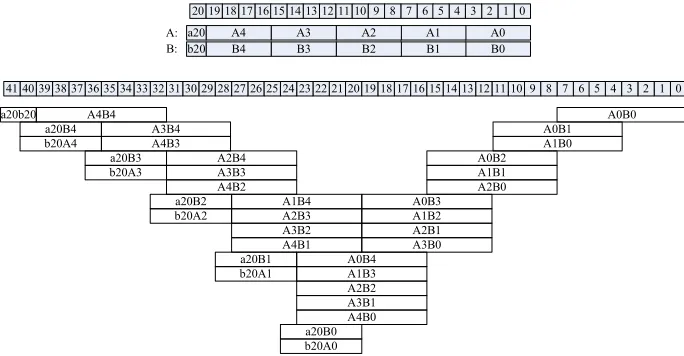
multiplication inFp2 in a intuitive manner (see Figure 1). Reducing elements in
Fp2 is rather simple, because shifting operations can be discarded.
The running times of the two libraries are quite similar. The modular mul-tiplication inFp1 took 3177 clock cycles on average. The multiprecision
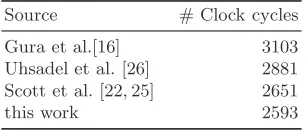
multi-plication 160×160 was performed in 2593 clock cycles and is about 60 cycles faster than [22] (see Table 1). The difference might be caused by some saved memory accesses, but there is no fundamental new approach. So we skip the investigation of that acceleration. In Fp2 the multiplication counted 3338 clock
cycles. The ratio of the two routines of 95% coincides with the ratio of the binary lengths of the prime numbers. In both libraries dedicated squaring routines lead to a speed up of the squaring by at least 26%.
Table 1: Comparison of 160×160 bit multiprecision multiplication
Source # Clock cycles
Gura et al.[16] 3103
Uhsadel et al. [26] 2881
Scott et al. [22, 25] 2651
39383736 40
41 35343332313029282726252423222120191817161514131211109 8 7 6 5 4 3 2 1 0 20 191817161514131211109 8 7 6 5 4 3 2 1 0
A0 A1 A2 A3 A4 a20 B0 B1 B2 B3 B4 b20 A0B0 A0B1 A1B0 A0B2 A1B1 A2B0 A0B3 A1B2 A2B1 A3B0 A0B4 A1B3 A2B2 A3B1 A4B0 A1B4 A2B3 A3B2 A4B1 A2B4 A3B3 A4B2 A3B4 A4B3 A4B4 a20B0 b20A0 a20B1 b20A1 a20B2 b20A2 a20B3 b20A3 a20B4 b20A4 39383736 40
41 35343332313029282726252423222120191817161514131211109 8 7 6 5 4 3 2 1 0 a20b20 22 23 24 26 28 30 32 34 36 38 40 25 27 29 31 33 35 37 39 41 20 21
22 191817161514131211109 8 7 6 5 4 3 2 1 0 22
21 20 191817161514131211109 8 7 6 5 4 3 2 1 0
+ + + + + + + + + + + + + + + + + + + + + + + + + + + + + + + + + + + + + + + + + + + + + + + + + + + + + + + + + + + + + + + + + + A: B:
Fig. 1: Multiplication in GF(2168 −28
−1).
Note, that our numbers for modular multiplication involve also the clock cycles for saving and recovering the registers prior to the function call or prior to the return jump. These necessary cycles are discarded in the previous papers [16, 22, 26].
3.2 Finite Field Extensions of Odd Characteristic Greater 3.
In [4] Bailey and Paar propose finite extension fields of odd characteristic p, wherepis adapted to the word size of the target processor. Similar to finite fields of characteristic 2 the elements of the finite field are represented by polynomials with coefficients inFp. Bailey and Paar define so called optimal extension fields which have the following two properties:
1. The characteristicpof the extension field can be written asp= 2n−c, where c2< n.
2. The field extension is defined by an irreducible binomial, i.e.
Fpd∼=Fp[X]/(Xd−ω), ω∈Fp.
7. Diem shows in [11] that those finite fields prevent the attack based on the Weil descent presented by Gaudry et al. in [13] for finite fields of characteristic 2.
It is easy to see, that OEFs cannot be defined for every arbitrary primep. Bailey and Paar mention, that the extension degreedhas to divide the ordere ofωinFp but it must not divide the number (p−1)/e. This sufficient condition restricts the number of possibilities.
The arithmetic in OEF is derived from the usual arithmetic in polynomial rings. The addition of two polynomials is done by the addition of their coefficients modulopand the multiplication is computed by a complete multiplication of two polynomials and the subsequent reduction modulo the irreducible polynomial.
Depending on the constant term ω it might be advantageous to choose a trinomial of the formXd±Xm±1, because all its coefficients have the absolute value 1 and hence the reduction consists of additions in Fp only. In particular, if the smallest possible value forω involves a multiplication and if the multipli-cation on the target microcontroller is much more expensive than an addition, the trinomial might reduce the computation time compared to the binomial.
Our implementation is based on the finite fieldFp11, where p = 216−129
and the extension is defined by X11−3. Although our target platform has an 8-bit architecture the 16 bit construction is much more efficient than choosing an 8-bit prime number.
Choosing an 8-bit prime number results in an extension degree d = 23 in order to obtain an elliptic curve which provides at least 160 bit security. There is only one possibility p = 139 with irreducible polynomial X23−2. In the multiplication of polynomials of degree 23 we have to reveal 23 partial products for every coefficient of the product. Those partial products are summed up in an accumulator of 24 bits and therefore we need 3 additions for every partial product. If we assume, that we have to load the two factors into the CPU we can conclude that the computation of one coefficient of the product consumes 23·(2 + 3 + 4) clock cycles (multiplication + additions + loading) without reduction modulo p and X23−ω. So a lower limit for the clock cycles of one multiplication is 23·207 = 4761.
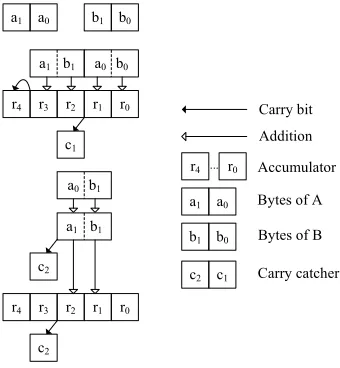
If p is a 16-bit prime number, then we have exactly 11 multiplications of 16-bit numbers for every coefficient. The multiplication of two 16-bit numbers results in a 32-bit value which has to be added to a 40 bit accumulator. The two factors a = a128+a
clock cycles without any reduction. This is an acceleration of almost 30% and justifies the choice of 16-bit prime numbers.
a0
a1 b1 b0
c1
r0
r1
r2
r3
r4
r0
r1
r2
r3
r4
a0 b0
a1 b1
a0 b1
a1 b1
c2
c2
Carry bit
Addition
r0
r4 Accumulator
a0
a1 Bytes of A
b0
b1 Bytes of B
c1
c2 Carry catcher
...
Fig. 2: 16×16-bit multiplication with 40 bit accumulator and carry catchers.
The reduction of the higher coefficients ci, i ∈ {11, . . . ,20}, is performed within the calculation of the coefficientsci−11. Reducing the coefficientciresults in an addition of the carry bits (4 clock cycles), copying, shifting and adding the accumulator (15 further cycles). All in all the reduction of a higher coefficient, i.e. the multiplication by 3, is done in 19 cycles. Since the shift instruction is only twice as fast as the 8×8 multiplication on the ATmega128, the reduction of the accumulator modulo 216−129 is built on 7 multiplications. The total count of clock cycles for one field multiplication in Fpd is 4188. Furthermore
we implemented a particular squaring function in order to avoid the double computation of the mixed terms. The acceleration is about 46%. In Table 2 we give a detailed analysis of the instruction counts computing the product of two OEF-elements. Note, that clock cycles for storing or recovering of registers are neglected in the table.
3.3 Finite Fields of Characteristic Two.
Finite extension fields of characteristic two are very attractive for hardware accelerated elliptic curve operations, since their field arithmetic consists of binary operations only.
Table 2: Instruction counts for OEF-multiplication.
Instruction Counts
Load/Store 506
Mul 561
Add 1686
Shift 61
other 181
total 2995
Clock cycles 4062
an irreducible polynomialf(X). To decrease the computation time spent in the reduction of polynomials,f(X) should be sparse, i.e. a trinomial or pentanomial. Binary polynomials are represented with a binary vector of lengthd, which can be stored in⌈d/w⌉processor words. Hankerson et al. propose several tech-niques implementing the modular multiplication of A(X),B(X)∈ F2d in
soft-ware [17]. The basic multiplication method — calledShift-and-Add— is derived from the well-known Horner scheme and performs deg(A)−1 left shifts and an addition of B(X) for every non-zero coefficient of A. If the left shift causes a polynomial of degree greater thand, a reduction is executed. Hankerson presents several variants of the Shift-and-Add algorithm. The most efficient one is the comb multiplication with windows of width four.
To explain this method and its implementation on the ATmega128, we write A(X) in the following way
A(X) = d−1 X i=0
aiXi=
⌈(d−1)/4⌉ X i=0
3 X j=0
a4i+jXj
| {z }
αi
X4i.
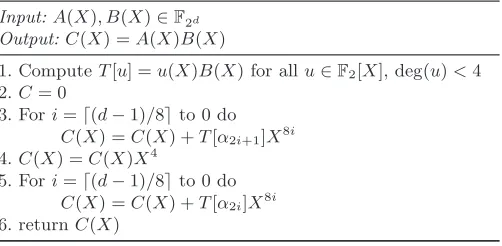
The basic algorithm described by Hankerson et al. [18] works as follows:
Algorithm 1: Comb method with windows of width4.
Input:A(X), B(X)∈F2d
Output:C(X) =A(X)B(X)
1. ComputeT[u] =u(X)B(X) for allu∈F2[X], deg(u)<4 2.C= 0
3. For i=⌈(d−1)/8⌉to 0 do C(X) =C(X) +T[α2i+1]X8i 4.C(X) =C(X)X4
5. For i=⌈(d−1)/8⌉to 0 do C(X) =C(X) +T[α2i]X8i
Seo, Han and Hong try to optimize the number of memory accesses to the variableC by combining several windowsαi [23]. They explain their technique for two windowsαi andαi+1and show that a lot of redundant memory accesses can be discarded. But their implementation is not written in assembly language and therefore, the CPU registers are not used in an optimal way. In particular, the overhead generated by the C-compiler affects the runtime negatively. So we pursue the strategy, processing the windowsαisequentially but using all registers of the processor. Of course this strategy results in a bigger code size, but we will see, that the code size is still acceptable.
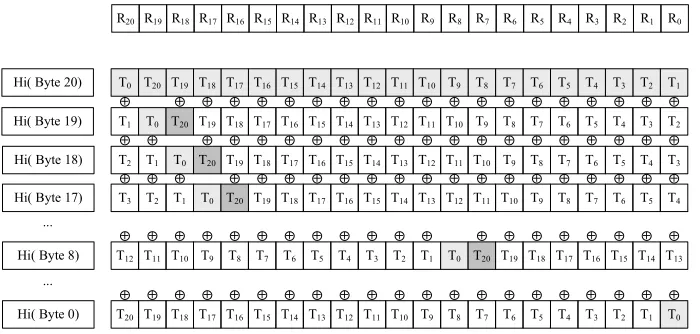
In our approach the comb multiplication with windows of width four is also executed in two loops following the algorithm given above. Since the ATmega128 has an 8-bit architecture, the multiplication by X8i is replaced by an address computation, but the most important problem is the handling of the polynomial C(X). Our implementation is based on the observation, that nearly all registers, which are affected by the addition of the multiple αiB(X) are altered again during the addition of αi−2B(X). Only one single register after the addition of αiB(X) keeps untouched. On the other hand, adding αi−2B(X) changes a new register of the variableC, so we have to load this part of the memory into the CPU. In order to avoid unnecessary copy instructions, these two bytes are exchanged. This results in a total number of 42 memory accesses processingC inside both loops (see Figure 3).
T1 T2 T3 T4 T5 T6 T7 T8 T9 T10 T11 T12 T13 T14 T15 T16 T17 T18 T19 T0 R1 R2 R3 R4 R5 R6 R7 R8 R9 R10 R11 R12 R13 R14 R15 R16 R17 R18 R19 R0
Hi( Byte 20)
T1 T0 T19 T18 T17 T16 T15 T14 T13 T12 T11 T10 T9 T8 T7 T6 T5 T4 T3 T2 Hi( Byte 19)
R20
T20
T20
T1
T2 T0 T19 T18 T17 T16 T15 T14 T13 T12 T11 T10 T9 T8 T7 T6 T5 T4 T3
Hi( Byte 18) T20
T1 T2
T3 T0 T19 T18 T17 T16 T15 T14 T13 T12 T11 T10 T9 T8 T7 T6 T5 T4
Hi( Byte 17) T20
T1 T2 T3 T4 T5 T6 T7 T8 T9 T10 T11
T12 T0 T19 T18 T17 T16 T15 T14 T13
Hi( Byte 8) T20
T1 T2 T3 T4 T5 T6 T7 T8 T9 T10 T11 T12 T13 T14 T15 T16 T17 T18 T19 T0
Hi( Byte 0) T20 ... ... + + + + + + + + + + + + + + + + + + + + + + + + + + + + + + + + + + + + + + + + + + + + + + + + + + + + + + + + + + + + + + + + + + + + + + + + + + + + + + + + + + + + + + + + + + + + + + + + + + + + +
Fig. 3: First part of GF(2167) comb multiplication with windows of width 4. T0 to T20 denote the 21 bytes of the multiple of B(X) determined by the nibble “Hi(Byte XX)”. The bytes without filling are added to the registers. Bytes filled with light-gray are loaded into the registers. The dark-gray bytes are stored in the RAM after the addition (except T20 of Hi(Byte 20)).
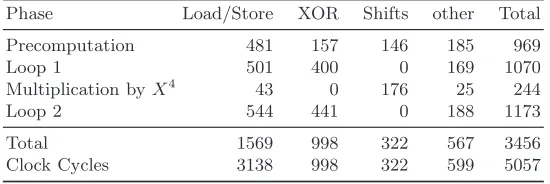
multiplication of the polynomial byX4 is separated to provide more details on the implementation. Instructions calculating the addresses or clearing registers are summed up in a separate column. It turns out, that the number of memory accesses is lower than the reported number of load and store instructions given by Seo, Han and Hong [23].
Table 3: Instruction counts for comb method with window width 4.
Phase Load/Store XOR Shifts other Total
Precomputation 481 157 146 185 969
Loop 1 501 400 0 169 1070
Multiplication byX4
43 0 176 25 244
Loop 2 544 441 0 188 1173
Total 1569 998 322 567 3456
Clock Cycles 3138 998 322 599 5057
The reduction of the polynomialC(X) is then performed byte-wise. Hanker-son presents in [17] an efficient reduction method for sparse reduction polyno-mials. We adapt this methodology to our reduction polynomialX167+X6+ 1. We reduce one complete register by the congruenceX168≡X7+X, such that we have to perform two left shift, two right shift and four XOR instructions. The implementation of the multiplication in assembly language as well as the faster reduction caused by the different reduction polynomial lead to an efficient multiplication in GF(2167) (see Table 4). While our implementation computes the product of two finite field elements in 0.67 ms, Seo et al. consume about 2.9 ms. This is an improvement by a factor 4.
Additionally, we composed a particular function to square a polynomial in
F2d, because squaring in characteristic 2 is just a spreading of the coefficients
[5]:
A(X)2= d−1 X i=0
aiXi !2
= d−1 X i=0
aiX2i modf.
As recommended in [17], the spreading is achieved by a table look-up. In order to avoid a resultC(X) =A(X)2of double length, we composed a second look-up table storing the coefficients of the polynomialsu(X)2(X7+X) in two bytes per entry. The polynomials are used to include the reduction into the spreading of the upper half.
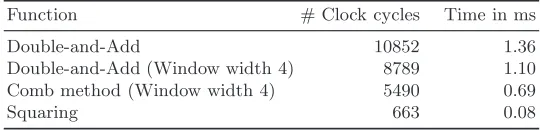
Finally, we want to illustrate the advantage of the comb method with win-dows of width 4 and so we have implemented the binary Shift-and-Add as well as two window methods on the ATmega128. We have chosen the finite field F2[X]/(f(X)), where f(X) = X167 +X6+ 1 ∈
F2[X]. In Table 4 we give the clock cycles and timings of all implemented multiplication routines in
L0 H0 L1 H1 L2 H2 R1 R2 R3 R4 R5 R6 R7 R8 R9 R10 R11 R12 R13 R14 R15 R16 R17 R18
R19 R0
R20 L3 H3 L4 H4 L5 H5 L6 H6 L7 H7 L8 H8 L9 H9 L10 H10 L11 H11 L12 H12 L13 H13 L14 H14 L15 H15 L16 H16 L17 H17 L18 H18 L19 H19 L20 H20 H20 + + + + + + + + + + + + + + + + + + + + + + + + + + + + + + + + + + + + + + + + + +
Fig. 4: Squaring in GF(2167
) including reduction. The light-gray bytes are copied into the registers of the microcontroller. The reduced bytesA(X)2
(X7
+1) (H10. . . H20and L11. . . L20) are xored with the registers.
Table 4: Clock cycles of multiplication functions inF2[X]/(X167+X6+ 1)
Function # Clock cycles Time in ms
Double-and-Add 10852 1.36
Double-and-Add (Window width 4) 8789 1.10
Comb method (Window width 4) 5490 0.69
Squaring 663 0.08
4
Application to Elliptic Curves
In this section we apply our efficient arithmetic to elliptic curve cryptography. In the following the notationFq will denote a finite field of characteristicp >3 with q elements. The parameter q has not to be a prime number but a prime powerq=pd. Ifq is a prime power then
Fq is a field extension over the prime fieldFpof degreed. If the finite field has characteristic 2, then it will be explicitly denoted byF2d.
LetEbe an elliptic curve over an arbitrary finite field, then the elliptic curve can be represented by an shortened Weierstraß-equation
E:y2 =x3+ax+b, witha, b∈F
q and 4a3+ 27b26= 0. E:y2+xy=x3+ax2+b, witha, b∈F
2d andb6= 0.
The set of solutions of the polynomials together with the point at infinity form an additive group. The addition law of the elliptic curve is built on operations in the finite field Fq or F2d resp. Therefore fast arithmetic in the finite fields
is necessary for efficient elliptic curve cryptosystems. In [9] the authors report, that field inversions reduce the efficiency of elliptic curve based cryptosystems drastically, because the ratio of a field inversion to the field multiplication is rather high. For all finite fields we were able to confirm this statement, such that we avoid field inversions by switching to projective coordinates.
characteristic the Jacobian representation
P2(Fq)→A2(Fq) [X:Y :Z]7→
X Z2,
Y Z3
for Z6= 0.
of coordinates offers the fastest implementations. In characteristic 2 coordinates introduced by Lopez and Dahab are the optimal choice [19].
P2(F2d)→A2(F2d)
[X :Y :Z]7→
X Z,
Y Z2
for Z6= 0.
We recall addition laws for these projective representations in order to select our algorithms for scalar multiplication.
Table 5: Point addition and point doubling for Jacobian coordinates inFq
P 6=Q P =Q
X3=−CE−2AE+D2 X3=C
Y3=−BCE+D(AE−X3) Y3=−8Y14+B(A−C)
Z3=Z1Z2C Z3= 2Y1Z1
A=X1Z22, B=Y1Z23, A= 4X1Y12, B= 3X 2 1+aZ
4 1, C=X2Z
2
1 −A, D=Y2Z 3
1−B, E=C 2
C=−2A+B2
The computational effort for adding two different points in Jacobian coordi-nates consists of 12 multiplications and 4 squarings. For the doubling of P we have to perform 4 multiplications and 6 squarings. Representing points in Jaco-bian coordinates is more efficient than affine coordinates if the multiplication is 12 times faster than an inversion.
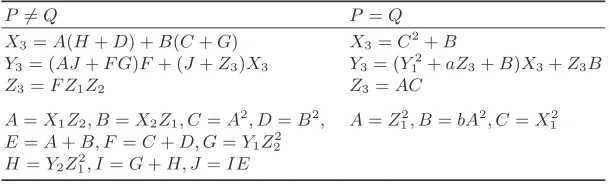
Table 6: Point addition and point doubling for Lopez-Dahab coordinates inF2d
P 6=Q P=Q
X3=A(H+D) +B(C+G) X3=C2+B
Y3= (AJ+F G)F+ (J+Z3)X3 Y3= (Y12+aZ3+B)X3+Z3B
Z3=F Z1Z2 Z3=AC
A=X1Z2, B=X2Z1, C=A2, D=B2, A=Z12, B=bA 2
, C=X2 1 E=A+B, F =C+D, G=Y1Z
2 2 H =Y2Z12, I=G+H, J=IE
ad-dition, whereas we only need 5 multiplications and 4 squarings in the case of point doubling.
The core of elliptic curve cryptosystems is the scalar multiplication, i.e. the iterated addition of a point to itself. It is well-known that cryptosystems resistant against theoretical attacks might be vulnerable to side-channel attacks. These attacks exploit information like power consumption, electromagnetic radiation, run time oscillation or handling of calculation faults. In particular, simple power analysis is a very dangerous and efficient threat. It assigns parts of the power consumption profile to operations on the elliptic curve, i.e. the power consump-tion profile is divided into addiconsump-tions and doublings on the curve. Therefore, it is indispensable to adjust the power consumption profile by dummy operations or to use scalar multiplication algorithms which process the key bits in a constant manner.
There are several proposals for scalar multiplications preventing simple side channel attacks. The most efficient algorithm is based on a window technique [18], but since we are interested in memory saving methods we restrict to al-gorithms, which do not need precomputed points. So, there are two remaining algorithms, which can be used in secure implementations of elliptic curve cryp-tosystems.
The Double-And-Add-Always (see Algorithm 2) is resistant against simple side chanel attacks, because an addition and a doubling is executed indepen-dently from the certain value of the key bit. Using mixed coordinates the algo-rithm consumes 12nmultiplications and 9nsquarings forFq[10] (12n multiplica-tions and 10nsquarings forF2d[18]). Additions in the finite fields are neglected,
because they play not an important role for the total running time.
Algorithm 2: Algorithm 3: Double-and-add-always Montgomery ladder
Input: P ∈E,k∈Z Output:Q=kP
Input: X1
Output:A/B=Xk/Zk,C/D=Xk+1/Zk+1
Q[0]←P; A←1;B←0;C←X1;D←1;
j←0; i←n−1;
Whilej < n Whilei >−1;
Q[0]←P; Ifki= 1
Q[1]←Q[0] +P; add(A,B,A,B,C,D);
Q←Q[ki]; double(C,D,C,D);
P←2P; Else
j←j+ 1; add(C,D,C,D,A,B);
ReturnQ; double(A,B,A,B);
i←i−1; Return;
factorization based on elliptic curves. It can be applied to elliptic curves defined over arbitrary finite fields and the concrete formulas are summarized in [12] and [18]. Montgomery determines the projectivex-coordinates (X3, Z3), (X4, Z4) of pointsP3=P1+P2,P4= 2P2, such that the projectivex-coordinates (X1, Z1) and (X2, Z2) ofP1, P2and the differenceP2−P1are used only. Starting with the input pointsP1=OandP2=P, we can derive the multiplekP such that the same operations are executed for different values of the key bits. InF2dwe need
6n multiplications and 4n squarings. For arbitrary elliptic curves defined over finite fields of characteristicp >3 we have 5nsquarings and 14nmultiplications. Since inFq squaring is not twice as fast as the multiplication, the Montgomery-Ladder is faster than the Double-And-Add-Always for every choice of the finite field.
In Table 7 we give the running times of the Montgomery-ladder on the AT-mega128 for all finite fields implemented in the previous section. The used curves were cryptographically strong, such that the security levels of the curves are sim-ilar.
Table 7: Performance data of Montgomery-ladder without scalar randomization and without reconstruction of they-coordinate on ATmega128@8MHz
Finite field length of scalar # Clock cycles Running time Code size
Fp1 160 10086676 1.261 s 7.7 kB
Fp2 168 10534273 1.317 s 9.6 kB
Fp11,p= 216−129 176 13830892 1.729 s 9.8 kB
F2167 165 6100462 0.763 s 11 kB
Table 7 shows, that the efficiency of the finite field is not the single argument for fast ECC implementations. In particular, for finite fields of characteristic two the short formulas of the Montgomery-Ladder enable scalar multiplications secured against simple side channel attacks, which are comparable to other fi-nite fields. Although the parameters extension field Fpd were adapted to the
properties of the target platform large prime fields are not less efficient.
5
Conclusion
References
1. MIRACL, Multiprecision Integer and Rational Arithmetic C/C++ Library. http: //www.shamus.ie/.
2. Atmel Corporation. AVR 8-Bit RISC Third Party. available athttp://www.atmel. com/products/AVR/thirdparty.asp.
3. Atmel Corporation. Datasheet: ATmega128(L). available athttp://www.atmel. com/products/avr/.
4. D.V. Bailey and C. Paar. Optimal Extension Fields for Fast Arithmetic in Public-Key Algorithms. In H. Krawczyk, editor, Advances in Cryptology – CRYPTO 98, volume 1462 ofLecture Notes in Computer Science, pages 472–485. Springer-Verlag, 2000.
5. I. Blake, G. Seroussi, and N. Smart. Elliptic Curves in Cryptography. Cambridge University Press, 1999.
6. E.-O. Blaß and M. Zitterbart. Efficient Implementation of Elliptic Curve Cryp-tography for Wireless Sensor Networks. Technical Report TM-2005-1, Insitute of Telematics, University of Karlsruhe, 3 2005.
7. M. Braun, E. Hess, and B. Meyer. Using Elliptic Curves on RFID Tags. IJCSNS International Journal of Computer Science and Network Security, 8(2):1–9, 2008. 8. D. Brown. SEC 1: Elliptic Curve Cryptography. Certicom Research, February
2005. Working Draft Version 1.5.
9. M. Brown, D. Hankerson, J. Lopez, and A. Menezes. Software Implementation of the NIST Elliptic Curves over Prime Fields. Technical Report CORR 2000-58, Centre for Applied Cryptography, University of Waterloo, 2000.
10. H. Cohen, A. Miyaji, and T. Ono. Efficient Elliptic Curve Exponentiation Using Mixed Coordinates. In K. Ohta and D. Pei, editors, Advances in Cryptology -ASIACRYPT’98, volume 1514 of Lecture Notes in Computer Science, pages 51– 65. Springer-Verlag, 1998.
11. C. Diem. The GHS Attack in Odd Characteristic. J. Ramanujan. Math. Soc., 18(1):1–32, 2003.
12. W. Fischer, C. Giraud, E.W. Knudsen, and J.P. Seifert. Parallel scalar multiplica-tion on general elliptic curves overFphedged against Non-Differential Side-Channel
Attacks. Cryptology ePrint Archive, 2002/007.
13. P. Gaudry, F. Hess, and N.P. Smart. Constructive and Destructive Facets of Weil Descent on Elliptic Curves. Technical Report CSTR-00-016, Department of Computer Science, University of Bristol, 2000.
14. T. Granlund. The GNU Multiple Precision Arithmetic Library, September 2004. Available athttp://www.swox.com/gmp/.
15. T. G¨uneysu and C. Paar. Ultra High Performance ECC over NIST Primes on Com-mercial FPGAs. In E. Oswald and P. Rohatgi, editors, Cryptographic Hardware and Embedded Systems - CHES 2008, volume 5154 ofLecture Notes in Computer Science, pages 62–78. Springer-Verlag, 2008.
16. N. Gura, A. Patel, A. Wander, H. Eberle, and S. C. Shantz. Comparing Elliptic Curve Cryptography and RSA on 8-bit CPUs. In M. Joye and J. J. Quisquater, editors, Cryptographic Hardware and Embedded Systems — CHES 2004, volume 3156 ofLecture Notes in Computer Science, pages 119–132. Springer-Verlag, 2004. 17. D. Hankerson, J.L. Hernandez, and A. Menezes. Software implementation of el-liptic curve cryptography over binary fields. In C¸ .K. Ko¸c and C. Paar, editors,
Cryptographic Hardware and Embedded Systems - CHES 2000, volume 1965 of
18. D. Hankerson, A. Menezes, and S. Vanstone.Guide to Elliptic Curve Cryptography. Springer-Verlag, 2004.
19. J. L´opez and R. Dahab. Improved Algorithms for Elliptic Curve Arithmetic in GF(2n). In S.E. Tavares and H. Meijer, editors, Selected Areas in Cryptography — SAC ’98, volume 1556 ofLecture Notes in Computer Science, pages 201–212. Springer-Verlag, 1998.
20. D.J. Malan, M. Welsh, and M.D. Smith. A public-key infrastructure for key dis-tribution in TinyOS based on elliptic curve cryptography. InSensor and Ad Hoc Communications and Networks, 2004, pages 71–80, 2004.
21. P.L. Montgomery. Speeding the Pollard and Elliptic Curve Methods of Factoriza-tion. Math. Comp., 48:243–264, 1987.
22. M. Scott and P. Szczechowiak. Optimizing Multiprecision Multiplication for Public Key Cryptography. Cryptology ePrint Archive, Report 2007/299, 2007. http: //eprint.iacr.org/.
23. S.C. Seo, D. G. Hand, and S. Hong. TinyECCK: Efficient Elliptic Curve Cryp-tography Implementation over GF(2m) on 8-bit MICAz Mote. Cryptology ePrint
Archive, Report 2008/XXX, 2008. http://eprint.iacr.org/.
24. Z.J. Shi and H. Yan. Software Implementations of Elliptic Curve Cryptography.
International Journal of Network Security, 7(2):157–166, 2008.
25. P. Szczechowiak, L. B. Oliveira, M. Scott, M. Collier, and R. Dahab. Nanoecc: Testing the Limits of Elliptic Curve Cryptography in Sensor Networks. In R. Ver-done, editor, Wireless Sensor Networks — EWSN 2008, volume 4913 of Lecture Notes in Computer Science, pages 305–320. Springer-Verlag, 2008.
26. L. Uhsadel, A. Poschmann, and C. Paar. Enabling Full-Size Public-Key Algorithms on 8-Bit Sensor Nodes. In F. Stajano, C. Meadows, S. Capkun, and T. Moore, editors, Security and Privacy in Ad-hoc and Sensor Networks, volume 4572 of