THE EFFECT OF CHANNEL CODING RATE ON THE RESISTANCE OF DIRECT-SEQUENCE
SPREAD-SPECTRUM COMMUNICATION SYSTEMS TO NARROW-BAND INTERFERENCE
P. Azmi
Electrical Engineering Department Tarbiat Modares University Iran
Abstract—In this paper, optimum code rates for a number of channel codes which are used in the coded direct-sequence spread-spectrum (DS-SS) and coded code-division multiple-access (CDMA) communication systems operating in the presence of narrow-band
interference (NBI) are investigated. The criteria in obtaining the
optimum code rates is based on maximum tolerable NBI power to signal power ratio.
First, we consider Optimum Codes, Super Orthogonal Codes (SOC), and Repetition Codes for a single-user DS-SS system and then, the optimum rates for the Optimum Codes in CDMA system using single-user and multi-user detection methods are obtained. In the latter case, we will consider evaluating the optimum code rate for two different multi-user detection schemes, namely, a detection method using joint coding/decoding and a detection method using successive interference cancellation.
1. INTRODUCTION
In many communication systems, one may confront various intentional or unintentional narrow-band interference (NBI). For example, due to ubiquitous use of wide-band cellular system and electromagnetic spectrum scarcity, one may have to design a cellular communication system at the same carrier frequency. Hence techniques that need to operate properly in the presence of other narrow-band communication systems that could combat or reduce the effect of NBI could prove to be of utmost importance.
performance of a digital system in combating against the NBI. Due to necessary bandwidth expansion in using the above techniques, there is a coding-spreading tradeoff in the coded spread-spectrum systems and the available bandwidth must be optimally divided between these two. The coding-spreading tradeoff has been considered from many different points of views in several articles [1–7]. These papers present the optimization between the processing gain and the coding gain of a direct-sequence spread-spectrum system such that different capabilities of the system are optimized. Hui in his pioneering work has shown that in binary input channels, the performance of the systems is superior in terms of throughput and antijam capability when more bandwidth is devoted to error correction [1]. In other noticeable paper, Verdu and Shamai have profoundly investigated the maximization of spectral efficiency [2]. They have shown that the spectral efficiency depends on the type of receiver’s structure and thus they have considered the optimum coding-spreading tradeoff for different receiver’s structures
in order to maximize spectral efficiency. In yet another important
paper, the antijam capability of the system is considered [3]. In [3], the optimum rate of (BCH) channel codes are considered in the single-user direct-sequence spread-spectrum system. The authors have shown that an optimum rate exists and it certainly depends on the characteristics of the channel codes.
The above interesting results on coding-spreading tradeoff have encouraged us to further investigate the optimum rate of different channel codes in direct-sequence spread-spectrum systems with different receiver’s structure. Our analysis follows the same line of thought as in [3], namely, we are concerned with the optimization of the rate of the channel codes in a coded spread-spectrum system on the basis of reducing the effect of NBI. In other words, the criterion used for the code rate optimization, is the maximization of the maximum
tolerable NBI power to signal power ratio ((J/S)T ol.). Thus the
optimum code rate,r, can be found by the following formula,
rOpt= arg
max
r ((J/S)T ol.)
. (1)
In this paper, we will consider the optimization of rate of several channel codes for two different communication systems, namely, single-user direct-sequence spectrum DS-SS and multi-single-user spread-spectrum CDMA systems. Furthermore, for the CDMA systems, the optimum rates of several channel codes assuming various detection schemes are discussed.
Following this introduction, in Section 2, a model for a coded
spread-spectrum system is described. We obtain a mathematical
In Section 3 the optimum code rate for a few well-known codes, which maximizes the (J/S)T ol.in a single-user DS-SS system, is investigated. The optimization of the optimum codes’ rate for different forms of multi-user CDMA systems is considered in Section 4. We conclude this paper in Section 5.
2. DESCRIPTION OF SPREAD-SPECTRUM SYSTEMS
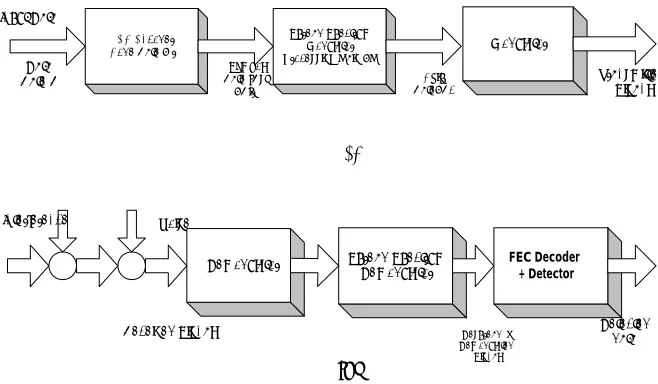
A typical block diagram for a coded spread-spectrum system is shown in Figure 1. It is well known that, in the spread-spectrum systems, we spread the spectrum of the desired signal by multiplying it by a wide-band pseudo-random spreading signal such that the wide-bandwidth of the desired information signal is approximately spread to the bandwidth of the spreading signal. On the other hand, at the receiver, the desired signal will be despread with a locally generated copy of the spreading signal.
FEC Encoder Code Rate = r Input Data
Data Rate R
Spread Spectrum Modulator Processing Gain =G Symbol
Rate (Rs) =R/r
Chip Rate=Rc
Modulator
(a)
Interference Noise
Demodulator Spread Spectrum
Demodulator
FEC Decoder + Detector
(b)
Transmitte Siganl
Received Signal Despread &
Demodulated Signal
Detected data
Figure 1. The block diagram of a standard coded DS-SS system. (a) Transmitter. (b) Receiver.
Moreover, we know that if there is any NBI component in the received signal, its spectrum will be spread in the spread-spectrum demodulator and its bandwidth will spread to at least, the bandwidth
of the spreading signal. If we assume that the bandwidth of the
spreading signal isW, the result is that the NBI will have a bandwidth
watts, then its average power spectral density, can be modeled as a white noise, with an spectral level equivalent to,
N0 =J/W. (2)
LetS(Watts) be the desired received signal’s average power. Thus
if the data rate of the signal isR bits/second, the received energy per
bit,Eb, is
Eb=
Es
r = S Rsr
= S
R watts.sec, (3)
wherer is the code rate. Moreover, Es and Rs represent the received
energy per symbol and the symbol rate respectively. Usually in the presence of an effective NBI, we can safely neglect the thermal noise. In this case using (2) and (3) it can be seen that, the maximum tolerable NBI power to signal power ratio is
J S
T ol.
= W/R
(Eb/N0)Req.
, (4)
where (Eb/N0)Req.is the minimum required signal to NBI ratio for the decoder.
The well-known theories in communication sciences prove that the (Eb/N0)Req. is a function of the code rate (r). Thus (4) shows
that, for the purpose of maximizing the (J/S)T ol., we must minimize
the minimum required signal to noise ratio ((Eb/N0)Req.). Without any loss of generality and due to its simplicity, instead of finding the code rate that maximizes the (J/S)T ol., in the following Sections, we attempt to find the code rate that minimizes the (Eb/N0)Req..
3. OPTIMUM CODE RATE FOR SINGLE-USER DS-SS SYSTEMS
In this section, we obtain the optimum code rates for three different coding schemes namely Optimum Codes, Super Orthogonal Codes (SOC), and Repetition Codes for a single-user DS-SS system in the presence of an NBI. These optimum code rates are determined in
such a way that maximizes the (J/S)T ol. or equally minimizes the
3.1. Optimum Code Rate for Optimum Codes
It is known that a channel can be characterized by a single parameter; namely the channel capacity. Shannon demonstrated that it is possible to transmit information at any rate below capacity with an arbitrary small probability of error. The method of proof is now referred to, not very appropriately, as “random coding”. In this proof, the existence of good codes is shown by averaging over all possible codes. Since this is an existence theorem, there is no guidance as how to find the codes or how complex they may be when implemented. In this paper these theoretical good codes are referred to as Optimum Codes.
In this subsection, the effect of the code rate of the Optimum
Codes on the single-user DS-SS systems is investigated. In the
previous Section, it was argued that at the output of a spread-spectrum demodulator, the NBI could be modeled as an additive white noise. Furthermore using central limit theorem, it can be shown that the probability density function of the received NBI at the output of a spread-spectrum demodulator can be modeled as a Gaussian distribution. Thus in a single-user DS-SS system in the presence of an NBI, the channel can be modeled as an additive white Gaussian noise (AWGN) channel.
Based on Shannon theory, in an AWGN channel the relationship
amongst the optimum code rate r, data rate R, and Shannon
bandwidth B, which is defined as one half of the minimum number of
dimensions per second required to represent the uncoded modulated signal [8], is given by,
R= B
r log2
1 +
S N0B/r
. (5)
Substituting (3) we obtain that,
R= B
r log2
1 +
Eb
N0
Req.
R B/r
, (6)
or equivalently,
(Eb/N0)Req.=
2rRB −1
rR/B . (7)
Substituting (7) in (4) yields,
J S
T ol.
= rW /B
Using (7), it can be realized that (Eb/N0)Req. is an increasing function of the code rate, thus the optimization of the code rate based on the minimization of the (Eb/N0)Req. yields,
rOpt=
B
W, (9)
where W represents the channel bandwidth and B is the Shannon
bandwidth of the signal. Substituting (9) in (4) and (7), it can be seen that the maximum of (J/S)T ol. is
J S
T ol.
max
= 1
2R/W −1, (10)
whereR represents the bit rate of the user.
The main result of this section is generalization of Hui result. Hui has only considered the binary input channels but in this section the result is proved for the general AWGN channels.
3.2. Optimum Code Rate for Super Orthogonal Codes
It is well known that in contrast to the other usual kinds of convolutional codes, the generating function of the Super Orthogonal
Codes (SOC) are only dependent on the rate of the codes. This
property brings them forth as the proper choice for our analysis. The upper bound on the bit error probability of a convolutional code can be obtained using the generating function of the code [9]. The generating function of the SOC is computed in [10] as,
T(Z, b) = bG
L+2(1−G)
1−G(1 +b(1 +GL−3−2GL−2)), (11)
in which G = Z2L−3 and L = −log2r + 2. Using the generating
function, an upper bound of the bit error probability is obtained as follows,
Pb <
∂T(Z, b)
∂b |b=1 =
GL+2
(1−2G)2
1−G
1−GL−2
2
, (12)
whereG=Z2L−3. The parameterZ in a binary input channel is given
by,
Z = E
y|1
P(y|0 )
P(y|1 )|1
whereyis the output of the channel. In a binary input AWGN channel the value ofZ is calculated as [9],
Z =e−ESN0. (14)
Using these relations, it can be seen that the bit error probability of the Super Orthogonal Codes operating in an AWGN channel is upper bounded by
Pb ≤
G4−log2r
(1−2G)2
1−G
1−G−(log2r) 2
G=e−
Eb
8N0
, (15)
Using somewhat lengthy but straightforward computations, it can be shown that for a fixed upper bound on the bit error probability,
the minimum of (Eb/N0)Req. will be an increasing function of the
code rate. Thus similar to Optimum Codes the optimum code rate is the minimum code rate that can be sent in to the available channel. Therefore the optimum code rate can also be found by (9) where the Shannon bandwidth in the 2-dimension systems becomes,
B =R (16)
In this case the maximum of the (J/S)T ol. is a complicated
function of the fixed bit error probability. But, in practical situations fore−Eb/N0 1, and log
2r −1, we can only consider the first term
of the expansion of (15) and with using (4), the (J/S)T ol.can be found by,
(J/S)T ol.≤
4 + log2
1
r
W/R
2 ln (1/Pb)
(17)
Then the maximum of the (J/S)T ol. can be determined as,
((J/S)T ol.)max≤
4 + log2
W R
W/R
2 ln (1/Pb)
(18)
3.3. Optimum Code Rate for Repetition Codes
In the Repetition Codes, an analytic relation between the code rate
r and the probability of error can be obtained. Using hard decoding
based on majority law, the probability of error can be found as follows,
Pb = N
i=N/2+1
N i
Pi
Eb
N0
1−P
Eb
N0
N−i
whereN = 1/r≥2 and P(Eb/Nb) is the probability of decision error on the coded symbols. Because of the complexity of (19), no analytic
equation between the code rate and the (Eb/N0)Req. can be found.
Thus in the following, we use an upper bound on the probability of error.
Using the well-known Chernoff bound [12], the following upper bound of the probability of error is obtained,
Pb≤e−N/2s0Φ(s0), (20)
where Φ (s) =
1−P
Eb
N0
(1−es)
N
and s0 can be found by solving
the following equation,
N/2Φ(s0) =
d dsΦ (s)
s=s0 (21)
or equivalently,
s0 = ln
1−P(E b/N0)
P(Eb/N0)
+ ln
N/2
N − N/2
(22)
Substituting (22), (20) reduces to,
Pb ≤
2
P(Eb/N0) (1−P(Eb/N0))
1/r1−P(E b/N0)
P(Eb/N0)
. (23)
In the following, for a fixed upper bound of the bit error probability, we try to find the optimum code rate that minimizes the (Eb/N0)Req.. Since the optimum code rate is dependent on the P(.), the model of communication channel and the method of modulation and detection must be determined.
It is well known that an upper bound on the probability of error of a 2-dimension system, in an AWGN channel, can be shown to be
P(Eb/N0) ≤ 12e−rEb/2N0. In practical situations for e−Eb/N0 1, an upper bound on the (J/S)T ol. can be found as,
(J/S)T ol.≤ 1
2r(1−2r)
W/R
2rln (2/Pb) + ln 2
, (24)
Then the maximization of (J/S)T ol. leads to,
rOpt=
1
2ln (2/P)/ln 2 + 1 + 1
and the maximum of (J/S)T ol. can be obtained and it is expected as,
(J/S)T ol.≤ W/R 4 ln 2
1
ln (2/Pb)/ln 2 + 1 + 1
2. (26)
3.4. Numerical Results
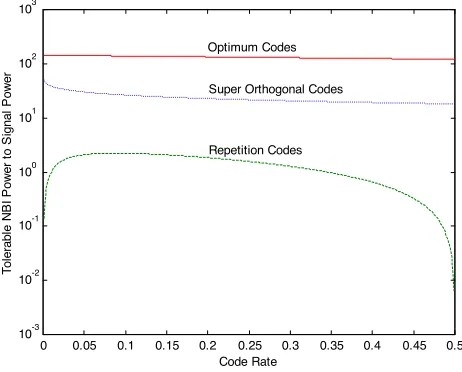
Figure 2 shows the (J/S)T ol.of a 2-dimension coded single-user DS-SS system as a function of code rate for different channel coding schemes, namely, Optimum Codes, Super Orthogonal Codes, and Repetition
Codes. TheW/Ris fixed to 100 and we assume that the probability of
error in Super Orthogonal Codes and Repetition Codes is 10−6. These
parameters only determine a multiplicative factor of the (J/S)T ol.
thus they cannot influence on the main results. The curves of this
figure confirm the result of this section, namely, the optimum code
rate of the Optimum Codes and Super Orthogonal Channel codes is the minimum rate that can be sent in to the channel and the optimum rate of Repetition Codes can be given by (25). Assuming Pb = 10−6, the optimum rate of Repetition Codes will be 088.
0 0.05 0.1 0.15 0.2 0.25 0.3 0.35 0.4 0.45 0.5
10-3
10-2
10-1
100
101
102
103
Code Rate
T
o
le
rabl
e
N
B
I
P
o
w
e
r
to
S
ignal
P
ow
er
Optimum Codes
Super Orthogonal Codes
Repetition Codes
Figure 2. The tolerable narrow-band interference power to signal power ratio in the single-user spread-spectrum system for optimum codes, SOC and repetition codes.
Furthermore, it can be seen that, the Super Orthogonal Codes
reminded that on the basis of these curves, we can not compare the Optimum Codes with the others, because by using the Optimum Codes it is possible to transmit information with an arbitrary small probability of error but in the others the probability of error is set to 10−6. If the probability of error approaches to zero, the (J/S)T ol. of the non-optimum codes approaches to zero and this fact proves the superiority of the optimum codes.
4. OPTIMUM CODE RATE FOR MULTI-USER CDMA SYSTEMS
In this section, the optimum code rate is investigated for typical CDMA systems. At first the conventional power-controlled CDMA
is considered. Then the CDMA systems using both joint
coding/decoding and successive interference cancellation are taken into consideration.
4.1. Optimum Code Rate for Power-controlled CDMA Systems
Without elaborating on the system implementation, we note that for a power-controlled CDMA system, all signals are received at the same
power level. For an M-users system, the demodulator receives a
composite signal containing the desired signal having power S and
M −1 interfering signals each having the same power S and bit rate
R. With Guassian approximation, the following relation between the
code rate and the (Eb/N0)Req. is established,
R= B
r log2
1 + (Eb/N0)Req.
R Br 1 + (M−1) (Eb/N0)Req.RBr
. (27)
With some manipulations, the following explicit equation for (Eb/N0)Req. is derived,
(Eb/N0)Req.=
2rR/B−1
rR B
1−(M−1)
2rR/B−1
. (28)
will be an increasing function of the code rate. the optimum code rate is given by (9) and the maximum of the (J/S)T ol. is expressed as,
J S T ol. max
= 1−(M−1)
2R/W −1
2R/W −1 . (29)
4.2. Optimum Code Rate for Multi-user CDMA Systems Using Joint Coding/Decoding
In this section the maximization of the (J/S)T ol. is also considered
in a CDMA system with multi-user joint coding/decoding. Based on Shannon theory, the following relation is established [8],
M
i=1
Ri = M i=1 Bi ri log2 1 + Eb N0
Req.| i
Ri
Bi/ri
. (30)
where Ri, Bi, ri, and (Eb/N0)Req.|i are the bit rate, the Shannon bandwidth, the code rate, and the minimum required signal to noise
ratio of the ith user. Due to the concavity of the logarithm function,
the following inequality is established,
M i=1 Ri M i=1
Bi/ri
≤log2
1 + M i=1 Eb N0 Req. |i Ri
M
i=1
Bi/ri . (31)
The equality case can be obtained when,
Ri E b N0 Req. i =cBi
ri
i∈ {1,2, . . . , M}, (32)
wherecis a constant. Substituting (32) in (31), the following inequality is obtained,
c≥2 M
i=1 Ri/
M
i=1 Bi/ri
−1, (33)
or equivalently, E b N0 Req. i ≥ 2 M i=1 Ri/
M
i=1 Bi/ri
−1
Riri/Bi
Substituting (34) in (4), it can be shown that the tolerable interference to signal power ratio of theith user will be,
J W
T ol. |i ≤
W (ri/Bi)
2 M
i=1 Ri/
M
i=1 Bi/ri
−1
. (35)
For simultaneously maximizing (J/W)T ol.|i ∀i= 1,2, . . . , M, it can be further shown that the following equalities must be established,
ri
Bi
=C ∀i= 1,2, . . . , M, (36)
where C is a constant. Substituting (36) in (35), the following
inequality is obtained,
J W
T ol.| i ≤
W C
2 M
i=1 Ri/M C
−1
. (37)
The right hand side of (37) is a decreasing function ofC thus the
optimum code rate of users will be,
rOpt|i =
Bi
W i= 1,2, . . . , M. (38)
and the maximum of the (J/S)T ol. is,
J S
T ol.
max
= 1
2 M
i=1 Ri/M W
−1
. (39)
and if we assume equal rate users, (39) reduces to (10).
4.3. Optimum Code Rate for Multi-User CDMA Systems Using Successive Interference Cancellation
Due to the complicated design and decoding of the joint multi-user channel codes, it is more practical that a single-user channel code along with successive interference cancellation be used. In this Section, the optimum code rate for equal rate users with a successive interference cancellation is investigated.
Supposing that the kth user is the user which is decoded, and
following relationship between the minimum required signal to noise ratio of thekth user and the 1st user holds [12],
(Eb/N0)Req.|k= (Eb/N0)Req.|1
1 +rR/B(Eb/N0)Req.|1
k−1
. (40)
It can be seen that the optimum code rate is the minimum code rate and thus it can be obtained by (9).
Since the decoding of the kth user must be done in the presence
of the interference of the M −k−1 users, the (Eb/N0)Req. of the
different users are not the same. In fact the first user is at the
highest (Eb/N0)Req. and the Mth user is at the lowest (Eb/N0)Req.. By substituting the optimum rate in (9), it can also be seen that the maximization of the tolerable interference to signal ratio in the best case,Mth user, leads to (10), but in thekth user, (10) changes to,
J S
T ol.
max
= 2−
(M−k)R/W
2R/W −1 . (41)
4.4. Numerical Results
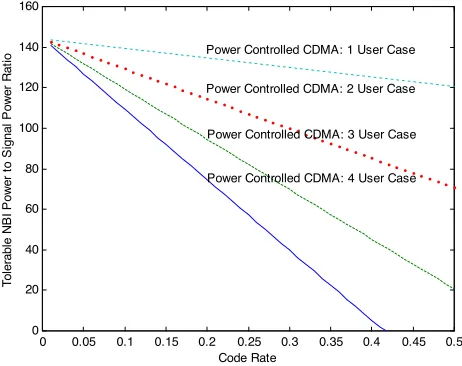
In Figure 3, the curves of the (J/S)T ol. versus code rate for a coded power-controlled CDMA with 1, 2, 3, and 4 users are plotted. Similar
to single-user case, W/R is fixed to 100. This figure confirms the
0 0.05 0.1 0.15 0.2 0.25 0.3 0.35 0.4 0.45 0.5
0 20 40 60 80 100 120 140 160
Code Rate
T
o
le
ra
b
le
NB
I
P
o
wer
to
S
ig
n
a
l
P
o
wer
R
a
ti
o Power Controlled CDMA: 1 User Case
Power Controlled CDMA: 2 User Case
Power Controlled CDMA: 3 User Case
Power Controlled CDMA: 4 User Case
results of the previous sections that the optimum code rate is the minimum code rate that can be sent in to the channel. Furthermore, it can be seen that by increasing the number of users, the resistance of power-controlled CDMA system to narrow-band interference severely degrades.
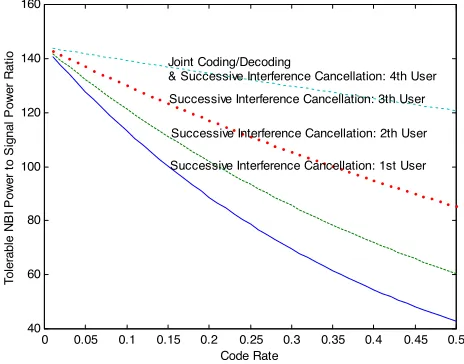
In the Figure 4, the curves of the (J/S)T ol. versus code rate
for a coded spread-spectrum CDMA system with 4 rate equal-bandwidth users is plotted for different multi-user detection schemes, namely, joint coding/decoding and successive interference cancellation.
Similar to the other cases, W/R is fixed to 100. These curves also
confirm the results of the previous sections that the optimum code rate is the minimum code rate that can be sent in to the channel.
0 0.05 0.1 0.15 0.2 0.25 0.3 0.35 0.4 0.45 0.5
40 60 80 100 120 140 160
Code Rate
T
o
le
ra
b
le
NB
I
P
o
wer
to
S
ig
n
a
l
P
o
wer
R
a
ti
o
Joint Coding/Decoding
& Successive Interference Cancellation: 4th User
Successive Interference Cancellation: 3th User
Successive Interference Cancellation: 2th User
Successive Interference Cancellation: 1st User
Figure 4. The tolerable narrow-band interference power to signal power ratio in multi-user CDMA system for joint coding/decoding and successive interference cancellation.
5. CONCLUSIONS
In this paper the optimum rates of different channel coding schemes
was investigated for various spread-spectrum systems. It has been
REFERENCES
1. Hui, J. Y. N., “Throughput analysis for code division multiple
accessing of the spread spectrum channel,” IEEE Journal on
Selected Areas in Communications, Vol. 2, No. 4, 482–486, July 1984.
2. Verdu, S. and S. Shamai, “Spectral efficiency of CDMA with
random spreading,”IEEE Trans. on Inf. Theory, Vol. 45, No. 2,
622–640, March 1999.
3. Li, K. H. and L. B. Milstein, “On the optimum processing gain of
a blocked-coded direct-sequence spread-spectrum system,” IEEE
Journal on Selec. Area in Comm., Vol. 7, No. 4, May 1989.
4. Azmi, P. and M. Nasiri-Kenar, “Narrow-band interference
suppression CDMA spread spectrum communication systems
based on sub-optimum unitary transforms,” IEICE Trans.
Communication, Vol. E85-B, No. 1, 239–246, January 2002. 5. Azmi, P. and M. Nasiri-Kenar, “Generalised Fourier
transform-domain technique for narrowband interference suppression in
CDMA communication systems,” Electronics Letters, Vol. 37,
No. 10, 652–654, 2001.
6. Azmi, P. and N. Tavakkoli, “Narrow-band interference suppression in CDMA spread-spectrum communication system using
pre-processing based techniques in transform-domain,” Progress In
Electromagnetics Research Letters, Vol. 3, 141–150, 2008.
7. Haccoun, D. and Z. Gherbi, “On the application of very low rate
error control coding to CDMA,”IEEE CCECE’97, 466–469, 1996.
8. Massey, J. L., “Toward an information theory of spread-spectrum
systems,” DMA Communications, 29–46, Kluwer Academic
Publisher, 1995.
9. Viterbi, A. J. and J. K. Omura, Principles of Digital
Communications and Coding, McGraw-Hill, New York, 1979.
10. Viterbi, A. J.,CDMA: Principles of Spread Spectrum
Communi-cations, Addison-Wesley Pub., 1995.
11. Viterbi, A. J., “Very low rate convolutional codes for maximum theoretical performance of spread-spectrum multiple-access
chan-nels,”IEEE Journal of Selected Area on Communications, Vol. 8,
No. 4, 641–649, May 1990.
12. Vantrees, H. L., Detection Estimation, and Modulation Theory,