Hardness of Learning Problems over Burnside Groups of Exponent 3
Nelly Fazio∗ Kevin Iga† Antonio Nicolosi‡ Ludovic Perret§ William E. Skeith III∗
Abstract
In this work we investigate the hardness of a computational problem introduced in the recent work of Baumslaget al.in [3, 4]. In particular, we study theBn-LHNproblem, which is a generalized version of the learning with errors (LWE) problem, instantiated with a particular family of non-abelian groups (free Burnside groups of exponent 3). In our main result, we demonstrate a random self-reducibility property forBn-LHN. Along the way, we also prove a sequence of lemmas regarding homomorphisms of free Burnside groups of exponent 3 that may be of independent interest.
Keywords. Random self-reducibility. Learning with errors. Post-quantum cryptography. Non-commutative cryptogra-phy. Burnside groups.
∗
The City College of CUNY,{fazio,wes}@cs.ccny.cuny.edu. Supported in part by NSF grants CNS 1117675.
†
Pepperdine University, [email protected]
‡
Stevens Institute of Technology, [email protected]. Supported in part by NSF grants CNS 1117679.
§
1
Introduction
Motivation & Background. In the recent work of Baumslaget al. [3, 4], the authors derive a number of basic cryptographic primitives (e.g., symmetric encryption) from a generalization of thelearning parity with noise (LPN [1, 11, 5]) and learning with errors (LWE [15, 14, 12, 2]) problems to an abstract class of group-theoretic learning problems, termed learning homomorphisms with noise (LHN). As shown in [3], this class of problems contains LPN and LWE as special cases, but also allows instantiations based on non-abelian groups. Specifically, the work of [3] describes a combinatorial instantiation of LHN using a class of finite groups known as free Burnside groups, which are in some sense the “most general” groups for which every element has a finite order dividing some constant n. The Burnside group instantiation of the problem was termed learning Burnside homomorphisms with noise (Bn-LHN). While a number of cryptographic aspects of the Bn-LHN problem were addressed in [3] (cf. Appendix A for a discussion on the computational aspects of Burnside groups, and their relevance for cryptographic applications), several important matters were left open; perhaps the most prominent being the question of complexity reductions (e.g., worst-case to average-case reductions). We take steps toward resolving these questions by showing a certain random self-reducibility property for Bn-LHN.
Random self-reducibility. Since any practical implementation of a cryptographic scheme must include an algorithm which generates hard problem instances, it is desirable that such instances do not take much effort to find. One notion that in some sense captures this idea is that of random self-reducibility.
Roughly speaking, a random self-reducibility property makes an assertion about the average-case hardness of a computational problem. In particular, it says that solving the problem on a random instance is not any easier than solving the problem on an arbitrary instance. Hence, if a computational problem satisfies random self-reducibility, it is a trivial matter to sample “good” instances: a random instance will suffice. Indeed, random self-reducibility is one of the hallmarks of intractability assumptions that have withstood the test of time. Notable examples include the RSA problem [16]; the discrete logarithm problem and the Diffie-Hellman problem [6]; the quadratic residuosity assumption [7]; the composite residuosity assumption [13]; and the learning with errors (LWE) problem [15]. As it turns out, however, random self-reducibility properties come in several shapes. For example, the type of random self-self-reducibility enjoyed by the LWE is, in a sense, the strongest, in that the secret key itself can be randomized: given instances relative to a secrets, new instances relative to a uniformly random secrets0 can be constructed in a way that solutions to the latter yield solutions to the former. This is a more complete form of random self-reducibility than what is known for many number-theoretic assumptions, like RSA, where it is possible to randomize individual instances based on a given private key, but for which there is no apparent way to re-randomize the key itself. More concretely, given an instance c = me mod n, one can compute a new instancec0=cre mod n= (mr)e mod n, whose solution (together with knowledge ofr) yields a solution forc, yet there is no apparent way to find a connected instance relative to a different modulusn06=n. We stress that the reduction shown in our work is of the LWE type: the worst-case to average-case reduction applies to the secret keys.
Our Contributions. In this paper, we make progress towards understanding the computational hardness of learning Burnside homomorphisms with noise. In particular, we establish a random self-reducibility property for Bn-LHN, by showing that learning under uniform surjective secret homomorphisms is no
easier than learning under an arbitrary one. We remark that the original formulation of Bn-LHN did not require that the homomorphism be a surjection. However, this limitation seems rather inconsequential for the cryptographic application of the assumption. First, as the security parameter grows, the probability of sampling a non-surjective secret diminishes exponentially. Hence the distributions of instances coming from the two variations on the assumption are in fact statistically close (cf.Appendix B). Moreover, as shown in Section 5, there is an efficiently computable test for surjectivity, so that the distribution of instances for the modified assumption remains efficiently sampleable (via rejection sampling). Finally, in Section 6, we present a limited form of a search-to-decision reduction forBn-LHN.
expo-nent 3 (denoted Bn) involve relating the groups and their morphisms to their abelianized counterparts
(Bn/[Bn, Bn]), as well as finding certain useful facts that are preserved under this relation. In a study with
such a focus on homomorphisms, a number of elementary ideas from homological algebra apply naturally. In particular, we make frequent use of commutative diagrams, exact sequences, and occasionally, the five lemma. These techniques are briefly reviewed in Appendix 2.
Organization. Section 3 provides some background on free Burnside groups of exponent 3. The learning Burnside homomorphisms with noise (Bn-LHN) problem is defined in Section 4. Section 5 presents the random self-reducibility result for Bn-LHN. Section 6 looks into the relationship between the search and decision versions of Bn-LHN.
2
Background: Group Theory and Homological Algebra
Free groups. If X is a subset of a group G, let X−1 = {x−1 |x ∈ X}. An expression w of the form
a1. . . an (n≥0, ai∈X∪X−1) is termed aword or an X-word. Such an X-word is said to be reduced
ifn >0 and no subword aiai+1 takes either of the formsxx−1 orx−1x. IfF is a group and X is a subset
of F such that X generates F and every reduced X-word is different from 1F, then one says that F is a
free group, freely generated by the setX, and refers toX as afree set of generators of F, and writesF
as F(X). A key property of a free groupF freely generated by a set X is that for every group H, every mapping θ from X into H can be extended uniquely to a homomorphism θ∗ from F into H. If θ∗ is a surjection, and ifK is the kernel ofθ∗, then the quotient groupF/K is isomorphic toH. IfRis a subset of
F, then in the event thatK is generated by all of the conjugates of the elements ofR, we express this by writingH =hX;Ri and term the pairhX;Ri apresentation of H (notice that the mappingθis usually implicit).
Relatively Free Groups. If F is a free group and K a normal subgroup of F, then the factor group
F/K is calledrelatively free ifK is fully invariant, i.e.,ifα(K) ≤K for any endomorphism α of F. Ifx1, . . . , xn are free generators ofF, thenx1K, . . . , xnK are called relatively free generators ofF/K, and
typically denoted simply by x1, . . . , xn when there is no risk of confusion. LetEn denote a relatively free group of rank n, i.e.,Fn =F(x1, . . . , xn) and En =Fn/K for some fully invariant K. One key property
of such a group is that any set map on its generators intoEn can be extended to an endomorphism ofEn.
Hence, one is immediately equipped with an exponential number of homomorphisms, provided that the image is non-trivial.
Cayley distance. Finitely generated groups can also be viewed as geometric objects via the notion of theCayley graph. The Cayley graph of a groupGrelative to a particular set of generators has the group elements as vertexes, and an edge between two vertexes if and only if multiplication by a generator (or its inverse) translates one to the other. Figure 1 depicts Cayley graphs for several groups, including the 27-element Burnside group B(2,3) of exponent 3 with 2 generators. (Burnside groups are discussed in Section 3.) The Cayley distance between two group elements is defined as the length of the shortest path between the corresponding nodes in the Cayley graph. The maximum Cayley distance between any two elements in the graph is the diameter of the Cayley graph. The Cayley norm of an element x, denoted kxk, is its distance from the identity element in the Cayley graph. We remark that maxx∈G(kxk)
corresponds precisely to the diameter.
Commutators. In non-abelian groups, thecommutator of two group elementsa, b, denoted [a, b], is the group element satisfying the identity ab=ba[a, b], that is, [a, b] =a−1b−1ab. Starting with the generators
x1, . . . , xn of the group as the recursive basis, one obtains an ordered sequence of formal commutators
(a) Free group,F(a, b) (b)B(2,2)∼= (F22,+) (c)B(2,3) =B2
Figure 1: Cayley graphs for various groups
Commutator subgroups. IfG is a group, then the commutator subgroup [G, G] is the subgroup of
G generated by elements of the form [a, b] where a, b ∈G. The commutator subgroup of G is a normal subgroup of G. More generally, if A and B are normal subgroups of G, then [A, B] is the subgroup of
G generated by elements of the form [a, b] where a ∈ A and b ∈ B. Thus, we can define a sequence of subgroups G1 = G, G2 = [G, G], G3 = [[G, G], G], and recursively, Gn+1 = [Gn, G]. This sequence of groups is called the lower central series forG.
Abelianization. If G is a group, then G/[G, G] is called the abelianization of G: It is an abelian group obtained from G by creating new relations to ensure that all elements of the group commute. The canonical epimorphism ρG : G - G/[G, G] that takes g ∈ G into its g[G, G] in G/[G, G] is usually
referred to as theprojection onto the abelianization ofG. When there is no risk of confusion, we will drop the subscript and denote the projection onto the abelianization simply byρ.
It is a basic fact from category theory that ρ is universal for homomorphisms from G into abelian groups: that is, if Ais any abelian group, then any homomorphism θ:G - A splits asθ=θ0◦ρ, for a
unique homomorphismθ0 :G/[G, G] - A. IfGandHare groups, andφ:G - His a homomorphism,
then using the above construction on θ=ρH ◦φyields a homomorphism φ:G/[G, G] - H/[H, H] so
that the following diagram commutes:
G φ - H
G/[G, G]
ρG
? φ
- H/[H, H] ρH
?
We refer toφ as theabelianization of the homomorphism φ.
Exact Sequences and the Five Lemma. Consider a sequence of homomorphisms of groups
A1 f1- A2 f2
- A3 f3
- · · · fk−1
- Ak.
Such a sequence is said to beexact if for every j ∈ {1, . . . , k−2}we have that Im(fj) = ker(fj+1). One
common example is 0 - H
j - G
p
- G/H - 0 where H C G, j is the inclusion of H into
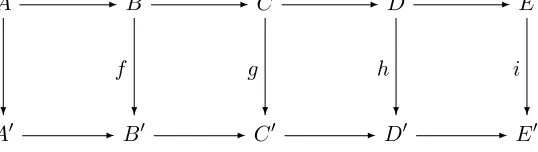
G, and p is the canonical epimorphism ofG onto the quotient, sending g 7→ gH. Consider the following commutative diagram, where the rows are exact.
A - B - C - D - E
A0 e
?
- B0 f
?
- C0 g
?
- D0 h
?
- E0 i
The five lemma states that ifeis surjective andi is injective, then iff and h are isomorphisms, so isg. Furthermore, ifi is injective andf and h are surjective, theng is also surjective.1
3
Brief Background on Burnside Groups
For a positive integer k, consider the class of groups for which all elements x satisfy xk = 1. Such a
group is said to be of exponent k. We will be interested in a certain family of such groups called the
free Burnside groups of exponent k, which are in some sense the “largest.” The free Burnside groups are uniquely determined by two parameters: the number of generatorsn, and the exponentk. We will denote these groups byB(n, k):
Definition 3.1 (Free Burnside group) For any n, k ≥ 0, the Burnside group of exponent k with n
generators is defined as
B(n, k) =h{x1, . . . , xn};{wk| for all words w over x1, . . . , xn}i.
Since we are interested in average-case hardness, it is important that B(n, k) be finite, else even basic issues regarding the probability distribution become unclear. The question of whether B(n, k) is finite or not is known as the bounded Burnside problem. For sufficiently large k,B(n, k) is generally infinite [10]. For small exponents, it is known that k∈ {2,3,4,6} yields finite groups for alln. (We remark that with the exception of k = 2, for which B(n, k) =Fn2 is abelian, these are non-trivial results.) For other small
values ofk (most notably,k= 5), the question remains open.
To ensure finiteness, our current knowledge of Burnside groups would require k to be in the set
{2,3,4,6}; however, following the work of [3], we will focus on k = 3. The main reasons are as fol-lows: k= 2 would give the more familiar (and already studied) caseB(n, k) =Fn2; it is convenient forkto
be prime (hence eliminating k= 4 and k= 6); and perhaps most importantly, the structure of B(n,3) is much better understood in comparison to than that of k= 4,6. Hence, in what follows we will deal only withB(n,3) and denote it simply byBn for brevity.
Next, we review some important facts about Bn (see also Appendix B, or [9, 8] for a fuller account). Bnis free. In the category of groups of exponent 3,Bnis a free object on the set of generators{x1, . . . , xn}.
That is, if G is any group such that g3 = 1 for all g ∈G, then for any set map f :{x
1, . . . , xn} - G,
there exists a unique homomorphism f : Bn - G such that f(xi) = f(xi) for every i∈ [n]. In other
words, to define a homomorphism from Bn to G we need only define the function on {x1, . . . , xn}. Any
such assignment will extend uniquely to a group homomorphism.
Normal form of Bn. Although Bn is non-abelian, an interesting consequence of the order law w3 = 1
forw∈Bn is thatBn has a simple normal form: EachBn-element can be written uniquely as an ordered sequence of (a subset of) generators (or their inverses2), appearing in lexicographical order, followed by (a subset of) the commutators of weight 2 (or their inverses), and finally by (a subset of) the commutators of weight 3 (or their inverses):
xα1 1 · · ·x
αi
i · · ·xαnn[x1, x2]β1,2· · ·[xi, xj]βi,j· · ·[xn−1, xn]βn−1,n[x1, x2, x3]γ1,2,3
· · ·[xi, xj, xk]γi,j,k· · ·[xn−2, xn−1, xn]γn−2,n−1,n =
n Y
i=1 xαi
i Y
i<j
[xi, xj]βi,j Y
i<j<k
[xi, xj, xk]γi,j,k
where allαi, βi,j, γi,j,k ∈ {0,1,−1} for all 1≤i < j < k≤n, and [xi, xj, xk] = [[xi, xj], xk].
Order of Bn. From the above normal form, it follows that Bn has exactly 3n+(
n
2)+(
n
3) elements.
1Dually, ifeis surjective andf, hinjective, thengis also injective. 2
Center of Bn. The center, Z(Bn) ={g∈Bn | [g, h] = 1∀h∈Bn} is the subgroup [[Bn, Bn], Bn]
gen-erated by all commutators of weight 3. This follows in part from the fact that all commutators of weight 4 are the identity in Bn.
Homomorphisms from Bn to Br. There are 3n(r+(
r
2)+(
r
3)) homomorphisms from Bn - Br. This
follows immediately from the order of Br and from the fact that Bn is a free object in the category of
groups of exponent 3 with generating set of sizen.
4
Learning Burnside Homomorphisms with Noise
In this section, we review (a variant of) a group-theoretic learning problem introduced in [3], under the name of learning Burnside homomorphisms with noise (Bn-LHN). Our formulation of the problem samples only surjective homomorphisms for problem instances, in contrast to [3] which samples uniformly over all homomorphisms. As we show in Appendix B, this modification is of essentially no consequence from a computational perspective. In what follows, for groups G, H we will denote the set of epimorphisms (i.e.,
surjective homomorphisms) fromG toH by Epi(G, H).
4.1 The Bn-LHN Problem
For a security parameter n >0, the Bn-LHNsetting consists of the groups Gn=. Bn and Pn=. Br, where
2 ≤ r.3 Let Φn be the uniform distribution over the set of surjective homomorphisms from Bn to Br:
Φn=. U(Epi(Bn, Br)). At a high level, theBn-LHN problem is to distinguish randomGn×Pn pairs from
random (preimage, “noisy” image) pairs under a hidden homomorphismϕ←$ Φn. The “noise” in the pairs
is determined by an error distribution Ψn on Br, which amounts to taking a randomly ordered product of
a random subset of the generators and their inverses. More precisely, the probability mass function of Ψn
is defined as:
∀e∈Br, PrE$ ←Ψn
[E =e] = Pr
v←$Fr3,σ $ ←Sr
" e=
r Y
i=1 xvi
σ(i) #
(1)
where thexi’s are the generators of Br, the vi’s are the components of v, and Sr denotes the symmetric
group onr letters. Since x2 =x−1 inBr, the normkekof a Ψn-sampleeis at most r.
Definition 4.1 (LHN-Decision Problem) For a(Bn, Br)-homomorphismϕ, define the distributionAΨϕn onBn×Br whose samples are preimage/distorted image pairs (a, b) where a←$ U(Bn) and b=ϕ(a)e for e←$ Ψn. The LHN-decision problem is to distinguish the uniform distribution U(Bn×Br) fromAΨϕn, for ϕ←$ Φn.
Since Bn is a relatively free group, any mapping of its n generators uniquely extends to a
homo-morphism, and hence U(hom(Bn, Br)) is efficiently sampleable. Furthermore, we argue that surjective
homomorphisms account for an overwhelming fraction of hom(Bn, Br) (cf.Appendix B) and are efficiently recognizable (cf.Section 5). It follows that Φnis efficiently sampleable via rejection sampling.
5
Random Self-Reducibility of
B
n-
LHN
In this section, we establish a random self-reducibility property of the learning Burnside homomorphisms with noise problem: Learning under uniform surjective secret homomorphisms is no easier than learning under an arbitrary one (Theorem 5.6).
We start with a general observation regarding theLHNproblem over arbitrary groupsGn,Pn(Lemma 5.1), which immediately yields a partial key-randomization property forLHNin general. We then show that this
3For the cryptographic applications described in [3], it was required thatr≤4 so that a certain computational problem in
randomization is in fact complete for the specific case ofBn-LHNif we restrict theBn-LHNsecret key to be
surjective. This essentially follows from proving that any two epimorphisms fromBntoBrcan be converted
into each other via automorphisms of Bn (Lemma 5.4). In turn, this “transitivity” property hinges upon a technical lemma that characterizes (Bn, Br)-epimorphisms as precisely those maps whose abelianization
is an (Fn3,Fr3)-epimorphism (Lemma 5.2). Together with Lemma 5.1, Lemma 5.4 essentially establishes the
random self-reducibility ofBn-LHNunder surjective homomorphisms (Theorem 5.6). (In light of the argu-ment of Appendix B about the prominence of epimorphisms among (Bn, Br)-homomorphisms, Theorem 5.6
additionally yields the random self-reducibility of the original Bn-LHN assumption from [3].)
Lemma 5.1 Let a, b=ϕ(a)·e∈ Gn×Pn be an instance of LHN sampled according to AΨn
ϕ , and α be a permutation onGn. It holds that(a0, b) = α(a), b∈Gn×Pn is sampled according to AΨn
ϕ◦α−1.
Proof: We have (a0 =α(a), b) = α(a), ϕ(a)·e= α(a), ϕ◦α−1(α(a))·e= a0, ϕ◦α−1(a0)·e.
Letρ:G - G/[G, G] denote the projection onto the abelianization. Consider the following diagram:
Bn ρ - Fn3
Br ϕ
? ρ
- Fr3 ϕ
?
(2)
Lemma 5.2 Let ϕ∈hom(Bn, Br), and let ϕ∈hom(Fn3,Fr3) be the corresponding map on the abelianiza-tion. Then ϕ is surjective ⇐⇒ ϕ is surjective.
Proof: Consider the following diagram:
0 - [Bn, Bn] i
- Bn ρ
- Fn3 - 0
0 - [Br, Br]
ˆ
ϕ
? i
- Br ϕ
? ρ
- Fr3 ϕ
?
- 0
(3)
The short exact sequences are the result of abelianization of Bn and Br to Fn3 and Fr3, respectively.
The central vertical map is the given homomorphismϕ, and ˆϕisϕrestricted to the commutator subgroup [Bn, Bn]. Since homomorphisms map commutators to commutators, ˆϕmaps into [Br, Br]. The map ϕ is
obtained by considering the map ρ◦ϕ :Bn - Fr3, which is a map to an abelian group and therefore
factors through the abelianization ofBn asϕ◦ρ. Thus, this diagram is commutative. ( =⇒) Ifϕ∈Epi(Bn, Br), then a diagram chase around (2) shows that ϕis also surjective.
( ⇐= ) Now suppose that ϕ is surjective. Let {x1, . . . , xr} be the generators for Br. Ideally, we would like to argue that xi is in the image ofϕ for all i, which would yield the desired result. Surjectivity of ϕ
does not immediately imply thatϕhits all generatorsxi of Br; nevertheless, along with commutativity of
the right square of (3), it guarantees that ϕ hits a collection of “quasi-generators”: there exist elements
e1, . . . , er∈Bn and γ1, . . . γr∈[Br, Br] so that
ϕ(ei) =xiγi.
Next, we leverage the existence of the ei’s and the properties of their commutators to argue surjectivity of
ˆ
To show that ˆϕ is surjective, in turn we invoke the Five Lemma on the commutative diagram below:
0 - [[Bn, Bn], Bn] j
- [Bn, Bn] π
- [Bn, Bn]/[[Bn, Bn], Bn] - 0
0 - [[Br, Br], Br] α
? j
- [Br, Br]
ˆ
ϕ
? π
- [Br, Br]/[[Br, Br], Br] β
?
- 0
(4)
The map α is the restriction of ˆϕ (and hence of ϕ) to [[Bn, Bn], Bn], and since commutators map to commutators, it maps into [[Br, Br], Br]. The existence of the homomorphismβ and the commutativity of the diagram is a standard diagram chase. All that remains to prove is then surjectivity ofα and β.
Because the lower central series for Br terminates at [[Br, Br], Br], we know that [Br, Br] is generated by {[xi, xj]}i,j and {[[xi, xj], xk]}i,j,k. Therefore, [Br, Br]/[[Br, Br], Br] is generated by {π[xi, xj]}i,j, and
so to show thatβ is surjective, it suffices to show that for everyiand j,π([xi, xj]) is in the image ofβ.
Recall that there existeiso thatϕ(ei) =xiγi. We show below thatπ([ei, ej]) is a pre-image ofπ([xi, xj]) underβ. We compute:
ˆ
ϕ([ei, ej]) =ϕ([ei, ej]) = [ϕ(ei), ϕ(ej)] = [xiγi, xjγj] =γi−1x−1i γj−1x−1j xiγixjγj (5)
We then introduce a commutator to reverse the order of the first two elements:
=x−1i γi−1[γi−1, x−1i ]γj−1x−1j xiγixjγj
and then use the fact that [γi−1, x−1i ]∈ [[Bn, Bn], Bn] is in the center, to move this commutator past the other terms, to the far right:
=x−1i γi−1γ−1j xj−1xiγixjγj[γi−1, x−1i ]. (6)
Comparing this result with (5), we note that this sequence of manipulations allowed us to move the first termγi−1 one element to the right, at the expense of generating one element [γi−1, x−1i ]∈[[Br, Br], Br] at
the far right. Using this same technique, we move γi−1 to the right again and again, until it is adjacent to γi, at which point it cancels γi. As before, each such move produces another [[Br, Br], Br]-factor on the right. Next, we deal with γj−1 analogously: We move it to the right (each time producing additional [[Br, Br], Br]-elements) until it cancels γj. At the end of this procedure, continuing from (6), we have
. . .=x−1i x−1j xixj Y
yk
where eachyk is some element of [[Br, Br], Br]. If we call this productzi,j =Qyk, we then have
ˆ
ϕ([ei, ej]) =[xi, xj]zi,j
wherezi,j ∈[[Br, Br], Br]. We then see that
β(π([ei, ej])) =π( ˆϕ([ei, ej])) =π([xi, xj]zi,j) =π([xi, xj]).
Therefore, β is surjective.
Now we wish to showα is surjective. Since [[Br, Br], Br] is generated by{[[xi, xj], xk]}i,j,k, it suffices to
show that these are all in the image ofα. In particular, we show below that, for all i, j, k,α([[ei, ej], ek]) =
[[xi, xj], xk]. Again we compute
Recalling from the previous computation that [xiγi, xjγj] = [xi, xj]zi,j, we have
=[[xi, xj]zi,j, xkγk]
Since zi,j ∈ [[Br, Br], Br] is central, we can commute it and its inverse together in this expression and cancel them:
=[[xi, xj], xkγk].
We then expand this commutator
=[xi, xj]−1γk−1x−1k [xi, xj]xkγk
and introduce [[xi, xj], xk] to movexk to the left:
=[xi, xj]−1γk−1x−1k xk[xi, xj][[xi, xj], xk]γk
We then use the fact that [[xi, xj], xk]∈[[Br, Br], Br] is central to move this to the right.
=[xi, xj]−1γk−1[xi, xj]γk[[xi, xj], xk]
and moveγk to the left using another commutator:
=[xi, xj]−1γk−1γk[xi, xj][[xi, xj], γk][[xi, xj], xk]
at which point we can first cancelγk−1 with γk, and then cancel [xi, xj]−1 with [xi, xj], to get
=[[xi, xj], γk][[xi, xj], xk].
Next, we note that the first factor, [[xi, xj], γk], is in [[Br, Br],[Br, Br]], which is trivial. What remains
is [[xi, xj], xk], which we have now shown to be in the image of α. Therefore α is an epimorphism. The
Five Lemma on (4) then proves that ˆϕis an epimorphism, and the Five Lemma on (3) proves thatϕis an
epimorphism.
We also make note of the following simple but useful consequence of this Lemma.
Corollary 5.3 Let ρ :Br - Fr3 denote the projection onto the abelianization. Let {t1, . . . , tn} ⊂ Br.
Then {t1, . . . , tn} generatesBr if and only if {ρ(t1), . . . , ρ(tn)} generates Fr3.
Proof: Consider the mapϕ :Bn - Br defined by xi 7→ ti for each i∈ [n], and let ϕ:Fn3 - Fr3
be the abelianization. Then {t1, . . . , tn} generates Br if and only if ϕis surjective, and {ρ(t1), . . . , ρ(tn)}
generates Fr3 if and only ifϕis surjective. By Lemma 5.2, these two conditions are equivalent.
Remarks. We use Lemma 5.2 below in our proof that the randomization from Lemma 5.1 is in fact a complete random self reduction, but it also has computational significance: given a description of ϕ ∈
hom(Bn, Br) as mappings of the generators, we now have an easy test for surjectivity: simply compute the rank of the corresponding map of linear spaces in the abelianization.
Next, we show that Aut(Bn) acts transitively on Epi(Bn, Br) by composition on the right, and thus
for the case of Bn-LHN, the construction from Lemma 5.1 provides a random self-reduction.
Proof: Letϕ∗ ∈Epi(Bn, Br) denote the “target” surjection, and let ϕ∈Epi(Bn, Br) be an arbitrary
surjection. We would like to find α∈Aut(Bn) such that ϕ∗ =ϕ◦α. In other words, we wish to define a
bijective mapα so that the following diagram commutes:
Bn ϕ ∗
- Br
Bn α
? ϕ
- Br
1Br
?
(7)
Let x1, . . . , xn be free generators of Bn. To define α, it suffices to define α(xi) for each i ∈ [n]. To derive suitable α(xi) values such thatα as a whole is bijective, it is convenient to study the abelianization
of all the groups and maps in (7), which results in the following diagram:
Bn
ϕ∗
- Br
0 - K
-ρ
Bn
ϕ
-α
-ρ
Br - 0 1
B
r
-Fn3
? ϕ∗
- Fr3
?
0 - K
τ
?
- Fn3 ρ
? ϕ
-α
-Fr3 ρ
? - 0 1
Fr
3
-(8)
In this diagram, the vertical maps ρ denote the projections onto the abelianization. K is the kernel of ϕ, K is the kernel of ϕ, and τ is an epimorphism from K to K (essentially just the restriction of
ρ:Bn - Fn3 toK⊂Bn) that is defined in Step 3 below.
Step 1: Finding a minimal subsetT of the {ϕ∗(xi)}i∈[n] that generatesBr.
Letti=ϕ∗(xi) fori∈[n]. Sinceϕ∗is surjective, thetimust generateBr. LetT ⊂ {t1, . . . , tn}be a minimal
generating set for Br, and let S ⊂[n] denote the corresponding set of indexes (so that T ={ti}i∈S). By Corollary 5.3, ρ(T) is also a minimal generating set for Fr3. Since Fr3 is a vector space of dimensionr, we
know thatT, and thus S, hasr elements.
Step 2: Finding a set {ai}i∈[n] ofϕ-preimages of the {ti}i∈[n] of minimal “rank”.
We would like to define elements {ai}i∈[n]⊂Bn such thatϕ(ai) =ti for everyi∈[n], yet the subgroup of
Bn generated by the {ai}i∈[n]admits a generating set A={ai}i∈S with onlyr elements. To this aim, for i∈ S we invoke surjectivity of ϕ on ti to find ai ∈ Bn such that ϕ(ai) = ti. For i∈[n]\S, instead, we leverage the fact that T is a generating set for Br and define ai as a word over A. In detail, let wi be a word that expresses ti in terms ofT,i.e.,such thatti=wi(T). We then define
ai =wi(A).
Note thatϕ(ai) =ϕ(wi(A)) =wi(ϕ(A)) =wi(T) =ti; moreover,Ageneratesha1, . . . , aniby construction.
Step 3: Definingτ :K - K.
We define a morphism τ : K - K to make the leftmost portion of diagram (8) above commute.
then ρ(ϕ(k)) = ρ(1) = 0. By commutativity of the right square in (8), ϕ(ρ(k)) = ρ(ϕ(k)) = 0, i.e., ρ(k)∈ker(ϕ) =K. Definingτ :k∈K 7→ρ(k)∈K maps K toK and makes the diagram commute.
Step 4: Provingτ :K - K is a surjection.
Next, we prove that τ : K - K is an epimorphism, i.e., that τ(K) = K. Toward this end, let y ∈ K = ker(ϕ). By the surjectivity of ρ : Bn - F3n, there exists a b ∈ Bn so that ρ(b) = y. Since
0 =ϕ(y) = ϕ(ρ(b)) = ρ(ϕ(b)), we have that ϕ(b) ∈ [Br, Br]. By the proof of Lemma 5.2, we know that
ϕ restricted to [Bn, Bn] maps surjectively to [Br, Br], so there exists a γ ∈[Bn, Bn] so that ϕ(γ) = ϕ(b).
Thenϕ(bγ−1) = 1 sobγ−1 ∈K. Now τ(bγ−1) =ρ(bγ−1) =ρ(b) +ρ(γ−1) =y−0 =y, and thusτ(K) =K.
Step 5: Defining a minimal generating setK ⊂K.
Consider the map ϕ:Fn3 - Fr3 in (8). This is a surjective linear map of vector spaces, and so its kernel
is a linear subspace of dimension n−r. Choose a basisK for ker(ϕ). Sinceτ is surjective, for eachki∈ K,
we find pre-imageski ∈K withτ(ki) =ki. We denote this set byK. It will be convenient to use then−r
elements of [n]\S as indices so that K={ki}i∈[n]\S.
Step 6: Defining the homomorphismα.
We are now ready to define α. Since x1, . . . , xn are free generators, to define α it will suffice to define
α(xi) for each i∈[n]. The natural choice might seem to be defining α(xi) =ai, but in order to ensureα
is bijective, it will be necessary to tack on elements of K when necessary. In particular, define
α(xi) =
ai, ifi∈S; aiki ifi∈[n]\S.
Since Bn is free on the xi, this assignment defines a unique homomorphism α onBn.
Step 7: Proving that ϕ∗ =ϕ◦α.
By freeness of Bn, it suffices to show that ϕ∗ and ϕ◦α agree on x1, . . . , xn. For all i ∈ S, we have ϕ◦α(xi) =ϕ(ai) =ϕ∗(xi). For alli6∈S, we have ϕ◦α(xi) =ϕ(aiki) =ϕ(ai)ϕ(ki) =ϕ(ai) =ϕ∗(xi).
Step 8: Proving that the abelianization α ofα is an epimorphism.
We now study the abelianization α of α. Note that ρ(A) must have dimension r, and furthermore,
hρ(A)i ∩K ={0} by commutativity of (8).4 Therefore, ρ(A)∪ K is a basis of Fn3. Furthermore, letting ui =ρ(xi), we see thatα(ui) =ρ(α(xi)). This, in turn, depends on whetheri∈S ori6∈S:
α(ui) = (
ρ(ai), i∈S ρ(ai) +ki, i6∈S
(9)
Now for i ∈ S, α(ui) = ρ(ai), so ρ(A) ⊂ Span(α(u1), . . . , α(un)). For i 6∈ S, α(ui) = ρ(wi(A)) +ki, and subtracting off ρ(wi(A)) = wi(ρ(A)) (which is clearly in Span(α(u1), . . . , α(un))), we see that also ki ∈ Span(α(u1), . . . , α(un)). Therefore, we see that ρ(A)∪ K ⊂ Span(α(u1), . . . , α(un)), and hence the α(ui) span all of Fn3. Thus, α is an epimorphism.
Step 9: Provingα is an isomorphism.
By Lemma 5.2, it follows that α is also an epimorphism of Bn. Sinceα is a surjective map from a finite
set into itself, it is also bijective. Thereforeα is an automorphism ofFn3, which completes the proof.
Lemma 5.5 Let G be a finite group, and S a set on which G acts transitively. Let s∈S be an arbitrary element, and consider the distributionAs onS whose samples areg·swhereg←$ U(G). ThenAs =U(S).
Proof: Lett∈S be an arbitrary element. We wish to compute Pr [As=t]; that is, the probability that
g·s=t, over the uniform choice ofg←$ G. Recall that thestabilizer ofs∈S(denoted by stab(s)) is the subgroup ofG defined by stab(s) ={g∈G | g·s=s}. Note that #{g | g·s=t} is given by|stab(s)|
since g·s= g0·s ⇐⇒ g0−1g ∈ stab(s), which states that g, g0 are in the same coset modulo stab(s).5 Recall that
[G: stab(t)] =|G·t|=|S|
4This can also be seen via the rank theorem, which states that
Fn3 =hρ(A)i ⊕K, withρ(A)∪ Kserving as a basis. 5
with the last equality following from the transitivity of the action. Hence,|stab(t)|=|G|/|S|, and
Pr [As =t] = |G|
|S| ·
1
|G| =
1
|S|
which completes the proof.
Theorem 5.6 (Bn-LHN Random Self-Reducibility) With notation as in Definition 4.1, any instance of the Bn-LHN-decision problem in which ϕ is an arbitrary surjection from Bn onto Br can be reduced to a Bn-LHN-instance in whichϕ
$
←Epi(Bn, Br).
Proof: This is a straightforward consequence of Lemma 5.1, Lemma 5.4, and Lemma 5.5. Let ϕ ∈
Epi(Bn, Br) be an arbitrary surjection and suppose we are given a distributionRwhich is eitherU(Bn×Br) or AΨn
ϕ . Let α $
← Aut(Bn). (Note that by Lemma 5.2, we can efficiently, sample such an α.) We then
construct a new distribution R0 whose samples are (α(a), b) where (a, b) ←$ R. If R =U, then R0 = U
as well, since α is a bijection. Otherwise, by Lemma 5.1, R0 = AΨn
ϕ0 , where ϕ0 =ϕ◦α−1. Moreover, by
Lemma 5.4 and Lemma 5.5, we see that ϕ0 is distributed according to U(Epi(Bn, Br)). It follows that
an algorithm to solve the Bn-LHN-decision problem on a random epimorphism can be used to solve the
Bn-LHN-decision problem on an arbitrary one.
6
A Weak Decision-to-Search Equivalence
In this part, we investigate the relation betweenBrLHNand LHN-Decision. We first observe the following.
Proposition 6.1 Let q be the cardinality6 of B
r. Let also A be an algorithm distinguishing AΨϕn from
U(Bn×Br) in time t with advantage at least , i.e. A is an algorithm solvingLHN-Decision. Finally, let x←$ Bn. There exists an algorithm B working in poly(q, t) such that:
Pr
(a,b)←$AΨn ϕ
B a, b, x=ϕ(x)
≥ + 1 q ,
Proof: We can w.l.o.g. assume that the success probability ofAis greater onAΨn
ϕ than onU(Bn×Br),
i.e. it holds that:
Pr
(a,b)←$AΨn ϕ
A(a, b) = 1
−Pr
(a,b)←$U(Bn×Br)
A(a, b) = 1
≥ .
Let Pr1 = Pr(a,b)←$
AΨn ϕ
A(a, b) = 1
, and Pr2= Pr(a,b)←$
U(Bn×Br)
A(a, b) = 1
.
Algorithm B works as follows. It samples (a, b)←$ AΨn
ϕ , a guessh $
←U(Br) for the value of ϕ(x), and invokes algorithmAon x·a, h·b= (a0, b0).Finally, B returnshifAreturns 1 and any value of Br\ {h}
otherwise.
Suppose h = ϕ(x), then h·ϕ(a) = ϕ(x·a). It follows that (a0, b0) = x·a, h·ϕ(a)·e
is sampled according to AΨn
ϕ . Hence:
Pr
(a,b)←$AΨn ϕ
B a, b, x=ϕ(x)
= Pr
(a0,b0)←$AΨn ϕ
A a0, b0= 1
= Pr1.
Assume now thath6=ϕ(x). In this case, (a0, b0) = x·a, h·ϕ(a)·e
is distributed according toU(Bn×Br).
Thus:
Pr
(a,b)←$AΨn ϕ
B a, b, x=ϕ(x)
= Pr
(a0,b0)←$U(B
n×Br)
B(a0, b0) = 0
q−1 =
1−Pr2
(q−1).
6
As a consequence:
Pr
(p,b)←$AΨn ϕ
B p,b, x=ϕ(x)
= 1
q
Pr1+ (q−1)
(1−Pr2) q−1
= Pr1−Pr2+ 1
q ≥
+ 1
q .
Thus, Proposition 6.1 proves that an oracle for LHN-Decision allows to predict the results of ϕ(x), for arbitrary x←$ Bn, slightly better than guessing randomly.
In the high advantage case (i.e. the distinguisher is perfect), we get:
Corollary 6.2 (“Weak” Decision-to-Search) Let q be the cardinality of Br. If AϕΨn and U(Bn× Br) are are perfectly distinguishable, i.e. there exists a distinguisher A working in time t accepting with probability exponentially close to1 elements fromAΨn
ϕ and rejecting with probability exponentially close to
1 elements from U(Bn×Br) then there is an algorithm C working in poly(t, q) such that:
Pr
(a,b)←$AΨn
ϕ ,y←C(a,b)$
ϕ(y) =b
with probability exponentially close to 1.
Proof: The algorithmC to consider is exactly the algorithm described in the proof of Prop. 6.1.
We emphasize that the general case (arbitrary advantage) remains an open problem. Interestingly enough, this reduces to generalize the famous Goldreich-Levin Theorem to non-abelian groups. The ob-stacle on the proofs seems to be the impossibility – due to non-commutativity – to sufficiently amplify the success probability of Proposition 6.1.
7
Conclusions and Future Work
In this work, we take steps towards understanding the computational hardness of the Bn-LHN problem
put forth in [3]. With a minor modification to the problem formulation (which results in an instance distribution statistically close to the original), we demonstrate a strong random self-reducibility property, giving evidence that theBn-LHNproblem is difficult in the average case.
Future work includes continued efforts to assess the hardness of the Bn-LHN problem—either via
References
[1] D. Angluin and P. Laird. Learning from noisy examples. Machine Learning, 2(4):343–370, 1988.
[2] Sanjeev Arora and Rong Ge. New algorithms for learning in presence of errors. Manuscript, 2011.
[3] G. Baumslag, N. Fazio, A. R. Nicolosi, V. Shpilrain, and W.E. Skeith III. Generalized learning problems and applications to non-commutative cryptography. InInternational Conference on Provable Security—ProvSec ’11 (to appear). Springer, 2011. LNCS.
[4] Gilbert Baumslag, Nelly Fazio, Antonio R. Nicolosi, Vladimir Shpilrain, and William E. Skeith III. Generalized learning problems and applications to non-commutative cryptography. Cryptology ePrint Archive, Report 2011/357, 2011. Full version of [3]. Available athttp://eprint.iacr.org/2011/357.
[5] A. Blum, A. Kalai, and H. Wasserman. Noise-tolerant learning, the parity problem, and the statistical query model. J. ACM, 50:2003, 2003.
[6] W. Diffie and M.E. Hellman. New directions in cryptography. IEEE Transactions on Information Theory, IT-22(6):644–654, 1976.
[7] S. Goldwasser and S. Micali. Probabilistic encryption. JCSS, 28(2):270–299, 1984.
[8] N. Gupta. On groups in which every element has finite order. Amer. Math. Month., 96:297–308, 1989.
[9] M. Hall. The Theory of Groups. Macmillan Company, New York, 1959.
[10] Sergei V. Ivanov. The free Burnside groups of sufficiently large exponents. Internat. J. Algebra Comput., 4(1-2):ii+308, 1994.
[11] M. Kearns. Efficient noise-tolerant learning from statistical queries. In Journal of the ACM, pages 392–401. ACM Press, 1993.
[12] Vadim Lyubashevsky, Chris Peikert, and Oded Regev. On ideal lattices and learning with errors over rings. In EUROCRYPT, pages 1–23, 2010.
[13] Pascal Paillier. Public-key cryptosystems based on composite degree residuosity classes. In EURO-CRYPT, pages 223–238, 1999.
[14] Chris Peikert. Public-key cryptosystems from the worst-case shortest vector problem: extended ab-stract. InSTOC, pages 333–342, 2009.
[15] O. Regev. On lattices, learning with errors, random linear codes, and cryptography. In STOC, pages 84–93. ACM Press, 2005.
A
Computational Aspects of Burnside Groups
In order for the Burnside groups to be of use in cryptography, at a minimum, they must have a concise representation, and the group operation must be efficiently computable. We demonstrate here that both criteria are met. First, we note that as described above, each element ofBn has a unique normal form as
a product of the generators and certain commutators. Hence by storing an array of the exponents (each of which is in the set{0,1,−1}) we can uniquely represent an element. The size of the array is cubic in n. As for the group operation, this can be computed simply by concatenating two normal forms, and then reducing the resulting word back into normal form. This process, referred to as the collection process, takes cubic time (see [9], chap. 11) in the length of the input (which is itself cubic in n). However, all commutators of weight 3 are in the centerZ(Bn) ofBn, and hence there is no need to expand them and apply
the collection process—one can simply add the corresponding exponents modulo 3. Furthermore, since all commutators of weight 4 are trivial (see [9], chap. 18), we know that [Bn, Bn] is commutative. Hence, we can again avoid the collection process when moving the weight-2 commutators amongst themselves, and in cubic time, we can reduce the expression to a “nearly” normal form consisting of a product of at most 2n
generators (or their inverses) followed by commutators in normal form. Therefore we need only to apply the collection process on linear input, and so the overall running time of computing the product is indeed
O(n3). Inverses can also be computed overB
n in at most cubic time by a similar (yet somewhat simpler)
collecting process.
The last and most challenging computational aspect ofBn relates to itsgeodesics—the computation of
distances in the Cayley graph. For the applications introduced in [3], it suffice to compute the norm (i.e.,
the distance to the identity of the group), in the codomain groupPn, which is generally small, and does not necessarily grow with the security parameter (although it may grow with a correctness parameter). For the case of the free Burnside groupBr, one possible solution is to perform a breadth-first search of the Cayley
graph, storing the norm of every element in a table. This process will begin to become infeasible around
r = 5. However, even with this small number of generators, the diameter is large enough to properly decode for many interesting error distributions Ψn.
B
Surjective Homomorphisms of
B
nThe original phrasing of the Bn-LHN problem sampled secrets uniformly from all of hom(Bn, Br), in
contrast to the above definition, in which Φn = U(Epi(Bn, Br)). We argue below that this modification
has minimal impact on the computational aspects of the problem.
First, we note that as the security parameterngrows, the probability of sampling an instanceϕthat is not surjective is negligible inn. As we will show in Lemma 5.2, a homomorphismϕ∈hom(Bn, Br) is surjec-tive if and only if its corresponding “abelianized” mapϕ∈hom(Fn3,Fr3) is surjective. Furthermore, any two ϕ, ϕ0 ∈ hom(Fn3,Fr3) are associated (via abelianization) to the same number of (Bn, Br)-homomorphisms.
Hence, to compute the fraction of hom(Bn, Br) which is not surjective, we need only compute the fraction of hom(Fn3,Fr3) which is not surjective. A crude upper bound that suffices for our purposes can be obtained
via the union bound: We estimate the probability that a randomly selectedϕ∈hom(Fn3,Fr3) is not
surjec-tive by bounding the probability that its image is contained in somer−1 dimensional subspace V ofFr3.
Specifically, forϕ←$ hom(Fn3,Fr3) and any subspaceV ⊂Fr3 such that dim(V) =r−1, denote withEV the
event that Im(ϕ)⊂V. Then we have
Pr [ϕ6∈Epi(Fn3,Fr3)] = Pr
[
dim(V) =r−1 V ⊂Fr3
EV
where the probability is overϕ←$ hom(Fn3,Fr3), and the union on the right hand side is over all subspaces of
linear equation over the basis ofFr3, we see that there are 3
r−1
2 such subspaces. Furthermore, the image of
each of the n generators of Fn3 satisfies the linear equation of the subspace wth a 1/3 chance, and hence
Pr [EV] = 31n for each V. By the union bound we then have
Pr
[
dim(V) =r−1 V ⊂Fr3
EV
≤ 3 r−1
2·3n <3 r−n
which is negligible in n as long as the gap between r and n is superlogarithmic (e.g., if r is a constant fraction of n). We remark that in fact r is bounded by a small constant both in the formulation of the
Bn-LHN assumption in this paper (cf. Definition 4.1) and in that of [3].
As a consequence, our distribution of instances Φn is statistically close to the uniform distribution
U(hom(Bn, Br)). Indeed, for any Xn⊂Sn, we have
∆(U(Xn),U(Sn)) = |Sn\Xn|
|Sn|
whereU(Xn) is considered a distribution onSn by assigning probability 0 to all elements inSn\Xn, and
where ∆ denotes statistical distance (total variation distance). Hence, whenever ν(n) =|Sn\Xn|/|Sn|is
negligible in n(as in our case), then the ensemble of distributions U(Xn) is statistically close toU(Sn). To summarize, for typical choices of the parametersrandn, the computational hardness of theBn-LHN
problem under uniform unconstrained homomorphisms (the original assumption from [3]) vs. uniform epimorphisms (Definition 4.1) are information-theoretically equivalent. In other words, constraining the sampling of instances to Epi(Bn, Br) does not alter the computational characteristics of the Bn-LHN