Available online: https://edupediapublications.org/journals/index.php/IJR/ P a g e | 483
Performance Evaluation of SUI Modeling Based OFDM System
by BER Analysis under Different Modulation Techniques
Swaleha Mohammed Nazimuddin 1, Amit Goswami2
Department of Electronics and Telecommunication engineering1,2
Disha Institute of Management and Technology,Raipur,Chhattisgarh, INDIA1,2
[email protected][email protected]2
Abstract:-Orthogonal Frequency Division
Multiplexing (OFDM) and Multiple Input and
Multiple Output (MIMO) are two main
techniques employed in 4th Generation Long
Term Evolution (LTE). In OFDM multiple
carriers are used and it provides higher level of
spectral efficiency as compared to Frequency
Division Multiplexing (FDM). In OFDM
because of loss of orthogonality between the
subcarriers there is inter-carrier interference
(ICI) and inter-symbol interference (ISI) and
to overcome this problem use of cyclic
prefixing (CP) is required, which uses 20% of
available bandwidth. Wavelet based OFDM
provides good orthogonality and with its use
Bit Error Rate (BER) is improved. Wavelet
based system does not require cyclic prefix, so
spectrum efficiency is increased. It is proposed
to use wavelet based OFDM at the place of
Discrete Fourier Transform (DFT) based
OFDM in LTE. We have compared the BER
performance of wavelets and DFT based
OFDM.
Index words: OFDM, Bit Error Rate, FFT,
DFT, AWGN, FDM.
I. INTRODUCTION
The revolution of wireless communications
certainly was one of the most extraordinary
Changes underlying our contemporary world
although we may not realize it, everyday our
lives are profoundly affected by the use of
radio waves. Radio and television
transmissions, radio-controlled devices,
mobile telephones, satellite communications,
and radar and systems of radio navigation are
all examples of wireless communications
happening around us. However, less than a
hundred years ago, none of these existed,
while the telegraph and telephone were most
common for communication, which required
direct wire connection between two places.
There mark able advancement in
communication of today is the result of an
Italian scientist, Gugliemo Marconi, as he
began experiments using radio waves for
communication in 1895. These invisible
transmittable waves travelled in air, and since
the receiving and transmitting equipment was
not connected by wires, the method of
communication used was then recognized as
wireless communication. Marconi's first
Available online: https://edupediapublications.org/journals/index.php/IJR/ P a g e | 484
ability to provide continuous contact with
ships sailing the English Channel.
By 1920, radio circled the globe and the first
radio transmitter was developed and
broadcasted programs for the public. Later, the
idea of the radio was adopted by Television,
radar and communication systems, due to the
advancement in electronics Equipment and
enabled radio waves to be sent over greater
distances.
A. The Cellular Concept:
The world's first cellular network was
introduced in the early1980s,using analog
radio transmission technologies such as
AMPS(Advanced Mobile Phone System), The
cellular concept, a diagrammatic
representation is presented in Figure1.1
Fig 1.1: Cellular Concept
In Figure above, each colored cell is viewed as
the (approximate) coverage area of a particular
land site. Each cell uses a distinct set of
frequencies (channels) and is shown by the
difference in color between cells. However,
cells that are far enough a part to avoid
co-channel interference can reuse the same
channel set. In the cellular concept, a mobile
user is allowed mobility as a call is "handed
off" from one cell to another as the user leaves
one cell and enters another.
The AMPS cellular system was very popular.
However, with the gigantic increase in
Subscribers in order of million each year, the
AMPS cellular systems began to over loading
capacity and became incapable of delivering
sufficient air time to reach user .To overcome
the problem, more effective multiple access
techniques were invented.
B. Bit Error Rate:
In digital transmission, the number of bit
errors is the number of received bits of a data
stream over a communication channel that has
been altered due
to noise, interference, distortion or bit
synchronization errors. The bit error rate or bit
error ratio (BER) is the number of bit errors
divided by the total number of transferred bits
during a studied time interval. BER is a unit
less performance measure, often expressed as
a percentage. The bit error probability pe is
the expectation value of the BER. The BER
can be considered as an approximate estimate
of the bit error probability. This estimate is
accurate for a long time interval and a high
number of bit errors.
II. OFDM GENERATION
To generate OFDM successfully the
relationship between all the carriers must be
carefully controlled to maintain the
orthogonality of the carriers. For this reason,
OFDM is generated by firstly choosing the
spectrum required, based on the input data,
Available online: https://edupediapublications.org/journals/index.php/IJR/ P a g e | 485
be produced is assigned some data to transmit.
The required amplitude and phase of the
carrier is then calculated based on the
modulation scheme (typically differential
BPSK, QPSK, or QAM). The required
spectrum is then converted back to its time
domain signal using an Inverse Fourier
Transform. In most applications, an Inverse
Fast Fourier Transform (IFFT) is used. The
IFFT performs the transformation very
efficiently, and provides a simple way of
ensuring the carrier signals produced are
orthogonal.
The IFFT performs the reverse process,
transforming a spectrum (amplitude and phase
of each component) into a time domain signal.
An IFFT converts a number of complex data
points, of length, which is a power of 2, into
the time domain signal of the same number of
points. Each data point in frequency spectrum
used for an FFT or IFFT is called a bin. The
orthogonal carriers required for the OFDM
signal can be easily generated by setting the
amplitude and phase of each bin, then
performing the IFFT. Since each bin of an
IFFT corresponds to the amplitude and phase
of a set of orthogonal sinusoids, the reverse
process guarantees that the carriers generated
are orthogonal.
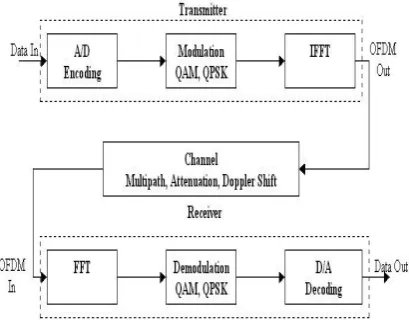
Figure 2.1: OFDM Block Diagram
Fig. 2.1 shows the setup for a basic OFDM
transmitter and receiver. The signal generated
is a base band, thus the signal is filtered, then
stepped up in frequency before transmitting
the signal. OFDM time domain waveforms are
chosen such that mutual orthogonality is
ensured even though sub-carrier spectra may
overlap. Typically QAM or Differential
Quadrature Phase Shift Keying (DQPSK)
modulation schemes are applied to the
individual sub carriers. To prevent ISI, the
individual blocks are separated by guard
intervals wherein the blocks are periodically
extended.
The Fast Fourier Transform (FFT) transforms
a cyclic time domain signal into its equivalent
frequency spectrum. This is done by finding
the equivalent waveform, generated by a sum
of orthogonal sinusoidal components. The
amplitude and phase of the sinusoidal
components represent the frequency spectrum
of the time domain signal.
However, OFDM is not without drawbacks.
peak-to-Available online: https://edupediapublications.org/journals/index.php/IJR/ P a g e | 486
average power ratio (PAPR). High PAPR
increases the complexity of analog-to-digital
(A/D) and digital-to-analog (D/A) converters,
and lowers the efficiency of power amplifiers.
Over the past decade various PAPR reduction
techniques have been proposed, such as block
coding, selective mapping (SLM) and tone
reservation, just to name a few . Among all
these techniques the simplest solution is to clip
the transmitted signal when its amplitude
exceeds a desired threshold. Clipping is a
highly nonlinear process, however. It produces
significant out-of-band interference (OBI).
A good remedy for the OBI is the so-called
companding. The technique ‘soft’ compresses, rather than ‘hard’ clips, the signal peak and
causes far less OBI. The method was first
proposed in, which employed the classical 𝜇
-law transform and showed to be rather
effective. Since then many different
companding transforms with better
performances have been published. This paper
proposes and evaluates a new companding
algorithm. The algorithm uses the special airy
function and is able to offer an improved bit
error rate (BER) and minimized OBI while
reducing PAPR effectively. The paper is
organized as follows. In the next section the
PAPR problem in OFDM is briefly reviewed.
III. METHODOLOGY
In previous works use of Discrete Fourier
Transform was proposed for the
implementation of OFDM. Wavelet transform
show the potential to replace the DFT in
OFDM. Wavelet transform is a tool for
analysis of the signal in time and frequency
domain jointly. It is a multi resolution analysis
mechanism where input signal is decomposed
into different frequency components for the
analysis with particular resolution matching to
scale . Using any particular type of wavelet
filter the system can be designed according to
the need and also the multi resolution signal
can be generated by the use of wavelets. By
the use of varying wavelet filter, one can
design waveforms with selectable
time/frequency partitioning for multi user
application. Wavelets possess better
orthogonality and have localization both in
time and frequency domain. Because of good
orthogonality wavelets are capable of reducing
the power of the ISI and ICI, which results
from loss of orthogonality.
To reduce ISI and ICI in conventional OFDM
system use of cyclic prefix is there, which uses
20% of available bandwidth, so results in
bandwidth inefficiency but this cyclic prefix is
not required in wavelet based OFDM system.
Complexity can also be reduced by using
wavelet transform as compared with the
Fourier transform because in wavelet
complexity is O[N] as compared with
complexity of Fourier transform of O[N
log2N]. Wavelet based OFDM is simple and
the DFT based OFDM is complex. Wavelet
based OFDM is flexible as well and because
better orthogonality is provided by it, there is
no any need of cyclic prefixing in wavelet
based OFDM, which is required in DFT based
Available online: https://edupediapublications.org/journals/index.php/IJR/ P a g e | 487
based system is more bandwidth efficient as
compared with the DFT based OFDM. In
discrete wavelet transform (DWT), input
signal presented will pass through several
different filters and will be decomposed into
low pass and high pass bands through the
filters. During decomposition the high pass
filter will remove the frequencies below half
of the highest frequency and low pass filter
will remove frequencies that are above half of
the highest frequency.
The decomposition halves the time resolution
because half of the samples are used to
characterize the signal similarly frequency
resolution will be doubled and this
decomposition process will be repeated again
for obtaining the wavelet coefficients of
required level. Two types of coefficients are
obtained through processing, first ones are
called detailed coefficients obtained through
high pass filter and second ones are called
coarse approximations obtained through low
pass filter related with scaling process. After
passing the data through filters the decimation
process will be performed. The whole
procedure will continue until the required level
is obtained. This decomposition can be given
as where x[n] is the original signal, g[n] is
impulse response of half-band high pass filter
and h[n] is impulse response of half-band low
pass filter. yhigh [k] and ylow [k] are obtained
after filtering and decimation by a factor of 2.
In inverse discrete wavelet transform (IDWT),
the reverse process of decomposition is
performed, so here firstly up sampling is done
then the signal is passed through the filters.
The data obtained after filtering is combined to
obtain reconstructed data. Number of levels
during reconstruction will be same as that of
the decomposition.
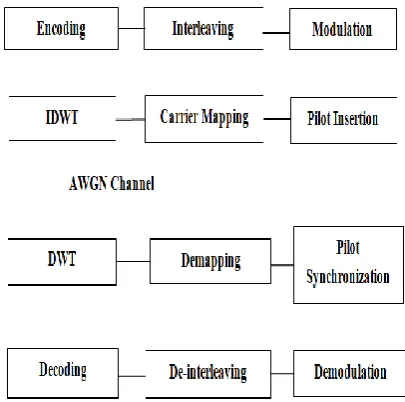
Fig. 3.1: Wavelet Based Proposed OFDM
System Design
In this proposed model we are using IDWT
and DWT at the place of IDFT and DFT.
AWGN channel is used for transmission and
cyclic prefixing is not used. Here first of all
conventional encoding is done followed by
interleaving then data is converted to decimal
form and modulation is done next. After
modulation the pilot insertion and sub carrier
mapping is done then comes the IDWT of the
data, which provides the orthogonality to the
subcarriers. IDWT will convert time domain
signal to the frequency domain. After passing
through the channel on the signal DWT will be
Available online: https://edupediapublications.org/journals/index.php/IJR/ P a g e | 488
where the inserted pilots at the transmitter are
removed then the demodulation is done.
Demodulated data is converted to binary form
and the de-interleaved and decoded to obtain
the original data transmitted.
A. BER Performance Evaluation:
By using MATLAB performance
characteristic of DFT based OFDM and
wavelet based OFDM are obtained for
different modulations that are used for the
LTE, as shown in figures 3-5. Modulations
that could be used for LTE are QPSK, 16
QAM and 64 QAM (Uplink and downlink).
QPSK does not carry data at very high speed.
When signal to noise ratio is of good quality
then only higher modulation techniques can be
used. Lower forms of modulation (QPSK)
does not require high signal to noise ratio.
Fig. 3.2: BER Performance of Wavelets and
DFT Based OFDM System Using QPSK
Modulation.
For the purpose of simulation, signal to noise
ratio (SNR) of different values are introduced
through AWGN channel. Data of 9600 bits is
sent in the form of 100 symbols, so one
symbol is of 96 bits. Averaging for a particular
value of SNR for all the symbols is done and
BER is obtained and same process is repeated
for all the values of SNR and final BERs are
obtained. Firstly the performance of DFT
based OFDM and wavelet based OFDM are
obtained for different modulation techniques.
Different wavelet types daubechies2 and haar
is used in Wavelet based OFDM for QPSK,
16-QAM, 64-QAM, It is clear from the figure,
that the BER performance of wavelet based
OFDM is better than the DFT based OFDM.
IV.RESULTS AND DISCUSSION
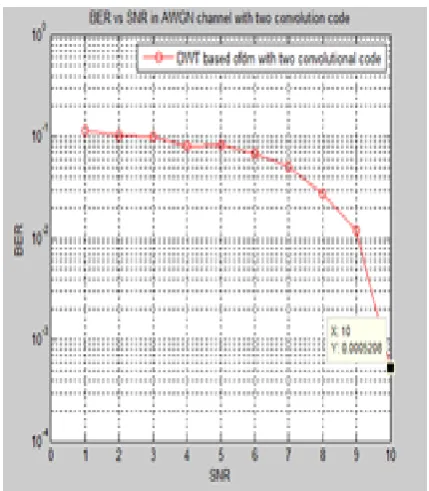
Proposed Convolutional encoder model. The
last results give an enhancement in the wavelet
based OFDM system performance than FFT.
Available online: https://edupediapublications.org/journals/index.php/IJR/ P a g e | 489
The BER value can be reduced when using the
Haar function and the convolution encoder.
The BER value in the proposed model is low.
The proposed model decreases the value of
BER for the same S/N ratio used. When
increase the number of stages of the proposed
model lead to reducing the BER but increase
the complexity and cost. The value of BER
with one stage convolutional encoder can be
obtained for two stage convolutional encoder
at nearly 6.5 dB to save more than 3.5 dB
which save the system power.
V. CONCLUSION
In this paper we analyzed the performance of
wavelet based OFDM system and compared it
with the performance of DFT based OFDM
system. From the performance curve we have
observed that the BER curves obtained from
wavelet based OFDM are better than that of
DFT based OFDM. We used three modulation
techniques for implementation that are QPSK,
16 QAM and 64 QAM, which are used in
LTE. In wavelet based OFDM different types
of filters can be used with the help of different
wavelets available. We have used daubechies2
and haar wavelets, both provide their best
performances at different intervals of SNR.
REFERENCE
[1]. A. Ian F., G. David M., R. Elias Chavarria,
“The evolution to 4Gcellular systems: LTE-advanced”, Physical communication, Elsevier,
vol. 3, no. 4, pp. 217-244, Dec. 2010
[2]. B. John A. C., “Multicarrier modulation
for data transmission: an idea whose time has
come”, IEEE Communications magazine, vol.
28, no.5, pp. 5-14, May 1990.
[3]. L. Jun, T. Tjeng Thiang, F. Adachi, H.
Cheng Li, “BER performance of
OFDM-MDPSK system in frequency selective rician
fading and diversity reception” IEEE
Transactions on Vehicular Technology, vol.49,
no. 4, pp. 1216-1225, July 2000.
[4]. K. Abbas Hasan, M. Waleed A., N.
Saad,“The performance of multiwavelets
based OFDM system under different channel
conditions”, Digital signal processing,
Elsevier, vol. 20, no. 2, pp. 472-482, March
2010.
[5]. K. Volkan, K. Oguz, “Alamouti coded
wavelet based OFDM for multipath fading
channels”, IEEE Wireless telecommunications
symposium, pp.1-5, April 2009.
[6]. G. Mahesh Kumar, S. Tiwari,
“Performance evaluation of conventional and wavelet based OFDM system”, International
journal of electronics and communications,
Elsevier, vol. 67, no. 4, pp. 348-354, April
2013.
[7]. J. Antony, M. Petri, “Wavelet packet modulation for wireless communication”,
Wireless communication & mobile computing
journal, vol. 5, no. 2, pp. 1-18, March 2005.
[8]. L. Madan Kumar, N. Homayoun, “A
review of wavelets for digital wireless
communication”, Wireless personal
Available online: https://edupediapublications.org/journals/index.php/IJR/ P a g e | 490
Plenum publishers, vol. 37, no. 3-4, pp.
387-420,May 2006.
[9]. L. Alan, “Wavelet packet modulation for orthogonally multiplexed communication”,
IEEE transaction on signal processing, vol. 45,
no. 5,pp. 1336-1339, May 1997.
[10]. K. Werner, P. Gotz, U. Jorn, Z Georg, “A comparison of various MCM schemes”, 5th
International OFDM-workshop, Hamburg,
Germany, pp.20-1 – 20-5, July 2000.
[11]. IEEE std., IEEE proposal for 802.16.3,
RM wavelet based (WOFDM), PHY proposal
for 802.16.3, Rainmaker technologies, 2001.
[12]. O. Eiji, I Yasunori, I Tetsushi,
“Multimode transmission using wavelet packet modulation and OFDM”, IEEE vehicular
technology conference, vol. 3, pp. 1458-1462,
Oct. 2003.
[13]. L. Louis, P. Michael, “The principle of
OFDM” RF signal processing,
http://www.rfdesign.com, pp. 30-48, Jan 2001.
[14]. “LTE in a nutshell: The physical layer”,
white paper, 2010,http://www.tsiwireless.com.
[15]. R. Mika, T. Olav, “LTE, the radio technology path toward 4G”,Computer
communications, Elsevier, vol. 33, no. 16, pp.
1894-1906,Oct. 2010.
[16]. Broughton SA, Bryan K. Discrete
Fourier analysis and wavelets. New Jersey,
John Wiley, 2009.
[17]. C. See Jung, L. Moon Ho, P. Ju Yong,
“A high speed VLSI architecture of discrete
wavelet transform for MPEG-4”, IEEE
transaction consumer electron, vol. 43, no. 3,