Western University Western University
Scholarship@Western
Scholarship@Western
Electronic Thesis and Dissertation Repository
12-10-2018 10:30 AM
Objective Assessment of Machine Learning Algorithms for
Objective Assessment of Machine Learning Algorithms for
Speech Enhancement in Hearing Aids
Speech Enhancement in Hearing Aids
Krishnan Parameswaran The University of Western Ontario
Supervisor Parsa Vijay
The University of Western Ontario
Graduate Program in Electrical and Computer Engineering
A thesis submitted in partial fulfillment of the requirements for the degree in Master of Engineering Science
© Krishnan Parameswaran 2018
Follow this and additional works at: https://ir.lib.uwo.ca/etd
Part of the Signal Processing Commons
Recommended Citation Recommended Citation
Parameswaran, Krishnan, "Objective Assessment of Machine Learning Algorithms for Speech Enhancement in Hearing Aids" (2018). Electronic Thesis and Dissertation Repository. 5904.
https://ir.lib.uwo.ca/etd/5904
This Dissertation/Thesis is brought to you for free and open access by Scholarship@Western. It has been accepted for inclusion in Electronic Thesis and Dissertation Repository by an authorized administrator of
ii
Abstract
Speech enhancement in assistive hearing devices has been an area of research for many
decades. Noise reduction is particularly challenging because of the wide variety of noise sources
and the non-stationarity of speech and noise. Digital signal processing (DSP) algorithms deployed
in modern hearing aids for noise reduction rely on certain assumptions on the statistical properties
of undesired signals. This could be disadvantageous in accurate estimation of different noise types,
which subsequently leads to suboptimal noise reduction. In this research, a relatively unexplored
technique based on deep learning, i.e. Recurrent Neural Network (RNN), is used to perform noise
reduction and dereverberation for assisting hearing-impaired listeners. For noise reduction, the
performance of the deep learning model was evaluated objectively and compared with that of open
Master Hearing Aid (openMHA), a conventional signal processing based framework, and a Deep
Neural Network (DNN) based model. It was found that the RNN model can suppress noise and
improve speech understanding better than the conventional hearing aid noise reduction algorithm
and the DNN model. The same RNN model was shown to reduce reverberation components with
proper training. A real-time implementation of the deep learning model is also discussed.
Keywords
Machine learning, Deep learning, Digital signal processing, Hearing aid, Recurrent Neural
iii
Acknowledgments
I would like to thank my supervisor, Associate Professor, Dr. Vijay Parsa, Principal
Investigator, National Centre for Audiology, for guiding me through my research work during the
last two years. I would also like to thank the faculty members of National Centre for Audiology
for their direct/indirect support during my research. I shall extend my gratitude to Ontario
Research Fund group which offered financial support for the project.
I take this opportunity to thank my peers and friends who supported me and motivated me
throughout my research period. Lastly, I express my indebtedness to my family members for
iv
Table of Contents
Abstract……….. ii
Acknowledgments………... iii
Table of Contents………... iv
List of Tables………. vii
List of Figures………..…. viii
List of Acronyms………..……… vii i Chapter 1……… 1
1 Introduction………... 1
1.1 Background……….. 1
1.2 Brief history of hearing aids……….…………... 2
1.3 Signal processing in hearing aids……….……… 4
1.4 Introduction to machine learning……….……… 5
1.5 Problem statement and contributions………... 6
1.6 Thesis outline……….……. 6
Chapter 2……….. . 7
2 Conventional signal processing algorithms………. 7
2.1 Digital Signal Processing over the years……….……… 7
2.2 Signal Processing in hearing aids……...……….……… 8
2.3 Audibility………. 10
2.4 Sound cleaning………. 11
v
3 Machine learning in hearing aids………….………18
3.1 Types of machine learning……….………18
3.2 Artificial Neural Networks (ANNs)……….……… 19
3.2.1 Activation function……….……… 20
3.2.2 Feedforward neural network……….. 21
3.3Learning process in neural networks……….... 22
3.3.1 Forward propagation……….. 22
3.3.2 Back propagation………....………… 23
3.4Regularization………... 24
3.5 Recurrent Neural Network……… 25
3.5.1 Back propagation through time……….. 26
3.5.2 Vanishing gradient problem………... 27
3.5.3 Long Short-Term memory………. 28
3.5.4 Gated Recurrent Unit………. 31
Chapter 4………. 32
4 Implementation ……….. 32
4.1 Feature extraction……….. 33
4.2 Neural Network architecture………. 36
4.3 Training………....………. 37
4.31. Loss function……… 38
4.3.2 Optimization………. 38
4.4 Database………. 40
4.5 Pretrained RNN model………... 41
4.6 Evaluation metrics……….. 42
4.6.1 Short-Time Objective Intelligibility (STOI) measure………... 42
4.6.2 Hearing Aid Speech Perception Index (HASPI)………... 44
4.6.3 Hearing Aid Speech Quality Index (HASQI)………... 46
vi
4.7.1 Band energy………. 48
4.7.2 Band correlation……….. 49
4.7.3 Interpolated band gain………. 49
Chapter 5………... 51
5 Experimental results………... 51
5.1 Open Master Hearing Aid………... 51
5.2 DNN-based speech enhancement………... 54
5.3 Bark filter bank-based speech enhancement……… 56
5.3.1 Scaling of input waveforms……… 57
5.3.2 Different SNRs………57
5.3.3 Acoustic context………... 58
5.3.4 Final configuration………... 59
5.4 Dereverberation………...………. 61
5.4.1 Convolution and addition……… 63
5.4.2 Acoustic context………... 64
5.4.3 Comparison of results……….... 65
5.5 Portable implementation………...………… 67
Chapter 6……….... 68
6 Conclusion………. 68
6.1Summary………... 68
6.2 Future work………... 69
References……….. 70
vii
List of Tables
Table 4.1: Gammatone frequencies………. 48
Table 5.1: Intelligibility (HASPI) index values - Speech with noise for different
models………. 59
Table 5.2: Quality (HASPI) index values - Speech with noise for different models…….. 60
Table 5.3: Intelligibility (HASPI) index values - Speech with reverberation for different
models………. 65
Table 5.4: Quality (HASQI) index values - Speech with reverberation for different
viii
List of Figures
Figure 2.1: Signal Processing in hearing aids……….. 8
Figure 2.2: A comparison of performance of different spectral subtraction methods……. 14
Figure 3.1: Artificial neuron……… 20
Figure 3.2: a) sigmoid activation b) ReLU activation function………20
Figure 3.3: Multilayer Perceptron (MLP)……… 22
Figure 3.4: Recurrent Neural Network……… 26
Figure 3.5: RNN unrolled in time……… 27
Figure 3.6: Mathematical model of RNNs……….. 29
Figure 3.7: Mathematical model of LSTMs……… 30
Figure 3.8: Operations………. 30
Figure 3.9: Gated Recurrent Unit……… 31
Figure 4.1: Noise reduction scheme……… 32
Figure 4.2: Speech enhancement using RNN model………34
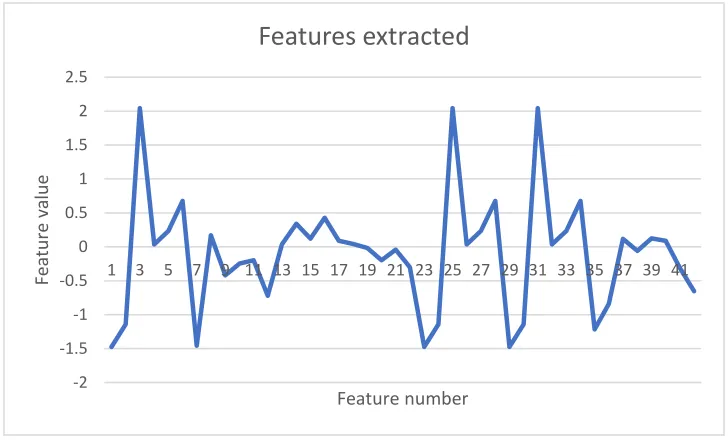
Figure 4.3: Features from an audio frame………35
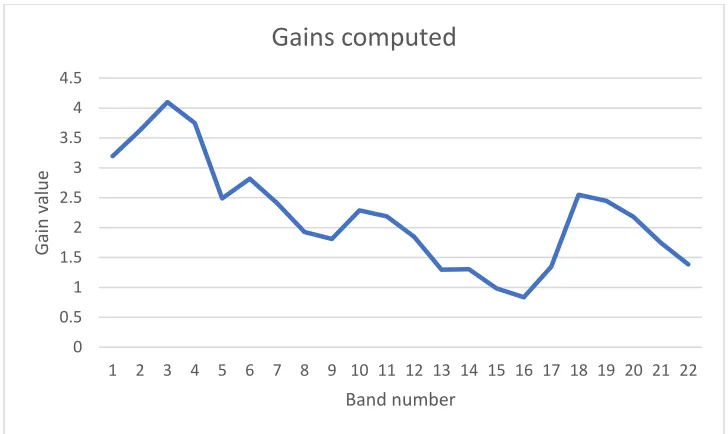
Figure 4.4: Gains computed for an audio frame during Bark frequency analysis…………35
Figure 4.5: RNN model………37
ix
Figure 4.7: Spectogram……… 41
Figure 4.8: STOI model……….. 43
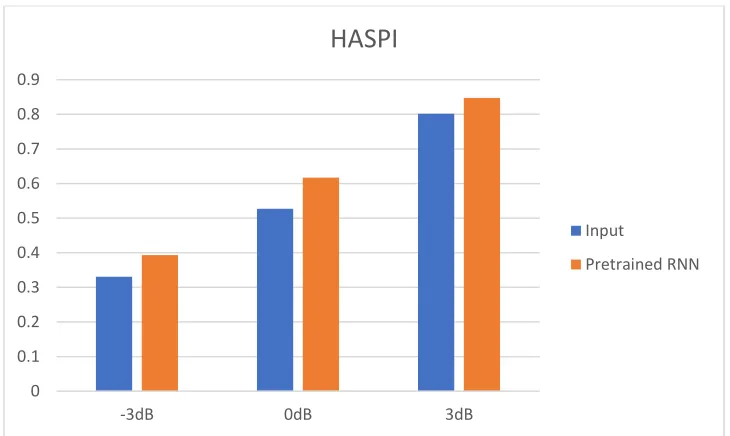
Figure 4.9: Comparison of STOI values between noisy speech and the output of pretrained RNN model at SNRs -3dB, 0dB and 3dB……… 43
Figure 4.10:HASPI model………44
Figure 4.11: Comparison of HASPI values between noisy speech and the output of pretrained RNN model at SNRs -3dB, 0dB and 3dB………. 45
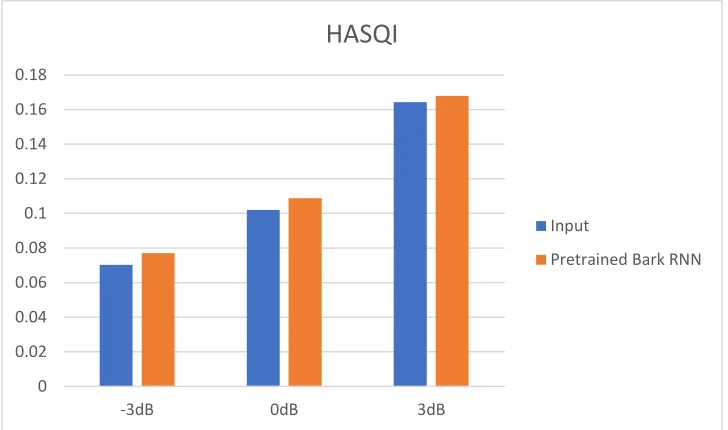
Figure 4.12: Comparison of HASPI values between noisy speech and the output of pretrained RNN model at SNRs -3dB, 0dB and 3dB……… 47
Figure 4.13: Comparison of HASPI values between input and output of RNN trained with Gammatone features at SNRs -3dB, 0dB and 3dB……… 50
Figure 5.1: OpenMHA framework………. 51
Figure 5.2: Waveform representation of a) Input noisy speech b) Output of pretrained RNN c) Output of MHANR algorithm……… 53
Figure 5.3: HASPI comparison between pretrained RNN and MHANR……….. 54
Figure 5.4: Speech enhancement by DNN model………. 55
Figure 5.5: Waveform representation of a) input noisy speech b) output of pretrained RNN model c) output of RBM-based DNN model………. 55
Figure 5.6: HASPI comparison between pretrained RNN and DNN models………56
Figure 5.7: HASPI values for different scaling configurations………. 57
Figure 5.8: HASPI values for different SNR configurations………. 58
x
Figure 5.10: Graphical representation of HASPI values - Speech with multitalker
babble for different models……….59
Figure 5.11: Graphical representation of HASQI values - Speech with multitalker
babble for different models……… 60
Figure 5.12: Spectrogram of a) Noisy input at 0dB SNR, b) Output from pretrained
RNN model, c) OpenMHA output RBM model output, e) Output from
trained GT RNN model and f) Output from trained Bark RNN model………61
Figure 5.13: Measurement of room impulse response calculation……….. 62
Figure 5.14: a) Speech with impulse response of Aula Carolina b) Speech with lecture
c) Speech with booth d) Speech with office………62
Figure 5.15: HASQI values with different methods for convolution……….. 62
Figure 5.16: HASQI values for different window size……… 63
Figure 5.17: Graphical representation of HASPI values - Speech with reverberation
for different models………. 64
Figure 5.18: a) Input reverberating (office) speech, b) Output of pretrained,
RNN model c) Output of RNN model trained with noise, d) Output of
RNN model trained with reverberated speech……… 65
Figure 5.19: Graphical representation of HASQI values - Speech with reverberation
xi
List of Acronyms
HA Hearing Aid
DSP Digital Signal Processing
dB Decibels
SNR Signal to Noise Ratio
CMOS Complementary Metal Oxide Semiconductor
ML Machine Learning
RNN Recurrent Neural Network
VLSI Very Large Scale Integrated
ASIC Application Specific Integration Circuit
ADC Analog-to-Digital Converter
IIR Infinite Impulse Response
FIR Finite Impulse Response
FFT Fast Fourier Transform
IFFT Inverse Fast Fourier Transform
SPL Sound Pressure Level
ILD Interaural Level Difference
BTE Behind-The-Ear
BSS Basic Spectral Subtraction
SOS Spectral Over Subtraction
NSS Non-Linear Spectral Subtraction
MBSS Multi-Band Spectral Subtraction
WF Weiner Filter
WGN White Gaussian Noise
PSD Power Spectral Density
ISS Iterative Spectral Subtraction
SSPP Spectral Subtraction Based on Perceptual Properties
DNR Digital Noise Reduction
DNN Deep Neural Network
xii
ANN Artificial Neural Network
ReLU Rectified Linear Unit
DAG Directed Acyclic Graph
MLP Multi-Layer Perception
MSE Mean Squared Error
MAE Mean Absolute Error
BP Back Propagation
BPTT Back Propagation Through Time
LSTM Long Short-Term Memory
GRU Gated Recurrent Unit
VAD Voice Activity Detector
DCT Discrete Cosine Transform
BFCC Bark Frequency Cepstral Coefficients
HINT Hearing In Noise Test
STOI Short-Time Objective Intelligibility
OIM Objective Intelligibility Measure
AI Articulation Index
SII Speech Intelligibility Index
STI Speech Transmission Index
CSII Coherence-Based Speech Intelligibility Index
ITFS Ideal Time Frequency Segregation
TF Time Frequency
DFT Discrete Fourier Transform
HASPI Hearing Aid Speech Perception Index
TFS Temporal Fine Structure
IBM Ideal Binary Mask
OHC Outer Hair Cell
IHC Inner Hair Cell
MFCC Mel-Frequency Cepstral Coefficients
BM Basilar Membrane
xiii
CC Cepstral Correlation
GT Gammatone
ERB Equivalent Rectangular Bandwidth
MHA Master Hearing Aid
LPC Linear Predictive Coding
NLMS Normalised Least Mean Squared
MHANR Master Hearing Aid Noise Reduction
CLA Command line Application
IO Input-Output
JACK Jack Audio Connection Kit
TCP/IP Transmission Control Protocol/Internet Protocol
SCNR Single Channel Noise Reduction
RBM Restricted Boltzmann Machine
CD Contrastive Divergence
MMSE Minimum Mean Squared Error
AIR Aachen Impulse Response
OS Operating System
1
Chapter 1
1. Introduction
This chapter deals with the background, a brief history of hearing aids (HAs), conventional
signal processingalgorithms in hearing aids, machine learning in hearing aids and thesis outline.
1.1 Background
Individuals who are unable to listen clearly like those with normal hearing ability i.e.
hearing thresholds (sound level below which a person’s ear is unable to detect any sound) of 25
dB (decibels) or better in both the ears are known to be suffering from hearing impairment [1]. In
other terms, hearing loss is characterized by an increase in hearing, threshold for a sound
frequency. It implies that the hearing sensitivity decreases, eventually, making it difficult for the
listener to detect soft sounds. The magnitude of hearing loss can range from mild to moderate,
severe, or profound, affecting either a single ear or both the ears thereby making it difficult to hear
conversational speech or loud sounds. The reasons for loss of hearing or deafness may be
congenital or acquired.
Statistics reveal that approximately 466 million individuals around the world have
problems of disabling healing loss of which 34 million are reported to be children. Disabling
hearing loss indicates hearing loss greater than 40 decibels (dB) in the better hearing ear in adults
and a hearing loss greater than 30 dB in the better hearing ear in children. Studies reveal that by
the year 2050 roughly nine hundred million individuals (one in every ten people) are likely to
suffer from disabling hearing loss [1].
The exposure of the younger generation aged between 12 and 35 years, to loud noise in
recreational settings have posed a risk of hearing loss to about 1.1 billion people in this cohort.
The annual world-wide cost of unaddressed hearing impairment is estimated to be US$750 billion
[1]. Preventing, identifying and addressing hearing impairment issues are cost-effective, bring
huge benefit to people. Majority of these hearing-impaired people require custom assistive hearing
devices.
The intelligibility of human speech is quite significant in hearing and communication. It is
2
characteristics, conditions in communication and capacity of information as well as the ability to
gather information from a specific context, mimics and gesture determine the quality and
intelligibility of speech [2]. Intelligibility can be better understood by discussing the distinction
between real and recorded speech. In a real conversation, individuals will be able to
identify/distinguish the sounds in the background and focus on the speech of the person
conversing, thus filtering the desired information from the audio environment. This helps to
significantly increase the speech intelligibility and comprehension although the communication
may happen in a noisy environment [2].
The environment in which speech signals are transmitted are typically noisy in real-time
situations. Persons with normal hearing may understand speech in a moderately noisy environment
since speech is an extremely redundant signal [3]. Therefore, even if part of the signal is masked
by noise, the unmasked part may still allow the speech segments to be intelligible for effective
communication. Comparatively, there is reduced redundancy in speech signal for individuals
suffering from hearing impairment because the either the speech is partially audible or is severely
distorted. Background noise that masks even a small portion of the remaining speech signal will
degrade intelligibility significantly. Thus, people with hearing loss have a greater difficulty in
understanding speech in a noisy environment than the people with normal hearing [3].
The noise potential for masking speech is expressed by the Signal-Noise Ratio (SNR)
which is the ratio of the power of speech signal to the power of noise, when both are presented
concurrently. Lower the value, bigger is the loss in understanding of speech for both normal
hearing and hearing impaired[4]. Consequently, as the SNR increases, the speech intelligibility
improves significantly.
1.2 A brief history of hearing aids
Hearing aids are small electronic devices that amplifies sound and makes it easier to
understand speech. They are designed in a way that they can capture sound waves using a very
small microphone, modify softer sounds into audible sounds, and finally pass the same to the ear
by means of a tiny speaker, enabling individuals with hearing disability to perceive sounds again,
and enhance their ability to hear. Thus, it can acquire, process and feedback acoustic signal in real
time in noisy conditions [2]. In the modern day, with the help of microchips, hearing aids are not
3
The invention of hearing aids is centred on no single person. Though there are no recorded
dates, it is believed that ear horns have existed in every civilization for thousands of years since
humans first created carved objects. Giovanni Battista Porta was most likely the first to describe
ear trumpet, a metal version of the ear horn, around 1588 [5]. The 17th century saw the growth of
speaking tubes as assistive hearing devices until pre-electric horns and trumpets became popular.
In the 1800s the introduction of decorative and functional hearing aids which could be
concealed and made less obvious, addressed the concerns regarding public perception about
hearing aids [5]. Finally, in the nineteenth century the idea of electrically-powered hearing aid
instruments was introduced which consisted a battery box, earpiece and microphone, made of
carbon dust which was to be refined later.
The first electronic hearing aids were devised after the invention of the telephone (the
technology within which increased how acoustic signal could be altered) and microphone in the
1870s and 1880s. In 1898 Miller Reese Hutchison created the first electric hearing aid and named
it Akouphone [6]. The use of carbon transmitter assisted in amplifying the sound by taking a weak
signal and making the same stronger with the help of electric current.
The invention of microprocessor led to the miniaturization of hearing aids. In 1987, the
first commercial digital hearing aids was invented. Until then, the hearing aids were analog in
nature. In analog hearing aids, incoming noise are dealt with by taking electrical sound waves
emerging from the microphone, amplifying the same ‘as is’ and transmitting it to the ear while
digital hearing aids transforms soundwaves from a microphone into digital binary code which is
in turn altered by a microchip within the hearing aids prior to transforming back into analog signals
and delivering to the speaker [7].
The functionalities of both analog and digital hearing aids are basically similar i.e taking
sounds to amplify them so that they can assist with better hear. Both analog and digital hearing
aids are programmable, whereby the microchips within can be customised to improve the sound
quality and matched with the individual user. At the same time, they can be customised to develop
4
quiet environment and can be readjusted while in a noisy restaurant and further readjusted in large
auditoriums.
Compared to analog hearing aids, digital hearing aids contain additional features and
flexibility which are perceived to be user-configurable as it has the ability to modify sound in
digital form. For example, digital hearing devices offer numerous channels and memories,
providing advantage of being able to save more location-specific profiles. Additionally, digital
hearing aids possess the capability to decrease surrounding noise automatically, eliminate
feedback or whistling, or the capability to favour human voices over any other noise.
1.3 Signal processing in hearing aids
Digital Signal Processing (DSP) is a relatively recent technique that involves the sampling
of an analog signal and the processing of these samples in digital form. This processing can be
accomplished using standard digital integrated circuit technologies such as complimentary metal
oxide semiconductor (CMOS), which is space and energy efficient. The digital processing of
speech is a mature technology and a wide range of algorithms is available for filtering,
compression, noise reduction, dereverberation, feedback reduction and special effects as well as
coding for bandwidth reduction. Many of these techniques would prove beneficial to the hearing
impaired if tailored correctly to their needs and implemented in a hearing aid [8].
Signal processing research on digital hearing aids encompasses signal acquisition,
amplification, transmission, measurement, filtering, parameter estimation, separation, detection,
enhancement, modeling, and classification [9]. They can be broadly categorised into four areas.
The first area adopts advanced signal processing methods to characterize and compensate for
hearing loss like loudness and frequency selectivity loss. The second area focuses on effective
target signal improvement and reducing noise, including adaptive microphone array technologies,
spectral subtraction algorithms, and blind source separation methods. The third area consists of
practical usage of hearing aids to address problems like flexibility, convenience, feedback
cancellation, and artifact reduction. Finally, the fourth area concentrates on developing hearing aid
technology into devices, the functions of which can also be used for hand phones and music players
[9]. Here the focus is mainly placed on problems like echo cancellation, bone conductive
5
necessities, computational speed, consumption of power and other pragmatic issues, the
advancement and application of signal processing methods in digital hearing aids have faced
numerous challenges in the last decade [9].
1.4 Introduction to machine learning
Machine learning is a technique of analysing data, which helps to automate building of
analytical models. It is that branch of artificial intelligence, which adopts the idea that data can be
learnt effectively from the systems, patterns can be identified, and decisions can be made with
little human involvement. This field of computer science uses statistical methods and provides
computer systems a learning ability to improve performance, gradually on specific tasks, either
with or without explicitly programming the data.
Machine learning has applications in various areas such as image recognition (face
detection and recognition in Facebook), speech recognition (as in Siri in Apple phones and Alexa
for home automation), medical diagnosis (prediction of disease progression), product
recommendation (as in Amazon, Netflix or Youtube websites), basket analysis (learning
association between products people buy), classification and prediction of potential customer
behaviours in terms of loan repayment in banks, real-time information extraction from web pages,
data security (predicting which files are malware), fraud detection (in PayPal), traffic and route
recommendations (as in Google Maps) etc.
While implementing conventional signal processing algorithms in digital hearing aids, the
speech characteristics need to be learnt, analysed and then hard coded to segregate speech in audio
segments. Similarly, the types of noise and various environments that the hearing-impaired
listeners are subjected to, must be known during design to be able to program the noise
characteristics into the hearing aids. Recently, machine-learning approaches to enhancement of
speech have been promising in refining speech intelligibility for people with hearing impairment.
A machine learning model understands the underlying details and learns to differentiate speech
from noise when trained with features of speech and noise separately. The recent researches also
indicate that deep learning can be used for automatic speech recognition where latency is not
important [18]. This project focuses on speech enhancement using a combination of signal
6
1.5 Problem statement and contributions
Conventional noise reduction techniques in modern hearing aids work well with stationary
noise. They may also provide improvement in SNR. However, the improvement in SNR does not
necessarily enhance speech intelligibility as per behavioural studies. The conventional
methodologies have limitations processing non-stationary noise. Recently, deep learning-based
models have been found to perform better than conventional algorithms for hearing aid
applications. This thesis focuses on training and implementation of a deep neural network for the
purposes of noise reduction and dereverberation, evaluation of its performance using objective
predictors of speech intelligibility and quality and real-time implementation of the algorithm in a
portable computing platform.
1.6 Thesis outline
This thesis is organized in chapters that discuss conventional signal processing algorithms
in a bit more detail (chapter 2), Machine Learning (ML) and its speech applications so far (chapter
3), the implementation of speech enhancement algorithm, database used to evaluate it, the
objective metric and comparison between Gammatone and Bark filters (chapter 4), results from
the objective assessment of pretrained and trained Bark RNN and their comparison with a couple
7
Chapter 2
2 Conventional signal processing algorithms
Signal processing in hearing aids has come a long way over the past few decades. This
chapter briefly discusses the advancement in digital signal processing (DSP) over the past few
decades, outlines the various DSP algorithms incorporated into hearing aids, and finally focuses
on the conventional noise reduction DSP algorithms and their effectiveness in enhancing speech
perception by hearing impaired listeners.
2.1 DSP over the years
The world is becoming more and more digital in our daily activities since the invention of
integrated circuits. Not only did the size of microelectronics shrink, but the computational power of the microelectronic systems doubled almost every two years. This follows the “Moore’s law of microelectronics” which led to a remarkable influence on the technology within hearing aids. An
all-digital hearing aid was reported to be developed in the 1980s [10]. Researchers created several
prototype hearing aids with the help of customised DSP chips using less power as well as very
large scale integrated (VLSI) chip technology. These hearing aids were put to use for research on
individuals with hearing-impairment. Now, most of the commercially available hearing aids are
digital. Modern hearing aids have become intelligent systems providing a wide variety of
algorithms for specific and diverse hearing and communication challenges of users in various
acoustic environments [10].
Numerous hearing aids, in the modern times, comprise application-specific integrated
circuits (ASICs) as well as reprogrammable DSP cores and microcontroller cores providing
advantages of flexible reuse of the microelectronics for different signal processing algorithms.
There has been significant improvement in the performance of digital hearing aids during the last
two decades [10]. The objectives of hearing aids have been upgraded to improve quality of sound
by reducing the artifacts and providing more natural sound output, in addition to improving speech
intelligibility. These requirements must be met in dynamically changing listening environments in
everyday life situations.
Newer DSP platforms provide computational abilities to implement advance functions like
8
where there has been a huge improvement is in systems integration [10]. Adaptive algorithms
could sometimes counteract each other, just like algorithms for noise-cancellation and acoustic
feedback controlling algorithms are likely to decrease gain and work in opposition to amplification
schemes. These effects are taken into consideration during design, implementation as well as in
choice of parameters for signal processing algorithms. A more detailed description of individual
DSP algorithms within hearing aids is given next.
2.2 Signal processing in hearing aids
The types of hearing loss are so diverse that each of them needs custom prescriptions. One
listener may need frequency-dependent gain, the other may need level-dependent and the third
listener may need a combination of both. Thus, technology in hearing aids must be flexible enough
to be able to meet revised requirements and digital hearing aid is the solution available today.
Figure 2.1 provides a framework of signal processing algorithms in digital hearing aids of modern
times. The signals from the environment that come to listener’s ear are picked up by one or more
omnidirectional microphones. These signals would be analog in nature. Hearing aids in the early
stages used to process analog signals only which means amplification of input in simple terms.
This may not help the hearing-impaired listeners much and in fact amplification could just cause
distress.
Figure 2.1: Signal processing in hearing aids Sound Pickup Sound cleaning wireless audio
FFT
IFFT Environment classification
Signal output output Acoustic Mechanic Electric IFFT Analysis filter bank Gain calculation (incl. amplitude compression) Synthesis filter bank Environment detection Adaptive beam former Pinna simulation MIC matching steering Noise reduction
• Stationary noise
• Impulsive noise
9
The analog signal (sound waves) is converted to electrical signal by the vibration of
diaphragm in microphones which is caused by the changes in air pressure. This electrical signal is
then sampled and digitized using an Analog-to-Digital Converter (ADC), which usually provides
a usable audio bandwidth of 8 to 16kHz. The resultant discrete time signal may be analyzed
spectrally either in frequency domain or in time domain depending on the signal processing
algorithm used in the device[10]. Either of the methods will involve trade-offs in time-frequency
resolution. The hearing devices these days are expected to have a delay no more than 10-12ms to avoid incongruity between the speaker’s lip movement, echo and the audio signal [10]. The
spectral resolution is dependent on frequencies with bandwidth proportional to center frequency.
The time domain analysis of speech signals can be done using a bank of infinite impulse
response (IIR) filters as: Signal from microphone → Filter bank (Combination of low pass, band
pass and high pass filters) → Sound cleaning → Loudness adjustment → Recombination of signals
into single output. Each of the filters in filter bank may allow or stop a specific range of frequencies
that form a band. The channel width increases with center frequency with more frequency
resolution at lower frequencies. IIR filters require much lesser computation to achieve desired filter
slopes when compared to FIR filters. However, a cautious design is required to evade the artifacts
that may be produced otherwise. It is recommended to process a block of samples instead of
processing each sample when it comes for computational efficiency [10].
The analysis in frequency domain is done by taking Fourier transform of the signal: Store
specific number of samples in a buffer → Multiply the values with a window function (to avoid
discontinuities at the edges) → Apply Fourier transform (FFT) → Sound cleaning → Loudness
adjustment → Inverse FFT → Output synthesis [10].
Hybrid analysis systems combine the time domain online processing with frequency
domain offline processing. The signal collected by microphone is processed first in time domain
up to sound cleaning, which is summed across channels before passing it on to the filter bank in
frequency domain. Such systems join lower quantization sound as well as the time domain filter
distortion with the higher frequency resolution of FFT systems. At the same time there is little
need to smoothen the gain across frequency or have large temporal overlap between consecutive
blocks. Time-frequency analysis schemes form the basis for different adaptive algorithms though
10
The signal processing algorithms are broadly classified into three types based on their
functionality:
1) Frequency and level-dependent gain application to provide a satisfactory volume for
the respective hearing profile (usually audiogram)
2) Sound cleaning by removal of stationary and non-stationary noises and reducing
acoustic feedback through the use of various algorithms for noise reduction.
3) Environment classification for automatic adjustment of hearing aid settings to choose
suitable signal processing algorithm for a given condition
No single algorithm may provide optimal performance in all these aspects. Though
different manufacturers may have or come up with entirely different signal processing strategies
and solutions the underlying class of these strategies remain same with premises and scope clearly
defined for each of these solutions.
2.3 Audibility
There are a couple of important strategies to restore audibility. Most people suffering from
sensorineural hearing impairment endure loudness recruitment, a phenomenon which causes the
loudness to grow rapidly for any sound above the absolute threshold. The gain should reduce when
input levels increase to compensate this effect, which means the input-output function is
compressive and the process by which we achieve it is called multichannel compression. For lower
inputs, up to about 40 dB SPL, the gain is kept constant. The applied gain decreases with further
increase up to 100 dB SPL which compensates loudness recruitment and the compression ratio is
made infinite beyond 100 dB SPL for limiting [10]. The compression algorithms can be
slow-acting (like in Adaptive Dynamic Range Optimization) based on input sound level which will help
maintain signals for localization of sound based on Interaural Level Differences (ILD) or
fast-acting which will have comparatively shorter attacks and release times and are able to make
loudness perception level closer to normal.
Many a times it is quite tough to restore audibility at high frequencies for individuals
suffering from extreme hearing loss. Applying gains at these frequencies could cause acoustic
feedback or loudness discomfort, especially when they have narrow dynamic range. Frequency
lowering is an alternative approach in such situations. This would be perceptually beneficial
11
into three categories: a) frequency transposition – a block of higher frequency component is shifted
downward to a frequency in destination band, b) frequency compression or frequency division –
frequency components up to a frequency stay unaffected and the components above are shifted
downward with a lower slope and c) spectral envelope warping - lowering of part of the spectral
envelope, keeping the spectral components unchanged.
2.4 Sound cleaning
It is important to note that restoring audibility alone will not suffice for speech perception
in acoustically challenging environments. It is indeed challenging for hearing-impaired people to
understand speech (intelligibility) in noisy environments. Though reducing noise may sound an
easier task, this has been a prime area of focus since the invention of digital hearing aids. There
are so very divergent types of speech and background noise to deal with. What makes it more
difficult is the constantly changing speech and noise in realistic sound scenarios. The target speech
differs due to the characteristics of speaker, vocal effort, distance and orientation of the speaker,
the amount of reverberation in the listening environment and the presence/absence of visual cues.
Due to this variability, a single algorithm for optimal noise reduction is not available.
The most successful approach for noise reduction uses directional microphone, that can
help when there is a spatial separation of target speech from source of the noise. Hearing aids using
this technique will have two omnidirectional microphones – one at the front and the other toward
the back side. The signal collected from one microphone is delayed and added with the other to
form a beam pattern. In this manner, the target signal from the beam’s direction will be captured
and others will be attenuated. The shape of beam pattern is constant in a static beamformer whereas
it dynamically adapts based on environment in an adaptive beamformer. When the direction of
highly interfering sound changes, the adaptive beamforming system shall adjust itself to maintain
the good suppression of the interference. The beamformer may be independently applied to various
frequency bands instead of the entire broadband signal.
Directional microphones provide 2-5 dB improvement in the threshold of speech reception
in realistic conditions [10]. Though use of these microphones is advantageous in many ways, these
may not help in understanding of speech coming from side or back like a vehicle coming from
12
microphones such as in the Behind-The-Ear (BTE) hearing aids, far from the pinna may also affect
their directivity.
Binaural beamformer is a technique combining the four microphones of two bilaterally
worn hearing aids that forms a four-microphone directional system. The outputs of two
microphones on both sides are initially combined before exchanging over a wireless link with the
hearing aid on the other side. Thus, the ipsilateral and contralateral signals in each hearing aid are
combined using a frequency dependent weighting function to create binaural directivity pattern,
which is narrower than the monoaural one. This static beamformer can be made adaptive by
combining the resulting signal in one hearing aid with the current spatiotemporal distribution of
undesired signals. Researches earlier have demonstrated the way this approach can enhance speech
intelligibility while reducing the effort made to hear.
The above two approaches assume that source of speech is directly at the front side of the
listener. However, this is not the case in many of the communication scenarios, just like the target
could be on the side while driving. A solution for such a situation is to pick up signal from the ear
that is ipsilateral (better ear) to the target and transmit the same to the contralateral side. This will
allow both the ears to receive a reasonably clean representation of the target.
In situations where speech and noise are spatially co-located, or in small-size custom
hearing aids which preclude the placement of two microphones due to size restrictions, additional
strategy is required for noise reduction. Single microphone noise canceling algorithms are such
strategies and represent one of the most widely used techniques in digital hearing aids today. It
works on the premise that speech signal has different temporal properties than that of the
interfering sounds and that low-rate temporal fluctuations are relatively scarce in case of the
background sounds. These temporal fluctuations in speech signal are used to estimate the SNR,
which is used in computationally efficient algorithms like spectral subtraction, harmonic
extraction, and Wiener filtering techniques to reduce interference. These algorithms are briefly
described next.
One of the initial noise reduction algorithms that was first proposed for single channel
speech improvement was spectral subtraction (BSS) [11]. It is a technique to restore power or the
magnitude spectrum observed signals in additive noise, by subtracting the estimated average noise
13
from the periods when there is no signal while the noise alone exists. In this manner, the estimation
of noise spectrum is made when there are pauses in speech and is deducted from the spectrum
when the speech is noisy. While doing so, an assumption is made that the noise is not correlated
with speech and that the noise is additive in nature. Many variants of spectral subtraction are
present, and the principle for all the variants is to estimate short time speech spectral magnitude
by deducting sound from noisy speech or by multiplying the noisy spectrum with gain functions
and combine with the phase of noisy speech.
Spectral over-subtraction (SOS) introduced two extra parameters such as over-subtraction
factor and noise spectral floor in basic spectral subtraction method to reduce remnant noise
(processing distortion), which is one of the two drawbacks of BSS, the other being narrow band
musical noise [11]. The over-subtraction factor restricts the quantum of noise power spectrum
subtracted from the noisy speech power spectrum in each frame. The spectral floor parameter helps
to dissuade the ensuing spectrum from dipping beyond a pre-determined minimum level instead
of setting to zero (spectral floor). This implementation considers that the speech spectrum is
affected by noise evenly and the subtraction factor subtracts an over-estimate of noise from noisy
spectrum. In order to draw a balance between the surrounding noise and remnant noise elimination,
numerous combinations of over-subtraction factor α, and spectral floor parameter β provides a
trade-off between the quantity of residual noise in the background and the extent of perceived
remnant noise. Because noise is perceived to influence speech spectrum equally and that the
over-subtraction feature is constant across frequencies, the enhanced speech may be distorted.
In reality, noise is colored and influences speech signal in a different way throughout the
spectrum and subtraction factor is expected to be frequency dependent to explain various types of
noise. The non-linear spectral subtraction (NSS) idea, extends this ability by forcing the
dependency of the over-subtraction factor frequency while the subtraction process remains
non-linear. Bigger values are deducted at frequencies with low SNR levels, and lesser values are
deducted at frequencies with high SNR levels giving better flexibility for compensation of errors
in the estimation of noise energy in various frequency bins [11].
Multi-band spectral subtraction (MBSS) groups frequencies into bands and multiple bands
14
random in nature, enhancement in MBSS algorithm is required for the reduction of WGN. The
MBSS algorithm usually performs better than other subtractive-type algorithms.
In a Wiener filter (WF) design it is assumed that speech and noise are not correlated [11].
They are considered to be in normal distribution and this filter aims to reduce the mean squared
error criterion. The gain function of WF is fixed at all frequencies and it requires power spectral
density (PSD) of clean signal and noise for filtering, which are the main drawbacks of WF. It is
not possible to apply non-causal WF directly in order to estimate clean speech since it is not
possible to assume that speech is stationary. An adaptive WF implementation decreases each
component of frequency by a certain amount that depends on the power of noise at that frequency.
The gain function in WF is calculated using power spectrum of noisy speech, rather than
clean speech which will degrade its accuracy. An iterative algorithm is used to solve this problem.
In the iterative spectral subtraction (ISS) algorithm, the improved speech output is taken to be the
input for following iteration and consequently for spectral subtraction, the remnant noise is
re-estimated in every iteration. Therefore, a larger number of iterations will provide a better enhanced
speech when compared to WF.
Figure 2.2: A comparison of performance of different spectral subtraction methods [11]
The use of fixed subtraction parameter is one of the major drawbacks of spectral
subtraction while the noise spectrum in real time is changing constantly. Although MBSS will
allow the adaptation of parameters, the remnant noise is not completely suppressed especially at
15
properties of spectral subtraction[11]. By incorporating the masking properties of human auditory
system into enhancement process, it is possible to attenuate components of noise that were
previously inaudible as a result of masking. Based on the masking properties, the subtraction
parameters are adapted in the algorithm. Through the calculation of noise masking threshold,
masking properties are modelled.
The spectral subtraction effectiveness is highly depending on estimation of accurate noise
that is mostly a tough task. Since the power spectrum and magnitude are non-negative variables,
the negative estimates of these variables, if any, must be mapped into a non-negative value. The
distribution of the restored signal is distorted by this nonlinear rectification method and the
distortion is more visible when the SNR reduces. Spectral subtraction that is based on perceptual
properties (SSPP) performs better in comparison to above discussed algorithms for speech
improvement. WF leads to reduced remnant noise, however, the structure of noise is musical and
speech regions, especially fricative consonants, are reduced. Such spectral subtraction can lead to
distortion of speech. Thus, using SSPP algorithm for enhanced speech is more pleasant reducing
the remnant noise with least speech distortion, if any. A comparison of various spectral subtraction
methods is demonstrated in figure 2.2, which indicates the advantage of SSPP algorithms[11].
It is important to note that difference exist among manufacturer-specific implementations
of the aforementioned spectral subtraction and Wiener filtering algorithms. Estimation of speech
and noise spectra and rules for engaging/disengaging noise are proprietary. As such, assessment
of noise reduction feature, either objectively or through subjective measurements, is of great
importance. Few studies have investigated the effectiveness of noise reduction algorithms as
implemented in commercial hearing with hearing impaired listeners. For example, Ricketts et al.
studied the effect of digital noise reduction (DNR) in hearing aids on speech recognition and
quality [12]. This subjective study with 14 adults wearing hearing aids presented that there is no
impact on speech understanding with the use of conventional noise reduction techniques although
there may be an improvement in speech quality. Another study by Bentler et al. showed that DNR
can improve listening comfort but has no effect on speech perception of even with visual cues [13].
Desjardins et al. found that speech recognition in noise score did not change much with noise
16
observed different perceptual effects among hearing aids and that none of the noise reduction
algorithms actually improved speech intelligibility while they may reduce annoyance of noise [15].
Single microphone noise canceling is usually effective for noise spectrum that hardly
changes over time and does not take into account the undesirable effects from an enclosed
environment [10]. In environments such as office, lecture rooms and big halls, the target speech
will have multiple paths from the source to listener. Apart from shortest direct path from source to
listener, the target signal could hit any part of the room (floor, ceilings or walls) and objects in the
room and reflect from them before it adds on to the direct path to listener. This process is called
reverberation and can cause severe impact on the ability to perceive speech. The performance of
beamformers depreciates when distance between target and listener increases and with increasing
reverberation. The reverberated speech can be represented as the convolution of original speech
and the impulse response of the environment. Dereverberation would need an algorithm to estimate
and segregate the parts of speech that are reflected off the objects in the reverberating environment
from the speech collected by the hearing aid.
Thus, dereverberation is a highly complex task in real-time due to its need to estimate the
constantly changing original speech target and the unknown impulse response of the room or hall.
The dereverberation approaches are generally very complicated to implement them in hearing aids
leading to time delays, which may not be acceptable for hearing aids. Lebart et al. [16] took a
simpler approach to this problem by estimating parts that are decaying over time and attenuating
them. This signal processing was done by converting the time-domain signal into frequency
domain and comparing the decay rate with respect to standard reverberation time. This method
definitely has shown improvement in quality of sound and hearing ease but does not enhance
speech intelligibility [17].
Signal processing algorithms provide a wide range of solutions to improve speech
intelligibility in adverse listening environments. However, there are limitations for every algorithm
based on environment in which it is assessed. The objective and subjective results may vary most
of the time because of the change in premises in realistic environments. Hence it is important to
specify the testing conditions and every result would be slightly or largely different from the other
17
To summarize, signal processing in hearing aids, the conventional signal processing
techniques to restore audibility and sound cleaning are discussed. Though there are many noise
reduction techniques available, the increase in SNR provided by these methods does not
necessarily improve speech intelligibility. The same is observed with dereverberation though there
are evidences of improvement in speech quality. Emerging evidence suggests that algorithms
incorporating machine learning are effective in enhancing speech understanding by
hearing-impaired listeners in noisy environments. Machine learning techniques are discussed in detail in
18
Chapter 3
3. Machine learning in hearing aids
Speech enhancement in noisy conditions has always been a challenging task for better
speech recognition and further processing, not just in hearing aids but also in all
telecommunication systems. The objective of speech enhancement is to reduce noise and to
increase intelligibility of the input noisy speech. However, the results using conventional signal
processing methodologies are not always satisfactory in terms of speech intelligibility and speech
quality, in adverse conditions. Hence there is always a need for better performing adaptive noise
reduction algorithms because of the non-stationarity of speech and noise signals.
Machine learning is that branch of artificial intelligence which has been recently found
useful in various speech recognition and natural language processing tasks. Specifically, deep
learning has the capability to learn complex patterns underlying speech data. Healy et al. used deep
neural network (DNN) to segregate speech from noise for hearing-impaired listeners [18]. This
work focused on ideal binary mask estimation with a classification approach using a Restricted
Boltzmann Machine (RBM). Chen et al. extended the work with ideal ratio mask estimation
instead using a deep neural network [19]. This chapter explains a bit about machine learning, deep
learning, artificial neural networks and their learning process.
3.1 Types of machine learning
ML algorithms are generally classified into three, based on the way the models learn.
1) Supervised learning - This algorithm includes a target or outcome variable (also known as
dependent variable) which will be predicted from a set of predictors (independent
variables). The algorithm attempts to model the relationship and dependencies between
the dependent and independent variable with the help of the given set of variables, in a way
that the output values for a new data set based on those relationship can be predicted This
training process goes on till the model is able to achieve the desired accuracy level on the
training data. Example: Regression and classification tasks
2) Unsupervised learning - In this algorithm, no target or outcome variable is available to
19
population in different groups generally uses unsupervised technique for segmenting
customers in different groups for specific intervention.
3) Semi-supervised learning – This method falls in between the above two. The cost of getting
labeled dataset is usually high and, in such situations, we obtain some labeled data along
with lots of unlabeled data for training.
4) Reinforcement learning - Here, the machine is exposed to an environment where it trains
itself repeatedly through trial and error and has to determine the ideal behaviour within the
given context to maximize performance. Q-learning, temporal difference and deep
adversarial networks are some of them.
ML can be further categorized into three based on the objective the model is trying to achieve.
1) Regression: For prediction of a continuous real number
2) Classification: For prediction of a discrete number
3) Clustering: For segmentation
Deep Learning (DL) uses different architectures of Artificial Neural Networks (ANNs) to learn
from data. These ANNs are a family of machine learning models that have taken inspiration from
human brain and the biological nervous system.
3.2 Artificial neural networks (ANNs)
An ANN is composed of neurons, which are the basic functional units inspired from
neurons in biological neural network. These neurons are interconnected to form a network of
neurons that takes in and processes a set of inputs to provide a set of outputs. The neurons (also
called as nodes) are organised in layers containing specific number of them in every layer and
connected with specific ones in another layer. Each of these connections (called edges) has a
weight that is multiplied with the conveyed value. Figure 3.1 illustrates a neuron for which 𝜃1,
𝜃2,…,𝜃N are the weights for incoming values with 𝜃0 and 1 being the weight and input representing
the bias to the neuron. The sum of weighted inputs to the neuron is passed to an activation function
that computes the output or activation of the neuron.
20
Figure 3.1: Artificial neuron
3.2.1 Activation function
An activation function is a function that transforms the input value to an output to
determine whether the neuron must be activated or not.
𝑦 = 𝑓(∑𝑁𝑖=1𝜃𝑖𝑥𝑖+ 𝜃0) (3.1)
𝑦 = 𝑓(𝜃𝑇𝑥) (3.2)
where, 𝜃 is the weight vector, x is the input vector and w0 is the bias
If 𝜇 = 𝜃𝑇𝑥, a sigmoid activation function would have the following representation:
𝑓(𝜇) = 1
1+𝑒−𝜇 (3.3)
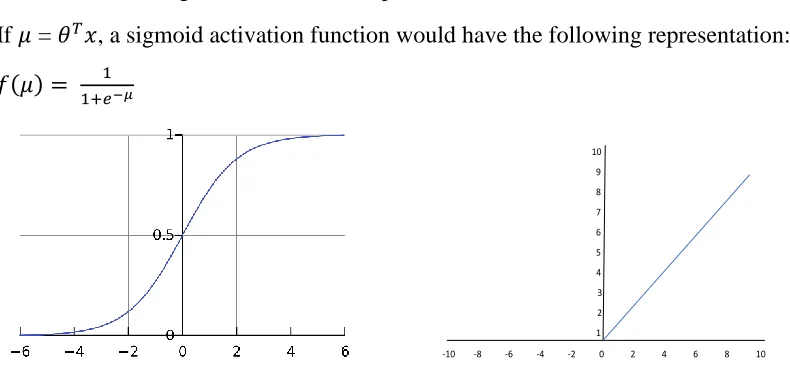
Figure 3.2 (from left to right) a) sigmoid activation [20] b) ReLU activation function
A Rectified Linear Unit activation (ReLU) function and a leaky ReLU are given by
𝑅𝑒𝐿𝑈: 𝑓(𝜇) = max(𝜇, 0) (3.4)
𝐿𝑒𝑎𝑘𝑦 𝑅𝑒𝐿𝑈: 𝑓(𝜇) = max(𝜇, 0) + 𝛼min (𝜇, 0) (3.5)
10 9 8 7 6 5 4 3 2 1
-10 -8 -6 -4 -2 0 2 4 6 8 10
𝑓(𝛴(∙)) 𝜃1
𝜃2
𝜃𝑁
𝑦 1
𝑥1
𝑥2
𝑥𝑁
21
The sigmoid activation function is linear when the weights are small and the corresponding
weighted sum is close to zero. However, it will turn non-linear as the weighted sum grows in both
the positive and negative directions as in figure 3.2a. This would result in neuron be considered on
or off as the weighted sum tends to infinity. The magnitude of bias value acts as the threshold
weighted sum that the inputs must provide to activate the neuron and contribute to output. Recent
years have seen the development of rectified non-linear activation functions like Rectified Linear
Unit (ReLU, figure 3.2b), which increases linearly for positive inputs and gives zero output for
any negative input. The drawback with ReLU is that it is not differentiable for negative inputs,
which provides no further learning. Leaky ReLU is a variant of ReLU that has a non-zero gradient
for any negative input, which is more popular for image classification tasks than conventional
ones.
Rectified non-linearity is observed to provide significant boost to the performance of object
recognition system as per [21]. [22] found that types of ReLU can provide a better model of
biological neurons than conventional hyperbolic tangent or sigmoid functions. [23] recommends
replacement of sigmoid with ReLU in feedforward neural networks.
3.2.2 Feedforward neural network
Feedforward neural networks are a subclass of ANNs in which the nodes are organised in
a directed acyclic graph (DAG) from input to output. A unique type of these networks is the
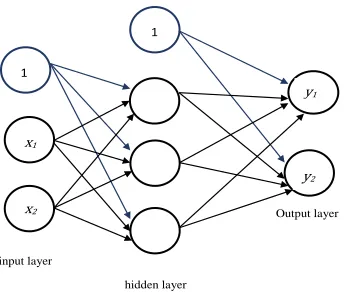
multilayer perceptron (MLP) as in figure 3.3. Here the nodes are arranged in layers where
connections are provided only between neighbouring layers. The features are fed in to the first
layer which is the input layer. The output is taken from the final layer of the network termed as the
output layer. The layers between input and output layers are termed as the hidden layers. The
number of layers is identified by counting the number of layers in the network and neglecting the
input layer since it does not perform any computations. By this convention, the network in figure
22
Figure 3.3: Multilayer Perceptron (MLP)
3.3 Learning process in neural networks
Multilayer perceptrons are usually trained in supervised manner using labeled data.
Problem identification is the first step in any machine learning task, followed by collecting data.
The training data is a collection of input-output pairs [{xk, yk}, k = 1 to m] where xk is feature set
of kth training example, yk is the corresponding label and m is the total number of examples.
3.3.1 Forward propagation
The inputs are multiplied with respective weights progressively layer after layer. The
output from final layer is the prediction by the network. A cost/loss function is defined to measure
the difference between actual (target) output and the output predicted by the network. The training
process calculates the loss value after every pass of specific number of examples specified by batch
size from input to output (forward propagation) and updates the parameters so as to minimize the
loss value [24]. For a 3-layer network (2 hidden layers and an output layer),
a(1) = x(i) (inputs)
z(2) = 𝜃(1) a(1)
a(2) = g (z(2)) (add a
0 (2)
)
z(3) = 𝜃(2) a(2)
a(3) = g(z(3)) (add a
0 (3)
)
z(4) = 𝜃(3) a(3)
a(4) = hѲ(x) = g (z(4)) (prediction)
Output layer input layer hidden layer 1 1 1 x2 x1 y1 y2
23 The (MSE) cost/loss function is defined as:
J(𝜃) = ∑𝑚 [ℎ𝜃(𝑥𝑖) – 𝑦(𝑖)]2
𝑖=1 (3.7)
A few widely used loss functions are mean squared error (MSE), sum of squared error (SSE) mean
absolute error (MAE) and cross entropy error. The objective of the network is to find the set of
weights or parameters that minimize the loss function:
𝑚𝑖𝑛
𝜃 J(𝜃) Need code to compute J(𝜃) , 𝜕 𝜕𝜃𝑖𝑗𝑙 J(𝜃)
The most critical part of training is the update of parameters which is done using backpropagation
in MLPs. The neural network is initialized with small weights and once the loss value is calculated,
the derivates of loss with respect to the weights of the networks are calculated and the resulting
value times learning rate (a factor that determines the rate of update of parameters) is subtracted
from the previous weights.
𝜃 : = 𝜃 - ∝ 𝜕
𝜕𝜃 J(𝜃) (3.8)
𝜃 is theweight vector,
∝ is thelearning rate and
𝜕
𝜕𝜃 J(𝜃) is the gradient vector
3.3.2 Backpropagation (BP)
BP uses a gradient based update rule and hence the cost and activations must be
differentiable. The differentiation of the objective cost function with respect to output will result
in an error term. Derivatives are calculated with respect to all output elements and these terms are
propagated backwards in the network using chain rule.
𝛿𝑗(𝑙) = error of node j in layer 𝑙
𝛿𝑗(4) = 𝑎𝑗(4)– y4 or 𝛿4 = a(4)– y
𝛿3 = (𝜃(3))T𝛿4 . ∗ g′(z(3)) a(3) . ∗ (1 – a(3)) 𝛿2 = (𝜃(2))T𝛿3 . ∗g′(z(2))
No (𝛿1)
24 In general, the partial derivatives can be given by
𝜕
𝜕𝜃𝑖𝑗(𝑙) J(𝜃) = 𝑎𝑗 (𝑙)
𝛿𝑗(𝑙+1) (ignoring regularization part) (3.10)
∆𝑖𝑗(𝑙) := ∆𝑖𝑗(𝑙) + 𝑎𝑗(𝑙) 𝛿𝑖(𝑙+1) (3.11)
𝐷𝑖𝑗(𝑙) := 1 𝑚 ∆𝑖𝑗
(𝑙) +
𝜆 𝜃𝑖𝑗𝑙 if j ≠ 0 (3.12a)
𝐷𝑖𝑗(𝑙) := 1 𝑚 ∆𝑖𝑗
(𝑙)
if j = 0 (3.12b)
𝜕
𝜕𝜃𝑖𝑗𝑙 J(𝜃) = 𝐷𝑖𝑗
(𝑙)
(3.13)
The training set size is usually large (>>1) and a summation over the gradient term is
necessary to get the derivatives of objective function. The update of weights is sometimes done
using the entire training data, called as full batch learning. It is recommended to update weights
more frequently using a subset of the entire training data called mini-batch or after every training
example is passed through the network which can be considered as batch size = 1.
3.4 Regularization
The key to successful training of a neural network is to have large enough training
examples proportional to the dimensionality of features. This will enable the network to learn
various combinations of features and generalize well for unseen data. However, if the neural
network has too large number of parameters compared to the number of training examples or if
the training data is not representative enough, then there is a risk of overfitting the network
parameters with the limited number of training examples. This would mean that the model will
memorize the feature mapping from training data and perform less better when it is exposed to
unseen data. This results in high accuracy or performance with training data and low accuracy or
performance with testing data. Reducing the complexity of the model will obviously make
overfitting less likely but this can limit the ability of the network to learn complex pattern and
cause underfitting.
The solution to overfitting is to have a complex enough model with large number of
training examples. Though this looks like a straight forward solution, the size of data that can be
25
Fortunately, there are many alternatives in place to avoid overfitting in complex models. These are
collectively called as regularization. One of the regularization methods aims to avoid the weights
of the network from growing too big. This is done by incorporating an additional term in loss
function which penalizes the loss when the values of weights increase, which will essentially make
the learning smoother and less susceptible to outlier occurrences.
An example of such a regularization function is L2 that adds a parameter times the sum of
square of weights to the cost function. If the regularization parameter has a big value, the only way
to reduce loss and optimize the network is by reducing the sum of square of weights small, which
means the weight values must be small. L2 or weight decay ensures that the weights with small or
zero gradient terms are slowly scaled towards zero, reducing the effect of unnecessary parameters
and simplifying the model. Thus, regularization is a method to improve performance on unseen
test data by probably making the performance on training data conservative.
Another example of regularization is L1 which penalizes the sum of absolute values of
weights rather sum of squared values. This method is chosen when the result is desired to be sparse
and many weights will have an optimal value of zero.
3.5 Recurrent neural network
Artificial neural networks typically process a set of features and predict the dependent
variable without considering time. They assume that subsequent inputs are independent of each
other. However, there are applications like speech recognition, natural language processing and
time series forecasting where the values of input at different time instants may be important for
prediction of future output. A recurrent neural network is a type of artificial neural network which
uses its internal state or memory to process sequences of input and this makes it applicable to such

![Figure 3.9: Gated Recurrent Unit [34]](https://thumb-us.123doks.com/thumbv2/123dok_us/1937856.1254652/44.612.160.363.201.355/figure-gated-recurrent-unit.webp)
![Figure 4.5: RNN model [37]](https://thumb-us.123doks.com/thumbv2/123dok_us/1937856.1254652/50.612.174.441.276.485/figure-rnn-model.webp)