Robust Combiner for Obfuscators
Amir Herzberg? and Haya Shulman?? Bar Ilan University
Department of Computer Science Ramat Gan, 52900, Israel
Abstract. Practical software hardening schemes are heuristic and are not proven to be secure. One technique to enhance security is robust combiners. An algorithmCis a robust combiner for specication S, e.g., privacy, if for any two implementations X and Y, of a cryptographic scheme, the combined schemeC(X, Y)satisesS provided eitherX orY satisfyS.
We present the rst robust combiner for software hardening, specically for obfuscation [2]. Obfuscators are software hardening techniques that are employed to protect execution of programs in remote, hostile environment. Obfuscators protect the code (and secret data) of the program that is sent to the remote host for execution.
Robust combiners are particularly important for software hardening, where there is no standard whose security is established. In addition, robust combiners for software hardening are interesting from soft-ware engineering perspective since they introduce new techniques of softsoft-ware only fault tolerance.
Keywords: White-box security, software hardening, obfuscation, robust combiners, fault tolerance, cryptographic protocols.
1 Introduction
Many applications rely on secure execution of programs in untrusted, potentially hostile, envi-ronments. White-box security, refers to ensuring security of programs running in such untrusted environments. Over the last two decades there is a growing interest in white-box security, in order to enable distributed network applications including on-line software distribution and licensing, mo-bile agents, grid computing, and others. In white-box security the software is at full control of the platform executing the software. The originator loses all control over her software, which is com-pletely exposed to the hosting environment, and the entity controlling the execution environment obtains full access to the program, and can observe and manipulate the execution, code and data.
White box security stands in contrast to traditional cryptography, which assumes a trusted platform, i.e., a black-box, on which secrets, e.g., private keys, can be stored. In black-box security all the computations are performed inside a trusted black-box, and secrets (keys) never leave its boundaries. Attackers can only observe the input/output behaviour, but cannot access the code or data, or observe the execution inside the black-box. To support execution in untrusted environment, this approach requires and relies on an additional tamper-resistant hardware module, e.g., a trusted server as in [1]. In contrast, white box security does not assume a trusted module, and relies on software hardening techniques, rather than depending on (specialized) hardware. In particular, the software is hardened in order to prevent undetected tampering or exposure of secret information, by providing integrity and condentiality of the execution and of the computations performed.
Although provably secure software hardening techniques exist, e.g., [4], they are highly inecient for practical applications, and due to eciency considerations, software hardening techniques em-ployed in practice do not rely on provable security. Heuristic implementations are a typical choice in practice, which often gain a reasonable security reputation as a result of failed eorts to cryptanalyse them, and as a result of build-break-x1paradigm. Same approach is also taken in black-box cryptog-raphy, e.g., instead of implementing schemes with provable security, cryptanalysis secure standards, such as AES [8], are employed, resulting in ecient and practical implementations. When security of the cryptographic primitive is not proven, robust combiner is a safe choice, to ensure that the overall security of the cryptosystem will be as that of the most secure underlying primitive. In this work we focus on robust combiners for software hardening techniques. More specically, we present a robust combiner for obfuscators, [2], in Section 3. Our approach and constructions may constitute a methodology for future heuristic white-box primitives.
Robust combiners ensure that the scheme is at least as secure as the stronger one of the underly-ing candidates. Robust combiners are employed for practical constructions to provide security when the security of the underlying primitives is not known, e.g., the primitive is believed to be secure due to failed crypt-analysis. Robust combiners are especially important in white-box security, where mostly heuristic or cryptanalysis secure solutions are employed, since provably secure solutions are inecient for practical purposes.
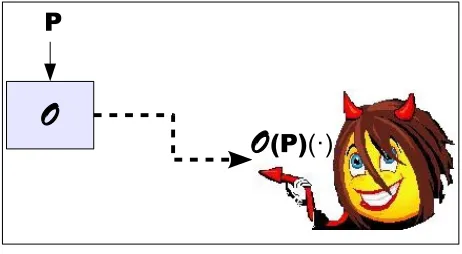
Obfuscation is a prevalent software hardening technique used in practice, and can be employed as a building block in higher layer protocols. Obfuscator O is an ecient algorithm, that when applied on some program P, see Figure 2, produces an obfuscated program P0, that has the same functionality as P (for any input, O(P) produces the same result as P), but its code is harder to understand and analyse. There are many practical constructions of obfuscators, yet none is known to be provably secure, and due to result of Barak et al. [2] we cannot hope for a universal obfuscator that would turn the code of every program into one that is hard to understand and reverse engineer. Obfuscators aim to hide the code of the executing program, and once the program is obfuscated and sent to remote host, there is no further interaction with the originator of the program, and the remote environment can execute the obfuscated program on any input of its choice and observe the output. Obfuscator can be used for software protection and licensing, where a program (implement-ing some secret, proprietary algorithm) is distributed to users, that can evaluate the program on any input and obtain result. For instance, a program can implement an algorithm that nds prime factors of a given composite number. The user purchases the program and can factor any number of its choice. The goal is to prevent the malicious acts targeted at circumventing software protection to recover the secret algorithm, e.g., by competitors. Since the security of existing obfuscators is not proven, robust combiners is a natural choice to enhance security.
1.1 Our contribution: Robust Combiners for Obfuscators
We present robust combiners for software hardening, specically for obfuscation [2]. Applying obfus-cator on an obfuscated program, i.e., combining obfusobfus-cators, is a folklore way to enhance security, yet no formal construction prior to this work was given. In addition, whether combining obfuscators indeed contributes to overall security has been controversial among practitioners. In this work we precisely dene cascade combiner for obfuscation, and provide a formal proof of security, i.e., we
1A software implementation is published for public scrutiny and undergoes extensive eorts to cryptanalyse it.
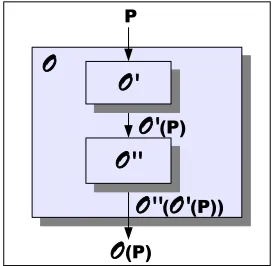
show that cascade is a robust combiner for obfuscation. Our combiner for obfuscators is (1,2)-robust, i.e., it receives two obfuscatorsO0 andO00, and produces a third obfuscatorOthat is secure accord-ing to virtual black-box property, if one of the underlyaccord-ing obfuscators is virtual black-box secure. The cascade combiner for obfuscatorO, see Figure 1, receives a program P in an input, appliesO0 and receivesO0(P). It then provides O0(P) in an input to obfuscatorO00, and returns the resulting obfuscated programO00(O0(P)).
O
P
O'
(P)O''
(O'
(P))O
(P)O'
O''
Fig. 1. Cascade obfuscatorOreceives a programP, and appliesO0 andO00sequentially. The resulting obfuscated programO00
(O0
(P))is then output.
1.2 Robust Combiners
The security of cryptographic constructions often depends on unproven hardness assumptions, or on the security of primitives that withstood cryptanalysis attacks. A common approach employed to enhance security is to construct robust combiners, by combining two or more cryptographic primitives into one, s.t. the resulting construction is secure even when only some of the candidates are secure. Robust combiners can also be applied for fault tolerance, i.e., to ensure the correctness of the resulting combined scheme and to prevent erroneous implementations or design bugs. Robust combiners for various cryptographic primitives were shown, and alternately, an impossibility of achieving robust constructions for others was presented.
The most well-known combiner is the cascade combiner, which is a sequential application of two cryptographic primitives. Even and Goldreich [9] showed that cascade is a robust combiners of block ciphers, against message recovery attacks. Cascade, and other basic robust combiners, were studied by Herzberg [12], for encryption, MAC, signature and commitment schemes. Robust combiners were also studied for other primitives, e.g. hash functions Fischlin and Lehmann [10], Boneh and Boyen [3], private information retrieval (PIR) Meier and Przydatek [14] and oblivious transfer Harnik et al. [11].
In principle, robust combiners ensure also fault tolerance: the combined output will meet the spec, even if the code (or hardware) running one mechanism has some fault, and as a result the output of this mechanism does not meet its specications. However, we caution that many construc-tions of robust combiners, including the one we present in Section 3, only ensure robustness to the security properties, and assume that some basic functionality is preserved by all modules. In such cases, where functionality is not preserved, the robust combiner does not ensure also fault tolerance (for arbitrary hardware/software faults). We leave it as an open question, whether it is possible to design a robust combiner for obfuscators, which will be tolerant for arbitrary faults (not just faults on security specications).
1.3 Software Hardening Techniques: Virtual Black-Box Obfuscation
In white-box security the attacker obtains full access to the implementation. This is in contrast to traditional cryptography where a black-box (such as a trusted hardware) is assumed to exist, on which secrets can be stored. An attacker cannot access this black-box but can only observe the input-output behavior of the cryptographic implementation, e.g. a server performing signature computations on request. The inherent distinction in the attacker's abilities between the two models implies that traditional cryptographic tools are not applicable to remote environments, since they rely on the fact that the secrets used by the software do not reside on the same execution platform as the malicious host, and are thus not accessible to the attacker. Therefore, alternative tools and techniques have been proposed, with obfuscation being a prevailing technique employed by practitioners to harden software for execution in a remote environment, e.g., [6, 7]. There are practical and theoretical works on obfuscation, including formal denitions and negative and positive results, which we briey survey below. In [2] Barak et al. formalised the notion of obfuscation: an obfuscatorO(·), is a probabilistic
polynomial time algorithm, which on an input a programP generates an obfuscated programO(P),
such thatO(P) has the same functionality as P, is at most polynomially slower than P, but leaks no more information aboutP than a black-box access toP would. Obfuscated program is then sent o to remote platform, see Figure 2. Intuitively this means that the resulting obfuscated program should be harder to reverse engineer and to analyse. That is, the goal of obfuscation is to prevent reverse engineering, and to make it hard to extract information from the binary code. Consider a
P
O
O
(P)
(·)
mobile agent purchasing goods on behalf of its originator. The agent purchases best oer based on its internal parameters and signs the purchase with an embedded secret signing key. If the platform hosting the agent could extract the secret key, it could use it to sign any document of its choice. However given a secure obfuscator, it would be possible to obfuscate the agent's code, thus preventing key extraction and analysis of agent's code and data.
The result in [2] also showed that there are programs which cannot be obfuscated. Namely, they showed that there does not exist an obfuscator that can protect every program's code from exposing more than the program's input-output behavior. Thus the goal is to investigate obfuscators for specic function families. Positive results in obfuscation presented constructions of obfuscated functions e.g. [5, 15, 13], which are secure according to [2]. However, none of these works show how to construct an obfuscator that could be applied on programs to harden them, but they instead construct obfuscated programs from `scratch'. Those results do not suce for practical denition of `obfuscation' but they do exhibit a feasibility, paving way to future work in this direction.
As for practical and commercial mechanisms based on obfuscation, those lack a clearly stated security analysis, and rely on security by obscurity, which contradicts basic cryptographic principles, and assume limited patience of the attackers when reverse engineering. Other proposed obfuscations may rely on program analysis that is known to be pragmatically dicult, however, are very suscep-tible to continuing improvements in program analysis. Unfortunately, to date, no secure practical obfuscation candidates are known to exist, e.g. it is not known how to obfuscate simple programs that upon receipt of an encrypted input, decrypt and execute it, without revealing anything of the inputs or computation.
1.4 Organisation
We rst present the denition of obfuscation and virtual black-box obfuscation in Section 2, where we extend the existing virtual black-box denition of [2]. We subsequently dene cascade of obfuscators in Section 3.1, and then in Section 3.2 we prove that cascade is robust for obfuscation.
2 Obfuscation: Denitions
We initiate with rened denition of obfuscation, which is based on the denition given by Barak et al. in [2], and then present cascade combiner construction for obfuscation and prove its security. According to [2], universal obfuscator for every program does not exist, therefore we use the denition of obfuscation w.r.t. a family of programs. To simplify exposition, in denitions below we dene obfuscation w.r.t. a family of circuits (instead of programs). The dierence between circuits and programs, is that circuits are dened for a specic input size, therefore no need to explicitly refer to running time and other technicalities. We next give two denitions of obfuscation: Denition 1 says nothing of security, but only species correctness and functionality properties; Denition 2, in addition to correctness and functionality, also denes security of the obfuscator. The distinction between the two denitions, 1 and 2, is essential to emphasise that not every obfuscator delivers on the `expected' security.
Denition 1 (Obfuscation). Let C={Ck} be a family of polynomial size circuits of input length k. A polynomial time algorithm O on C is an obfuscator that takes as input a circuit C from Ck,
(Preserving Functionality) For every k, and every C∈ Ck, O(C) is a circuit that computes the
same function as C.
(Polynomial Slowdown) Obfuscated circuitO(C)is roughly as ecient as a circuit C, i.e., there exists a polynomial p(·), such that for suciently large k's, for every C ∈ Ck holds: |O(C)| ≤ |p(|C|)|
Denition 2 (Virtual Black-Box Obfuscation). Let C = {Ck} be a family of polynomial size circuits of input lengthk. A polynomial time algorithm O on C is an obfuscator that takes as input a circuit C fromCk, and outputs an obfuscated circuit O(C)∈ Ck, s.t.:
(Preserving Functionality) For every k, and every C∈ Ck, O(C) is a circuit that computes the
same function as C.
(Polynomial Slowdown) Obfuscated circuit O(C) is roghly as ecient as a circuitC, i.e., there exists a polynomial p(·), such that for suciently large k's, for every C ∈ Ck holds: |O(C)| ≤ |p(|C|)|
(Virtual Black-Box) For every polynomialp(·) and every probabilistic polynomial time algorithm
A, there exists a probabilistic polynomial time simulator S, such that for all suciently large k's, for all C∈ Ck, holds:
Pr[A(O(C)) = 1]−Pr[S
C(1k) = 1] <
1
p(k)
Where the probabilities are taken over the random coins ofA and S. Several comments related to above denitions are in order:
The denition presented in [2] is a special case of virtual black-box denition given in 2, where the family of circuits Ck is dened to be all the circuits.
Dening two types of obfusctors, one w.r.t. functionality and correctness, and another that is also secure (which is also true in reality, an obfuscator can be correct, but not deliver on its security guarantees) is important for cascade combiner, which we show below, to show that it suces for only one of the underlying obfuscators, input to the combiner, to be secure according to Denition 2, so that the cascade obfuscator results in a secure obfuscator, according to Denition 2.
Another subtlety which should be explicitly dealt with when dening obfuscation (and cascade combiner thereof) w.r.t. family of circuits, is that the family of circuits should be closed for obfuscation and for cascade of obfuscators. Namely, upon input a circuit C from family of circuits Ck, the result is an obfuscated circuit O(C) which is also an element in the family Ck.
The obfuscated circuitO(C)can thus be supplied in an input to obfuscatorO(sinceOis dened for Ck) again, and will result in O(O(C)), which is also an element in Ck. This technicality is motivated by the fact that practical obfuscators are typically written in the same language as the programs on which they are applied.
3 Cascade Combiner for Obfuscators: Construction
3.1 Cascade Combiner for Obfuscation: Construction
Denition 3 (Cascade of Obfuscators). Let O0 and O00 be two obfuscators for circuits family Ck. Their cascade obfuscator O=O0◦ O00 is presented in Algorithm 1.
Algorithm 1Construction of cascade obfuscatorO.On input a circuitC∈ Ck,Orst appliesO0onCand obtains
C0∈ Ck. ThenOrunsO00onC0and as a result receivesC00∈ Ck;OoutputsC00.
O(C){ C0← O0
(C)
C00← O00
(C0)
returnC00 }
Intuitively, the resulting combined obfuscatorOis virtual black-box secure, according to Denition 2, if at least one of the underlying obfuscators, O0 or O00, is virtual black-box secure, i.e., satises the properties in Denition 2, and the other is obfuscator according to Denition 1. Assume that O0 is virtual black-box secure, then the circuit is hidden and even if the externalO00exposes it, the security relies on the security ofO0. A similar argument holds forO00. We next, in Section 3.2, present a formal and detailed proof of the cascade construction (Algorithm 1), and show that cascade is robust for virtual black-box obfuscation.
3.2 Cascade Combiner is Robust for Obfuscation: Proof
Lemma 1 (Cascade is Robust for Obfuscation) LetO0 andO00 be two obfuscators for circuits family C, the cascade O=O0◦ O00 is a virtual black-box obfuscator for circuits family C, according to Denition 2, if at least one of O0 or O00 is virtual black-box secure forC.
Proof. In order to show that cascade is robust for obfuscators, we prove that O satises the func-tionality and the security requirements in Denition 2. We rst show thatOis indeed an obfuscator, i.e., satises the eciency and correctness requirements in Denition 1.
Preserving Functionality: Let C ∈ Ck. Then according to functionality requirement of O0, the
ob-fuscated circuit O0(C) = C0 is also an obfuscator, i.e., C0 ∈ Ck, and has the same functionality as C. Obfuscator O00 also satises a functionality requirement, and therefore when applied on C0 it produces an obfuscated circuit C00, i.e., C00 = O00(C0), such that C00 is also a circuit C00 ∈ Ck,
and has the same functionality as C0. Since C,C0 and C00 all compute the same function, cascade obfuscator preseves the functionality of the original circuitC.
Polynomial Slow Down: Cascade obfuscator O applies O0 on C, then O00 on O0(C), and
out-puts the result. According to denition, there exists a polynomial p0(·) bounding the encoding
of the obfuscated circuit O0(C) (and thus its running time), and there exists a polynomial p00(·),
bounding the size of O00(O0(C)); composition of polynomials p0(·) and p00(·) is a polynomial, i.e.,
|O(C)| ≤p00(|p0(|C|)|), thus Ois ecient if O0 and O00 are.
Virtual Black-Box: Assume towards contradiction that there exists a PPT algorithmAand a poly-nomialp(·), such that for every simulator S holds:
Pr[A(O(C)) = 1]−Pr[S
C(1k) = 1] ≥
1
p(k)
Given a PPT algorithm A against O we construct PPT algorithms A0 and A00 against O0 and O00 respectively, s.t. for every C∈ Ck holds:
Pr[A0(O0(C)) = 1] = Pr[A(O(C)) = 1] (1)
∀C,∃C0, s.t. Pr[A00(O00(C0)) = 1] = Pr[A(O(C)) = 1] (2)
Where C0 is a result application of O0 on C. We prove equations (1) and (2) in Claims 2 and 3. We then show, in Claims 4, and 5, that there do not exist simulators S0 and S00 for A0 and A00 respectively. Namely, givenS0 (respectivelyS00) we show how to construct a simulatorS forA, thus obtaining:
Pr[S0C(1k) = 1] = Pr[SC(1k) = 1] (3) Pr[S00C
0
(1k) = 1] = Pr[SC(1k) = 1] (4)
However, existence of a simulator S for A contradicts the initial assumption, that there does not exist a simulator forA. More specically, if there exists anA for which no simulator exists, we can use it to constructA0 andA00againstO0 and O00. Thus the advantage of A0 and A00 over S0 andS00 respectively, is equivalent to the advantage of A overS:
Pr[A
0
(O0(C)) = 1]−Pr[S0C(1k) = 1]
=
Pr[A(O(C)) = 1]−Pr[S
C(1k) = 1]
(5)
Pr[A
00(O00(C0)) = 1]−Pr[S00C0
(1k) = 1]
=
Pr[A(O(C)) = 1]−Pr[S
C(1k) = 1]
(6)
Therefore, cascade is robust for virtual black-box obfuscation, andO is a secure obfuscator. ut
Claim 2 Given a PPT algorithm A, there exists a PPT algorithm A0, s.t., for innitely manyk's equation 1 holds.
Proof. LetAbe a PPT algorithm againstO. We useA to constructA0. The algorithmA0, in Algo-rithm 2, will receive an obfuscated program O0(C), and will emulate the execution of A providing it withO00(O0(C))and will output whateverA outputs. SinceA0 appliesO00 on O0(C) and invokes
Awith the resulting program, it is ecient if Ais ecient, and achieves the same probability asA,
i.e., Equation 1 holds. ut
Claim 3 Given a PPT algorithm A, there exists a PPT algorithm A00, s.t., for innitely manyk's equation 2 holds.
Proof. Let A be a PPT algorithm against O. We use A to construct A00. The algorithm A00, in Algorithm 2, will receive an obfuscated programO00(O0(C)), will invokeAwithO00(O0(C))and will
output whateverAoutputs. SinceA00 only invokesA, it is ecient if Ais ecient, and achieves the
Algorithm 2Given an algorithmAagainstO, we construct algorithmsA0andA00, againstO0andO00respectively,
that achieve the same advantage asA. A0(C0=O0(C)){
C00← O00
(C0)
returnA(C00)
}
A00(C00=O00(O0(C))){ returnA(C00)
}
Claim 4 Given a PPT simulator S0 there exists a PPT simulatorS such that Equation 3 holds.
Proof. Let S0 be a PPT simulator for which A0 cannot achieve a non-negligible advantage against O0. We use S0 to construct S, such that A will not be able to achieve non-negligible advantage againstS contradicting the assumption. The algorithm S is given access to C, it simply invokes S0 and provides it with an oracle access toC, in Algorithm 3. For each input query ofS0,S queriesC and returns the result toS0, precisely simulating the real execution toS0; thus Equation 3 holds. ut
Claim 5 Given a PPT simulator S00 there exists a PPT simulator S such that Equation 4 holds. Proof. LetS00 be a PPT simulator for whichA00 cannot achieve a non-negligible advantage against O0. We use S00 to construct S such that A will not be able to achieve non-negligible advantage against S contradicting the assumption. The algorithm S is given access to C, it invokes S00 and provides it with an oracle access toC, in Algorithm 3. For each input query ofS00,S queriesC and returns the result toS0, precisely simulating the real execution toS0; thus Equation 4 holds. ut Note that the simulatorSis implemented identically when usingS0orS00. This is due to the fact that the simulatorS obtains an oracle access to C, and has to simulate execution for S0 and S00, which receive an oracle access to C and C0. Yet according to denition of obfuscator, the functionality is preserved, thus allS should do, is query its own oracle upon requests fromS0 (resp.S00) and return the responses as is.
Algorithm 3 Given a simulator S0 (respectively, S00) we show how to construct S that will achieve the same advantage when given a black-box access toC.
SC(1k){
returnS0C(1k)
}
SC(1k){
returnS00C0(1k)
}
References
[1] Joy Algesheimer, Christian Cachin, Jan Camenisch, and Gunter Karjoth. Cryptographic security for mobile code. In SP '01: Proceedings of the 2001 IEEE Symposium on Security and Privacy, page 2, Washington, DC, USA, 2001. IEEE Computer Society.
[2] Boaz Barak, Oded Goldreich, Russell Impagliazzo, Steven Rudich, Amit Sahai, Salil Vadhan, and Ke Yang. On the (im)possibility of obfuscating programs. In CRYPTO '01: Proceedings of the 21st Annual International Cryptology Conference on Advances in Cryptology, London, UK, 2001. Springer-Verlag. ISBN 3-540-42456-3. [3] D. Boneh and X. Boyen. On the impossibility of eciently combining collision resistant hash functions. [4] Christian Cachin, Jan Camenisch, Joe Kilian, and Joy Muller. One-round secure computation and secure
[5] Ran Canetti. Towards realizing random oracles: Hash functions that hide all partial information. In Burton S. Kaliski, Jr., editor, Advances in Cryptology CRYPTO ' 97, volume 1294 of Lecture Notes in Computer Science, pages 455469. International Association for Cryptologic Research, Springer-Verlag, Berlin Germany, 1997. URL http://philby.ucsd.edu/psfiles/97-07.ps(longerToCLversion,June2,97).
[6] C. Collberg, C. Thomborson, and D. Low. A taxonomy of obfuscating transformations. University of Auckland Technical Report, 170, 1997.
[7] CS Collberg and C. Thomborson. Watermarking, tamper-proong, and obfuscation-tools for software protection. Software Engineering, IEEE Transactions on, 28(8):735746, 2002.
[8] J. Daemen and V. Rijmen. The Design of Rijndael: AESthe Advanced Encryption Standard. Springer, 2002. [9] S. Even and O. Goldreich. On the power of cascade ciphers. In D. Chaum, editor, Proc. CRYPTO 83, pages
4350, New York, 1984. Plenum Press.
[10] M. Fischlin and A. Lehmann. Multi-Property Preserving Combiners for Hash Functions.
[11] D. Harnik, J. Kilian, M. Naor, O. Reingold, and A. Rosen. On robust combiners for oblivious transfer and other primitives. Proc. EUROCRYPT 2005, pages 96113, 2005.
[12] Amir Herzberg. Folklore, practice and theory of robust combiners. Cryptology ePrint Archive, Report 2002/135, 2002. http://eprint.iacr.org/.
[13] S. Hohenberger and G.N. Rothblum. Securely Obfuscating Re-Encryption. TCC, pages 233252, 2007. [14] R. Meier and B. Przydatek. On robust combiners for private information retrieval and other primitives. Proc.
CRYPTO 2006, pages 555569, 2006.