Scholarship@Western
Scholarship@Western
Electronic Thesis and Dissertation Repository
4-16-2019 1:45 PM
Future changes of hydroclimatic extremes in western North
Future changes of hydroclimatic extremes in western North
America using a large ensemble: The role of internal variability
America using a large ensemble: The role of internal variability
Mohammad Hasan Mahmoudi
The University of Western Ontario
Supervisor Najafi, Reza
The University of Western Ontario
Graduate Program in Civil and Environmental Engineering
A thesis submitted in partial fulfillment of the requirements for the degree in Master of Science © Mohammad Hasan Mahmoudi 2019
Follow this and additional works at: https://ir.lib.uwo.ca/etd
Part of the Environmental Engineering Commons, Environmental Indicators and Impact Assessment Commons, Hydraulic Engineering Commons, Other Civil and Environmental Engineering Commons, and the Water Resource Management Commons
Recommended Citation Recommended Citation
Mahmoudi, Mohammad Hasan, "Future changes of hydroclimatic extremes in western North America using a large ensemble: The role of internal variability" (2019). Electronic Thesis and Dissertation Repository. 6151.
https://ir.lib.uwo.ca/etd/6151
This Dissertation/Thesis is brought to you for free and open access by Scholarship@Western. It has been accepted for inclusion in Electronic Thesis and Dissertation Repository by an authorized administrator of
I
Increases in the intensity and frequency of extreme events in Western North America (WNA)
can cause significant socioeconomic problems and threaten existing infrastructure. In this study
we analyze the impacts of climate change on hydroclimatic extremes and assess the role of
internal variability over WNA, which collectively drain an area of about 1 million km2. We
used gridded observations and downscaled precipitation, maximum and minimum temperature
from seven General Circulation Models (GCMs) that participated in the Coupled Model
Intercomparison Project Phase 5 (CMIP5) and a large ensemble of CanESM2 model
simulations (CanESM2-LE; 50 members) for this analysis. Spatial and temporal changes of
eight climate extreme indices are assessed over the historical (1981-2010) and future
(2060-2089) time periods. In addition, changes in extreme events with high return periods are
analyzed based on the extreme value theory. To better understand the effects of internal climate
variability on the hydroclimatology of WNA we assess the relations between 14 Low
Frequency Variability Modes (LFVMs), with three different time lags, and the regional
temperature and precipitation. The correlation between each LFVM and the principle
component of temperature and precipitation over the spatial domain is computed using
Maximum Covariance Analysis (MCA). Robustness of the results is further evaluated using
composite analysis. Results show that the intensity and frequency of extreme precipitation and
temperature are projected to increase over WNA. The uncertainties due to internal variability
(represented by CanESM2-LE) are significant and comparable to those arising from GCM
structures. El Nino Southern Oscillation, Trans-Polar Index (TPI), Southern Annular Mode
(SAM), Eastern Pacific (EP) and West Pacific (WP) are found to be dominant LFVMs that can
II
Hydroclimatic extremes, climate change, internal variability, precipitation, temperature,
runoff, western North America, Low frequency variability mode, CLIMDEX, composite
III
First and foremost, I would like to thank the brain for its never-ending grace, mercy and
provision during challenging times of my life. Although, I need to apologize to it for not being
able to use all of it.
I would like to thank my thesis advisor Dr. Mohammad Reza Najafi, my patient supervisor
whose office’s door was always open whenever I ran into a problem or had a question about
my research or writing.
I would like to thank my research group and the experts who provided passionate support
throughout my study including Dr. Alireza Massah, Mohammad Sadeq Abbasian and Harry
Singh. I also thank Markus Schnorbus and Arelia Werner from Pacific Climate Impacts
Consortium who provided downscaled climate model simulations and gridded observations
over western North America; and Dr. George Josh, BC Hydro, for sharing the calibrated
hydrological model.
Finally, I must express my very profound gratitude to my parents (Maman Pouri and Baba
Reza), to my girlfriend and future wife Brianna Ananthan and my best friend Dr. Erfun
Asadipour for providing me with unfailing support and continuous encouragement throughout
my years of study and through the process of researching and writing this thesis. This
IV
Abstract ... I
Acknowledgement ... III
Table of Contents ... IV
List of tables ... VII
List of Figures ... VIII
Acronyms ... XV
Chapter 1 ... 1
1. Introduction ... 1
1.1. Hydroclimatic extreme events ... 1
1.2. Changes in extreme events ... 2
1.2.1 Impacts of climate change on extreme events ... 3
1.2.2 Internal variability ... 6
1.3. Research Objectives ... 9
1.4. Research questions ... 10
1.5. Thesis organization ... 10
Chapter 2 ... 11
2. Literature review ... 11
2.1. Assessment of Climate Change Impacts on Hydroclimatic Extremes ... 11
2.2. Impacts of LFVMs ... 15
V
3.1. Study area ... 18
3.2. Data ... 22
3.2.1. Daily Gridded Observation ... 23
3.2.2. General Circulation Models ... 23
3.3. Methods ... 26
3.5.1. Climate extreme indices ... 27
3.5.2. Generalized Extreme Value Distribution ... 30
3.5.3. Composite Analysis ... 32
3.5.4. Maximum Covariance Analysis ... 34
Chapter 4 ... 37
4. Results and discussion ... 37
4.1. Temporal changes of the annual maximum precipitation and temperature ... 37
4.2. Spatial changes in indices of extreme precipitation and temperature for WNA ... 43
4.3 Temporal changes of extreme indices ... 49
4.4. Spatial distributions of extreme Pr&T with 50- and 100-year return levels ... 55
4.5. Impacts of low frequency variability modes on WNA’s hydroclimatic variables ... 59
4.6. Streamflow ... 72
Chapter 5 ... 78
5. Conclusion ... 78
VI
VII
Table 1. LFVMs and their indices ... 8
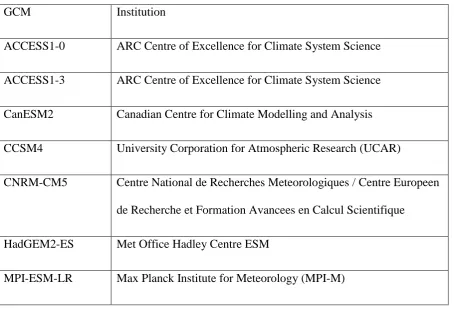
Table 2.GCMs used in this study ... 25
Table 3.Climate extreme indices (CLIMDEX) that are analyzed in this study ... 28
Table 4.The changes of AM from historical to future period over WNA (FRB, PRB, CRB,
CaRB) ... 38
Table 5. Same as table 4 but in percentage ... 38
Table 6. P-factors of CanESM2_LE and SR_GCMs for four key river basins over WNA (FRB,
PRB, CRB, CaRB) ... 43
Table 7. R-factors of CanESM2_LE and SR_GCMs for four key river basins over WNA (FRB,
PRB, CRB, CaRB) ... 43
Table 8. P-factor and R-factor of CanESM2_LE and SR_GCMs for TNN, TXX, CDD and
GSL ... 53
Table 9. P-factor and R-factor of CanESM2_LE and SR_GCMs for R10, R95PTOT, RX5day
and SDII ... 55
Table 10. 5 lowest and highest LFVM years ... 63
VIII
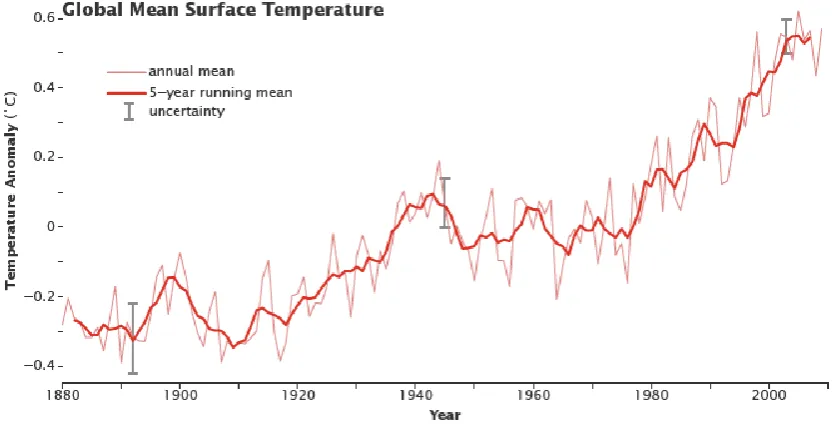
Figure 1.Global mean surface temperature (Hansen et al., 2010)... 4
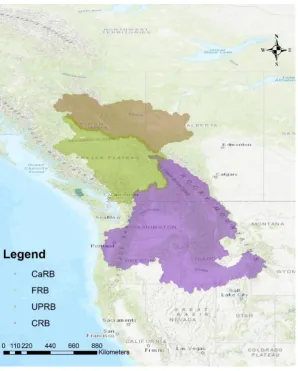
Figure 2. Four key river basins in WNA (light green: FRB, beige: PRB, purple: CRB, blue: CaRB) ... 21
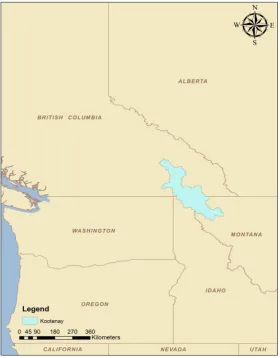
Figure 3. Kootenay River Basin ... 22
Figure 4. Methodology flowchart ... 27
Figure 5. Composite Analysis flowchart... 33
Figure 6. Changes in the AM precipitation, tasmax and tasmin over FRB. The black solid line represents the observations; blue and red shades show the 95th quantiles of seven GCMs and 50 CanESM2-LE runs, respectively, over historical (1981-2010) and future (2060-2089) periods. ... 40
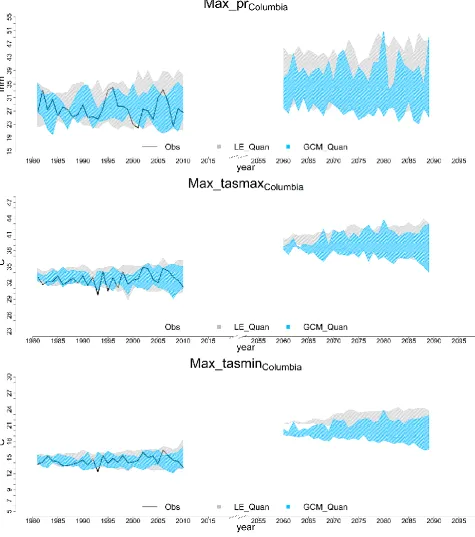
Figure 7. Changes in the AM precipitation, tasmax and tasmin over PRB. The black solid line represents the observations; blue and red shades show the 95th quantiles of seven GCMs and 50 CanESM2-LE runs, respectively, over historical (1981-2010) and future (2060-2089) periods. ... 40
Figure 8. Changes in the AM precipitation, tasmax and tasmin over CRB. The black solid line represents the observations; blue and red shades show the 95th quantiles of seven GCMs and 50 CanESM2-LE runs, respectively, over historical (1981-2010) and future (2060-2089) periods. ... 41
IX
CanESM2_LE and SR_GCM simulations over the historical (1981-2010) (first rows) and
future (2060-2089) (second rows) periods over WNA ... 45
Figure 11. Spatial average Changes of CDD and GSL based on gridded observations,
CanESM2_LE and SR_GCM simulations over the historical (1981-2010) (first rows) and
future (2060-2089) (second rows) periods over WNA ... 47
Figure 12. Monthly variation of RX5day, TXX and TNN based on gridded observations (black
dashed line), CanESM2_LE and GCM simulations for historical (1981-2010) (green and blue
dashed line associated with CanESM2_LE and SR_GCMs, respectively) and future
(2060-2089) (red and brown dashed line associated with CanESM2_LE and SR_GCMs, respectively)
periods ... 50
Figure 13. Historical (1981-2010) and projected (2060-2089) changes of TNN, TXX, CDD
and GSL based on gridded observation (solid black line), CanESM2_LE (left side) and
SR_GCM (right side) simulations. Red and blue dashed lines are 95th quantile of simulations
(CanESM2_LE on the left and SR_GCMs on the right side) for historical and projection period,
respectively. Solid green line is the temporal average of CanESM2_LE/SR_GCM simulations.
The solid red and blue lines are the mean of the historical and projection period, respectively.
... 52
Figure 14. Historical (1981-2010) and projected (2060-2089) changes of R10, R95PTOT,
RX5day and SDII based on gridded observation (solid black line), CanESM2_LE (left side)
and SR_GCM (right side) simulations. Red and blue dashed lines are 95th quantile of
simulations (CanESM2_LE on the left and SR_GCMs on the right side) for historical and
projection period, respectively. Solid green line is the temporal average of
CanESM2_LE/SR_GCM simulations. The solid red and blue lines are the mean of the
X
and on future period (2060-2089) (second row) over WNA using gridded observation (left
column), CanESM2_LE (middle column) and SR_GCM (right column) simulations. ... 56
Figure 16. Tasmax 50-year return level based on historical period (1981-2010) (first row) and
on future period (2060-2089) (second row) over WNA using gridded observation (left column),
CanESM2_LE (middle column) and SR_GCM (right column) simulations. ... 57
Figure 17. Tasmin 50-year return level based on historical period (1981-2010) (first row) and
on future period (2060-2089) (second row) over WNA using gridded observation (left column),
CanESM2_LE (middle column) and SR_GCM (right column) simulations. ... 57
Figure 18. Correlation between LFVMs signals using three lags (no lag, one month lag, two
months lag) and expansion coefficient of average temperature... 60
Figure 19. Correlation between LFVMs using three lags (no lag, one month lag, two months
lag) and expansion coefficient of average precipitation ... 61
Figure 20. Correlation between LFVMs using three lags (no lag, one month lag, two months
lag) and expansion coefficient of maximum precipitation ... 62
Figure 21. Differences in the extended winter hydroclimatic variables (Precipitation: first row,
maximum temperature: second row, minimum temperature: third row) averaged from 5 years
associated with highest and lowest value of EA with three different lags (no lag: first column,
one month lag: second column, two months lag: third column). Shadowed areas are those grids
whose differences are statistically significant... 66
Figure 22. Differences in the extended winter hydroclimatic variables (Precipitation: first row,
maximum temperature: second row, minimum temperature: third row) averaged from 5 years
associated with highest and lowest value of NAO with three different lags (no lag: first column,
one month lag: second column, two months lag: third column). Shadowed areas are those grids
XI
maximum temperature: second row, minimum temperature: third row) averaged from 5 years
associated with highest and lowest value of Nino3.4 with three different lags (no lag: first
column, one month lag: second column, two months lag: third column). Shadowed areas are
those grids whose differences are statistically significant. ... 68
Figure 24. Differences in the extended winter hydroclimatic variables (Precipitation: first row,
maximum temperature: second row, minimum temperature: third row) averaged from 5 years
associated with highest and lowest value of NTA with three different lags (no lag: first column,
one month lag: second column, two months lag: third column). Shadowed areas are those grids
whose differences are statistically significant... 69
Figure 25. Differences in the extended winter hydroclimatic variables (Precipitation: first row,
maximum temperature: second row, minimum temperature: third row) averaged from 5 years
associated with highest and lowest value of WP with three different lags (no lag: first column,
one month lag: second column, two months lag: third column). Shadowed areas are those grids
whose differences are statistically significant... 70
Figure 26.Temporal streamflow based on gridded observation (first row), CanESM2_LE
(second row) and GCMs (third row) ... 73
Figure 27. 95th quantile of historical and future simulated streamflow based on GCMs (blue
shadow) and observed streamflow based on gridded observation (solid black line) ... 74
Figure 28. 95th quantile of historical and future simulated streamflow based on CanESM2_LE
(blue shadow) and observed streamflow based on gridded observation (solid black line) ... 75
Figure 29. Maximum daily streamflow over the KRB based on observed gridded observation
(black line), CanESM2_LE (red line) and GCMs (green line) over historical (top) and future
XII
CanESM2_LE and SR_GCM simulations over the historical (1981-2010) (first rows) and
future (2060-2089) (second rows) periods over WNA ... 81
Appendix 2. Spatial average Changes of RX5day and SDII based on gridded observations,
CanESM2_LE and SR_GCM simulations over the historical (1981-2010) (first rows) and
future (2060-2089) (second rows) periods over WNA ... 82
Appendix 3. Precipitation 100-year return level based on historical period (1981-2010) (first
row) and on future period (2060-2089) (second row) over WNA using gridded observation (left
column), CanESM2_LE (middle column) and SR_GCM (right column) simulations. ... 83
Appendix 4. Tasmax 100-year return level based on historical period (1981-2010) (first row)
and on future period (2060-2089) (second row) over WNA using gridded observation (left
column), CanESM2_LE (middle column) and SR_GCM (right column) simulations. ... 83
Appendix 5. Tasmin 100-year return level based on historical period (1981-2010) (first row)
and on future period (2060-2089) (second row) over WNA using gridded observation (left
column), CanESM2_LE (middle column) and SR_GCM (right column) simulations. ... 84
Appendix 6. Differences in the extended winter hydroclimatic variables (Precipitation: first
row, maximum temperature: second row, minimum temperature: third row) averaged from 5
years associated with highest and lowest value of AO with three different lags (no lag: first
column, one month lag: second column, two months lag: third column). Shadowed areas are
those grids whose differences are statistically significant. ... 85
Appendix 7. Differences in the extended winter hydroclimatic variables (Precipitation: first
row, maximum temperature: second row, minimum temperature: third row) averaged from 5
years associated with highest and lowest value of DMI with three different lags (no lag: first
column, one month lag: second column, two months lag: third column). Shadowed areas are
XIII
row, maximum temperature: second row, minimum temperature: third row) averaged from 5
years associated with highest and lowest value of EP with three different lags (no lag: first
column, one month lag: second column, two months lag: third column). Shadowed areas are
those grids whose differences are statistically significant. ... 87
Appendix 9. Differences in the extended winter hydroclimatic variables (Precipitation: first
row, maximum temperature: second row, minimum temperature: third row) averaged from 5
years associated with highest and lowest value of ONI with three different lags (no lag: first
column, one month lag: second column, two months lag: third column). Shadowed areas are
those grids whose differences are statistically significant. ... 88
Appendix 10. Differences in the extended winter hydroclimatic variables (Precipitation: first
row, maximum temperature: second row, minimum temperature: third row) averaged from 5
years associated with highest and lowest value of PDO with three different lags (no lag: first
column, one month lag: second column, two months lag: third column). Shadowed areas are
those grids whose differences are statistically significant. ... 89
Appendix 11. Differences in the extended winter hydroclimatic variables (Precipitation: first
row, maximum temperature: second row, minimum temperature: third row) averaged from 5
years associated with highest and lowest value of PNA with three different lags (no lag: first
column, one month lag: second column, two months lag: third column). Shadowed areas are
those grids whose differences are statistically significant. ... 90
Appendix 12. Differences in the extended winter hydroclimatic variables (Precipitation: first
row, maximum temperature: second row, minimum temperature: third row) averaged from 5
years associated with highest and lowest value of SAM with three different lags (no lag: first
column, one month lag: second column, two months lag: third column). Shadowed areas are
XIV
row, maximum temperature: second row, minimum temperature: third row) averaged from 5
years associated with highest and lowest value of SOI with three different lags (no lag: first
column, one month lag: second column, two months lag: third column). Shadowed areas are
those grids whose differences are statistically significant. ... 92
Appendix 14. Differences in the extended winter hydroclimatic variables (Precipitation: first
row, maximum temperature: second row, minimum temperature: third row) averaged from 5
years associated with highest and lowest value of TPI with three different lags (no lag: first
column, one month lag: second column, two months lag: third column). Shadowed areas are
XV
*.nc = NetCDF ... 23
ACCESS1-0 =ARC Centre of Excellence for Climate System Science... 25
ACCESS1-3 =ARC Centre of Excellence for Climate System Science... 25
AO = Arctic Oscillation ... 8
BCCA = Bias Correction Constructed Analogues ... 25
BCCAQ = Bias Correction/Constructed Analogues with Quantile mapping reordering approach ... 24
BCCI = Bias Corrected Climate Imprint ... 25
CanESM2 =Canadian Centre for Climate Modelling and Analysis ... 25
CanESM2-LE =CanESM2- Large Ensemble ... 26
CaRB = Campbell River Basin ... 20
CCA = Canonical Correlation Analysis ... 35
CCSM4 =University Corporation for Atmospheric Research (UCAR) ... 25
CDD = maximum number of consecutive dry days... 5
CLIMDEX = Climate extreme indices ... 4
CMIP3 = Coupled Model Intercomparison Project Phase 3 ... 11
CMIP5 = Coupled Model Intercomparison Project Phase 5 ... 11
CNRM-CM5 =Centre National de Recherches Meteorologiques / Centre Europeen de Recherche et Formation Avancees en Calcul Scientifique ... 25
CRB = Columbia River Basin ... 16
DMI =Dipole Mode Index ... 8
EA =East Atlantic ... 8
XVI
EP =Eastern Pacific ... 8
ETCCDI = Expert Team on Climate Change Detection and Indices ... 11
EVT = Extreme Value Theory ... 5
FRB = Fraser River Basin ... 18
GEV = Generalized Extreme Value ... 14
GP = generalized Pareto ... 30
GSL = Growing Season Length ... 5
HadGEM2-ES =Met Office Hadley Centre ESM ... 25
HIV = Human Immunodeficiency Viruses ... 1
IPCC = Intergovernmental Panel on Climate Change ... 3
MCA = Maximum Covariance Analysis ... 9
MCA1 = MCA mode 1 ... 59
MPI-ESM-LR =Max Planck Institute for Meteorology (MPI-M) ... 25
NAO =North Atlantic Oscillation ... 8
NP = North Pacific ... 17
NTA =North Tropical Atlantic ... 8
PC = Principal Component ... 16
PDF = Probability Density Function ... 31
PDO =Pacific Decadal Oscillation ... 8
PDSI = Palmer Drought Severity Index ... 16
PNA =Pacific/North American Pattern ... 8
R10 = number of days with precipitation greater than 10 mm ... 5
XVII
RCP = Representative Concentration Pathway... 3
RX5day = monthly maximum consecutive 5-day precipitation ... 5
SAM = Southern Annular Mode ... 8
SCF = Square Covariance Fraction ... 36
SDII = simple precipitation intensity index ... 5
SOI =Southern Oscillation Index ... 8
SST = Sea Surface Temperature ... 16
SVD = Singular Value Decomposition ... 16
tasmax = maximum daily temperature ... 32
tasmin = minimum daily temperature ... 32
TNn = minimum Temperature ... 5
TPI =Trans Polar Index ... 8
TXx = maximum temperature ... 5
UPRB = Upper Peace River Basin... 19
1
Chapter 1
1.
Introduction
This section discusses hydroclimatic extreme events (including precipitation, temperature and
runoff), their driving mechanisms, examples of historical events, and the role of climate change
and internal variability followed by the thesis outline in the end.
1.1. Hydroclimatic extreme events
Definition of extreme events varies between different disciplines. Politicians and journalists
define them as any event with an important consequence. According to this definition, a heavy
rainfall that cause no flooding is not considered an extreme event. Pandemics such as HIV or
flu are extreme societal events. Other examples include large benefit/loss in market turbulence,
embezzlement in politics, earthquake and landslide in geoscience, flood and drought in natural
science. Hydrologists define extreme events as deviations from the usual trend of the observed
or simulated variable (such as precipitation, temperature, runoff), or as unusual/unexplainable
events regardless of their impacts (Albeverio, Jentsch and Kantz, 2006). In general, the tails of
a probability distribution of a variable are considered as extremes.
Extreme events, such as floods and droughts, commonly occur in North America (NA) as well
as other regions around the world resulting in significant socioeconomic consequences.
Examples include flooding in central Arizona on July 24th in 1990, which was initiated by
heavy rainfall and locally strong winds. Texas faced severe drought conditions starting from
October 2010 with an average precipitation amount of 14.8 inches recorded in 2011, as the
2
predicted based on above-average snow survey records in February. Temperature rise
contributed to snowmelt in May 2018 and resulted in massive flooding in British Columbia as
well. It caused thousands of residents to be displaced in Grand Forks, Osoyoos with some on
alert in Chilliwack.
Increases in the severity and frequency of extreme events, due to natural or human-induced
causes, can result in severe damages and losses in the future. Understanding historical changes
of the characteristics of extremes and the driving mechanisms is essential for their accurate
future predictions.
1.2. Changes in extreme events
According to the Clausius-Clapeyron relationship increases in the atmospheric temperature
would raise its moisture holding capacity resulting in more severe and more frequent extreme
events. Therefore, in a changing climate more intense flooding, caused by heavier rainfall
among others, are expected to occur in many regions around the world particularly the ones
that are categorized as wet areas. Temperature increases would also increase the
evapotranspiration rates and reduce the average rainfall rates particularly in dry areas resulting
in severe drought conditions. Therefore, societies and infrastructure are more vulnerable to
hydroclimatic extreme events under climate change. In addition, internal climate variability,
due to the chaotic nature of the atmospheric and oceanic processes play a significant role in
3
1.2.1 Impacts of climate change on extreme events
Climate is an average state of weather prevailing in an area over a long period of time. The
global climate has always been oscillating, however observational data shows that the average
global temperature has been increasing over the past decades particularly since 1980s. There is
strong evidence that these observed changes are associated with anthropogenic greenhouse
effects caused by human-induced emissions via industrialization (Najafi et al., 2015).
Greenhouse gasses (GHGs), including carbon dioxide, methane, water-vapor, nitrous oxide,
among others, can trap the long-wave radiation emitted from the Earth’s surface into the
atmosphere resulting in increases in the Earth’s surface temperature. Since 19th century global
GHG concentrations have been increasing steadily (van Vuuren et al., 2011). Because of the
lack of knowledge of future GHG concentrations, the Intergovernmental Panel on Climate
Change (IPCC) has introduced four distinct GHG emission scenarios, representing possible
range of future GHG concentrations, called Representative Concentration Pathways (RCPs)
2.6, 4.5, 6.0 and 8.5 (Stocker et al., 2013). Total radiative forcing, which is a cumulative
measure of human emissions of GHG levels, is used to define different RCPs by the end of
2100.
The global average temperature has increased by 2°C over the past 35 years because of the
human influence (Northon, 2017). Although the average rate of temperature changes is not
large (compared to daily and seasonal variations), even the consequences of small temperature
changes are significantly destructive. Rising temperature can intensify the hydrological cycle
and increase the severity and frequency of extremes through increased evapotranspiration,
snow cover declines, glacial retreats, rising sea levels, warming oceans, shrinking ice sheets,
heavy rainfall, among others (Wuebbles, Fahey and Hibbard, 2017). These changes can
4
sea levels, warming oceans, shrinking ice sheets and extreme events (Wuebbles, Fahey and
Hibbard, 2017).
Figure 1.Global mean surface temperature (Hansen et al., 2010)
As Figure 1 shows two main characteristics of the global mean surface temperature changes
including climate signals, i.e. the long-term trends and projections of the climate system, and
noise, i.e. internal climate variability. The climate signal (or the forced response) represents the
effects of climate change or the fingerprints of anthropogenic GHG emissions in long-term
temperature trends. In this study we analyze the impacts of climate change on hydroclimate
extremes using parametric and non-parametric statistical methods.
Statistical analysis is required to analyze the impacts of climate change on extreme events and
quantify the uncertainties. In this study, we use parametric and non-parametric methods based
on Extreme Value Theory (EVT) and climate extreme indices (CLIMDEX), which are
quantitative metrics that show changes in extreme temperature and precipitation at the monthly
5
data that are defined by the Expert Team on Climate Change Detection and Indices (ETCCDI)
(Karl, Nicholls and Ghazi, 1999a; Zhang et al., 2005). In this study, CLIMDEX indices are
used to assess spatial and temporal variability of hydroclimatic extremes, quantify the
uncertainties in climate change impacts on extremes, evaluate GCMs, and characterize climate
signal and internal variability of extremes.
We selected eight CLIMDEX indices, which represent the intensity (I) and frequency (F) of
extreme Pr &T (e.g. growing length, drying days, very high precipitation etc.). These include
three temperature-based indices: Growing Season Length (GSL; F), maximum temperature
(TXx; I), minimum Temperature (TNn; I); and five precipitation indices including the number
of days with precipitation greater than 10 mm (R10; F), monthly maximum consecutive 5-day
precipitation (RX5day; I), simple precipitation intensity index (SDII; I), total amount of
precipitation exceeding the 95th percentile of the climatological distribution for wet days (i.e.
daily RR ≥ 1.0mm) (R95pTOT; F), and maximum number of consecutive dry days (i.e. RR <
1mm; F) (CDD), which is a precipitation based drought index.
Additionally, we analyzed extreme precipitation and temperature values at the tails of their
corresponding probability distributions. Extreme Value Theory (EVT) was used to analyze the
stochastic behavior of extreme values and characterize events that have relatively long return
periods (~100 years). Extreme value distributions are fitted to the observed and simulated
extremes over the historical and future periods, the corresponding parameters are inferred using
available methods such as Maximum Likelihood Estimation (MLE), and extreme events with
6
Impacts of climate change on streamflow
Increases in the intensity and frequency of hydroclimatic extremes (Touma et al., 2015; Pagán
et al., 2016) would challenge water resources management. For example, lengthening drought
durations in arid and semi-arid regions can cause difficulties in releasing the minimum
environmental flows from the reservoirs. Increases in precipitation, however, demands more
storage in reservoirs and attention for downstream water releases (Carlton and Kandathil,
2013). Therefore, any changes in hydroclimatic variables, especially precipitation, can have
significant consequences for recreational activities, dam operations, ecosystems and water
quality upstream and downstream of the reservoirs (Naz et al., 2018).
To better understanding the impact of climate change on streamflow, we use a hydrological
model (setup and calibrated by BC-Hydro) to assess the projected changes of regional
streamflow.
1.2.2 Internal variability
Internal variability originates from internal processes within the climate system and the
interactions between the atmosphere, ocean and land surface components (i.e. soil, vegetation
etc.). Characterization and prediction of internal variability (noise; Figure 1) are quite
challenging because of the complexities that exist in this natural system. However it is critical
to understand and distinguish the influence of internal climate variability and forcing signals
on hydroclimatic extremes for future policy making, and planning and design of civil
7
variability are more noticeable in precipitation compared to temperature particularly at regional
scales (Deser, Knutti, et al., 2012; Fischer, Beyerle and Knutti, 2013; Xie et al., 2015).
Low Frequency Variability Modes (LFVMs)
Large-scale atmospheric circulations can affect the regional weather patterns of many regions
around the world and last for several days, weeks, months, or years. LFVMs are large-scale
anomalies that refer to periodic patterns of pressure and circulation over a vast area. The chaotic
changes of the sea-level pressure between two regions can lead to changes in sea surface
temperature (SST) that can affect the hydroclimate of many regions around the world. Low
Frequency Variability Modes (LFVMs) are generally defined based on the anomalies of
pressure or temperature at a specific time period. There are several teleconnection patterns that
span over the Pacific and Atlantic oceans including El Niño Southern Oscillation (ENSO),
which is defined as the anomaly of spatially averaged SST over the equatorial Pacific Ocean).
Since teleconnection patterns commonly remain for a relatively long time (they might last for
weeks to several years), they are also referred to as preferred modes of low-frequency
variability.
The most common and important LFVMs affecting NA are associated with the anomalies that
occur over the Pacific and Atlantic oceans including changes in the tropical SSTs (Barnston et
al., 1991). The well-known examples of internally generated variabilities in North America
(NA) include Pacific Decadal Oscillation (PDO), ENSO, Atlantic Multidecadal Oscillation
(AMO) and North Atlantic Oscillation (NAO). ENSO is known as one of the most influential
8
analyzed the effects of 14 teleconnection signals on hydroclimatic extremes over western North
America (WNA; Table 1).
Table 1. LFVMs and their indices
Teleconnection name Abbreviation
Arctic Oscillation AO
Dipole Mode Index DMI
East Atlantic EA
Eastern Pacific EP
North Atlantic Oscillation NAO
El Niño-Southern Oscillation Nino3.4
North Tropical Atlantic NTA
El Niño-Southern Oscillation ONI
Pacific Decadal Oscillation PDO
Pacific/North American Pattern PNA
Southern Annular Mode SAM
Southern Oscillation Index SOI
Trans Polar Index TPI
West Pacific WP
Teleconnection impacts on extreme events
Considering that LFVMs can influence regional hydroclimatic variables, there are two main
questions that need to be addressed: which teleconnection signals can affect the hydroclimatic
variables at a specific region? and how much can they explain the hydroclimatic variabilities?
We used two statistical approaches to address these questions including composite analysis and
maximum covariance analysis.
Composite analysis is a straightforward, non-parametric approach to analyze basic structural
9
variability modes on regional extremes (Zhang et al., 2010). Maximum Covariance Analysis
(MCA) is a systematic approach to characterize the relationships between LFVMs and
hydroclimatic variables. MCA analyzes the patterns, between a spatio-temporally varying
hydroclimatic variable and LFVMs, which explain a maximum fraction of covariance between
them. Wilks, (2015) showed that MCA is a suitable approach to capture atmospheric and
oceanic processes. MCA analyzes the dominant modes of interaction robustly because of its
comprehensive assessment of the relationship between the space-time datasets (Frankignoul,
Chouaib and Liu, 2011).
1.3. Research Objectives
The overall objective of this research is to assess the observed and projected changes of
hydroclimatic extreme events in WNA and understand the driving mechanisms. The first
objective is to evaluate simulated changes of extreme hydroclimatic variables based on a Large
Ensemble (LE) of downscaled General Circulation Models (GCMs) using gridded observations
over western NA. The second objective is to assess future spatial and temporal changes in
extreme Pr&T under climate change. The third objective is to characterize the uncertainties in
GCM structures and model initialization and understand the roles of climate change and
internal variability in characterizing extremes. The fourth objective is to quantify the influence
of LFVMs on extremes over the study region. And the fifth objective is to assess projected
changes in runoffs in selected watersheds in western NA using the large suite of downscaled
10
1.4. Research questions
The following questions are addressed in this research:
How do the spatial patterns of observed and GCM simulated extreme events compare
in terms of both frequency and intensity?
How do frequency and intensity of extreme events in WNA change under climate
change?
Are there consistencies between parametric and non-parametric analyses of extreme
events?
What are the uncertainties of GCMs? Are they reliable for further studies over the
region?
What is the relationship between LFVMs and hydroclimatic variables? Which
LFVMs affect hydroclimatic variables in WNA and to what extent?
What are projected changes in streamflow over the region?
1.5. Thesis organization
Chapter 2 provides a review of the literature related to climate change and its impacts on
hydroclimatic extreme events. The first two sections of this chapter are about non-parametric
and parametric approaches that are used to characterize climate extremes. It then discusses the
effects of LFVMs.
Chapter 3 describes the methodology used to assess the impacts of climate change and LFVMs.
11
Chapter 2
2.
Literature review
According to the Fifth Assessment Report of the Intergovernmental Panel on Climate Change
(IPCC AR5) the global average surface temperature has increased by 0.85˚C ± 0.20˚C during
1880-2012 based on several observed datasets (Field et al., 2014). The warming rate has almost
doubled between 1956-2005 compared to the last 100 years (1906-2005) (IPCC AR4)
(Solomon et al., 2007). It is widely recognized that the resulting changes in extremes can be
more significant compared to the means, and it is not possible to estimate extreme events, under
climate change, by shifting the location of the climatological distribution (Katz and Brown,
1994; Najafi and Moazami, 2016). Previous studies on the historical and projected changes of
the hydroclimate confirm that changes in the tails of a variable’s distribution (e.g. precipitation)
are not consistent with changes in its mean (Klein Tank et al., 2003; Robeson, 2004; Kharin
and Zwiers, 2005). In addition, changes in the tails of the temperature distribution may not be
symmetric implying that Max/Min temperature may vary differently.
2.1. Assessment of Climate Change Impacts on
Hydroclimatic Extremes
Climate Extreme Indices
Climate extreme indices (known as CLIMDEX) are defined by the Expert Team on Climate
Change Detection and Indices (ETCCDI). These indices are used to represent projected
extreme events based on simulated Pr&T from GCMs participating in the Coupled Model
12
1999b; Peterson, T.C., Folland, C., Gruza, G., Hogg, W., Mokssit, A. and Plummer, 2001;
Zhang et al., 2005).
Observed changes of climate variables have been voiced since late 1950s (Tebaldi et al., 2006;
Najafi, Zwiers and Gillett, 2016, 2017a, 2017b). Frich et al. (2002) analyzed both frequency
and intensity of extreme events during the second half of the 20th century using 10 CLIMDEX
indices. Their results show that global average Pr&T have increased in the late 20th century. A
year after that Kiktev et al. (2003) analyzed the spatially distributed trends of six Pr&T based
climate extreme indices using gridded observations and simulations. Their results were
consistent with those of Frich et al. (2002). Alexander et al. (2006) assessed the global changes
of extreme Pr&T during the 20th century using 27 indices. Their results showed that in the
second half of the 20th century cold nights decreased by almost 70% while the number of warm
nights and the intensity of temperature increased, with varying patterns around the world.
Since the beginning of 21st century, a number of studies have attempted to determine the
observed and projected changes of extreme events under climate change. Using 10 Pr&T-based
indices and a suite of Atmosphere-Ocean General Circulation Models (AOGCMs) Tebaldi et
al., (2006) found that both temperature- and precipitation-based extreme indicators
(representing frequency and intensity of extremes) will increase in the future. A study
conducted by Sillmann and Roeckner (2008) showed that GCMs could capture the observed
climatological large-scale patterns of six Pr&T-based indices. They also found projected global
temperature increases over the 21st century as well as increases in precipitation intensity
particularly in wet regions. Orlowsky and Seneviratne (2012) compared the characteristics of
extreme events at the end of this century with current conditions at seasonal time-scale. Their
results showed increases in high temperature events, decreases in cold extremes and
non-uniform patterns of change in precipitation-related extremes. Sillmann et al. (2013) provided
13
reference period (1981-2000). They used different scenarios of climate change simulations
using GCMs from the Coupled Model Intercomparison Project Phase 3 (CMIP3) and Phase 5
(CMIP5). Their results showed a disagreement on the sign of precipitation-based indices
between models for some regions. Minimum temperature changes are more significant on a
daily basis than maximum temperature, and most noticeable Pr&T changes occur under
Representative Concentration Pathway (RCP) 8.5.
Although it is important to study the impacts of climate change on extreme events globally, it
is also critical to characterize and determine changes in regional extreme events at a high spatial
and temporal resolution to better understand and predict their socio-economic impacts, . Future
changes of extreme events and the role of climate variability are the primary concerns in
determining the impacts of climate change (Tebaldi et al., 2006). Klutse et al. (2018) examined
two precipitation and seasonal drought indices over West Africa under two global warming
rates of +1.5 °C and +2 °C. They used a suite of 25 Regional Climate Models (RCMs) nested
within 10 GCMs. Results showed increases in dry days and decreases in wet days over the
study region. Ongoma et al. (2018) analyzed the variability of extreme events in the Equatorial
East Africa over the 21st century. They used an ensemble of 18 (24) CMIP5 GCM precipitation
(temperature) simulations based on RCPs 4.5&8.5 emission scenarios. Significant increases in
the intensity and frequency of extreme temperature as well as increases in precipitation
variability are projected by the end of the 21st century.
Although these aforementioned studies’ results are important for stakeholders’ long-term
plans, they are mostly based on relatively coarse resolution data. In order to have a more
accurate and precise overview of changes in extreme events, we need to use finer resolution
14
Extreme value theory
Analyzing the present and future characteristics of extreme Pr&T is critical for water
management. Precipitation, which is the main component of the hydrological cycle, is
characterized by natural spatial and temporal climate variability and anthropogenic human
influence (Field, Christopher B., 2012). Extreme Value Theory (EVT) is a parametric statistical
approach to work with probability distributions of extreme data. It has been widely used in
hydroclimatic studies to analyze trends and estimate extremes with specific return periods.
Beniston et al. (2007) compared changes of European heat waves, heavy precipitation, drought,
windstorms, and storm surges over the historical and projected periods using RCMs. Their
results showed that heavy precipitation will increase in central and northern Europe and will
decrease in the south by the end of the 21st century. Fowler et al. (2007) used RCMs over
Europe to assess the model uncertainty in simulating the future and historical changes of
extremes using Generalized Extreme Value (GEV) distribution. They found that RCMs project
increases in the intensity of both short and long-duration extreme precipitation for most parts
of Europe, although individual model projections show varying results. They state that both
the resolution and the number of ensemble members can affect the projection changes.
Extreme value theory has the flexibility to characterize nonstationary extremes by including
additional explanatory variables or covariates such as time (Katz, 2013). Westra et al. 2013
determined the trends of the annual maximum precipitation events using global ground-based
observations. Based on a nonstationary generalized extreme value analysis they found
significant association between extreme precipitation and globally averaged near-surface
temperature. Two-thirds of the stations showed an increase in the trends of extreme
precipitation events. Sun et al. (2015) analyzed the effects of El-Nino Southern Oscillation
15
regional extreme value model. They used 7000 high quality observation sites and took Southern
Oscillation Index (SOI), an index to measure ENSO, as a covariate to characterize the changes
in extreme precipitation. Their results showed that ENSO affected regions globally and
confirmed that ENSO is an important Low Frequency Variability Mode (LFVM) worldwide,
specifically in winters. Fix et al. (2018) used a 30-member ensemble under the RCP8.5
scenario and a 15-member ensemble under the RCP4.5 scenario to fit a nonstationary
distribution to determine temporal changes of extreme precipitation.
We compared changes of extreme precipitation and Max/Min temperature by fitting a GEV
distribution to their spatial annual maxima using high resolution gridded data in historical and
future time periods.
2.2. Impacts of LFVMs
LFVMs can significantly affect hydroclimatic variables over NA particularly in winters (Zhang
et al., 2010). Hurrell and Van Loon (1997) found PDO as an influential driver of the North
American climate. Low-flows over Western Canada are influenced by warm/dry conditions
during El Niño and positive phases of PDO and PNA (Bonsal and Shabbar, 2008). The effects
of ENSO, as a dominant LFVM, on the frequency of heavy precipitation was examined over
contiguous United States (Cayan, et al 1999; Gershunov and Cayan, 2003). Positive phase of
NAO was found to reduce the average winter precipitation over Canada (Stone, Weaver and
Zwiers, 2000).
Time-dependent spatial fields of data
Matrix method from linear algebra is a way of finding spatial and temporal structures in
16
variance of a two-dimensional dataset (i.e. one dimension represents its structure and the other
one is the dimension that the realization of the structure is sampled from (Briggs, 2007)).
Assuming that the structure dimension of a two-dimensional dataset represents coordinates of
the observed records (e.g. location of each grid or point) and the sampling dimension is time,
the analysis will result in a set of structures in the spatial dimension, which are called EOF’s.
Another set of structures that are related to one-to-one to the EOF’s are called Principal
Components (PC’s). Maximum Covariance Analysis is one of the approaches to find both
EOF’s and PC’s of two two-dimensional datasets. MCA is a widely used approached; however,
it is alternatively referred as Singular Value Decomposition (SVD) because the main process
of the methodology of MCA is done by SVD (Mo, 2003).
Large-scale linear relationship of two hydroclimatic variables have been studied since the late
20th century. Shabbar and Bonsal (2004) used Maximum Covariance Analysis (MCA) to find
how Canadian temperature linearly co-varies with the dominant patterns of the northern
hemisphere atmospheric and global oceanic circulation. Their results confirmed that ENSO has
a significant role in variability of winter cold and warm spells over Canada. Shabbar and
Skinner (2004) analyzed the linear relationship between Palmer Drought Severity Index (PDSI)
over Canada and previous winter Sea Surface Temperature (SST) patterns. They estimated
modes of MCA that explain more than 80% of the covariance between PDSI and SST.
According to their results, summer moisture availability in Canada is affected by ENSO,
Pacific Decadal Oscillation (PDO) and their interrelationship. Joly and Voldoire (2009) applied
MCA to find regions in West Africa where precipitation co-varies with ENSO using
observations and 16 CMIP3 GCM simulations in the 20th century. They showed that the
developing phase of ENSO influences West African Monsoon. Zarekarizi, et al. 2018 assessed
the relationship between a few precipitation-based extreme indices and climate
17
They found that East Pacific (EP), Western Pacific (WP), East Atlantic (EA) and North Atlantic
Oscillation (NAO) are influential signals.
The impacts of LFVMs, specifically ENSO, strongly depend on the their timing onsets and the
time lag of atmospheric response (Joly and Voldoire, 2009). Therefore, we analyze the relations
between 14 LFVMs and average/extreme Pr&T considering three monthly lags. In addition,
we quantify the contribution of each teleconnection to the variability of each component over
western NA.
Composite Analysis
Composite analysis is a useful technique in meteorology or climatology to determine which
LFVMs can significantly affect hydroclimatic variables. Kenyon and Hegerl (2010) used
ground-based observations to determine the effects of LFVMs (including ENSO, NAO and
North Pacific (NP)) on the global extreme precipitation. Zhang, et al. (2010) identified the
statistical relationship between LFVMs (ENSO, PDO and NAO) and winter maximum daily
precipitation over NA. They showed that increased likelihood of extreme precipitation over
Southern NA corresponds to the positive phase of ENSO and PDO. Tan et al. (2016) analyzed
the impacts of LFVMs (including ENSO, PDO and NAO) on monthly and seasonal maximum
daily precipitation. Their results, based on composite analysis, showed that extreme
precipitation is influenced by NAO patterns over almost half of stations in Canada, while
relatively three fourths of the stations are statistically influenced by ENSO and PDO patterns.
In this study, we performed a comprehensive analysis of the relationships between
average/extreme precipitation and temperature and almost all important LFVMs over WNA
18
Chapter 3
3.
Methodology
3.1. Study area
The study area in WNA is located between the Pacific Ocean on the West and the Rocky and
Columbia Mountain Ranges on the East. It has a complex topography and includes parts of
British Columbia (BC) and Alberta (AL) in Canada, and four states in the USA (Washington,
Oregon, Idaho and Montana) with a total area of 958,000 km2 (Figure 2). We investigated
extreme temperature, precipitation and runoff and their driving mechanisms over 4 major river
basins including Fraser, Peace, Columbia and Campbell.
The Fraser River Basin (FRB) is one of the largest watersheds in western Canada that includes
densely populated urban areas (such as the city of Vancouver) and diverse ecosystems. Almost
67% of BC’s population live in FRB with considerable socio-economic and cultural activities.
It drains the western slopes of the North American Cordillera. FRB lies between the Coast
Mountains and the Continental Divide, which originates from BC’s northeast (near Jasper,
Alberta) and drains into the Pacific Ocean in the southwest. Due to its relatively large area
(230,000 km2) and elevation diversity (varies from the sea level to 4000m), it includes different
climate zones (12 ecoregions and 9 biogeoclimatic zones (Shrestha et al., 2012)). The area
ranges from dry interior plateaus and wet fertile valleys nearest the Pacific west coast to snowy
mountains of the eastern Rockies. FRB’s major tributaries include the Stuart, Nechako,
Quesnel, Chilcotin, Thompson and Harrison Rivers. According togridded observations data
derived from Environment and Climate Change Canada’s climate station observations, the
mean annual temperature in FRB varies between -5°C to 10°C and its precipitation ranges
19
The Peace River Basin (PRB) located in Northern British Columbia and extending to Alberta
drains an area of approximately 101,000 km2. It stretches from BC’s border to the Smoky river
comprising small rivers and creeks such as Hines, Jack, McLean, Lathrop and Sweeney Creeks
and Eureka, Clear, and Montagneuse Rivers, and a number of lakes, including the George Lake.
The Wapiti-Smoky River, which drains the front ranges of the Rockies, is the main tributary
downstream. PRB plays a major role in hydropower generation and is regulated by the W.A.C.
Bennett Dam and companion Williston Lake Reservoir (Romolo et al., 2006). PRB
originates from the Rocky Mountains and passes 1100 km before flowing into the Southwestern
tip of the Lake Athabasca. The elevation of PRB ranges from 400m to 2800m, while the range
of its continental climate average is between -11.7°C in January and 12.4°C in July. Most of
the annual precipitation over the PRB occurs between October-April and relatively 51% of the
precipitation falls as snow (Najafi, Zwiers and Gillett, 2017a).
The Columbia River Basin (CRB), also known as “the most managed river system in the world”
(with many dam and flow control structures) (Nehlsen, Williams and Lichatowich, 1991),
consists of the third largest river in the USA in terms of the flow volume (i.e. Columbia River).
The Columbia river is 1954 km long and drains and area of approximately 616,417 km2. The
Kootenai and Flathead/Pend 'Oreille Rivers, which cross the United States-Canada border, the
Snake and Willamette Rivers are its major tributaries. The CRB is mainly a snowmelt driven
(nival) system (Pulwarty and Redmond, 1997) and receives most of its precipitation in the
winter and the remaining 20% in June to August. Almost half of CRB’s runoff outflows from
16% of the basin that lies in Canada. CRB has a wide range of average annual precipitation
from almost 200mm over eastern Rockies, including the Snake River basin, to more than
1500mm in the coastal mountains. The temperature of CRB, as a humid-continental climate
20
The Campbell River Basin (CaRB) is in between the dry east and wet west coast climate in the
Vancouver Island in southwestern Canada. The Campbell River is 33km long, originates from
Strathcona provincial park and drains an area of 1193 km2. CaRB consists of three lakes (Buttle
Lake and Upper Campbell Lake, Lower Campbell Lake and John Hart Lake) has a mixture of
nival/pluvial regime. CaRB has high streamflow volume during Falls and Springs and low
flows in the summers (Mandal, Srivastav and Simonovic, 2016). CaRB’s elevation varies
significantly compared to its area and ranges between 139–2200m with an average elevation
of 932m. Average minimum January temperature is -4°C, while the average maximum July
temperature is 16°C. CaRB is among the basins that receive great amount of precipitation in
western Canada with a total average annual precipitation of 5716mm (Bennett, Werner and
Schnorbus, 2012). CaRB receives almost 80% of its precipitation between October to March
21
Figure 2. Four key river basins in WNA (light green: FRB, beige: PRB, purple: CRB, blue: CaRB)
This study analyzes the hydroclimatic extreme events and determine their relationship with
large-scale climate variabilities over four key basins in Pacific Northwest (FRB, UPRB, CRB
and CaRB) covering more than 958 thousand square kilometers (Figure 2). Not only the area
is so large to use high-resolution data for, but also the elevation varies a lot within the study
area, which makes the precipitation and temperature over the study area fluctuated.
Moreover, the impact of climate change on streamflow is assessed over the Kootenay
(Kootenai) River Basin (KRB). The KRB (Figure 3) is a major river basin in southeastern
British Columbia and northern Montana and Idaho in the United States. The KRB, whose outlet
is Skookumchuck, is the second largest tributaries of the Columbia River. The length of KR is
22
Rockies with the mean elevation of 1800 meters. The KRB is divided into three sub-watersheds
draining approximately 13000 km2. The range of temperature is from below freezing in winters
to 30 °C in summers. The annual peak flows of the KRB exceed 660 m3/s routinely.
Figure 3. Kootenay River Basin
3.2. Data
The analyses are conducted using high-resolution observations and simulations at 1/16° spatial
and daily temporal resolution. This section describes downscaled data, gridded observations,
23
3.2.1. Daily Gridded Observation
Daily gridded observed precipitation, Max/Min temperature at 1/16° spatial and daily temporal
resolution are provided by the hydrology team at the Pacific Climate Impacts Consortium
(PCIC) that covers 1951-2010. Observation dataset is obtained in NetCDF (*.nc) file format
and is accessed and analyzed using R statistical programming language.
3.2.2. General Circulation Models
Hydroclimatic extremes are influenced by internal variability, natural (e.g. changes in solar
radiation, volcanic eruptions) and anthropogenic forcing factors (e.g. increases in GHG
concentrations including CO2, CH4 etc.). General Circulation Models (GCMs) are complex
atmosphere-ocean-land numerical models that are commonly used to understand changes of
extreme events in response to human-induced climate change and the role of internal
variability/forcing response and predict projected changes in hydroclimatic variables in the
future. We use a set of GCM simulations that participated in the Coupled Model
Intercomparison Project Phase 5 (CMIP5) (Meehl et al., 2000). In addition, we use a large set
of simulations (50 ensemble runs) from a single GCM (i.e. CanESM2) to better understand the
uncertainties in model structures and initialization, the role of internal variability and forcing
response in hydroclimatic extremes of WNA, and predict the projected changes of extreme
events (Tebaldi and Knutti, 2007; Tebaldi, Arblaster and Knutti, 2011; Deser, Knutti, Solomon
24
GCM Downscaling
GCMs contain large-scale information of the hydroclimate system (including forcing responses
and internal variabilities), however they have a coarse spatial resolution and cannot be used to
analyze hydroclimatic extremes at local scales particularly in regions with complex topography
(Mearns et al., 2001). Downscaling, which is the process of translating coarse resolution GCM
simulation outputs to regional hydroclimatic variables at fine spatiotemporal resolution, is
commonly categorized into two approaches: statistical downscaling and dynamical modeling
(Haylock et al., 2006; Najafi, Moradkhani and Wherry, 2011). In dynamical downscaling,
Regional Climate Models (RCMs) are nested within GCMs to represent the historical/future
physical processes at a high resolution (Christensen and Christensen, 2004; Pal, Giorgi and Bi,
2004; Frei et al., 2006; Fowler et al., 2007; Wood et al., 2004). This approach is
computationally demanding and can be time consuming. The other drawback of dynamical
downscaling is the dependency of RCMs on boundary conditions obtained from GCMs and
lack of transferability to different regions (Mandal, Srivastav and Simonovic, 2016).
Statistical downscaling methods find empirical linear/nonlinear relationships between large
scale predictors (i.e. GCM outputs) and local scale predictands (e.g. local precipitation) using
a variety of statistical techniques (Wilby and Wigley, 1997). One of the advantages of statistical
downscaling is its simplicity and flexibility (requiring relatively straightforward modifications
for use at various locations) compared to dynamical downscaling approach. Which has made
it popular among researchers.
In this study, we used GCM simulations that are downscaled statistically using a
state-of-the-art method called Bias Correction/Constructed Analogues with Quantile mapping reordering
25
Correction Constructed Analogues (BCCA) with Bias Corrected Climate Imprint delta method
(BCCI) and is suitable for the analysis of extreme events (Cannon, Sobie and Murdock, 2015).
CMIP5 GCMs
We analyzed outputs from seven CMIP5 GCMs (including precipitation, minimum and
maximum temperature) for historical (1981-2010) and future (2060-2089) time periods, which
include ACCESS1-0, ACCESS1-3, CanESM2, CCSM4, CNRM-CM5, HadGEM2-ES, and
MPI-ESM-LR (Table 2). All GCMs are downscaled using the BCCAQ approach based on the
Representative Concentration Pathway (RCP)8.5 (Werner and Cannon, 2016).
Table 2.GCMs used in this study
GCM Institution
ACCESS1-0 ARC Centre of Excellence for Climate System Science
ACCESS1-3 ARC Centre of Excellence for Climate System Science
CanESM2 Canadian Centre for Climate Modelling and Analysis
CCSM4 University Corporation for Atmospheric Research (UCAR)
CNRM-CM5 Centre National de Recherches Meteorologiques / Centre Europeen
de Recherche et Formation Avancees en Calcul Scientifique
HadGEM2-ES Met Office Hadley Centre ESM
26
CanESM2 Large Ensemble (LE) Simulations
A large ensemble of 50 climate simulations based on the CanESM2 model (CanESM2-LE) are
used to distinguish the uncertainties in model structure and internal variability and assess the
roles of forcing responses and variability in regional hydroclimatic extremes. These
simulations represent changes in the initialization of the CanESM2 GCM. Hence, the modeling
uncertainty boundary would cut off due to the unit structure of the simulation model. Similar
to other GCMs, we used downscaled precipitation, minimum and maximum temperature over
the historical (1981-2010) and future (2060-2089) periods. The Large Ensemble simulations
have been downscaled by PCIC to 1/16° resolution using BCCAQ under the RCP8.5 emission
scenario (Werner and Cannon, 2016).
All datasets are obtained in *.nc file format and are accessed and analyzed using R statistical
programming language.
3.3. Methods
The statistical and process-based models to assess the impacts of climate change and LFVMs
on hydroclimatic extremes in WNA are described in this section, which include: climate
extreme indices, Generalized Extreme Value distribution, composite analysis, maximum
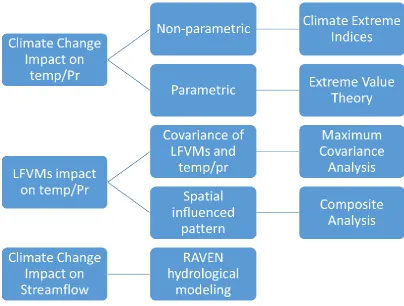
covariance analysis and hydrological modeling. Figure 4 briefly demonstrates the flowchart of
27
Figure 4. Methodology flowchart
3.5.1.
Climate extreme indices
Climate extreme indices (i.e. CLIMDEX) were defined by Expert Team on Climate Change
Detection and Indices (ETCCDI). Most of these indices represent moderate extremes that occur
at least once a year (Zhang et al., 2011). There are 27 CLIMDEX indices available that are
based on daily data from which 16 are temperature-based and 11 are precipitation-based. Some
indices can be used to estimate hydroclimatic extremes with long return periods using annual
28
CLIMDEX can be divided into two categories. One that characterizes the amounts of
maximum/minimum temperature and precipitation and the other that measure the number of
days in a year when extremes exceed certain threshold (Zhang et al., 2011). Analysis of both
types of indices are critical for the design and planning of structure and infrastructure,
agricultural and water resources management. Through a comprehensive literature review, we
selected eight indices that best represent the intensity and frequency of extreme temperature (3
indices) and precipitation (5 indices)(Karl, Nicholls and Ghazi, 1999b; Zhang et al., 2005).
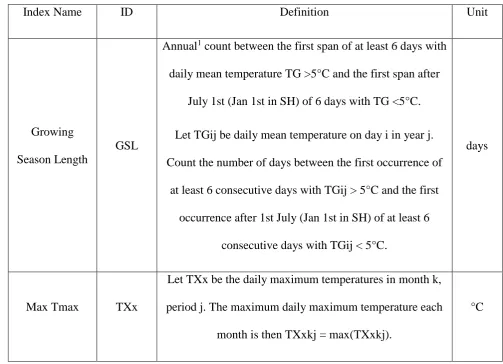
These indices are described in Table 3.
Table 3.Climate extreme indices (CLIMDEX) that are analyzed in this study
Index Name ID Definition Unit
Growing
Season Length
GSL
Annual1 count between the first span of at least 6 days with
daily mean temperature TG >5°C and the first span after
July 1st (Jan 1st in SH) of 6 days with TG <5°C.
Let TGij be daily mean temperature on day i in year j.
Count the number of days between the first occurrence of
at least 6 consecutive days with TGij > 5°C and the first
occurrence after 1st July (Jan 1st in SH) of at least 6
consecutive days with TGij < 5°C.
days
Max Tmax TXx
Let TXx be the daily maximum temperatures in month k,
period j. The maximum daily maximum temperature each
month is then TXxkj = max(TXxkj).
°C
1Annual means Jan 1st to Dec 31st in the Northern Hemisphere (NH); July 1st to June 30th in the Southern
29
Min Tmin TNn
Let TNn be the daily minimum temperatures in month k,
period j. The minimum daily minimum temperature each
month is then TNnkj=min(TNnkj)
°C Number of Heavy Precipitation Days R10
Let RRij be the daily precipitation amount on day i in
period j. Count the number of days where RRij ≥ 10mm
days
Max 5-day
Precipitation
Amount
RX5day
Let RRkj be the precipitation amount for the 5-day interval
ending k, period j. Then maximum 5-day values for period
j are Rx5dayj = max (RRkj)
mm
Simple Daily
Intensity Index
SDII
Let RRwj be the daily precipitation amount on wet days, w
(RR ≥ 1mm) in period j. If W represents number of wet
days in j, then:
𝑆𝐷𝐼𝐼𝑗 =∑ 𝑅𝑅𝑤𝑗
𝑊 𝑤=1
𝑊
mm/day
Very Wet Days R95pTOT
Let RRwj be the daily precipitation amount on a wet day w
(RR ≥ 1.0mm) in period i and let RRwn95 be the 95th
percentile of precipitation on wet days in the 1961-1990
period. If W represents the number of wet days in the
period, then:
𝑅95𝑝𝑇𝑂𝑇 = ∑ 𝑅𝑅𝑤𝑗
𝑊
𝑤=1
𝑤ℎ𝑒𝑟𝑒 𝑅𝑅𝑤𝑗 > 𝑅𝑅𝑤𝑛95