The Weakness of Integrity Protection for LTE
Teng Wu and Guang Gong
Department of Electrical and Computer Engineering
University of Waterloo
Waterloo, ON N2L 3G1, Canada
{
teng.wu, ggong
}
@uwaterloo.ca
Abstract
In this paper, we concentrate on the security issues of the integrity protection of LTE and present two different forgery attacks. For the first attack, referred to as a linear forgery attack, EIA1 and EIA3, two integrity protection algorithms of LTE, are insecure if the initial value (IV) can be repeated twice during the life cycle of an integrity key (IK). Because of the linearity of EIA1 and EIA3, given two valid Message Authentication Codes (MACs) our algorithm can forge up to 232valid MACs. Thus, the probability of finding a valid MAC is dramatically increased. Although the combination of IV and IK never repeats in the ordinary case, in our well-designed scenario, the attacker can make the same combination occur twice. The duplication provides the opportunity to conduct our linear forgery attack, which may harm the security of communication. To test our linear forgery attack algorithm, we generate two counter check messages and successfully forge the third one. We also examine the attack timing by simulating real communication. From the experimental results, our attack is applicable. The second attack is referred to as atrace extension
forgery attack, which works only in theory. However, this attack is more general than the linear
forgery attack. Known only one MAC and message pair, we can construct a different message, who has the same MAC as the original one, with the probability 2116. In this attack, trace function is
applied to the message to shrink the guessing space.
Index Terms. Forgery, MAC, LTE, man-in-the-middle.
1
Introduction
After more than twenty years evolution, cellular system has evolved to the fourth generation.
Se-curity issues of the cellular system are attracting more and more attention, because the expenses of
attacking the system are much cheaper than before.
Integrity protection can protect messages from being modified. It also can prevent the impersonation
attacks. Thus, integrity protection is important in communication, especially in wireless channels.
Compared with wired transmission, active eavesdropping in a wireless environment is relatively easy.
Without integrity protection, attackers can modify messages transmitted over the air as they wish.
In the public key cryptography domain, integrity is protected by digital signatures; similarly, in
inefficient, in some resource-constrained applications, integrity protection is always based on MACs.
A MAC-generating algorithm usually has two components: the underlying cipher and the upper-level
structure. An underlying cipher could be the keyed hash function, block cipher or stream cipher. The
input messages of the algorithm are allowed to have arbitrary length. Input messages pass through the
underlying cipher and become cipher text. This cipher text is assembled by the upper-level structure
to get a length-fixed string, which is the output of the MAC. There are many widely used MACs, such
as HMAC [7], EMAC [11], XCBC [9], OMAC [18], TMAC [13] and XOR MAC [8].
One threat to integrity protection is forgery attacks. If an attacker wants to impersonate some
identities or to modify some messages, he must have the ability to forge the MAC (or the signature
in public key cryptography) of some specific data. In this paper, since the cellular communications
are protected by MACs, we focus on a forgery attack on MAC. There are basically two ways to forge
a MAC: breaking the underlying cipher or bypassing the underlying cipher. The former one is hard
to achieve, since the underlying ciphers are usually chosen to be classical ciphers, which have already
been proven to be secure in both theory and practice. Thus, attackers always choose the latter one,
when they try to forge a MAC. We also chose the latter way, which means our goal is to bypass the
underlying ciphers of the cellular system to forge a MAC.
To bypass the underlying cipher, the attacker can apply either a probabilistic method or a structure
dependent method. The probabilistic method, for example, the birthday attack, can be launched at
most MAC generating algorithms. Although its target is general, the result of a birthday attack is not
very significant, because the searching complexity is still exponential. The attack is also not realistic,
because in practice, the attacker is not allowed to make that many queries. In contrast, some
structure-dependent attacks, which only target on certain MAC-generating algorithms, are more implementable.
Our method being able to forge depends on the linear structures of some specific MACs. It is also a
kind of structure-dependent method.
1.1
Applications of MAC in LTE
UMTS and LTE are two cellular standards proposed and maintained by 3GPP. UMTS is considered
a third-generation cellular communication system. Its successor is called LTE, which is considered
to be the fourth generation. As wireless communication systems, the resources of mobile devices are
constrained. Thus, MACs are used to protect the integrity of these two systems. In UMTS, the
underlying ciphers of MACs are Kasumi [3] and Snow 3G [1]. The former is a block cipher, and the
latter is a stream cipher. When UMTS migrated to LTE, AES was standardized. Consequently, Kasumi
has been replaced by AES. Besides AES and Snow 3G, a new stream cipher, ZUC [5], has been added
into the current standard.
Kasumi and Snow 3G respectively. In LTE, integrity protection algorithms are called EIA. EIA1 is
adopted from UIA2, which is based on Snow 3G; EIA2 is based on AES, and EIA3 [4] is based on
ZUC. We use EIA in this paper to name these integrity protection methods in accordance with LTE,
the latest standard.
1.2
MAC Based On Stream Ciphers and EIA
Wireless communication is widely used in daily life. As a result, stream ciphers are becoming more
important than ever before. Originally, most MACs were based on keyed hash functions and block
ciphers. Now some researchers have turned to the design of MACs based on stream ciphers.
In the past, the research on stream ciphers based MACs has not received much attention as that
of block ciphers or hash functions based MACs. Recently, researchers have realized the importance of
MACs using stream ciphers. Some significant work has been presented, such as GMAC [15], Grain-128a
[6], EIA1, and EIA3. The underlying cipher of GMAC is a block cipher in counter mode, which makes
a block cipher act as a stream cipher. Thus, GMAC can work with other stream ciphers directly.
Both EIA1 and EIA3 have adopted some ideas from GMAC with some modifications to form their own
MAC-generating algorithms.
It is publicly acknowledged that EIA2 can be considered as a secure MAC-generating algorithm,
because it utilizes AES as the underlying cipher and CMAC as the MAC structure. AES is widely used
for commercial purposes, and gets many analyses from academic study. AES has proven to be secure
so far both theoretically and practically. CMAC is a kind of CBC MAC. Such kinds of MACs have
already received many analyses, and proven to be secure.
Unlike EIA2, grounds for trusting EIA1 and EIA3 are not so solid. Since they are not as popular
as AES and CBC MAC, the security of these algorithms is still not well studied. To the authors’ best
knowledge, there has been no significant attack on EIA1 so far, which means it does not evolve after it
is created. EIA3 receives more attacks. But only some of them are significant.
1.3
Related Work
There is already some work analyzing the EIA family. The following attacks are two of the most
significant.
Cycling Attack [17] can be applied to all polynomial MACs. Since EIA1 is a kind of polynomial
MAC, it also suffers such attacks.
ZUC and EIA3 were published later than Snow 3G and EIA1. However, EIA3 has received more
analyses than EIA1. The attack [19] proposed by Thomas et al. makes EIA3 change from v1.3 to v1.5.
After changing to v1.5, EIA3 does not suffer such attacks any more. However, it is still not immune to
1.4
Our Contributions
Linear structures of EIA1 and EIA3 enable us to forge a valid MAC if we know two MACs generated
by the same IV and IK. On top of such facts, we develop a method that, with known two valid MACs,
we can forge up to 232valid MACs by introducing a coefficientλ. Since we have 232valid MAC-message pairs, the probability of finding a pair with valid MAC and valid message is quite high. Statistically,
there is more than one meaningful pair among those 232 pairs. For brute-force attacks, the probability
of finding the valid MAC of a message is 2132. Now the probability that we get a meaningful
MAC-message pair is increased to more than 2132. In fact, finding theλthat can generate a meaningful pair
is much easier in practice than finding it in theory, because the messages usually have some specific
structures. Those structures may shrink the searching space. In addition, such an attack does not aim
at only EIA1 and EIA3 but also at some general polynomial MACs.
To prove that our linear forgery attack is doable, we create a scenario from which our attack can
be launched. Such a scenario is based on the observation that the authentication of LTE and UMTS is
not really mutual, although it is claimed to be a mutual authentication. In Extensible Authentication
Protocol - Authentication and Key Agreement (EAP-AKA), only the server sends the challenge to a
client. Checking the response of the challenge, the server can authenticate clients. Nevertheless, a
client does not challenge the server. Thus, it can only authenticate a server by checking the MAC of
the authentication vector. Such a protocol leaves a hole for the replay attack. Ordinarily speaking, the
replay attack cannot get anything. However, because of our attack, the replay attack makes the forgery
possible.
The second attack that we propose in this paper is referred to as a trace extension forgery attack.
For this attack, we can construct a new message, who has the same MAC as the known message, with
the probability 1
216. The observation is that we can extend the original message such that the difference
between the original MAC and the new MAC is a function ofβ over GF(264), whereβ ∈GF(216)⊂
GF(264). Then the probability of guessing β is 2116, which is greater than the probability of guessing
the MAC. If we get the correctβ, then we can forge the message.
The rest part of this paper is organized as followings. In Section 2 we introduce MACs and the EIA
family. In Section 3, we present some security issues of EIA1 and EIA3, and present the linear forgery
attack. In Section 4, we show how the trace extension forgery attack works. Section 5 describes a
scenario from which the linear forgery attack can be launched in practice, and shows some experimental
2
Preliminary
In this section, we introduce the definition of the linear operation. This concept is the vital part of
our attack. Generally, most polynomial MACs, such as EIA1 and EIA3, have this linear property.
2.1
Notation, Definition and Data Representation
For the purpose of this paper, theLinear Operation is defined as
Definition 1 F(x)represents the operation F applied tox. If the operationF satisfies
• F(a+b) =F(a) +F(b)
• F(c·a) =cF(a),
wherea,bandcare from a Galois Field;a,bandc·a∈Domain of F, thenF is called linear operation.
We also need a function that can map an element in a Galois field to an integer.
Definition 2 A function N at(x) : GF(264) 7→
Z. ∀x ∈ GF(264), x can be represented as a binary
number under the normal basis. FunctionN at(x)returns this binary number as an integer.
Trace function maps an element in a Galois field to its subfield. We borrow the definition of trace
function from Golomb and Gong [12].
Definition 3 Let q be a prime or a power of a prime. Forα∈F =GF(qn)andK=GF(q), the trace function T rF /K(x),x∈F, is defined by
T rF /K(x) =x+xq+· · ·+xq
n−1
, x∈F.
We can easily proveT rF /K(x)∈GF(q). Thus we omit the proof [12] here.
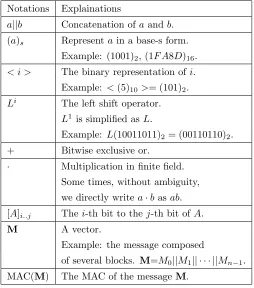
Table 1 lists all notations used in this paper.
In the following part of this paper, all data variables are presented with the most significant bit on
the left-hand side. For example,V is a 64-bit integer,< V >= (V0V1· · ·V62V63)2, whereVi is thei-th
bit ofV. V0is the most significant bit.
We use the term “package” and “message” to represent the protocol data unit and the information
that carried by the package respectively. Package is composed of the header (used for control) and
the message. Take the counter check message for example, it is a package of radio resource control
(RRC) protocol. The control message sequence number (SQN) is the header, and the values of different
Table 1: Notations used in this paper
Notations Explainations
a||b Concatenation ofaandb. (a)s Representain a base-s form.
Example: (1001)2, (1F A8D)16.
< i > The binary representation ofi. Example: <(5)10>= (101)2.
Li The left shift operator.
L1 is simplified asL.
Example: L(10011011)2= (00110110)2.
+ Bitwise exclusive or.
· Multiplication in finite field. Some times, without ambiguity,
we directly writea·b asab. [A]i..j Thei-th bit to thej-th bit ofA.
M A vector.
Example: the message composed
of several blocks. M=M0||M1|| · · · ||Mn−1.
2.2
CBC-MAC, XOR MAC and GMAC
In wireless communication network, MAC is one of the most important elements to secure the
system. CBC-MAC and XOR MAC are two well-known MACs. CBC-MAC comes from the CBC mode
of block ciphers. There are a lot of variations of CBC-MAC, such as EMAC [11], XCBC [9], OMAC [18]
and TMAC [13]. XOR MAC [8] has two categories, XMACC and XMACR. Compared with CBC-MAC,
the structure of XOR-MAC is relatively simple.
GMAC has different design compared with CBC-MAC and XOR MAC, because it is based on the
counter mode of the block cipher. GMAC [15] is standardized by NIST in 2007. When it is used for
encrypted authentication, it is called GCM. GCM outputs both the encrypted data and MAC. When
it is only used to generate MAC without encryption, it is called GMAC. Unlike GCM, GMAC does
not output the encrypted data. GMAC is composed of two parts, GCTR and GHASH. GCTR is the
counter mode of a block cipher. GHASH is a polynomial hash function. Messages first are encrypted
by GCTR, and then passed through GHASH.
2.3
EIA1, EIA2 and EIA3
Because both the underlying cipher and the upper-level structure of EIA2 are proven to be secure,
we do not discuss it in this paper. Hence, in this section, we present more details of EIA1 and EIA3
than of EIA2.
2.3.1 EIA1
...
Truncate
M1 M2 Mn−1 LEN Q
P
OT P
OU T P U T
Figure 1: EIA1: based on Snow 3G
EIA1 is adopted from UIA2. The underlying cipher is Snow 3G. In the evaluation of EIA1, it is said
that EIA1 comes from GMAC. In fact, it only borrows the idea of GHASH. Thus, EIA1 is considered
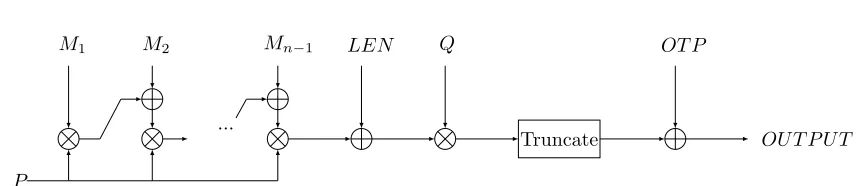
to be a polynomial MAC. Details of EIA1 are shown in Figure 1. At the beginning stage of EIA1, Snow
are 64-bit words. OT P is a 32-bit word. In Figure 1, Mi is thei-th block of message. The length of
each block is 64 bits.
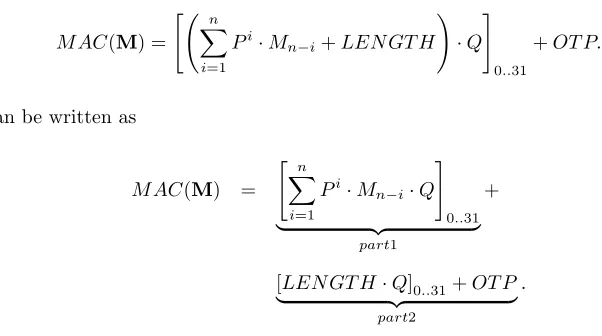
The mathematical description of EIA1 is given by
M AC(M) = " n
X
i=1
Pi·Mn−i+LEN GT H
!
·Q
#
0..31
+OT P. (1)
Equation 1 can be written as
M AC(M) = " n
X
i=1
Pi·Mn−i·Q
#
0..31
| {z }
part1
+
[LEN GT H·Q]0..31+OT P
| {z }
part2
.
Part 1 is a linear operation of the message. Part 2 is a value only relevant to the length of the message.
If the length is fixed, part 2 is a constant. So MAC is computed by a linear combination of one linear
block operation and a constant.
2.3.2 EIA2
Kasumi is replaced by AES in the new standard. Accordingly, EIA2 is put into the standard to
replace UIA1. The underlying cipher of EIA2 is AES. As a block cipher, AES can use some existing MAC
generating algorithms without any changes. CMAC [14] is chosen as the MAC generating algorithm of
EIA2. CMAC is a kind of CBC-MAC, which has already been well studied.
2.3.3 EIA3
M[0]
Z0
M[1]
Z1
M[n−1]
Zn−1
...
ZLEN Z32∗(L−1)
OU T P U T
Originally, ZUC is not in UMTS. It is added to the standard after the system migrates to LTE. The
integrity protection based on ZUC is EIA3. The same as EIA1, EIA3 is also claimed to be GMAC.
However, Figure 2 suggests that it is much closer to XOR MAC. In Figure 2, M[i] is the i-th bit of message,Zi is thei-th word of the key stream generated by ZUC.Zi starts with thei-th bit of the key
stream. EIA3 pads every message with a ”1”. Z32∗(L−1) is the mask to encrypt the intermediate tag.
Lis equal todLEN GT H/32e+ 2.
A mathematical expression of Figure 2 is given by
M AC(M) =
n−1
X
i=0
M[i]zi
| {z }
part1
+zLEN GT H+z32∗(L−1)
| {z }
part2
,
whereM[i] is thei-th bit of message;ziis thei-th word in the key stream, i.e. zi=z[i]||z[i+1]|| · · · ||z[i+
31];L=dLEN GT H/32e+ 2. The main observation of EIA3 is that Part 1 is a linear operation. This is very straightforward:
X
i
(M[i] +M0[i])zi =
X
i
(M[i]zi+M0[i]zi)
= X
i
M[i]zi+
X
i
M0[i]zi.
Part 2 is a constant if the length is fixed.
2.4
IV Synchronization Mechanism
EIA1, EIA2 and EIA3 synchronize IVs in the same way. As required by the EIA family,COU N T−I
andF RESHare input as parameters to form IV of the underlying cipher. F RESHis a random number.
COU N T−I is a counter that records how many times IK has already been used so far. It contains two parts, SQN and hyper frame number (HFN). SQN is the sequence number. It is increased after a
package is sent. When SQN overflows, HFN is increased. COU N T−IandF RESH together are used to prevent replay attacks.
F RESH andCOU N T−I are written in the package to synchronize the transmitter and receiver, which maintain two counters, namedCOU N T ERtxandCOU N T ERrx, respectively. The transmitter
uses COU N T ERtx as the value of its COU N T −I, and then generates key streams. When the
receiver receives a package, the value ofCOU N T−I is compared with the value ofCOU N T ERrx. If
the value of COU N T −I is greater than COU N T ERrx, F RESH is used to form IV together with
3
Security Issue of EIA1 and EIA3
We present our work in this section. Compared with other works before, our attack is more practical.
We need only two valid MACs to forge another valid MAC.
3.1
Quasi-Linearity Property of EIA1 and EIA3
LetM= (M0, M1,· · ·, Mn−1), whereMiis a 64-bit vector, treated as an element inGF(264), which
is defined by a primitive polynomialt(x) =x64+x4+x3+x+ 1. Letαbe a root oft(x) inGF(264),
and letβ =α232+1. Thenβ is a primitive element of GF(232), a subfield of GF(264). The minimal
polynomial ofαoverGF(232) is given by
t1(x) =x2+ux+v,
where u=β17, v =β. Then each element inGF(264) can be represented asa+bα, a, b∈GF(232).
We define
f(M, P) =
n
X
i=1
Mn−iPi, f or P ∈GF(264), Mi ∈GF(264).
Property 1 For any λ∈GF(232)⊂GF(264),
M1= (M1,0, M1,1,· · · , M1,n−1)
M2= (M2,0, M2,1,· · · , M2,n−1),
then
f(M1+M2, P) =f(M1, P) +f(M2, P) (2)
f(λM, P) =λf(M, P). (3)
Proof 1 According to the definition of f(M, P), we have
f(M1+M2, P) = n
X
i=1
(M1,n−i+M2,n−i)Pi
=
n
X
i=1
M1,n−iPi+ n
X
i=1
M2,n−iPi
= f(M1, P) +f(M2, P).
f(λM, P) =
n
X
i=1
(λMn−i)Pi
= λ
n
X
i=1
Thus, the assertions are true.
We have the MAC ofM generated by EIA1 as
M AC(M) = [Q·f(M, P)]0..31+ [Length·Q]0..31+OT P
LetQ·f(M, P) =a+bα,Length·Q=c+dα, a,b,c, andd∈GF(232). From the MAC generation
of EIA1 in Section 2.3.1 and Property 1, the following result follows immediately.
Property 2 For any λ∈GF(232),
M AC(M) = a+c+OT P (4)
M AC(λM) = λa+c+OT P. (5)
EIA3 has the same property of Property 2. In other words, 4 and 5 are true, where MAC is generated
by EIA3. The proof is straightforward. Thus, we omit it here.
3.2
Linear Forgery Attack Algorithm
Assume that we can make three queries to obtain MACs of the messagesMi, for i= 1,2,3, under
the same IV. Let
Q·f(Mi, P) =ai+biα, ai, bi∈GF(232). (6)
Theorem 1 Let (i, j, k)be a permutation of (1,2,3). For anyλ∈GF(232)
M AC(Mnew) =λ(M AC(Mi) +M AC(Mj)) +M AC(Mk) (7)
which is a valid MAC value of the message
Mnew=λ(Mi+Mj) +Mk.
Proof 2 We give a proof only for (i, j, k) = (1,2,3), since the proofs for the other cases are similar. In order to prove (7), we compute the results of both sides of (7). According to Properties 1 and 2
M AC(Mnew) =λ(a1+a2) +a3+c+OT P. (8)
On the other hand,
λ(M AC(M1) +M AC(M2))) +M AC(M3)
= λ(a1+c+OT P +a2+c+OT P) +a3+c+OT P
= λ(a1+a2) +a3+c+OT P. (9)
From (7), we have the following corollary.
Corollary 1 Let (i, j)be a permutation of(1,2), andk∈(1,2). For anyλ∈GF(232),(7) is true. In other words, if we have the valid MACs from two queries, then
M AC(λ(M1+M2) +M1)
=λ(M AC(M1) +M AC(M2)) +M AC(M1)
M AC(λ(M1+M2) +M2)
=λ(M AC(M1) +M AC(M2)) +M AC(M2)
are valid.
From Corollary 1, we need only two valid MACs to forge a new one. In practice, we can reduce the
number of queries by applying Corollary 1. Obtaining two valid MACs generated by the same IV is
much easier than obtaining three.
The algorithm to forge a valid MAC by using two known valid MACs is shown in Algorithm 1,
where f indλ() is a function that returns a λsuch that either λ(M1+M2) +M AC(M1) orλ(M1+
M2) +M AC(M2) is a valid message. How to find λ, such that the message is also valid, is discussed
in Section 3.3.
Algorithm 1:Linear forgery
Data: two messagesM1,M2, and the MACs of these two messagesM AC(M1),M AC(M2)
Result: one message and its valid MAC
λ=f indλ();
temp=λ(M1+M2);
if temp+M1 is a valid message then Mnew=temp+M1;
M AC(Mnew) =λ(M AC(M1) +M AC(M2)) +M AC(M1);
else
Mnew=temp+M2;
M AC(Mnew) =λ(M AC(M1) +M AC(M2)) +M AC(M2);
end
returnM AC(Mnew)andMnew;
Remark 1 EIA’s MAC has 32 bits. An attacker wishes to forge a valid MAC, it is equivalent to him
queries for obtaining two valid MACs, then he can forge 232 messages with valid MACs. In Section 5,
we will demonstrate how the attacker can obtain two valid MACs in practice.
3.3
How To Find
λ
We randomly pick aλ, then we can get a MAC of a message. However, this message may not be a valid message for a protocol. Thus, the problem is how to find aλthat can generate the MAC of a valid message.
Usually in a real environment, it is easier to find λ, because there is a relationship between these two known messages, such as the relationship between two counter check messages. Two counter check
messages have very similar structures. Therefore, most bits in the exclusive or of two counter check
messages are zeros. We need to consider only very few bits, which are nonzero.
Moreover, even if we cannot find the valid message, our linear forgery attack can still cause some
Denial-of-Service (DoS) attacks. Because the MAC is valid, every time the receiver must do the decoding
and then finds the message is not well formatted, the computational resource will be occupied by
verifying and decoding.
4
Trace Extension Forgery Attack
This attack focuses only on EIA1. Assume, we have the message M = M0||M1|| · · · ||Mn−1 and
M AC(M). From EIA1 we know
M AC(M) = " n
X
i=1
Pi·Mn−i+LEN GT H
!
·Q
#
0..31
+OT P.
Let
g(M) =
n
X
i=1
Pi·Mn−i.
Then we have the Lemma 1.
Lemma 1 Extend the messageM toMnew=c0|| · · · ||cN−n−1||cN−n+M0|| · · · ||cN−1+Mn−1, where
N ≥248,
ci=
(
α, for i =N−1,N−216,N−232,N−248,α∈GF(264);
0, others.
Let F=GF(264)andK=GF(216). Then we have
Proof 3 The proof is very straightforward.
g(Mnew) = n
X
i=1
Pi(Mn−i+cN−i) + N
X
i=n+1
PicN−i
= g(M) +α·(P248+P232+P216+P)
= g(M) +α·T rF /K(P).
Theorem 2 If the integrity protection method is EIA1, then the probability of finding a message, which
has the same MAC as a known message, is no less than 1 216.
Proof 4 Assume we have a message M, whose length isLEN, and its MAC is M AC(M). We con-struct a method that can find another message, whose MAC is also M AC(M). From Lemma 1, Mnew has the property thatg(Mnew) =g(M) +α·T rF /K(P). Since αcan be arbitrary element in GF(264), thus we always have at least oneαsuch thatN at(α·T rF /K(P) +LEN)≥N at(LEN), whereN at(x) :
GF(264)7→
Zis the function we defined before. Lett=N at(α·T rF /K(P)+LEN)−N at(LEN). We pad
tzeros to the left side of Mnew to get another message denoted byMf. Obviously,g(Mnew) =g(Mf). Thus the MAC ofMf is
M AC(Mf) =
(g(Mnew) +α·T rF /K(P) +LEN)·Q
0..31+OT P
=
(g(M) +α·T rF /K(P) +α·T rF /K(P) +LEN)·Q
0..31+OT P
= [(g(M) +LEN)·Q]0..31+OT P
= M AC(M).
To getMf, we need to guessT rF /K(P). SinceT rF /K(P)mapsP toGF(216), the probability of guessing
T rF /K(P)is 2116.
Remark 2 The proof of Theorem 2 naturally gives a way to find the message, who has the same MAC
as the original one. Instead of guessing the MAC, whose probability is 1
232, our method tries to find the message, who has the specific MAC. The success probability of trace extension forgery attack is 2116, which is much greater than 2132.
5
Application of Linear Forgery Attack
In this section, we design a scenario in which the same IV and IK will occur twice. Following this,
5.1
A Scenario of Fixing IV
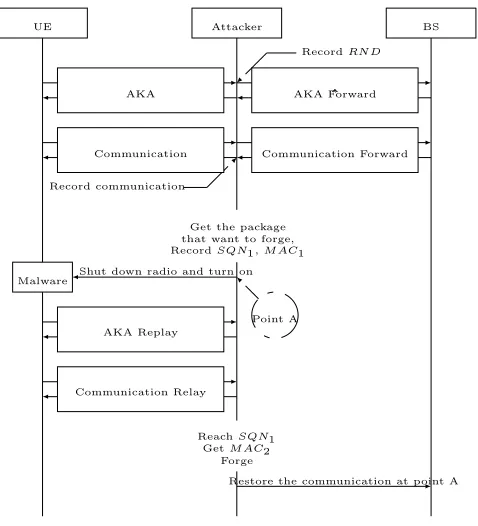
Figure 3 demonstrates the procedure by which we can get the same SQN together with the same IK.
The preconditions are: (1) we can set up the man-in-the-middle (MITM), and (2) there is a malware
on the phone that can shut down and turn on the radio. Perez et al. [16] show that Condition (1) is
applicable. Condition (2) is also easy to satisfy. We can choose the Android smart phone to be our
target because Android is an open platform, which is popular around the world.
UE Attacker BS
AKA AKA Forward
Communication Forward RecordRN D
Record communication
Get the package that want to forge, RecordSQN1 ,M AC1
Malware Shut down radio and turn on Communication
AKA Replay
Communication Relay
Point A
ReachSQN1 GetM AC2
Forge
Restore the communication at point A
Figure 3: Fixing IV
First, the MITM attacker records all user data messages and control messages, including the
au-thentication and key agreement messages. When this attacker observes the package he wants to forge,
he shuts down the radio of the victim and then turns it on. The MITM attacker uses the recorded
AKA messages to conduct a replay attack. In the AKA protocol, mobile devices are not required to
verify whether the random number has been received before or not. Thus, the victim believes it is
talking with the real base station. Notice that the EAP-AKA is claimed to be mutually authenticated.
The user equipment (UE) proves its identity to an radio network controller (RNC) by replying to the
challenge from the RNC. However, since the UE does not send the challenge to the RNC, the RNC
authentication vector can make sure each authentication vector is unique. However, the UE cannot
record all random numbers it received before. This enables the replay attack. Such attack makes the
UE accept the fake RNC. Generally, the attacker can get nothing from the replay attack, because he
still cannot get the key. But in our case, we do not care about the key. The only thing we care about
is the SQN. As long as we get two identical SQNs with the same IK, we can launch our linear forgery
attack.
After the victim accepts the random number, it generates the same IK, which is also used in the
session suspended by the attacker. When the victim believes the attacker is the real base station, it
begins to send packages. The attacker replies with the previously recorded packages. The victim may
accept or reject those packages, but it does not matter, because the only target for the attacker is to
increase the victim’s counter until the SQN reaches the recorded value.
As long as we get the sequence number that we want, the MITM attacker applies our linear forgery
attack to forge a valid MAC of the package. This forged package together with the forged MAC will
be forwarded to the real base station. Since the MAC will pass the verification, this package will be
accepted.
5.2
Counter Check Message
A realistic application of our linear forgery attack is that we can forge the counter check message.
In LTE, the integrity of the user plane is not protected. Thus, the counter check message is sent from
the RNC to the UE to check the number of data packages that have been transmitted. The RNC
includes the most significantsbits of its counter in the counter check message. When the UE receives the counter check message, it compares its own counter with the value included in the counter check
message and sends its counter’s value back. If the difference is not acceptable, the RNC will release
the connection. This procedure is shown in Figure 4. Chen et al. [10] present more details about the
counter check message.
We want to forge the counter check message because sometimes the attacker inserts some data into
user plane data. If the counter check message is conducted correctly, the RNC will find out the insertion.
For example, the MITM attacker inserts a redirect URL command or advertisement into the web page
that the user is browsing. He must expect that RNC cannot detect the insertion. Then he needs to
modify the counter check message.
5.3
Launching Attack
We assume that the MAC-I in Figure 4 is generated by EIA1 or EIA3. IVs of EIA1 and EIA3
are composed of two portions. The least significant four bits represent the Radio Resource Controller
UE RNC
1. Counter check(Cc, F RESH, M AC−I)
2. Counter check response(Cc , F RESH, M AC0 −I)
3. Release connection, if failed
Figure 4: Counter Check Message.
signal is sent, the RRC SQN is increased by one. If there is an overflow of the RRC SQN, the HFN is
increased by one.
Attacking scenario:
1. RNC sends a counter check message to the MITM attacker.
2. The MITM attacker forwards this message to the UE, and gets the reply form the UE withM AC1.
3. The MITM attacker applies the attack we mentioned above, and getsM AC2.
4. The MITM attacker forges λ(M AC1+M AC2) +M AC1 or M AC2+λ(M AC1+M AC2), then
forwards to the real base station.
5. The RNC finds the difference is acceptable, and continues to communicate with the MITM
at-tacker.
6. The MITM attacker can continue to forward messages between the RNC and the UE without
being detected by the RNC.
This process creates a forged MAC. In this procedure, there is a drawback, i.e., the connection between
the MITM attacker and the RNC may time out during the forgery process. So such attack can forge
only the counter check message that is sent not too long after powering up.
5.4
Experimental Results
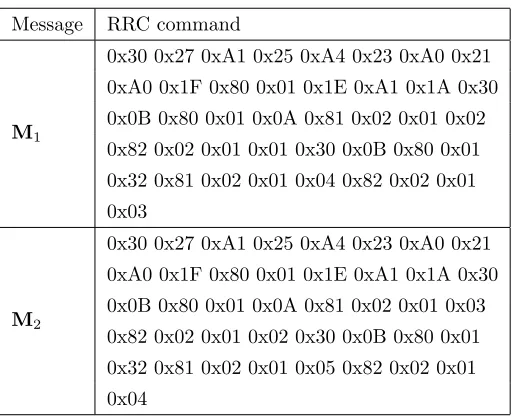
In order to test our attack, we generate two counter check messages, in which there are two counters,
Table 2: Counter Check Messages
Message Identity UCounter DCounter
M1 10 258 257
50 260 259
M2
10 259 258
50 261 260
Table 3: Counter Check Messages in Hex
Message RRC command
M1
0x30 0x27 0xA1 0x25 0xA4 0x23 0xA0 0x21
0xA0 0x1F 0x80 0x01 0x1E 0xA1 0x1A 0x30
0x0B 0x80 0x01 0x0A 0x81 0x02 0x01 0x02
0x82 0x02 0x01 0x01 0x30 0x0B 0x80 0x01
0x32 0x81 0x02 0x01 0x04 0x82 0x02 0x01
0x03
M2
0x30 0x27 0xA1 0x25 0xA4 0x23 0xA0 0x21
0xA0 0x1F 0x80 0x01 0x1E 0xA1 0x1A 0x30
0x0B 0x80 0x01 0x0A 0x81 0x02 0x01 0x03
0x82 0x02 0x01 0x02 0x30 0x0B 0x80 0x01
0x32 0x81 0x02 0x01 0x05 0x82 0x02 0x01
5.4.1 Forge Procedure
The xor sum of these two messages is
0x00 0x00 0x00 0x00 0x00 0x00 0x00 0x00
0x00 0x00 0x00 0x00 0x00 0x00 0x00 0x00
0x00 0x00 0x00 0x00 0x00 0x00 0x00 0x01
0x00 0x00 0x00 0x03 0x00 0x00 0x00 0x00
0x00 0x00 0x00 0x00 0x01 0x00 0x00 0x00
0x07
Then choseλ=0x1B,λ(M1+M2) is
0x00 0x00 0x00 0x00 0x00 0x00 0x00 0x00
0x00 0x00 0x00 0x00 0x00 0x00 0x00 0x00
0x00 0x00 0x00 0x00 0x00 0x00 0x00 0x1B
0x00 0x00 0x00 0x2D 0x00 0x00 0x00 0x00
0x00 0x00 0x00 0x00 0x1B 0x00 0x00 0x00
0x41
Finally, we get the messageMnew=M2+λ(M1+M2)
0x30 0x27 0xA1 0x25 0xA4 0x23 0xA0 0x21
0xA0 0x1F 0x80 0x01 0x1e 0xa1 0x1A 0x30
0x0B 0x80 0x01 0x0A 0x81 0x02 0x01 0x18
0x82 0x02 0x01 0x2F 0x30 0x0B 0x80 0x01
0x32 0x81 0x02 0x01 0x1E 0x82 0x02 0x01
0x45
This message is represented in a binary form. Decoding the binary message, we get the result shown
in Figure 5, which demonstrates the xml form of the binary message. From Figure 5, it is obvious that
the forged message still contains the counter values of the bearers 10 and 50. The uplink and downlink
counter values of the bearer 10 are 577 and 531 respectively. They are increased compared with the real
values. The counter values of the bearer 50 are increased as well. The forged value of uplink counter is
274, and the forged downlink counter value is 352. We can also verify the MAC of the messageMnew.
M AC(Mnew) is indeedM AC2+λ(M AC1+M AC2). Therefore we successfully forge a valid package,
in which the value of each counter is increased, and the MAC of the message is valid. This means if the
<DL-DCCH-Message> <message>
<counterCheck> <r3>
<counterCheck-r3>
<rrc-TransactionIdentifier>30</rrc-TransactionIdentifier> <rb-COUNT-C-MSB-InformationList>
<RB-COUNT-C-MSB-Information> <rb-Identity>10</rb-Identity>
<count-C-MSB-UL>577</count-C-MSB-UL> <count-C-MSB-DL>531</count-C-MSB-DL> </RB-COUNT-C-MSB-Information> <RB-COUNT-C-MSB-Information>
<rb-Identity>50</rb-Identity>
<count-C-MSB-UL>274</count-C-MSB-UL> <count-C-MSB-DL>352</count-C-MSB-DL> </RB-COUNT-C-MSB-Information> </rb-COUNT-C-MSB-InformationList> </counterCheck-r3>
</r3> </counterCheck> </message> </DL-DCCH-Message>
Figure 5: Decoding result
5.4.2 Timing of Attack
Turning the radio off and on usually costs three to six seconds. If RNC does not time out within
this range, our attack can be launched. There is no requirement for this time-out duration in the
standard. It is decided by the manufacturer. We cannot make a direct test, because analysis of public
communications is forbidden by the law. However, since RRC commands are sent in an ARQ fashion,
we can use the retransmitting time to show the time out duration intuitively. We simulate an Additive
White Gaussian Noise (AWGN) channel. The modulation scheme is Quaternary Phase Shift Keying
(QPSK). The result is shown in Figure 6. Each column is corresponding to a set of coding parameters.
The top row shows the bit Signal to Noise Ratio (SNR), while the bottom row represents the symbol
SNR.
Figure 6 indicates that when the bit SNR or symbol SNR is around−0.2dB, the base station needs to transmit a message three times on average to ensure that the user can receive that message. If
users are in a building, such a situation may occur with high probability. To make sure all users can
get services, the time out duration must be relatively long. This may give us a chance to conduct the
attack.
6
Conclusion and Future Work
In this paper, we proposed a method whereby two known valid MAC-message pairs generated by
the same IV and IK, we can forge 232 valid MAC-message pairs. In a real environment, we can easily
0 2 4 6 0 1 2 3 4 5 6 7
re−transmission times / SNR
Bit SNR in dB
re−transmission times
0 1 2 3 4 5 0 1 2 3 4 5 6 7
re−transmission times / SNR
Symbol SNR in dB
re−transmission times
0 2 4 6 0 1 2 3 4 5 6 7 8 9 10
re−transmission times / SNR
Bit SNR in dB
re−transmission times
−1 0 1 2 3 4 0 1 2 3 4 5 6 7 8 9 10
re−transmission times / SNR
Symbol SNR in dB
re−transmission times
0 2 4 6 0 2 4 6 8 10 12 14
re−transmission times / SNR
Bit SNR in dB
re−transmission times
0 1 2 3 4 5 0 2 4 6 8 10 12
re−transmission times / SNR
Symbol SNR in dB
re−transmission times
−1 0 1 2 3 4 5 6 0 5 10 15 20 25 30
re−transmission times / SNR
Bit SNR in dB
re−transmission times
0 1 2 3 4 5 0 5 10 15 20 25 30
re−transmission times / SNR
Symbol SNR in dB
re−transmission times
Figure 6: Retransmission times / SNR
the same IV and IK occur twice. This enables our linear forgery attack in practice.
To prevent our linear forgery attack, the structures of EIA1 and EIA3 need to be changed such that
either the message is involved in generating the key stream or the MAC is generated in a nonlinear
fashion. The problem is how to find a way that can avoid linear structures without compromising
efficiency. So far, this issue seems to be a trade-off.
Although the trace extension forgery attack is only theoretical, the success probability 2116 is
con-siderable. Besides, it needs merely one pair of message and MAC. This attack shows the polynomial
like MAC is not secure.
In the next stage of our research, the way to fix IV needs some improvement, for it heavily depends
on the timing. If we can find a better way to get the same IV and IK twice, then our attack can launch
at any time of communication (not only the time not too long after powering up), and also the failure
rate caused by timing out will be reduced.
The trace extension attack can only construct the message, whose length is more than 248 blocks.
This number is too huge to be realistic. To improve, we need to reduce the length of the message.
Moreover, if we can mapP to a subfield, which is smaller than GF(216), then the probability will be
References
[1] 3GPP. Specification of the 3GPP Confidentiality and Integrity Algorithms UEA2 & UIA2.
Docu-ment 2: SNOW 3G Specification. September 2006.
[2] 3GPP. Specification of the 3GPP Confidentiality and Integrity Algorithms. Document 1: f8 and
f9 Specification. 2007.
[3] 3GPP. Specification of the 3GPP Confidentiality and Integrity Algorithms. Document 2: Kasumi
Specification. June 2007.
[4] 3GPP. Specification of the 3GPP Confidentiality and Integrity Algorithms 128-EEA3 & 128-EIA3.
Document 1: 128-EEA3 and 128-EIA3 Specification. January 2011.
[5] 3GPP. Specification of the 3GPP Confidentiality and Integrity Algorithms 128-EEA3 & 128-EIA3.
Document 2: ZUC Specification. January 2011.
[6] M. Agren, M. Hell, T. Johansson, and W. Meier. Grain-128a: A New Version of Grain-128 with
Optional Authentication. Int. J. Wire. Mob. Comput., 5(1):58–59, December 2011.
[7] M. Bellare, R. Canetti, and H. Krawczyk. Keying Hash Functions for Message Authentication. In
Proceedings of the 16th Annual International Cryptology Conference on Advances in Cryptology,
CRYPTO ’96, pages 1–15, London, UK, UK, 1996. Springer-Verlag.
[8] M. Bellare, R. Gu´erin, and P. Rogaway. XOR MACs: New Methods for Message Authentication
Using Finite Pseudorandom Functions. InProceedings of the 15th Annual International
Cryptol-ogy Conference on Advances in CryptolCryptol-ogy, CRYPTO ’95, pages 15–28, London, UK, UK, 1995.
Springer-Verlag.
[9] J. Black and P. Rogaway. CBC MACs for Arbitrary-Length Messages: The Three-Key
Construc-tions. In Proceedings of the 20th Annual International Cryptology Conference on Advances in
Cryptology, CRYPTO ’00, pages 197–215, London, UK, UK, 2000. Springer-Verlag.
[10] L. Chen and G. Gong. Communication System Security, chapter 10, pages 358–359. CRC Press
Taylor & Francis Group, 2012.
[11] P. Erez and R. Charles. CBC MAC for Real-Time Data Sources. J. Cryptology, 13:315–338, 2000.
[12] S. W. Golomb and G. Gong. Signal Design for Good Correlation For Wireless Communication,
[13] K. Kurosawa and T. Iwata. TMAC: Two-Key CBC MAC. InProceedings of the 2003 RSA
confer-ence on The cryptographers’ track, CT-RSA’03, pages 33–49, Berlin, Heidelberg, 2003.
Springer-Verlag.
[14] NIST. Recommendation for Block Cipher Mode of Operation: The CMAC Mode for
Authentica-tion. NIST Special Publication 800-38B. 2005.
[15] NIST. Recommendation for Block Cipher Modes of Operation: Galois/Counter Mode (GCM) and
GMAC. NIST Special Publication 800-38D. 2007.
[16] D. Perez and J. Pico. A Practical Attack Against GPRS/EDGE/UMTS/HSPA Mobile Data
Communications. Presented in Black Hat Conference, 2011.
[17] M.-J. O. Saarine. Cycling Attacks on GCM, GHASH and Other Polynomial MACs and Hashes.
InProceedings of the Fast Software Encryption 2012, 2012.
[18] I. Tetsu and K. Kaoru. OMAC: One-Key CBC MAC. InPre-proceedings of Fast Software
Encryp-tion, FSE 2003, FSE ’03, pages 137–161. Springer-Verlag, 2002.
[19] F. Thomas, G. Henri, R. Jean-Rene, and M. Videau. A Forgery Attack on the Candidate LTE