Available Online at www.ijcsmc.com
International Journal of Computer Science and Mobile Computing
A Monthly Journal of Computer Science and Information Technology
ISSN 2320–088X
IMPACT FACTOR: 6.199
IJCSMC, Vol. 8, Issue. 5, May 2019, pg.109 – 118
Recognition of Human Facial
Expression using Machine
Learning Algorithm
Lamia Zuha A
1; Anand M J
21
Department of ECE, PESCE, Mandya, India
²Assistant Professor, Department of ECE, PESCE, Mandya, India 1
[email protected]; 2 [email protected]
Abstract— In the vision of the computer, Human Action Recognition (HAR) plays a huge role in the research area. The human facial expressions convey a lot of information visually rather than articulately. Hence, to identify these facial expression by computer with high recognition rate was a challenging task. To overcome these problem, this paper presents a new technique for human face recognition using the real time videos. The aim of this paper is to recognizethe Human Facial Expression like joy, sadness, surprise, fear, anger and disgust from the input video having homogeneous background. The extracted features are given to the pre-processing stage to remove noise and the required features are obtained from the Pre-loaded video sequence. For this gage of work we are using Viola-Jones Algorithm to recognize face, matching algorithms is used for training data, Extreme Sparse Learning and Kernel Extreme Sparse Learning algorithm to recognize the expression of human face. The main application of this works are information security, authentication, biometric identification, video surveillance, data privacy, Human Action Recognition (HAR), Human Computer Interface (HCI), Health Care etc. It also presents the application of the machine learning algorithm to recognize and classification of facial expressions in real time video. Here the pre-loaded video sequence of the human facial expression is given as the input to the MATLAB software to obtain the ideal output. This paper can be implemented using the High Configuration MATLAB simulation software.
Keywords— Human Facial Expression, HAR, HCI, Viola - Jones Algorithm, Matching Algorithm, ESL and KESL.
I. INTRODUCTION
described by Emotions. Basics emotions are categorized into six classes: JOY, SADNESS, SURPRISE, FEAR, ANGER and DISGUST. These are the basic six emotions that blend to form complex emotions. The Viola-Jones algorithm is real-time processing system for face detection. It is designed by applying AdaBoost algorithms for rectangular features classifier in "cascade" stages [2]. The primitive concept allows background image are discarded quickly and their face detection proceeded in 15 frames per second (fps) [1]. The main objective of this project is to recognition/analyse the problems existed in HAR and to develop a robust human facial expression recognition algorithm which helps to recognize many actions such as: joy, sadness, surprise, fear, anger and disgust etc., from the input video sequences. It also check the performance in the fusion of activities which includes emotions of person are mapping and testing for HAR System [3].
II. PROPOSEDWORK
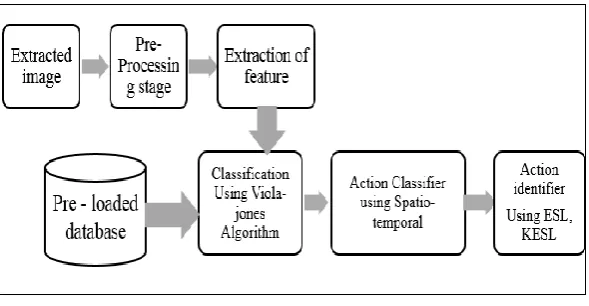
The proposed work is as shown in Figure.1 and it consists of any input video sequence that is been considered for the detection of the expression is first split into frames. These frames are converted into images. The converted images are pre-processed in order to remove unwanted noise. The feature that are needed for the processing is been extracted by the Viola-Jones
Algorithm [4]. The desired expressions are identified and the output is obtained. The
proposed block diagram of Human Activity Recognition (HAR) system is as shown below in Figure 2. In order to have a robust recognition, the system should be invariant to scale, homogeneous background. There are two sets of data 1) Training and 2) Testing. The training datasets are used to train the complete system with relevant data of the actions present in the current video sequences and the testing dataset is used for performance evaluation of the system.
Figure 2: General Human Activity recognition System Figure 1: A System for Image Extraction
Input video sequence
The details of the each block of the proposed system from Figure.2 is given below.
Image Extraction Model:
The video sequence is used as the input to the developed system. The video should be analysed frame by frame to obtain the appearance of the object details such as shape and motion characteristics of the video. Hence, the video sequence is converted into frames and in turn into images [4].
Pre-processing:
In general, due to the presence of unwanted noise the input video, which is affected while capturing, lighting variations, changes in background clutters like, trees and so on, due to which the required details cannot to be extracted satisfactorily [5]. Hence, before feature extraction process there is a need of pre-processing the input image to remove unwanted noise in order to preserve the required details.
Feature Extraction:
In order to perform the recognition task in HAR system there is a necessary for the details which characterize the motions of the object. There are many types of features which can be extracted to characterize the details of motions of human action [5]. These features which represent the characteristics of the motions are necessary to train and test the algorithm which is used to recognize the different types of actions of human body.
III. DESIGN AND IMPLEMENTATION
a) Viola – Jones Algorithm
b) Spatio- Temporal Algorithm
c) Active Appearance Model
d) Extreme Sparse Learning Algorithm
e) Kernel Extreme Sparse Learning Algorithm
a) VIOLA JONES ALGORITHM:
To identify whether it is face or not we are using viola jones algorithm. It consist of four step
Harr feature extraction.
Integral image
Adaboost method
Cascade classifier
Harr feature extraction:
All human faces have some similar property, to match these similarity we are using Harr feature. For ex: Eye region is darkening than the upper cheeks, Nose bridge region is brighter than the eyes. Each feature is correlate to a particular position in the sub- window [6].
We having three types of Rectangular feature i.e. Two, Three, Four rectangular feature. Viola jones uses two rectangular features.
Integral image:
Image representation is known as integral image, it finds the value of rectangular feature in constant time. Integral image at location (X, Y), is the sum of the pixels above and to the left of (X, Y).
Adaboost method:
It is used to select the best feature and to train the classifiers. It built a “strong” classifier as a linear combination of weighted simple “weak” classifier.
H(x) = sign [𝒋 (𝒙)] 𝑴𝒋 =𝟏
Each weak classifier is a threshold function based on the feature f j.
Hj (x) = −𝒔𝒋𝒊𝒇𝒇𝒋< 𝜃𝑗
𝒔𝒋 ; 𝒐𝒕𝒉𝒆𝒓𝒘𝒊𝒔𝒆
The threshold value θj and the polarity sj ∈ ±1 are determined in the training as well as the
coefficient αj.
Cascade classifier:
The first classifier in the cascade known as attention operator. It uses two features to attain a false negative rate of about 0% and a false positive rate of 40%. In cascading, all phase consists of a strong classifier [6]. So all the features are grouped into some phases where each phase has certain number of feature. The task of each phase is to find whether a given sub-window is face or not. A given sub-sub-window is straightway discarded as not a face if it loss in any of the phases.
The false positive rate for an entire cascade is given by
F=𝒇𝒊. 𝒌𝒊 =𝟏
Detection rate is given by
D=𝒅𝒊𝒌𝒊 =𝟏
b) SPATIAL TEMPORAL ALGORITHM:
The variation of space with respect to time is given by Spatio Temporal Algorithm. The extension of spatial domain is Spatio Temporal, which includes geometry over time and location of object moving over invariant geometry [7].
In this paper we have considered the Spatio-Temporal Algorithm that is based on the
pose invariant Optical Flow that is capable of expressing the expression even when there is a head movement. There are two proposed descriptors which uses the histogram to extract the features from the Optical Flow.
The encoded motion information of facial components is proposed for the pose-invariant features
The divergence of the flow field
This is used to measure the amount of facial muscle expansion or contraction.
The Optical Flow perpendicular to the local spin around
This referred as Curl which is useful to measure the dynamics of the local circular motion of the facial components.
c) ACTIVE APPEARANCE MODEL (AAM):
AN AAM is a computer vision algorithm in order to match a statistical model of an object shape and appearance to a new image. They are built during a training phase. A set of images, together with coordinates of landmarks that appear in all of the images, is provided to the training supervisor [7]. In AAM we learn the relationship between error and parameter
scale, and orientation. Image difference in the moving object is recorded. It is important to consider the reference frame when computing image difference which is used to shape-normalized representation (warping).
d) EXTREME SPARSE LEARNING:
Sparse is a powerful tool for high-dimensional data compression, representation and extraction. The sparse representation has the ability to unveil the important information from dictionary atoms of the signals which makes it a successful technique to represent noisy signals [8]. Extreme Sparse Learning is used for the classification of the expression. By Adding the Extreme Learning Machine (ELM) error into the objective function of the conventional sparse representation to learn a dictionary that is both reconstructive and discriminative defines ESL. The objective functions that are combined here has both linear
and non-linear terms which is solved by an approach called Class Specific Matching
Pursuit (CSMP).
e) KERNEL EXTREME SPARSE LEARNING:
The kernel extension of the Extreme Sparse Learning framework is Kernel Extreme Sparse
Learning [8]. It increases the robustness of extreme sparse learning machine (ELM) by
turning linearly the non-separable data in a low dimensional space into a linearly separable
one. However, the internal power parameters of ESL are initialized at random, causing the
algorithm to be unstable. We use the active operator’s particle to obtain an optimal set of
initial parameters for KESL, thus creating an optimal KESL classifier. Moreover, KESL
algorithm has good stability and convergence, and is shown to be a reliable and effective classification algorithm.
IV. RESULT AND DISCUSSIONS
The expression consider for processing was joy and the result obtained is the same. The input image is converted from RGB to gray scale and the features are extracted from the Gray Scale image to recognize the input expression of the video sequence [8]. Following are the results obtained.
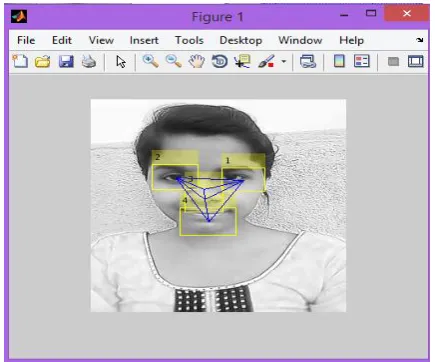
The Figure 3 shows the extraction of feature by Viola Jones algorithm. With the help of this algorithm the extracted features will be represented in rectangular box. Here nose is consider as the centre point. Each feature is correlated to a particular position in the sub- window.
Figure 4: Vector for Extracted features
Figure 4 shows the pixel to pixel representation in the graph. The extracted features
are represented in vector by using support vector machine.
Figure 5: Preview, Warped & Current frames of the Feature extracted frames
From the Figure 5, the subtracted frame from the averaged frames are indicated in the
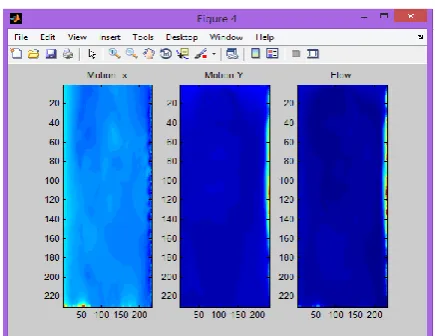
Figure 6 represents the Variation of motion to X and Y axis and flow with respect to time for the extracted frame. Motion-X represents the amount of facial expansion and contraction, Motion-Y represents the face neural and flow represents the background clutters.
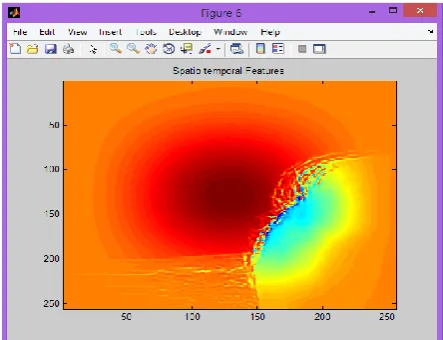
Figure 7: Spatio temporal features of the best feature extracted frame
The Figure 7 gives the Spatio temporal features of the best feature extracted frame.
Most contraction and expansion muscle variation is depicted in various color by using Spatio temporal feature.
Figure 8: Confidence Map
Figure 8 represents the Confidence map in which the Extracted features from the
Spatio temporal are indicated in 3D view. The best feature obtained is represented at its peak with respect to the neutral and background clutters on the base.
Figure 9 shows the Weighted Histogram which contains only magnitude with positive and negative bins. Here above the face contraction and expansion is consider as positive and below the face contraction and expansion is consider as negative.
Figure 10: Non-Weighted histogram
Figure 10 shows the Non-Weighted Histogram which contains only sign of features
with positive, negative and zero bins. Here positive and negative are indicated same as weighted histogram and zero is consider as the movement of the mouth.
Figure 11: Recognition rate of proposed system
Figure 11 represents the graph of Recognition rate of the proposed system. It is
Figure 12 represents Recognition rate. It shows with respect to Recognition rate in percent and different methods like without AAM, ESL and KESL.
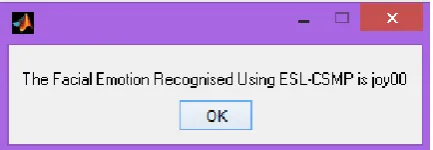
Figure 13: Expected Result for the preloaded video (joy expression)
Figure 13 displays the final result. An Input expression will be Joy and we get the
output expression indicated will also be Joy.
Table 1:Outputs of different expressions Expression Without
AAM
ESL KESL
Joy 62.34% 65.45% 83.12%
Anger 51.89% 61.94% 80.59%
Fear 61.16% 66.69% 91.07%
Disgust 61.19% 66.66% 91.54%
Table 1 shows the ideal outputs of different expressions using various algorithms. The KESL algorithm have high stability and convergence. Therefore the efficiency of KESL algorithm is high when compared to other two algorithms.
V. CONCLUSION
Human Facial Expression place a vital role in inters personal communication containing extremely abundant information of human behaviour. Viola-Jones Algorithm is used to determine whether the given extracted frame is a face or not. Spatio-Temporal Algorithm is used determine the variation of space with respect to the varying time. For the purpose of matching we use Active Appearance Model (AAM), Extreme Sparse Learning (ESL) and Kernel Extreme Sparse Learning (KESL) Algorithms. The main application of this work are information security, authentication, biometric identification, video surveillance, data privacy, Human Action Recognition (HAR), Human Computer Interface (HCI), Health Care etc.
ACKNOWLEDGEMENT
R
EFERENCES
1) Luca Turchet and Roberto Bresin, “Effects of Interactive Sonification on Emotionally Expressive Walking Styles”: IEEE Transactions on affective computing, Vol.6, No.2 April-June-2015.
2) Muhammad Babar Rasheed, Haris Baidar Raja and Turki Ali Alghamdi, “Evolution of Human Activity Recognition and Fall Detection Using Android Phone”, 2015 IEEE 29th International Conference on Advanced Information Networking and Applications.
3) R. V. Darekar, A. P. Dhande, “Emotion Detection with Multimodal Fusion Using Speech - A Review” International Journal of Computer Science and Communication Engineering Volume 3 issue 1(February 2014 issue)
4) V. Kulkarni and Savitha S. Raut, “Emotion Recognition by Using Speech and Facial Expressions”. Proceedings of 9th IRF International Conference, Pune, India, 18th May. 2014, ISBN: 978-93-84209-20-9. PNCDI No. 339/2007.
5) Lu Xia and J. K. Aggarwal,”Spatio-Temporal Depth Cuboid Similarity Feature for Activity Recognition Using Depth Camera”, Computer & Vision Research Center / Department of ECE, The University of Texas at Austin in 2013
6) Harish Kumar Dogra , Zohaib Hasan , Ashish Kumar Dogra “Face expression recognition using Scaled-conjugate gradient Back-Propagation algorithm” International Journal of Modern Engineering Research (IJMER) Vol. 3, Issue. 4, Jul - Aug. 2013 pp-1919-1922
7) Michael B. Holte, “Human Pose Estimation and Activity Recognition from Multi-View Videos”: Comparative Explorations of Recent Developments, IEEE Journal of Selected Topics In Signal Processing, Vol. 6, No. 5, September 2012