HYBRID GENETIC ALGORITHM FOR INVENTORY ROUTING PROBLEM WITH CARBON EMISSION CONSIDERATION
CHOONG JING YEE
A dissertation submitted in partial fulfilment of the requirements for the award of the degree of
Master of Science
Faculty of Science Universiti Teknologi Malaysia
iv
ACKNOWLEDGMENT
First and foremost, I would like to offer my sincerest gratitude to my supervisor, Dr Nur Arina Bazilah Aziz for her guidance throughout the completion of my dissertation. Dr Nur Arina Bazilah Aziz has been very patient and supportive in various ways and often gave productive suggestions when I encountered difficulties during the preparation of my dissertation. This dissertation will not be completed without her help and support. I am also thankful to my co-supervisor, Encik Ismail Kamis for helping me with the finishing touches of my dissertation.
I would like to take this chance to thank my family and partner for their support and encouragement throughout my master studies. Besides that, I would also like to thank my friends and course mate for their willingness to help me when I seek for their suggestion and advice.
ABSTRACT
vi
ABSTRAK
TABLE OF CONTENTS
CHAPTER TITLE PAGE
DECLARATION ii
DEDICATION iii
ACKNOWLEDGEMENT iv
ABSTRACT v
ABSTRAK vi
TABLE OF CONTENTS vii
LIST OF TABLES x
LIST OF FIGURES xii
LIST OF ABBREVIATIONS xiii
LIST OF SYMBOLS xv
1 INTRODUCTION 1
1.1 Preface 1
1.2 Background of the Problem 2
1.3 Statement of the Problem 6
1.4 Objective of the Study 7
1.5 Scope of the Study 7
1.6 Significance of the Study 7
viii
2 LITERATURE REVIEW 9
2.1 Introduction 9
2.2 Classical IRP 9
2.3 IRP Involving Carbon Emission Consideration 12 2.4 Genetic Algorithm (GA) in Routing Problems 14 2.5 Double Sweep Algorithm (DSW) in Routing
Problems
17
2.6 Summary 20
3 METHODOLOGY 21
3.1 Introduction 21
3.2 Description of the Problem 21
3.3 Lists of Notations 22
3.3.1 Sets 22
3.3.2 Parameters 22
3.3.3 Decision variables 23
3.4 Formulation of Mathematical Model 23
3.4.1 Computation of fuel consumption 24
3.4.2 Formulation of MIRP Model 24
3.5 Operational Framework 27
3.6 Development of the Hybrid Genetic Algorithm 28
3.6 Validation of the Model 36
3.7 Parameter Sensitivity Analysis 37
3.8 Summary 37
4 RESULTS AND DISCUSSIONS 38
4.1 Introduction 38
4.2 Solution of the proposed MIRP model with HGA 39 4.3 Validation of the proposed MIRP model 48
4.4 Solving Real Data Set 52
4.5 Parameter Sensitivity Analysis 54
4.5.1 Unit Carbon Price 54
4.6 Summary 60
5 CONCLUSION AND RECOMMENDATIONS 61
5.1 Conclusion 61
5.2 Recommendations 63
REFERENCES 64
x
LIST OF TABLES
TABLE NO. TITLE PAGE
3.1 Example of binary matrix representation and product collection matrix
29
3.2 Example on prevention of violation of vehicle’s capacity 31
3.3 Example of nodes rotation 32
3.4 Example of crossover with bitwise AND operation 34 3.5 Example of crossover with bitwise OR operation 35
3.6 Example of mutation operator 36
4.1 Demand matrix 39
4.2 Best chromosome from initial solution 39
4.3 Best binary chromosome matrix 40
4.4 Best product collection matrix 40
4.5 Coordinates before and after rotation 41
4.6 Distance between each node 41
4.7 After sorting 𝑦-coordinate 41
4.8 Clusters of product collection 42
4.9 Clusters of product collection for period 1 43
4.10 Product collection routes 43
4.11 Breakdown of best total costs for 𝑆5𝐻5 data set 44 4.12 Calculations for total inventory holding cost 44 4.13 Calculations for total fuel consumption cost 45
4.14 Calculations for total emission purchased 47
4.15 Calculations for total fixed vehicle cost 48
xii
LIST OF FIGURES
FIGURE NO. TITLE PAGE
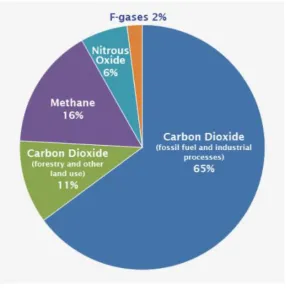
1.1 Global GHGs emission (IPCC, 2014) 2
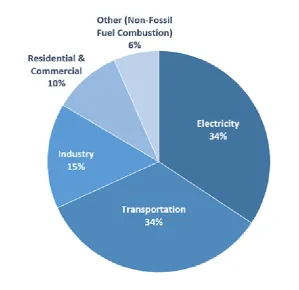
1.2 US CO2 emission by source (EPA, 2018) 3
3.1 Operational framework 27
3.2 AND crossover operation 33
3.3 OR crossover operation 34
4.1 Execution time of HGA and CPLEX 49
4.2 Gap percentage trend 50
4.3 System’s cost 51
4.4 Product Collection Route 53
4.5 Convergence of 𝑆98𝐻14 solutions 54
4.6 Total system cost under different unit carbon price 55 4.7 Emission cost, Inventory cost, Fuel consumption cost and
Emission level under different unit carbon price
56
4.8 Total system cost under different carbon cap 58 4.9 Emission cost, Inventory cost, Fuel consumption cost
Emission level under different carbon cap
LIST OF ABBREVIATIONS
ACO - Ant colony optimization AGA - Adaptive genetic algorithm CH4 - Methane
CO2 - Carbon dioxide
DP - Dynamic programming DSW - Double sweep algorithm EU - European Union
F-gases - Fluorinated gases GA - Genetic algorithm GDP - Gross domestic product GHGs - Greenhouse gases
HGA - Hybrid genetic algorithm HTS - Hybrid tabu search
IC-SA - Imperialist competitive-simulated annealing IRP - Inventory routing problem
LCSM - Low carbon supply chain management m-CTP - multi-vehicle covering tour problem MILP - Mixed-integer linear programming MIP - Mixed integer programming
MIRP - Multi-period inventory routing problem mm-CTP - multi-vehicle multi-covering tour problem N2O - Nitrous oxide
PSO - Particle swarm optimization RTIs - Returnable transport items SA - Simulated annealing
xiv
SI - Swarm intelligence
SIRP - Stochastic inventory routing problem SW - Sweep algorithm
UN - United Nation US - United States
LIST OF SYMBOLS
𝐴 - A set of all nodes 𝑆 - A set of suppliers
𝐷𝑃 - Depot
𝐴𝑃 - Assembly plant
𝐻 - Time horizon
𝑑𝑖𝑡 - Demand for product type 𝑖 in period 𝑡(𝑡 ∈ 𝐻) 𝐹 - Fixed vehicle cost per trip
𝐶 - The weight capacity of each vehicle
ℎ𝑖 - Unit inventory holding cost at assembly plant for product 𝑖 𝑐𝑖𝑗 - Distance between node 𝑖 and node 𝑗
𝑓 - Unit fuel price ($
𝑙)
𝜌0 - The fuel consumption rate ( 𝑙
𝑘𝑚) for empty-loaded vehicle
𝜌∗ - The fuel consumption rate ( 𝑙
𝑘𝑚) for fully-loaded vehicle
𝜀 - Emissions generated per unit of fuel consumption (𝑘𝑔𝐶𝑂2
𝑙 )
𝑐𝑐𝑡 - Carbon cap in period 𝑡
𝑝 - The price per unit carbon emission bought 𝑥𝑖𝑗𝑡 - arc (𝑖, 𝑗)
𝜔𝑖𝑗𝑡 - The total product weight carried by a vehicle through arc (𝑖, 𝑗) in period 𝑡
𝑞𝑖𝑡 - The product quantity picked up at supplier 𝑖 in period 𝑡
𝐼𝑖𝑡 - The inventory level of product 𝑖 at the assembly plant at the end of period 𝑡
1
CHAPTER 1
INTRODUCTION
1.1 Preface
Inventory Routing Problem (IRP) incorporates both vehicle routing problems and inventory management problems in a supply chain network. The main objective of the traditional IRP is to minimize simultaneously the inventory cost and transportation cost of a supply chain. From the optimal solution of the IRP, decisions can be made on the delivery schedule, quantity of goods to be delivered to the customers and the delivery routing (Campbell et al., 1997).
Along with the increasing environmental concern related to global warming, various initiatives had been taken to achieve a green and sustainable economy. One of the many initiatives is to develop a low carbon supply chain system by focusing on the transportation network. Researchers had made an extension on the existing IRP model by considering the minimization of carbon emission in the model to optimize simultaneously the inventory cost, transportation cost and cost related to carbon emission of a supply chain.
1.2 Background of the Problem
IRP is a fundamental decision-making approach in supply chain management and has been researched and improved upon extensively, most notably since the seminar paper published by Bell et al. (1983) where customers inventory level must be met under stochastics demand. In the past, classical IRP often revolves around maximizing profits and minimizing costs with some additional requirements such as travelling time or distance (Li et al., 2014; Madadi et al., 2010).
Over the years, IRP had been continuously developed and improved to meet various demands from current issues for instance, the global warming issue particularly related to greenhouse gases (GHGs) emission. GHGs contributes to global warming by trapping heat from leaving the atmosphere and make the planet warmer. The burning of fossil fuel for transportations such as cars, trucks, ships, trains, and planes primarily emits GHGs. Over 90 percent of the fuel used for transportation is petroleum based, which includes gasoline and diesel (IPCC, 2007).
3
Globally, the key GHGs emitted by human activities are carbon dioxide (CO2), methane (CH4), nitrous oxide (N2O) and fluorinated gases (F-gases). Figure 1.1 shows the contribution of each gas to the global GHGs emission. It is obvious that CO2 from fossil fuel and industrial process is the largest contributor to global GHGs emission at a total of 65 percent. Therefore, it is crucial to tackle on reducing the amount of CO2 gases in the atmosphere to prevent global warming from getting worse.
Figure 1.2 US CO2 emission by source (EPA, 2018)
Nationally, to play a role in halting global warming, in 2009, an announcement made by Malaysia’s former Prime Minister Datuk Seri Najib Razak at the 15th Conference of the Parties to the United Nations Framework Convention on Climate Change that by 2020, Malaysia will reduce the level of GHGs emission of its Gross Domestic Product (GDP) by up to 40 percent compared to the levels in 2005. The Tenth Malaysia Plan from 2011 to 2015 focuses on the Renewable Energy Act, Feed-in Tariff mechanism, household recycling, forest reserve while in the transportation sector, the government gazetted EURO 4M standards in 2013 to control emissions from motor vehicles along with higher use of energy efficient vehicles and bio-fuels. On the Eleventh Malaysia Plan, Sustainable Consumption and Production (SCP) approach is established. Under SCP, the government creates market for green products and services, purchases environmentally friendly products and services to spur demand for green industries and encourages low carbon mobility through utilisation of energy efficient vehicles and public transportation (Economic Planning Unit, 2015).
However, these are not the only methods that can be implemented to play a role in preserving the environment, the government may encourage companies in Malaysia to practice a sustainable supply chain to curb carbon emissions. For instance, foreign companies such as IKEA, HP, IBM and GE, made effort to implement environmental friendly initiatives not only by designing greener products but also considers carbon emission in their supply chain networks (Wang et al., 2011).
5
emission credits if its emission level is higher (or lower) than the cap. Lastly, under the carbon taxing policy, a company must pay for its carbon emissions as taxes (Cheng et al., 2016). In addition to the existing methods to halt global warming in the Tenth and Eleventh Malaysia Plan, controlling carbon emission in supply chain is considerably an important initiative to achieving the voluntary target set by the 6th Prime Minister of Malaysia.
There have been several transportation studies focusing on minimizing fuel consumption and carbon emissions by using fuel cost to measure varying transportation cost in IRP. Treitl et al. (2014) proposed and applied Inventory Routing Model to a case study of the petrochemical industry. The focus was on analysing how will the routing decisions in transport processes will affect the economy and environment in a supply chain. Niakan and Rahimi (2015) presented a new IRP model specialized in healthcare sector for medicinal drug distribution to healthcare facilities. Cheng et al. (2016) studied four different carbon emission regulations, namely the carbon cap, carbon cap and offset, carbon cap and trade, and carbon taxing on the IRP for inbound distribution. Lin and Sarker (2017) developed a new inventory model considering carbon tax policy and investigated the effect of different carbon tax systems on the model. Kang et al. (2018) studied the effect of carbon credit price and a carbon cap on the cost of an inventory-allocation network.
IRP is known to be NP-hard as it is an integration between inventory control and vehicle routing problem (VRP) (Federgruen and Simchi-Levi, 1995). A metaheuristic algorithm is essential to produce a near optimal solution in a reasonable amount of time. Recent researches show that genetic algorithm (GA) is an effective and time-saving method to solve NP-hard problems. For instance, Park
to a problem involving the electric vehicles battery swap station location and inventory problem which determines the location and battery inventory of battery swap stations. The GA algorithm is effective in solving large-scale network.
Therefore, the focus of this study is on solving a multi-period inventory routing problem (MIRP) involving carbon emission consideration based on carbon cap and offset policy. HGA based on allocation first and routing second is used to compute a solution for the MIRP in this study. The HGA is a combined algorithm of GA and double sweep algorithm (DSW) with the former is used for allocation decisions, while the latter is used for routing decisions. The supply chain involved in this study is an inbound product collection network with one depot, a set of geographically dispersed suppliers and one assembly plant with deterministic and time-varying demands. The transportation cost, fuel consumption cost and inventory holding cost are fixed. Fuel consumption is used to generate the value of carbon emissions. The expected solution will display the best supplier allocation choice and product collection route which results in minimal system’s total cost.
1.3 Statement of the Problem
Global warming is among the greatest issue throughout the years and CO2
7
1.4 Objectives of the Study
The objectives of this study are:
a) To solve the proposed MIRP model involving carbon emission consideration with HGA.
b) To validate the effectiveness of the proposed HGA on data of different sizes.
c) To apply the proposed MIRP model and HGA on real data. d) To perform parameter sensitivity analysis on the MIRP model.
1.5 Scope of the Study
This study focuses on an inbound product collection network consisting of one depot, several suppliers which provide different products and one assembly plant with deterministic and time-varying demand. Data sets of different sizes ranging from small, medium to large and a real data is used in this study.
1.6 Significance of the Study
1.7 Overview of the Study
64
REFERENCES
Abdelmaguid, T. F. & Dessouky, M. M. (2006). A genetic algorithm approach to the integrated inventory-distribution problem. International Journal of Production Research, 44, 4445-4464.
Akhand, M. A. H., Peya, Z. J., Sultana, T. & Rahman, M. M. H. (2017). Solving Capacitated Vehicle Routing Problem Using Variant Sweep and Swarm Intelligence. Journal of Applied Science and Engineering, 20, 511-524. Andersson, H., Hoff, A., Christiansen, M., Hasle, G. & Løkketangen, A. (2010).
Industrial aspects and literature survey: Combined inventory management and routing. Computers & Operations Research, 37, 1515-1536.
Azadeh, A., Elahi, S., Farahani, M. H. & Nasirian, B. (2017). A genetic algorithm-Taguchi based approach to inventory routing problem of a single perishable product with transshipment. Computers & Industrial Engineering, 104, 124-133.
Bard, J. F., Huang, L., Jaillet, P. & Dror, M. (1998). A Decomposition Approach to the Inventory Routing Problem with Satellite Facilities. Transportation Science, 32, 189-203.
Bell, W. J., Dalberto, L. M., Fisher, M. L., Greenfield, A. J., Jaikumar, R., Kedia, P., Mack, R. G. & Prutzman, P. J. (1983). Improving the Distribution of Industrial Gases with an On-Line Computerized Routing and Scheduling Optimizer. Interfaces, 13, 4-23.
Cachon, G. P. (2014). Retail Store Density and the Cost of Greenhouse Gas Emissions. Management Science, 60, 1907-1925.
Campbell, A., Clarke, L., Kleywegt, A. & Savelsbergh, M. (1997). The Inventory Routing Problem.
Carbon Market Watch. (2017). Pricing carbon to achieve the Paris goals - Carbon
Market Watch. [online] Available at:
https://carbonmarketwatch.org/publications/policy-briefing-pricing-carbon-achieve-paris-goals/ [Accessed 21 May 2018].
Cheng, C., Qi, M. Y., WANG, X. Y. & ZHANG, Y. (2016). Multi-period inventory routing problem under carbon emission regulations. International Journal of Production Economics, 182, 263-275.
Cheng, C., Yang, P., Qi, M. & Rousseau, L. -M. (2017). Modeling a green inventory routing problem with a heterogeneous fleet. Transportation Research Part E: Logistics and Transportation Review, 97, 97-112.
Cho, D. W., Lee, Y. H., Lee, T. Y. & Gen, M. (2014). An adaptive genetic algorithm for the time dependent inventory routing problem. Journal of Intelligent Manufacturing, 25, 1025-1042.
Coelho, L. C. & Laporte, G. (2013). A branch-and-cut algorithm for the multi-product multi-vehicle inventory-routing problem. International Journal of Production Research, 51, 7156-7169.
Corso, L. L. & Wallace, M. (2015). A hybrid method for transportation with stochastic demand. International Journal of Logistics-Research and Applications, 18, 342-354.
Dondo, R. & Cerda, J. (2013). A sweep-heuristic based formulation for the vehicle routing problem with cross-docking. Computers & Chemical Engineering, 48, 293-311.
Dondo, R. & Cerda, J. (2015). The heterogeneous vehicle routing and truck scheduling problem in a multi-door cross-dock system. Computers & Chemical Engineering, 76, 42-62.
Economic Planning Unit. (2015), Eleventh Malaysia Plan 2016-2020, FGAC, Malaysia.
66
Ellis, K. P., Sherali, H. D., Saunders, L., Shao, S. Z. & Crawford, C. (2014). Bulk tank allocation to improve distribution planning for the industrial gas industry.
Iie Transactions, 46, 557-566.
EPA. (2018). Inventory of U.S. Greenhouse Gas Emissions an Sinks. [online] Available at: https://www.epa.gov/sites/production/files/2018-01/documents/2018_complete_report.pdf [Accessed 21 May 2018].
Esparcia-Alcazar, A. I., Lluch-Revert, L., Cardos, M., Sharman, K. & Andres-Romano, C. (2006). Design of a retail chain stocking up policy with a hybrid evolutionary algorithm. Evolutionary Computation in Combinatorial Optimization, Proceedings, 3906, 49-60.
European Comission. (2016), A European Strategy for Low-Emission Mobility, EC, Brussels.
Federgruen, A. & Simchi-Levi, D. (1995). Chapter 4 Analysis of vehicle routing and inventory-routing problems. Handbooks in Operations Research and Management Science. Elsevier.
Gaskell, T. J. (1967). Bases for Vehicle Fleet Scheduling. Journal of the Operational Research Society, 18, 281-295.
Ghorbani, A. & Akbari Jokar, M. R. (2016). A hybrid imperialist competitive-simulated annealing algorithm for a multisource multi-product location-routing-inventory problem. Computers & Industrial Engineering, 101, 116-127.
Gillet, B. E., Miller, L. E. & Johnson, J. G. (1979). Vehicle dispatching — Sweep algorithm and extensions. In: Ritzman, L. P., Krajewski, L. J., Berry, W. L., Goodman, S. H., Hardy, S. T. & Vitt, L. D. (eds. ) Disaggregation: Problems in manufacturing and service organizations. Dordrecht: Springer Netherlands.
Hiassat, A., Diabat, A. & Rahwan, I. (2017). A genetic algorithm approach for location-inventory-routing problem with perishable products. Journal of Manufacturing Systems, 42, 93-103.
Huang, S. -H. & Lin, P. -C. (2010). A modified ant colony optimization algorithm for multi-item inventory routing problems with demand uncertainty.
Transportation Research Part E: Logistics and Transportation Review, 46, 598-611.
Iassinovskaia, G., Limbourg, S. & Riane, F. (2017). The inventory-routing problem of returnable transport items with time windows and simultaneous pickup and delivery in closed-loop supply chains. International Journal of Production Economics, 183, 570-582.
IPCC. (2007). Chapter 5: Transport and its infrastructure - AR4 WGIII. [online] Available at: http://www.ipcc.ch/publications_and_data/ar4/wg3/en/ch5.html [Accessed 21 May 2018].
IPCC. (2014). Fifth Assessment Report - Mitigation of Climate Change. [online] Available at: https://www.ipcc.ch/report/ar5/wg3/ [Accessed 21 May 2018]. Kang, K., Pu, W., Ma, Y. & Wei, X. A Novel Inventory and Distribution Planning
Model with Non-conforming Items Disposal Under Fuzzy Random Environment. 2017 Singapore. Springer Singapore, 1191-1201.
Kang, K., Pu, W. & Ma, Y. F. (2018). A Dynamic Programming-Based Sustainable Inventory-Allocation Planning Problem with Carbon Emissions and Defective Item Disposal under a Fuzzy Random Environment. Mathematical Problems in Engineering.
Konur, D. & Schaefer, B. (2014). Integrated inventory control and transportation decisions under carbon emissions regulations: LTL vs. TL carriers.
Transportation Research Part E-Logistics and Transportation Review, 68, 14-38.
Lee, C. -G., Bozer, Y. A. & White III, C. (2003). A heuristic approach and properties of optimal solutions to the dynamic inventory routing problem.
Li, K. P., Chen, B., Sivakumar, A. I. & Wu, Y. (2014). An inventory-routing problem with the objective of travel time minimization. European Journal of Operational Research, 236, 936-945.
68
Madadi, A., Kurz, M. E. & Ashayeri, J. (2010). Multi-level inventory management decisions with transportation cost consideration. Transportation Research Part E-Logistics and Transportation Review, 46, 719-734.
Mirzapour Al-E-Hashem, S. M. J. & Rekik, Y. (2014). Multi-product multi-period Inventory Routing Problem with a transshipment option: A green approach.
International Journal of Production Economics, 157, 80-88.
Mjirda, A., Jarboui, B., Macedo, R., Hanafi, S. & Mladenović, N. (2014). A two phase variable neighborhood search for the multi-product inventory routing problem. Computers & Operations Research, 52, 291-299.
Moin, N. H., Salhi, S. & Aziz, N. A. B. (2011). An efficient hybrid genetic algorithm for the multi-product multi-period inventory routing problem.
International Journal of Production Economics, 133, 334-343.
Niakan, F. & Rahimi, M. (2015). A multi-objective healthcare inventory routing problem; a fuzzy possibilistic approach. Transportation Research Part E-Logistics and Transportation Review, 80, 74-94.
Park, Y.-B., Yoo, J.-S. & Park, H.-S. (2016). A genetic algorithm for the vendor-managed inventory routing problem with lost sales. Expert Systems with Applications, 53, 149-159.
Pham, S., Gascon, V. & Dinh, T. (2014). Heuristics to Solve a Real-world Asymmetric Vehicle Routing Problem with Side Constraints. Fundamenta Informaticae, 130, 231-246.
Pham, T. A., Ha, M. H. & Nguyen, X. H. (2017). Solving the vehicle multi-covering tour problem. Computers & Operations Research, 88, 258-278. Rahimi, M., Baboli, A. & Rekik, Y. (2017). Multi-objective inventory routing
problem: A stochastic model to consider profit, service level and green criteria.
Transportation Research Part E: Logistics and Transportation Review, 101, 59-83.
Sazvar, Z., Mirzapour AL-E-Hashem, S. M. J., Baboli, A. & Akbari Jokar, M. R. (2014). A bi-objective stochastic programming model for a centralized green supply chain with deteriorating products. International Journal of Production Economics, 150, 140-154.
Sourirajan, K., Centonze, P., Helander, M. E., Katircioglu, K., Ben-Hamida, M. & Boucher, C. (2009). Carbon management in assembly manufacturing logistics.
Ibm Journal of Research and Development, 53.
Soysal, M., Bloemhof-Ruwaard, J. M., Haijema, R. & Van Der Vorst, J. G. A. J. (2015). Modeling an Inventory Routing Problem for perishable products with environmental considerations and demand uncertainty. International Journal of Production Economics, 164, 118-133.
Tam, M. (2018). Fuel prices stay the same. The Star Online. [online] Available at: https://www.thestar.com.my/news/nation/2018/05/16/fuel-prices-stay-the-same/ [Accessed 21 May 2018].
Treitl, S., Nolz, P. C. & Jammernegg, W. (2014). Incorporating environmental aspects in an inventory routing problem. A case study from the petrochemical industry. Flexible Services and Manufacturing Journal, 26, 143-169.
Ubeda, S., Arcelus, F. J. & Faulin, J. (2011). Green logistics at Eroski: A case study.
International Journal of Production Economics, 131, 44-51.
Vidović, M., Popović, D. & Ratković, B. (2014). Mixed integer and heuristics model for the inventory routing problem in fuel delivery. International Journal of Production Economics, 147, 593-604.
Wang, F., Lai, X. F. & Shi, N. (2011). A multi-objective optimization for green supply chain network design. Decision Support Systems, 51, 262-269.
Wang, Z. Z., Zhao, L. Y., Cao, N. B., Yang, L. & Chen, M. T. (2016). Vehicle routing optimum model of hazardous materials transportation under fuzzy environment. Journal of Intelligent & Fuzzy Systems, 31, 3067-3074.
Xiao, Y. Y., Zhao, Q. H., Kaku, I. & Xu, Y. C. (2012). Development of a fuel consumption optimization model for the capacitated vehicle routing problem.
Computers & Operations Research, 39, 1419-1431.
70
Yu, Y., Chu, C., Chen, H. & Chu, F. (2012). Large scale stochastic inventory routing problems with split delivery and service level constraints. Annals of Operations Research, 197, 135-158.
Zhalechian, M., Tavakkoli-Moghaddam, R., Zahiri, B. & Mohammadi, M. (2016). Sustainable design of a closed-loop location-routing-inventory supply chain network under mixed uncertainty. Transportation Research Part E: Logistics and Transportation Review, 89, 182-214.
Zhang, S. Z., Lee, C. K. M., Choy, K. L., Ho, W. & Ip, W. H. (2014). Design and development of a hybrid artificial bee colony algorithm for the environmental vehicle routing problem. Transportation Research Part D-Transport and Environment, 31, 85-99.
Zhao, Q. -H., Wang, S. -Y. & Lai, K. K. (2007). A partition approach to the inventory/routing problem. European Journal of Operational Research, 177, 786-802.