EFFECTIVE AEROSOL OPTICAL THICKNESS RETRIEVAL ALGORITHM USING MODIS 500 METRE DATA
AHMAD MUBIN BIN WAHAB
EFFECTIVE AEROSOL OPTICAL THICKNESS RETRIEVAL ALGORITHM USING MODIS 500 METRE DATA
AHMAD MUBIN BIN WAHAB
A thesis submitted in fulfilment of the requirements for the award of the degree of
Master of Science (Remote Sensing)
Faculty of Geoinformation and Real Estate Universiti Teknologi Malaysia
iii
DEDICATION
Specially dedicated to my beloved parents, wife, siblings
ACKNOWLEDGEMENT
First and for most I would like to thank to Allah S.W.T for his presence, protection and guidance me during the whole study period. I wish to express my sincerity to my supervisor Dr. Md. Latifur Rahman Sarker for his encouragement, guidance, supports, advices, and motivation during my study. Without his continued support, this thesis would not have been the same as presented here.
I would like to thanks Department of Geoinformation, Faculty of Geoinformation and Real Estate, and Universiti Teknologi Malaysia (UTM) for assisting during my study. Special thank also goes to School of Graduate Studies (SPS) UTM and Ministry of Higher Education (MOHE) for funding my study. I am also indebted to Janet Nichole for providing Aerosol Robotic Network (AERONET) data for Hong Kong Polytechnic University station and Hok Tsui station.
v
ABSTRACT
ABSTRAK
vii
TABLE OF CONTENTS
CHAPTER TITLE PAGE
DECLARATION ii
DEDICATION iii
ACKNOWLEDGEMENT iv
ABSTRACT v
ABSTRAK vi
TABLE OF CONTENTS vii
LIST OF TABLES xi
LIST OF FIGURES xiii
LIST OF ABBREVIATIONS xvii
LIST OF SYMBOLS xxi
LIST OF APPENDICES xxiii
1 INTRODUCTION 1
1.1 Background of the Study 1
1.2 Problem Statement 6
1.3 Objectives of the Study 10
1.4 Scope of the Study 10
1.5 Study Area 12
1.6 Significance of the Study 15
1.7 Outline of the Thesis 16
2 LITERATURE REVIEW 18
2.1 Atmospheric Aerosol 18
2.1.2 Aerosol Effects 25
2.1.3 Aerosol Measurements 27
2.1.4 Satellite Aerosol Measurements 29 2.1.5 Satellite Aerosol Remote Sensing Techniques 32
2.2 Radiative Transfer Theory 36
2.2.1 Scalar Radiative Transfer Model 37 2.2.2 Vector Radiative Transfer Model 39
2.2.3 Rayleigh Scattering 40
2.2.4 Mie Scattering 46
2.2.5 Gas Absorption 51
2.2.6 Successive Orders of Scattering (SOS) Method 55 2.2.7 Discrete Ordinates Radiative Transfer
(DISORT) method
56
2.3 Radiative Transfer Codes 58
2.3.1 MODerate Resolution Atmospheric TRANsmission (MODTRAN) code
59
2.3.2 Santa Barbara DISORT Atmospheric
Radiative Transfer Program (SBDART) code
60
2.3.2 Second Simulation of a Satellite Signal in the Solar Spectrum (6S) code
61
2.4 Concluding Remarks 63
3 RESEARCH METHODOLOGY 66
3.1 Data Preparation 68
3.1.1 Data Selection 68
3.1.2 Data Pre-processing 71
3.2 Aerosol Reflectance Estimation 75
3.2.1 Top of Atmosphere (TOA) Reflectance 77
3.2.2 Rayleigh Reflectance 79
3.2.3 Total Atmospheric Transmission 81
3.2.4 Land Surface Reflectance 83
3.2.5 Hemispheric Reflectance 86
ix
3.3 Local Aerosol Model Characterization 89 3.3.1 Identify Number of Clusters (k) 92
3.3.2 Clustering Analysis 93
3.4 Aerosol Optical Thickness (AOT) Retrieval 94 3.4.1 Aerosol Optical Thickness Retrieval based on
Look-up Tables using Santa Barbara DISORT Radiative Transfer (SBDART) code
95
3.4.2 Aerosol Optical Thickness Retrieval based on Look-up Tables using Second Simulation of a Satellite Signal in the Solar Spectrum Vector (6SV) code
99
3.4.3 Aerosol Optical Thickness Retrieval without Look-up Tables
102
3.5 Validation and Comparison of Aerosol Optical Thickness at 0.55 µm
105
4 RESULT AND ANALYSIS 107
4.1 Local Aerosol Model Characterization 107 4.1.1 Selection of the Number of Clusters (k) 108 4.1.2 Development of Local Aerosol Models 112 4.1.3 Sensitivity Test of the Local Aerosol Models 114
4.2 Surface Reflectance Estimation 117
4.3 Validation of MODIS 500 m Aerosol Optical Thickness using Aerosol Optical Thickness from Aerosol Robotic Network (AERONET) Station
120
4.3.1 Validation of Aerosol Optical Thickness Retrieved from MODIS 500 m using Look-up Tables of Santa Barbara DISORT Radiative Transfer (SBDART) code
121
4.3.2 Validation of Aerosol Optical Thickness Retrieved from MODIS 500 m using Look-up Tables of Second Simulation of a Satellite Signal in the Solar Spectrum Vector (6SV)
code
4.3.3 Validation of Aerosol Optical Thickness Retrieved From MODIS 500 m Using Direct Analytical Equation (DAE)
128
4.4 Comparison of Accuracy of Different Aerosol Optical Thickness Retrieval Models
134
4.5 Comparison between Aerosol Optical Thickness from MODIS 500 m and Aerosol Optical Thickness from MODIS Aerosol Product
137
4.6 Spatial Distribution of Aerosol Optical Thickness Generated from the Best Aerosol Optical Thickness Retrieval Model
140
4.6.1 Comparison of Spatial Distribution of MODIS Aerosol Optical Thickness at 500 m and MODIS Aerosol Product over Hong Kong and Pearl River Delta Region
140
4.6.2 Spatial Distribution of AOT over Hong Kong Region
142
4.7 Concluding Remarks 145
5 DISCUSSION 146
6 CONCLUSION AND RECOMMENDATIONS 151
6.1 Conclusion 151
6.2 Recommendations 153
REFERENCES 155
xi
LIST OF TABLES
TABLE NO. TITLE PAGE
2.1 Sources and Estimates of Global Emissions of Atmospheric Aerosols (Hinds, 2012)
20
2.2 The coefficients derived from the least-square fit of the Rayleigh cross section
43
2.3 Coefficient of 𝐴𝜏 for each standard atmosphere model at surface pressure and temperature of each model (Bucholtz, 1995)
45
2.4 Inputs for the MIEV code 50
2.5 List of several RT codes 58
3.1 Characteristics of MODIS Terra data used in the aerosol retrieval algorithm
69
3.2 𝐸𝑠𝑢𝑛λ of MODIS for each wavelength 78
3.3 Coefficient a, b, c, and d in Rayleigh scattering 80 3.4 Depolarization factor (𝛿) and 𝛾 values 81 3.5 Polynomial coefficients for total transmission of Rayleigh
and aerosol (Hoyningen-Huene et al., 2007)
82
SBDART code
3.10 Aerosol parameters used in the cluster analysis for 6SV code.
91
3.11 The variables used for generating LUTs using SBDART code
96
3.12 The variables used for generating LUTs using 6SV code 100 4.1 Optical properties of local aerosol models used in 6SV code 112-113 4.2 Optical properties of local aerosol models used in SBDART
code
113-114
4.3 Statistical analysis of comparison between AOT retrieved using direct analytical equation (MODIS-DAE AOT) against AERONET AOT for HK Poly-U site
130-131
4.4 Statistical analysis of comparison between AOT retrieved using direct analytical equation (MODIS-DAE AOT) against AERONET AOT for HK Hok Tsui site
xiii
LIST OF FIGURES
FIGURE NO. TITLE PAGE
1.1 (a) Study areas of Hong Kong region, (b) AERONET station at Hong Kong Polytechnic-University site and (c) AERONET station at Hong Kong Hok Tsui site
14
2.1 Illustrations of the different processes involved in the sources, formation, and removal of atmospheric aerosol particles (Go Green Cebu, 2013)
21
2.2 Illustration of aerosol phase function mechanism 23 2.3 Example of aerosol size distribution using (a) lognormal
distribution and (b) linear scale
24
2.4 The respiratory system showing the extent of penetration of particulate matter (Stern, 1984)
26
2.5 Ground based aerosol measurement of a) Multi-Filter Rotating Shadow Band Radiometer and b) sky scanning spectral radiometer (Chew et al., 2009)
29
2.6 Illustration of atmospheric radiative transfer and the boundary condition. The solar and viewing angles are 𝜃𝑜 and 𝜃𝑣 respectively. The surface is non-Lambertian (Liang, 2005)
37
2.7 Rayleigh scattering diagram (Hong, 2012) 41 2.8 Mie scatter diagram for different size particles (dp) 47
2.9 Vertical column water vapour amount from GOME 2 (blue point) with mean values (red point) and standard deviation (Grossi et al., 1999)
3.1 Overall methodology 67
3.2 UTM zones projection map 72
3.3 Panoramic Bow-tie effect 73
3.4 The absorptivity of gases in the atmosphere (Fleagle and Businger, 1980)
87
3.5 Work flows of AOT retrieval based on LUTs using SBDART code
96
3.6 Work flows of AOT retrieval based on LUTs using 6SV code
100
3.7 Work flows of AOT retrieval using direct analytical equation
104
4.1 VRC and ωk value for each cluster of aerosol model used in 6SV (a) and SBDART (b) for Hong Kong Poly-U site
109
4.2 VRC and ωk value for each cluster of aerosol model used in 6SV (a) and SBDART (b) for Hong Kong Hok Tsui site
109
4.3 Elbow rule for each cluster of aerosol model parameters used in 6SV (a) and SBDART (b) for Hong Kong Poly-U site
110
4.4 Elbow rule for each cluster of aerosol model parameters used in 6SV (a) and SBDART (b) for Hong Kong Hok Tsui site
110
4.5 Aerosol dominance model used by 6SV(a) and SBDART(b) for HK Poly-U site
114
4.6 Aerosol dominance model used by 6SV (a) and SBDART (b) for HK Hok Tsui site
115
4.7 Aerosol reflectance against AOT value of aerosol models used by 6SV(a) and SBDART (b) for HK Poly-U site
116
4.8 Aerosol reflectance against AOT value of aerosol models used by 6SV (a) and SBDART (b) for HK Hok Tsui site
xv
4.9 Comparison between surface reflectance derived from (a) DDV at 0.466 µm, (b) DDV at 0.646 µm, (c) 6SV-cont+biom at 0.466 µm, (d) cont+biom at 0.646 µm, (e) ATCOR-6SV-cont+des at 0.466 µm, and (f) ATCOR-6SV-ATCOR-6SV-cont+des at 0.646 µm against surface reflectance estimated using MOD09GA at 0.466 µm and 0.646 µm for HK Poly-U site
119
4.10 Validation results between MODIS AOT at 0.55 µm using SBDART (a) 2-channel (MOD09GA), (b) 1-channel (MOD09GA), (c) 2-1-channel (ATCOR-6SV-cont+biom), (d) 1-channel (ATCOR-6SV-(ATCOR-6SV-cont+biom), (e) 2-channel (ATCOR-6SV-cont+des), (f) 1-channel (ATCOR-6SV-cont+des), and (g) 2-channel (DDV) and AERONET AOT at 0.55 µm for HK Poly-U site
122
4.11 Validation results between MODIS AOT at 0.55 µm using SBDART (a) 2-channel (MOD09GA), (b) 1-channel (MOD09GA), (c) 2-1-channel (ATCOR-6SV-cont+biom), (d) 1-channel (ATCOR-6SV-(ATCOR-6SV-cont+biom), (e) 2-channel (ATCOR-6SV-cont+des), (f) 1-channel (ATCOR-6SV-cont+des), and (g) 2-channel (DDV) and AERONET AOT at 0.55 µm for HK Hok Tsui site
123
4.12 Comparison between MODIS AOT at 0.55 µm using 6SV (a) 2-channel (MOD09GA), (b) 1-channel (MOD09GA), (c) 2-channel (ATCOR-6SV-cont+biom), (d) 1-channel (ATCOR-6SV-cont+biom), (e) 2-channel cont+des), (f) 1-channel (ATCOR-6SV-cont+des), and (g) 2-channel (DDV) against AERONET AOT at 0.55 µm for HK Poly-U site
125
4.13 Comparison between MODIS AOT at 0.55 µm using 6SV (a) 2-channel (MOD09GA), (b) 1-channel (MOD09GA), (c) 2-channel (ATCOR-6SV-cont+biom), (d) 1-channel (ATCOR-6SV-cont+biom), (e) 2-channel
cont+des), (f) 1-channel (ATCOR-6SV-cont+des), and (g) 2-channel (DDV) against AERONET AOT at 0.55 µm for HK Hok Tsui site
4.14 Comparison of R value and RMSE value of all AOT retrieval models for HK Poly-U site
135
4.15 Comparison of R value and RMSE value of all AOT retrieval models for HK Hok Tsui site
136
4.16 Comparison of accuracy between MODIS AOT product (a) and AOT from MODIS 500 m (b) for HK Poly-U site
138
4.17 Comparison of accuracy between MODIS AOT product (a) and AOT from MODIS 500 m (b) for HK Hok Tsui site
138
4.18 AOT spatial distribution map of (a) MODIS AOT 500m (MODIS-2-channel ATCOR-6SV (cont+des)) and (b) MODIS AOT product (MOD04 L2 C005 AOT)
141
xvii
LIST OF ABBREVIATIONS
6S - Second Simulation of a Satellite Signal in the Solar Spectrum
AATSR - Advanced Along-Track Scanning Radiometer AOT - Aerosol optical thickness
AOD - Aerosol optical depth
AI - Aerosol Index
AERONET - Aerosol Robotic Network ANOVA - Analysis of Variance ATCOR - Atmospheric correction
ACE-Asia - Asian Pacific Regional Aerosol Characterization Experiment
AVHRR - Advanced High Resolution Radiometer BAER - Bremen AErosol Retrieval
BRDF - Bidirectional Reflectance Distribution Functions CALIOP - Cloud-Aerosol Lidar with Orthogonal Polarization CALIPSO - Cloud-Aerosol Lidar and Infrared Pathfinder Satellite
Observations
CCN - Cloud Condensation Nuclei
CNES - Centre for Space Studies
CO2 - Carbon dioxide
CPC - Climate Prediction Centre DAE - Direct Analytical Equation
DDV - Dark Dense Vegetation
DISORT - Discrete Ordinate Radiative Transfer
DOY - Day of Year
ERTS - Earth Resources Technology Satellite
GCP - Ground Control Point
GDAS - Global Data Assimilation System GLAS - Geoscience Laser Altimeter System
HK - Hong Kong
HKIA - Hong Kong International Airport
H2O - Water vapour
ICESat - Ice Cloud and Elevation Satellite IDL - Interactive Data Language
ILAS - Improved Limb Atmospheric Spectrometer
IR - Infrared
Lidar - Light detection and ranging
LITE - Lidar In-Space Technology Experiment LOWTRAN - Low Resolution Transmittance
LUT - Look-up table
LSR SCF - Land Surface Reflectance Science Computing Facility MERIS - Medium Resolution Imaging Spectrometer on the
Environmental Satellite
MFRSR - Multifilter Rotating Shadow Band Radiometer MISR - Multiangle Imaging SpectroRadiometer MRT - Minimum reflectance technique
MODIS - Moderate Resolution Imaging Spectroradiometer MOD02HKM - MODIS Calibrate Radiances L1B Swath 500 m MOD021KM - MODIS Calibrate Radiances L1B Swath 1 km MOD03 - MODIS geolocation data
MOD04 L2 C005 - MODIS aerosol product level 2 collection 005 MOD05 - MODIS precipitable water product
MOD07 - MODIS atmospheric product
MOD09GA - MODIS land surface reflectance product MODTRAN - Moderate Resolution Transmittance MRT - Minimum Reflectivity Technique
xix
NASA - National Aeronautics and Space Administration NASDA - National Space Development Agency of Japan NCAR - National Centre for Atmospheric Research NCEP - National Centres for Environmental NDVI - Normalized Difference Vegetation Index
NOAA - National Ocean and Atmosphere Administration
NO2 - Nitrogen dioxide
O3 - Ozone
PM - Particulate matter
POAM - Polar Ozone and Aerosol Measurement
POLDER - Polarization and Directionality of the Earth’s Reflectance Poly-U - Polytechnic University
Qext - Extinction coefficient REFI - Imaginary refractive index REFR - Real refractive index
ROI - Region of Interest
RSR - Relative Spectral Response
RTM - Radiative Transfer Model
SAGE - Stratospheric Aerosol and Gas Experiment SAM - Stratospheric Aerosol Measurement SARA - Simplified Aerosol Retrieval Algorithm
SBDART - Santa Barbara DISORT Atmospheric Radiative Transfer SBUV - Solar Backscatter Ultraviolet Radiometer
SCIAMACHY - Scanning Imaging Absorption Spectrometer for Atmospheric Cartography
SeaWiFS - Sea-Viewing Wide Field-of-View Sensor
SHARM - Spherical Harmonic
SOS - Successive Orders of Scattering SSA - Single scattering albedo
TIROS - Television and Infrared Observation Satellite
TOA - Top of Atmosphere
TOVS - TIROS Operational Vertical Sounder UTM - Universal Transverse Mercator
UV - Ultraviolet
VIIRS - Visible Infrared Imaging Radiometer Suite VRC - Variance Ratio Criteria
WGS - World Geodetic System
xxi
LIST OF SYMBOLS
𝛼 - Angstrom exponent coefficient
𝜃𝑠 - Solar zenith angle
𝜃𝑣 - Sensor zenith angle
𝜇 - Cosine zenith angle
𝜙 - Relative azimuth angle
𝜌𝑇𝑂𝐴 - Top of Atmosphere reflectance
𝐿𝑇𝑂𝐴 - Top of Atmosphere spectral radiance
𝜌𝐴𝑒𝑟 - Aerosol reflectance
𝜌𝑅𝑎𝑦 - Rayleigh reflectance
𝑇𝑎𝑡𝑚 - Total atmospheric transmission
𝑇(𝜃𝑠) - Total transmission from Sun to Earth’s surface
𝑇(𝜃𝑣) - total transmission from Earth’s surface to sensor
𝑇𝑔 - Total transmission of other gases
𝑇𝐻2𝑂 - Total transmission of water vapour
𝑇𝑂3 - Total transmission of ozone gas
𝑈𝐻2𝑂 Total water vapour content
𝑈𝑂3 - Total ozone content
𝑀 - Air mass factor
𝜌𝑠 - Surface reflectance
𝜌𝐻𝑒𝑚 - Hemispheric reflectance
𝜏𝑎𝑒𝑟 - Aerosol optical thickness
𝜏𝑅𝑎𝑦 - Rayleigh optical thickness
𝑃𝑅𝑎𝑦(θ) - Rayleigh phase function
𝜔𝑜 - single scattering albedo
𝜎𝑒 - Volume extinction coefficient
𝜎𝑎𝑒𝑟 - Aerosol extinction coefficient
𝜆 - Wavelength
𝑛 - Complex refractive index
𝑚 - Real refractive index
𝑇 - Temperature
𝑃 - Pressure
𝑧 - Elevation
θ - Scattering angle
𝑝(θ) - Phase function
µm - Micrometre
nm - Nanometre
I - Spectral radiance
𝐸𝑠𝑢𝑛λ - Mean solar exoatmospheric irradiance
𝛿 - Depolarization factor
xxiii
LIST OF APPENDICES
APPENDIX TITLE PAGE
A Microphysical properties of local aerosol models used in 6SV code
171
B Microphysical properties of local aerosol models used in SBDART code
INTRODUCTION
1.1 Background of the Study
Atmospheric aerosol, suspension of liquid and solid particles with radii varying from a few nanometre (nm) to larger than 100 micrometre (µm), plays an important role in solar radiation budget, climate change, hydrology process, air quality and visibility through the scattering and absorption of incoming solar energy (Levy et al., 2009). Natural aerosol (such as dust, volcanic, sea-salt) and anthropogenic aerosol (such as industrial activity, fossil fuel burning) are the two main sources of aerosols (Lee and Kim, 2010), however, based on the size distribution aerosols can also be classified into two groups i.e. particulate matter 2.5 (PM 2.5) and particulate matter 10 (PM 10). PM 2.5 is also known as fine mode that refers to the particles of aerosol with the diameter of size less than 2.5 µm, while PM 10 is known as coarse mode which describes particles with the diameter less than 10 µm. The particulate matters can be measured as the amount of particles contained in a cubic meter of air, expressed as micrograms per cubic meters (µg/m3).
2
penetrate through respiratory system and affect the lungs and heart (Brook et al., 2004). Concentration of aerosol in atmosphere can influence climate directly as well as indirectly. Direct effects can be seen as greenhouse effect that producing the phenomena of global warming due to the fact that aerosol particles absorb the solar radiation from the sun and trap the heat into the atmosphere layer. On the other hand, aerosol concentration indirectly altering cloud properties by providing more cloud condensation nuclei (CCN) that affect rainfall pattern, radiation balance and hydrological balance (De Leeuw et al., 2011).
Two main properties of aerosol are optical properties and microphysical properties (e.g. aerosol size distribution and refractive index). Aerosol optical property consists of several parameters such as aerosol optical thickness (AOT), extinction coefficient (Qext), aerosol phase function (𝑝(θ)), single scattering albedo
(𝜔𝑜), and asymmetry parameters (g) (Levoni et al., 1997). Extinction coefficient (Qext), aerosol phase function (𝑝(θ)), single scattering albedo (𝜔𝑜), and asymmetry parameters (g) can be derived from microphysical properties using Mie scattering calculation (Wiscombe, 1978). Meanwhile, AOT can be retrieved from direct solar radiation measurement by using sun-photometer instrument. However, two key parameters for retrieving aerosol from satellite measurement are aerosol optical thickness (AOT) and Angstrom exponent coefficient (𝛼). AOT can be described as an integral of the aerosol light extinction over vertical path through the atmosphere and it is a function of wavelength (Kokhanovsky and de Leeuw, 2009). Whereas, Angstrom exponent is related to the spectral dependence of the extinction at two different wavelengths. AOT tells us how much direct sunlight is prevented from reaching the ground by these aerosol particles. It is a dimensionless number that is related to the amount of aerosol in the vertical column of atmosphere over the observation location. A value of 0.01 corresponds to an extremely clean atmosphere, and a value of 0.4 would correspond to a very hazy condition.
hand held, ship-based, and ground based network measurement based on sun photometer instrument. The most widely used ground based measurement instrument for aerosol retrieval over land with high spatial and temporal resolution is AERONET (Aerosol Robotic Network) which provides direct Sun algorithm measurement (e.g. AOT value and precipitable water) and inversion of sky radiance measurement (e.g. microphysical properties) from visible to near infrared spectrum (Aube et al., 2000). On the other hand, airborne measurement such as air balloon, aircraft, and remote sensing satellite can be used to retrieve aerosol in directly or indirectly with high spatial and wide areas coverage of aerosol information (Aube et al., 2000). Moreover, remote sensing satellites are increasingly being used for retrieving information on aerosol properties includes optical properties and microphysical properties because remote sensing satellite has capability to retrieve AOT information at good spatial resolution, high temporal resolution, and wide coverage (Kokhanovsky and de Leeuw, 2009). However, it is important to note that AOT retrieval requires satellite data with high spatial and temporal resolution because of the short life span of aerosol (7 to 10 days) (Zubko et al., 2007).
4
Although many satellite sensors can be used for the estimation of AOT, retrieval of AOT directly from satellite estimation is rarely possible without an effective algorithm. Numerous aerosol retrieval approaches are available based on the characteristics of satellite data as retrieval algorithms are varied due to different properties of sensors such as spectral, spatial, view angles, polarizations, and so on. Aerosol retrieval algorithm over land using remote sensing techniques is more complicated compared to the aerosol retrieval over ocean because of the heterogeneous land features (Kokhanovsky and de Leeuw, 2009). However, aerosol retrieval over land can be simplified by decomposing the Top of Atmosphere (TOA) reflectance from surface reflectance and the Rayleigh reflectance in order to retrieve aerosol reflectance. The key factor on the aerosol retrieval algorithm is to estimate surface reflectance which attempts to differentiate the aerosol signal from surface (Kaufman et al., 1997b).
The most common estimation of surface reflectance over land uses dark surface assumption techniques by retrieving surface reflectance at dark pixels using shorter wavelength (near ultraviolet and UV) (von Hoyningen-Huene et al., 2003; Hsu et al., 2004, 2006; von Hoyningen-Huene et al., 2006). Over vegetation areas, Kaufman et al. (1997) was firstly proposed the dark dense vegetation (DDV) technique for estimating surface reflectance using the multi-wavelength algorithm on the MODIS images. Thus, Levy et al. (2009) has developed an algorithm for estimating surface reflectance over dark target based on empirical surface reflectance relationship using Normalized Difference Vegetation Index (NDVI). However, apart from the DDV algorithm, many other techniques can also be used to estimate surface reflectance over land such as empirical relationship between short-wave infrared and visible channel (Levy et al., 2007; Vermote and Saleous, 2006) and Minimum Reflectance Technique (MRT) (Wong et al., 2011).
obtain aerosol reflectance as a function of AOT values (Kokhanovsky and de Leeuw, 2009). Several radiative transfer (RT) codes are available that can be used to construct LUTs such as Low Resolution Transmittance (LOWTRAN) code, Moderate Resolution Transmittance (MODTRAN) code, Second Simulation of a Satellite Signal in the Solar Spectrum (6S) code, Santa Barbara DISORT Atmospheric Radiative Transfer (SBDART) code, and so on although all RT codes are equally effective for aerosol retrieval. For aerosol retrieval, all RT codes require an accurate estimation of the optical aerosol properties such as extinction efficiency, single scattering albedo, asymmetry parameter, etc. (von Hoyningen-Huene et al., 2003). Although in past the RT code was difficult to use because of the generation of the code in operation environment, recently lots of improvement for RTM have been done to make user-friendly interfaces for RTM code (Ricchiazzi et al., 1998).
6
1.2 Problem Statement
The increasing amount of tropospheric aerosol in the atmosphere due to anthropogenic activities can cause harm to human health as well as premature deaths. World Health Organization (WHO) has recorded 3.7 million of premature deaths due to air pollution that occurs in the cities and rural areas for worldwide in 2012. The greatest number of premature deaths (88%) caused by air pollution occurs in the low and medium income countries such as Western Pacific and South-East Asia. Effect of premature deaths from air pollution (fine particles) contributes to chronic diseases such as heart disease and stroke (80% of premature deaths), chronic obstructive pulmonary disease (14% of premature deaths) and lung cancer (6% of premature deaths). Exposure to fine particle more risky to elderly, patients with pre-existing heart and lung disease, children, and asthmatic (U.S EPA, 1997). Indeed, a detailed measurement of aerosol over urban region is required in order to prevent these problems from become worse.
Aerosol measurement from ground-based sun-photometer instruments (e.g. AERONET and shipboard measurement) have provides high accuracy of AOT retrieval over land and ocean (Porter et al., 2001; Mishchenko et al., 2007). However, ground-based measurements have disadvantage on spatial information (narrow coverage) due to point based measurement technique. Moreover, it’s impossible to obtain aerosol information over whole region (global coverage) especially in remote areas. Therefore, to overcome these limitations, remote sensing satellite has become powerful scientific tools to retrieve aerosol information in the Earth’s atmosphere from space. Besides, it can provide AOT distribution at local and global scale, good spatial resolution, and high temporal resolution.
distributions for long-term effects in climate studies, but, the problems of global aerosol product are;
(i) Aerosol product derived from satellite data has offers aerosol information at low spatial resolution. For example, MOD04 L2 C005 has provides aerosol product at 10 km spatial resolution in order to monitor aerosol distribution at global scale. However at local scale, low spatial resolution could not be able to give good spatial information to monitor aerosol sources from anthropogenic activities. With the low spatial resolution of MODIS aerosol product, only few pixels can be covered for urban, industrial, and rural areas. Therefore, it is insufficient to show aerosol variation due to inherent aerosol variability over heterogeneous land surface (Li et al., 2005).
8
Many studies actually have been carried out using data from different satellite sensors and diverse aerosol retrieval algorithms based on Look-up tables (LUTs) from Radiative Transfer Model (RTM) (Lee et al., 2007; Levy et al., 2009; Kokhanovsky et al., 2010). AOT retrieved from satellite data by constructing LUTs using Radiative Transfer (RT) code shows a good agreement against AOT from AERONET measurement (von Hoyningen-Huene et al., 2003; Lee et al., 2007; Wong et al., 2010). But, the construction of LUTs for set of geometry angles, aerosol models, and so on using RT code are complex and difficult. The LUTs construction process require lots of parameters in order to do computation and simulation which is not easy to carry out within a short period because LUTs is based on huge bulk of pre-computed data which needs to be recomputed every time as the atmospheric model changes (Katsev et al., 2010). Instead of constructing LUTs, AOT can also be retrieved using direct computation without RT codes (Bilal et al., 2013) but this technique has several limitations i.e. i) computation is too simple without accounting properly molecular effects, ii) require to make several of assumptions and iii) can only be operated under condition of atmospheric optical thickness value is less and equal than 0.01 (Kokhanovsky, 2008).
However, apart from the complexity of LUTs construction, selection of RT code, selection of appropriate local aerosol model and selection of suitable satellite data, the most challenging part of aerosol estimation over bright surfaces is to retrieve surface reflectance information due to bidirectional effect and adjacency effect from heterogeneous surface though the estimation of surface reflectance over ocean (homogeneous surface) can be retrieved easily using dark ratio technique. Although estimation of surface reflectance is challenging part for aerosol retrieval over land, the measurement of accurate surface reflectance over land is necessary in order to monitor the sources of aerosol over land, and an error of 0.01 for surface reflectance estimation results in an uncertainty of 10% in AOT estimation (Kaufman et al., 1997).
assumption is not effective at longer wavelengths (Kokhanovsky and de Leeuw, 2009). Therefore, the Dark Dense Vegetation (DDV) techniques was introduced to estimate surface reflectance based on empirical relationship between surface reflectance at shortwave infrared channel and surface reflectance at visible channel, and the DDV technique has been used for retrieving MODIS aerosol product (MOD04 L2 C004) over land region (Kaufman et al., 1997c). However, this algorithm works only on vegetation areas with coverage larger than 60% where the surface reflectance are very low, and because of this assumption DDV algorithm can't be used effectively for aerosol estimation over bright surface such as deserts and urban. Thus, in the MODIS collection 005, the improvement has been made by developing algorithm from empirical relationship between shortwave infrared and visible channel based on NDVI values. Although, this algorithm is more reliable compared to previous algorithm, however, AOT value over urban region (bright surfaces) show bias (<2 %) (Levy et al., 2010).
10
1.3 Objectives of the Study
The main objective of this study is to develop an effective aerosol optical thickness (AOT) retrieval algorithm over land using 500 m spatial resolution MODIS data. There are several specific objectives that need to be addressed in order to achieve the main objective:
(i) to evaluate the potential of MODIS 500 m data for the retrieval of AOT using different retrieval algorithms,
(ii) to investigate the effect of surface reflectance estimated/obtained using different techniques,
(iii) to validate AOT retrieved from MODIS 500 m with the AOT from AERONET data and AOT from MODIS aerosol product (10 km), and
(iv) to propose an effective AOT retrieval algorithm using MODIS 500 m data considering accuracy and errors with respect to ground based AERONET data and MODIS aerosol product.
1.4 Scope of the Study
the world where air pollution is a very frequent incident due to different anthropogenic activities in and around the city, ii) the availability of long-term ground data measurement (AERONET data) from the two AERONET stations (one is located in city center and the other is located in rural area) which is very important in order to develop an effective aerosol retrieval algorithm, iii) the availability of MODIS data due to less cloud cover in several months in a year, and iv) several studies were carried out in this study area which is crucial to understand the effectiveness of the proposed algorithm.
In this study, data from MODIS Terra satellite was used to retrieve aerosol reflectance at 0.466 µm, 0.553 µm, 0.646 µm and 2.119 µm wavelength by categorizing it into three primary data, which include i) MOD02HKM (MODIS calibrated radiance at 500 m), ii) MOD03 (MODIS geolocation data) and iii) MOD09GA (MODIS land surface reflectance product). Besides that, total ozone content (MODIS atmospheric product, MOD07), total water vapour content (MODIS precipitable water product, MOD05) and cirrus cloud data (MODIS calibrated radiance at 1 km, MOD021KM) were used in retrieval computation to reduce uncertainty due to the cloud and gas effect. However, for the ground measurement, AERONET data from HK Poly-U site (2006-2011) and HK Hok Tsui (2007-2009) site were used to validate AOT retrieved from MODIS 500 m data. Moreover, a set of parameter from AERONET inversion product level 2 data were taken in order to classify local aerosol model into several types. Additionally, MOD04 L2 C005 (MODIS aerosol product level 2 collection 005) was used to make a comparison with AOT retrieved from MODIS 500 m data.
12
AOT retrieval algorithm, therefore, surface reflectance from three techniques were used to investigate the effect of surface reflectance on AOT retrieval process that are i) taking directly from MOD09GA, ii) extracting from Dark Dense Vegetation (DDV) technique and iii) deriving using atmospheric correction based on 6SV code (ATCOR-6SV).
In this study, aerosol optical and microphysical properties obtained from AERONET inversion product level-2 data were used to develop local aerosol models using K-mean clustering analysis. All the developed aerosol models were tested in the RT code and an effective aerosol retrieval model was chosen based on the high accuracy obtained through validation with AERONET measurement. There are several software i.e. remote sensing (such as ENVI) and programming (Matlab, IDL, Python) were used for the overall processing of AOT retrieval.
1.5 Study Area
2007). The mostly cloudy weather occurs in January and February with prevailed by dry northerly winds. Then, high humidity with fog and drizzle happens in March and April and most of the rainfall occurs between May and September. While in November and December, the weather is sunny with pleasant breezes and comfortable temperatures (HKO, 2003).
The major economic activity in Hong Kong is service sector such as trade, financial services, tourism, retail, and real estate. The industrial activity in Hong Kong is very minimal as most of the industrial plants were relocated to the neighbour by region. However, since Hong Kong is close to the Pearl River Delta region (big industrial activities); it has given big impact in worsening air quality of Hong Kong due to the high emission of aerosols from industrial activities at Pearl River Delta region. Furthermore, Hong Kong city is densely populated and its massive urban infrastructures contribute to increase aerosol emission from the various anthropogenic activities (e.g. transportation and construction activity).
14
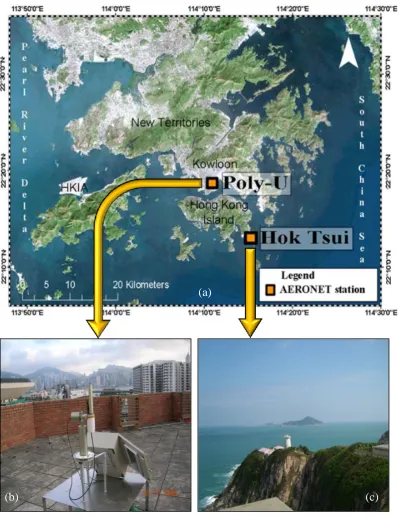
Figure 1.1 (a) Study area of Hong Kong, (b) AERONET station at Hong Kong Polytechnic-University site and (c) AERONET station at Hong Kong Hok Tsui site
(a)
1.6 Significance of the Study
The importance of air quality estimation is well-known since air quality has obviously an impact on human health, economic activities, the environment, and climate change. However, although the accurate estimation of air quality can be obtained from the point-based ground measurement, the lacking of such information over a larger area or a remote area is created a demand to use satellite data for estimating air quality over larger area though the process of air quality estimation is very complex.
However, the main problem to obtain high accuracy aerosol information from satellite data is that which algorithms/techniques are going to be used to estimate AOT over land by minimum retrieval error since several complex processing steps are involved, thus, not so much studies have been carried out to estimate AOT over land from the satellite data. Therefore, the proposed AOT retrieval algorithm using MODIS 500 m data has an immense significant in the field of air quality estimation as it has a potential to obtain aerosol information with good accuracy and minimum retrieval error. Nevertheless, the specific contributions of this study can be described as follows:
(i) It determines which RT codes that can be used to obtained high accuracy against AOT from AERONET measurement.
(ii) Investigate whether AOT retrieved using direct analytical equation can produce better accuracy than AOT retrieved using LUTs generated from RT code.
16
(iv) Promote new accurate surface reflectance estimation technique that can solve significant bias over bright surface.
(v) It can show how far the accuracy of AOT retrieved from MODIS 500 m can be achieved against AOT retrieved from AERONET data.
Indeed, the high resolution of MODIS data (500 m) planned to be used in this study would provide spatial distribution of AOT value in detailed in urban region compared to spatial distribution of AOT from MODIS aerosol product (10 km). The necessaries of high spatial resolution to estimate aerosol over urban region due to this region are the sources of anthropogenic aerosol. Therefore, AOT value at 500 m spatial resolution could provide good spatial distribution with high accuracies level that could be used over urban region. Furthermore, the local aerosol model used instead of global aerosol model could increase the accuracies level due to the characteristic of aerosol model, based on its usage on local areas. The research would also be significant for obtaining AOT value at near real time acquisition due to MODIS aerosol product that does not provide data at near real time. Thus, with the achieved AOT data at near real time, the spatial distribution and concentration of aerosol could be monitored quickly.
1.7 Outline of the Thesis
objective was provided and the specific objectives to achieve the main objective were stated. The scope, study areas, and significant of the study were discussed in details in this chapter.
In Chapter 2, the overview of aerosol background including types, sources, parameters and properties, effects, measurement techniques, and algorithm were described in detailed. In this chapter, previous studies of aerosol retrieval techniques using satellite data were analysed in order to develop an effective technique/approach to retrieve aerosol information. A detail clarification of Radiative Transfer Model (RTM) were described and several radiative transfer (RT) codes were listed and discussed.
Chapter 3 provides a comprehensive methodology for retrieving aerosol optical thickness (AOT) from MODIS 500 m data using different techniques. It consists of data preparation, data pre-processing, aerosol reflectance estimation, local aerosol model characterization, AOT retrieval, and validation and comparison of AOT retrieved.
Chapter 4 presents and analyses results which obtained from different processing algorithms. A detail description of the outcome of the local aerosol model characterization, surface reflectance estimation, validation of MODIS AOT 500 m using AOT from AERONET, comparison of accuracy of different AOT retrieval models, comparison between AOT from MODIS 500 m and AOT from MODIS product, and spatial distribution of MODIS 500 m AOT were presented.
155
REFERENCES
Alencar, A., Asner, G. P., Knapp, D. and Zarin, D. (2011). Temporal variability of forest fires in eastern Amazonia. Ecological Applications, 21 (7), Ecological Society of America, pp.2397–2412.
Ångström, A. (1929). On the atmospheric transmission of sun radiation and on the dust in the air. Geogr. ANN, 12, pp. 130–159.
Aube, M., O’Neill, N. T. and Royer, A. (2000). Modelling of aerosol optical depth variability at regional scale. In: IGARSS 2000. IEEE 2000 International Geoscience and Remote Sensing Symposium. Taking the Pulse of the Planet: The Role of Remote Sensing in Managing the Environment. Proceedings (Cat. No.00CH37120), 1, 2000, IEEE, pp. 199–201.
Bergin, M. H. (2000). Aerosol Radiative Properties and Their Impacts. From Weather Forecasting.
Berk, A., Anderson, G. P., Acharya, P. K., Bernstein, L. S., Muratov, L., Lee, J., Fox, M., Adler-Golden, S. M., Chetwynd, Jr., J. H., Hoke, M. L., Lockwood, R. B., Gardner, J. a., Cooley, T. W., Borel, C. C., Lewis, P. E., Shettle, E. P. and Chetwynd James H., J. (2006). MODTRAN5: 2006 update. In Defense and Security Symposium, International Society for Optics and Photonics, pp. 62331F-62331F.
Berk, A., Anderson, G. P., Bernstein, L. S., Acharya, P. K. and Dothe, H. (1999). MODTRAN4 Radiative Transfer Modeling for Atmospheric Correction. 3756 (July).
Bilal, M., Nichol, J. E., Bleiweiss, M. P. and Dubois, D. (2013). A Simplified high resolution MODIS Aerosol Retrieval Algorithm (SARA) for use over mixed surfaces. Remote Sensing of Environment, 136, pp. 135–145.
Bodhaine, B. A., Wood, N. B., Dutton, E. G. and Slusser, J. R. (1999). On Rayleigh Optical Depth Calculations. Journal of Atmospheric and Oceanic Technology, 16 (11), pp. 1854–1861.
Bourassa, A. E., Rieger, L. A., Lloyd, N. D. and Degenstein, D. A. (2012). Odin-OSIRIS stratospheric aerosol data product and SAGE III intercomparison. Atmospheric Chemistry and Physics, 12 (1), pp. 605–614.
Bowman, K. and Krueger, A. (1985). A global climatology of total ozone from the Nimbus 7 total ozone mapping spectrometer. Journal of Geophysical Research: Atmospheres, 90, pp. 7967–7976.
Bréon, F. M. (1992). Reflectance of Broken Cloud Fields: Simulation and Parameterization. Journal of the Atmospheric Sciences, 49 (14), pp. 1221–1232. Brimblecombe, P. (1987). The Big Smoke: A History of Air Pollution in London
Since Medieval Times. Methuen, p. 202.
Brimblecombe, P. (2011). The Big Smoke (Routledge Revivals): A History of Air Pollution in London since Medieval Times. Routledge, p. 202.
Brook, R. D., Franklin, B., Cascio, W., Hong, Y., Howard, G., Lipsett, M., Luepker, R., Mittleman, M., Samet, J. and Smith, S. C. (2004). Air pollution and cardiovascular disease A statement for healthcare professionals from the expert panel on population and prevention science of the American Heart Association. Circulation, 109 (21), pp. 2655–2671.
Bucholtz, A. (1995). Rayleigh-scattering calculations for the terrestrial atmosphere. Applied Optics, 34 (15), pp. 2765–2773.
Calinski, T. and Harabasz, J. (1974). A dendrite method for cluster analysis. Communications in Statistics - Theory and Methods, 3 (1), Taylor & Francis, pp. 1–27.
Chandrasekhar, S. (1960). Radiative transfer. Courier Dover Publications.
Chew, B., Liew, S. and Balasubramanian, R. (2009). Seven Southeast Asian Studies (7 Seas): atmospheric supersite in Singapore. 30th Asian Conference on Remote Sensing (ACRS 2009).
Chin, M., Ginoux, P., Lucchesi, R., Huebert, B., Weber, R., Anderson, T., Masonis, S., Blomquist, B., Bandy, A. and Thornton, D. (2003). A global aerosol model forecast for the ACE-Asia field experiment. Journal of Geophysical Research, 108 (August), p. 8654.
Clerici, M. and Merlin, F. (2005). Representing Aerosol Optical Properties with Theoretical Modelling and Global Observations. European Commission – Joint Research Centre , Institute for Environment and Sustainability Inland & Marine Waters Unit , TP 272, I-21020 Ispra (VA) – Italy.
157
Diner, D., Abdou, W., Thomas P. Ackerman, Crean, K., Gordon, H. R., Kahn, R. A., John V. Martonchik and McMuldroch, S. (2008). Level 2 aerosol retrieval algorithm theoretical basis. Jet Propulsion Laboratory, California Institute of Technology.
Diner, D. J., Beckert, J. C., Reilly, T. H., Bruegge, C. J., Conel, J. E., Kahn, R. A., Martonchik, J. V., Ackerman, T. P., Davies, R., Gerstl, S. A. W., Gordon, H. R., Muller, J., Myneni, R. B., Sellers, P. J., Pinty, B. and Verstraete, M. M. (1998). Multi-angle Imaging SpectroRadiometer (MISR) instrument description and experiment overview. IEEE Transactions on Geoscience and Remote Sensing, 36 (4), pp. 1072–1087.
Du, H. (2004). Mie-Scattering Calculation. Applied Optics, 43 (9), p.1951.
Du, P., Liu, C. and Ma, L. (2004). An Analytical Non-ephemeris Algorithm for MODIS Bowtie Removal. In Remote Sensing, International Society for Optics and Photonics, 5573, pp. 396–406.
Duan, M., Min, Q. and Lü, D. (2010). A polarized Radiative Transfer model based on successive order of scattering. Advances in Atmospheric Sciences, 27 (4), pp. 891–900.
Dubovik, O., Holben, B., Eck, T. F., Smirnov, A., Kaufman, Y. J., King, M. D., Tanré, D. and Slutsker, I. (2002). Variability of absorption and optical properties of key aerosol types observed in worldwide locations. Journal of the Atmospheric Sciences, 59 (3), pp. 590–608.
Dubovik, O., Sinyuk, A., Lapyonok, T., Holben, B. N., Mishchenko, M., Yang, P., Eck, T. F., Volten, H., Muñoz, O., Veihelmann, B., van der Zande, W. J., Leon, J.-F., Sorokin, M. and Slutsker, I. (2006). Application of spheroid models to account for aerosol particle nonsphericity in remote sensing of desert dust. Journal of Geophysical Research, 111 (D11), p. D11208.
Duffie, J. and Beckman, W. (1994). Solar engineering of thermal processes : second edition. John Wiley & Sons.
Eck, T. F., Holben, B. N., Reid, J. S., Dubovik, O., Smirnov, A., O’Neill, N. T., Slutsker, I. and Kinne, S. (1999). Wavelength dependence of the optical depth of biomass burning, urban, and desert dust aerosols. Journal of Geophysical Research, 104 (D24), p. 31333.
Elimelech, M., Gregory, J. and Jia, X. (2013). Particle Deposition and Aggregation: Measurement, Modelling and Simulation (p. 458). Elsevier Science.
Engdahl, R. B. (1953). The Role of the Area Survey in the Control of Dust. Air Repair, 3 (1), Taylor & Francis, pp. 11–15.
Evans, K. F. and Stephens, G. L. (1991). A new polarized atmospheric radiative transfer model. Journal of Quantitative Spectroscopy and Radiative Transfer, 46 (5), pp. 413–423.
Felske, J. D., Chu, Z. Z. and Ku, J. C. (1983). Mie scattering subroutines (DBMIE and MIEV0): a comparison of computational times. Applied Optics, 22 (15), OSA, p. 2240.
Fischer, J., Leinweber, R. and Preusker, R. (2010). Retrieval of Total Water Vapour Content from MERIS Measurements Algorithm Theoretical Basis Document.
Fleagle, R. G. and Businger, J. A. (1980). An Introduction to Atmospheric Physics, International Geophysics (p. 346). Academic Press.
Fleig, A. J., Klenk, K. F. and Bhartia, P. K. (1982). User’s Guide for the Total-Ozone Mapping Spectrometer ( TOMS ) Instrument First-Year Ozone-T Data Set User’s Guide for the / Total-Ozone Mapping Spectrometer ( TOMS ) Instrument First-Year Ozone-T Data Set.
Fraser, R. S., Bahethi, O. P. and Al-Abbas, A. H. (1977). The effect of the atmosphere on the classification of satellite observations to identify surface features. Remote Sensing of Environment, 6 (3), pp. 229–249.
Friedlander, S. K. (1970). The characterization of aerosols distributed with respect to size and chemical composition. Journal of Aerosol Science, 1 (4), pp. 295–307. Friedlander, S. K. (1971). The characterization of aerosols distributed with respect to
size and chemical composition - II. Classification and design of aerosol measuring devices. Journal of Aerosol Science, 2 (3), pp. 331–340.
Gao, B.-C. and Kaufman, Y. J. (2003). Water vapor retrievals using Moderate Resolution Imaging Spectroradiometer (MODIS) near-infrared channels. Journal of Geophysical Research, 108 (D13), p. 4389.
Geogdzhayev, I. V., Mishchenko, M. I., Rossow, W. B., Cairns, B. and Lacis, A. A. (2002). Global Two-Channel AVHRR Retrievals of Aerosol Properties over the Ocean for the Period of NOAA-9 Observations and Preliminary Retrievals Using NOAA-7 and NOAA-11 Data. Journal of the Atmospheric Sciences, 59 (3), pp. 262–278.
Gnauk, T., Müller, K., van Pinxteren, D., He, L.-Y., Niu, Y., Hu, M. and Herrmann, H. (2008). Size-segregated particulate chemical composition in Xinken, Pearl River Delta, China: OC/EC and organic compounds. Atmospheric Environment, 42 (25), pp. 6296–6309.
159
Griggs, M. (1975). Measurements of Atmospheric Aerosol Optical Thickness over Water Using ERTS-1 Data. Journal of the Air Pollution Control Association, 25 (6), Taylor & Francis, pp. 622–626.
Grossi, M., Valks, P., Slijkhuis, S., Loyola, D., Aberle, B., Mies, K., Wagner, T., Gleisner, H., Lauritsen, K. B. (1999). Water Vapour Column Density Product from GOME-2: Validation with Independent Satellite Observations, 3 (1).
Guo, H., So, K. L., Simpson, I. J., Barletta, B., Meinardi, S. and Blake, D. R. (2007). C1–C8 volatile organic compounds in the atmosphere of Hong Kong: Overview of atmospheric processing and source apportionment. Atmospheric Environment, 41 (7), pp. 1456–1472.
De Haan, J. F., Bosma, P. B. and Hovenier, J. W. (1987). The adding method for multiple scattering calculations of polarized light. Astronomy and Astrophysics, 183, pp. 371–391.
Hahn, D. W. (2009). Light Scattering Theory (pp. 1–13). Department of Mechanical and Aerospace Engineering, Florida.
Hansen, J. E. (1971). Multiple Scattering of Polarized Light in Planetary Atmospheres. Part I. The Doubling Method. Journal of the Atmospheric Sciences, 28 (1), pp. 120–125.
Heidinger, A. K., O’Dell, C., Bennartz, R. and Greenwald, T. (2006). The Successive-Order-of-Interaction Radiative Transfer Model. Part I: Model Development. Journal of Applied Meteorology and Climatology, 45 (10), pp. 1388–1402.
Heintzenberg, J. (1994). Properties of the Log-Normal Particle Size Distribution. Aerosol Science and Technology, 21 (1), Taylor & Francis Group, pp. 46–48.
Henyey, L. G. and Greenstein, J. L. (1941). Diffuse radiation in the galaxy. The Astrophysical Journal, 93, pp. 70–83.
Herman, J. R., Bhartia, P. K., Torres, O., Hsu, C., Seftor, C. and Celarier, E. (1997). Global distribution of UV-absorbing aerosols from Nimbus 7/TOMS data. Journal of Geophysical Research, 102, p. 16911.
Herman, M. (2005). Aerosol remote sensing from POLDER/ADEOS over the ocean: Improved retrieval using a nonspherical particle model. Journal of Geophysical Research, 110 (D10), p. D10S02.
Hewitt, C. N. and Jackson, A. V. (2008). Handbook of Atmospheric Science: Principles and Applications (p. 648). John Wiley & Sons
Holben, B. N., Eck, T. F., Slutsker, I., Tanre, D., Tanré, D., Buis, J. P., Setzer, A., Vermote, E., Reagan, J. A., Kaufman, Y. J., Nakajima, T., Lavenu, F., Jankowiak, I. and Smirnov, A. (1998). AERONET — A Federated Instrument Network and Data Archive for Aerosol Characterization. Remote Sensing of Environment, 4257 (98), pp. 1–16.
Hong, I. P. (2012). Rayleigh scattering and Mie scattering in Maya. Retrieved on January 10, 2015, from http://inpyo3d.blogspot.com/
Hong Kong Observatory. (2003). Climate of Hong Kong, from http://www.hko.gov.hk.
Hoyningen-Huene, W. von, Kokhanovsky, A. A., Wuttke, M. W., Buchwitz, M., Noël, S., Gerilowski, K., Burrows, J. P., Latter, B., Siddans, R. and Kerridge, B. J. (2007). Validation of SCIAMACHY top-of-atmosphere reflectance for aerosol remote sensing using MERIS L1 data. Atmospheric Chemistry and Physics, 7 (1), pp. 97–106.
Hsu, N. C., Tsay, S. C., King, M. D. and Herman, J. R. (2006). Deep blue retrievals of Asian aerosol properties during ACE-Asia. IEEE Transactions on Geoscience and Remote Sensing, 44 (11), pp. 3180–3195.
Hsu, N. C., Tsay, S. C., King, M. D. and Herman, J. R. (2004). Aerosol properties over bright-reflecting source regions. IEEE Transactions on Geoscience and Remote Sensing, 42 (3), pp. 557–569.
Hsu, N. C., Herman, J. R., Bhartia, P. K., Seftor, C. J., Torres, O., Thompson, A. M., Gleason, J. F., Eck, T. F. and Holben, B. N. (1996). Detection of biomass burning smoke from TOMS measurements. Geophysical Research Letters, 23 (7), pp. 745–748.
Huebert, B. J., Bates, T., Russell, P. B., Shi, G., Kim, Y. J., Kawamura, K., Carmichael, G. and Nakajima, T. (2003). An overview of ACE-Asia: Strategies for quantifying the relationships between Asian aerosols and their climatic impacts. Journal of Geophysical Research, 108 (D23), pp. 8633.
Hulst, H. C., and Van De Hulst, H. C. (1957). Light Scattering by Small Particles. Courier Dover Publications.
Ichoku, C., Chu, D. A., Mattoo, S., Kaufman, Y. J., Remer, L. A., Tanré, D., Slutsker, I. and Holben, B. N. (2002). A spatio‐temporal approach for global validation and analysis of MODIS aerosol products. Geophysical Research Letters, 29 (12), MOD1–1.
161
Kahn, R., West, R., McDonald, D., Rheingans, B. and Mishchenko, M. I. (1997). Sensitivity of multiangle remote sensing observations to aerosol sphericity. Journal of Geophysical Research, 102 (D14), p. 16861.
Katsev, I. L., Prikhach, A. S., Zege, E. P., Grudo, J. O. and Kokhanovsky, A. A. (2010). Speeding up the aerosol optical thickness retrieval using analytical solutions of radiative transfer theory. Atmospheric Measurement Techniques, 3 (5), pp. 1403–1422.
Kattawar, G. W. and Plass, G. N. (1968). Radiance and polarization of multiple scattered light from haze and clouds. Applied optics, 7 (8), Optical Society of America, pp. 1519–1527.
Kaufman, Y. J. and Tanré, D. (1998). Algorithm for remote sensing of tropospheric aerosol from MODIS. NASA MODIS Algorithm Theoretical Basis Document, Goddard Space Flight Center, 85.
Kaufman, Y. J., Tanré, D., Gordon, H. R., Nakajima, T., Lenoble, J., Frouin, R., Grassl, H., Herman, B. M., King, M. D. and Teillet, P. M. (1997a). Passive remote sensing of tropospheric aerosol and atmospheric correction for the aerosol effect. Journal of Geophysical Research: Atmospheres (1984–2012), 102 (D14), pp. 16815–16830.
Kaufman, Y. J., Tanré, D., Remer, L. A., Vermote, E. F., Chu, A. and Holben, B. N. (1997b). Operational remote sensing of tropospheric aerosol over land from EOS moderate resolution imaging spectroradiometer. Journal of Geophysical Research, 102 (D14), p. 67,17017–17051.
Kaufman, Y. J., Wald, A. E., Remer, L. A. and Flynn, L. (1997c). The MODIS 2.1-μm channel-correlation with visible reflectance for use in remote sensing of aerosol. IEEE Transactions on Geoscience and Remote Sensing, 35 (5), pp. 1286– 1298.
Kerker, M. (1969). The scattering of light and other electromagnetic radiation (p. 666). Academic Press.
King, M. D., Kaufman, Y. J., Menzel, W. P. and Tanre, D. (1992). Remote sensing of cloud, aerosol, and water vapor properties from the moderate resolution imaging spectrometer (MODIS). IEEE Transactions on Geoscience and Remote Sensing, 30 (1), pp. 2–27.
Kokhanovsky, a. a., Deuzé, J. L., Diner, D. J., Dubovik, O., Ducos, F., Emde, C., Garay, M. J., Grainger, R. G., Heckel, a., Herman, M., Katsev, I. L., Keller, J., Levy, R., North, P. R. J., Prikhach, a. S., Rozanov, V. V., Sayer, a. M., Ota, Y., Tanré, D., Thomas, G. E. and Zege, E. P. (2010). The inter-comparison of major satellite aerosol retrieval algorithms using simulated intensity and polarization characteristics of reflected light. Atmospheric Measurement Techniques, 3 (4), pp. 909–932.
Kokhanovsky, A. A., Breon, F. M., Cacciari, A., Carboni, E., Diner, D., Di Nicolantonio, W., Grainger, R. G., Grey, W. M. F., Höller, R., Lee, K. H., Li, Z., North, P. R. J., Sayer, A. M., Thomas, G. E. and von Hoyningen-Huene, W. (2007). Aerosol remote sensing over land: A comparison of satellite retrievals using different algorithms and instruments. Atmospheric Research, 85 (3–4), pp. 372–394.
Kokhanovsky, A. A. and de Leeuw, G. H. (2009). Satellite aerosol remote sensing over land. Berlin, Heidelberg: Springer.
Kotchenova, S. Y. and Vermote, E. F. (2007). Validation of a vector version of the 6S radiative transfer code for atmospheric correction of satellite data. Part II. Homogeneous Lambertian and anisotropic surfaces. Applied Optics, 46 (20), pp. 4455–4464.
Kotchenova, S. Y., Vermote, E. F., Levy, R. and Lyapustin, A. (2008). Radiative transfer codes for atmospheric correction and aerosol retrieval: intercomparison study. Applied Optics, 47 (13), OSA, pp. 2215–2226.
Kotchenova, S. Y., Vermote, E. F., Matarrese, R. and Klemm, F. J. (2006a). Validation of a vector version of the 6S radiative transfer code for atmospheric correction of satellite data. Part I: path radiance. Applied optics, 45 (26), pp. 6762–6774.
Kotchenova, S. Y., Vermote, E. F., Matarrese, R. and Klemm, Jr., F. J. (2006b). Validation of a vector version of the 6S radiative transfer code for atmospheric correction of satellite data. Part I: Path radiance. Applied Optics, 45 (26), OSA, p. 6762.
Krotkov, N. A., Flittner, D. E., Krueger, A. J., Kostinski, A., Riley, C., Rose, W. and Torres, O. (1999). Effect of particle non-sphericity on satellite monitoring of drifting volcanic ash clouds. Journal of Quantitative Spectroscopy and Radiative Transfer, 63 (2-6), pp. 613–630.
Lacis, A. A., Chowdhary, J., Mishchenko, M. I. and Cairns, B. (1998). Modeling errors in diffuse-sky radiation: Vector vs scalar treatment. Geophysical Research Letters, 25 (2), pp. 135–138.
Lee, K. H. and Kim, Y. J. (2010). Satellite remote sensing of Asian aerosols: a case study of clean, polluted, and Asian dust storm days. Atmospheric Measurement Techniques, 3 (6), pp. 1771–1784.
Lee, K. H., Kim, Y. J., von Hoyningen-Huene, W. and Burrow, J. P. (2007). Spatio-temporal variability of satellite-derived aerosol optical thickness over Northeast Asia in 2004. Atmospheric Environment, 41 (19), pp. 3959–3973.
163
De Leeuw, G., Kinne, S., Léon, J.-F., Pelon, J., Rosenfeld, D., Schaap, M., Veefkind, P. J., Veihelmann, B., Winker, D. M. and von Hoyningen-Huene, W. (2011). Retrieval of aerosol properties. The Remote Sensing of Tropospheric Composition from Space, Springer, pp. 259–313.
Lenoble, J., Herman, M., Deuzé, J. L., Lafrance, B., Santer, R. and Tanré, D. (2007). A successive order of scattering code for solving the vector equation of transfer in the earth’s atmosphere with aerosols. Journal of Quantitative Spectroscopy and Radiative Transfer, 107 (3), pp. 479–507.
Lenoble, J., Remer, L., Tanré, D. and Chang, N. (2012). Aerosol remote sensing. Springer.
Lentz, W. J. (1976). Generating bessel functions in mie scattering calculations using continued fractions. Applied optics, 15 (3), OSA, pp. 668–671.
Leroy, M., Deuzé, J. L., Bréon, F. M., Hautecoeur, O., Herman, M., Buriez, J. C., Tanré, D., Bouffiès, S., Chazette, P. and Roujean, J. L. (1997). Retrieval of atmospheric properties and surface bidirectional reflectances over land from POLDER/ADEOS. Journal of Geophysical Research, 102 (D14), p. 17023. Levoni, C., Cervino, M., Guzzi, R. and Torricella, F. (1997). Atmospheric aerosol
optical properties: a database of radiative characteristics for different components and classes. Applied optics, 36 (30), pp. 8031–8041.
Levy, R. C., Remer, L. A., Kleidman, R. G., Mattoo, S., Ichoku, C., Kahn, R. and Eck, T. F. (2010). Global evaluation of the Collection 5 MODIS dark-target aerosol products over land. Atmospheric Chemistry and Physics Discussions, 10 (6), Copernicus GmbH, pp. 14815–14873.
Levy, R., Remer, L. and Tanré́́́, D. (2009). Algorithm for Remote Sensing of Tropospheric Aerosol over Dark Targets from MODIS: Collections 005 and 051: Revision 2; Feb 2009. Download from http://modisatmos.gsfc.nasa. gov/_docs/ATBD_MOD04_C005_rev2. pdf (2009).
Levy, R. C., Remer, L. A., Mattoo, S., Vermote, E. F. and Kaufman, Y. J. (2007). Second‐generation operational algorithm: Retrieval of aerosol properties over land from inversion of Moderate Resolution Imaging Spectroradiometer spectral reflectance. Journal of Geophysical Research: Atmospheres (1984–2012), 112 (D13).
Levy, R. C., Remer, L. A. and Kaufman, Y. J. (2004). Effects of neglecting polarization on the MODIS aerosol retrieval over land. IEEE Transactions on Geoscience and Remote Sensing, 42 (11), pp. 2576–2583.
Lewis, P., Gómez-Dans, J., Kaminski, T., Settle, J., Quaife, T., Gobron, N., Styles, J. and Berger, M. (2012). An Earth Observation Land Data Assimilation System (EO-LDAS). Remote Sensing of Environment, 120, pp. 219–235.
Li, C., Lau, A. K.-H. and Chu, D. A. (2005). Retrieval, validation, and application of the 1-km aerosol optical depth from MODIS measurements over Hong Kong. IEEE Transactions on Geoscience and Remote Sensing, 43 (11), pp. 2650–2658.
Li, Z., Zhao, X., Kahn, R., Mishchenko, M., Remer, L., Lee, K.-H., Wang, M., Laszlo, I., Nakajima, T. and Maring, H. (2009). Uncertainties in satellite remote sensing of aerosols and impact on monitoring its long-term trend: a review and perspective. Annales Geophysicae, 27 (7), Copernicus GmbH, pp. 2755–2770. Liang, S. (2005). Quantitative remote sensing of land surfaces (Vol. 30). John Wiley
& Sons.
Liang, S. (2008). Advances in land remote sensing: system, modeling, inversion and application. Springer.
Lyapustin, A. I. (2005). Radiative transfer code SHARM for atmospheric and terrestrial applications. Applied Optics, 44 (36), OSA, p. 7764.
Martins, J. V. (2002). MODIS Cloud screening for remote sensing of aerosols over oceans using spatial variability. Geophysical Research Letters, 29 (12), p. 8009. Masuoka, E. and Fleig, A. (1998). Key characteristics of MODIS data products.
IEEE Transactions on Geoscience and Remote Sensing, 36 (4), pp. 1313–1323.
McCartney, E. J. (1976). Optics of the Atmosphere: Scattering by Molecules and Particles (Pure & Applied Optics). (p. 426). John Wiley & Sons Inc.
McMurry, P. H. (2000). A review of atmospheric aerosol measurements. Atmospheric Environment, 34 (12), pp. 1959–1999.
Mekler, Y., Quenzel, H., Ohring, G. and Marcus, I. (1977). Relative atmospheric aerosol content from erts observations. Journal of Geophysical Research, 82 (6), pp. 967–970.
Mie, G. (1908). Beiträge zur Optik trüber Medien, speziell kolloidaler Metallösungen. Annalen der Physik, 330 (3), pp. 377–445.
Min, Q. and Duan, M. (2004). A successive order of scattering model for solving vector radiative transfer in the atmosphere. Journal of Quantitative Spectroscopy and Radiative Transfer, 87 (3), pp. 243–259.
165
Mishchenko, M. I., Geogdzhayev, I. V., Cairns, B., Carlson, B. E., Chowdhary, J., Lacis, A. a., Liu, L., Rossow, W. B. and Travis, L. D. (2007). Past, present, and future of global aerosol climatologies derived from satellite observations: A perspective. Journal of Quantitative Spectroscopy and Radiative Transfer, 106 (1-3), pp. 325–347.
Mishchenko, M. I., Hovenier, J. W. and Travis, L. D. (1999). Light Scattering by Nonspherical Particles: Theory, Measurements, and Applications. Academic Press, p. 690.
Mishchenko, M. I., Lacis, A. A. and Travis, L. D. (1994). Errors induced by the neglect of polarization in radiance calculations for rayleigh-scattering atmospheres. Journal of Quantitative Spectroscopy and Radiative Transfer, 51 (3), pp. 491–510.
Mishchenko, M. I. and Travis, L. D. (2003). Electromagnetic scattering by nonspherical particles. In Exploring the Atmosphere by Remote Sensing Techniques. Springer Berlin Heidelberg, pp. 77–127.
Mishchenko, M. I., Travis, L. D. and Lacis, A. A. (2002). Scattering, Absorption, and Emission of Light by Small Particles. Cambridge university press.
Mishchenko, M. I., Travis, L. D. and Mackowski, D. W. (1996). T-matrix computations of light scattering by nonspherical particles: A review. Journal of Quantitative Spectroscopy and Radiative Transfer, 55 (5), pp. 535–575.
Omar, A. H., Won, J., Winker, D. M., Yoon, S., Dubovik, O. and Mccormick, M. P. (2005). Development of global aerosol models using cluster analysis of Aerosol Robotic Network ( AERONET ) measurements. Journal of Geophysical Research: Atmospheres (1984–2012), 110, pp. 1–14.
Ouaidrari, H. and Vermote, E. F. (1999). Operational Atmospheric Correction of Landsat TM Data. Remote Sensing of Environment, 70 (1), pp. 4–15.
Peck, E. R. and Reeder, K. (1972). Dispersion of Air. Journal of the