A PARAMETERIZED RELATION FOR V
S-KAPPA CORRECTIONS
TO ADJUST
THE GLOBAL GROUND MOTION PREDICTION
EQUATIONS TO SWISS NPP SITES
Yesim Biro1, Philippe Renault2
1 Specialist Hazard and Structural Analyses, swissnuclear, Olten, Switzerland
2 Head of Hazard and Structural Analyses, swissnuclear, Olten, Switzerland
ABSTRACT
Under the scope of PEGASOS Refinement Project (PRP), where probabilistic seismic hazard assessment is performed for the nuclear power plant sites in Switzerland, one of the key issue was adjusting ground motion equations for the targeted region. During the PRP several sensitivity studies were performed with respect to the impact of the host-to-target conversion and it turned out that Vs-Kappa corrections are playing a key role with a large impact on the seismic hazard results as presented in SMIRT 21 (Renault, 2011). As a new step, it was tried to develop a generalized approach and get parameterized relations from pre-processed evaluation to apply Vs-Kappa correction to a specific GMPE.
INTRODUCTION
In the PEGASOS Refinement Project (PRP) (Renault et al., 2010) a specific set of ground motion prediction equations (GMPE) were selected, and it was deemed necessary to adjust them for the Swiss rock conditions in order to make them applicable for the site specific PSHA. Nowadays, the host-to-target conversion mainly consists in applying the so-called hybrid empirical method (Campbell, 2003 & 2006, Scherbaum et al., 2004) which defines a method to adjust ground-motion prediction equations to target regions different from the region for which they were developed by using response spectral host-to-target-region-conversion filters. This accounts for the differences in the shear wave velocity profiles (VS)
and Kappa (κ) values of the individual GMPE-host-regions (for which they were implicitly developed based on the regional data) and the conditions in the target region, here the Alpine foreland in Switzerland.
During the PRP several sensitivity studies were performed with respect to the impact of the host-to-target conversion and it turned out to be a key factor with a large impact on the seismic hazard results. A couple of alternatives approaches were developed in order to try to account for the epistemic uncertainty of this correction. Beside the classical hybrid empirical method, some iterative approaches based on the hybrid empirical approach were developed by the experts. Empirical correction values were also derived in order to be able to estimate constraints based on the observed data. In the course of the sensitivity analysis, due to high variation of Kappa ranges and the impact on PSHA, a new approach of estimating Kappa on Fourier spectra based on an inverse RVT approach was introduced in PRP. Furthermore, comparisons to estimates were performed, based on existing VS30-Kappa relationships
evaluated for generic Swiss rock conditions and specific hard rock sites.
ADJUSTING SELECTED GMPES TO THE SWISS ROCK CONDITIONS
Within the PEGASOS Refinement Project (PRP), the Sub-Project 2 (SP2) experts decided to apply host-to-target corrections for the GMPE to be applicable for the Swiss reference rock profile
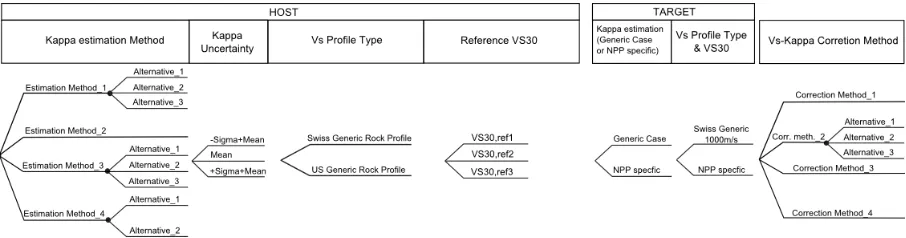
site conditions (with VS30 between 1100 and 2500m/s). In the course of the project a logic-tree (Figure 1)
was developed in order to build a clear structure for the different contributing variables and to cover the epistemic uncertainty.
The SP2 expert panel has selected 11 GMPEs to be considered in the logic-tree for the median models (based on extended selection criteria of Cotton et al., 2006). The selected models include four of the NGA GMPE, two GMPE for Eastern North America, three for Europe and the Middle East, one for Japan and alternative version of the new Swiss stochastic model. Here in this paper we will concentrate on the NGA GMPEs, which are Abrahamson & Silva (2008), Boore & Atkinson (2008), Campbell & Bozorgnia (2008) and Chiou & Youngs (2008).
Figure 1. Schematic representation of the logic-tree used in PRP for adjusting the GMPEs to Swiss conditions.
In the project, the hazard will be calculated in terms of ordinates of spectral acceleration at 9 response frequencies between 0.5 and 100 Hz. The SP2 experts decided that developing host-to-target region scale factors for the full set of stochastic point source parameters was desired as the stress-drop scaling in Switzerland was not well constrained, but they considered the differences in the shear wave velocity profiles and Kappa to be important effects that should be considered. Therefore, the objective was to isolate the VS and Kappa correction from the full model correction.
SOURCES OF UNCERTAINTIES
The shape (gradient) and values of an underlying generic shear wave velocity profiles for the host conditions are not well constrained (discussed in more detail in topic “VS profile difference”).
Nevertheless, the background models used to evaluate the VS correction need as input information the
crustal amplification and thus, two alternative profiles have been adopted. The same issue occurs for the target profile, but if measurements are available it is justified to develop a single generic hard rock profile to be used. Form the sensitivity analyses it has been seen that the VS correction is straight forward, robust
and has a much smaller impact than the Kappa correction (if done separately).
Furthermore, there are alternative estimates of crustal damping (Kappa) in the host and target region which can be used (discussed in more detail in topic “Kappa difference”). As Kappa is implicitly part of the dataset for which the GMPE was developed and not directly a modifiable variable in the attenuation model, it is hard to quantify and constrain.
In the framework of the PRP also alternative approaches for the Kappa evaluation were proposed which are based on the development of Kappa-fpeak relationships. The approach consists in the simulation
model, Kappa versus “fpeak” values are plotted for each magnitude and distance scenarios and the
parameters of the power fit (c and n) between Kappa and “fpeak” were determined:
n peak
f
c
.
=
κ
(1)These relationships allow the estimation of Kappa for the different point-source stochastic models knowing fpeak for a certain earthquake magnitude and distance.
The host-to-target correction can be performed in a full single step or in a 2-step approach which would consist in first correction from the generic host conditions to the generic target conditions and then applying a second correction towards the site specific target conditions. In order to be able to relatively compare different corrected GMPEs and their correction functions it makes sense to do this for the generic target conditions in order to have a common reference. A sample comparison has shown that the 2-step correction produces slightly higher correction factors (approx. 5%) at the peak of the correction function (around 30 Hz). As a slight difference in the VS-Kappa correction function can lead to a
significant difference in the end results it is worth to assess this difference in more depth.
VS PROFILE DIFFERENCE
For the host GMPE VS profile, there are two sets of reference profiles in PRP: Swiss generic and
US generic. A specific generic velocity profile for a GMPE is interpolated from the set of reference VS
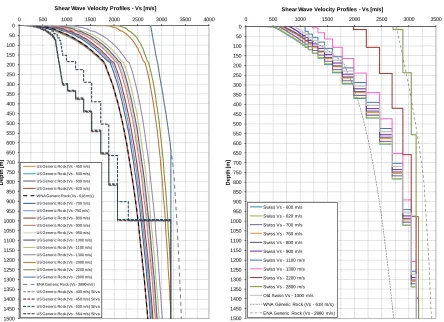
profiles. The generic Swiss profile is based on the reference rock VS profile (Figure2b). For other VS30
values, the Swiss reference VS profile is shifted to match the VS30 of each GMPE as shown in Figure2b.
The generic US profiles consist of the 618 m/s VS30 profile for western North America (WNA) and the
2880 m/s VS30 profile for eastern North America (ENA) (Boore & Joyner, 1997). The interpolation of US
generic profiles between 618 and 2880m/s is done based on Cotton et al. (2006) and shown in Figure 2a.
A range of alternative reference VS30 values for each GMPE were selected by the SP2 experts to account
for its uncertainty.
The references VS30 values for the four NGA models are fixed to a single value to be selected by
the SP2 expert. A single value is used for these models because the NGA models include VS30 as an input
parameter in the model. For the other PRP selected GMPEs, which are not discussed here in this paper,
the shear wave velocity adjustment is performed based on alternative reference VS30 values, intended to
capture the possible best estimates consistent with the used site classes. For some of those GMPE the experts also considered shear wave velocities below 618m/s which would have required an extrapolation of the profile. This turned out to be problematic as the shape of the US generic rock profile is very flat in the shallow part. As alternative, measured US shear wave profiles in the range of 400 to 560m/s (personal communication by W. Silva) were used to define profiles based on soft rock profiles. On the other hand it can be seen that those soft rock profiles show a significant different shape than the WNA profile of Boore & Joyner (1997), highlighting again the none-uniqueness of this generic VS adjustment.
As target VS profile, the Swiss generic rock shear wave profile and NPP specific versions of it
will be used for the PSHA evaluation at each site.
KAPPA DIFFERENCE
In the PRP, estimates of the damping in the upper crust (Kappa) are needed for each GMPE (host region) and for Switzerland (target region) in order to perform a host-to-target conversion to make the GMPEs applicable. Three alternative methods for estimation of the Kappa are considered: Kappa based
on response spectral shapes from the GMPE, Kappa based on empirical VS-Kappa correlations, Kappa
0 50 100 150 200 250 300 350 400 450 500 550 600 650 700 750 800 850 900 950 1000 1050 1100 1150 1200 1250 1300 1350 1400 1450 1500
0 500 1000 1500 2000 2500 3000 3500 4000
D e p th [ m ]
Shear Wave Velocity Profiles - Vs [m/s]
US Generic Rock (Vs - 450 m/s)
US Generic Rock (Vs - 500 m/s)
US Generic Rock (Vs - 600 m/s)
US Generic Rock (Vs - 620 m/s)
WNA Generic Rock (Vs - 618 m/s)
US Generic Rock (Vs - 700 m/s)
US Generic Rock (Vs -750 m/s)
US Generic Rock (Vs - 800 m/s)
US Generic Rock (Vs - 900 m/s)
US Generic Rock (Vs - 950 m/s)
US Generic Rock (Vs - 1000 m/s)
US Generic Rock (Vs - 1100 m/s)
US Generic Rock (Vs - 1300 m/s)
US Generic Rock (Vs - 2000 m/s)
US Generic Rock (Vs - 2200 m/s)
US Generic Rock (Vs - 2800 m/s)
ENA Generic Rock (Vs - 2880 m/s)
US Generic Rock (Vs - 400 m/s) Silva
US Generic Rock (Vs - 450 m/s) Silva
US Generic Rock (Vs - 500 m/s) Silva
US Generic Rock (Vs - 564 m/s) Silva
Figure 2. Alternative VS profiles based on the US generic (a: left) and Swiss generic (b: right) VS profiles.
The interpolation of US generic profiles between 618 and 2880m/s is done based on Cotton et al. (2006).
Kappa based on Response Spectral Shapes
To improve the robustness of the estimation of Kappa, initially it was proposed that the Kappa value be estimated based on the frequency at which the acceleration response spectrum reaches its peak (fpeak) or a representative characteristic frequency (famp). Using the point-source stochastic model, the
relation between the fpeak and Kappa can be derived for different magnitude and distances using short
distances scenarios (to avoid large effects of Q). When the Kappa is reduced, the peak of the spectrum shifts to higher frequencies. The relation between Kappa and fpeak is not strongly dependent of the
stress-drop. The relation is also similar for the WUS and CEUS background models indicating that this correlation is fairly robust. Alternative definitions of the characteristic frequency have been evaluated also and the associated standard deviation.
Using this approach, Kappa values were estimated for each of the GMPE selected within the PRP. However, even though the mean Kappa values were quite similar, the point source inversion leads to very different estimates of Kappa values for the four NGA models when the variability of the estimated Kappa values is included.
Kappa based on VS-Kappa correlations
Kappa can be estimated for a GMPE using the VS30 for the GMPE and empirical correlations
between Kappa and VS30. Two correlation models considered as bounding cases are considered in the
PRP: Edwards et al. (2012) and Silva et al. (1998). The Edward et al. model is based on Swiss data using
0 50 100 150 200 250 300 350 400 450 500 550 600 650 700 750 800 850 900 950 1000 1050 1100 1150 1200 1250 1300 1350 1400 1450 1500
0 500 1000 1500 2000 2500 3000 3500
D e p th [ m ]
Shear Wave Velocity Profiles - Vs [m/s]
Swiss Vs - 600 m/s
Swiss Vs - 620 m/s
Swiss Vs - 700 m/s
Swiss Vs - 760 m/s
Swiss Vs - 800 m/s
Swiss Vs - 900 m/s
Swiss Vs - 1100 m/s
Swiss Vs - 1300 m/s
Swiss Vs - 2200 m/s
Swiss Vs - 2800 m/s
Old Swiss Vs - 1000 m/s
WNA Generic Rock (Vs - 618 m/s)
the Kappa estimated for the Swiss stations as part of the development of the Swiss stochastic model. The Silva model is based on world-wide data (mostly California) using Kappa values estimated from inversions of the Fourier spectral values. A recent evaluation of VS30-Kappa relation based on world-wide
data using Kappa values based on measured slopes of Fourier spectra is given by Van Houtte (2011). They found a VS30-Kappa relation similar to the Silva et al. (1998) model. A comparison of the different
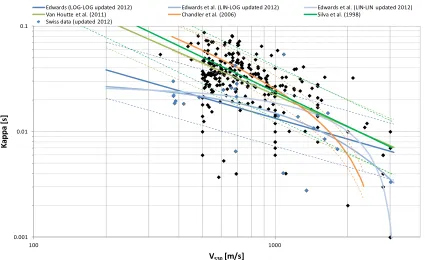
alternative VS30-Kappa relations is shown in Figure 3.
It should be noted that the data is very sparse in the range of hard rock VS30 values of interest for
the Swiss NPP (1100 – 2500m/s) and that the different empirical models lead to very different kappa estimates for such hard rock conditions. Furthermore, if only data above 1000m/s would be considered, there is no clear trend anymore which could be used to derive a model.
0.001 0.01 0.1
100 1000
Kap
pa [
s]
VS30[m/s]
Kappa-VS30models (median +/-sigma)
Edwards (LOG-LOG updated 2012) Edwards et al. (LIN-LOG updated 2012) Edwards et al. (LIN-LIN updated 2012) Van Houtte et al. (2011) Chandler et al. (2006) Silva et al. (1998)
Swiss data (updated 2012)
Figure 3. Published correlations between Kappa and VS30. The dashed lines represent +/- one standard
deviation about the median relationship (Renault, 2011).
Kappa based onFourier Spectra from IRVT
Kappa can also be estimated for a GMPE based on the slope of the Fourier Amplitude Spectrum
(FAS) estimated from the response spectrum. This approach consists of deriving VS‐Kappa adjustment
functions which are based on the scaling of the Fourier amplitude spectra corresponding to the host
GMPE response spectra for differences in Kappa and VS profiles between the host and target regions.
Response spectra‐compatible FAS for the host and target regions are obtained through inverse random
for a given magnitude and distance. For each GMPE and each reference VS30 value, this process is
repeated for different earthquake scenarios (e.g. magnitudes Mw=5, Mw=6, and Mw=7 and distances Rjb = 5, 10 and 20 km).
Kappa Estimation Using Empirical Ground Motion Data
Different Kappa scaling were also derived using empirical ground motion data from Western US (WUS), Central and Eastern America (CENA), and Switzerland. The intention of this evaluation was to try to find some empirical constraints in order to provide guidance on the simulation based Kappa-corrections to be retained. For WUS data, Kappa scaling was evaluated using the within-event residuals of the data with respect to the Abrahamson & Silva (2008) and the Campbell & Bozorgnia (2008) GMPE. For the CENA data, Kappa scaling has been evaluated using within-event residuals of the data with respect to the Atkinson & Boore (2006) model. For the empirical ground motion datasets used herein, Kappa is estimated for each recording using IRVT-based relationships between Kappa and famp1.3, famp1.5,
famp1.7 and famp2.0 where famp1.3 to famp2.0 are the highest frequencies of the response spectrum that correspond
to spectral acceleration values equal to 1.3 and 2 times the peak ground acceleration (PGA), respectively.
f1 f2 f3 f1 f2 f3 f1 f2 f3 f1 f2 f3 f1 f2 f3 f1 f2 f3 Edwards Silva Edwards Silva Edwards Silva famp1.3 famp1.5 famp1.7 famp2.0 Vs30,ref1 Vs30,ref2 vs30,ref3 Vs30,ref1 Vs30,ref2 Vs30,ref3 Vs30,ref1 Vs30,ref2 Vs30,ref3 Vs30,ref1 Vs30,ref2 Vs30,ref3 Vs30,ref1 Vs30,ref1
US CH Vs30-Kappa correlation Empricical iRVT AbSi08 0.0639 0.0801 0.0665 0.0545 0.0717 0.0606 0.0494 0.0649 0.0547 0.0567 0.0723 0.0603 0.0495 0.0671 0.0569 0.0452 0.0612 0.0517 0.0197 0.0401 0.0173 0.0303 0.015 0.0238 0.047 0.051 0.059 0.064 0.0412 0.0407 0.0394 BoAt08 0.0511 0.0672 0.0534 0.048 0.0604 0.0511 0.0457 0.0556 0.0489 0.0445 0.0601 0.0483 0.0433 0.056 0.0477 0.0417 0.0521 0.0461 0.0197 0.0401 0.0173 0.0303 0.015 0.0238 0.044 0.046 0.044 0.049 0.0404 0.0402 0.04 CaBo08 0.0518 0.0599 0.0526 0.0478 0.0544 0.0495 0.0438 0.0497 0.0465 0.0451 0.053 0.0475 0.0431 0.0501 0.0462 0.0399 0.0463 0.0438 0.0197 0.0401 0.0173 0.0303 0.015 0.0238 0.04 0.044 0.047 0.049 0.0405 0.0398 0.0385 ChYo08 0.0452 0.0751 0.0502 0.0416 0.068 0.0466 0.0389 0.0645 0.0441 0.0389 0.0675 0.0453 0.0372 0.0634 0.0433 0.0352 0.0608 0.0415 0.0197 0.0401 0.0173 0.0303 0.015 0.0238 0.044 0.048 0.054 0.06 0.0379 0.0353 0.0339
0 0.01 0.02 0.03 0.04 0.05 0.06 0.07 0.08 0.09
Ka
pp
a [
s]
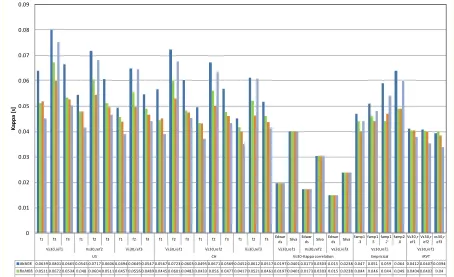
Figure 4. Representation of alternative Kappa estimates obtained through different approaches for the four NGA GMPEs. The first 18 columns correspond the approach based on response spectral shapes, the
Kappa values in column 19-24 to the approach based on VS-Kappa correlations, column 25-28 to
approach based on Fourier Spectra from IRVT and the last three columns to the approach estimation using empirical ground motion data.
Comparison of different Kappa Estimates
course of the sensitivity analyses in the framework of the PRP certainly reflects the several uncertainties being part of the evaluation. Figure 4 illustrates the various values obtained for the four selected NGA models. What can be seen is that even within the NGA GMPEs, which is more or less based on a similar
dataset, the first set of Kappa estimates based on response spectral shapes are within a large range. On
the other hand, the Kappa values obtained on the base of the empirical evaluation of data and the IRVT approach show to be more robust and consistent with expert judgment.
IMPACT OF HOST-TO-TARGET CONVERSIONS ON HAZARD
It is well known that GMPEs should not be used directly as published for regions other than the one on which the underlying dataset is based and for which the model has been constrained. Their applicability should always be verified or adjustments are necessary based on the local available data. Nevertheless, little attention was paid to the host-to-target correction and its consequences in the past, or was even completely ignored. There is a significant difference in the impact of VS and Kappa conditions
from host-to-target. In the framework of PRP, hazard sensitivity studies have identified these correction
functions, derived from the combination of VS and Kappa conditions, as being one of the most important
contributors in terms of effect on the overall hazard results.
Impact of VS and Kappa, and their derived VS-Kappa correction functions
An example of VS and Kappa correction functions for different host and target conditions
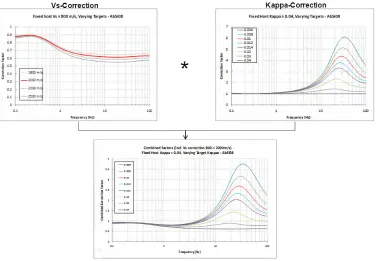
combined in the end to a joint correction function and evaluated for the Abrahamson & Silva (2008) GMPE is illustrated in Figure5. The top left graph shows the corrections assuming a host VS30 = 800 m/s
and corrected to four different target VS values in the range of 1800-2500 m/s. The top right graph shows
the corrections functions assuming a host of Kappa=0.04 s and different target values between 0.006 and
0.04 s. The combined VS-Kappa correction shown here was built with the VS-correction for 2000 m/s
(red line) and the different target Kappa values.
Impact on Hazard
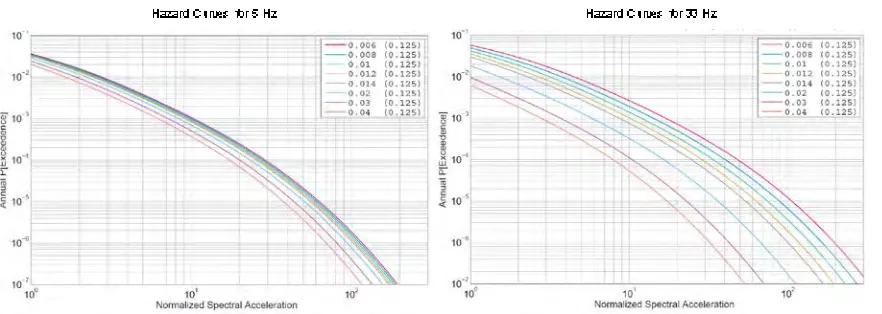
Figure 6 shows the impact of the correction functions displayed in Figure 5 on the seismic hazard. The effect is not negligible and dominating compared to most other parameters which have been
evaluated in the framework of the SP2 refinements. The assumed values for VS and Kappa in the host
and target region are reasonable and credible estimates based on the available information. Nevertheless, it is of course acknowledged that those should not be set independently from each other, as they are
correlated. Depending on the selected host and target VS and Kappa values and their combination the
correction can have difference outcome than shown in the example.
It is clear and from the figures below, which show the impact on the hazard at 5 and 33 Hz, that the Kappa correction shows its biggest impact at the higher frequencies up to PGA.
Figure 5. Hazard sensitivity to different target Kappa values for 5 Hz (left) and 33 Hz (right) at an example site in Switzerland. The host Kappa is fixed as 0.04 s with VS30 = 800 m/s. The target conditions
are VS30 = 2000 m/s with different Kappa values ranging from 0.006 s to 0.004 s.
CONCLUSION
This paper gives an overview of the performed VS-Kappa sensitivity evaluations with respect to
the input values and resulting host-to-target conversion correction factors, which were evaluated with different alternative approaches. Nevertheless, it should be recognized that there is an illusion of precision in the out coming correction function, as many uncertainties are involved in the different steps, and especially with respect to the used input values. Yet, no definitive conclusions could have been drawn as the used parameters, the associated uncertainties in their estimation and used methods are still evaluated and under development, respectively. One of the main issues is certainly that it is hard to account for the correlations of all parameters in the used attenuation models and the used stochastic
versions. As the VS-Kappa correction has been identified as a dominant contributor to the hazard and a
source of large uncertainty its scientific investigation deserves some more profound evaluation and attention in the future.
OUTLOOK
The next step after having performed the sensitivity studies discussed above is to develop
parameterized versions of the VS-Kappa correction functions which depend on the main host and target
variables, VS30 and Kappa. The shape of the correction function seems robust enough to perform a
GMPE and avoiding developing correction functions for each specific case and scenario. This piece of work has not been finalized at this point in time and will be the subject of another paper.
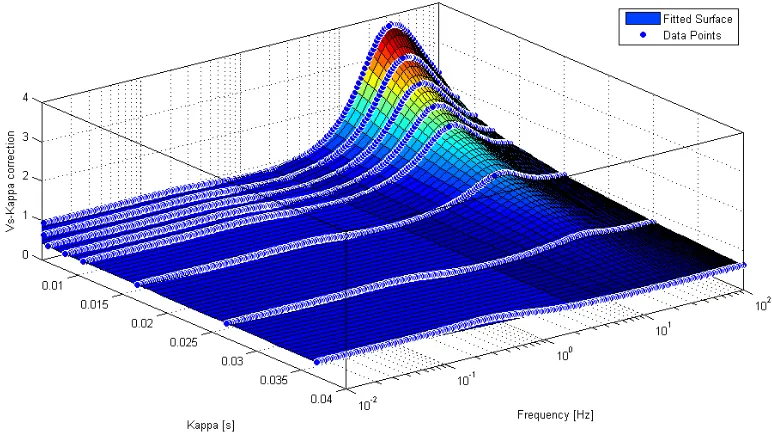
Figure 6. Example parameterization of VS- and Kappa-correction functions by fitting a surface to the
evaluated correction functions (here for a given VS30 and a range of target Kappa values).
ACKNOWLEDGEMENT
The authors would like to acknowledge the support of N. Kühn for the initial coding and evaluation of the different VS-Kappa corrections and also L. Al Atik, J. Hollenback and N.A.
Abrahamson for the development of the inverse RVT approach to evaluate the Kappa corrections. The discussions with the latter have always been very helpful and constructive in order to develop the alternative approaches over the last 2 years and to focus on the main aspects which contribute to the impact on the hazard.
This paper is intended for educational purposes only and does not replace independent professional judgment. Statements of fact and opinions expressed are those of the authors and, not necessarily the opinion or position of swissnuclear, its sponsors or its committees. swissnuclear makes no representation or warranty, express or implied, regarding the content, accuracy, completeness or fitness for use for any purpose of the information presented.
REFERENCES
Abrahamson, N. and Silva, W. (2008). “Summary of the Abrahamson and Silva NGA
Ground-Motion Relations”,
Earthquake Spectra
24, February, No. 1, 67-97.
Al Atik, L., Kottke, A., Abrahamson, N., and Hollenback, J. (in print, 2013). “Kappa Scaling of Ground
Motion Prediction Equations Using IRVT Approach”, Bulletin of the Seismological Society of
America (BSSA), in print.
Biro Y., Renault P. (2012). “Importance and Impact of Host-to-Target Conversions for Ground Motion
Prediction Equations in PSHA”, 15th World Conference in Earthquake Engineering (15WCEE),
Boore, D. M. and Joyner, W. B. (1997). “Site Amplifications for Generic Rock Sites”,
Bulletin of
the Seismological Society of America (BSSA)
, 87:2, 327-341.
Boore, D. M. and Atkinson, G. M. (2008). “Ground-Motion Prediction Equations for the
Average Horizontal Component of PGA, PGV, and 5and 10.0 s”,
Earthquake Spectra
24,
February, No. 1, 99-138.
Campbell, K. W. (2003). “Prediction of Strong Ground Motion Using the Hybrid Empirical Method and Its Use in the Development of Ground-Motion (Attenuation) Relations in Eastern North America”,
Bulletin of the Seismological Society of America (BSSA)
,
93:3, 1012–1033.Campbell, K. W. and Bozorgnia, Y. (2006). “Next Generation Attenuation (NGA) Empirical Ground
Motion Models: Can They Be Used In Europe?”, 1st ECEES - First European Conference on
Earthquake Engineering and Seismology, Paper Number: 459.
Campbell, K. W. and Bozorgnia, Y. (2008). “NGA Ground Motion Model for the Geometric Mean
Horizontal Component of PGA, PGV, PGD and 5Ranging from 0.01 to 10 s”, Earthquake Spectra
24, February, No. 1, 139-171.
Chiou, B. S.-J. and Youngs, R. R. (2008). “An NGA Model for the Average Horizontal Component of
Peak Ground Motion and Response Spectra”, Earthquake Spectra 24, February, No. 1, 173-215.
Cotton, F., Scherbaum, F., Bommer, J. J. and Bungum, H. (2006). „Criteria for selecting and adjusting ground-motion models for specific target regions: Application to Central Europe and rock sites”
Journal of Seismology, 10, 137-156.
Edwards, B.; Fäh, D. and Giardini, D. (2011). “Attenuation of seismic shear wave energy in Switzerland”,
Geophysical Journal International 185, 967-984.
Kottke, A. R., and E. M. Rathje (2008). STRATA, University of Texas at Austin, Version alpha, Revision 381.
Kottke, A.R. and E.M. Rathje (2008). “Technical manual for STRATA. Report 2008/10”, Pacific Earthquake Engineering Research (PEER) Center, Berkeley, California.
Rathje, E. M., Kottke, A. R. and M. C. Ozbey (2005). “Using inverse random vibration theory to develop input Fourier amplitude spectra for use in site response”, 16th International Conference on Soil Mechanics and Geotechnical Engineering: TC4 Earthquake Geotechnical Engineering Satellite Conference, Osaka, Japan, September, pp. 160-166.
Renault, P.; Heuberger, S. and N.A. Abrahamson (2010). “PEGASOS Refinement Project: An improved
PSHA for Swiss nuclear power plants”, In proceedings of 14th European Conference on
Earthquake Engineering - 30. August - 3. September, Ohrid, Republic of Macedonia.
Renault P. (2011). “PEGASOS Refinement Project: New Findings and challenges from a PSHA for Swiss
Nuclear Power Plants”, SMiRT 21, 6-11 November, New Delhi, India, Paper ID # 561.
Scherbaum, F., Schmedes, J. and Cotton F. (2004). “On the Conversion of Source-to-Site Distance
Measures for Extended Earthquake Source Models” Bulletin of the Seismological Society of
America (BSSA), 94:3, 1053-1069.
Silva, W., Darragh, R., Gregor, N.; Martin, G., Abrahamson, N. & Kircher C. (1998). “Reassessment of site coefficients and near-fault factors for building code provisions”, Technical Report Program Element II: 98-HQGR-1010, Pacific Engineering and Analysis, El Cerrito, USA.
Stafford, P. J., Strasser, F. O. and Bommer J. J. (2008). “An Evaluation of the Applicability of the NGA
Models to Ground-Motion Prediction in the Euro-Mediterranean Region”, Bulletin of the
Seismological Society of America (BSSA), 6:2, 149-177.
Scherbaum, F., Schmedes, J. and Cotton F. (2004). “On the Conversion of Source-to-Site Distance
Measures for Extended Earthquake Source Models”, Bulletin of the Seismological Society of
America (BSSA), 94:3, 1053-1069.
Van Houtte, C., Drouet, S. and Cotton F. (2011). “Analysis of the origins of Kappa to compute hard rock