Spatial Statistics: Topic 3 1
Descriptive Statistics
Assoc. Prof. Dr. Abdul Hamid b. Hj. Mar Iman
Director Centre for Real Estate Studies Faculty of Engineering and Geoinformation Science Universiti Tekbnologi Malaysia Skudai, Johor
Learning Objectives
Overall: To give students a basic understanding of
descriptive statistics
Specific: Students will be able to:
* understand the basic concept of descriptive statistics
* understand the concept of distribution
* can calculate measures of central tendency dispersion
Spatial Statistics: Topic 3 3
Contents
What is descriptive statistics
Central tendency, dispersion, kurtosis,
skewness
Use sample information to explain/make
abstraction of population “phenomena”.
Common “phenomena”:
* Association (e.g. σ1,2.3 = 0.75)
* Tendency (left-skew, right-skew)
* Trend, pattern, location, dispersion, range * Causal relationship (e.g. if X then Y)
Emphasis on meaningful characterisation of data
(e.g. central tendency, variability), graphics, and description
Use non-parametric analysis (e.g. 2, t-test, 2-way
Spatial Statistics: Topic 3 5 Trends in property loan, shop house demand & supply
0 50000 100000 150000 200000
Year (1990 - 1997) Loan to property sector (RM
million)
32635.8 38100.6 42468.1 47684.7 48408.2 61433.6 77255.7 97810.1 Demand for shop shouses (units) 71719 73892 85843 95916 101107 117857 134864 86323 Supply of shop houses (units) 85534 85821 90366 101508 111952 125334 143530 154179 1 2 3 4 5 6 7 8
0 50,000 100,000 150,000 200,000 250,000 300,000 350,000 Batu Pah at Joho
r Bah ru Klua ng Kota Tin ggi Mer sing Muar
Pont ian Sega mat District N o . o f h o u se s 1991 2000 0 2 4 6 8 10 12 14 0-4 10-1 4 20-2 4 30-3 4 40-4 4 50-5 4 60-6 4 70-7 4
Age Category (Years Old)
P ro p o rt io n ( % )
E.g. of Abstraction of phenomena
Demand (% sales success)
Using sample
statistics
to infer some
“phenomena” of population
parameters
Common “phenomena”: cause-and-effect
* One-way r/ship
* Feedback r/ship
* Recursive
Use parametric analysis (e.g. α and
)
through regression analysis
Emphasis on hypothesis testing
Y1 = f(Y2, X, e1) Y2 = f(Y1, Z, e2)
Y1 = f(X, e1) Y2 = f(Y1, Z, e2)
Y = f(X)
Spatial Statistics: Topic 3 7
Statistical analysis that attempts to explain
the population parameter using a sample
E.g. of statistical parameters: mean,
variance, std. dev., R
2, t-value, F-ratio,
xy
,
etc.
It assumes that the distributions of the
variables being assessed belong to known
parameterised families of
probability distributions
Examples of parametric relationship
Coefficientsa
1993.108 239.632 8.317 .000 -4.472 1.199 -.190 -3.728 .000 6.938 .619 .705 11.209 .000 4.393 1.807 .139 2.431 .017 (Constant)
Tanah Bangunan Ansilari Model
1
B Std. Error Unstandardized
Coefficients
Beta Standardized
Coefficients
t Sig.
Dep=9t – 215.8
Spatial Statistics: Topic 3 9
First used by Wolfowitz (1942)
Statistical analysis that attempts to explain the
population parameter using a sample without making assumption about the frequency
distribution of the assessed variable
In other words, the variable being assessed is
distribution-free
E.g. of non-parametric statistics: histogram,
stochastic kernel, non-parametric regression
DS gather information about a population
characteristic (e.g. income) and describe it with a parameter of interest (e.g. mean)
IS uses the parameter to test a hypothesis
pertaining to that characteristic. E.g.
Ho: mean income = RM 4,000
H1: mean income < RM 4,000)
The result for hypothesis testing is used to make
inference about the characteristic of interest
(e.g. Malaysian upper middle income)
Spatial Statistics: Topic 3 11
Measure Advantages Disadvantages
Mean (Sum of all values ÷ no. of values)
Best known average
Exactly calculable
Make use of all data
Useful for statistical analysis
Affected by extreme values
Can be absurd for discrete data
(e.g. Family size = 4.5 person)
Cannot be obtained graphically
Median
(middle value)
Not influenced by extreme values
Obtainable even if data
distribution unknown (e.g. group/aggregate data)
Unaffected by irregular class
width
Unaffected by open-ended class
Needs interpolation for group/ aggregate data (cumulative frequency curve)
May not be characteristic of group when: (1) items are only few; (2) distribution irregular
Very limited statistical use
Mode
(most frequent value)
Unaffected by extreme values
Easy to obtain from histogram
Determinable from only values near the modal class
Cannot be determined exactly in group data
Very limited statistical use
Central Tendency –
Mean
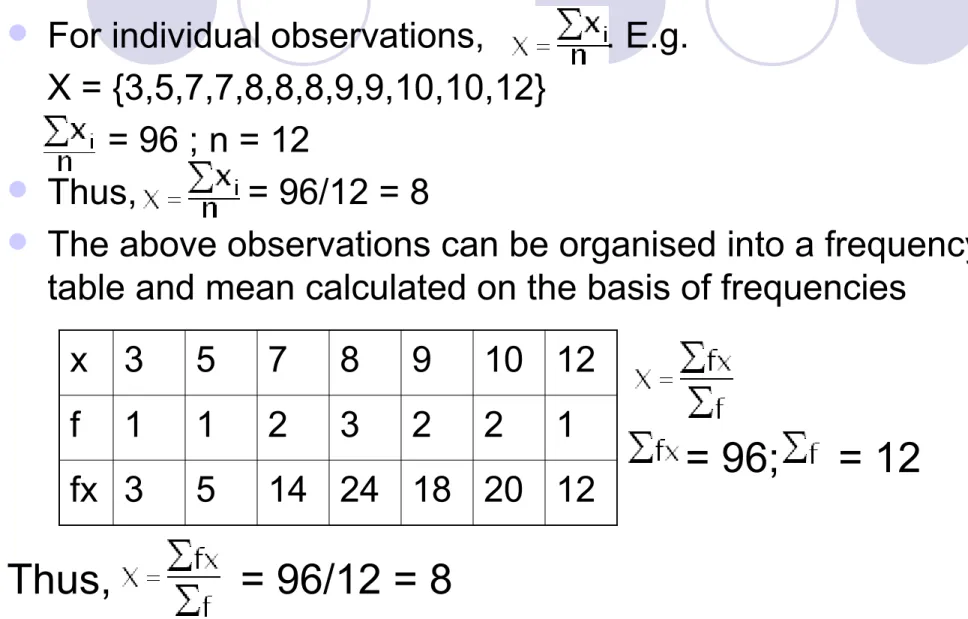
For individual observations, . E.g.
X = {3,5,7,7,8,8,8,9,9,10,10,12} = 96 ; n = 12
Thus, = 96/12 = 8
The above observations can be organised into a frequency
table and mean calculated on the basis of frequencies
= 96; = 12
Thus, = 96/12 = 8
x 3 5 7 8 9 10 12
f 1 1 2 3 2 2 1
Spatial Statistics: Topic 3 13
Central Tendency -
Mean
and
Mid-point
Let say we have data like this:
Location Min Max
Town A 228 450
Town B 320 430
Price (RM ‘000/unit) of Shop Houses in Skudai
Central Tendency -
Mean
and
Mid-point
(contd.)
Let’s calculate:
Town A: (228+450)/2 = 339
Town B: (320+430)/2 = 375
Are these figures means?
Spatial Statistics: Topic 3 15
Central Tendency -
Mean
and
Mid-point
(contd.)
Let’s say we have price data as follows:
Town A: 228, 295, 310, 420, 450 Town B: 320, 295, 310, 400, 430
Calculate the means?
Town A: Town B:
Are the results same as previously?
Central Tendency – Mean of
Grouped Data
House rental or prices in the PMR are frequently
tabulated as a range of values. E.g.
What is the mean rental across the areas?
= 23; = 3317.5
Thus, = 3317.5/23 = 144.24
Rental (RM/month) 135-140 140-145 145-150 150-155 155-160
Mid-point value (x) 137.5 142.5 147.5 152.5 157.5
Number of Taman (f) 5 9 6 2 1
Spatial Statistics: Topic 3 17
Central Tendency –
Median
Let say house rentals in a particular town are tabulated:
Calculation of “median” rental needs a graphical aids→
Rental (RM/month) 130-135 135-140 140-145 155-50 150-155
Number of Taman (f) 3 5 9 6 2
Rental (RM/month) >135 > 140 > 145 > 150 > 155
Cumulative frequency 3 8 17 23 25
1. Median = (n+1)/2 = (25+1)/2 =13th.
Taman
2. (i.e. between 10 – 15 points on the vertical axis of ogive).
3. Corresponds to RM
140-145/month on the horizontal axis
4. There are (17-8) = 9 Taman in the range of RM 140-145/month
5. Taman 13th. is 5th. out of the 9
Taman
6. The rental interval width is 5
7. Therefore, the median rental can
be calculated as:
Spatial Statistics: Topic 3 19
Central Tendency –
Quartiles
(contd.)
Upper quartile = ¾(n+1) = 19.5th.
Taman
UQ = 145 + (3/7 x 5) = RM 147.1/ month
Lower quartile = (n+1)/4 = 26/4 = 6.5 th. Taman
LQ = 135 + (3.5/5 x 5) = RM138.5/month
Inter-quartile = UQ – LQ = 147.1 – 138.5 = 8.6th. Taman
IQ = 138.5 + (4/5 x 5) = RM 142.5/month
Variability
Indicates dispersion, spread, variation, deviation
For single population or sample data:
where σ2 and s2 = population and sample variance respectively, x i = individual observations, μ = population mean, = sample mean, and n = total number of individual observations.
Spatial Statistics: Topic 3 21
Variability (contd.)
Why “measure of dispersion” important?
Consider yields of two plant species:
* Plant A (ton) = {1.8, 1.9, 2.0, 2.1, 3.6} * Plant B (ton) = {1.0, 1.5, 2.0, 3.0, 3.9}
Mean A = mean B = 2.28% But, different variability!
Var(A) = 0.557, Var(B) = 1.367
Variability (contd.)
Coefficient of variation – CV – std. deviation as % of
the mean:
A better measure compared to std. dev. in case
where samples have different means. E.g.
Spatial Statistics: Topic 3 23 Farm No. Yield (ton/ha) Species X Species Y
1 1.2 1.4
2 1.4 1.5
3 2.6 2.1
4 2.7 3.2
5 3.9 3.9
Mean 2.36 2.42
Var. 1.20 1.20
Variability (cont.)
Calculate CV for both species.
CVx = (1.2/2.36) x 100
= 50.97%
CVy = (1.2/2.42) x 100
= 49.46%
Species X is a little more
Variability (cont.)
Std. dev. of a frequency distribution
Spatial Statistics: Topic 3 25
Probability distribution
If there 20 lecturers, the probability that
A becomes a professor is: p = 1/20 = 0.05
Out of 100 births, half of them were
girls (p=0.5), as the number increased to 1,000, two-third
were girls (p=0.67) but from a record of 10,000 new-born
babies, three-quarter were girls (p=0.75)
The probability of a drug addict
recovering from addiction is 50:50
General rule:
No. of times event X occurs Pr (event X) = Total number of occurrences
Probability of certain event X to occur has a specific form of
distribution
Logical probability:
Experiential probability:
Probability Distribution
Dice1
Dice2 1 2 3 4 5 6
1 2 3 4 5 6 7
2 3 4 5 6 7 8
3 4 5 6 7 8 9
4 5 6 7 8 9 10
5 6 7 8 9 10 11
6 7 8 9 10 11 12
Spatial Statistics: Topic 3 27
Probability Distribution (contd.)
Values of x are discrete (discontinuous)
Sum of lengths of vertical bars p(X=x) = 1
all x
Probability Distribution (cont.)
Age Freq Prob.
36 3 0.02
37 14 0.07
38 10 0.04
39 36 0.18
40 73 0.36
41 27 0.14
42 20 0.10
43 17 0.09
Total 200 1.00
Pr (Area under curve) = 1
Pr (Area under curve) = 1
Continuous variable
Mean = 39.5
Spatial Statistics: Topic 3 29
Pr (Age ≤ 36) = 0.02
Pr (Age ≤ 37) = Pr (Age ≤ 36) + Pr (Age = 37) = 0.02 + 0.07 = 0.09
Pr (Age ≤ 38) = Pr (Age ≤ 37) + Pr (Age = 38) = 0.09 + 0.04 = 0.13
Pr (Age ≤ 39) = Pr (Age ≤ 38) + Pr (Age = 39) = 0.13 + 0.18 = 0.31
Pr (Age ≤ 40) = Pr (Age ≤ 39) + Pr (Age = 40) = 0.31 + 0.36 = 0.67
Pr (Age ≤ 41) = Pr (Age ≤ 40) + Pr (Age = 41) = 0.67 + 0.14 = 0.81
Pr (Age ≤ 42) = Pr (Age ≤ 41) + Pr (Age = 42) = 0.81 + 0.10 = 0.91
Pr (Age ≤ 43) = Pr (Age ≤ 42) + Pr (Age = 43) = 0.91 + 0.09 = 1.00
Probability Distribution (cont.)
Cumulative probability corresponds to the As larger and larger
samples are drawn, the probability distribution is getting smoother
Tens of different types of
probability distribution: Z, t, F, gamma, etc
Most important: normal
Larger sample
Very large sample
Spatial Statistics: Topic 3 31
Normal Distribution - ND
Salient features of ND:
* Bell-shaped, symmetrical * Total area under curve = 1 * Area under curve between any two points = prob. of
values in that range (shaded area) * Prob. of any exact value = 0
* Has a function of:
Normal Distribution - ND
Population 1 Population 2
1
2
1
2* A larger population has
narrower base (smaller * determines location
Spatial Statistics: Topic 3 33
Normal Distribution (cont.)
* Has a mean and a variance 2, i.e. X N(,
2 )* Has the following distribution of observation:
“Home-buyers example…”
Mean age = 39.3
Standard Normal Distribution (SND)
Since different populations have different and
(thus, locations and shapes of distribution), they have to be standardised.
Most common standardisation: standard normal
distribution (SND) or called Z-distribution
(X=x) is given by area under curve
Has no standard algebraic method of integration
→ Z ~ N(0,1)
To transform f(x) into f(z):
x - µ
Spatial Statistics: Topic 3 35
Z-Distribution
Probability is such a way that:
* Approx. 68% -1< z <1
Z-distribution (cont.)
When X= μ, Z = 0, i.e.
When X = μ + σ, Z = 1
When X = μ + 2σ, Z = 2
When X = μ + 3σ, Z = 3 and so on.
It can be proven that P(X1 <X< Xk) = P(Z1 <Z< Zk)
SND shows the probability to the right of any
Spatial Statistics: Topic 3 37
Normal distribution…Questions
A study found that the mean age, A of second-home buyers in Johor Bahru is 39.3 years old with a variance of RM 2.45.Assuming normality, how sure are you that the mean age is: (a) ≥ 40 years old; (b) 39 to 42 years old?
Answer (a): P(A ≥ 40)
= P[Z ≥ (40 – 39.3)/2.4] = P(Z ≥ 0.2917 0.3000) = 0.3821
(b) P(39 ≤ A ≤ 42)
= P(A ≥ 39) – P(A ≥ 42)
= 0.45224 – P[A ≥ (42-39.3)/2.4]
= 0.45224 – P(A ≥ 1.125) = 0.45224 – 0.12924
= 0.3230
Always remember: to convert to SND, subtract the mean and divide by the std. dev.
“Student’s t-Distribution”
Similar to Z-distribution (bell-shaped, symmetrical)
Has a function of
where = gamma distribution; v = n-1 = d.o.f; = 3.147
Flatter with thicker tails
Distributed with t(0,σ) and -∞ < t < +∞
As n→∞ t(0,σ) → N(0,1)
Probability calculation requires
Spatial Statistics: Topic 3 39
How Are t-dist. and Z-dist. Related?
Using central limit theorem, N(, 2/n) will becomezN(0, 1) as n→∞
For a large sample, t-dist. of a variable or a
parameter is given by:
The interval of critical values for variable, x is:
Skewness, m
3& Kurtosis, m
4 Skewness, m
3 measures
degree of symmetry of distribution
Kurtosis, m
4 measures its
degree of peakness
Both are useful when
comparing sample
distributions with different shapes
Useful in data analysis
Xi = indivudal sample observation, =
Spatial Statistics: Topic 3 41
Skewness
Bimodal Uniform J-shaped
Perfectly normal (zero skew) Right (+ve) skew Left (-ve) skew
Kurtosis
Mesokurtic
(normal)
(zero kurtosis) Leptokurtic
(high peak)
(+ve kurtosis)
Platykurtic
(low peak)
(-ve kurtosis)
Mesokurtic distribution…kurtosis = 3
Spatial Statistics: Topic 3 43 X-coord. (000) Y-coord. (000) Trees with Ganoderma
535.60 104.80 8
536.70 107.30 12
536.80 106.80 11
537.30 107.31 12
537.15 105.40 13
537.40 105.37 13
538.48 107.82 9
542.22 106.10 8
540.35 105.91 7
540.10 104.95 7
540.30 104.75 6
538.75 102.80 5
545.10 105.90 4
546.30 105.90 3
547.15 105.90 2
Occurrence of ganoderma
X-coord. (000) Y-coord. (000) Trees with ganoderma
547.75 106.08 5
547.10 105.25 8
547.80 101.05 7
548.18 105.92 8
548.80 105.90 12
548.95 104.85 15
548.94 104.50 13
548.75 103.73 7
548.94 102.80 4
Al p.p.m. Freq. 0 0 250 7 500 13 750 25 1000 18 1250 13 1500 9 1750 7 2000 3 2250 4
E.g. Al2++ + H
2++O--
→
Al2O + H2sum 102.00
mean 1073.53
553.05
305867.94
169161266 .28 935551939 11.64 skew 0.77
Spatial Statistics: Topic 3 45
E.g. WCM = ((545.10-542.86)2 + (105.90-105.48)2)0.5
= (5.0176 + 0.1764)0.5
= 2.28 (i.e. 2,280 m)
Measures of spatial separation
Weighted mean centre (Xcoord.) =
Weighted mean centre (Ycoord.) =
Standard distance =
Occurrence of ganoderma
Sum f = 191.00 Xw = 103687.00 Yw = 20147.40 (Xw- )2 =588.46 (Yw- )2 = 55.50
Weighted mean centre 542.86 105.48 Standard distance 1.84
Point to point distance (e.g.)
Spatial Statistics: Topic 3 47
Spatial distribution – point data
Ethnic distribution of residence
k = (fx) -1
-8.15 tc 0.12 CV 0.02 CV 0.01 2 0.49 1.54 68 140 1.51 18 9 2 0.51 50 50 1 -0.49 0 81 0
(x- )2
fx f
x
Ho: 2 = (pattern is random)
H1: 2 > (pattern is clustered) or 2 < (pattern is scattered)
X = no. of observations per quadrat; f = frequency of quadrats; = (fx)/f; 2 = (x- )2/(fx) -1; CV = 2/ ;
Reject Ho…