LANGUAGE SWITCHING AMONG MALAY UNDERGRADUATES IN AN ENGLISH AS A SECOND LANGUAGE WRITING
MAHANI BINTI STAPA
A thesis submitted in fulfilment of the requirements for the award of the degree of
Doctor of Philosophy (Teaching English as a Second Language)
Faculty of Education Universiti Teknologi Malaysia
To my beloved husband Mohd. Nasir Harun
To my much-loved children Muhammad Adam Izzuddin and Nur Sarah Nabilah
To my dear friend, Dr. Tina Abdullah
ACKNOWLEDGEMENTS
First and foremost, I thank Allah Almighty for giving me the strength and patience to complete this study.
Secondly, I would like to express my deepest appreciation to my two supervisors, Associate Professor Dr. Wan Fara Adlina Wan Mansor and Professor Dr. Masputeriah Hamzah for their valuable guidance and assistance throughout the completion of this work. Their valuable comments and suggestions as well as words of encouragement are deeply appreciated.
I also would like to thank Professor Marilyn Martin-Jones for her feedbacks and comments at the early stage of my writing.
A note of appreciation is also due to my friends and colleagues, especially to Associate Professor Dr. Masdinah Alauyah Mohd Yusof for believing that I can finish this. A very special thanks goes to my dear friend Dr Tina Abdullah for her countless helps during the last phase of my writing.
I am also indebted to Universiti Teknologi Malaysia for granting me the study leave and the Ministry of Higher Education for funding my PhD study.
Many thanks also go to the respondents who spent a considerable amount of time participating in this study.
ABSTRAK
CHAPTER TITLE PAGE
DECLARATION ii
DEDICATION iii
ACKNOWLEDGEMENTS iv
ABSTRACT v
ABSTRAK vi
TABLE OF CONTENTS vii
LIST OF TABLES xi
LIST OF FIGURES xiii
LIST OF ABBREVIATIONS xiv
1 INTRODUCTION 1
1.0 Introduction 1
1.1 Background of the Study 3
1.2 Statement of the Problem 6
1.3 Objectives of the Study 8
1.4 Research Questions 8
1.5 Significance of the Study 9
1.6 Scope of the Study 11
1.7 Theoretical Framework 12
1.8 Conceptual Framework 16
1.9 Definition of Terms 19
1.9.1 Language switching 19
1.9.2 Tertiary Malay writers 19
1.9.3 Academic context 20
1.9.5 Second language (L2) 20 1.9.6 Lexical borrowing 20 1.9.7 Language mixing 21
1.10 Conclusion 21
2 REVIEW OF LITERATURE 22
2.0 Introduction 22
2.1 Models of Writing Processes 23 2.1.2 Model of L2 Writing Processes 29
2.2 Process Writing 31
2.3 Composing Processes 33
2.2.1 L2 Composing Process 36 2.4 Language Switching and L2 Writing 38 2.5 Factors Affecting Language Switching 44
2.6 Language Switching and ESL Writing Quality 46
2.7 Use of L1 in L2 Writing 48
2.8 The use of L1 and essay quality 51 2.9 Summary of key research 53
2.10 Conclusion 54
3 RESEARCH METHODOLOGY 55
3.0 Introduction 55
3.1 The Research Design 55
3.2 The Pilot Study 58
3.3 The Actual Study 60 3.4 The Participants of the Study 61
3.5 Sampling Procedure 64
3.6 Data Collection Instruments 67
3.6.1 Questionnaire 67
3.6.2 Writing Task 70
3.7 Validity and Reliability 82
3.8 Data Analysis 83
3.8.1 Analysis of Questionnaires 84 3.8.2 Analysis of the Observation 88 3.8.3 Analysis of the Stimulated Recalls 89 3.8.4 Analysis of the Interviews 91 3.8.5 Analysis of the Pre-writing Notes 93
3.8.6 Analysis of the Essays 95
3.9 Conclusion 98
4 FINDINGS AND DISCUSSIONS 99
4.0 Introduction 99
4.1 Language Switching and Levels of 100 English Proficiency
4.2 Language Switching : How Bahasa Melayu 114 was Used while Writing in English
4.2.1 Insights from students’ pre-writing
notes 127
4.2.2 Insights from students’ essays 136 4.2.3 Stages of Writing where Bahasa
Melayu was most utilized 142
4.3 Functions of Bahasa Melayu when
Writing in English 149
4.4 Students’ Insights on the Use Of Bahasa Melayu when Writing
English Compositions 160
4.6 Discussion of findings 168
4.6.1 Use of Bahasa Melayu while writing
English composition 169
4.6.2 How Bahasa Melayu was used while
4.6.3 When Bahasa Melayu was used 172 4.6.4 Functions of Bahasa Melayu 173 4.6.5 Students’ perceptions on the use of Bahasa
Melayu 174
4.7 Summary of findings 176
4.8 Conclusion 178
5 CONCLUSIONS AND RECOMMENDATIONS 179
5.1 Conclusions of the study 179
5.1.1 Proficiency and language switching 179 5.1.2 Use of L1 in L2 writing 181 5.1.3 Forms of language switching 183 5.2 Implications of Findings on ESL
Writing Pedagogy 184
5.3 Suggested framework for the teaching of ESL
Writing to Malay students 188
5.4 Limitations of the Study 192
5.4 Suggestions for Future Research 193
REFERENCES 195
LIST OF TABLES TABLE NO. 2.1 3.1 3.2 3.3 3.4 3.5 3.6 3.7 3.8 3.9 3.10 3.11 3.12 4.1 4.2 4.3 4.4 4.5 4.6 4.7 4.8 TITLE
Summary of key research Pilot stage respondents and their language proficiencies
The distribution of respondents based on MUET score Respondents’ proficiency levels based on MUET scores Summary of main instruments
Coding for Question 4 Coding for Question 5 Coding for Question 6 Coding for Question 7 Coding for stimulated recall
Themes/Categories of Interview Responses
Coding for language switching in pre-writing notes Coding for language switching in essays
Respondents’ MUET scores Respondents’ use of Bahasa Melayu while writing
in English
Percentage of use of Bahasa Melayu while writing in English
Frequency of use of Bahasa Melayu according to MUET Scores
How Bahasa Melayu was used when writing in English How Bahasa Melayu was used when writing in English by students of different proficiency levels
How Bahasa Melayu was Used Students’ writing processes
4.9
4.10
4.11 4.12
4.13 4.14
4.15 4.16 4.17
Different stages of Writing where Bahasa Melayu was most utilized
When Bahasa Melayu was mostly used by students of different proficiency levels
Reasons for using Bahasa Melayu when writing in English Reasons for using Bahasa Melayu when writing in English by students of different proficiency levels
Does using Bahasa Melayu help
Students’ insights into the usefulness of Bahasa Melayu in writing English compositions according to proficiency levels
Students’ essay marks Samples of students’ writing Summary of findings
142
145 149
151 161
LIST OF FIGURES FIGURE NO. 1.1 1.2 2.1 2.2 2.3 2.4 3.1 4.1 4.2 4.3 4.4 4.5 4.6 4.7 4.8 4.9 4.10 4.11 4.12 4.13 5.1 TITLE Theoretical Framework Conceptual Framework
Flower and Hayes’ (1981) model of cognitive processes in writing
Bereiter and Scardamalia’s (1987) structure of the knowledge-telling process
Bereiter and Scardamalia’s (1987) structure of the knowledge-transforming model
A descriptive model of L2 composing process Summary of data collection procedure
Pre-writing notes of Student A Pre-writing notes of Student B Pre-writing notes of Student C Pre-writing notes of Student D Pre-writing notes of Student E Pre-writing notes of Student F Pre-writing notes of Student G Pre-writing notes of Student H Pre-writing notes of Student I
Pre-writing notes of Student J Pre-writing notes of Student K Pre-writing notes of Student L
Pre-writing notes of Student M
LIST OF ABBREVIATIONS
ESL L1 L2 SPM
MUET TESL UTM
- - - - - - - -
English as a Second Language Bahasa Melayu
English
Sijil Pelajaran Malaysia (Malaysian Certificate of Education)
Malaysian University English Test
CHAPTER 1
INTRODUCTION
1.0 Introduction
The development of writing skills has received considerable attention from English as a Second Language (ESL) practitioners especially when it is found that second language (L2) writing skills are different from first language (L1) writing skills. One distinctive difference is that almost all L2 writers are blessed with the capability of acquiring more than one language, their native language or first language (L1) as well as a second language, more often than not, the English language.
In relation to the above, Hyland (2003) stated that while the impact of the first language on second language ability will obviously vary, it is a crucial feature distinguishing L1 and L2 writing. And for those engaged in the teaching of second language writing, an understanding of the theoretical issues related to first and second language writing would definitely help in the process of teaching L2 writing. As highlighted by Silva (1990) viable approaches to the teaching of ESL
composition need to be based on a broader, more comprehensive conception of what L2 writing involves.
In addition, research into the composing process has revealed that there is not much difference between L1 and L2 writers where the composing process is
concerned, in that L1 and L2 writers use the same strategies while composing. Zamel (1985) found that experienced L2 writers, regardless of their linguistic proficiency, use composing processes similar to that of experienced L1 writers. This shows that where composing is concerned, L1 and L2 writers are not as different as they were once thought to be.
Writing in a second language (L2) is a challenging process (Wolfersberger, 2003:1). He continues to explain that this is because while the first language (L1) writing process includes producing content, drafting ideas, revising writing, choosing appropriate vocabulary, and editing texts, writing in L2 involves all of these elements combined with second language processing issues. In addition to that, L2 writers are also faced with other challenges that can affect their composing competence. Factors such as linguistic competence, cognitive ability as well as social aspects also need to be addressed by ESL practitioners in order to understand L2 writing better. Because of the constraints imposed by limited second-language knowledge, writing in a second language may be hampered because of the need to focus on language rather than content (Weigle, 2002: 35).
It is true that language form does play an important role in L2 writing but it should not be the only element that needs attention. Writing in a second language classroom should not be impeded by putting too much focus on the language. As such, a shift in paradigm is needed so as to address other important elements that underlie L2 writing such as background knowledge, writing strategies, writing processes, the role of L1, and others.
The role of writing processes in L2 writing, for example, needs to be
In relation to the role of L1 in language learning, the research literature in language switching is vast. Most research has focused on language switching (or code switching) in spoken language, that is, face-to-face interaction. The key contributors to this area of knowledge-building have been sociolinguists (e.g Gumperz, 1982; Aver, 1984, 1995; and Galaranga, 2005). However, the
sociolinguistic research literature in language switching in writing is relatively slim, with the notable exception of Sebba (2000) and Sebba (2012). The main contributors to research in language switching in writing has come from those engaged in
research in second language writing, on the writing strategies of individuals and on the cognitive processes involved in language tasks.
With reference to the role of L1 in L2 writing, numerous studies have revealed that L2 learners use their L1 and L2 interactively for various strategic purposes while composing in L2 (Wang, 2003; Friedlander, 1990; Qi, 1998; Uzawa, 1996; Bosher, 1998; Kubota 1998: Woodall, 2000, 2002; and Wang, 2003). This means to say that L2 writers, either “skilled” or “unskilled”, switch back and forth between their L1 and L2 in order to work through a particular problem that they are struggling with while composing in the L2 (Wang, 2003: 348).
Thus, it can be inferred here that L1 does play a significant role where L2 writing is concerned; that is L2 writers do interactively switch from L1 to L2 and vice-versa when writing in L2. And, without a doubt, this language-switching is a salient feature in L2 writing. In order to recognize the importance of language switching in L2 writing, it is thus imperative for us to understand the phenomenon of language switching.
According to Qi (1998), language switching is the act of switching from L2 to L1 as the language of thinking by a bilingual person engaged in an L2 composing task. Wang (2003) defines language switching as mental operations that went from L2 to L1 as cognitive processes of problem-solving and decision-making while writers were engaging in their L2 writing.
produce when she/he uses L1 only (Qi, 1998:428). Similarly, Cumming (1990) in Wang and Wen (2002) found that student writers use their L1 to search and to assess appropriate wordings, to compare cross-linguistic equivalents, and, sometimes, to reason about linguistic choices in the L2.
So, there appears to be some evidence that L2 learners continuously use their L1 for various purposes while writing in L2. L2 learners have more than one
language at their disposal and they actively use them. They may use both L1 and L2 for cognitive operations when they are composing in the L2 (Wang and Wen,
2002:225). This is further supported by Qi (1998) who argues that language switching as a cognitive behaviour is frequently found in the mental activities of almost all bilingual people engaged in an L2 task.
However, traditional ESL teachers have emphasized the need for ESL writers to think and write as completely as possible in English (Friedlander, 1990:109). The belief is that if ESL writers do any of their work in their first language, this will inhibit acquisition of the second language (L2). Furthermore, it is argued that it will also interfere with the generation of L2 structures, due to transfer of structures and vocabulary from their first language in an incorrect way (Friedlander, 1990:109).
Nevertheless, the view adapted in this thesis is that restricting L2 learners from using their L1 while composing is not appropriate. This pedagogic approach contradicts earlier findings of the research cited earlier which emphasize the
1.2 Statement of the Problem
It is found that much of L2 writing research has been strongly influenced by research in L1 writing (Sasaki 2000). Therefore, there should be studies conducted in the area of L2 writing especially on the use of L1 in L2 writing of Malay writers writing in an academic setting. Studies on composing processes conducted by researchers such as Perl (1979), Pianko (1979), Zamel (1982, 1983), and
Wolfersberger (2003) were mainly on L1 composing processes in a native English speaking environment (L1). Studies on writing among non-native speakers of English conducted by Bosher (1998), Wang (2003), Friedlander (1990), Qi (1998), Woodall (2000, 2002), Uzawa (1996), Wang and Wen (2002) and Kubota (1998), were also administered in an L1 setting. Furthermore, all these research did not include participants whose first language is Bahasa Melayu; the group of ESL learners that this study is addressing.
Furthermore, second language writing research focusing on language-switching is very much needed so as to help teachers and students gain a better understanding of whether or not language-switching in the course of L2 composing should be encouraged, and, if so, in what specific situations (Qi, 1998:416). This is further supported by Wang and Wen (2002) who claim that one important difference between L1 and L2 writing processes is that L2 writers have more than one language at their disposal; that is, they may use both L1 and L2 for cognitive operations when they are composing in the L2.
understanding of the unique features of L2 writing and a lack of a coherent,
comprehensive L2 writing theory. This research is therefore undertaken in an effort to address this issue by providing evidence of the role of language-switching in second language writing, in particular among Malay L2 writers.
Apart from that, L2 writing researchers should not rely on the research findings of their L1 counterparts in order to address the issues related to composing competence of L2 learners. Krapels (1990) commented that the first language writing process research has informed second language research, but L2 researchers must be careful not to let L1 studies guide and determine their investigations of second language writing process because the research contexts are not the same. The same view is shared by others such as Silva (1993) and Myles (2003). Silva (1993) suggested that ESL writing practitioners need to have a clear understanding of the unique nature of L2 writing, which, obviously, is different from L1 writing. In addition to that, Myles (2003) commented that much of the research on L2 writing has been closely dependent on L1 research. As such, a research on composing processes of L2 learners in a L2 environment is very much needed.
In relation to that, ESL writers are usually more fluent in their native language (L1) while struggling somewhat to achieve varying degrees of success when writing in L2. This could be due to the fact that apart from having problems with the generation of ideas and thoughts during the composing phase, these writers are also having problems with their command of the second language (L2).
1.3 Objectives of the Study
The objectives of this research are:
1. to determine if Malay university students with different levels of English proficiency switch to Bahasa Melayu (L1) when writing in English.
2. to ascertain how and when do Malay university students use L1 when writing English compositions.
3. to establish what functions does the language switching serve.
4. to find out in what ways do the students see the use of L1 as helpful in carrying out a writing task in English.
5. to propose a framework for the teaching of writing to the Malay engineering students
1.5 Research Questions
Building on the above objectives, the main questions that this research attempts to answer are:
1. To what extent do Malay university students with different levels of English language proficiency switch to Bahasa Melayu (L1) when writing in English? 2. How and when do Malay university students use L1 when writing English
compositions?
3. What functions does the use of L1 serve?
4. In what ways do the students perceive the use of L1 as helpful in carrying out a writing task in English?
an effort to promote ESL writing competence.
1.5 Significance of the Study
As indicated earlier, not much work has been done on the role of L1 in the composing in a Malaysian higher education context. In this study, the focus is on a sample of undergraduates enrolled in engineering classes of a public university in Malaysia and on their use of Bahasa Melayu while undertaking a writing task in English. All students in this sample are bilingual in Bahasa Melayu and English. However, this is a context where the use of English is restricted to classroom learning.
In particular, a study on the conditions in which L2 learners switch language as well as on the reasons why they language-switch will be useful both to teachers as well as the learners themselves. It is believed that research of this nature will help teachers and students gain a better understanding of whether or not language-switching in the course of L2 composing should be encouraged, and, if so, in what specific situation or circumstance (Qi, 1998:416). To sum up, Qi (1998) clearly argues that it is important to inquire into the issue of the role of L1 in an L2 composing task since the use of L1 seems to be a natural and frequent cognitive behaviour in a bilingual mind engaging in an L2 task.
It is also noted that language switching is a subject that is largely ignored by related studies on L2 writing. Nevertheless, this field is undoubtedly of fundamental importance to the field of bilingualism as a whole (Qi, 1998: 432). Based on findings of his study, Qi (1998) feels that further inquiry into the factors that influence
investigations could have extensive implications not only for the field of bilingual studies but for the cognitive sciences in general (Qi, 1998: 432). Based on these arguments and rationales, it is timely that a study to investigate this matter further should be undertaken.
In addition, previous research on language-switching and L2 writing has been conducted with other L1 users (i.e. Spanish, Chinese, and Japanese) and as far as I am aware, none has been done on Malay users thus far. Studies with other language groups have significantly highlighted how the use of L1 during the composing process can actually help L2 learners become better L2 writers. Therefore, it is of utmost importance to conduct a study on language-switching during the composing process among bilingual Malay student writers so as to investigate the specific influence of language-switching on L2 writing. This is imperative so as to gain better insights into the understanding of L2 writing processes among the Malay student writers.
To the very best of my knowledge, much of the previous research on language-switching among L2 learners has been conducted with L2 learners in a native English speaking environment. For these learners, the use of English is not restricted to the classroom but it is also widely used beyond the classroom. This is very different from the experience of Malay L2 learners in a second language environment where the use of English is very much restricted to classroom learning. A study such as this which is conducted in a non-native environment is much needed to provide a better understanding of the relationship between language-switching and L2 writing in a university setting where students have little exposure in English outside class. Furthermore, a study of this nature would provide different outcomes than those conducted in a native English speaking environment. The outcomes would be much more relevant in addressing issues pertaining to improving L2 writing competence.
this in turn can contribute to quality L2 writing. Therefore, our students should not be prevented from using their L1 altogether when attempting writing tasks in L2. Instead, they should be exposed to the proper techniques for using their L1 to promote L2 writing performance.
Concurrently, findings from this study would provide valuable insights for language practitioners and enable them to actually reflect on their present teaching approaches and techniques where the teaching of L2 writing is concerned. Teachers of L2 writing would need to acknowledge their learners’ cognitive abilities and language switching practices during the composing process and match these
capabilities with their teaching. By doing this, they would be actually matching their students’ innate capabilities with their teaching methodologies and techniques to maximize the students’ L2 writing competence.
1.6 Scope of the Study
This study focuses mainly on the use of Bahasa Melayu by ESL Malay
writing processes that these Malay engineering undergraduates have to go through in in order to produce the essays required of them.
1.7 Theoretical Framework
The discussion on the theoretical framework concerns the theories of both L1 and L2 writing that will ultimately shape the framework of this research. A great deal of the empirical research on second language (L2) writing has taken the position that the process of writing in one’s native language (L1) is largely the same as that of writing in the L2 (Woodall, 2000:1). In addition, the general purpose of L2 writing has been viewed as the same as writing in one’s mother tongue: regardless of the language medium, writers still generate ideas related to a given topic, organize those ideas according to some plan, translate those ideas into words, sentences, and
paragraphs, and revise and/or edit the text according to the plan.
Nevertheless, it is unjustified to claim that there are no differences between writing in L1 and writing in L2. Woodall (2000) claims that if there is to be a theory of a second language writing, it will have to be based on the differences between L1 and L2 writing. This is due to the fact that, unlike L1 writers, L2 writers have two or more languages at their disposal. This unique feature will somehow interact
interchangeably especially during the writing process. This is especially true when, according to Woodall (2000), second language writers sometimes switch languages during the writing process, something the monolingual writer does not do.
In addition to that, any discussion of L2 students’ writing needs must first take into account the wide diversity among L2 learners as distinct groups with their own uses of, and needs for, writing (Grabe and Kaplan, 1996: 23). The diversity of these learners has led to a more complex L2 writing theory and practice. Issues such as language proficiency, social as well as cultural influence as well as the effects of the learners’ L1 have contributed significantly towards the understanding of the nature of L2 writing. Significantly, in a much recent publication, Grabe (2001) puts forward six supporting theories that will influence the construct of writing and they are:
1. A theory of language
2. A theory of conceptual knowledge
3. A theory of language processing (writing processes) 4. A theory of motivation and affective variables 5. A theory of social context influences
6. A theory of learning
(Grabe, 2001:42) Clearly, language processing or writing processes is seen as an important construct when discussion on theories of L2 writing is concerned.
With reference to research in second language writing, it is noted that applied linguistics has been the academic discipline giving most attention to the writing needs and problems of students (Grabe and Kaplan, 1996: 27). Specifically,
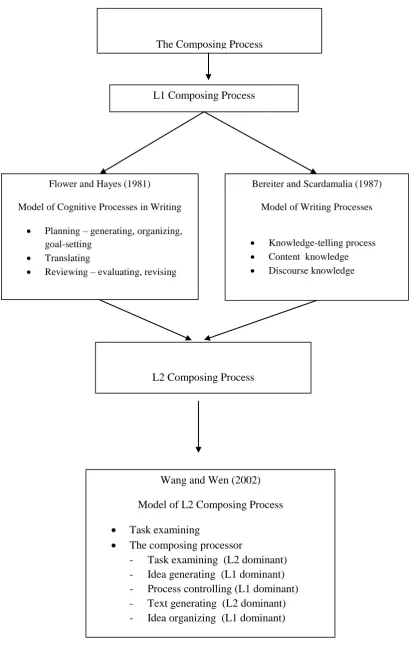
In addition to theories of L1 and L2 writing, this research is also shaped by the models that emerged in the field of writing processes. Two prominent models of writing processes namely Flower and Hayes (1981) model of cognitive processes in writing (cited in Swarts et. al, 1984) and Bereiter and Scardamalia’s (1987) model of writing processes (cited in Grabe and Kaplan, 1996:117) have formed the
theoretical foundation to this research.
These two models have been influential in both L1 and L2 writing research and have some way form a foundation for the development of L2 writing models. One such model is that of Wang and Wen (2002). This model specifically
Figure 1.1 : Theoretical Framework
Bereiter and Scardamalia (1987)
Model of Writing Processes
Knowledge-telling process Content knowledge Discourse knowledge L1 Composing Process
Flower and Hayes (1981)
Model of Cognitive Processes in Writing
Planning – generating, organizing, goal-setting
Translating
Reviewing – evaluating, revising
L2 Composing Process
Wang and Wen (2002)
Model of L2 Composing Process
Task examining
The composing processor
1.8 Conceptual Framework
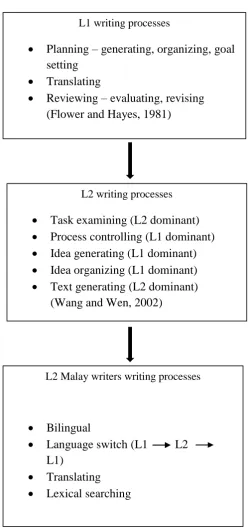
This chapter discusses the conceptual framework of this study in an attempt to highlight the relationship of the related concepts underlying this study, as
indicated in the following diagram.
Figure 1.2 : Conceptual Framework
L1 writing processes
Planning – generating, organizing, goal setting
Translating
Reviewing – evaluating, revising (Flower and Hayes, 1981)
L2 writing processes
Task examining (L2 dominant)
Process controlling (L1 dominant)
Idea generating (L1 dominant)
Idea organizing (L1 dominant)
Text generating (L2 dominant) (Wang and Wen, 2002)
L2 Malay writers writing processes
Bilingual
Language switch (L1 L2 L1)
Translating
conceptual framework seeks to find the relationships between the different concepts under investigation as well as to be clear of the outcomes to be expected at the end of the study.
The first key concept underlying the framework is derived from the
understanding of L1 writing processes as put forward by Flower and Hays (1981). L1 writing processes explain the different key processes involved in the completion of a writing task, such as planning (generating, organizing and goal setting), translating and reviewing (evaluating and revising).
Nevertheless, the above key concepts fail to address one crucial concept, which is the role of language in the writing processes. On the other hand, it is
expected since the key concepts mentioned here are mainly formulated to explain the writing processes of L1 writers where language proficiency is not an issue for them. The different processes mentioned significantly forms the initial conceptual
framework of this study.
The discussion on the conceptual framework continues with L2 writing processes. The discussion centers mainly on the concepts of L2 writing processes as developed by Wang and Wen (2002). The writing processes are similar to L1 writing processes except for the inclusion of the language dominantly used (either L1 or L2) at the different levels of the writing processes. This conforms to the fact that L1 and L2 are used interchangeably by most L2 writers. This significantly indicates that L1 is used considerably at three different levels, which are process controlling, idea generating as well as idea organizing. Meanwhile, task examining and text
generating are best executed using L2.This concept further supports the fact that both languages (L1 and L2) are of equal importance to second language writers.
be added, such as bilinguals, with majority of them being dominant bilinguals. Dominant bilingual is a person who is more proficient in one language compared with the other language. Closely related to the notion of bilingual is the concept of language switch. Language switching is an act of switching from L1 to L2 and vice versa, as and when the need arises. In other words, the decision to language switch depends on the appropriateness of it, in relation to the writing task at hand. Hence, the different writing processes described by Wang and Wen (2002) are very much related to the concept of language switching in the sense that the L2 writers do switch from L1 to L2 and vice versa.
Another characteristic unique of second language users, the Malays included, is translating. As stated earlier, idea generating and idea organizing are done mainly using L1. Therefore, in order to reach the text generating phase, which is done mainly in L2, the ideas generated and organized earlier in L1 need to be translated into L2 so that the output of the writing task will be entirely in L2. Hence,
translation is another concept worth investigating in the study of L2 Malay writers. It is interesting to see the product of ideas initially thought in L1 being translated into L2 at the text generating phase.
In relation to translating, another concept worth mentioning is lexical
searching. Lexical searching can take the form of examining and exploring possible English words to replace words initially thought in L1. Lexical searching can be a unique writing process as the Malay L2 writers try to negotiate equivalent L2 words to replace L1 words to form a complete text that should entirely be in L2. Therefore, translating and lexical searching are very much inter-related in this context.
There are several terms used in this study. The definition of the terms discussed here is based on the context as used in this study.
1.9.1 Language switching
Language switching is the act of switching from L2 to L1 as the language of thinking by a bilingual person engaged in an L2 composing task (Qi, 1998). In this study, L1 is Bahasa Melayu, while L2 is English. Therefore, language switching in this context refers to the act of switching from Bahasa Melayu to English and vice versa.
Wang (2003) defines language switching as mental operations that went from L2 to L1 as cognitive processes of problem-solving and decision-making while writers were engaging in their L2 writing. In the context of this study, the use of L1 is seen as part of a cognitive process taken place during the completion of an L2 writing task.
1.9.2 Tertiary Malay writers
1.9.3 Academic context
In this study, academic context refers to a setting where the process of teaching and learning takes place. Therefore, the writing activities done in an
academic context are mainly for teaching and learning purposes and the ultimate goal would be to evaluate students’ writing performance.
1.9.4 First language (L1)
First language in this study refers to the language a person is most comfortable with in communication (Nor Azmi, 2004). In this study, the first language refers to Bahasa Melayu.
1.9.5 Second language (L2)
The language other than the first language that is used for variety of purposes, such as education, political, trades as well as social. In Malaysia, Bahasa Melayu is the national language while English is regarded as the second language. Hence, in this study, second language refers to English.
1.9.6 Lexical borrowing
Language mixing in this study refers to the use of both Bahasa Melayu and English to complete a written work, especially at the idea generating phase. In this study, language mixing is most evident in the pre-writing notes as both languages were used interchangeably.
1.10 Conclusion
REFERENCES
Badger, R and White, G. 2000. A process genre approach to teaching writing. ELT Journal. 54(2): 153-160.
Ballard, B and Clanchy, J. 1991. Assessment by Misconception: Cultural Influences and Intellectual Traditions. In Hamp-Lyons, L. (Ed.). Assessing Second Language Writing in Academic Contexts. New Jersey: Ablex Publishing Corporation,19-35.
Barkaoui, K. 2007. Teaching Writing to Second Language Learners: Insights from Theory and Research. TESL Reporter. 40(1): 35-48.
Beach, R and Bridwell, L.S. 1984. The Composing Process. In Beach, R and Bridwell, L.S (Eds.). New Directions in Composition Research. New York: The Guilford Press.
Beare, S and Bourdages, J.S. 2007. Skilled Writers’ Generating Strategies in L1 and L2: An Exploratory Study. In Rijlaarsm, G. (Series Ed.) and Torrance, M, van Waes, L, and Galbraith, D. (Volume Eds). Writing and Cognition: Research and
Applications. Vol. 20 (151-161).
Best, J.W and Kahn, J.V. 1998. Research In Education (8th. edition). Boston: Allyn and Bacon.
Bhela, B. 1999. Native language interference in learning a second language: Exploratory case studies of native language interference with target language usage.
International Education Journal: 1(1) : 22-31.
Blaxter, L, Hughes, C. and Tight, M. 1996. How To Research. Philadelphia: Open University Press.
Canagarajah, A. S. 1999. Resisting Linguistic Imperialism in English Teaching. Oxford: Oxford University Press.
Caudery, T. 1995. What the “Process Approach” Means to Practising Teachers. TESL-EJ. 1(4): 1-16.
Chengappa, S., Daniel, K. E., Bhat, S. (2004). Langauge mixing and switching in Malayalm-English Bilingual Aphasics. Asia Pacific Disability Rehabilitation Journal. 15(2):68-76.
Cohen, A.D. and Brooks-Carson, A. (2001). Research on Direct versus Translated Writing: Students’ Strategies and Their Results. The Modern Language Journal. 85(2):169-188.
Creswell, J.W. 2003. Research Design – Qualitative, Quantitative, and Mixed methods Approaches. 2nd. Edition. California: Sage Publications.
Creswell, J.W. 2012. Educational Research: Planning, Conducting, and Evaluating Quantitative and Qualitative Research. Boston: Pearson.
Daulton, F.E. 2012. The Encyclopedia of Applied Linguistics. Retrieved 29 September 2014.
Deane, P, Odendahl, N, Quinlan, T, Fowles, M, Welsh, C and Bivens-Tatum, J. 2008. Cognitive Models of Writing: Writing Proficiency as a Complex Intergrated Skill. Education Testing Service Reserach Report. Rerieved 29 September 2014 from http://www.ets.org.
Dörnyei, Z. 2007. Research Methods in Applied Linguistics. Oxford: Oxford University Press.
Edelsky, C. 1982. Writing in A Bilingual Program: The Relation of L1 and L2 Texts. TESOL Quarterly. 16(2): 213-225.
Research insights for the classroom. Cambridge: Cambridge University Press, 109-125.
Grabe, W and Kaplan, R.B. 1996. Theory and Practice of Writing. Essex: Addison Wesley Longman.
Grabe, W. 2001. Notes Toward a Theory of Second Language Writing. In Silva, T and Matsuda P.K.(Eds.). On Second Language Writing. New Jersey: Lawrence Erlbaum Associates Inc.: 39-55.
Guerini, F. 2014. Language contact, language mixing and identity: The Akan spoken by Ghanaian immigrants in Northern Italy. International Journal of Bilingualism. 18: 329-345.
Hashemnezhad, H and Hashemnezhad, N. 2012. A Comparative Study of Product, Process, and Post-process Approaches in Iranian EFL Students’ Writing Skill. Journal of Language Teaching and Research. 3(4): 722-729.
Hirschman, C. 1987. The Meaning and Measurement of Ethnicity in Malaysia: An Analysis of Census Classification. The Journal of Asian Studies. 3(46) : 555-582. Hui, Y. 2010. The Role of L1 Transfer on L2 and Pedagogical Implications. Canada
Social Science. 693): 97-103.
Huitt, W. 2011. Bool et al.’s Taxonomy of the Cognitive Domain. Educational Psychology Interactive. Retrieved 29 September 2014 from
http//www.edpsycinteractive.org.
Hyland, K. 2003. Second Language Writing. Cambridge: Cambridge University Press. Hyland, K. 2003. Genre-based pedagogies.: A social response to process. Journal of
Second Language Writing. 12: 17-29.
Krapels, A. R. 1990. An overview of second language writing process research. In Kroll, B. (Ed.). Second Language Writing – Research insights for the classroom.
Cambridge: Cambridge University Press, 37-56.
Kroll, B. (2003). Introduction: Teaching the next generation of second language writers. In Kroll, B. (Ed.). Exploring the Dynamics of Second Language Writing.
Cambridge: Cambridge University Press.
Llach, M.P.A. 2010. An overview of Variables affecting Lexical Transfer in Writing: A Review Study. International Journal of Linguistics. 2(1). Retrieved 20 September 2014.
Leki, I. 1996. L2 Composing: Strategies and Perceptions. In Leeds, B. (Ed.). Writing in a Second Language – Insights from First and Second Language Teaching and Research. New York: Addison-Wesley Publishing Company, Inc., 27-37. Leki, I and Carson, J. 1997. Completely Different World: EAP and the Writing
Experiences of ESL Students in University Courses. TESOL Quarterly. 31(1): 39-66.
Mahani Stapa. 1999. Assessing ESL Writing: The Influence of Background Knowledge on Writing Performance. Unpublished Masters Dissertation. Skudai: Universiti Teknologi Malaysia.
Manchón, R.M, De Larios J.R., Murphy, L. 2007. A review of writing strategies: focus on conceptualizations and impact of first language. In Cohen. A.D and Macaro, E. (Eds.). Language Learner Strategies. Oxford: Oxford University Press.
Mann, C.C. 1996. The Socio-linguistics of Writing: An Investigative Report. In Fulcher, G. (Ed.). Writing in the English Language Classroom. Review of English
Language Teaching. 6(2): 77-90.
Matsuda, P.K., Ortmeier-Hooper, C., and Matsuda, A. (2009). The Expansion of Second Language Writing. In Beard, R., Myhill, D., Riley, J., and Nystrand, M. (Eds.). The SAGE Handbook of Writing Development. London: SAGE Publications Ltd.
Merriam, S.B. 2001. Qualitative Research and Case Study Applications in Education. San Francisco: Jossey-Bass Publishers.
Moskal, B.M. and Leydens, J.A. 2000. Scoring Rubric Development: Validity and Reliability. Practical Assessment, Research & Evaluation. 7(10). Retrieved 29 September 2014.
Myles, J. 2002. Second Language Writing and Research: The Writing Process and Error Analysis in Student Texts. TESL-EJ.6(2): 1-20.
Nor Azmi Mostafa. 2004. Bilingualism: Its Relationships with Intelligence and Academic Achievement. Kuala Lumpur: University of Malaya Press. Onwuegbuzie, A.J and Leech, N.L. 2006. Linking Research Questions to Mixed
Methods Data Analysis procedures. The Qualitative Report. 11(3): 474-498. Perl, S. 1979. The Composing Process of Unskilled College Writers. Research in the
Teaching of English. 13(4): 319-336.
Pianko, S. 1979. A Description of the Composing Process of College Freshman Writers. Research in the Teaching of English. 13(1): 5-22.
Vogt, P.W. 2007. Quantitative Research Methods for Professionals. Boston: Pearson Education Inc.
Qi, D. 1998. An Inquiry into Language-switching in Second Language Composing Process. The Canadian Modern Language Review. 54 (3): 413-435.
Ramirez, J.M.P. 2012. Language switching: a qualitative clinical study of four second language learners’ composing processes. Unpublished PhD Dissertation. University of Iowa. Retrieved 28 September 2014.
Raimes, A. 1985. What Unskilled ESL Students Do as They Write: A Classroom Study of Composing. TESOL Quarterly. 19(2): 220-258.
Read, J. 1990. Providing Relevant Content in an EAP Writing Test. English for Specific Purposes. 9(2): 109-121.
Sarantakos, S. 1993. Social Research. Australia: Macmillan Education Australia Pty. Ltd.
Silva, T. 1993. Toward an Understanding of the Distinct Nature of L2 writing: The ESL Research and Its Implications. TESOL Quarterly. 27(4):657-677.
Silva, T., Reichelt, M., Chikuma, Y., Duval-Couetil N., Mo, RPJ., Vélez-Rendón, G and Wood, S. (2003). Second language writing up close and personal: Some success stories. In Kroll, B (Ed.). Exploring the Dynamics of Second Language Writing. Cambridge: Cambridge University Press.
Siti Hamin Stapa and Abdul Hameed Abdul Majid (2006) The Use of First Language in Limited English proficiency Classes: Good, Bad or Ugly? Jurnal e-Bangi. 1(1):1-12.
Siti Hamin Stapa and Abdul Hameed Abdul Majid (2009). The Use of First Language in developing Ideas in second Language Writing. European Journal of Social Sciences. 7(4):41-47
Spira, M.A. 2007. Bilingualism as Teaching Aid in a Language Class: L1 as a Facilitator in Teaching/Learning Process of L2 at Intermediate/Certificate Level.
Unpublished PhD Dissertation. National Universiti of Modern Languages, Islamabad, Pakistan.
Swarts, H., Flower, L.S., and Hayes, J.R. 1984. Designing Protocol Studies of the writing Process: An Introduction. . In Beach, R and Bridwell, L.S (Eds.). New Directions in Composition Research. New York: The Guilford Press, 53-71. Tashakkori, A and Teddlie, C. 1998. Mixed Methodology: Combining Qualitative and
Quantitative Approaches. Applied Social Resaerch Methods Series. Vol. 6. Thosuand Oaks, CA: Sage Publications, Inc.
Teddlie, C and Yu, F. 2007. Mixed Methods Sampling: A Typology With Examples. Journal of Mixed Methods Research. 1(77): 77-100.
Tedick, D. 1990. ESL Writing Assessment: Subject-Matter Knowledge and Its Impact on Performance. English for Specific Purposes. 9(2): 123-143.
Weijin, v. D., Bergh, v d H., Rijlaarsdam, G., Sanders, T. (2009). L1 use during L2 writing: An empirical study of a complex phenomenon. Journal of Second Language Writing. 18 (2009):235-250.
Wang, L. 2003. Switching to first language among writers with differing second- language proficiency. Journal of Second Language Writing. 12 (2003): 347-375. Wang and Wen. 2002. L1 Use in the L2 Composing Process: An Exploratory Study of
16 Chinese EFL Writers. Journal of Second Language Writing. 11(2002:225-246)
Watkhaolarm, P. 2005. Thin in Thai, write in English: Thainess in Thai English literature. World Englishes. 24(2): 145-158.
Weigle, S. C. 2002. Assessing Writing. Cambridge : Cambridge University Press. Wolfersberger, M. 2003. L1 to L2 Writing Process and Strategy Transfer: A Closer
Look at Lower Proficiency Writers. TESL-EJ. 7(2): 1-12.
Woodall, B.R. 2000. Language Switching in Second Language Writing. Unpublished doctoral dissertation. Washington: University of Washington.
Woodall, B.R. 2002. Language-switching : Using the first language while writing in a second language. Journal of Second Language Writing. 11: 7-28.
Zamel, V. 1982. Writing: The Process of Discovering Meaning. TESOL Quarterly. 16(2): 195-209.
Zamel, V. 1983. The Composing Processes of Advanced ESL Students: Six Case Studies. TESOL Quarterly. 17(2): 165-187.