Transactions of the 17th International Conference on Structural Mechanics in Reactor Technology (SMiRT 17) Prague, Czech Republic, August 17 –22, 2003
Paper # F02-4
Chemistry Effect of Heat-Exchange Pipes on Functional Reliability of Steam
Generators in PWR and VVER NPPs
V.I.Baranenko, M.B.Bakirov, S.G.Oleinik, V.A. Kumov, V.N.Merkushev, T.E.Schederkina
Elctrogorsk Research and Engineering Center on Nuclear Power Plants Safety of All-Russian Research Institute on NPP Operation (EREC VNII AES)
Electrogorsk, Russia
Functional reliability of steam generators depends heavily on the selection of material for steam generator heat-exchange pipes (SG HEP). Close analysis of references follows that most of damaged SG HEP in NPPs with PWR reactors are made of alloy 600 МА [1,2]. The paper represents the analysis of effect of different steel chemical elements on their corrosion resistance. The choice of materials for manufacturing SG HEP is proved.
Key words: austenitic stainless steels and alloys, stress corrosion cracking, residual stresses, hardening, thermal treatment, homogenization, chromium, nickel, copper, titanium, carbon, sulfur, phosphorus, oxygen, chlorides, carbides, grain boundaries, alkaline and acid solutions.
Austenitic stainless steels and alloys are the most suitable structural material (SM) for manufac-turing SG HEP with consideration for their mechanical and thermal properties, and also their corrosion resistance. Close analysis of references [1-3] follows, that untill the late sixties stainless steels 18-10 (type A1S1-304, 316, 347) and alloy Monel-400 were used for manufacturing SG HEP for PWR NPPs. SG HEPs manufactured from such steels were adequately operating during 70000 hours (e.g., French NPP “Shouz”). These stainless steels and alloy Monel-400 are very sensitive to stress corrosion cracking (SCC) in many corrosive mediums, especially in the presence of chlorides and oxygen as well as com-pounds of copper and lead. Since 1967 alloy 600 MA was widely used in steam generators manufac-tured by " Westinghouse Electric ", " Combustion Engineering " and " Babcock and Wilcox ". The FGR “ Kraftwerke Union ” has chosen alloy 800 for manufacturing SGs.
Alloy operating characteristics are improved mainly due to reduction of residual stresses arisen during manufacturing of SG pipes. To improve operating characteristics of alloy 600, after joint studies carried out by " Electricite de France ", " Framatome " and " Westinghouse Electric ”, the thermotreat-ment technique has been developed which enables [4]:
1. to contribute largely in decreasing of residual stresses arisen from flattening and polishing as well as in reducing stresses in the curvilinear areas of small radius, arisen from bending of pipes.
2. to remove hardening caused by the pipes flattening and polishing, and also by the sand-jet treatment of the internal surface which is made to decrease stress level on curvilinear areas of large radius and to reduce corrosion in the the primary coolant circuit.
3. to make the alloy less sensitive to intergranular corrosion withstanding at temperature for a time allowing to rehomogenize chromium, contained in the vicinity of free carbides, besides to re-duce considerably the amount of chromium carbide which can be generated during further ageing at working temperature.
4. to increase internal corrosion resistance under stress in alkaline solutions, and also, appar-ently, in pure water, in the assumption, that these two phenomena represent the phenomena of the same type.
After thermal treatment the resultant alloy 600ТТ is less sensitive to SCC.
In the late eighties alloy 690 with austenitic structure came to be used to manufacture SG HEP. Alloy 690 contains larger amount of chromiun than in alloy 600 that allows to enhance op-eration chatacteristics of SM in respect to some types of corrosion.
Alloy Ni Cr Fe C Mn Si Cu Al Co Ti S 600 ≥72 14-17 6-10 ≤0.15 ≤1.0 ≤0.5 ≤0.5 - - - ≤ 6902 ≥58 28-31 7-11 0.05- ≤0.5 ≤0.5 - ≤0.5 ≤0.02 ≤0.5 ≤0.01
800M3 32-25 20-23 ≥39.5 ≤0.03 0.4-1.0
0.3-0.7 ≤0.75
0.15-0.45 ≤0.1 ≤0.6
Monel ≥63.0 ≤2.5 ≤0.3 ≤2.0 ≤0.5 28-34 - - - ≤0.024 0.025
4001
1 Inco Alloys International IncP. Produkt Handbооk 2 EPRI Specifications (ERI 1990a)
3 Siemens / KWU Specification
Sensitivity of stainless steels (SS) and austenitic non-corrosive alloys (ANCA) to the
development of corrosion processes is determined substantially from nickel and chromium contents. Alloy ANCA Inconel 600 is prone to stress intergranular cracking in water of the primary circuit of PWR NPP (PWSCC). Alloys ANCA Inconel 690 and Incoloy 800 are steady to PWSCC.
SS with nickel content under 15 % are prone to transcrystalline cracking if the coolant chloride concen-tration is high.
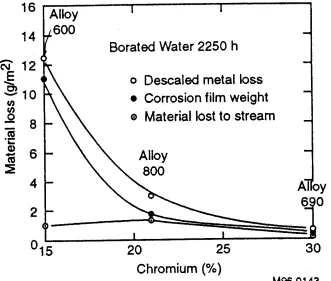
Effect of chromium concentration on loss of metal at high temperature of borated coolant with low content of oxygen at coolant speed 5,5 m/sec is shown on the diagram, Fig. 1.
Figure 1 - Effect of chromium content on loss of metal in deaerated water at coolant speed 5,5 m/sec.
ANCA, containing high percent of chroium - 690, 800 (Inconel 690, Incoloy 800) are less tended to loss of weight than alloy Inconel 600, probably due to low dissolubility of chrome oxyde in the primary coolant circuit with low oxygen content.
.
Table 2 - Scope of vortex-current inspection and number of defective HEP on NPP Paksh Units 1 ÷ 4 according to data for 2002, [5 ].
Unit Inspection rate (%) defects found Defects/ inspected tubes
1 75 71 0,29 %
2 100 725 2,18 %
3 83 285 1,03 %
4 75 142 0,57 %
In most cases the indications were found under or on the edge of tube support plates, except Unit 1, where high number оf indications were found on the span.
The type of indications: transgranular stress corrosion cracks initiated from the outer sur-face of the heat exchanger tubes (ODSCC).
In accordance with our experience, distribution of defects does not follow general rules consid-ering distribution either between legs or between tube support plates (See Fig 4).
Table 3 represents effect data of the chemical austenitic stainless steels and alloys on metal op-eration characteristics.
Table 3 - Influence of elements of chemical compound of austenitic non-corrosive alloys (ANCA) and stainless steels (SS) on their operation characteristics.
# Element Chemical effect Concentration of Ni
%
1 2 3 4
1 Nickel (Ni) Increase of nickel content promotes enhancement of cor-rosion cracking resistance (CC), thus sensitization suscep-tibility increases resulting ambiguity of nickel effect on transcrystalline cracking (TCC) of ANCA.
8-80
2 Chromium (Cr)
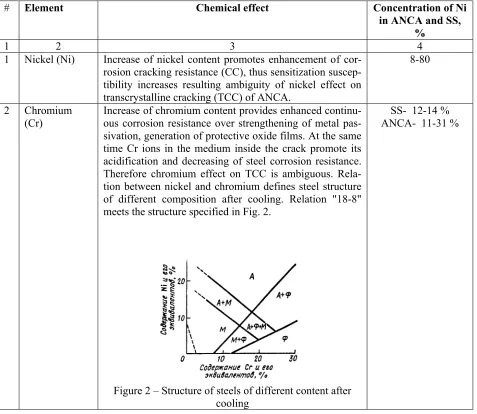
Increase of chromium content provides enhanced continu-ous corrosion resistance over strengthening of metal pas-sivation, generation of protective oxide films. At the same time Cr ions in the medium inside the crack promote its acidification and decreasing of steel corrosion resistance. Therefore chromium effect on TCC is ambiguous. Rela-tion between nickel and chromium defines steel structure of different composition after cooling. Relation "18-8" meets the structure specified in Fig. 2.
Figure 2 – Structure of steels of different content after cooling
A– austenite; M – martensite; Ф - δ- ferrite (on Sheffler)
3 Titan (Ti) Titan is entered into ANCA to bind carbon (the stabilizing additive). To bind carbon more valuable for steels of 8-10 % Ni the titanium concentration is defined from the fol-lowing expression:
Ti ≥ (5-6) C,
for steels with increased nickel content: Ti ≥4C + 0.15
Stabilization of SS, used for the work in highly- oxidizing medium due to possible knife-line corrosion along the welds is less suitable, and sometimes noxious. Dropping of titanium into SS in order to bind carbon was wide-spread in the thirties of last century.
0.2-0.8
4 Silicon (Si) Silicon is used for deoxidation of ANCA. In acidic medi-ums at chloride TCC the silicon as oxides comes over a film and improves its protective inhibitive properties.
0.3-0.8
5 Copper (Cu) Copper promotes inhibition of ANCA dissolution in acids in the active state.
0.05-0.75
6 Carbon (С) Carbon contains in ANCA as an admixture in amount (0.05-0.15) %. Carbon in amalgamation with chromium forms carbides which precipitate on grain boundaries. Alloy 600 is stable to intergranular corrosion cracking (ICC) when grain boundaries are completely surrounded by carbides. If the grains are surrounded partially by car-bides then the ICC resistance decreases. In the absence of carbides on the grain boundaries the heaviest ICC was observed. In this connection, low carbide concentrations are to be avoided for alloy 600; complete dissolution of chromium carbide is required in the course of annealing. On low carbide contents there is a risk of that due to grain growth and absence of intergranular carbides the yield point is reduced inadmissibly. In the twenties of last cen-tury the known most economic relation between chro-mium and carbon concentrations in foreign SS 9, 18-12 Мо, 18-10 Ti and others (at chromium concentration (16-20) %, carbon concentration (0.08-0.15) %) has been established.
0.035-0.05
7 Phosphorus (Р) Phosphorus is present in SS and ANCA as impurities and its presence increases steel cold-short. Therefore they ap-proach to the maximal clearing of steels from phosphorus.
0.035-0.050
8 Sulfur (S) In aqueous mediums of high temperature at the sulfur contents up to 0.1 % and in boiling mediums at t = 154 °C solutions MgCl2 negative action of sulfur impurity up to
(0.06-0.20) % on chloride ICC was not revealed.
0.02-0.20
9 Molybdenum (Мо)
Presence of molybdenum in SS and ANCA promotes in-creasing of steel corrosion resistance in acid and air me-diums.
0.5-4.0
CONCLUSIONS
1. Steam generators serviceability depends substantially on the selection of materials for the heat exchange pipes.
2. The most suitable structural material for manufacturing SG HEP with consideration for their thermal and mechanical properties as well as corrosion resistance are stainless steels (SS) and austenitic stainless alloys (ANCA).
cor-rosion (STCC), austenitic non-corrosive alloys with nickel contents more (70-72) % are subject to inter-crystalline corrosion cracking on stresses (ICCS).
4. Corrosion resistance of stainless steels and austenitic non-corrosion alloys depends on the contents of cromium, titanium, carbon and other chemical elements. The proved choice of weight con-tents of chemical elements in SS and ANCA as well as the technique for their manufacturing and heat treatment allows to receive SS and ANCA with high corrosion resistance.
REFERENCES
1. Dow B., Jr, Tomas R.S. Update: repair and replacement trends.// Nucl. Eng. Inter. Feb. 1998. P. 38 – 40.
2. Kocourek J. SG replacement project update.// Nucl. Eng. Inter. August. 1996. P. 18 – 19. 3. Steam Generator Tube Failures.// NUREG / CR - 6365. INEL – 95 / 0383. April 1996.
Pre-pared for Safety Programs Division. U.S. Nuclear Regulatory Commission. Washington, DC 20555-0001. NRC Job Code E8238. 272 p.
4. Berge Ph., Donati J.R. Materials requirements for pressurized water reactor steam generator tubing. // Nuclear Technology 1981. Vol. 65. № 1. Р. 88-104.
5. Doczi V. Steam Generator Insspections at Paks NPP.//Nechnical Meet
ing on Steam Generator Problems Repair and Replacement (IAEA Meeting). NRI Rez, Czech Republic-February 4-6.