Received September 8, 2017, accepted October 7, 2017, date of publication October 13, 2017, date of current version November 28, 2017.
Digital Object Identifier 10.1109/ACCESS.2017.2762693
CDBFIP: Common Database Forensic
Investigation Processes for
Internet of Things
ARAFAT AL-DHAQM1,2, SHUKOR RAZAK1, SITI HAJAR OTHMAN1, KIM-KWANG RAYMOND CHOO 3, (Senior Member, IEEE),
WILLIAM BRADLEY GLISSON4, ABDULALEM ALI1, AND MOHAMMAD ABRAR1
1Department of Computer Science, Faculty of Computing, Universiti Teknologi Malaysia, Johor 81310, Malaysia 2Department of Computer Science, Aden Community College, Aden 262, Yemen
3Department of Information Systems and Cyber Security, The University of Texas at San Antonio, San Antonio, TX 78249-0631, USA 4School of Computing, University of South Alabama, Mobile, AL 36688, USA
Corresponding author: Arafat Al-Dhaqm ([email protected])
This work was supported in part by the Universiti Teknologi Malaysia, in part by MOHE through FRGS under Grant R.J130000.7813.4F193, and in part by the Universiti Teknologi Malaysia (GUP) under Grant Q.J130000.2513.18H31.
ABSTRACT Database forensics is a domain that uses database content and metadata to reveal malicious activities on database systems in an Internet of Things environment. Although the concept of database forensics has been around for a while, the investigation of cybercrime activities and cyber breaches in an Internet of Things environment would benefit from the development of a common investigative standard that unifies the knowledge in the domain. Therefore, this paper proposes common database forensic investigation processes using a design science research approach. The proposed process comprises four phases, namely: 1) identification; 2) artefact collection; 3) artefact analysis; and 4) the documentation and presentation process. It allows the reconciliation of the concepts and terminologies of all common database forensic investigation processes; hence, it facilitates the sharing of knowledge on database forensic investigation among domain newcomers, users, and practitioners.
INDEX TERMS Forensics, database forensics, Internet of Things forensics.
I. INTRODUCTION
The integration of apps on mobile devices, software used on Internet of Things (IoT) devices, along with the need to improve functionality in numerous business applications, continue to motivate interest in the area of database forensics. Coupling this information with increasing interest in resid-ual data in legal environments [1], [2], necessitates research in this relatively understudied area. Database forensics is a branch of digital forensics that uses database content, meta-data, log files, data files, and memory data to create timelines, establish relationships and recover relevant data [3].
The numerous pieces of input that potentially impact a dig-ital forensic investigation involving a Database Management System (DBMS) is inherently more complex than that of a traditional file system [4], particularly in an IoT environment that is likely to comprise a wide range of heterogeneous devices. For example, in an IoT deployment in battlefields (also referred to as Internet of Battlefield Things or Internet of Military Things), we would need to collect evidential data from a wide range of sensors installed on military vehicles,
cameras (e.g. IP-based CCTV feeds), road side units, etc. These data are also likely to be in different formats (e.g. proprietary formats) and of different sizes. While files are often abstracted as streams of bytes, a database is a col-lection of data where data elements are related to one another. Hence, the process or procedures that are used in a digital investigation directly impact the results of the examination. Selecting investigative processes that do not fit, potentially, leads to incomplete and/or loss of evidence [5]. This incom-plete or missing data may lead to indecisive consequences and give invalid conclusions. In other words, evidence that is not acquired in a forensically sound manner may risk being inadmissible in a court of law [6].
Thus, several database forensic investigation models have been proposed in the literature. The proposed models range in focus from specific scenarios to generic applications and, in doing so, provide a variety of details as a result. The diversity in scenarios and resulting details perceivably make it challenging, or even complicated, particularly for newer forensic investigators, to adopt accurate or proper
investigation models. Due to the lack of a generic/common database forensic investigation process model [7], [8], this study provides a structure, referred to as the Common Database Forensic Investigation Process (CDBFIP), which unifies, facilitates, and shares knowledge of database forensic investigation processes among database users and practition-ers. Unifying these processes in a single abstract diagram increases the knowledge available to users, newcomers, and practitioners. Additionally, it reduces the complexity and ambiguity of the investigation.
This paper is organized as follows. Section II presents works related to this research. Section III describes the actual development process of our CDBFIP based on the Design Science Research (DSR) methodology. While it would be ideal to evaluate CDBFIP using real-world IoT cases, it is challenging to obtain access to such cases partly due to the sensitive nature of forensic investigations. Therefore, in Section IV, we use a set of nine database forensic models to validate CDBFIP. Finally, we conclude the paper in Section V with recommendations for possible future work.
II. BACKGROUND AND RELATED WORK
The database forensics domain uses database content and metadata to identify, collect, preserve, reconstruct, analyse and document evidence of crime. Owing to the complexity and multidimensional nature of DBMS, database forensics has received little attention from researchers [3]–[5], [7], [9], [10]. Existing works in database forensics can be viewed from three perspectives, namely: technology (tools, algorithms, and methods, etc), investi-gation process (e.g. identification, collection, analysis, and presentation) and the database forensic dimension (destroyed dimension, compromised dimension, changed dimension, etc) [11].
A number of studies have been conducted on Oracle databases; these works encompass specific Oracle investi-gation tasks, activities, processes, techniques, concepts and terminologies. For instance, a forensic investigation model was developed by Wong and Edwards [12] that consists of generic steps to discover information about an operation performed on the database [9]. A Log Miner tool was developed by Wright [13] that allows a Data Base Admin-istrator (DBA) or forensic analyst to reconstruct actions taken on a database [11]. Seven practical investigation forensic models were developed by Litchfield [14]. The author addressed information available from redo logs, dropped objects, authentication, flashback, and a recycle bin. Wright and Burleson [15] published a forensic textbook on Oracle RDBMS; however, the book was written as a guide and intended for database administrators [9]. A block diagram to collect evidence was developed by Tripathi and Meshram [16] that is based on a series of prac-tical methods developed to analyse database tampering in an Oracle database [14].
In addition, a number of practical studies have been carried out on Microsoft SQL Database Server (MSSQL Database
Server). These studies covered database investigation tasks, activities, processes, techniques, concepts and terminolo-gies. A methodology for an SQL Server Forensic Analysis was proposed by Fowler [10]; the proposed methodology involves four processes, namely, investigation preparation, incident verification, artefact collection, and artefact analysis, dealing specifically with an SQL server database [4], [11]. A Detection and investigation model was developed by
Son et al. [17] to detect the database server and collect
data. Fowleret al.[18] also proposed an approach to gather and analyze data in practical and real-world scenarios. Their approach covers technical concepts that investigators use to investigate compromised databases. An approach for detect-ing the tamperdetect-ing of forensic evidence in an SQL server was proposed by Basu [19]; the proposed technique shows how tampering can be detected and how to localize the affected data but does not provide tamper-prevention measures [20], [21]. A methodology to distinguish suspi-cious transactions from legitimate transactions among the SQL Server artefacts, in order to eliminate irrelevant data, was proposed by Khanuja and Adane [22]. This methodology specifically considered the investigation processes, technol-ogy, and database dimension in its solution.
Relatively few studies have been conducted that investi-gate a MySQL database in reference to database forensics. A study by Khanuja and Adane [3] did develop a framework for MySQL database forensic analysis. The proposed frame-work focuses on discovering malicious tampering in My SQL database. The authors further highlighted the database server artefacts that were employed for the investigation.
It is worth noting that a model for detecting database incon-sistencies was proposed by Fruhwirtet al.[23]; nevertheless, there was no knowledge discovered for multiple log files or cache for further analysis [24]. To address the limitations of the model proposed by Frühwirtet al. [24], another model was proposed by Frühwirtet al.[25] to reconstruct the basic SQL statements from InnoDB’s redo logs. However, this model focuses on the Data Manipulation Language (DML) statements and ignores the Data Definition Language (DDL) statements. To address situations where the user is unavail-able or where the user is under investigation, Lawrence [26] proposed a technical investigation method to gain access to users’ MySQL database without user consent. According to Adedayo [27], several works have been conducted in digital forensics. However, they largely focus on cloud forensics and smartphone forensics [28]–[45]. They do not directly mention ddatabase forensics. While certain aspects of database foren-sics have been investigated over the years [7], [11], [46], [47], there has been minimal research into the development of a standard/common approach for unifying investigation tasks and activities among investigators.
mobile forensics to categorise and structure mobile forensics domain [49]. Therefore, this paper addresses the variety of the investigation process for whole database forensics domain.
III. METHODOLOGY
This study embraces a Design Science Research (DSR) methodology to design the proposed process artefact, here-after referred to as the Common Database Forensic Inves-tigation Processes (CDBFIP) [50], [51]. DSR is a research methodology that is used to create new and persistent arte-facts for a special problem domain that enables analytics to be examined [52]. This particular implementation of DSR concentrates on Information Technology (IT) artefacts that significantly impact the application domain. According to March and Smith [52], the creation of DSR can be explained in terms of four kinds of artefacts which include the fol-lowing: constructs that organize the language to identify problems and solutions, models that use this language to describe problems and solutions, methods that define pro-cesses that offer assistance on how to answer problems and the final artefact instantiations which are defined as combi-nations of constructs, models, and methods. The DSR life-cycle embraces repetitious assessment of produced artefacts. The execution of the DSR life-cycle necessitates that the building and assessment of the artefact are completed before the artefact is offered to users. The design science process includes six steps, which are illustrated in Fig. 1 [47], [53].
FIGURE 1. Database Forensic models covering different perspectives.
A. IDENTIFY AND SELECT DATABASE FORENSIC INVESTIGATION MODELS
Several database forensic models were discussed and ana-lyzed in the literature review. Model selection for this research was based on coverage factors that were identified in previous research [47], [54]. A wide coverage of perspectives, concepts, and terminologies that are broadly applicable is required to fulfill the aim of proposing a common investi-gation process for database forensics. Using coverage metric quickly provides an indication of sourced model applicability. The model is said to have a high coverage value, if the model can cover all database forensic perspectives (i.e., a general model). The model has a reduced amount of coverage value,
FIGURE 2. Method for proposing a common investigation process for database forensics, adapted from existing research [47], [53].
if the model only describes a specific database forensic per-spective, such as the technology perspective (i.e., a specific model). Therefore, models that cover at least two database forensic dimensions, two databases forensic investigation processes, and at least one database forensic investigation technology (tool, method, or algorithm) were identified and selected for developing CDBFIP. However, models that cov-ered only specific database forensics perspectives (i.e., one or two perspectives) were identified and selected for validation purposes. For example, a System and Method for
Investi-gating a Data Operation Performed on a Database Model,
which is proposed by Wong and Edwards [12], covered three perspectives of the database forensics domain. In addition, the
SQL Server Forensic Analysis Methodology approachthat is
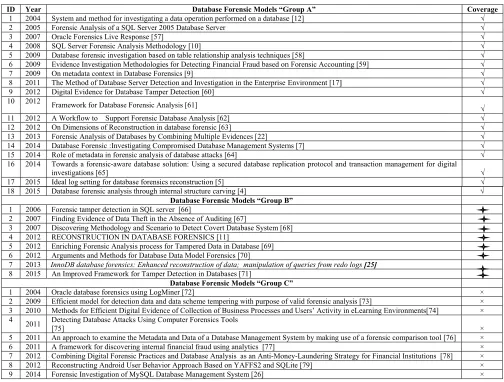
proposed by Fowler [10] covered the three database foren-sics perspectives. Table 1 displays thirty-eight (38) database forensic models that were identified and selected from forty (40) existing database forensic models. Fig 2 displays the models that cover both generic and specific database forensic perspectives. Group ‘‘A’’ refers to models that cover the all database forensic perspectives. Group ‘‘B’’ refers to models that cover only two database forensic perspectives. Group ‘‘C’’ refers to models that cover a single database forensic perspective. Step 3.2 concentrates on recognizing and extracting investigation processes from the eighteen (18) selected database forensics models.
TABLE 1. Database forensic investigation models.
C1: Titles, abstracts, related works and conclusions were excluded; the investigation process was either extracted from the diagram or from the main textual model.
C2: The investigation process must have a definition or activity; the investigation process must have a definition or activity to recognize the purpose, meaning, and functioning of the process.
C3: Irrelevant investigation processes not related to con-ducting database forensics were excluded.
C4: Include explicit and implicit investigation processes from models.
The above criteria were utilized in an attempt to avoid any missing or random process selections. For example, the investigation process model to reveal malicious database activities for an Oracle database was proposed by Wong and Edwards [12]. Their solution consists of four investigation processes, namely:Suspending database operation, collect-ing data, reconstructcollect-ing a database, and restorcollect-ing database
integrity. Another model was developed by Wright [13] to
discover and analyze intruder activities in an MSSQL server
database. Wright [13] provided a solution that consists of four investigation processes, namely:Verification, Evidence
Col-lection, Timeline Creation, and Media Analysis.In addition,
two investigation processes were extracted from [56], which
were Identification and Collection, to identify and collect
volatile and non-volatile data.
Additionally, four investigation processes have been extracted from Fowler’s [10] model to identify, verify, collect and analyze MSSQL server database incidents: Investiga-tion preparaInvestiga-tion, Incident verificaInvestiga-tion, Artefact collecInvestiga-tion,
and Artefact analysis. In addition, two investigation
pro-cesses were extracted from a model to detect and extract malicious relations among tables that were proposed by Lee and Choi [57]: Preparation of database environment and data extraction. The other three investigation processes,
Data acquisition, Financial data analysis, Final report and
court submission,were proposed by Choiet al.[58] to detect
TABLE 2. Extracted database forensic investigation process from 18 models.
In addition, a process investigation model was introduced by Sonet al.[17] for enterprise environments. The investi-gation process involves three steps: server process detection
subsequent to an incident report, followed bydata collection
and aninvestigation on the data collected.
In addition, a tamper detection model was proposed by Tripathi and Meshram [16] to introduce the concept of tamper detection for digital evidence stored in a database. Thus, the two investigation processes highlighted in [16] areSetup evidence collection server and file collection.
A framework proposed by Khanuja and Adane [3] deals with the forensic analysis of a MySQL server database. It consists of four main investigation processes:
Identification, Artefact collection, Artefact analysis and
Final forensic report. Another framework was offered
by Susaimanickam [59] to analyze database incidents. It consists of four investigation processes: Examination preparation, Collection phase, Reconstruction phase, and
Documentation and presentation.In addition, six
investiga-tive processes were advocated by Fasan and Oliver [60] to investigate database incidents, namely:Determine database dimension, Determination of acquisition method, Collection of volatile artefacts, Collection of non-volatile artefacts, Preservation and authentication of collected data, and
Anal-ysis of collected data.Another forensic analysis model was
proposed by Khanuja and Adane [22] for combining mul-tiple pieces of evidences. Their solution offers two general processes for this purpose:Artefact collection and Forensic
analysis.Additionally, a model was proposed by Beyers [7]
to investigate a compromised database management sys-tem. Generally, it consists of two main investigation pro-cesses: theIdentification process and the Collection process.
In addition, another process model was proposed by
Khanuja and Suratkar [61] to collect, preserve and analyze database metadata against database attacks. Three main investigation processes were proposed by Khanuja and Suratkar [61]:Collection of metadata, Preser-vation of metadata, and Analysis of database attacks.
The model proposed by Frühwirtet al.[62] is designed to reconstruct database events to detect intruder activities, via the following: a Collection process to gather evidence by replicating sources and aReconstructing evidence process
that is necessary to rebuild user activities and detect malicious activities. Similarly, an investigation process model was pro-posed by Adedayo and Oliver [5] to reconstruct and analyse database activity using log files via theReconstruction pro-cessandAnalysis process.Finally, Wagneret al., [4] proposed a database forensic analysis model to reconstruct database activities through internal structure carving, via Reconstruct-ing volatile artefacts, and recoverReconstruct-ing database schema.
Therefore, as an output of this section, fifty-four (54) investigation processes were identified and extracted from these eighteen (18) database forensic models. The proposed investigation processes are interlinked activities and tasks to achieve the goal of the Database Forensic activity. Thus, the next step merged and extracted investigation processes that were grouped based on their activities and meaning. Table 2 presents the extracted database forensic investigation process from the eighteen (18) models.
B. MERGING AND GROUPING OF THE EXTRACTED DATABASE FORENSIC INVESTIGATION PROCESSES
TABLE 3. The first group of organized, merged and grouped investigation processes.
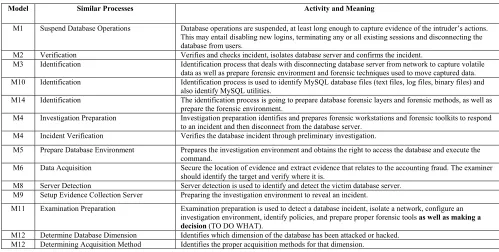
merged and grouped into separate collections. The first grouping scrutinized processes that broadly dealt with inves-tigation preparation, incident identification, and verifica-tion. The initial merging and grouping of the extracted database forensic investigation processes is demonstrated as follows.
The Suspension of Database Operation in the model of
Wong and Edwards [12] isolates the database server from the users in order to capture database activities, while the
Verificationprocess in the model of Fowleret al. [18]
ver-ifies and checks incidents, isolates the database server, and confirms the incident. In addition, the Identification pro-cess in [56] deals with disconnecting database servers from the network in order to capture volatile data. Likewise, the purpose of theInvestigation preparation andIncident
veri-ficationin [10] is to identify and verify database incidents
through a preliminary investigation, prepare forensic work-stations and forensic toolkits to respond to incidents and then disconnect the database server. Furthermore, thePreparation
of the Database Environmentproposed in Leeet al’s[57] used
to prepare the investigation environment and to obtain neces-sary permission to access the database and execute required commands. Additionally, theData Acquisitionprocess neces-sitates securing the location of evidence and extracting evi-dence that relates to a crime or an incident [58]. Another process of interest is Server Detection which is used to identify and detect the victim database server [17]. Further-more, theSetup Evidence Collection Serverprocess described in [16] is used to prepare the investigation environment to store incidents, while the Identification process described
in [3] identifies relevant MySQL database files (text files, log files, binary files) and utilities.
Similarly, Susaimanickam [59] proposed a model for the
Examination Preparation process, which is used to detect
database incidents by cutting off the network, configuring the investigation environment, identifying policies, preparing the proper tools and also informing decision making.
In addition, Fasan and Oliver [60] proposed a model for
Determining Database DimensionandAcquisition Method,
which is used for identifying which dimension of the database has been attacked or hacked. Once this has been achieved, the proper acquisition methods for that dimension are then identified. An identification process model is proposed by Beyers [7] that is aimed at the database forensic layers, meth-ods and environment. Therefore, fourteen (14) investigation processes have been organized, merged and grouped based on their activities and congruent concepts. Table 3 presents the first group of organized, merged and grouped investigation processes.
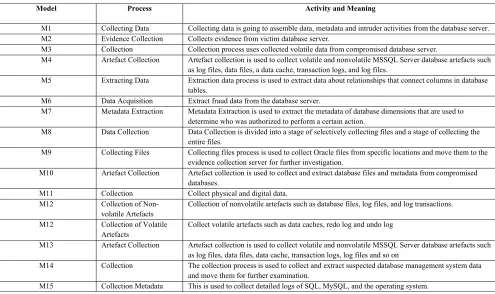
The second grouping inspected processes from the data collection perspective. Wong and Edwards [12] proposed a model for the data collection process aimed at assembling data metadata and intruder activity. Similar processes are introduced by Fowleret al.[18] that includeEvidence Collec-tionto collect evidence from the victim database server and
anEvidence Collectionprocess proposed by Litchfield [56]
TABLE 4. The second group of organized merged and grouped investigation processes.
files, data files, a data cache, transaction logs, and log files.
Additionally, a data Extraction process is proposed by
Lee et al.[57] to extract data on relationships that connect
columns in database tables. In addition, theData Acquisition
process, proposed by Choi et al. [58], has similar activi-ties designed to extract fraud data from a database server. Additionally, the Metadata Extraction process offered by Oliver [9] to extract the metadata of the database dimension is used to determine who was authorized to perform a certain action. In addition, theData Collectionprocess presented by
Sonet al.[17] is subdivided into two stages that consist of
a stage dedicated to selectively files and another stage that focuses on collecting entire files. In addition, a file collec-tion model was introduced by Tripathi and Meshram [16] to collect Oracle files from specific locations and move them to the evidence collection server for further investigation. Furthermore, the Artefact Collectionprocess was proposed by Khanuja and Adane [3] to collect and extract database files and metadata from compromised MySQL Server databases. Similarly, Susaimanickam [59] proposed aCollectionprocess as a sub-process of physical and digital examination to collect physical and digital data. Moreover, theCollection of Volatile
ArtefactsandNon-Volatile Artefactsprocesses were proposed
by Fasan and Oliver [60] to collect database files, log files, log transactions and also volatile artefacts such as data caches, redo log, and undo log.
Similar to the Artefact Collection process presented by Fowler [10], anArtefact Collectionprocess was proposed by Khanuja and Adane [22]. TheCollectionprocess introduced by Beyers [7] allows one to collect and extract suspected database management system data and move it to a secure area for further forensic investigation, and theMetadata
Col-lectionprocess proposed by Khanuja and Suratkar [61] allows
one to collect detailed multiple logs of SQL, MySQL and operating systems.
Implicitly, the preservation process is mentioned by Wong and Edwards [12] under theCollecting Data pro-cess to protect the integrity of data by hashing collected data. It is also mentioned in Fowler’s [10] model under
theArtefact Collectionprocess to prevent any modification
of collected data. In addition, Choi et al. [58] mentioned implicitly as ‘‘Secure data sources’’ under theData
Acqui-sitionprocess. In [9], it was mentioned as an integrity
mea-sure to provide an exact copy of the original data. In the model proposed by Susaimanickam [59], it was described as the main preservation process in thePhysical & Digital
Examination process. Explicitly, it was mentioned in [60]
TABLE 5. The third group of organized, merged and grouped investigation processes.
grouped investigation processes having similar activities and concepts.
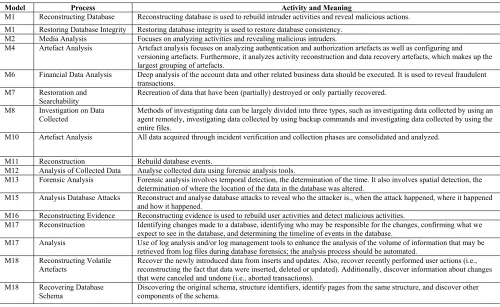
The third grouping broadly focused on database recon-struction, artefact analysis and overall forensic analysis. For example, an Analysis process has been mentioned in sev-eral models. In the model of Wong and Edwards [12], it was used toReconstruct a DatabaseandRestore Database Integrity after collecting data to rebuild intruder activities along with revealing malicious actions and restoring database consistency. In addition, Fowler [18] mentioned it as dif-ferent names in two models. For example, in the model of Folwer et al. [18], it was mentioned as part of the
Timeline Creation and Media Analysis processes, while
Fowler [10] described it as part of the Artefact Analysis
process to reconstruct timeline events and analyse malicious activity. In addition, Choi et al’s. [58] model referred to the analysis process asFinancial Data Analysisand used it to reveal fraudulent transactions. Other models referred to the analysis process as Restoration and Searchability [9], where Son et al’s., [17] model referred to it as the
Investigation on Data Collected process. Furthermore,
Khanuja and Adane’s [3] model mentioned it explicitly
as Artefact Analysis. It is mentioned implicitly as part of
the Reconstruction phase along with the physical and
dig-ital examination process in [59]. Other models referred to the Analysis process as Forensic Analysis [22], Analysing
Database Attacks[61],Reconstructing Evidence[62],
Recon-struction[5], andReconstructing Volatile Artefacts[4]. Some models highlighted certain investigation processes explicitly or implicitly. For example, theReconstruction pro-cess was mentioned explicitly in several models [4], [5], [12], [62], while it was mentioned implicitly under theArtefact
analysis process in [10] and also mentioned implicitly in
Choiet al.’s[58] model under theFinancial Data Analysis
process. In addition, it is mentioned as theRestoration pro-cess in [9], which used it to refer to the recreation of data that have been (partially) destroyed or only partially recovered by a forensic capture process. Moreover, it is mentioned implicitly under thePhysical & digital examinationprocess in [59]. Therefore, it will be merged and grouped along with theAnalysisprocess because it is part of the process that is used to rebuild timeline events during the analysis process. Therefore, seventeen (17) investigation processes have been organized, merged and grouped based on their activities and concepts. Table 5 presents the third grouping of organized, merged and grouped investigation processes with similar con-cepts and activities.
An additional refinement of the identified processes exam-ined the similarities from the broad perspective of docu-mentation which would include presentation and reporting.
TheDocumentation and Presentationprocess was mentioned
TABLE 6. The fourth group of organized merged and grouped investigation processes.
TABLE 7. Mapping process of forensic investigation group 1
investigation stages and submit the results to the court. In addition, Choiet al.[58] offered it as a final report and court submission, whereas Khanuja and Adane [3] mentioned it as a final forensic report. Table 6 displays the fourth group of organized and merged investigation processes.
In the summary of this section, fifty-four (54) extracted database forensic investigation processes have been orga-nized, merged, and grouped based on their activities and concepts. Four forensic investigation groups have been high-lighted. Every group has similar processes in meaning and activities, regardless of actual naming. Every group has a common investigation process amongst other processes. Therefore, the common investigation process for every group will be proposed in the next section.
C. PROPOSED COMMON INVESTIGATION PROCESS FOR DATABASE FORENSIC EXAMINATION
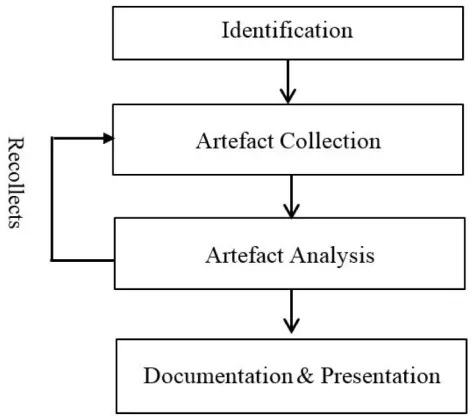
Four forensic investigation groups have been highlighted in Section 3.3 based on similarities in concept and activities. This section aims to propose a common investigation process for every group. The mapping process has been adopted to propose common investigation processes. The investigative process, which has a higher frequency in the group, will be a candidate and be referred to as a common investigation process. From these phases, four common database foren-sic investigation processes were derived:Identification pro-cess, Artefact Collection & Preservation, Artefact Analysis,
and Documentation and presentation process. Since some of
these processes overlap, it was necessary to take into account the activities performed in each of the investigative processes and to not rely solely on naming conventions [63], [64].
The mapping process is adopted to select the more frequent investigation process for every forensic investigation group.
Identification processwas identified as an investigation pro-cess by fifteen (15) investigation propro-cesses in Group 1. It appears three times in three models [56], [3], [7]. Table 7 shows the mapping process of forensic investigation in Group 1.
In addition,Artefact Collectionwas identified as an inves-tigative process by sixteen (16) investigation processes in Group 2. It appears three times in three models [10], [22], [3]. Table 8 shows the mapping process of forensic investigation in Group 2.
TheArtefact analysisprocess was identified as a common
investigation process among seventeen (17) investigation pro-cesses in forensic investigation Group 2. It appears two times in two different models [10], [3]. Table 9 shows the mapping process of forensic investigation in Group 3.
In addition, theDocumentation and Presentationprocess was identified as a common investigation process from foren-sic investigation Group 4. This process has rarely been men-tioned by researchers. Therefore, the author suggests using this process due to its generality. Fig 3 displays the pro-posed common investigation process for a database forensic investigation.
In summary, four (4) common investigation processes have been proposed based on their frequency or generality. Three common investigation processes have been proposed based on their frequency (Identification, Artefact Collection, and
Artefact Analysis). However, the Documentation and
Pre-sentation processhas been proposed based on its generality.
TABLE 8. Mapping process of forensic investigation group 2.
TABLE 9. Mapping process of forensic investigation group 3.
the forensic investigation. The next section will com-bine the various definitions of database forensic inves-tigation processes and reconcile them to the abstract definition.
D. RECONCILIATION OF INVESTIGATION PROCESS DEFINITIONS
Explicit definitions are important in science. Precise defini-tions help to give a clear meaning of concepts. Differences between definitions are reconciled in this phase.
In choosing or synthesizing, the common investigation pro-cess definitions to be used are shortlisted in this phase. If there is a conflict in the definition between two or more sources,
then the definitions are reconciled based on common defini-tions and environment applicability. Some models explicitly omit defining their concept; in such cases, they do not provide any input to the reconciliation process. Therefore, this section aims to harmonize and reconcile the investigation process shortlisted definition. The same reconciliation approach pro-cess has been implemented in previous research [47], [53]. Similar definitions are reconciled and harmonized into one abstract definition.
FIGURE 3. Proposed common database forensic investigation processes (CDBFIP).
captured data in’’, whereas [3] defined it as ‘‘Identification process used to identify MySQL database files (text files, log files, binary files) and also identify MySQL utilities’’. On the other hand, Beyers [7] defined it as ‘‘Identification process for preparing database forensic layers and forensic methods, as well as preparing forensic environment (found environment, clean environment)’’. Therefore, the definition of Litchfield’s [56] is specific to isolating the database server along with preparing the forensic environment and forensic techniques, whereas the definition by Khanuja and Adane [3] is too specific to deal with preparing MySQL database files and utilities. However, the definition of Beyers [7] is similar to [56]. Thus, Byers’s definition and Litchfield’s definition will be reconciled and harmonized in one abstract definition: ‘‘Identification process is the first Database Forensic inves-tigation process that is used to prepare a clean database foren-sic investigation environment and trust forenforen-sic techniques, as well as allow the investigation team to isolate the database server enough from the network to prevent users from tam-pering and capturing volatile and non-volatile data’’.
In addition, ‘‘Artefact Collection’’ was defined by three different researchers. Fowler [10] defined it as ‘‘collec-tion of volatile and non-volatile MSSQL Server database artefacts such as log files, data files, data cache, transac-tion logs, and log files’’. Whereas, Khanuja and Adane [3] defined it as ‘‘collection and extraction of database files and metadata from a compromised database’’. In addition, Khanuja and Adane [22] defined it as a ‘‘collection of volatile and nonvolatile MSSQL Server database artefacts such as log files, data files, a data cache, transaction logs, and log files’’. From an analysis viewpoint, [10] definition is too specific to MSSQL server database, whereas [22] defined the Artefact Collection process from two perspectives. The first defini-tion focused on non-volatile artefacts, whereas the second
definition was borrowed from Fowler [10]. Consequently, a harmonized and reconciled version of this definition is as follows: ‘‘Artefact Collection process is the second Database Forensic investigation process that is used to collect and preserve volatile and non-volatile artefacts from the suspect database using trust forensic techniques’’.
Additionally, the Artefact Analysis process has two defini-tions. Fowler [10] defined it as ‘‘analysing authentication and authorization events, as well as configuring and versioning artefacts. Furthermore, analysing activity reconstruction and data recovery artefacts, which make up the largest grouping
of artefacts’’, whereas Khanujha and Adane [3] defined it as
‘‘analysing all data that are acquired through the incident
verification and collection phases’’. Clearly, [10] definition is brother than [3]. Thus, we harmonize and reconcile these definitions as ‘‘Artefact Analysis process is the third Database Forensic investigation process that is used to analyze acquired data, activity reconstruction and data recovery using spe-cial forensic techniques to reveal who is tampering, when and where the tampering happened and how the tampering happened.’’
Finally, the Documentation and Presentation process was defined by Susaimanickam [59] as ‘‘Documents and presents whole investigation stages, and submit the results to the court’’. However, the authors reconciled it as ‘‘Documen-tation and Presen‘‘Documen-tation investigation process is the fourth Database Forensic investigation process that is used to doc-ument and present the investigation stages and submit the results to the court’’.
In summary, the proposed common investigation process definitions have been reconciled and harmonized into abstract definitions. The next section concentrates on comparing the proposed common investigation processes against other exist-ing database forensic models to validate and verify the com-pleteness and generality of proposed common investigation processes.
IV. VALIDATION OF PROPOSED COMMON INVESTIGATION PROCESSES
The version of the proposed common investigation process will now be validated and improved to make it complete and coherent.
Artefact Analysis process, and Documentation & Presenta-tion process in the proposed common investigaPresenta-tion processes.
A. COMPARISON AGAINST EFFICIENT MODEL FOR DETECTING DATA AND DATA SCHEMES TAMPERING FOR THE PURPOSE OF VALID FORENSIC ANALYSIS
A detection model, proposed by Azemović and Mušić [72], aimed at detecting database system tampering. It offered an efficient approach to providing audit logs for transaction processing systems that can effectively and efficiently detect tampering. SQL coding and cryptographic techniques such as strong cryptographic hashing were used to provide authenti-cation codes on collected data. Thus, this model implicitly provides collection process. the collection process is used to extract data from log files and secure the validity of the col-lected data. Therefore, the proposed common investigation process ‘‘Artefact Collection’’ covered the existing investiga-tion process in the model ‘‘Collecinvestiga-tion process’’.
B. COMPARISON AGAINST METHODS FOR EFFICIENT DIGITAL EVIDENCE COLLECTION OF BUSINESS PROCESSES
Three techniques were proposed by Azemović and Mušić [73] to collect digital evidence from database systems: Triggers, Log file backup, and Replica-tions. Triggers are very powerful elements in a database system that, if used properly, can be very helpful in detecting data modifications. In addition, the log file backup concept can be used on a regular basis for collecting and keeping dig-ital evidence of users’ activity. Additionally, the replication method is a set of technologies for copying and distributing data and database objects from one environment to another; it then synchronizes between databases to maintain consis-tency. Therefore, this model offered a Collection process to collect evidence using three methods against user behavior. Thus, the proposed Artefact collection process has covered the Collection process.
C. COMPARISON WITH ASSEMBLING METADATA FOR DATABASE FORENSICS
A collection process model has been offered by Beyerset al.[82] to locate the key evidence and maintain the integrity and reliability of the evidence. This model describes a database forensic method that transforms a DBMS into the required state for a database forensic investigation. The method segments a DBMS into four abstract layers that separate the various levels of DBMS metadata and data. Therefore, the proposed common investigation process ‘‘Artefact Collection’’ covered the existing investigation pro-cess ‘‘Collection propro-cess’’ in this model.
D. COMPARISON AGAINST ORACLE FORENSICS PART 2: LOCATING DROPPED OBJECTS
The model offered by Litchfield [83] allows the investiga-tor to recover evidence directly from the data files of the compromised server, although an attacker may drop objects.
Several Oracle views and tables assist the investigator in locating dropped objects such as OBJ$, SOURCE$, IDL_UB1$, IDL_CHAR$, and RECYCLEBIN$ tables. Therefore, the proposed investigation process ‘‘Artefact anal-ysis’’ has been covered by the Recover evidence process that is offered in this model. In addition, the activities of this process, such as reconstructing events and timelines, are covered as well.
E. COMPARISON AGAINST ‘‘ON THE COMPLETENESS OF RECONSTRUCTED DATA FOR DATABASE FORENSICS’’ A specific reconstruction process was offered by [84] to rebuild deleted relations or deleted records from the database to introduce evidence against database incidents. A recon-struction algorithm is used through a reconrecon-struction pro-cess to allow the investigators to provide evidence against database modifications. Thus, this process and its activi-ties were enclosed by the proposed investigation process ‘‘Artefact Analysis’’.
F. COMPARISON AGAINST DATABASE TAMPERING AND DETECTION OF DATA FRAUD
Analysis process was proposed by Gawali and Gupta [85] to detect and analyze malicious activity. Therefore, the foren-sic detection algorithm and forenforen-sic analysis algorithm have been offered in this model to detect corruption events and determine when and where database tampering occurred. The outcome of this model has covered the proposed investigation process ‘‘Artefact Analysis’’.
G. COMPARISON AGAINST ENRICHING FORENSIC ANALYSIS PROCESS FOR TAMPERED DATA IN DATABASE A forensic analysis process for tampered data in the database was offered by Abhonkar and Kanthe [68] to detect and analyze database tampering. The Tiled Bitmap Algorithm was used to reveal when the tampering occurred and what data were altered. The outcome of this model covered the pro-posed investigation process ‘‘Artefact Analysis’’ with respect to activities and tasks.
H. COMPARISON AGAINST AN APPROACH TO EXAMINING THE METADATA AND DATA OF A DATABASE MANAGEMENT SYSTEM
This process model was proposed by Beyerset al.[75] to conduct a forensic examination on a DBMS. A Preparation process was offered in this model. The investigator prepares the forensic examination environment, for example, setting up the Ubuntu operating system and PostgreSQL DBMS, and also prepares the forensic comparison tool, which can be used by the investigator to reveal database tampering. Therefore, the preparation process was covered by the proposed common investigation process Identification process.
I. COMPARISON AGAINST FORENSIC ANALYSIS OF DATABASE TAMPERING
TABLE 10. A comparative summary: proposed common investigation process and existing database forensic models.
analysis algorithms were introduced in this model and are to be applied after detecting a database intrusion in order to answer questions regarding when and where tamper-ing occurred. Therefore, the forensic analysis process that was proposed in this model, along with the activities, has been covered by the proposed common investigation process ‘‘Artefact Analysis’’.
In summary, the proposed common investigation processes for database forensics was validated against nine existing database forensic models. The proposed common investi-gation process covers the investiinvesti-gation processes that are derived from the compared models. Table 10 displays the proposed common investigation process in comparison to the database forensic models.
V. CONCLUSION
The escalating dependency of IoT devices to retain and manipulate data stored in databases emphasizes the need to develop an in-depth understanding of the nuances associated with conducting a database forensic investigation (Kebande and Ray, 2016; Teing et al., 2017). This need will be more pronounced as IoT becomes the norm in both civilian and mil-itary settings, such as Internet of Battlefield/Milmil-itary Things. In this paper, we identified fifty-four (54) investigation pro-cesses that were extracted from eighteen (18) database foren-sic models. These processes were then grouped and refined based on common objectives to identify mutual investigation processes for the database forensic domain. This analysis resulted in the Common Database Forensic Investigation Processes (CDBFIP). Based on a thorough investigation of identified processes and models, the CDBFIP reveals that the database forensic investigation process has four common processes: identification, artefact collection and preservation process, artefact analysis process, and documentation and presentation process. We then used nine existing database
forensic investigation models to validate the completeness of the CDBFIP model.
Future work will include examining the concepts and rela-tionships in each of the identified processes in the CDBFIP by applying a software engineering approach known as a meta-model, as well as evaluating the CDBFIP using real-world IoT datasets. Future work will also investigate the application of probabilistic and measurement science techniques into specific IoT database extraction solutions. The idea is to start to be able to quantify confidence in terms of data relevance, origination and tool extraction performance. We will also be seeking out opportunities to implement and evaluate the proposed CDBFIP in a real-world IoT infrastructures, which will allow us to validate and refine the model.
ACKNOWLEDGEMENTS
The authors would like to thank the experts at Cybersecurity Malaysia for their assistance and evaluation of this work. We also acknowledge Professor John Walker for his assis-tance and evaluation of this work.
REFERENCES
[1] K. J. Berman, W. B. Glisson, and L. M. Glisson, ‘‘Investigating the impact of global positioning system (GPS) evidence in court cases,’’ presented at the Hawaii Int. Conf. Syst. Sci. (HICSS), Kauai, HI, USA, Jan. 2015. [2] J. McMillan, W. B. Glisson, and M. Bromby, ‘‘Investigating the increase
in mobile phone evidence in criminal activities,’’ presented at the Hawaii Int. Conf. Syst. Sci. (HICSS), Wailea, Hawaii, 2013.
[3] H. K. Khanuja and D. D. Adane, ‘‘A framework for database forensic analysis,’’Comput. Sci. Eng., Int. J., vol. 2, no. 3, p. 27, 2012.
[4] J. Wagner, A. Rasin, and J. Grier, ‘‘Database forensic analysis through internal structure carving,’’ Digit. Invest., vol. 14, pp. S106–S115, Aug. 2015.
[5] O. M. Adedayo and M. S. Olivier, ‘‘Ideal log setting for database forensics reconstruction,’’Digit. Invest., vol. 12, pp. 27–40, Mar. 2015.
[6] C. Hooper, B. Martini, and K.-K. R. Choo, ‘‘Cloud computing and its implications for cybercrime investigations in Australia,’’Comput. Law Secur. Rev., vol. 29, no. 2, pp. 152–163, 2013.
[7] H. Q. Beyers, ‘‘Database forensics: Investigating compromised database management systems,’’ Univ. Pretoria, Pretoria, South Africa, Tech. Rep., 2014.
[8] S. A. Razak, S. H. Othman, A. A. Aldolah, and M. A. Ngadi, ‘‘Conceptual investigation process model for managing database forensic investigation knowledge,’’Res. J. Appl. Sci., Eng. Technol., vol. 12, no. 4, pp. 386–394, 2016.
[9] M. S. Olivier, ‘‘On metadata context in database forensics,’’Digit. Invest., vol. 5, pp. 115–123, Mar. 2009.
[10] K. Fowler, SQL Server Forensic Analysis. London, U.K.: Pearson Education, 2008.
[11] O. Fasan and M. Olivier, ‘‘Reconstruction in database forensics,’’ in Advances in Digital Forensics VIII. Pretoria, South Africa: Springer, 2012, pp. 273–287.
[12] D. Wong and K. Edwards, ‘‘System and method for investigating a data operation performed on a database,’’ U.S. Patent 0 289 187 A1, Dec. 29, 2005.
[13] P. M. Wright-GSEC and G. GCFW, ‘‘Oracle database forensics using LogMiner,’’ Tech. Rep., 2005. [Online]. Available: https://www.giac.org/ paper/gcfa/159/oracle-database-forensics-logminer/105140
[14] D. Litchfield, ‘‘Oracle forensics part 2: Locating dropped objects,’’ NGSSoftw. Insight Secur. Res. (NISR) Pub., Next Generat. Secur. Softw., Manchester, U.K., Tech. Rep., 2007.
[15] P. M. Wright and D. Burleson,Oracle Forensics: Oracle Security Best Practices. New York, NY, USA: Rampant TechPress, 2008.
[16] S. Tripathi and B. B. Meshram, ‘‘Digital evidence for database tamper detection,’’J. Inf. Secur., vol. 3, pp. 113–121, Apr. 2012.
[18] K. Fowler, G. Gold, and M. MCSD, ‘‘A real world scenario of a SQL server 2005 database forensics investigation,’’ Inf. Secur. Reading Room Paper, SANS Institute, Tech. Rep., 2007.
[19] A. Basu. (2006). Forensic Tamper Detection in SQL Server. [Online]. Available: http://www. sqlsecurity.com/chipsblog/archivedposts [20] K. E. Pavlou and R. T. Snodgrass, ‘‘Generalizing database forensics,’’ACM
Trans. Database Syst., vol. 38, p. 12, Jun. 2013.
[21] K. E. Pavlou and R. T. Snodgrass, ‘‘Achieving database information accountability in the cloud,’’ inProc. IEEE 28th Int. Conf. Data Eng. Workshops (ICDEW), Apr. 2012, pp. 147–150.
[22] H. K. Khanuja and D. S. Adane, ‘‘Forensic analysis of databases by combining multiple evidences,’’Int. J. Comput. Technol., vol. 7, no. 3, pp. 654–663, 2013.
[23] P. Frühwirt, M. Huber, M. Mulazzani, and E. R. Weippl, ‘‘InnoDB database forensics,’’ inProc. 24th IEEE Int. Conf. Adv. Inf. Netw. Appl. (AINA), Apr. 2010, pp. 1028–1036.
[24] P. Frühwirt, P. Kieseberg, S. Schrittwieser, M. Huber, and E. Weippl, ‘‘InnoDB database forensics: Reconstructing data manipulation queries from redo logs,’’ inProc. 7th Int. Conf. Availability, Rel. Secur. (ARES), Aug. 2012, pp. 625–633.
[25] P. Frühwirt, P. Kieseberg, S. Schrittwieser, M. Huber, and E. Weippl, ‘‘Inn-oDB database forensics: Enhanced reconstruction of data manipulation queries from redo logs,’’Inf. Secur. Tech. Rep., vol. 17, no. 4, pp. 227–238, 2013.
[26] A. C. Lawrence, ‘‘Forensic investigation of MySQL database management system,’’ Univ. Cork, Cork, U.K., Tech. Rep., 2014.
[27] O. M. Adedayo, ‘‘Reconstruction in database forensics,’’ Dept. Comput. Sci., Univ. Pretoria, Hatfield, U.K., Tech. Rep., 2015.
[28] D. Quick, B. Martini, and R. Choo,Cloud Storage Forensics. Amsterdam, The Netherlands: Syngress, 2013.
[29] A. Azfar, K.-K. R. Choo, and L. Liu, ‘‘Forensic taxonomy of android productivity apps,’’Multimedia Tools Appl., vol. 76, no. 3, pp. 3313–3341, 2016.
[30] N. D. W. Cahyani, B. Martini, K.-K. R. Choo, and A. Al-Azhar, ‘‘Forensic data acquisition from cloud-of-things devices: Windows Smartphones as a case study,’’Concurrency Comput., Pract. Exper., vol. 29, no. 14, p. e3855, 2017.
[31] F. Daryabar, A. Dehghantanha, and K.-K. R. Choo, ‘‘Cloud storage foren-sics: MEGA as a case study,’’Austral. J. Forensic Sci., vol. 49, no. 3, pp. 344–357 , 2016.
[32] Y.-Y. Teing, A. Dehghantanha, K.-K. R. Choo, and L. T. Yang, ‘‘Forensic investigation of P2P cloud storage services and backbone for IoT net-works: BitTorrent Sync as a case study,’’Comput. Elect. Eng., vol. 58, pp. 350–363, Feb. 2016.
[33] N. H. Ab Rahman, W. B. Glisson, Y. Yang, and K.-K. R. Choo, ‘‘Forensic-by-design framework for cyber-physical cloud systems,’’IEEE Cloud Comput., vol. 3, no. 1, pp. 50–59, Jan./Feb. 2016.
[34] A. Azfar, K. K. R. Choo, and L. Liu, ‘‘An android communication app forensic taxonomy,’’J. Forensic Sci., vol. 61, no. 5, pp. 1337–1350, 2016. [35] Q. Do, B. Martini, and K. K. R. Choo, ‘‘Is the data on your wearable device secure? An Android Wear smartwatch case study,’’Softw., Pract. Exper., vol. 47, no. 3, pp. 391–403, 2016.
[36] D. Quick and K.-K. R. Choo, ‘‘Big forensic data reduction: Digital foren-sic images and electronic evidence,’’Cluster Comput., vol. 19, no. 2, pp. 723–740, 2016.
[37] T. Y. Yang, A. Dehghantanha, K.-K. R. Choo, and Z. Muda, ‘‘Windows instant messaging app forensics: Facebook and Skype as case studies,’’ PLoS ONE, vol. 11, no. 3, p. e0150300, 2016.
[38] Q. Do, B. Martini, and K.-K. R. Choo, ‘‘A forensically sound adversary model for mobile devices,’’PLoS ONE, vol. 10, no. 9, p. e0138449, 2015. [39] D. Quick and K.-K. R. Choo, ‘‘Impacts of increasing volume of digital forensic data: A survey and future research challenges,’’Digit. Invest., vol. 11, no. 4, pp. 273–294, 2014.
[40] D. Quick and K.-K. R. Choo, ‘‘Forensic collection of cloud storage data: Does the act of collection result in changes to the data or its metadata?’’ Digit. Invest., vol. 10, no. 3, pp. 266–277, 2013.
[41] Q. Do, B. Martini, and K.-K. R. Choo, ‘‘A cloud-focused mobile foren-sics methodology,’’ IEEE Cloud Comput., vol. 2, no. 4, pp. 60–65, Jul./Aug. 2015.
[42] F. Immanuel, B. Martini, and K.-K. R. Choo, ‘‘Android cache taxon-omy and forensic process,’’ inProc. IEEE Trustcom/BigDataSE/ISPA, Aug. 2015, pp. 1094–1101.
[43] B. Martini and K.-K. R. Choo, ‘‘Remote programmatic vCloud foren-sics: A six-step collection process and a proof of concept,’’ inProc. IEEE 13th Int. Conf. Trust, Secur. Privacy Comput. Commun., Sep. 2014, pp. 935–942.
[44] B. Martini and K.-K. R. Choo, ‘‘Distributed filesystem forensics: XtreemFS as a case study,’’Digit. Invest., vol. 11, no. 4, pp. 295–313, 2014. [45] N. H. A. Rahman, N. D. W. Cahyani, and K.-K. R. Choo, ‘‘Cloud incident handling and forensic-by-design: Cloud storage as a case study,’’ Concur-rency Comput., Pract. Exper., vol. 29, no. 14, p. e3868, 2017.
[46] W. K. Hauger and M. S. Olivier, ‘‘The state of database forensic research,’’ inProc. Inf. Secur. South Africa (ISSA), Aug. 2015, pp. 1–8.
[47] A. M. R. Al-Dhaqm, S. H. Othman, S. A. Razak, and A. Ngadi, ‘‘Towards adapting metamodelling technique for database forensics inves-tigation domain,’’ inProc. Int. Symp. Biometrics Secur. Technol. (ISBAST), Aug. 2014, pp. 322–327.
[48] A. Al-Dhaqm, S. Razak, S. H. Othman, A. Ngadi, M. N. Ahmed, and A. A. Mohammed, ‘‘Development and validation of a database forensic metamodel (DBFM),’’PLoS ONE, vol. 12, no. 2, p. e0170793, 2017. [49] A. Ali, S. A. Razak, S. H. Othman, A. Mohammed, and F. Saeed, ‘‘A
meta-model for mobile forensics investigation domain,’’PLoS ONE, vol. 12, no. 4, p. e0176223, 2017.
[50] R. H. Von Alan, S. T. March, J. Park, and S. Ram, ‘‘Design science in information systems research,’’MIS Quart., vol. 28, no. 1, pp. 75–105, 2004.
[51] S. H. Othman and G. Beydoun, ‘‘Metamodelling approach to support disaster management knowledge sharing,’’ inProc. 21st Australasian Conf. Inf. Syst. (ACIS), 2010, pp. 1–10.
[52] S. T. March and G. F. Smith, ‘‘Design and natural science research on information technology,’’ Decision Support Syst., vol. 15, no. 4, pp. 251–266, 1995.
[53] G. Beydounet al., ‘‘FAML: A generic metamodel for MAS development,’’ IEEE Trans. Softw. Eng., vol. 35, no. 6, pp. 841–863, Nov. 2009. [54] S. Kelly and R. Pohjonen, ‘‘Worst practices for domain-specific
model-ing,’’IEEE Softw., vol. 26, no. 4, pp. 22–29, Jul. 2009.
[55] A. Ali, S. A. Razak, S. H. Othman, and A. Mohammed, ‘‘Extraction of common concepts for the mobile forensics domain,’’ inProc. Int. Conf. Rel. Inf. Commun. Technol., 2017, pp. 141–154.
[56] D. Litchfield, ‘‘Oracle forensics part 4: Live response,’’ Tech. Rep., 2007. [Online]. Available: https://www.nccgroup.trust/uk/our-research/oracle-forensics-part-4-live-response/
[57] D. Lee, J. Choi, and S. Lee, ‘‘Database forensic investigation based on table relationship analysis techniques,’’ inProc. 2nd Int. Conf. Comput. Sci. Appl. (CSA), Dec. 2009, 2009.
[58] J. Choi, K. Choi, and S. Lee, ‘‘Evidence investigation methodologies for detecting financial fraud based on forensic accounting,’’ inProc. 2nd Int. Conf. Comput. Sci. Appl. (CSA), Dec. 2009, pp. 1–6.
[59] R. Susaimanickam, ‘‘A workflow to support forensic database analysis,’’ Dept. Inf. Technol., Murdoch Univ., Perth, WA, USA, Tech. Rep., 2012. [60] O. M. Fasan and M. S. Olivier, ‘‘On dimensions of reconstruction in
database forensics,’’ inProc. WDFIA, 2012, pp. 97–106.
[61] H. Khanuja and S. S. Suratkar, ‘‘‘Role of metadata in forensic analysis of database attacks,’’’ inProc. IEEE Int. Adv. Comput. Conf. (IACC), Feb. 2014, pp. 457–462.
[62] P. Frühwirt, P. Kieseberg, K. Krombholz, and E. Weippl, ‘‘Towards a forensic-aware database solution: Using a secured database replication protocol and transaction management for digital investigations,’’Digit. Invest., vol. 11, no. 4, pp. 336–348, 2014.
[63] A. Basu, ‘‘Forensic tamper detection in SQL server,’’ Tech. Rep., 2006. [Online]. Available: http://amitfrombangalore. blogspot.com/2015/08/forensic-tamper-detection-in-sql-server.html [64] D. Litchfield, ‘‘Oracle forensics part 5: Finding evidence of data theft in
the absence of auditing,’’ NGSSoftw. Insight Secur. Res. (NISR), Next Generat. Secur. Softw. Ltd., Sutton, U.K., Tech. Rep., 2007.
[65] G. T. Lee, S. Lee, E. Tsomko, and S. Lee, ‘‘Discovering methodology and scenario to detect covert database system,’’ inProc. Future Generat. Commun. Netw. (FGCN), Dec. 2007, pp. 130–135.
[66] P. D. Abhonkar and A. Kanthe, ‘‘Enriching forensic analysis process for tampered data in database,’’Int. J. Comput. Sci. Inf. Technol., vol. 3, no. 5, pp. 5078–5085, 2012.
[67] H. Q. Beyers, M. S. Olivier, and G. P. Hancke, ‘‘Arguments and methods for database data model forensics,’’ inProc. 7th Int. Workshop Digit. Forensics Incident Anal., 2012, p. 1.
[68] M. K. Kambire, P. H. Gaikwad, S. Y. Gadilkar, and Y. A. Funde, ‘‘An improved framework for tamper detection in databases,’’Int. J. Comput. Sci. Inf. Technol., vol. 6, no. 1, pp. 57–60, 2015.
[69] P. M. Wright, ‘‘Oracle database forensic using log-miner,’’ inProc. Jan. 10th 2005 London Jun. 2004 Conf., Jan. 2005, pp. 1–40.
[71] J. Azemović and D. Mušić, ‘‘Methods for efficient digital evidences collecting of business proceses and users activity in eLearning enviro-ments,’’ inProc. Int. Conf. e-Edu., e-Bus., e-Manag., e-Learn., Jan. 2010, pp. 126–130.
[72] F. Fatima, ‘‘Detecting database attacks using computer forensics tools,’’ Dept. Comput. Sci., Texas A&M Univ. Corpus Christi, Corpus Christi, TX, USA, Tech. Rep., 2011.
[73] H. Beyers, M. S. Olivier, and G. P. Hancke, ‘‘An approach to examine the metadata and data of a database management system by making use of a forensic comparison tool,’’ inProc. ISSA, 2011, pp. 1–6.
[74] P. K. Panigrahi, ‘‘A framework for discovering internal financial fraud using analytics,’’ inProc. Int. Conf. Commun. Syst. Netw. Technol. (CSNT), Jun. 2011, pp. 323–327.
[75] D. A. Flores, O. Angelopoulou, and R. J. Self, ‘‘Combining digital forensic practices and database analysis as an anti-money laundering strategy for financial institutions,’’ inProc. 3rd Int. Conf. Emerg. Intell. Data Web Technol. (EIDWT), Sep. 2012, pp. 218–224.
[76] M. Xuet al., ‘‘A reconstructing android user behavior approach based on YAFFS2 and SQLite,’’J. Comput., vol. 9, no. 10, pp. 2294–2302, 2014. [77] S. R. Selamat, R. Yusof, and S. Sahib, ‘‘Mapping process of digital forensic
investigation framework,’’Int. J. Comput. Sci. Netw. Secur., vol. 8, no. 10, pp. 163–169, 2008.
[78] Y. Yusoff, R. Ismail, and Z. Hassan, ‘‘Common phases of computer foren-sics investigation models,’’Int. J. Comput. Sci. Inf. Technol, vol. 3, no. 3, pp. 17–31, 2011.
[79] R. G. Sargent, ‘‘Verification and validation of simulation models,’’ pre-sented at the 37th Conf. Winter Simulation, Orlando, FL, USA, 2005. [80] R. G. Sargent, ‘‘Verification and validation of simulation models,’’
J. Simul., vol. 7, pp. 12–24, Feb. 2013.
[81] R. G. Sargent, ‘‘Model verification and validation,’’ inModeling and Sim-ulation in the Systems Engineering Life Cycle. London., U.K.: Springer, 2015, pp. 57–65.
[82] H. Beyers, M. Olivier, and G. Hancke, ‘‘Assembling metadata for database forensics,’’ inAdvances in Digital Forensics VII. Orlando, FL, USA: Springer, 2011, pp. 89–99.
[83] D. Litchfield, ‘‘Oracle forensics part 2: Locating dropped objects,’’ NGSSoftware Insight Security Research (NISR), Tech. Rep., 2007. [84] O. M. Adedayo and M. S. Olivier, ‘‘On the completeness of reconstructed
data for database forensics,’’ inDigital Forensics and Cyber Crime. Preto-ria, South Africa: Univ. PretoPreto-ria, 2012, pp. 220–238.
[85] P. P. Gawali and D. S. R. Gupta, ‘‘Database tampering and detection of data fraud by using the forensic scrutiny technique,’’Int. J. Emerg. Technol. Adv. Eng., vol. 3, no. 2, pp. 439–446, 2013.
[86] K. E. Pavlou and R. T. Snodgrass, ‘‘Forensic analysis of database tamper-ing,’’ACM Trans. Database Syst., vol. 33, no. 4, p. 30, 2008.
ARAFAT AL-DHAQM received the B.S. degree in computer science and information system from the Technology University of Iraq in 2002, and the M.S. degree in information security from Univer-siti Teknologi Malaysia, Malaysia, in 2013, where he is currently pursuing the Ph.D. degree in com-puter science. He was a Lecturer with the Aden Community College, Yemen. His current research interest includes propose high level model (meta-model) for database forensic investigation field. He is under the supervision of Prof. M. Dr. S. A. Razak.
SHUKOR RAZAKis currently an Associate Pro-fessor at Universiti Teknologi Malaysia. He has authored and co-authored many journals and con-ference proceedings at national and international levels. His research interests are on the security issues for mobile ad hoc networks, mobile IPv6, vehicular ad hoc network, and network security. He also actively conducts several researches in digital forensic investigation, wireless sensor net-works, and cloud computing.
SITI HAJAR OTHMANreceived the Ph.D. degree from the University of Wollongong, Australia. She is currently a Senior Lecturer with the Depart-ment of Computer Science, Universiti Teknologi Malaysia, Malaysia. Her current research interests include conceptual modeling, metamodeling, dis-aster management, information security, computer forensic, knowledge retrieval, disaster recovery, and business continuity planning.
KIM-KWANG RAYMOND CHOO (SM’15) holds the Cloud Technology Endowed Professor-ship with the Department of Information Systems and Cyber Security, The University of Texas at San Antonio, and has a courtesy appointment at the Department of Electrical and Computer Engi-neering. He is a fellow of the Australian Computer Society. He was named the Cybersecurity Educa-tor of the Year - APAC in 2016 (the Cybersecurity Excellence Awards are produced in cooperation with the Information Security Community on LinkedIn), and he led his team to win the Digital Forensics Research Challenge 2015 organized by the Germany’s University of Erlangen-Nuremberg. He was a recipient of various awards, including the ESORICS 2015 Best Paper Award, the 2014 Highly Commended Award by the Australia New Zealand Policing Advisory Agency, the Fulbright Scholarship in 2009, the 2008 Australia Day Achievement Medallion, and the British Computer Society’s Wilkes Award in 2008. He serves on the Editorial Board ofCluster Computing, Digital Investigation, the IEEE ACCESS, the IEEE CLOUDCOMPUTING, the IEEE Communications Magazine,Future Generation Computer Systems, theJournal of Network and Computer Applications, andPLoS ONE. He also serves as the Special Issue Guest Editor ofACM Transactions on Embedded Computing Systems (2017), ACM Transactions on Internet Technology (2016),Digital Investigation(2016),Future Generation Computer Systems (2016, 2018), the IEEE CLOUDCOMPUTING(2015), theIEEE Network(2016), the IEEE TRANSACTIONS ONCLOUDCOMPUTING(2017), the IEEE TRANSACTIONS ONDEPENDABLE ANDSECURECOMPUTING(2017), theJournal of Computer and System Sciences(2017),Multimedia Tools and Applications(2017),Personal and Ubiquitous Computing(2017),Pervasive and Mobile Computing(2016), andWireless Personal Communications(2017).
ABDULALEM ALI received the B.S. degree in computer science from Thamar University, Yemen, in 2004, and the M.S. degree in informa-tion security from Universiti Teknologi Malaysia, Malaysia, in 2013, where he is currently pursuing the Ph.D. degree in computer science. His current research interest includes propose high level model (metamodel) for mobile forensics.
![FIGURE 2. Method for proposing a common investigation process fordatabase forensics, adapted from existing research [47], [53].](https://thumb-us.123doks.com/thumbv2/123dok_us/1281469.1160664/3.576.42.274.406.546/figure-method-proposing-investigation-fordatabase-forensics-existing-research.webp)