PEGAH RAZMARA
MULTI-ROUND DIVISIBLE REAL-TIME SCHEDULING ALGORITHM ON MULTIPROCESSOR PLATFORMS
PEGAH RAZMARA
A thesis submitted in fulfilment of the requirements for the award of the degree of
Doctor of Philosophy (Computer Science)
Faculty of Computing Universiti Teknologi Malaysia
ACKNOWLEDGEMENT
In the name of Allah The Most Gracious The Most Merciful, Praise is to Allah who created us and gave us intelligence and guidance and peace is upon our prophet the teacher of all mankind and peace is upon his family.
I would like to thank my supervisor Dr.Suriayati bt Chuprat , the most patient person as far as know, for her advises , guidance , encouragement and support in my research.
ABSTRACT
ABSTRAK
TABLE OF CONTENTS
CHAPTER TITLE PAGE
DECLARATION ii
DEDICATION iii
ACKNOWLEDGEMENT iv
ABSTRACT v
ABSTRAK vi
TABLE OF CONTENTS vii
LIST OF TABLES xii
LIST OF FIGURES xiv
LIST OF ABBREVIATIONS xvii
LIST OF SYMBOLS xviii
1 INTRODUCTION 1 1.1 Overview 1 1.2 Research Background 1 1.3 Motivation 4
1.4 Problem Statement 4
1.5 Research Objectives 5
1.6 Research Scope and Limitations 6 1.7 Summary of Contributions 7
1.8 Organization of Thesis 9 2 LITERATURE REVIEW 11
2.1 Overview 11
2.3 Real-time Platform Model 13
2.4 Scheduling Methods 15
2.4.1 Static Scheduling 17
2.4.2 Dynamic Scheduling 18
2.5 Real-time Scheduling Methods 20
2.5.1 Static Priority Scheduling Algorithms 22
2.5.2 Fixed Job-priority Scheduling Algorithms 23
2.5.3 Dynamic Job-priority Scheduling Algorithms 24
2.6 Divisible load Theory 24
2.6.1 Linear Network Model 29
2.6.2 Tree Network Model 30
2.6.3 Single-round Strategy 32
2.6.4 Multi-round Strategy 33
2.7 Real-time Divisible Load Theory (RT-DLT) 36
2.7.1 Task Model and system Model 36
2.8 Related Research Work 39
2.8.1 Single-round Cluster Computing Algorithm 39
2.8.2 Cluster Computing with Different Processor Available Time 41
2.8.3 Scheduling Divisible Real-time Loads with Varying Processor Start Times 41
2.8.4 Multi-round Algorithm for Real-Time Divisible Load Scheduling 42
2.8.5 Efficient Algorithm for Real-Time Divisible Load Scheduling 42
2.9 Summary of Comprative Studies and Research Roadmap 43
3 METHODOLOGY 48
3.1 Introduction 48
3.2 Research Procedure 48
3.2.1 Investigation on Single-round and Multi-round Algorithm 50
3.2.2 Problem Identification 50
3.2.4 Analysis of RT-DLT in Single-round and Multi-round
Algorithm 51
3.2.5 Design of Multi-round Algorithm for Real-time Scheduling 51
3.2.6 Algorithm Implementation and Simulation Environment 52
3.2.7 Performance Metrics Measurement 53
3.2.8 Evaluation of Multi-round Algorithm 54
3.2.9 Documentation 55
3.3 Approach Model: Single-round and Selection Multi-round Model 55
3.3.1 Single-round Model 55
3.3.2 Selection Multi-round Model 57
3.4 Research Framework 59
3.4.1 Problem Formulation 60
3.4.2 Previous Model Implementation 60
3.4.3 Experiments 60
3.4.4 Analysis of Result 61
3.5 Summary 62
4 MULTI-ROUND ALGORITHM FOR REAL-TIME LOADS TO MINIMIZE THE PROCESSORS 63
4.1 Introduction 63
4.2 Motivation 64
4.3 Proposed Method to Minimize the Processing Nodes 66
4.3.1 Resources Allocation in Single-round Strategy 67
4.3.2 Resources Allocation in Selected Multi-round Strategy 68
4.4 Algorithm – Multiround 70
4.5 Performance Analysis and Discussion 73
4.5.1 Increasing Deadline 74
4.5.2 Increasing Data size 78
4.5.3 Increasing Communication Time 82
4.6 Discussion 89
4.7 Summary 91
5 DETERMINE THE OPTIMAL ROUND IN MULTI-ROUND REAL-TIME DIVISIBLE LOAD THEORY 92
5.1 Introduction 92
5.2 Proposed Method for Optimal Rounds 93
5.3 Algorithm – Optimal Round 95
5.4 Evaluating the Proposed Method and Discussion 98
5.4.1 Processing Nodes 100
5.4.2 Completion Time 104
5.5 Discussion 107
5.6 Summary 108
6 MULTI-ROUND ALGORITHM FOR THE EARLIEST COMPLETION TIME ON REAL-TIME LOADS 109
6.1 Introduction 109
6.2 Motivation 110
6.3 Proposed Method to Calculate Earliest Completion Time 111
6.4 Algorithm – Minimum Completion Time 114
6.5 Performance Analysis and Discussion 117
6.5.1 Comparison with Increasing Data Size 119
6.6 Discussion 130
6.7 Summary 131
7 COMPARISON OF THE PROPOSED MULTI-ROUND ALGORITHM WITH SMR ALGORITHM 132
7.1 Introduction 132
7.2 Simplified Multi-round (SMR) Algorithm 133
7.3 Comparison of Proposed Method with SMR 136
7.4 Performance Evaluation and Discussions 138
7.4.1 Minimum Number of processors 139
7.4.2 Earliest Completion Time 145
7.6 Summary 150
8 CONCLUSIONS 133
8.1 Summary 133
8.2 Contributions and Significance of Study 152
8.3 Future Works 154
8.3.1 Task Model 154
8.3.2 Scheduling Algorithms 155
8.3.3 Heterogeneous Platforms 155
8.3.4 Network model 155
8.3.5 Network with Front-end Processor 155
LIST OF TABLES
TABLE NO. TITLE PAGE
2. 1 Notations 39
2. 2 Summary of comparative studies on Real-time Divisible
Load Theory(RT-DLT) 44
4. 1 Comparison of generated with increasing deadline and cluster of n=16 processors 75
4. 2 Comparison of generated with increasing deadline
and cluster of n=32 processors 77
4. 3 Comparison of generated with increasing data size
and cluster of n=16 processors 79
4. 4 Comparison of generated with increasing
data size and cluster of n=32 processors 81
4. 5 Comparison of generated with increasing
communication time and cluster of n=16 processors 83
4. 6 Comparison of generated with increasing
communication time and cluster of n=32 processors 85
4. 7 Comparison of generated with increasing
computation time and cluster of n=16 processors 87
4. 8 Comparison of generated with increasing
computation time and cluster of n=32 processors 89 5. 1 Comparison of generated proper round in terms of
minimum processing node and cluster of n=16 processors 102
5. 2 Comparison of generated proper round in terms of
5. 3 Comparison of generated proper round in terms of
minimum completion time and cluster of n=16 processors 105
5. 4 Comparison of generated proper round in terms of
LIST OF FIGURES
FIGURE NO. TITLE PAGE
1.1 Organization of Thesis 10
2.1 Existing relationship among the various classes of
multiprocessor platforms 14
2.2 Taxonomy of scheduling method 16 2.3 Differences between global scheduling and Partitioned
scheduling 21
2.4 Data parallelism 26
2.5 Load distribution linear network 29 2.6 Load distribution tree network 31
2.7 System Topology 37
2.8 Research Roadmap 46
3.1 Research Procedure 49
3.2 Data transmission and execution time diagram in
single-round algorithm 56
3.3 The proposed multi-round model for data transmission
and execution time 57
3.4 The general stage of research framework 59 4.1 The proposed multi-round algorithm 71 4.2 Evaluation of produced 𝑢𝑙𝑡 − 𝑟𝑜𝑢 𝑑 with
increasing deadline and n=16 processing nodes 75 4.3 Evaluation of produced 𝑢𝑙𝑡 − 𝑟𝑜𝑢 𝑑 with
increasing deadline and n=32 processing nodes 76 4.4 Evaluation of produced 𝑢𝑙𝑡 − 𝑟𝑜𝑢 𝑑 with
4.5 Evaluation of produced 𝑢𝑙𝑡 − 𝑟𝑜𝑢 𝑑 with increasing data size and n=32 processing nodes 80 4.6 Evaluation of produced 𝑢𝑙𝑡 − 𝑟𝑜𝑢 𝑑 with
increasing communication time and n=16 processing nodes 83 4.7 Evaluation of produced 𝑢𝑙𝑡 − 𝑟𝑜𝑢 𝑑 with
increasing communication time and n=32 processing nodes 84 4.8 Evaluation of produced 𝑢𝑙𝑡 − 𝑟𝑜𝑢 𝑑 with
increasing computation time and n=16 processing nodes 87 4.9 Evaluation of produced 𝑢𝑙𝑡 − 𝑟𝑜𝑢 𝑑 with
increasing computation time and n=32 processing nodes 88 5.1 Computing optimal round 97 5.2 Evaluation of produced proper round according to minimum
number of processors and n=16 processing nodes. 101 5.3 Evaluation of produced proper round according to minimum
number of processors and n=32 processing nodes. 103 5.4 Evaluation of produced proper round according to minimum
completion time and n=16 processing nodes 105 5.5 Evaluation of produced proper round according to minimum
completion time and n=32 processing nodes. 106 6.1 Computing multi-round completion time 115
6.2 Evaluation of completion time with n=6 and deadline
D=1800 120
6.3 Evaluation of completion time with n=10 and deadline
D=1800 120
6.4 Evaluation of completion time with n=12 and deadline
D=1800 121
6.5 Evaluation of completion time with n=16 and deadline
D=1800 122
6.6 Evaluation of completion time with n=20 and deadline
D=1800 122
6.7 Evaluation of completion time with n=24 and deadline
D=1800 124
6.8 Evaluation of completion time with n=6 and deadline
6.9 Evaluation of completion time with n=10 and deadline
D=2800 126
6.10 Evaluation of completion time with n=12 and deadline
D=2800 127
6.11 Evaluation of completion time with n=16 and deadline
D=2800 128
6.12 Evaluation of completion time with n=20 and deadline
D=2800 129
6.13 Evaluation of completion time with n=24 and deadline
D=2800 129
7. 1 Data transmission and execution time diagram in SMR
algorithm 133
7. 2 Comparison of produced 𝑢𝑙𝑡 − 𝑟𝑜𝑢 𝑑 by
increasing data size and cluster of n=16 processing nodes 139
7. 3 Comparison of produced 𝑢𝑙𝑡 − 𝑟𝑜𝑢 𝑑 by increasing
deadline and cluster of n=16 processing nodes 140
7.4 Comparison of produced 𝑢𝑙𝑡 − 𝑟𝑜𝑢 𝑑 by increasing
computation time, data size and cluster of n=16
processing nodes 141
7.5 Comparison of produced 𝑢𝑙𝑡 − 𝑟𝑜𝑢 𝑑 by increasing
computation time, data size and cluster of n=16
processing nodes 142
7. 6 Comparison of produced 𝑢𝑙𝑡 − 𝑟𝑜𝑢 𝑑 by increasing
communication time, data size and cluster of n=16
processing nodes 143
7. 7 Comparison of produced 𝑢𝑙𝑡 − 𝑟𝑜𝑢 𝑑 by increasing
communication time, data size and cluster of n=16
processing nodes 144
7. 8 Comparison of completion time in cluster of n=24
processing nodes and deadline D=1800 146
7. 9 Comparison of completion time in cluster of n=24
LIST OF ABBREVIATIONS
DLT - Divisible Load Theory DM - Deadline Monotonic EDF - Earliest Deadline First
EDZL - Earliest Deadline Zero Laxity FX - Fixed Priority
FIFO - First In First Out IIT - Inserted Idle Time LP - Linear Programming MP - Multi-processor Platforms QoS - Quality of System
RM - Rate Monotonic
LIST OF SYMBOLS
A - Arrival Time
- Arrival time of Task
- Computation Requirement of Task - Computation Cost
- Communication Cost - Chunk Size of Round C(n) - Completion Time
- Communication Speed
D - Deadline
- Deadline of Task - Link
m - Number of Rounds n - Number of Processors
- Minimum Number of Processors - Processor
𝑟 - Ready Time Task - Start Time Task
- Processing Time - Task
Ti - Idle Time
V - Total Size of Each Round
- Total Workload
Greek Symbols
- Workload
- Total Size of Workload - Fraction of workload - Ratio of and ( + )
CHAPTER 1
INTRODUCTION
1.1 Overview
In this chapter, we present a general overview of the applications performance problem in current real-rime computational systems. In particular, our work is focused on data intensive parallel applications. This chapter introduces the motivation inspiring this work, as well as an overview of studies related to our research. In addition, it presents the goal and contributions of this work and describes the research motivation. Finally, we present the organization of this document.
1.2 Research Background
Within this kind of system, there are two wide groups: hard real-time and soft real-time systems. Hard real-time systems are those that have a strict attachment to deadline constraints; or else, the consequence is disastrous(Buttazzo, 2005, Buttazzo, 2011). In these kinds of systems, to guarantee deadline, we need to know the worst case execution times and for predictability, we need to know if deadlines may be missed.
One of the examples of a hard real-time system is a system of flight control, which in this system, if it does not respond to pilot’s command within microseconds, the system might fail and may cause catastrophic situations.
In contrast, soft real-time systems are those that do not have a strict attachment to deadline constraints (Buttazzo et al., 2006); but it is desirable to do so and if deadline is missed, there is a penalty. In this kind of system, we should provide statistical guarantees and we need to know the statistical distributions of execution times.
In other words, missing deadline in hard real-time systems causes disaster and in soft real-time systems, it can lead to a serious loss. Streaming media player is an example of soft real-time system, which means that if the system does not consider the performance criteria in a single step, then the quality of system becomes reduced and eventually may be lost. Most real-time systems have combination of both hard real time and soft real time tasks. In this research, hard real-time system is a major concern.
showed that the algorithms that are optimal for single processor systems are not optimal for increased numbers of processors.
One of limitations from models of uniprocessor to multiprocessor is that at each time, only one task can be executed upon at most one processor. It means that, the task does not have permission to execute in parallel platforms. Therefore, to solve this problem, many real-time models and scheduling algorithms have been explored. Divisible load model which is distributed by divisible load theory is a computation model that can be divided arbitrarily to different load pieces of workload and would be able to provide a good real-world application.
In general, if a scientific application is appropriately designed to take advantage of systems parallelism, its executions would be usually carried out in a fast and efficient way. Nevertheless, to process data efficiently is not only a matter of having enough processing units, but it also depends on specific characteristics of the workload of the application. In many cases, these applications can be naturally implemented in parallel by partitioning their data sets into smaller pieces and distributing them among the processing units of the parallel system. However, each partition may have different processing times and this situation may lead to significant imbalances in the execution time of the processing units of the application.
Lin et al. (2007, 2010) and Chuprat (2007, 2008, 2010 and 2011) and Mamat (2008, 2009, 2010, 2011 and 2012) have done research in this area and have applied Divisible Load Theory (DLT) to real-time systems in multiprocessor platforms. However, the process of load distribution causes communication delays and idle time for almost all the processing nodes since a processor can start computing only after receiving the entire load fraction assigned to it.
1.3 Motivation
The motivation of this research is to extend Divisible Load Theory (DLT) to real-time systems on multiprocessor platforms to schedule the large real-time task and reduce processor idle time during the initialization of computation phase. Therefore to achieve that, the load fractions are sent in more than one round and totally, the whole workload is distributed between the workers in multi-round algorithm in many small installments or fractions rather than one big fraction in single-round algorithm. Moreover, another motivation of this research is to optimize the utilization of the resources by efficient use of available resources and minimize the processing time of the task is distributed between the processors in order to meet the task deadline. Therefore, this study, will introduce multi-round algorithms in real-time multi-processor applications to improve the previous findings.
1.4 Problem Statement
The subject of scheduling a divisible workload on real-time multiprocessor platforms is quite understood when all processors become available instantly at the same time. However, in real systems, usually, all processors that are required at the start time of scheduling are not available because of previous scheduling task or local task. This reason causes inserted idle time. Most current studies in this field are about distributing data in single-round algorithm and there are limited studies in multi-round algorithm. In Divisible Load Theory (DLT), it is known that, distributing with single round promotes idle-time and aggregated idle-time would increase completion time and more processing nodes. Moreover, existing multi-round studies have some performance problems mainly due to inefficient use of available resources and long execution time for task scheduling. These issues lead to general research question:
Specifically, we consider four important issues:
i. How can we calculate the minimum number of processors upon multiprocessor
platforms in order to meet a job’s deadline?
ii. How can we calculate the optimal number of rounds upon multiprocessor
platforms in order to meet a job’s deadline?
iii. How can we compute the earliest completion time in order to meet a job’s deadline?
iv. What is the effective multi-round algorithm to extend Real-Time Divisible Load
Theory (RT-DLT) upon multiprocessor platforms in order to meet a job’s deadline by evaluate and comparison with the previous multi-round algorithm?
Therefore, to solve all the afore-mentioned problems, we will use multi-round algorithms instead of single-round algorithm and will extend and develop it accordingly, so as to calculate the minimum number of processors and minimum execution time that requires meeting an application’s deadline in order to reduce idle time.
1.5 Research Objectives
i. To build an effective multi-round scheduling algorithm that will calculate the minimum number of processors that must be assigned to a job in order to meets the deadline.
ii. To design an efficient multi-round scheduling algorithm to determining the most efficient number of rounds.
iii. To develop a scheduling multi-round algorithm to determine the minimum completion time upon a number of processor of multi-processor platform in order to meet deadline.
iv. To compare and evaluate our real-time round algorithms to previous multi-round algorithm.
1.6 Research Scope and Limitations
In this research, we use special formal real-time model that is used in many real-time distributed system designs. Thus, there are certain units which are known as workloads that require performing. In the base of real-time scheduling, there are many constraints being observed. In this research, we limit our studies on the only one of these limits which is the deadline of workloads or jobs.With consideration of the resource system, in this research, we focus on determining the minimum number of processors used and the optimal number of rounds needed for our multi-round algorithm. Moreover, the minimum completion time will be another finding in this research. Even though other resources of system, such as energy and bandwidth of network are also important, they are not our scopes within this research.
most researchers have developed and analyzed divisible load theory with single-round strategy.
However, there are many problems like blocking in scheduling and idle time for almost all processors in this method and a processor can start executing the workload fraction only after receiving the whole load fraction assigned to it. Therefore, these complexities will be solved effectively by utilizing divisible load theory with multi-round strategy. Thus we will restrict our research only to divisible load theory with multi-round method.
Also, there are some kinds of scheduling algorithms that can be joined potentially into RT-DLT such as Earliest Deadline Zero Laxity (EDZL)(Baker et al., 2008), Deadline Monotonic (Leung and Whitehead, 1982, Audsley et al., 1993b), Rate Monotonic(Liu and Layland, 1973, Baruah and Goossens, 2003) and etc. But, our work is related to Earliest Deadline First (EDF) (Liu and Layland, 1973) , (Baruah et al., 2003).
1.7 Summary of Contributions
The actual contributions in this research are generally relevant to our objectives that we have defined in the previous sections.
Therefore, to prove all issues in this thesis; we will produce 4 main contributions that can be summarized as:
i. Introducing an algorithm to calculate the minimum number of processors by creating a multi-round scheduling algorithm that must be assigned to a task in order to meet deadline. In this multi-round algorithm, we will divide the workload into small fractions and will allocate them to working processor in optimal number of rounds. Thus, the number of processors used will be minimal.
ii. Creating an effective multi-round scheduling algorithm to determine the most efficient number of rounds. In this algorithm, we will select the round with minimum number of processors and the earliest completion time as an optimal round in multi-round algorithm.
iii. Developing a scheduling multi-round algorithm to determine earliest completion time upon a number of processor on multi-processor platform in order to meet deadline. Thus, for approving this method, we will use multi-round algorithms to determine the minimum processors and the optimal number of round for calculating the earliest completion time.
1.8 Organization of Thesis
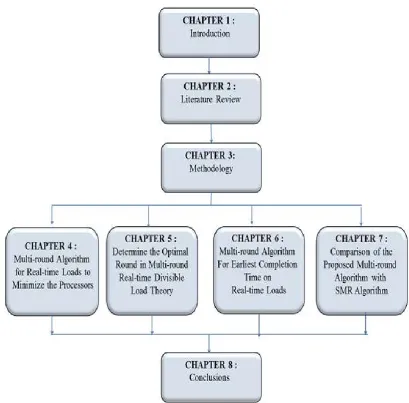
In this chapter, we have developed our objectives and have also described our contributions and motivation of our research. Moreover, we have specified our work limitations and scopes. In the next chapter, we will explain the literature review, related works and results on real-time systems and Divisible Load Theory (DLT). In Chapter 3, we will present our research methodology and research procedure that will be used in our work. So, taking such explanation as a starting point will lead to significant analysis in developing our research to calculate the minimum number of processing node in Chapter 4.
REFERENCES
Audsley, N., Burns, A., Richardson, M., Tindell, K. & Wellings, A. J. 1993a. Applying new scheduling theory to static priority pre-emptive scheduling. Software Engineering Journal, 8, 284-292.
Audsley, N., Burns, A. & Wellings, A. 1993b. Deadline monotonic scheduling theory and application. Control Engineering Practice, 1, 71-78.
Audsley, N. C., Burns, A., Richardson, M. F. & Wellings, A. J. Real-Time scheduling: the deadline-monotonic approach. in Proc. IEEE Workshop on Real-Time Operating Systems and Software, 1991, 133-137.
Baker, T. P. & Baruah, S. K. 2007. Schedulability analysis of multiprocessor sporadic task systems. Handbook of Real-Time and Embedded Systems, 3-1. Baker, T. P., Cirinei, M. & Bertogna, M. 2008. EDZL scheduling analysis.
Real-Time Systems, 40, 264-289.
Balafoutis, E., Paterakis, M., Triantafillou, P., Nerjes, G., Muth, P. & Weikum, G. 2003. Clustered scheduling algorithms for mixed-media disk workloads in a multimedia server. Cluster Computing, 6, 75-86.
Baruah, S. Feasibility analysis of preemptive real-time systems upon heterogeneous multiprocessor platforms. Real-Time Systems Symposium, 2004. Proceedings. 25th IEEE International, 2004a. IEEE, 37-46.
Baruah, S., Funk, S. & Goossens, J. 2003. Robustness results concerning EDF scheduling upon uniform multiprocessors. IEEE Transactions on Computers, 52, 1185-1195.
Baruah, S., Koren, G., Mao, D., Mishra, B., Raghunathan, A., Rosier, L., Shasha, D. & Wang, F. 1992. On the competitiveness of on-line real-time task scheduling. Real-Time Systems, 4, 125-144.
Baruah, S. K. Partitioning real-time tasks among heterogeneous multiprocessors. Parallel Processing, 2004. ICPP 2004. International Conference on, 2004c. IEEE, 467-474.
Baruah, S. K. Task Partitioning Upon Heterogeneous Multiprocessor Platforms. IEEE Real-Time and Embedded Technology and Applications Symposium, 2004d. Citeseer, 536-543.
Baruah, S. K. 2006. The non-preemptive scheduling of periodic tasks upon multiprocessors. Real-Time Systems, 32, 9-20.
Baruah, S. K., Cohen, N. K., Plaxton, C. G. & Varvel, D. A. 1996. Proportionate progress: A notion of fairness in resource allocation. Algorithmica, 15, 600-625.
Baruah, S. K., Gehrke, J. E. & Plaxton, C. G. Fast scheduling of periodic tasks on multiple resources. Parallel Processing Symposium, International, 1995. IEEE Computer Society, 280-280.
Baruah, S. K. & Goossens, J. 2003. Rate-monotonic scheduling on uniform multiprocessors. IEEE Transactions on Computers, 52, 966-970.
Baruah, S. K., Mok, A. K. & Rosier, L. E. Preemptively scheduling hard-real-time sporadic tasks on one processor. Real-Time Systems Symposium, 1990. Proceedings., 11th, 1990. IEEE, 182-190.
Bataineh, S., Hsiung, T.-Y. & Robertazzi, T. G. 1994. Closed form solutions for bus and tree networks of processors load sharing a divisible job. IEEE
Transactions on Computers, 43, 1184-1196.
Bharadwaj, V. 1996. Scheduling divisible loads in parallel and distributed systems, John Wiley & Sons.
Bharadwaj, V., Ghose, D. & Mani, V. 1994. Optimal sequencing and arrangement in distributed single-level tree networks with communication delays. Parallel
and Distributed Systems, IEEE Transactions on, 5, 968-976.
Bharadwaj, V., Ghose, D. & Mani, V. 1995. Multi-installment load distribution in tree networks with delays. Aerospace and Electronic Systems, IEEE Transactions on, 31, 555-567.
Bharadwaj, V., Ghose, D. & Robertazzi, T. G. 2003. Divisible load theory: A new paradigm for load scheduling in distributed systems. Cluster Computing, 6, 7-17.
Bokhari, S. H. 1981. On the mapping problem. Computers, IEEE Transactions on, 100, 207-214.
Bubendorfer, K. P. & Hine, J. H. 1999. A compositional classification for load-balancing algorithms, School of Mathematical and Computing Sciences, Victoria University of Wellington.
Burns, A. & Wellings, A. J. 2001. Real-time systems and programming languages: Ada 95, real-time Java, and real-time POSIX, Pearson Education.
Buttazzo, G. C. 2005. Hard Real-Time Computing Systems: Predictable Scheduling Algorithms and Applications. Real-Time Systems.
Buttazzo, G. C. 2011. Hard real-time computing systems: predictable scheduling algorithms and applications, Springer.
Buttazzo, G. C., Lipari, G., Abeni, L. & Caccamo, M. 2006. Soft Real-Time Systems: Predictability vs. Efficiency, Springer.
Casavant, T. L. & Kuhl, J. G. 1988. A taxonomy of scheduling in general-purpose distributed computing systems. Software Engineering, IEEE Transactions on, 14, 141-154.
Chan, S., Bharadwaj, V. & Ghose, D. 2001. Large matrix–vector products on distributed bus networks with communication delays using the divisible load paradigm: performance analysis and simulation. Mathematics and Computers in Simulation, 58, 71-92.
Cheng, Y.-C. & Robertazzi, T. G. 1988. Distributed computation with communication delay (distributed intelligent sensor networks). Aerospace
and Electronic Systems, IEEE Transactions on, 24, 700-712.
Chuprat, S. Divisible load scheduling of real-time task on heterogeneous clusters. Information Technology (ITSim), 2010 International Symposium in, 2010. IEEE, 721-726.
Chuprat, S. & Baruah, S. K. Deadline-based scheduling of divisible real-time loads. ISCA PDCS, 2007. 7-12.
Chuprat, S. & Baruah, S. K. Real-Time Divisible Load Theory: Incorporating Computation Costs. RTCSA (1), 2011. 33-37.
Chuprat, S. & Salleh, S. 2007. A deadline-based algorithm for dynamic task scheduling with precedence constraints. Proceedings of the 25th confernece
on Proceedings of the 25th IASTED International Multi-Conference: parallel
and distributed computing and networks , 551, 158.
Chuprat, S., Salleh, S. & Baruah, S. K. Evaluation of a linear programming approach towards scheduling divisible real-time loads. Information Technology, 2008. ITSim 2008. International Symposium on, 2008. IEEE, 1-8.
Cvetanovic, Z. 1987. The effects of problem partitioning, allocation, and granularity on the performance of multiple-processor systems. IEEE Transactions on Computers, 100, 421-432.
Dertouzos, M. L. & Mok, A. K. 1989. Multiprocessor online scheduling of hard-real-time tasks. Software Engineering, IEEE Transactions on, 15, 1497-1506. Devine, K. D., Boman, E. G. & Karypis, G. 2006. Partitioning and load balancing for
emerging parallel applications and architectures. Parallel Processing for Scientific Computing, 20,93- 99.
Drozdowski, M. & Lawenda, M. 2006. Multi-installment divisible load processing in heterogeneous systems with limited memory. Parallel Processing and Applied Mathematics. 847-854.Springer.
Katwijk, J. V. & Zalewski, J. 2001. Parallel and distributed real-time systems: An introduction. Scalable Computing: Practice and Experience, 2.
Kim, H. J., Jee, G.-I. & Lee, J. G. 1996. Optimal load distribution for tree network processors. Aerospace and Electronic Systems, IEEE Transactions on, 32, 607-612.
Krueger, P. & Livny, M. 1987. Load balancing, load sharing and performance in distributed systems, University of Wisconsin-Madison, Computer Sciences Department.
Leung, J. Y.-T. & Whitehead, J. 1982. On the complexity of fixed-priority scheduling of periodic, real-time tasks. Performance evaluation, 2, 237-250. Li, X., Liu, X. & Kang, H. Sensing workload scheduling in sensor networks using
divisible load theory. Global Telecommunications Conference, 2007. GLOBECOM'07. IEEE, 2007. IEEE, 785-789.
Li, X., Veeravalli, B. & Ko, C. 2003. Distributed image processing on a network of workstations. International Journal of Computers and Applications, 25, 136-145.
Lin, X., Deogun, J., Lu, Y. & Goddard, S. 2008. Multi-round real-time divisible load scheduling for clusters. High Performance Computing-HiPC 2008. Springer. Lin, X., Lu, Y., Deogun, J. & Goddard, S. 2007a. Enhanced real-time divisible load
scheduling with different processor available times. High Performance Computing–HiPC 2007. Springer.
Lin, X., Lu, Y., Deogun, J. & Goddard, S. Real-time divisible load scheduling for cluster computing. Real Time and Embedded Technology and Applications Symposium, 2007. RTAS'07. 13th IEEE, 2007b. IEEE, 303-314.
Lin, X., Lu, Y., Deogun, J. & Goddard, S. Real-time divisible load scheduling with different processor available times. Parallel Processing, 2007. ICPP 2007. International Conference on, 2007c. IEEE, 20-20.
Lin, X., Mamat, A., Lu, Y., Deogun, J. & Goddard, S. 2010. Real-time scheduling of divisible loads in cluster computing environments. Journal of Parallel and Distributed Computing, 70, 296-308.
Liu, C. L. & Layland, J. W. 1973. Scheduling algorithms for multiprogramming in a hard-real-time environment. Journal of the ACM (JACM), 20, 46-61.
Mamat, A. Real-time divisible load scheduling for cluster computing. THE UNIVERSITY OF NEBRASKA-LINCOLN , 2011.
Mamat, A., Lu, Y., Deogun, J. & Goddard, S. Real-time divisible load scheduling with advance reservation. Real-Time Systems, 2008. ECRTS'08. Euromicro Conference on, 2008. IEEE, 37-46.
Mamat, A., Lu, Y., Deogun, J. & Goddard, S. 2012a. Efficient real-time divisible load scheduling. Journal of Parallel and Distributed Computing, 72, 1603-1616.
Mamat, A., Lu, Y., Deogun, J. & Goddard, S. 2012b. Scheduling real-time divisible loads with advance reservations. Real-Time Systems, 48, 264-293.
Mamat, A., Lu, Y., Deogun, J. S. & Goddard, S. 2009. An Efficient Algorithm for Real-Time Divisible Load Scheduling. CSE Technical reports, 74.
Manimaran, G. & Murthy, C. S. R. 1998. An efficient dynamic scheduling algorithm for multiprocessor real-time systems. Parallel and Distributed Systems, IEEE Transactions on, 9, 312-319.
Mok, A. K.-L. & Dertouzos, M. L. 1978. Multiprocessor scheduling in a hard real-time environment, Domain Specific Systems Group [Massachusetts Institute of Technology].
Moore, R., Prince, T. A. & Ellisman, M. 1998. Data-intensive computing and digital libraries. Communications of the ACM, 41, 56-62.
Ouelhadj, D. & Petrovic, S. 2009. A survey of dynamic scheduling in manufacturing systems. Journal of Scheduling, 12, 417-431.
Paprzycki, M. & Zalewski, J. 1993. Call for Papers Distributed and Parallel Real Time Systems Special Issue of INFORMATICA. An International Journal of
Computing and Informatics, 17, 413-419.
Ramamritham, K., Stankovic, J. A. & Shiah, P.-F. 1990. Efficient scheduling algorithms for real-time multiprocessor systems. IEEE Transactions on Parallel and Distributed Systems, 1, 184-194.
Robertazzi, T. G. 1993. Processor equivalence for daisy chain load sharing processors. IEEE Transactions on Aerospace and Electronic Systems, 29, 1216-1221.
Robertazzi, T. G. 2003. Ten reasons to use divisible load theory. Computer, 36, 63-68.
Robertazzi, T. G. 2007. Networks and grids: technology and theory, Springer Science & Business Media.
Shokripour, A. & Othman, M. Categorizing researches about DLT in Ten groups. Computer Science and Information Technology-Spring Conference, 2009. IACSITSC'09. International Association of, 2009a. IEEE, 45-49.
Shokripour, A. & Othman, M. Survey on divisible load theory and its applications. Information Management and Engineering, 2009. ICIME'09. International Conference on, 2009b. IEEE, 300-304.
Shokripour, A., Othman, M. & Ibrahim, H. 2010. A new algorithm for divisible load scheduling with different processor available times. Intelligent Information
and Database Systems, 221-230.
Shokripour, A., Othman, M., Ibrahim, H. & Subramaniam, S. 2011. A method for scheduling heterogeneous multi-installment systems. Intelligent Information and Database Systems. Springer.
Shokripour, A., Othman, M., Ibrahim, H. & Subramaniam, S. 2012. New method for scheduling heterogeneous multi-installment systems. Future Generation
Computer Systems, 28, 1205-1216.
Shokripour, A., Othman, M., Ibrahim, H. & Subramaniam, S. 2013. A new method for job scheduling in two-levels hierarchical systems. Intelligent Information and Database Systems. Springer.
Sohn, J. & Robertazzi, T. 1995. An optimum load sharing strategy for divisible jobs with time-varying processor speed and channel speed. Proceedings of the ISCA International Conference on Parallel and Distributed Computing Systems. 27-32.
Sohn, J. & Robertazzi, T. G. 1996. Optimal divisible job load sharing for bus networks. IEEE Transactions on Aerospace and Electronic Systems, 32, 34-40.
Srinivasan, A. & Baruah, S. 2002. Deadline-based scheduling of periodic task systems on multiprocessors. Information Processing Letters, 84, 93-98. Veeravalli, B., Li, X. & Ko, C. C. 2000. On the influence of start-up costs in
scheduling divisible loads on bus networks. Parallel and Distributed Systems, IEEE Transactions on, 11, 1288-1305.
Willebeek-Lemair, M. H. & Reeves, A. P. 1993. Strategies for dynamic load balancing on highly parallel computers. Parallel and Distributed Systems, IEEE Transactions on, 4, 979-993.
Wolniewicz, P. & Drozdowski, M. 2002. Processing time and memory requirements for multi-instalment divisible job processing. Parallel Processing and Applied Mathematics. Springer.
Xu, C. 1997. Load balancing in parallel computers: theory and practice, Springer. Yang, Y. & Casanova, H. UMR: A multi-round algorithm for scheduling divisible
workloads. Parallel and Distributed Processing Symposium, 2003. Proceedings. International, 2003. IEEE, 9 pp.
Yang, Y., Casanova, H., Drozdowski, M., Lawenda, M. & Legrand, A. 2007. On the complexity of multi-round divisible load scheduling.
Yang, Y., Van Der Raadt, K. & Casanova, H. 2005. Multiround algorithms for scheduling divisible loads. IEEE Transactions on Parallel and Distributed Systems, 16, 1092-1102.