ASSESSING E-COMMERCE APPLICATION USING CO-CREATION OF VALUE
MAHDOKHT KHADEMI DEHKORDI
A dissertation submitted in fulfillment of the requirements for the award of the degree of
Master of Science (Information Technology - Management)
Faculty of Computer Science and Information Systems Universiti Teknologi Malaysia
iii
I dedicate this dissertation to my respected and beloved family, thank you for the moral and financial support you have provided me with throughout my academic life,
iv
ACKNOWLEDGEMENT
First of all I have special thanks to my love, who provided me with both moral and academic support with this project. He kept my moral on a high when I was feeling low during the stressful times and suffered my bad moods with a smile.
I appreciate my family that mentally and financially supported me. My sister Maryam, who gave me the benefits of all her experiences, my brothers Kamran & Keivan, who always listened to my problems without complaint, and my parents who gave me the strength to carry on when things had gotten difficult and stressful.
v
ABSTRACT
vi
ABSTRAK
vii
TABLE OF CONTENTS
CHAPTER TITLE PAGE
DECLARATION ii
DEDICATION iii
ACKNOWLEDGEMENT iv
ABSTARACT v
ABSTRAK vi
TABLE OF CONTENTS vii
LIST OF TABLES x
LIST OF FIGURES xi
1 INTRODUCTION 1
1.1 Introduction 1
1.2 Problem Background 4
1.3 Problem Statement 5
1.4 The Project Objectives 5
1.5 Project Scope 6
1.6 The Project Importance 6
2 LITRETURE REVIEW 8
2.1 Introduction 8
2.2 History of E-commerce 9
viii 2.6 Implementing the DART Building Block Aspects 16
2.6.1 Dialogue in Dart Building Block 16 2.6.2 Access in Dart Building Block 17 2.6.3 Risk Assessment in Dart Building Block 17 2.6.4 Transparency in Dart Building Block 18 2.7 The Aspects of DART Building Blocks in Combination 18 2.8 Different Definition for Co-creation of Value 21 2.9 Differences between Value Creation and Co-creation 23 2.10 Different Concepts of Value Co-creation 24 2.11 Eight Styles of Firm-Customer Knowledge Co-Creation 27 2.12 Co-creation of Value via Corporate Blogs 29
2.13 Outcomes of Value Co-creation 30
2.14 Conclusion 31
3 RESEARCH METODOLOGY 32
3.1 Introduction 32
3.2 Research Instruments 33
3.3 Literature Review 34
3.4 Project Methodology 35
3.5 The Different Phases in Detail 36
3.6 Summary 40
4 EXPERIMENT AND RESULTS 41
4.1 Introduction 41
4.2 Co-Creation Practices of Successful Companies 42 4.2.1 Investigating Co-creation of Value in E-bay 42 4.2.2 Investigating Co-creation of Value in Dell 47 4.2.3 Investigating Co-creation of Value in Amazon 52 4.2.4 Investigating Co-creation of Value in Nike 56 4.3 Summary of the DART Building Block Concepts 61
4.4 Survey Methodology 64
4.5 Designing Questionnaire 66
ix
5.1 Introduction 71
5.2 Weaknesses of the Kamdar Website and
Recommendations 72
5.3 Improvements in Prototype 79
5.4 Analysis of Responds for the First Part of Questionnaire 87 5.5 Analysis of Responds for the Second Part of
Questionnaire 91
5.6 The DART Building Block Concepts in Questionnaire 101
6 FINDING AND CONCLUSION 106
6.1 Introduction 106
6.2 Summary of Works Done 107
6.3 Summary of Results 109
6.4 Importance of the Work 110
6.5 Limitation 111
6.6 Future Works 112
REFRENCES 113
APPENDIX A 115
APPENDIX B 123
APPENDIX C 126
x
LIST OF TABLES
TABLE NO TITLE PAGE
Table 2.1 Environmental Factors Affecting E-commerce 11 Table 2.2 Sources of Value Creation on E-commerce 12 Table 2.3 Aspects of DART Building Block in Combination 19 Table 2.4 Different Definition of Value Co-creation 21 Table 2.5 Differences between Value Creation and Value Co-creation 23 Table 2.6 Different Concepts and Result of Them in value Co-creation 25 Table 2.7 Eight Style of Firm-Customer Knowledge Co-creation 27
Table 2.8 Outcome of Value Co-creation 30
Table 3.1 Description of the Six Phases in the Project 36
Table 4.1 Co-creation Concepts in E-bay 43
Table 4.2 The DART Analysis of E-bay 46
Table 4.3 Co-creation Concepts in Dell 48
Table 4.4 DART Analysis of Dell 51
Table 4.5 Co-creation Concepts in Amazon.com 53
Table 4.6 DART Analysis of Amazon.com 56
Table 4.7 Co-creation Concepts in Nike 58
Table 4.8 The DART Analysis of Nike 60
Table 4.9 Different Options for Carrying out The Survey 64
Table 4.10 The Pilot Questionnaire 67
Table 4.11 The Final Questionnaire 70
Table 5.1 The Weaknesses of Kamdar Website 73
Table 5.2 Co-creation Features in Prototype 79
Table 5.3 Personal Information Questions 88
xi
LIST OF FIGURES
FIGURE NO TITLE PAGE
Figure 1.1 Sources of Value Creation in E-commerce 2 Figure 2.1 External and Internal Value Drivers in E-commerce 14 Figure 2.2 Co-creation as Expanding Conventional Value Creation 26 Figure 2.3 Co-creation of Value via Corporate Blogs 29
Figure 3.1 Six Phases in the Project 35
Figure 4.1 Co-creation Environment-practice & Benefit 63
Figure 5.1 Mismatch Flash Slide with Category 76
Figure 5.2 Mismatch Chosen Product with the New Ones 76
Figure 5.3 Lack of Sufficient Description 77
Figure 5.4 Inadequate Images for One Product 77
Figure 5.5 Insufficient Place for Customers’ review 78 Figure 5.6 Sufficient Information about Product in Prototype 80
Figure 5.7 Adequate Pictures for one Product 80
Figure 5.8 Active Customer Review and Rating 81
Figure 5.9 Forum with Different Topics in Prototype 81
Figure 5.10 Making New Topic in Forum 82
Figure 5.11 Blog with Different Topic in Prototype 82
Figure 5.12 Link to Write a Review in Blog 83
Figure 5.13 Write a Review Part in Blog 83
Figure 5.14 Events Part in Prototype 84
Figure 5.15 Write a Review Link in Events 84
Figure 5.16 Write a Review Part about Each Event 85 Figure 5.17 Categorization Depends on Manufacturer, Price and Type 85
xii
Figure 5.19 Create a PayPal Account 86
Figure 5.20 Ability of Choosing Country in PayPal Website 87 Figure 5.21 E-commerce Experience and E-commerce Self Rating in the
Original Kamdar Website 89
Figure 5.22 E-commerce Experience and E-commerce Self Rating in the
Improved Website 89
Figure 5.23 The Age Demographics for Both the Original Kamdar Website
And the Improved Website 90
1
CHAPTER 1
INTRODUCTION
1.1 Introduction
Historically the process of value creation or co-creation has often been carried out through the actions of commerce. A major change in commerce came about with the advent of the World Wide Web; much new opportunities to enhance commerce were created. To be able to assess the role of e-commerce in the process of value creation (or co-creation), therefore it is important to have some knowledge on e-commerce, its history and some of its current applications.
E-commerce is known as exchanging products and services through internet by using electronic devices. By improving the facilities for using internet, the using of e-commerce become increase. Ecommerce applications consist of IT (hardware and software) facilitate business by using electronic medium.
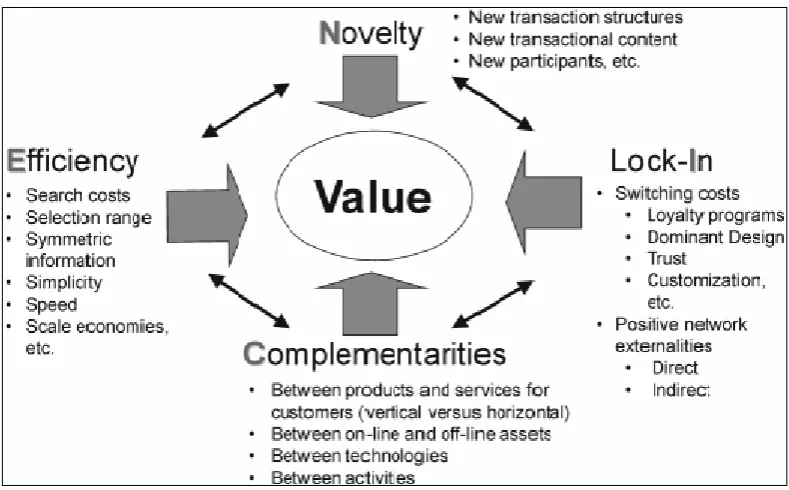
2 customers are outside the business and their only role is to use products. They don’t have any participation and direct input in products creation. This concept is referred to as a goods dominant (G-D) logic. In this view the firm makes the products, then it send them to the markets and after that customers pay money and purchase them. The value is therefore attached by exchanging object and money. These steps refer to value-in-exchange meaning of value (L. Vargo, P. Maglio, & Akaka, 2008).
Figure 1.1: Sources of Value Creation in E-commerce
3 facilitate customers’ access to products. A good example is customers being able to order products online, and receive them from high street stores. As a whole, these four aspects are value drivers in e-commerce and implementing them will increase customers’ motivation.
More recently, customers are much more directly taking part in producing products. They are inside the business; they can give their opinion about the design of products and customized them. These concepts are closely related to service dominant (S-D) logic. In this view both the customers and the producers take part in producing a product, and therefore together co-creating value. Through this view another meaning of value (value-in-use) appears (L. Vargo, P. Maglio, & Akaka, 2008).
4
1.2 Problem Background
The practice of value co-creation has become more prominent in e-commerce. There are still however many challenges associated with this practice. To be able to judge the success or failure in a case of value co-creation in e-commerce application; it is important to understand both the co-creation steps taken and some of the problems faced by these e-commerce practitioners. Only then can the criteria be identified to gauge the level of success or failure, and best practices be highlighted. In the opinion of the author, the main challenge associated with the co-creation of value in e-commerce is related to developing & maintaining relations between parties involved in the co-creation process.
The most well known application to the consumer is probably online retail. The most common practical problem identified with this application includes identity theft and faulty products. Product delivery can also be a potentially difficult issue to deal with. Such problems can arise from lack of communication between the parties involved and can lead to a lack of trust between the firm and its customers, causing an end to their business relationship. By applying the co-creation concept, the author will show in this report that much of these problems could be avoided, and new business opportunities created (R.Petrova, 2002).
5
1.3 Problem Statement
The problem statement for this thesis is the following:
“How to assess e-commerce application using co-creation of value?”
In the market today, there is a greater emphasis being placed on understanding the customer. With the current growth in e-commerce, businesses are looking for ways to distinguish their service and products from their competitors.
This thesis will review a number of cases where value co-creation was applied in e-commerce specifically in the case of online retail; where a number of successful cases will be examined. It will investigate the reasons for this success under the co-creation value concepts, and see what best practices can be obtained, these practices will then be tested with a local e-business, to gauge their success.
1.4 The Project Objectives
• To investigate the co-creation of value in e-commerce applications, in the field of online retail.
• To identify the successful practices and the criteria for success in the case of value co-creation in e-commerce application in the field of online retail.
• To propose a model to improve a local e-commerce application from the perspective of co-creation of value.
6
1.5 Project Scope
In this project, the author will look in detail at number of successful case studies where the concept of value co-creation was applied in the world of online retail. After understanding the co-creation of value concepts that are effective in company’s success, the author is looking for a local e-business to implement the co-creating features and then gauge its success with users. The focus of this study will be in the online retail business sector. For every case in the study, the author will focus on:
• Application of value co-creation in e-commerce.
• The role played by value co-creation to increase the level of success of the particular e-business.
• The utilization of value co-creation in local e-business (www.kamdaronline.com).
1.6 The Project Importance
113
REFRENCES
Amit, R., & Zott, C. (2001). Strategies for Value Creation in E-Commerce:Best Practice in Europe. European Management Journal.
Amit, R., & Zott, C. (2001). Value creation in e-business . Strategic Management Journal.
Casseres, B. G. ( 2001, spring). history.html. Retrieved from pages.cs.brandeis.edu: http://pages.cs.brandeis.edu/~magnus/ief248a/eBay/history.html
Chua, A. P., Parackal, M., & R.Deans, K. (2009). Conceptualising Co-creation of Value via Corporate Blogs:A Proposed Research Framework. International Journal of the Computer, the Internet and Management .
Craighead, C. W., & Show, N. G. (2003). E-commerce value creation and destruction: a resource-based, supply chain perspective. ACM SIGMIS Database .
D.Hoyer, W., Chandy, R., Dorotic, M., Krafft, M., & S.Singh, S. (2010). Consumer cocreation in new product development. Journal of Service Research . Doern, R. R., & Fey, C. F. (2006). E-commerce developements and strategies for
value creation:the case of Russia. Journal of World Business .
Laudon, K. C., & Traver, C. G. (2008). History of e-commerce. Retrieved from www.ecommerce-land.com:
http://www.ecommerce-land.com/history_ecommerce.html
Lawer, C. (2004). Eight styles of firm-customer knowledge co-creation. strategy and innovation .
114
Prahalad, C., & Ramaswamy, V. (2004). Co-creation experience: the next practice in value creation. Journal of interactive marketing .
Pullinger, D. (2010). Measuring website quality. COI.
Rachel R. Doern, C. F. (2006). E-commerce developments and strategies for value creation: The case of Russia. Journal of World Business .
Ramaswamy, P. (2004). Co-creating unique value with customers. Strategy & leadership.
Ramaswamy, V. (2005). Co-creating experiences with customers :new paradigm of value creation . The TMTC jornal of management .
Ramaswamy, V. (2007). Co-creating value through experience. Strategy and leadership .
Ramaswamy, V. (2009). Co-cretion of value-towards an expanded paradigm of value creation.
Ramaswamy, V., & Gouillart, F. (2010). The power of co-creation. New York: Fress Press.