COMMON SUB-EXPRESSION IDENTIFICATION
STRATEGY FOR MQO
Nor Hawaniah Zakaria, AP Dr Shamsul Sahibuddin, AP Dr Harihodin Selamat
Fakulti Sains Komputer & Sistem Maklumat, UTM
hawaniah,
[email protected]
,
07-5532410
Abstract
In query optimization, a query can be executed with different strategies, known as execution plan. The query optimizer will determine the best execution plan for a single query. However, when there are more than one query to be executed together, the locally optimal strategies for single queries may not be the best choice for obtaining a globally optimal execution cost. This will require for a multiple query optimizer that is able to select an alternative plan for each query in order to obtain an optimal global execution plan for the multiple queries. An optimal global plan can be obtained in two ways, by using an admissible heuristic with the search algorithms or by decreasing the number of search space through reducing the number of alternative plans generated. In generating alternative plans, the number and quality of the alternative plans produced are the major factors that will determine the performance of multiple-query optimization. In this paper, we propose the sharing opportunities for identifying the common sub-expressions.
Keywords
Query optimization, multiple query optimization, alternative plan, common tasks, global optimal plan
Introduction
One of the fundamental and important problems in the database field is query optimization. In
database applications, a set of queries may be submitted together to the system for evaluation. This set of queries is most likely to have some tasks that are common to every query in the set. These queries can be processed one at a time, however it is inefficient. To process these queries efficiently, the optimizer should try to take benefit of the common tasks existence. Multiple-query optimization is beneficial especially when there are many common tasks between the queries. We can reduce the cost of executing these common tasks by executing these tasks only once, avoiding redundant disk accesses, and thus a considerable decrease in the execution time of the queries. This thus becomes the goal of multiple-query optimization, i.e. to reduce the execution time of multiple queries with common tasks.
Parser Lexical and Grammer
Parsing
Multiple Query Optimizer
Alternative Plan Generator
Global Optimal Plan Selector
Query Tree
Alternative Plans
Optimal Global Execution Plan
Query Executor
Figure 1. Phases in MQO
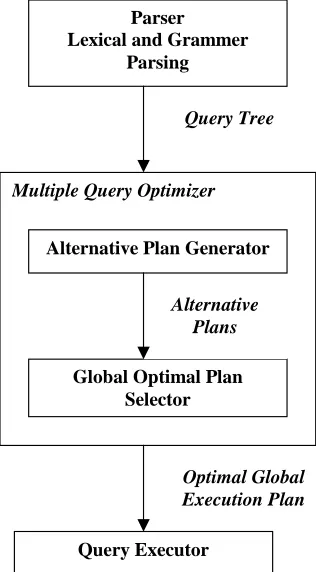
This paper is outlining our approach in solving the multiple-query optimization problem, and our focus is at the first phase, the alternative plan generator. In multiple-query optimization, the alternative plans generated will be the content of the search space of the multiple-query optimizer. The number of alternative plans generated will have an effect to the performance of the optimizer. In this paper we will describe our approach in identifying the common tasks of the alternative plans (the notions of sharing.)
Research Background
In query optimization, a query can be executed with different strategies, known as execution plan. The query optimizer will determine the best execution plan for a single query. However, when there are more than one query to be executed together, the locally optimal strategies for single queries may not be the best choice for obtaining a globally optimal execution cost. This will require for a multiple query optimizer that is able to select an alternative plan for each
query in order to obtain an optimal global execution plan for the multiple queries.
In determining the best optimal solution for multiple-query optimization, several approaches have been proposed in determining the best optimal solution (execution plan) for multiple queries. One approach, as described by Finkelstein [2], is based on the idea of building the multiple query optimizer on top of the current single query optimizers. In this approach, a single query optimizer generates one optimal plan for each query. A plan merger, another component in the system, will next examine all the plans and merges them to generate a global execution plan. This global plan is derived from the shared temporary results of the common parts of the queries. This approach is however may not guarantee the optimal global cost because it may miss some other plans (which are not necessary optimal for each query) that contain more common tasks with other queries.
Another approach in determining the optimal solution tries to solve the problem mentioned above. The approach [1] generates several alternative plans for each query instead of generating only one optimal plan. It detects and uses all common tasks found within the queries.
the proposed methods whilst managed to generate alternative plans they also created a large search space, which will increase the cost of MQO.
Alternative Plan Generator
The above Figure 1 depicts the main phases of MQO problem. As mentioned above, the alternative plans generated will be the input to the global optimal plan selector. In generating alternative plans, the number and quality of the alternative plans produced are the major factors that will determine the performance of multiple query optimization [4]. In order for the plans to be generated efficiently, it involves with two major issues, first is the identification of common sub-expressions that will contribute to the query rewriting of the original query and second, the number of alternative plans produced, which will contribute to the size of search space for the global optimal plan selector.
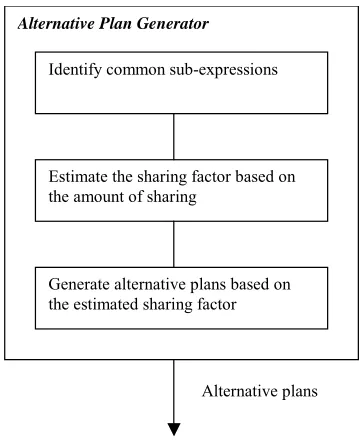
For the first issue, which is the subject of discussion of this paper, we are proposing our strategy to identify the common sub-expression. The next section outlines our proposed sharing opportunities for consideration. Since the number and the quality of alternative plans generated have a substantial effect on the cost of the MQO, it is important to be able to estimate the cost of the sharing among the queries. This is the next step in our approach. Among factors that can be considered in estimating the sharing cost are the common relations, joins and conditions [4]. Figure 2 reflects our approach in generating the alternative plans (i.e. the alternative plans generator phase).
Alternative Plan Generator
Identify common sub-expressions
Estimate the sharing factor based on the amount of sharing
Generate alternative plans based on the estimated sharing factor
Alternative plans
Figure 2. Approach in Alternative Plan Generator
Identifying Common Sub-expressions
Strategy
Identifying common sub-expressions (CSE) among queries is important in multiple-query optimization problem. In this paper, we introduce our strategy in identifying the common operators and our focus is currently on the most important and complex operator, the two-way join operator.
Consider two queries, Q1 and Q2. Assume there are two two-way joins, twj1 and twj2, where twj1 is a join of relations R1 and S1,
while twj2 is a join of relations R2 and S2, both
joins are over predicate p1 and p2, respectively.
twj1 : R1
⋈
S1
p1
twj2 : R2
⋈
S2
p2
Sharing opportunities considered are:
a) R1 = R2, S1 = S2
the CSE. In rewriting the query, twj2
will be deleted, and twj1 is shared by
Q1 and Q2.
For implication condition: p2 implies p1 (P2 → P1), (an example : p1 is r.a >= s.a, p2 is r.a = s.a) then twj1 is the
CSE. A Select operator should be
added on twj1’s result in order to get twj2’s result.
For intersection condition: P1 ∧ P2, a join operator with predicate p1 v p2 is the common operator. In rewriting, two
Select operator is added on top to
further restrict the CSE’s result.
b) R1 = R2, S1 ⊂ S2 (i.e. S1 = σt (S2) or S1 = σt1 (S1) ∧ S2 = σt2 (S) ∧ t1 →
t2)
For equivalent condition: P1 ≡ P2, twj1
is the CSE. In rewriting Q2, predicate t is moved up.
For implication condition: P2 →P1, similar to equivalent condition above.
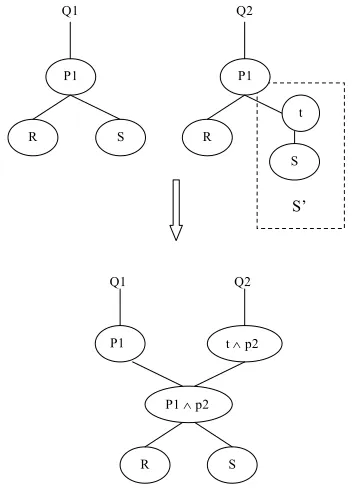
For intersection condition: P1 ∧ P2, the CSE and rewriting is shown in the Figure 3.
c) S1 = S2, R1 ⊂ R2
The sharing condition is analogous to (b) above.
d) R1 = R2, S1 ∩ S2 ≠φ (i.e. S1 = σt1 (S), S2 = σt2 (S), t1 ∧ t2 ≠ false)
For equivalent condition, P1 ≡ P2, the original two joins will be combined and then divided into 3 joins. One of the join is the CSE, see figure 4.
Similar goes to implication and intersection condition.
The above sharing strategies are applied to the next described algorithm in searching for the CSE and rewriting the queries trees. (To simplify explanation, we are considering only for two queries)
Algorithm: Searching for CSE and Query Rewriting
Input: Operator trees for each query. Output: Operator forest after rewriting
1. Traverse the operator trees in post-order (post-order traversal).
2. Compare between operator nodes of every operator trees.
2.1 Find the same type nodes.
2.2 Get the predicate over the operator nodes (i.e. p1 and p2)
2.3 If p1 and p2 empty,
2.3.1 Get the input relations for the operator nodes.
2.3.2 If the two operator nodes have common relations, use strategies described above to rewrite the query trees.
2.4 If p1 and p2 is not empty, traverse p1 in inorder way.
2.4.1 For each node n in p1
2.4.1.1 Traverse p2 in inorder way. Get node x in p2.
2.4.1.2 If node x and node n access different relations or different attributes, then backtrack p2 to grandfather node of x.
2.4.1.3 Else compare the father nodes and the right-brother nodes of node x and node n. Rewrite the query trees using the strategies described above. 2.4.1.4 Continue until traversing is over. 2.5 Continue loop 2 until post-order
traversal for q1 and q2 is completed.
The efficiency (theoretic) of the CSE search for the above algorithm can be calculated based on the number of comparisons between nodes when traversing the operator trees (step 2), the number of comparisons between the predicates (step 2.4.1-2.4.1.3) and the average association degree (AAD) between queries[5].
The AAD is given by k
∑ i *mi
i=1
AAD = --- where r is number of tables, m
The number of comparison between nodes (CBN) is
m-1
CBN= n * (n* ∑ (m – i)) i=1
where n is the average number of nodes in a tree, m is the number of queries.
The number of comparison between predicates (CBP) for m queries is
m
CBP = ∑ (i – 1) * p * 3 * AAD i=1
where p is the average number of predicate for each query.
Therefore, the total number of comparison (TNC) is the sum of comparison between nodes and comparison between predicates.
TNC = CBN + CBP m-1 m
= n * (n* ∑ (m – i)) + ∑ (i – 1) * p * 3 * AAD
i=1 i=1
= ½ m (3*p*AAD + n2)
Conclusion
In this paper, we proposed our approach in generating alternative plans. We have discussed briefly on the approach, which is shown in Figure 2. Included in our discussion is our strategy in identifying the common sub-expressions by producing the sharing opportunities, the algorithm to search for common sub-expressions and the theoretical analysis for the efficiency of the search algorithm. Our future work in the research is to experiment this algorithm with the sharing opportunities.
P1
R S
Q1
P1
R
S Q2
t
S’
P1 t ∧ p2
P1 ∧p2
R S
Q1 Q2
Figure 3. Sharing Opportunity Case (b)
P1
R
S Q2
t2
S2 P1
R
S Q1
t1
S1
P1
t1 ∧ t2
R S
Q1 Q2
t1 ∧ ¬ (t1∧t2 ) t2 ∧ ¬ (t1∧t2 )
P1 P2
union union
Bibliography:
1. Sellis, T.K., Multiple-Query Optimization. ACM Transaction on
Database Systems, 1988. 13(1): p. 23-52.
2. Finkelstein, S. Common Subexpression Analysis in Database Applications. in ACM-SIGMOD International Conference on the Management of Data. 1982. Orlando, Florida: ACM.
3. Cosar, A., Multiple Query Optimization, Phd Thesis, in Department of Computer Science, University of Minnesota. 1996:
Minneapolis.
4. Polat, F., A. Cosar, and R. Alhajj,
Semantic Information-based Alternative Plan Generation For Multiple Query Optimization. Information Sciences,
2001. 137(1-4): p. 103-133.
5. Chen, H., S. Zhou, and S. Wang.
Multiple Query Optimization in PBASE/3. in Fourth International Conference on High-Performance
Computing in Asia-Pasific Region.
2000: IEEE.
6. Hong, C., Z. Sheng, W. Shan. Multiple Query Optimization in PBASE/3. 4th International Conference on High-Performance Computing in Asia-Pasific Region. 2000. Volume 2.
7. Alsabbagh, J.R., V.V. Raghavan. A Framework for Multiple-Query Optimization. International Workshop on Research Issues in Data Engineering – Transaction and Query Processing.
1992. p.157-162.
8. Alsabbahgh, J. R., V.V. Raghavan.
Analysis of Common Sub-expressions Explotation Models in Multiple-Query Processing. 10th International Conference on Data Engineering.
1994. p. 488-497.
9. Alsabbahgh, J. R., V.V. Raghavan . A Model for Multiple-Query Processing based Upon Strong Factoring. International Conference on