.e
CATHERlllE T. BUR:I"CN. Autanorphism Groups of Balanced Incemplete Block Designs and Their Use in Statistical ~kxjel Construction and Analysis.
(Under the direction of I. H. CHAKRAVARrI.)
The analysis of variance of a BIB design using either of the con-ventional linear rrodels E(Y)
=
1Jj + D'T + L'S, Var(Y)=
0'21 or- .:q'l - -
-2 2
E(~) =
lJ1n
+ D'~, Var(Y) = a I + 0'1 L'L does not take into account cer-tain structural properties of the design, such as the autarorphism group. We assume here that the covariance matrix V of Y is invariant tmder the action of the group of permutation matrices which permute the flags, the treatment-block pairs, under the action of the group of auto-rrorphisms G. Thus V=
It c. V., where t is the dimension and V. ,. 1 l l l
l=
i
=
1, 2, ••• , t, is a linear basis of the conrnutant algebra corres-rxmding to the pennutation representation of G.For the desarguesian finite projective plane PG(2, 2) and the desarguesian finite affine plane EG(2, 3), the decanpositions into direct sums of irreducible representations of the permutation repre-sentations of the full collineation groups PC(2, 2) and EC(2, 3) have been detennined. The dimensions and the canfDnents of the covariance rratrices V of designs derived from such planes are thus detennined.
and eight , respectively. A linear basis for each case has also been derived.
Estimation is considered when the covariance matrices belongs to one of four relationship algebras R
6, R7, P7 or P8' algebras having lJasis matrices which reflect relationships between the flags. For the
fixed effects rrodel, the best linear unbiased estimator of E(1) is equal to t..1re simple least squares estimator of E(y); variance canponent esti-rration is also examined. For the random blocks model, the estimable canponents of variance are detennined along \lith the difference between the b.l. u. e. and the 1.s. e. of E(X) •
This research was supported in part by the National SCience Foundation (Grant HCS 78-01434).
•
_e
--iii
I wish to express my sincere gratitude to my M:ijor Professor, Dr. I. M Chakravarti, for the time, encouragement and guidance he has provided me in the preparation of this dissertation.
I thank Dr. Nonnan Johnson, the chainnan of my ccmnittee, and my conmittee members, Dr. R. L. Davis, Dr. Ronald Helms and
Dr. P. K. Sen. I extend my appreciation for their suPI;Ort and the in-struction that I received in their classes.
I also wish to express my gratitude for the support the entire Statistics I:ePart1nent has given me during my stay at the University of N:>rth Carolina at Chapel Hill. I am also indebted to the National Sci-ence Foundation (Grant M2S 78-01434) for partial support of my research.
I. rnTIDCUcrIOO • • • •
TABIE OF CCNI'ENTS
1
II. REVIEW OF LITERATURE • III. PRELll1INARY FORMULATIOOS
· . . . .
5.e
3.1 General Notation, Definitions and Prcperties
·
·
·
16 3.2 Definitions and Results fran Group Representationand Character Theory
· ·
·
·
· ·
•· ·
·
•
•·
• •·
20 3.3 Finite Desarguesian Geanetries and TheirCollineations
. · ·
·
·
·
·
· · ·
·
·
• •·
•·
•·
25 IV. DEC(MPOSITIOO INTO A DIREcr SUM OF IRRECUCIBIEREPRESENTATIooS FOR PC(2, 2) AND EC(2, 3)
4.1 Introduction
.
. .
·
· · ·
·
· · · ·
·
·
•· · ·
·
35 4.2 DecanPJsition of the Permutation Representation ofPC(2, 2) into a Direct
sum
of IrreducibleRepresentations
·
·
·
·
·
·
·
·
·
·
· · ·
·
· ·
•·
35 4.3 Decomposition of the Pennutation Representation ofEC(2, 3) into a Direct Sum of Irreducible
Representations
· · · · ·
· · ·
·
· ·
· ·
•
· ·
41 V. DEI'EFMINATIOO OF THE CCMMUTANT AIGEBRA FOR BAIANCEDrnCCMPIEI'E BIro< DESIGNS BASED 00 FrnITE GECMETI'RIES 5.1
5.2 5.3 5.4
The Design Based on the Desarguesian Finite Projective
r
Plane PG (2, s), s
=
p • • • • • • • • • • • • • • • The Design Based on the Desarguesian Finite Projectiver
Gecrnetry PG(k, s), k ~ 3, s
=
P • • • • • • • • • • The Design Based on the Desarguesian Finite Affiner
Plane EG(2, s), s
=
p • • • • • • • • • • • • • • • The Design Based on the Desarguesian Finite Affiner
Geanetry EX;(k , s), k ~ 3, s
=
p • • • • • • • • • • 4854
59
63 VI. ESTIMATION AND ANALYSIS
6.1 Estimation under the Assumption of a Zero Mean Vector • • .. • • • • • • • • • • • • • 6.2 Estimation under a Fixed Effects 1-bdel 6.3 Estimation under a Random Blocks M::xlel
--VII • CooCLUSION. • BIBLIOORAPHY • •
APPENDICES Appendix A • Appendix B • Appendix C • Appendix D • Appendix E Appendix F
v
84
86
88
95
97.e
An incidence s-tl'ucture (see, for instance, Derti:xMski (1968)) is
defined to be a triple S
=
(P, B, 1) where P, B and I are sets such thatP n B
=
~ and I oS P x B. The elements of P, B and I are called points~blocks and flags respectively. A flag will be denoted by an ordered pair
(p, B) which indicates that the point p is incident with the block B.
we
shall also only consider finite incidence structures, Le., the case when
P, B and I are finite sets.
A tactical configuration is an incidence structure with an equal
number of points on each block and an e:;rual number of blocks through
every point. SUch a tactical oonfiguration is called a balanced
incom-plete block design (BIB design) if every pair of points is incident with
an e:;rual number of blocks, say A (>0). This results in a design in
which v
=
IPI
treatmmts are arranged in b=
I
BI
blocks, such that eachblock contains k different treatnents, each treatmmt occurs in r blocks
and every pair of different treatnents occurs together in Ablocks (see,
for exaIrq?le, Hall (1967)). The results of an experiment based on such
a BIB design with parameters v, b, r, k, A may be written as the vector
of observations Y
=
(Yl , Y2, ••• , Yn)' where n
=
bk=
vr is the numberof experi..Irental units.
When the treatnents and blocks are fixed, the linear nodel E (Y)
=
]Jj
+
D'T+
L'S,
var (y) = a2I is C01tll'OI1ly used by statisticians in the""fl - - - n
2
pararreters,
.§.
the vector of block pararreters and fl a constant.~ is a vector of nones, D = «diu)) is a vxn matrix such that
d. = 1 if the uth experimental unit (flag) receives (contains) treat-lU
rrent i (point i); othe:rwise, d.
=
o.
L=
«1. )) is a bxn matrix suchlU JU
that 1.
=
1 if the uth experimental unit (flag) is found in block j; JUothe:rwise, 1.
=
o.
In the case of randan block effects, the linearJU 2
2 nodel E(Y)
=
flln + D'~, var (Y)=
0+
01 L'L is ccmronly used. SUch linear rrodels, however, do not discriminate between two BIB designs with the sarre nl.lIrerical values for the pararreters v, b, r, k, A but with dif-ferent structural properties. Combinational matherraticians have studied the differences in structure of these BIB designs by examining the groups of automorphisms (groups of sYJ11retries) of such designs, ho.vever statis-ticians have hardly considered these groups in the construction of ap-propriate rrodels and in the analysis of observations.
An automorphism of an incidence structure is a one-to-one map ¢ of points onto points and blocks onto blocks such that ¢P
=
P, ¢B=
Band incidences are preserved. Thus, for our block design D with treat-ItEIlts {t.} and blocks {B.}, an autorrorphism of the' design is a
one-te-l 1
one map q, such that (t., B.) is a flag (E 1) if and only if (¢ t. , ¢B.)
1 J 1 J
is a flag (E I). The set of all such aut.cm:>rphisms of an incidence
--structure (or a desiqn) fonn a finite group, a group being a set of ele-rrents G= {a. b, c, .•. } having a binary operation called a product such that
(i) The set G is closed under the binary operation. (ii) The elements of G are associative.
(iii) The set G has an identity element e.
_e
Such an autanorphism group of a design can be represented by a group
of permutations of the flags in the design. In fact, if G is the group
of autarorphisrns of a design, each g E G may be represented as a
permu-tation matrix P(g) reflecting the permupermu-tation of the flags under g.
In general, structurally different BIB designs with identical
Pararreters v, b, r, k, A have different autarorphism groups. We will
thus use these autarorphism groups to IOOdify our usual linear IOOdel.
we
assurre the distribution of
!
= (Yl' Y2' ••• , Yn)' is such that itsco-variance matrix Var(!) = L: is invariant under the action of the
permu-tation matrices representing the group of autarorphisms, Le., 0g(i)g(j)=
0 .. for i, j = 1, 2, •.• , n. This implies P(g)L: = L:P(g) for all g in
1)
G, that is, L: belongs to the aorrmutant aZgebra of the group of matrices
permuting the flags of the design. Thus, if t is the di.Irension and VI'
V
2, ••• , Vt is a linear basis of this algebra,
It is of interest to determine the eatmUtant algebra for a given design
and then to use the knowledge that L: belongs to the carmutant algebra in
the analysis of the experiment.
The first three chapters in this dissertation are introductory
in nature~ they provide notivation, preliminary formulations and a
his-torical fraIreWOrk for these problems. In Chapter IV, for the designs
based on the desarguesian finite projective plane PG(2,2) and the
desarguesian finite affine plane EX;(2,3), the matrix representations
{p (g)} of the autarorphisrn groups of the designs are decanposed into
direct sums of irreducible representations. The simple carponents of
4
In Chapter V, we consider designs based on desarguesian finite projective planes PG (2, pr) and desarguesian finite affine planes
EG(2, pr). Using a theorem of Schur and a COlIDting argurrent, the dirren-sions of the corresPJnding camnutant algebras are fOlIDd to be six and seven, respectively. For designs based on the proj ective geometries PG(k, pr), k ~ 3, and affine geometries EG(k, pr), k ~ 3, if the (k-l)-diIrensional spaces in the gearetries are taken to be blocks of the de-signs, the corresponding canmutant algebras will have d.i.rrensions seven and eight, respectively. Appropriate bases for all these carmutant al-gebras are indicated.
In Chapter VI, we consider the effect on the analysis of a BIB design if we assume the covariance matrix belongs to one of four pos-sible algebras.
we
wish to estimate the variance cenponents and todetermine estimates of the treabrent contrasts; roth the fixed effects case and the randan blocks situation are considered.
The occurrence and importance of symretry in nature has often
been considered. H. weyl (1952), for example, studied the fonns of
symretry and was led to the concept of invariance of SPatial
config-urations under autarorphic transfonnations. Upon encountering a
"structure-endawed entity
L,"
wey1 encourages an examination of thegroup of autarorphisms of the entity in order to gain insight into its
structure. It is only natural then to examine the structure of our BIB
_e
design We will represent the group of auton'orphisms of a design in tennsby examining its group of autarorphisms. of pennutation matrices reflecting the pennutation of the flags in thedesign, and as mentioned earlier, ~ will be concerned with the
can-IlUltant algebra of these permutation matrices. The
reZationship aZgebra
of the BIB design, introduced by A. T. Janes (1957), is inherently
use-fuL This algebra is generated by four nxn matrices based on symretric
relations between the experimental units: I, the nxn identity matrix;
G, the nxn matrix of ones; B
=
((b..)), b. .=
1 if the experi.rrental1.) 1.)
units i and j are in the sane block, b. .
=
0 othenv.i.se; and T= ((
t. .)) ,1.) 1.)
if the experimental units i and j share a treat:Jrent, t ..
=
01.)
Janes stated that these four matrices will generate a
non-t ..
=
11.)
otherwise.
-e
cannutative seven-dimensional associative algebra R
7 with basis matrices
I, G, B, T, BT, TB and BI'B. Since this algebra is generated by
one-6
cii.mensional and one 2x 2 canplete matrix algebra. (Such algebraic no-tions will be discussed in Section 3.1 of Chapter III.) f1ann (1960) later determined that if the design is symmetric , Le., b
=
v, then BTB=
(r-A) B + AG and the (semi-simple) algebra R6 determined by the relationship matrices will be six-di.rrensional and non-carmutative. In fact, the relationship algebra will be seven-di.Irensional if and only if the design is asymmetric, Le., b>v. (It is known for a BIB design that b~v.) Table 1 contains a multiplication table of the basis matrices of
TABLE 1
~-I G B T BT TB BTB
G nG kG rG krG krG k2rG
B kG kB BT kBT BTB kBTB
T rG TB rT AG + rTB AkG +
(r-A)T (r-A)TB
BT krG BTB rBT AkG + rBTB Ak2G +
(r-A)BT (r-A)BTB
TB krG kTB AG + (r-A)T AkG + AkG + Ak2G +
(r-A)kT (r-A)TB (r-A)kTB BTB k2
rG
kBTB AkG + Ak2G + Ak2G + Ak3G +(r-A)BT (r-A)kBT (r-A)BTB k(r-A)BTB
Janes pointed out that irrportant properties of the· experi.Irental design are indicated by examining the decanposition of the semi-simple algebra R7 into the direct sum of carplete matrix algebras. Equivalently, the algebra will decanpose into a direct sum of minimum two-sided ideals, each with a corresponding principal idempotent. '!he sums of squares in
e.
e-_e
the usual analysis of variance are quadratic fonns of these iden1J?c?tents.
Marm also oonsidered the deCC'l1'q?Osition of R
6 and R7 into carplete
matrix algebras, using the fact that the relationship algebra is just
the algebra generated by DID, L'L and I, where D' and L ' are the matrices
found in the linear rrodel.
These relationship algebras will also be of value in a different
sense: the four generating matrices are invariant under the action of
the autaoorphism group of the BIB design, Le., p(g) IP(g) I
=
I,P(g)GP(g)I
=
G, P(g)BP(g)'=
Band
P(g)TP(g),=
T for all ginG,
theautcm::>rphism group. Each of the generating matrices thus belongs to
the carmutant algebra of the group of matrices permuting the flags of
the design. Hence, the relationship algebra for the design will
te
asubalgebra of this carmutant algebra. In fact, James states, "For
certain designs, the relationship algebra is the ccmnutator (aomrrrutant)
algebra of the representation of a group expressing the syrrmetry of the
experi.Irental design. Such will be the subject of a further paper."
James, hcMever, published no further work on this Particular subject.
Our present work is in the spirit- of Hannan (1965) and McLaren
(1963). Hannan considered the structures of the carmutant algebras of
given group representations, in particular, the four-di..Irensional
al-gebra of the randanized block design (generated by the matrices I, G,
B and T) which coincides with the carmutant algebra of the
"repre-sentation of the group of syrmetries." He also indicated that the Pairs
of flags can be divided into equivalence classes, where two flag pairs
(s, t) and (s', t') are in the same class if there is a g in the group
8
when (s, t) belongs to the ith equivalence class and 0 otherwise, then
for any L:
=
«O'st» in the ccrrmutant algebra of a design,O'st
=
~
aixi(s, t), i.e., O'st=
O's't' if the flag pairs (s, t) and(s', t') are in the same equ.ivalence class. With the aid of
repre-sentation theory, McLaren also considered the algebra of matrices
can-:rruting with a matrix group representation. He studied the decanposition
of the representation into a direct sum of irreducible representations
and used this to detennine the structure of a matrix in the ccmnutant
algebra and conditions under which the matrix may be real and syrcmetric.
In a series of papers, Dubenko, Sysoev and Shaikin (1976, I, II),
Sysoev and Shaikin (1976, I, II, III) and Syscev (1977) also examined
the structure of the carmutant algebra for several designs by using
groups of permutations based on "syntretry prq:>erties." For a BIB design,
the symmetry group is defined to be the set of all g such that
b ..
lJ
=
b (.) (.) and t ..=
t (.) (.) for all exper:i.roental unit pairs (flagg
l
gJ
lJ
gl
gJ
pairs). Sysoev and Shaikin (1976, II) shCMed that in both the a.syrmetric
and syrcmetric cases, the relationship algebra may coincide with the
carmutant algebra only if A
=
1. In fact, they state, without proof,"For syrmetric scherres PG(m, q) the R-equivalence classes coincide with
equivalence classes in the sense (23), Le., the extended relationship
algebra P7 is a ccmnutator algebra. In the special case of
block-scherres PG(2, q) for which A
=
1, the ccmnutator algebra coincides withthe relationship algebra R
6• The relationship algebra R7 is the
can-mutator algebra in the case of asyrmetric block-scherres with A
=
1,generated by the finite Euclidean gecm=tries EG(2, q)." For the case
A > 1, they also extended R
6 by the addition of the matrix S
= (
s ..lJ
»
e.
e-where s ..
=
1 if (BT) ..=
(TB) ..=
1, 0 otherwise. S is invariant1J
1J
1J
under the action of the autarorphism group of the BIB design since BT
and TB are invariant. It is also linearly independent of the matrices
in the relationship algebra if and only if A >
1-Sysoev (1977) showed that in the asyrrrretric case for A > 1, R
7
oould be extended by the addition of S. The linear space of the
matrices may not necessarily constitute an algebra; if it does, h<::Mever,
it will be a subalgebra of the cannutant algebra containing the
appro-priate relationship algebra. Sysoev found that certain designs exist
in which the linear space is an algebra; these designs
are
characterizedby the follaving block intersection properties:
(i)
(ii)
Each pair of different blocks share either 6 or 0
treat-rrents (true for all syrrrretric designs).
Each triple of blocks share either 6,
v
or 0 treat:m:mts(0 s v
<6).
(iii) If any two distinct blocks share 6 treat:m:mts, then p
(iv)
blocks in the design share those 6 treat:m:mts.
For any pair of treatments
a,
S
and any pair of blocks B.,1
B. such that a € B., a
lB.,
S
€ B.,S ¢
B1· and B. n B.
':f
f1,
J
1
J
J
1
J
there
are
a
blocks which share the treat:m:mts a andS
andwhich share
v
treatnents with B. n B .•1 J
For the designs based on the finite projective gearetries PG(k, s),
k ~ 3, and the finite affine gearetries EG(k, s), k ~ 3, the addition of S
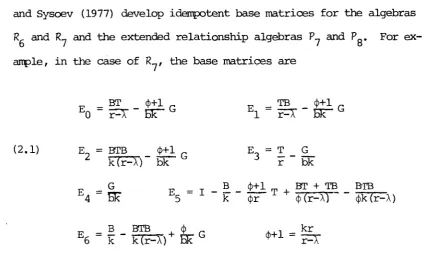
FollCMing the lead of James, Sysoev and Shaikin (1976, I, II) and Sysoev (1977) develop idempotent base matrices for the algebras
R
6 and R7 and the extended relationship algebras P7 and P8. For
ex-anple, in the case of R7, the base matrices are
10
(2.1) E
2
=
BI'Bk(r-A)_ ¢+1bk GE - TB ¢+l G
1 -
r-X -
EK"'"
E
=
T G3 - - -r bk
E =1 B ¢+IT+BI'+TB HI'B
S - k - ¢r ¢(r-A) - ¢k(r-A)
¢+l
=
kr r-AA multiplication table for these matrices is found in Table 2. Base matrices for R
6 may also be derived fran (2.1) by setting E6
=
0 andBI'B
=
(r -
A)B+
AG.TABLE 2
EO El E2 E3 E4 ES E6
EO EO (¢+1)E2 E2 EO 0 0 0
E
l (¢+1)E3 El El E3 0 0 0
E
2 EO E2 E2 EO 0 0 0
¢+l E
3 E3 El El E3 0 0 0
¢+l E
4 0 0 0 0 E4 0 0
E
S 0 0 0 0 0 ES 0
E
•
In addition, the authors give necessaxy and sufficient conditions for
matrices in the four algebras to be non-singular, positive definite
symretric and non-negative definite syrnretric. For exanple, in the
case of R
7, necessary and sufficient conditions for the matrix
V
=
/.6 c.E. to be syxmetric positive definite are:. 0 1 1
1=
c. > 0 i = 2, 3, ••• , 6
1
C
2C3 -
(~+1)c12
>0For R
6, the above conditions hold except for the condition on c6 since
E
6
is ncMO.
It is of interest to note here that in the sums of squares in
the usual analysis of variance, -
~(EO+El)
+~
E2 +~:l
E3 is the
idanpotent for the treatments (eliminating blocks) canponent, E
2 is the
idempotent for the treatments part of the blocks (ignoring treatments)
-e
carpanent, E
4 is the idempotent for the grand rrean, E5 is the idempotent
for the intra-block error and E
6 is the iderrpotent for the remainder
part of the blocks (ignoring treatment) carp:m.ent. We see this to be
true by first considering the observation vector Y = (Y
l , Y2, ••• , Yn)'
and defining
.th 1 . 1
g.
=
1 treatment tota ; 1= , ••• ,
V1
h.
=
jth block total; j=
1, ••• , bJ
T. = sum of block totals in which the i th treatment
1
occurs; i
=
1, .•• , v(as in SCheffe (1959». Note that BY is an n-di.rrensional vector such
that Y. is replaced by h., TY is an n-dirrensional vector such that Y.
is replaced by g. and TBY is a vector such that Y. is replaced by
1 1
T.. Thus
1
y'IY
=
L
n y.2 - - i=l 1Y'
~
= (,
't
Yi)
21=1 y'TY
=
LV
.2- - gl
i=l Y'BY
=
L
b h.2 - - j=l Jy'BTY
=
y'TBY=
LV
g.T. - - - - i=l 1 1Y'BTBY
=
LV
T.2- - i=l 1
Therefore,
_ 1 Y' ( B T TB + BTB + kT
- ~ - - r -
X-
r -X
k{r -A)
r -X
=
.!. (
k ,\v 2 _ 2 ,\V T + 1 ,\v T 2 )~ r - A ,L gi r - A ,L gi i k(r - A).L i
'I' 1=1= 1.=1 1.=1
k ,\V -1 2
= " \ L (g. - k or.) = SStr 1 bl
I\V ' 1 1 1
.e.
.
1=12
e.
Y'E Y
=
1LV
T. 2 _ ep + 1- 2- k(r - A) i=l 1. n
e-
--13
y'E Y
=
.! [
Ln
Y ]2-
~
n i=l i1
In
T.2=
In
y. 2 _.!I
b h. 2 - 55- ~k(r~ -
A}
'·1 1 . 1 1 k . 1 J tr.el.bl1= 1= J=
=
88errorY'EY=.!
I
b h.2 _ 1I
V T.2+1[
I
n y.]2- 6- k j=l J k (r -
X)
i=l 1 n i=l 1 •we
now concern ourselves with the analysis of ba.lanced incarpleteblock designs; 8cheffe (1959), Cochran and Cox (1950) and Kerrpthorne
(1952) are standard references for the traditional analysis. Appendix A
contains a short discussicn of the estimaticn of treatment contrasts and
the analysis of variance for these designs. For this discussicn, either
a normal fixed effects model E(Y) =
~j
+
D'T
+
L'S, Var(Y) =a
2
I
or a- """Il - - - n
nonnal randan block merlel E(y) =
~~
+
D'!..,Var(~.>
= a2In
+
a12L1L is
asstlIOOd. In this dissertation, hCMever, ~ are assuming that the
co-variance rratrix has a special linear structure. Consequently, ~ ncM
ccncern ourselves with estirration of the variance-covariance canpanents
and estirration of the treatment pararooters under the asSllltpticn of our
new model.
Regarding the estimaticn of our treatment, and perhaps block
14
estimator (b.Z.u.e.J
of a parametric function is identical to thatac-quired under the standard analysis. We thus want to find if a b.l.u.e. of the linearly estimable paraIretric function IUp. 8. can :be found
. 1 1. 1.
1=
through a solution of the normal equations, the solution not depending on the covariance structure. Many have dealt with such parametric es-timation, arrong them Kruskal (1968), Natson (1972), Mitra and Moore
(1973), 1'-1itra and Thome (1976) and Zyskind (1975). The efficiency of the simple least squares estimator with respect to the best linear unbiased estimator has also been discussed by Watson (1967) and Baksalary and Kala (1980). (The simple least squares estimates are
those which are determined under the assumption Var
(~.>
=
021; ifE(~.>
=
X~, the simple least squares estimate of ~ is derived fran a solution of the normal equation (X·X)8=
X·Y. If Var(Y) is a non-singular matrix V, the b.l.u.e. of ~ is derived fran the nonnalequa-tion (X'V-lXUl
=
X·V-~.)
Research has also been plentiful in the field of estimation of covariance matrices which are linear canbinations of given symretric ma-trices. Hany authors have dealt with unbiased estimation of functions of the parameters in a covariance matrix, functions It \) .c. where
. 1 1. 1. 1.=
V
=
c
IV1+
c2V2+ .•• +
CtVt is the appropriate covariance matrix •Seely (1969, 1971) in particular wrote Imlch on the unbiased and minimum variance unbiased estimation of a function It \). c. using quadratic
i=l 1. 1.
-e
Rao (1973) ccnsidered varianoo corrpon.ents by examining MINQUE estimators,
m:i.nirrum nonn invariant quadratic unbiased estimators. Gnot, Klcnecki
,.
. . ; 'and Zrnyslany (1977), Kleffe (1977) and Drygas (1977) also dealt with
est.i.mation of the varianoo carponents; several classes of estimators
were examined by them.
In particular, Sysoevand Shaikin (1976, III) found sufficient
statistics for the coefficients of a covarianoo matrix under the
assurnp-tion that Y is nonna11y distributed with mean ..Q. and covarianoo matrix
relonging to one of the three algebras R
6, R7 or P7. Far exanple, if
the covarianoo matrix V is in R
7, Le., V = 'I
6
c.E. and the set
i=O 1 1.
{~, U
=
1, 2, ••• , N} represents the repeated sample vectors, unbiasedestimators of cO' c1' .•. , c
6 are
c - e -
<p+
1 tr [[<p+
2 (E+
E) E E] 'IN y y ')o -
1 - <p2
(v-l)L2(<P+1)
0 1 - 2 - 3 ~=1 ~~C
=
<p+
1 tr [[- (EO+
E1)+
(<P+
1)E2
+
E3] 'IN y y ']2 <p2(v-I)
~=1
"4l"4l(2.2)
e
3=
~~(:~)
tr [[-
(EO+
Ell+
E2+
(~
+
llE3]J:
~.]
C4 =
tr[E4
'iN
y y '] ,65 =
bk-~V+l
tr[EO
'IN
y y ']~=1 -;...t-;...t ~=1 -;...t-4l
'" _ 1 [ \'N , ] ( _
Jr~
c6 - b-v tr E6 L Y Y , <p+
1) - r - A •~=1 -;...t-;...t
(Minor modifications are necessary for covariance matrices in either
R
6 or P7.) Sysoev (1977) also ex>nsidered the case where the covarianoo
--III. PRELIMINARY FORMULATICNS
3.1 General Notation, Definitions and Properties
we
shall be using tenninology and properties fran severalrnathe-matical fields, among them linear algebra and group the0l:Y.
we
assme
a basic knowledge of the theory of linear spaces (vector spaces); we
present here only the notation we use and simple definitions (see, for
exanple, Halroos (1958». If U and V are subspaces in a vector space
W, then U
+
V is the set {u-
+
v ; u E U, V E V}; if U and V aredis--
-
-joint, Le., U n
V
=
{.Q),
we write thedirect sum
U ~V
instead ofU
+
V.
For a subset U of a vector space, thespan
of U, written sp U,is the set of all finite linear canbinations of elements in U. We
shall define an
inner product space
to be a vector spaceW
wi.th anUl'l'erically valued function of the ordered pair of vectors, denoted
the
inner product
<~,Y!',
such that(i) <~,
'£'
=<l.,
x>(ii) <ax;).
+
Sxi2,
'£
= a <~l' y>+
B <xi2,Y!'
(iii) <~, ~ > 0 if ~
i
O.For a subspace U of a vector space (IJ~ the set UJ. denotes the set of all
vectors
~
E Wsuch that<~,
v> = 0 for all~
E U, i. e., UJ. is theNa.v let A be a linear operator on a vector space U into V. The
Y'ange of A, the set AU
=
{A~ : ~ E: U}, is denoted R(A) ~ the nuU space of A, the set {~ E: U : Au=
O}, is denoted N(A). The rank of A, indi-cated by p(A), is the dimension of R(A); the nu llity
of A, denoted v(A), is the dimension ofN
(A). For two square matrices A and B of degrees m and n, respectively, we define the Kronecker product (tensoror direct product) of A and B to be the IlU1><rnn matrix A ~ B
=
((a .. B) ) .lJ
we
shall also denote the direct swn of the matrices ~, ~, ••• , An as A=
diag (AI'~,
••• ,~)
=.
I
nl
Ell Ai
=
Al Ell~
Ell ••• Ell An. AI willde-l.=
note the transpose of a matrix; A-I will indicate the inverse.
For the statistician who does not have a ready knCMledge of mathe-matical structure theory, we introduce several definitions for terms used throughout this dissertation (see Gleeson and McGilchrist (1978) or
Van der Waerden (1970)). A
ring A
is a non-empty set R equipped with two binary operations (addition and multiplication) such that:(i) R is an abelian (ccnmutative) group under addition with a unit (zero) elerrent.
(ii) R is associative with respect to the operation of multi-plication.
(iii) 'the distributive laws of multiplication hold.
A division Y"':ng (skew fie ld) is a ring with a multiplicative identity 1 and a mUltiplicative inverse for every non-zero elerrent. A field is a division ring in which multiplication is carmutative. A field which contains a root for every equation
I
a.x
i=
0 with coefficients in thati=O l
field is said to be algebraically closed; clearly the complex numbers C
e-18
have this property, while the real numbers [R do not. An a'lgebra M is
a ring which is also a finite-dirrensional vector space over a field
F
and which satisfies the condition that cd~ = ~(av) = (a~~ for all
a E:
F,
~ and ~ E: M. A complete matPix algebra is the full algebra ofmatrices of a given d.:i.nension.
We have already rrentioned ideals and their corresponding
idem-potents. We now define a Pight (left) ideal to be a non-errpty subset
A of a ring R such that
(i) A is an additive subgroup of R.
(ii) For every r E: R and a E: A, then ar E: A (ra E: A).
A t:wo-sided idea l is a right ideal which is also a left ideal. A right
(left, two-sided) ideal is minimal if there is no right (left,
two-sided) ideal B in R such that
{oJ
c B c A. The ideal is nilpotent ifAn = {OJ for satE integer n. The descending chain condition of right
ideals holds for R if every strictly decreasing sequence of right ideals
Al ::J A
2 ::J • • • has only a finite number of right ideals. A semi-simple
Ping is a ring in which the descending chain condition for right ideals
holds and in which there are no non-zero nilpotent right ideals. We do
know that a semi-simple ring is isarorphic to a direct sum of carplete
matrix rings (Wedderbum-Artin Theorem). Fran Theorem 4.6 in Gleeson
and McGilchrist (1978), the ring generated by a finite set of nxn
sym-metric matrices is semi-simple if one of the generating matrices is
I. 'Iherefore, each of our relationship algebras and extended
relation-ship algebras is isanorphic to a direct sum of canplete matrix rings.
we
now nove to a few group theoretic notions (see Hall (1959) or cannichael (1937)). We have previously rrentioned pennutationsi we now fonnally state that a permutation is a one-to-one mapping of a set X onto itself. Of course, in this dissertation, we are concerned only with a finite set X. We shall use cyclic notation to indicate these permutations, e. g., for the mapping[~
2 23
4
we write (34) •
(we
will anit cycles of length one.) A permutation group is a group whose elements are pennutations of a finite set Xi the group has degree n if X has n symbols. Such a pennutation group G istransitive if for every pair
x.
andx.
in X, there exists agEG
1 )
such that gxi
=
x
j ; if the group is intransitive, it will divide X intoe.
transitive sets (orbits). The groupG
is k-ply transitive if anyordered set of k different symbols of X is taken into an arbitrary ordered set of k different symbols of X by sorre g in G. 'Th;o elements
g. and g. of G are conjugate if there exists agE G such that
1 J
gi = ggjg-l this defines an equivalence relation
on
G for which the equivalence classes are called conjugacy classes. Finally, we let Gx denote the set of all elements in
G
which fix the elementx,
i.e.,G
=
{g E G : gx=
x}. Such a set is a subgroup of the group G, called xthe stabilizer of the element x (isotropy group at x). For a transi-tive group G, the order or size of G is the order of G divided by its
x
degree.20
A theorem fran Schur (1933) is particularly useful in our work.
we
quote fran Wielandt (1964, p. 80):Theorem 3.1 (Theorem 28.4) If a transitive pennutation. group G is
regarded as a ma.trix group
G*,
then the matrices- which can:nute withall the ma.trices of G*-fonn a ring V
=
V(G). We call V the centralizerring corresponding to G. V is-a vector SPace over-the canplex number
field which has the ma.trices B(6) corresponding to-the orbits I::. of G
1
as a linear basis. In-particular, the dirrension of V co:i.ncides with
the number k of orbits of Gl.
The ma.trix B(I::.)
=
«v ..1::.) ), i, j=
1, 2, ••• , n associated with theor-1)
bit I::. is defined as:
v . .1::.
=
1 if there exists g E Gl , 0 E I::. such that gl
=
j, go=
i1)
=
0 otherwise.Fran a lern:na. by Burnside (see, for example, Liu (1968», if h is the
number of orbits of G l,
(3.1.1)
where '1'(g) is the number of elerre.nts in the set X which are invariant
under the pennutation g and
I
GIl is the order of the stabilizer subgroupGl •
3.2 Definitions and Results from Group Representation andCharaeter
Theory
Group representation theory is used throughout this dissertation;
since it is a subject with which many statisticians are not familiar, we
will present sare important definitions and results (see, for example,
order y
=
IGI;
let C. of order y., i=
1, 2, ••• , r, be the conjugacy1 1
classes of G and let C.' be the inverse class of C.. "We call a
repre-1 1
sentation
of G a homanorphic mapping of the group G into a group ofisorrorphisms GL (V) of a vector space V onto itself. "We will be concerned with representations A : G ~ GL (K) where GL (K) is the general linear
n n
group of degree n with coefficients in a ground field K. Thus, v.e have
a
matrix representation of degree n over
K
such that for every g E G,there exists a non-singular matrix A(g) of degree n with coefficients in K, where A(g)A(h)
=
A (gh) for every g, h E G.'TWo matrix representations {A(g)} and {B(g)} of G are
equivalent
if there is a fixed non-singular matrix T with coefficients in K such that A(g)
=
T-lB(g)T for all g E G; otherwise, they areinequivalent.
If {A(g)} and {B(g)} are equivalent, we write {A(g)} '" {B(g)}. A matrixrepresentation {A(g)} is
irreducible
if there is no non-singular matrixe
T over Ksuch that-1
T A(g)T
=
B(g)
D(g)
for all g E G. A matrix representation {A(g)} is
completely reducible
if {A(g)} '" {Ij
e~
(g)}, where {AA (g)} (A=
1,2, ... , j) areA=l
22
Since
we
are concerned only with carplex and real fields in this disser-tation,we
will consider our representations as carpletely reducible.) For K=
~, the number of inequivalent, irreducible matrix representa-tions of G is equal to the munber of conjugacy classes in G, here taken to be r. Any given matrix representation {A(g)} is then the direct sum of sate (or all) of these irreducible representations {~(g)},A
=
1, 2, ••• , r (possibly repeated). It is also of interest to note that each of these representaticns is equivalent to a unital:y repre-sentation.A lernna. by Schur is very useful in detennining the d.i.rrension of the ccnmutant algebra of a matrix representation.
Schur's Iemna. Let {AI..(G)} and {A].l (g) } be two irreducible matrix representations of G over K and let P be a matrix over K such that
P~(g)
=
A].l (g)Pfor all g in G. Then (i) P
=
0 or (ii) -- {AI.. (g)} and {A].l (g)} are equiva-lent (and P is non-singular). If {AI.. (g)} and {A].l (g)} are equivalent and the field K is algebraically closed, then P is a scalar multiple of the identity, Le., P=
CI for a scalar c.Unless othe:rwise SPecified, \~ rJ.(M consider K to be thefield !C. To extend this lernna., first consider {A(g)} as a crnpletely reducible representation of G over the algebraically closed field !C.
r
-Then {A(g)} ...,
{L
$ Id ~ ~(g) } where {~(g)}, A
=
1, 2, ••• , r are the /..=1 Ar inequivalent, irreducible representations of G such that {~(g)} has degree n" and occurs with multiplicity d~. If we assUll'e the repre-sentation {AI.. (g)} is of the fonn
{l
r e Id ~ A (g)}, by an extension
of Schur's Lernna, the conmutant algebra of {A(q)}, denoted C(A), is
(3.2.1)
where M
d is the canplete matrix algebra over <C. Thus the clilrension of A
the carrnutant algebra C(A) is
(3.2.2)
Of course, the degree of the representation {A(g)} is n
=
I
r dAnA.1..=1 These multiplicities d
Acan be found with the use of characters. For a matrix representation {A(g)}, the character is defined as
x
(g)=
Trace A(g). The character is a class function over the conjugacy classes of G, i.e., X(g)=
X(h) if g and h are in the sane conjugacy class; characters are also identical over equivalent representations. We shall thus write XI.. (Ci), i
=
1, 2, .•• , r for the characters of {AI.. (g)}, A=
1, 2, ••• , r. The degree of {AI.. (g)} is nA
=
XI..(e),
where e is the identity elerrent of G. If {AA* (g)} is the ccmplex conjugate of {AA (g)} with corres:£X)nding character XI..* (Ci), then X\*(Cj)=
XA(Cj)=
X;x(Ci f) where X;x (Ci ) is the corrplex conjugate of X'). (Ci) . If <p(g) and
l/J(g) are two functions on (j with values in C, we define an inner product
<<P,
~>G
=!
L
<P(g)~(g-l).
Then if X(C.), i=
1,2, ••• , rdenoteY gEG l
the characters of {A(g)} and d
Adenotes the number of times {~(g)} ap-pears in {A(g)}, we have
(3.2.3) d,
=
<xlx'>G=
~
I
r Y·X, (C·)X(C.).A A y i=l l A l l
24
must be known in order to use this result. Character tables for many
groups have been detennined (see, for exarrple, Littlewood (1950)).
Let the group G of pennutations on n symbols act transitively on
X and let {A(g)} be a pennutation matrix representation of degree n.
NCM consider the stabilizer H of the symbol x. If
n.
elements ofH
be-l
long to the class C., i
=
1, 2, .•• , r, by the Frobenius Reciprocity1
Theorem,
(3.2.4)
d,
=
<1 X'>H
I
= -
1 \ rLn·x,
- -(C.),
I\. I\.
n
i=l 1 I\. 1Where
I
rn.
=
n
is the order of H (see McLaren (1963)). (Of course, if. 1 1
1=
{A (g) } is intransitive, it is the direct sum of transitive
representa-tions, so an extension of (3.2.4) is necessary.)
The irreducible representations {AA (g)} (A
=
1, 2, ••• , r) areclassified as follCMS:
•
(i)
{AA (g)} is of the
fi!'st kind
if it is equivalent to aset of real matrices (the characters are real).
(ii) {AA (g)} is of the
second kind
if it is equivalent tothe eatplex conjugate representation {~*(g)} but not
to a set of real matrices (the characters are real).
(iii) {AA (g)} is of the
thi!'d kind
if {AA (g)} and {AA*(g)}are not equivalent (the characters are not all real) •
Fran a test of Wigner,
(3.2.5)
takes on the values 1, -lor 0 if and only if {AA (g)} is of the first,
that dim C(A)
=
I
r d A2
i the dimension
t
of the space of real symrretricA=l
matrices in C(A) is
(3.2.6)
(McLaren (1963)).
3.3 Finite Desarguesian Geometries and Their Collineations
A
k-dimensionaZ finite projective geometry
(see, for instance,Cannichael (1937)) is a finite set of points such that:
(i) There are one or more lines, each containing at least three points.
(ii) If A and B are distinct points, there is one and only one line containing A and B.
(iii) For any non-collinear points A, B and C, if a line
t
not containing A, B or C intersects line AB and line AC, then i t intersects line BC.(iv) If rn is an integer less than k, all the points in the georretry are not in the sane rn-space
(m-fZat).
(v) The set of points cannot form a (k
+
l)-space.A
projective pZane
is a two-dimensional projective geometry.The
pointsof a projective geometry denoted as PG(k, s) may be represented as ordered (k + l)-tuples ~
=
(xO' xl' ••• , ~)' where xo' xl' ••• , ~ are elerrents of the Galois field GF(s), s=
pr such that p is a prime and r is an integer. The elem2nt~ xo'
xl' .•• , ~ may not all be zero and(xo ' xl' •.. , ~)
=
(~XO' ~xl' •.. , ~~) for all non-zero ~ in GF(s). Similarly, ahyperp Zane
((k - 1) - space) is also defined by an ordered•
of the GF(s), not all zero, such that (yo' Y
I, ••• , Yk)
=
(llYo' llYl' ••• , llYk) for all non-zero II in GF (s). A point (Xo ' xl' ••• , ~) is contained in a hyperplane (Yo' YI, ••• , Yk) if xoYO + xIYI + + ¥ k -= O. If k
=
2, a hyperplane is a line.We used the notation PG(k, s) to indicate the projective gearetry constructed bymeans of the Galois field. It will also designate any projective ge<:m:!try which is isanorphic to a gearetry constructed in this manner. For k
=
2, these are precisely the desarguesicm projective planes, Le., projective planes in which the follCMing Theorem ofDesargues holds: If AOC and abc are two triangles in the same plane of a projective space such that Aa, Bb and Cc pass through the same point P, and if a
=
(Aa, Bb),S
=
(Aa, Cc) and y=
(Bb, Cc), then a,S
and y lie on the same line. For k ~ 3, every projective gearetry is desar-guesian and is isanorphic to a PG(k, s).A k-dirnensional finite affine geometry EG(k~ s) can be obtained fran PG (k, s) by omitting a hyperplane and all the points in that space. A point in this gearetry can be written as an ordered k-tuple
~
=
(xl' x2' .•. , ~)' 'Ymere Xl' x 2' 0 0 0 ' ~ are elements of GF(s) 0 Ahyperplane (for k
=
2, a line) is represented as a (k+
I)-tuplel
=
(yo' YI, 0 0 0 ' Yk)' where YO' YI , ' . 0 ' Yk are elements in GF(s) such that not all of Y
I, Y2, 0 0 0 , Y
k equal zero and (yo' YI, 0 0 0 ' Y
k)
=
(llYO' llYl ' 0 0 0 ' llY
k) for all non-zero II in GF (s)0 A point
(xl' ~, ... , ~) is contained in a hyPerplane (yo' Yl' ... , Yk) if
Yo
+ x1Yl + x,-Y? + 0 • • +XJ.?k
=
O. A fillite affine geanetry isThese finite projective geometries PG(k, s) and finite affine gearetries ffi(k, s) are of interest since a balanced incomplete block de-sign can be constructed fran a finite gearetry by taking points of the geanetry as treatments and subspaces of the georretry as blocks. hIe shall primarily be concerned with the case where the blocks are taken to be the hyPerplanes. Thus, for a projective geanetry PG(k, s), the parameters for the design are:
s - 1 sk+l -1
v=b=--_.._-s -
r
sk - 1
r=k=----.:-s -
1
s k-l - 1
.\ =
(3.3.1)
For an affine geanetry EG(k, s), the pararneters for the design are: k
v
=
s k=
sk-l(3.3.2)
k+l s - s b
=
---.,...-s - 1
.\ =
sk-l _ 1s - 1
r
=
sk - 1s -1
An automorphism of a gearetry (and hence, our design) is called a
repre-28
sented by the hanogeneous transfonnations of the po:ints (and hence, the subspaces)
(3.3.3)
u
px .
*
=
I
k a.oX.P
(i=
0, 1, ••• , k; u=
0, 1, ••• , r - 1), 1 j=O 1J Jwhere p{tO) E: GF{s) and the a .. are the e1emants of GF{s) such that 1J
.
.
.
.
.
.
t:,
=
~O '\1 • • •
'\k
is non-zero. For a given value of pU :in (3.3.3), two transfonnations are ietentical if the coefficients aij are identical despite distinct values of p. The order of the group PC(k, s) is
•
(3.3.4)
k r IT
·r
p - 1 i=O
(p(k
+
l)r - pir)=
k
r IT (sk
+
I _ i1 s ).
s - i=O
0_
Considered as a pennutation group on the po:ints, this group is doubly transitive.
The follav:ing theorem also holds:
Theorem 3.2 For a finite projective gearetry PG(k, s), s
=
pr, if the point vectors ~=
(xO' xl' ••• , ~)' are transfonned by the co11ineation( m
m
m),
u
A X
o '
xl ' ••• , ~ , m=
p for serna u=
0, 1, ••• , r - 1, then thehype:rplane vectors are trans:F.onred
J:y t"'le ynapProof: First we note here that if TIl
=
pU for u=
0, 1, ••• , r - 1 and if a, b E: GF(s), then (a+
b)ffi=
affi+
bro. In the expansion of (a+
b)ffi,. ffi m
the coefficients of the terms other than a and b share the factor Pi these coefficients are then
a
in GF(s).A point ~ is contained in a hyperplane
y..
if and only if y..'~=o.
As x is transforrrro to ~*, Y will be transfo:rmed to a ';L* such that
y..*'
~*=
O. For a hyperplaney..
and any point ~ contained in it:•
This defines
m m m ( m m m), -
a
~
(y
0 Y1 ... Yk ) Xo Xl
• ••
~-m -m m -1 m ffi TIl ,
~
(Yo Yl
••• Yk ) A A
(XO Xl
•••
~)=
a
All points ~ in the hyperplane y satisfy this last equatioo. the hyperplane transformation. 0
The set of transformations which fix the point (1, 0, ••• , 0) is the set of all collineations (3.3.3) such that
A(lm, am, ... , am),
=
p(l, 0, ••• , 0)', p(iO) E: GF(s).As a result, ~OO
=
p, a 10=
a 20= ••• =
akO=
O. emitting the equivalent transformations, we can say that the transfonnations which fix(1, 0, ••• , 0) are of the following form:
30
1 a
m
01 a02 aOk X
o
0 all aU a
lk
~m
(3.3.5) Ax
=
-m
o
~1 ~ • • •'\k
~mOf these, the co11ineations which also fix the hyperplane (0, 0, ••• 0, 1)
(~
=
0) aretrose
which satisfy:m
o , ••• ,
1~'=
cdO, 0, ••• ,0,1)',a(ti0) E GF (s) ,
which implies
"'((O, 0, ••• , 0, 1)'
=
A' (1, 0, ••• , 0, 1)', y(;lO) EGF(S).Therefore, for the transfonna.tion in (3.3.5), '1<-1 = ~2 = •••
=
~, k-1=
0, 'While ~= "'{.
The co1lineations which fix the point (1, 0, ••• , 0) and the hyperplane (0, 0, ••• , 0, 1) are thus of the fom:1 a
01
· ·
·
a O, k-1 aOk0 all a
lk
m
· ·
• a 1 , k-1 Xo
m
(3.3.6) Ax
=
Xl-m
0 '1<--1, 1 •
·
• '1<--1, k-1 ~-1, k
0 0
·
·
·
0'ide
m~
The full collineation group EC (k, s) of the desarguesian affine gearetry FX;(k, s) is represented by the non-hCJ.'Y'Ogeneous transfonnations
(3.3. 7) x.
*
aiO +I
k a .. .pu (i = 1, 2,.
..
,
k;l
j=l
lJ
u= 0, 1,
...
,
r - 1; a .. E GF(s)) ,lJ
such that
I':.
=
~l ~2
is non-zero. The order of the group EC(k, s) is
(3.3.8) rsk k-lIT (sk - s ).i
i=O
e.
Considered as a permutation group on the sk points, EC (k, s) is doubly transitive.
we
also have:Theorem 3.3 For a finite affine gearetry EG(k, s), if the point vee-tors ~ = (xl' x~, ••• , ~)' are transfonned by the collineation
a + Ax = alO all a m (a .. E GF(s);
12 alk xl
-ID
lJ
m u
a20 ~l a
22 a2k x2 m=p;
+ u= 0, 1,
...
,
r - 1) ,
32
then the hyperplane vectors (Yo' Yl' ••• , Yk) are transforrred as follcws:
p Y1
*
p(r!O}
EGF(s).
"-Proof: Choose any hyperplane Y
=
(YO' Yl ' ••• , Yk)'; for any point ~
=
(xl' x2' ••• , ~)' in the hyperplane,
m m m m m
=
0+ YO + Yl xl
+ •••
+ Yk ~m m m m -1
+ (yo
-
(Yl ' Y2 ' ••• Yk ) A ~} +
m m m -1
0 + (Yl ' Y2 '
...
,
Yk}A (~+ ~m)=
This equation is satisfied for all points ~ on the hyperplane y. There-fore, our transfomed hyperplane is determined. 0
The set of transfonnatians which fix the point (0, 0, ••• , O) is
the set of collineations such that ~
+
A(cfl,
Om, ••• , Om),(0, 0, ••. , 0, 1) (~= 0) are those such that
m
*
*
... , ~-l ' 0)'
=
(xl' x 2 ' •.• , ~-l*
' 0),
•Since
~lXlm
+
~~2m
+ ••• +
~, k_l~_lm
=
°
for all point vectors of the form (Xl' x 2 ' .•. , ~-l' 0), then ~l=
~2= •.• =
~, k-l=
0. 'I'hus, the collineations 'Which fix' the point (0, 0, ... , 0) and theh~TP8rplane (0, 0, .•• , 0, 1) are of the form:
(3.3.9) ~
=
. .
.
~-l, 1 ~-l, 2
o
°
~-l, k-l
°
'\-1,
k~
u
(m = p , u = 0, 1, ••• , r - 1)
such that A is non singular with coefficients in GF (s) (which implies that ~ is non-zero).
We also note that if the flags of a design are taken to be the in-cident point-hyperplane pairs, the groups PC (k, s) and Fe (k, s) are
transitive on the flags in their respective spaces. This is seen to be
true fran a result in Dembowski (1968, p. 80): "S\lppase that (r, A)
=
1.If
r
is doubly point transitive, then f is flag transitive.II (f here isthe autamrphism group of a design; (r, A) indicates the greatest carmon factor of r and A.) If the flags are the incident point-hyperplane pairs,
e-we see fran (3.3.1) and (3.3.2) that sk - 1 k-l k-2
r
=
=
s+
S+ ••• +
1s - 1
sk-1 _ 1 k-2 k-3
A
=
s _1
=
s+
S+ ••• +
1,
for the designs fran both PG(k, s) and ffi(k, s). Clearly (r, A)
=
1 and since PC(k, s) and EC(k, s) are doubly point transitive, they are flag transitive.REPRESENTATICNS FOR PC(2, 2) AND OC(2, 3)
4.1 Introduction
By deriving the decanposition of the pennutation representation
of an autanorphism group of a design into a direct sum of irreducible
representations over an algebraically closed field, we may gain insight
into the structure of the pennutation representation and the
corre-sponding carmutant algebra. In this spirit, we therefore dete:r::mine such
decanpositions for the pennutation (matrix) representations of the full
collineation groups PC(2, 2) and EC(2, 3) for the finite planes PG(2, 2)
and ffi(2, 3), respectively. We can then use the extension of Schur's
lerrrna. (3.2.1) to find the structure of the corresponding carmutant
alge-bra. Fran Wigner' s test (3.2.5) we can show that the irreducible
repre-sentations in the decarposition of the pennutation representation of the
groups PC(2, 2) and OC(2, 3) are all equivalent to real irreducible
representations and hence to sets of real orthogonal matrices.
4.2 Decanpc?sition of the Pennutation Representation of PC(2, 2) into a
Direct Sum of Irreducible Representations
We assign to the seven points of PG(2, 2) the letters A, B, C, D,
1 0 0 1 1 0 1
0 1 0 1 0 1 1
o
0 1 0 1 1 1A B C D E F G
The lines of the plane are indicated by the columns in the follaving diagram:
36
L
7
(xO+ xl + x2
=
0)D
E
F
The full collineation group PC(2, 2) of this plane consists of 168 3x3 non-singular matrices with coefficients in GF (2). Any given matrix A in this group induces a permutation of the points (and hence, the lines) through the linear transformation of the point vectors Ax.
..
.
-for the group and y. denotes the number of elerrents in the i th
conju-1
gacy class; the irreducible representations are indexed by A.
TABIE 3
Character Table of PC(2, 2), IpC(2, 2)
I
=
168 cycle(conjugacy
17 1322 132
classes) 124 7 7
A
o;r:der of i th class
y. 1 21 42 56 24 24
1
1 1 1 1 1 1 1
2 6 2 0 0 -1 -1
3 7 -1 -1 1 0 0
4 8 0 0 -1 1 1
5 3 -1 1 0 ~(-l
+
il7) ~(-1 - iv'7)6 3 -1 1 0 ~(-1 - i/?) ~(-l
+
i/?)The group of pennutatiens en the 7- points induCes a transitive group on the 21 flags (trea1:::Irent-block ccrnbinatians) of the design. Thus, the group of 2lx21 matrices reflecting the pennutatians of the flags is a representation· of the group PC (2, 2). In order to derive the decarpo-sitien of this representatien into a direct sum of irreducible represen-tatiens, we first consider the stabilizer Hof the flag (A, L3), Le., the suJ::group of PC(2, 2) which fixes the point A and line L
38
Hatrices of H Point Pennutations c;yc1es
,
0 0 .J..
0 1 0 identity 17
0 0 1
\1 0 1
1 0 (CE) (FG) 1322
l:
0 11 1 0
0 1 0 (BD) (FG) 1322
0 0 1
1 0 0
0 1 1 (CF) (EG) 1322
e
0 0 1
1 1 1
0 1 0 (BD) (CE) 1322
0 0 1
1 1 0
0 1 1 (BD) (CFEG) 124
0 0 1
1 0 1
0 1 1 (CG) (EF) 1322
1 1 1
0 1 1
o
0 1(BD) (CGEF)
124
These matrices can be f01ID.d fran (3. 3. 6) •
If
n.
is the number of elerrents of H in the conjugacy class C.~ ~
of PC(2, 2), then clearly
n
l = 1,
n
2 = 5,n
3 = 2 andn
4 =n
S =n
6 O. Fran (3.2.4), the multiplicities dAof the six inequivalent irreducible representations are d
l = 1, ~ = 2, d4 = 1, d3 = dS = d6 = O. If P (g) is a matrix of the representation {p(g)} of PC (2, 2), then
where P
l (g), P2(g) and P4 (g) are 1ID.itary matrices of degrees one, six and eight, respectively {n
A:: XI.. (identity». Note that the multi-plicities could have also been detennined fran (3.2.3) by the use of the characters X(C .) (i = 1, 2, ••• , 6) of the peDTlUtation
represen-~
tation of PC{2, 2). Table 4 contains these characters, found with the aid of a cacputer. It is also of interest to note that the partition of the number of flags 21 = 1
+
6+
6+
8 corresponds to the partition of the degrees of freedan in the usual analysis of variance of such a syrrmetric design: one for the constant, six for the treatrrents, six for the blocks and eight for error.The irreducible representations {PI(g) }, {P
40
E:
=
11
1
(2
=
168 (22
x6
+
42
x2 - 24 - 24)
=
1
1 E:
4
=
I68
(22
x8
+
56 - 24
+
24)
=
1.
The values of one for £'1' E2 and E4 imply that the irreducible repre-sentations are real.
TABIE 4
Cycles
1
7
1
3
2
2
124
13
2
7
7
X(C
i) 21
5
01
a
0Number of g
2
in each
Conjucacy Class
22
42
056
24
24
If V is a matrix belonging to the cammtant algebra of the group
e
of rnatrioes pennuting the flags of the design under the action ofPC(2, 2),
then by(3.2.1),
=
aThe set of real rna.trioes V which are in the carmutant algebra will have dirrension
L
6 d,\2=
6; the set of reals~tric
matrices which are in'\=1
(by (3.2. 6) }. Section 5.1 of Chapter V contains a discussion of basis
matrices for the a:::mnutant algebra.
This work may be sumnarized as:
Theorem 4.1 let {p (g}} be the pennutation representation of the
001-lineation group PC(2, 2} of PG(2, 2} (reflecting the pennutation of
the flags of the design under the action of the group). Then {p (g) }
is equivalent to the follCMing direct sum of irreducible matrix
representations:
where PI (g), P2(g) and P4 (g) are real orthogonal matrices of degrees
one, six and eight, respectively. The camlUtant algebra of this
representation has diroonsion six over the reals; the set of real,
surrrootric matrices in the ccmnutant algebra has di.mension five.
4.3 Deearposition of the Pennutatian Representation of EC(2, 3}into
a Direct Sum of Irreducible Representations
The desarguesian finite affine plane EG(2, 3} detenninesa BIB
design with par~tersv = 9, b = 12, r = 4, k = 3, A= L We assign
to the nine points of this plane the letters A, B, C, D, E,
F, G, H
and I as follows:
Xl 0 0 0 1 I 1 2 2 2
~
0 I 2 0 I 2 0 1 242
The lines of the plane are indicated by the COIUl1lI1S in the following
diagram:
x
I=
o
I
2
A D G
B E H
C F I
x
=
20 1 2 A B C
D E F
G H I
o
1 2A B C
F D E
H I G
0 1 2
A C B
E D F
I
H
G
Clearly, the design derived fran this plane is resolvable, Le., it is possible to separate the twelve blocks into four sets (corresponding to the linear fonus xl' x2' Xl
+
x2 and Xl+
2x2) such that each trea1:Irent occurs exactly once in each set.The full collineation group EC(2, 3) of the plane EG(2, 3) is detennined by the 432 affine transfomations
The matrices A
=
«a .. )) are the 2x2 noo-singular matrices with coeffi-1Jcients in GF (3), while the vectors
£
=
(bl, b2)' are the 2xl vectors with coefficients in GF(3). Considered as a pennutatioo group 00 the 9 points,
EC (2, 3) is doubly transitive and has eleven conjugacy classes. Table 5 contains the character table for the eleven irreducible inequivalent representations of EC(2, 3) (Little~ (1950)).
The group of pennutations of these 9 points induces a transitive
e-Character Table of EC(2, 3), IEC (2, 3)
I
= 432cycles (coo.jugacy
19 1323 1332 142 12
4
33 33classes) 18 . 18 126 36
order of i th class
A y.J. 1 36 24 54 54 54 72 9 8 48 72
1 1 1 1 1 1 1 1 1 1 1 1
2 1 -1 1 -1 -1 1 1 1 1 1 -1
3 2 0 -1 0 0 2 -1 2 2 -1 0
4 2 0 -1 i/2 -i/2 0 1 -2 2 -1 0
5 2 0 -1 -i/2 il2 0 1 -2 2 -1 0
6 3 1 0 -1 -1 -1 0 3 3 0 1
7 3 -1 0 1 1 -1 0 3 3 0 -1
8 8 2 2 0 0 0 0 0 -1 -1 -1
9 8 -2 2 0 0 0 0 0 -1 -1 1
10 16 0 -2 0 0 0 0 0 -2 1 0
11 4 0 .1 0 0 0 -1 ...;,4 4 1 0
mutations is a representation of the group of point pennutations
deter-mined fran EC(2 , 3); we wish to detennine the dea::rrpositien of this
representation into a direct sum of irreducible representations. let
H
be the subgroup of EC(2, 3) whose elerrents fix the flag consisting of
the point (0, 0) and the line ~ = O. This subgroup H has order
~c (~,
3)L
=4~~
= 12 and is induced by the follCMing matrices (which44
Matrices ·of
H
Point·· permutations.
Cycles[:
:]
identity 19
[:
:]
(BEH) (CIF) 13 32
[:
:]
(BHE) (CFI) 13 32
[~
:]
(Be) (EF) (HI) 1323[:
:]
(BF) (CH) (EI) 1 323
e
[:
:]
(BI) (CE) (PH) 1323
[:
:]
(IX;) (EH) (FI) 1 323
[:
:]
(BE) (CI) (rx;) 1 323[:
:]
(BH) (CF) (rx;) 1323
[:
:]
(Be) (rx;) (El) (PH) 124
(BFECHI) (IX;)
(BIHCEF) (IX;)
126
126
These rratrices can be determined by the transfonnations ~ressed in (3.3.9).
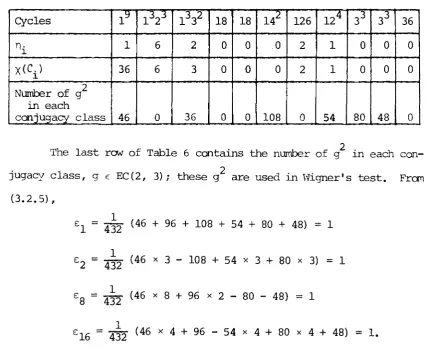
Table 6 contains the values
n.,
i=
1, 2, ••• , 11 wheren.
is the1 1
number of elerrents of the stabilizer H in the conjugacy class Ci • Fran (3.2.4), the multiplicities ' \ of the eleven inequivalent irreducible representations are dl
=
d6
=
dlO=
1, dS=
2 and d2=
d3=
d 4=
dS=
d7
=
d9=
dll=
O. Thus, for any matrix peg) in the (permutaticn)matrix representation {p (g)} of
:oc
(2, 3),where PI (g), P
6(g) , PS(g) and PlOeg) are unitary matrices of degrees one, three, eight and sixteen, respectively. The d;\ 's could also have been determined fran
~ =~.
IIIy.~(C.}
X(C.) (3.2.3). Table 6con-i=l 1 1 1
tains the values X(C. ), found with the aid of a e::atputer. The values
1
y. and x"\ (C.) are found in the table of characters, Table 5. ~1e note
1 1 \ 1
here also that the partition of the number of flags
36
=
1+
3+
S+
S+
16corresponds to the partition of the degrees of freedan in the usual
analysis of variance for such a resolvable design: one for the constant, three for the replications, eight for the treatments, eight for the