18th International Conference on Structural Mechanics in Reactor Technology (SMiRT 18) Beijing, China, August 7-12, 2005 SMiRT18-K05-6
ASSESSMENT OF SEISMIC ANALYSIS METHODOLOGIES FOR
DEEPLY EMBEDDED NPP STRUCTURES
Jim Xu*
Brookhaven National Laboratory, Building
130, P.O. Box 5000
Upton NY 11973-5000.
(631) 344-2183,
[email protected]
Charles Miller
Brookhaven National Laboratory
Carl Costantino
Brookhaven National Laboratory
Charles Hofmayer
Brookhaven National Laboratory
Herman Graves
U.S. Nuclear Regulatory Commission
ABSTRACT: Several of the new generation nuclear power plant designs have structural configurations which are proposed to be deeply embedded. Since current seismic analysis methodologies have been applied to shallow embedded structures (e.g., ASCE 4 suggest that simple formulations may be used to model embedment effect when the depth of embedment is less than 30% of its foundation radius), the US Nuclear Regulatory Commission is sponsoring a program at the Brookhaven National Laboratory with the objective of investigating the extent to which procedures acceptable for shallow embedment depths are adequate for larger embedment depths. This paper presents the results of a study comparing the response spectra obtained from two of the more popular analysis methods for structural configurations varying from shallow embedment to complete embedment.
A typical safety related structure embedded in a soil profile representative of a typical nuclear power plant site was utilized in the study and the depths of burial (DOB) considered range from 25 – 100% the height of the structure. Included in the paper are: 1) the description of a simplified analysis and a detailed approach for the SSI analyses of a structure with various DOB, 2) the comparison of the analysis results for the different DOBs between the two methods, and 3) the performance assessment of the analysis methodologies for SSI analyses of deeply embedded structures. The resulting assessment from this study has indicated that simplified methods may be capable of capturing the seismic response for much deeper embedded structures than would be normally allowed by the standard practice.
Keywords: SASSI, seismic, soil structure interaction, in-structure response spectra.
1 INTRODUCTION
In this assessment, a lump-mass beam model is used for the simplified approach and a finite element representation is employed for the detailed method. A typical NPP structure embedded in a soil profile representative of a typical nuclear power plant site was utilized, considering various embedment depths from shallow to full burial. BNL used the CARES program (Xu, et al., 1990 and Miller, et al., 2000) for the simplified model and the SASSI2000 program (Lysmer, et al., 1981 and 1999) for the detailed analyses. The BNL analyses are performed first to consider the kinematic effect, and then the full SSI effect. Due to limited space for this paper, only the SSI effect associated with acceleration time history is discussed. Other SSI effects such as seismic induced pressure and stress distributions in the structure are also expected to impact the seismic analysis methodologies for DEB structures, and will be discussed in future publications. In this paper, the seismic responses in terms of response spectra are calculated at the key locations of the DEB structure, which are used for the performance assessment of the applied methods for different depths of burial. Included in the paper are: 1) the description of both the simplified and detailed models for the SSI analyses of the DEB structure, 2) the comparison of the analysis results for the different depths of burial between the two methods, and 3) the performance assessment of the analysis methodologies for SSI analyses of DEB structures.
The paper is organized in four sections. Section 1 is the introduction and Section 2 provides a description of the DEB structure used in the analysis, as well as the soil profile and an outcrop input motion. The analysis models using CARES and SASSI are described in Section 3. Section 4 provides a discussion on the comparison of the analysis results for the different depths of burial between the two methods, and the performance assessment of the analysis methodologies for SSI analyses of DEB structures. Finally, conclusions are drawn in Section 5.
2 CHARACTERISTICS OF DEB STRUCTURE AND SITE CONDITION
A sketch of the DEB structure used in this study is shown in Figure 1, which is basically a cylindrical shell of reinforced concrete construction. The structure is derived from the characteristics of a conceptual design of a NPP structure for advanced reactors. The cylinder is 46m high and has an outer diameter of 27m. The actual structure consists of a variable thickness outer shell and several major walls spanning across the structure providing both flexural rigidity and dividing the space into major areas. This is modeled with a uniform thickness cylindrical shell. The wall thickness (2m) is selected to match the combined moment of inertia of the actual outer shell and major interior dividing walls.
A major parameter varied in the study is the depth of burial (DOB) of this model. The model is buried to depths (E) equal to 25% (11.5m), 50% (23m), 75% (34.5m), and 100 % (46m) of the structural height, which correspond to DOB to radius ratio (E/R) equal to 0.85, 1.7, 2.55, and 3.4 respectively. Current technology has been limited to E at the lowest end of this scale so that the primary objective of the study is to determine whether the application of this technology leads to uncertainties when the DOB increases beyond 25 % of the facility height or 85 % of the facility radius.
The stiffness characteristics of the internal equipment are not included in the model. However, the mass of the equipment is lumped with the mass of the cylindrical shell; the combined weight is 92,200 kN. The weights of the basemat and the roof are 40,474 kN and 4,450 kN respectively. The weights have been reduced to some extent from the actual weights to obtain structural frequencies that are likely to be interactive with the SSI frequencies. The following properties are used for the structure:
• Compressive strength = 27,579 kN/m2 • Poisson’s ratio = 0.2
• Damping = 5 % of critical • Density = 23.2 kN/m3
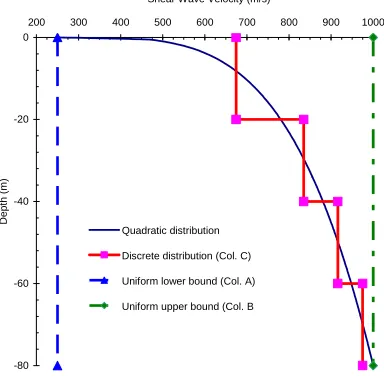
shear modulus and damping are not degraded as a function of shear strain in the soil column. In this way the level of the seismic input is not a parameter considered in the variation of parameter studies.
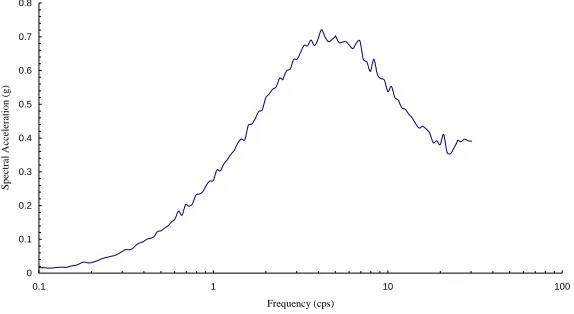
The input motion is specified at a rock outcrop and standard convolution procedures for vertically propagating horizontal shear waves are used to compute the free field motions within the soil column. The rock outcrop motion consistent with the Western US ground motion characteristics is developed according to the procedures specified in the NRC Regulatory Guide 1.165. The rock outcrop spectrum of the motion is shown on Figure 3.
2 3 m 2 7 m
2 m
4 6 m
E 3 m W e i g h t o f
c y li n d r i c a l w a l l s a n d i n t e r n a l s = 9 2 , 2 0 0 k N W e i g h t o f R o o f = 4 4 5 0 k N
E - Depth of burial
Ground surface R
(a) Cross Section
(b) Elevation
Figure 1. Structure Considered in the Study.
-80 -60 -40 -20 0
200 300 400 500 600 700 800 900 1000
Shear Wave Velocity (m/s)
Depth (m
)
Quadratic distribution
Discrete distribution (Col. C)
Uniform lower bound (Col. A)
Uniform upper bound (Col. B
0 0.1 0.2 0.3 0.4 0.5 0.6 0.7 0.8
0.1 1 10 100
Frequency (cps)
Sp
ec
tra
l A
c
ce
le
ration (g)
Figure 3. 5% Damped Response Spectrum of Rock Outcrop Input Motion
.3 DESCRIPTION OF THE ANALYSIS MODELS
As described in the introduction, the performance assessment of simplified vs. detailed methodologies is performed via comparisons of the DEB seismic responses computed with a lumped mass stick model and a finite element model. The CARES program is used to develop the lumped mass stick model, which is depicted in Figure 4. In this SSI model, the structure is represented with lumped masses and beams. The base of the model is connected to soil via interaction coefficients which include both base and side effects. Further, the embedded portion of the structure is assumed to be rigid and the method proposed by Iguchi (Iguchi, 1982), and further discussed by Pais, et al. (Pais, et al., 1985), is used to incorporate the kinematic interaction effect in the SSI model.
Figure 4. CARES Model.
Figure 5. SASSI Model.
4 ASSESSMENT OF SIMPLIFIED VS. DETAILED METHODOLOGIES FOR DEB STRUCTURES
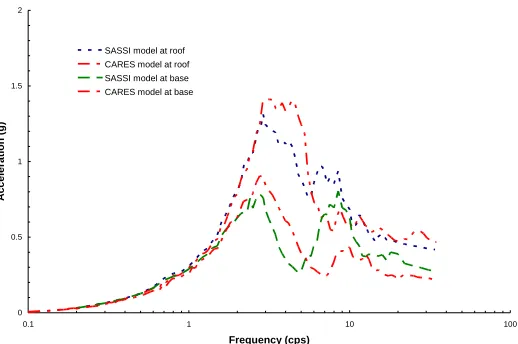
In order to study the DEB effect on seismic analysis methodologies, seismic response analysis was performed using both CARES and SASSI models for various depths of embedment as discussed in Section 2. The analysis results using the two methods will then be compared to determine their performance with respect to the depth of burial for the structure. The response parameters used for the comparisons are response spectra at the center of the basemat and the center of the roof of the structure.
0 0.5 1 1.5 2 2.5 3 3.5 4 4.5 5
0.1 1 10 100
Frequency (cps)
Ac
cel
er
at
io
n
(
g
)
SASSI model at roof
CARES model at roof
SASSI model at base
CARES model at base
Figure 6. Comparisons of SSI Response Spectra for 25% Embedment (E/R=0.85).
0 0.5 1 1.5 2 2.5 3 3.5 4
0.1 1 10 100
Frequency (cps)
A
c
ce
le
ra
tio
n
(g
)
SASSI model at roof
CARES model at roof
SASSI model at base
CARES model at base
Figure 7. Comparisons of SSI Response Spectra for 50% Embedment (E/R=1.70).
1.5 2
a
ti
o
n
(g)
0 0.5 1 1.5 2
0.1 1 10 100
Frequency (cps)
A
c
cel
er
at
io
n
(g
)
SASSI model at roof CARES model at roof
SASSI model at base CARES model at base
Figure 9. Comparisons of SSI Response Spectra for 100% Embedment (E/R=3.40).
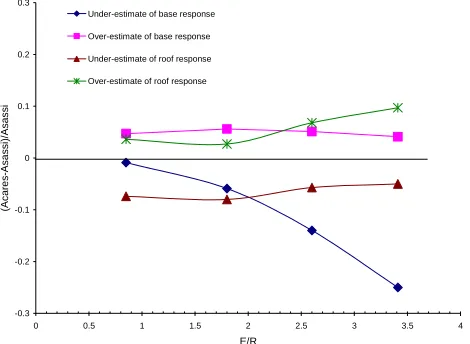
To place the relative performance of the simplified vs. detailed methods in proper perspective, two other indicators were established for the assessment. The first indicator calculates the difference of the areas under the response spectra between CARES and SASSI results and plots it against a burial parameter expressed as the E/R ratio (depth of burial/structural radius). This indicator provides an overall performance assessment across the entire frequency content. Since the seismic design is more interested in the peak response, a second indicator is constructed for the relative peak response difference. The peak responses compared are within the frequency range allowed by either peak shift or peak widening methods applied in the nuclear industry. The indicator is then plotted against the E/R ratio. The first indicator for the depths of burial analyzed is shown in Figure 10. A clear trend of performance as function of the depth of burial is readily exhibited in this figure. This figure also indicates a close to uniform distribution of the responses (within +/- 10% difference) for the depth of burial up to 340% of structural radius. The only exception is the base response which CARES tends to under predict compared to SASSI; however, the under-prediction can be kept within 20% if the depth of burial is less than 300% of structural radius. To shed light on the extent to which kinematic interaction effects impact the performance assessment, Figure 11 provides a plot which includes only the kinematic interaction effect in the models.
-0.3 -0.2 -0.1 0 0.1 0.2 0.3
0 0.5 1 1.5 2 2.5 3 3.5 4
E/R (A car e s-A s a ssi) /A s as si
Under-estimate of base response
Over-estimate of base response
Under-estimate of roof response
Over-estimate of roof response
Figure 10. Assessment Using Spectral Area Difference between CARES and SASSI SSI
Results.
-0.3 -0.2 -0.1 0 0.1 0.2 0.3
0 0.5 1 1.5 2 2.5 3 3.5 4
E/R (A care s-A s a s s i)/A s a ssi
Under-estimate of base response
Over-estimate of base response
Under-estimate of roof response
Over-estimate of roof response
The Beredugo–Novak (Beredugo, 1972) SSI model is used to represent the SSI coefficients between the structure and the free field in the CARES program. The sidewall interaction coefficients (both stiffness and damping terms) are derived by considering a horizontal slice of soil. Wolf (Wolf, 1996) has shown that for the three dimensional problem, a cut-off frequency exists below which the radiation damping is zero. Such an effect, however, is not accounted for in the SSI coefficients in CARES, and therefore, inevitably induces unwanted radiation damping in low frequency response.
A parametric study is therefore performed to examine the extent to which reduction in the radiation damping included in the Beredugo – Novak SSI model may bring the spectral peaks predicted with CARES closer to those predicted with SASSI. Figure 13 shows comparisons between the CARES and SASSI results when the radiation damping used in CARES is reduced to 70 % of the values contained in the present version of CARES. As may be seen the agreement would be quite good. Of course, a general rule to reduce the radiation damping in CARES to 70 % of the current values would result in conservative CARES predictions at other depths of burial.
0 0.5 1 1.5 2 2.5 3 3.5 4 4.5 5
0.1 1 10 100
Frequency (cps)
A
cce
le
ration (g's)
SASSI CARES DF=0.70
Figure13. Comparison of Response Spectra at the Roof Center of SSI Model with
11.5m Embedment.
Reduced Radiation Damping
5 CONCLUSIONS
A study was performed to provide an assessment of simplified vs. detailed seismic analysis methodologies for DEB structures. A structure with the characteristics of a conceptual design of a NPP structure for advanced reactors was modeled using the CARES program for the simplified method and the SASSI2000 program for the detailed model. A typical layered soil site was considered and a Western U.S. outcrop motion was used in the seismic analyses. The assessment of the methods was made first by examining the comparisons of the analysis results in terms of response spectra at key locations of the structure against various depths of embedment.
capturing the seismic response for much deeper embedded structures than would be normally allowed by the standard practice.
6 REFERENCES
Beredugo, Y.O., and Novak,, M., 1972, “Coupled Horizontal and Rocking Vibration of Embedded Footings,” Canadian Geotechnical Journal, Vol. 9.
Iguchi, M., 1982, “An Approximate Analysis of Input Motions for Rigid Embedded Foundations,” Trans. of Architectural Inst. of Japan, No. 315, pp. 61-75.
Lysmer, J., et al., 1999, “SASSI2000 – Theoretical Manual,” Revision 1, Geotechnical Engineering, University of California, Berkeley.
Miller, C., et al., 2000, “CARES: Computer Analysis for Rapid Evaluation of Structures,” Version 1.3, Earthquake Research Center at The City College of New York, prepared for U.S. Nuclear Regulatory Commission.
Pais, A., et al., 1985, “Stochastic response of foundations,” Report No. R8506, MIT, Massachusetts.
Seed, H. B., et al., 1984, “Soil Moduli and Damping Factors for Dynamic Response Analysis of Cohesionless Soils,” Report No. UCB/EERC-8914, Earthq. Eng. Research Center, University of California, Berkeley, CA.
Wolf, J.P. and Song, C. , 1996, Finite-Element Modeling of Unbounded Media, John Wiley & Sons, West Sussex, England.
Xu, J., et al., 2003, “Current Practice for Deeply Embedded/Buried NPP Structures Subject to Seismic Loadings,” BNL Technical Report, prepared for the U.S. Nuclear Regulatory Commission (NRC), Report No. Y-6718-091603.
Xu, J., et al., 1990, “CARES (Computer Analysis for Rapid Evaluation of Structures), Seismic Module”, Vol. 1, Theoretical Manual, Version 1.0, NUREG/CR-5588.
ACKNOWLEDGEMENT
This study was supported by the U.S. Nuclear Regulatory Commission, Office of Nuclear Regulatory Research. Their support and encouragement is gratefully recognized. It should be noted that the conclusions drawn in the study represent those of the authors and do not imply acceptance by the USNRC.