FINGERPRINT IMAGE SEGMENTATION USING HIERARCHICAL TECHNIQUE
WAN AEZWANIBT WAN ABU BAKAR
This thesis is submitted as a partial fulfilment of the requirements for the degree of Master of Science (Computer Science)
Faculty of Computer Science and Information System Universiti Teknologi Malaysia
SPECIAL TRIBUTES AND DEDICATIONS
My Family...
We, arwah cik, tok wan, brothers and sisters especially Pok Jih, Abang Har, Abang Lee, Kak Ina, Kak Ini, Ajea, Da and Aliza that my eternal grateful thanks and full gratitude goes to all of you that always neverendingly being there for me.
My seniors, juniors and colleagues...
Especially for Azmi Kamis and Masrina Sulong for welcoming me in the world of graphics fingerprint image. Also for my roommate Kak Shidah, my colleagues Kak Rad, Kak Teni, Kak Ana and Kak Lili for your support and encouragement.
My proof readers...
Especially for Hazinah Kutty Mummy, thanks for everything.
My fiance...
Especially for Abang Mus, I will never be able to produce this report if not for the effort of him with his productive comments and cross every T’s and dots every I’s.
And lastly...
ACKNOWLEDGEMENT
A special recognition goes to my project supervisor, Prof. Dr. Ghazali Sulong for his superb ideas and smart guidance that given me much effort to complete this project. Without his guidance, I don’t think I can further my knowledge and experience in developing the project.
A special thanks to all administration staffs of Faculty Of Computer Science and Information System, that from time to time always incorporates me with the management stuff and administration procedure and also to the technical staffs for maintaining the technical support.
A profound thanks also goes to School of Graduate Studies, University of
Cap jari merupakan corak batas dan galur yang terdapat pada jari manusia dimana pengesahan pada setiap cap jari merupakan teknik biometrik yang penting untuk pengenalan seseorang individu. Tahap kualiti pada imej cap jari merupakan faktor yang signifikan untuk menjalani proses pemadanan yang boleh dipercayai. Oleh sebab itu, setiap algoritma yang melibatkan peringkat pra-pemprosesan perlu menekankan kepada peningkatan tahap kualiti ciri-ciri yang ada pada imej cap jari tanpa mewujudkan ciri-ciri yang salah. Senario sebegini memberi idea kepada kajian untuk meneroka dan menumpukan kepada teknik segmentasi di dalam peringkat pra- pemprosesan imej. Tujuan kajian dibuat adalah untuk mengenalpasti pendekatan yang ada dalam proses segmentasi. Antara pendekatan yang diambilkira ialah Teknik Hirarki dan juga Teknik Region growing by pixel aggregation. Proses segmentasi
penting untuk pengendalian proses yang seterusnya seperti penipisan, penentuan antara minutiae yang benar atau yang salah dan juga proses pengekstrakan minutiae.
CHAPTER CONTENTS PAGE
TITLE OF THESIS i
DECLARATION ii
SPECIAL TRIBUTES & DEDICATIONS iii
ACKNOWLEDGEMENT iv
ABSTRACT v
ABSTRAK vi
TABLE OF CONTENTS vii
LIST OF FIGURES x
LIST OF TABLES xiii
LIST OF ABBREVIATIONS xiv
LIST OF APPENDICES xv
CHAPTER I INTRODUCTION
1.1 Introduction 1
1.1.1 History of fingerprint 1
1.1.2 The nature of fingerprint 3
1.1.3 Biometric overview 4
1.2 Background of the problem 6
1.3 Statement of the problem 8
1.4 Purpose / Objectives of the study 9
1.5 Theoretical framework 9
1.6 Importance of the study 11
1.7 Scope of the study 11
1.8 Definition of terms 12
CHAPTER II LITERATURE REVIEW
2.1 Introduction 15
2.1.1 Minutiae structures & Fingerprint patterns 16
2.2 Image acquisition 20
2.3 Fingerprint image quality enhancement 22
2.4 Fingerprint image quality control 23
2.5 Fingerprint image orientation estimation 24 2.6 Fingerprint image segmentation methodology 27
2.6.1 Block direction technique 28
2.6.2 Hierarchical technique 29
2.6.3 Region-Oriented technique 30
2.7 Summary 33
CHAPTER i n RESEARCH DESIGN
3.1 Introduction 34
3.2 Research design 34
3.3 Research operational framework 35
3.4 Data sources & Instrumentation 37
3.4.1 Hardware requirements 3 7
3.4.2 Software requirements 37
3.5 Research procedures & Data analysis 38
3.6 Assumptions & Limitations 38
3.7 Summary 39
CHAPTER IV RESULT AND DISCUSSION
4.1 Introduction 40
4.2 System development 40
4.2.1 Interface window 41
4.2.2 Segmentation interface window 42
4.3 System implementation 44
4.3.2 Result of noise removal process by median 47 3x3
4.3.3 Result of enhancement process 49 4.3.4 Result of orientation process 49 4.3.5 Result of segmentation process 51
4.4 System analysis 54
4.4.1 System performance 54
4.4.2 Quality control test 55
4.4.3 Orientation test 56
4.4.4 Segmentation test 57
4.5 Summary 61
CHAPTER V CONCLUSION
5.1 Discussion 63
5.2 Benefits 64
5.3 Suggestion 64
5.4 Future Works 64
5.5 Conclusion 65
BIBLIOGRAPHY APPENDICES
66
NO OF FIGURES TITLE OF FIGURES PAGE
1.1 Schematic Block Diagram of an AFIS 3
1.2 Biometric Applications 5
1.3 Schematic Block Diagram of Fingerprint Image 10 Processing
2.1 Arch 17
2.2 Tented arch 17
2.3 Right loop 18
2.4 Left loop 18
2.5 Whorl 19
2.6 Representation of core and delta 19
2.7 Normal Minutiae : Line endings and bifurcation 20
2.8 (a) Examples of images from live-scan (inkless) 21 biometric scanner a) good image b) bad image c)
xi 21 23 25 26 32 32 36 41 42 43 44 45 46 Examples of images from off-line (ink) a) under-
inked image b) over-inked image
Image Analysis
16x16 block mapping on image
Sobel Mask a) Image 3x3 region mask in gray scale 0-255 b) Mask for Gx for centre point of 3x3 region c) Mask for Gx for centre point of 3x3 region
Original image
Segmentation result using an absolute difference of less than 3 between intensity levels
Research Operational Framework
System’s interface window
Open button dialog box
Example of interface window when segmentation process is done
Region growing interface window
Examples of live-scan images scanned through Biometric-Scanner Veridicom Passprint
xii 46 47 48 49 50 50 52 53 55 55 56 Dirt (A and B) on veridicom passprint device
caused a noisy images
Over-inked (X) and under-inked (Y) images during pressure caused damage in fingerprint ridges
Examples of images before and after Noise removal using median 3x3
Examples of image enhancement using HighBoostl without and with noise removal process
Image orientation by 4x4 block region, 8x8 block region, 16x16 block region and 32x32 block region
Orientation line mapping by 8x8 block and 16x16 block
Location of ROI and its segmentation according to 4 different division o f blocks (parameter : median 3x3, HB1, threshold value = 93)
The result of segmentation process by RG with 3 different threshold value according to 2 different enhancement process
Quality control check for good image before enhancement process
Quality control check for poor image before enhancement process
LIST OF TABLES
NO TABLE TITLE OF TABLE PAGE
4.1 FAR and FRR of images after QC 56
4.2 Processing time vs. quality by hierarchical 58 technique
4.3(a) Region growing by HP 1 60
Dpi Dot per inch
FAR False Acceptance Ratio
FP Fingerprint Image
FRR False Rejection Ratio
FTIR Frustrated Total Internal Reflection
HB1 High Boost 1 filtering
HP Hewlett Packard
HP1 High Pass 1 filtering
ID Identification
Med 3x3 Median 3x3
QC Quality control check
RG Region growing
NO OF TITLE OF APPENDICES APPENDICES
A GANTT CHART FOR PEOJECT I AND II
B FINGERPRINT PATTERN TYPES
C ORIGINAL SIZE OF FINGERPRINT IMAGE
SCANNED THROUGH BIOMETRICS-SCANNER VERIDICOM PASSPRINT ( 300 x 300 PIXEL )
D RESULT OF 10 SAMPLES OF IMAGE
SEGMENTATION BY 4 X 4 AND 32 X 32 BLOCK WITH HIERARCHICAL TECHNIQUE
E RESULT OF 10 SAMPLES OF IMAGE
SEGMENTATION BY 8 X 8 AND 16X 16 BLOCK WITH HIERARCHICAL TECHNIQUE
F RESULT OF 10 SAMPLES OF IMAGE
SEGMENTATION BY REGION GROWING BY PIXEL AGGREGATION TECHNIQUE
G SAMPLES OF 42 GOOD FINGERPRINT IMAGES
PAGE
69
70
71
72
75
78
81
SOURCE CODE FOR SEGMENTATION BY HIERARCHICAL TECHNIQUE
CHAPTER I
INTRODUCTION
1.1 Introduction
1.1.1 History of fingerprint
The beginning of the fingerprint is not known. But for certain, there are definite periods in its history. The first period started when human beings become aware of fingerprint that such fingerprint is used as a mean of individual signature. The second period then started with the development of fingerprint coding and filing system and technique of searching for latent prints (Alobaidi, 1998).
Ancient Chinese and Babylon had been using fingerprints on clay tablets for business transactions. Later, in 14th Persia century, various official government papers had fingerprints until a doctor of one government officer observed that no two fingerprints were exactly the same (Alobaidi, 1998).
Credit for early scientific contributions in fingerprinting is given to many people especially Dr. Henry Faulds (1843 - 1930), Harris Wilder (1864 - 1928) and Henrich Poll (1877 - 1939). The first scientific contribution was made by Francis Galton (1822 - 1916). It was he who established the fact that no two fingerprints are the same. He had established the individuality and permanence of fingerprints and produced the first fingerprint classification system while in the mean time he identified the unique characteristics of fingerprint, whereby it’s known as Galton’s Details. He classified the patterns into three major types for filing purposes (Hughes,
1991).
A more advanced classification of fingerprints was made by Edward Henry (1850 - 1931). Henry's classification as it becomes known, is the basis for all of today's fingerprint classification schemes. The four major types in the Henry classification are : arches, loops, whorls and composites (Hughes, 1991).
In 1923, a professor of anatomy, John Evangelist Purkinji discussed about 9 fingerprint patterns but he too made no attempt of the value of fingerprint for personal identification.
Starting on 1960s, Federal Bureau of Investigation (FBI) and Paris Police Department had made a big investment to support the development of Automated Fingerprint Identification System (AFIS) which is the system to identify the
Figure 1.1: Schematic Block Diagram of an AFIS
1.1.2 The nature of fingerprint
1.1.3 Biometric Overview
Any human physiological or behavioural characteristic can be used to make a personal identification as long as it satisfies following requirements (Jain, et al.,
1997):
• Universality means that every person should have the characterisation. • Uniqueness indicates that no two person should be the same in terms of
characteristics.
• Permanence means that characteristics should be invariant with time. • Collectability indicates that the characteristics can be measured
quantitatively.
In practice, there are some other important requirements namely :
• Performance that refers to the achievable identification accuracy, the resource requirements to achieve an acceptable identification accuracy and the
working or environmental factors that affect the identification accuracy. • Acceptability that indicates to what extent people is willing to accept
biometric system.
• Circumvention that refers to how easy it is to fool system by fraudulent techniques.
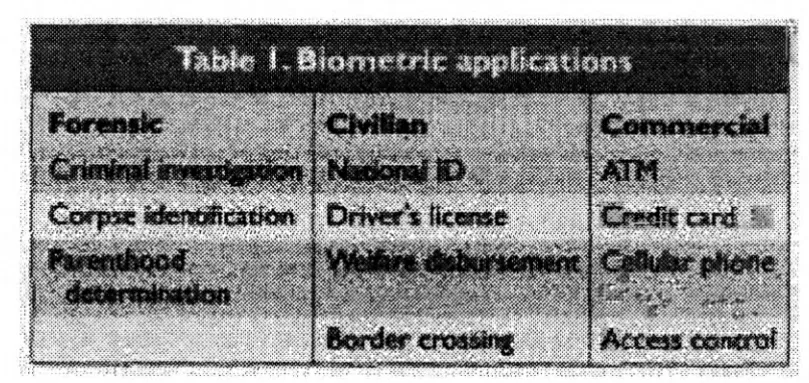
Biometrics is a rapidly evolving technology that has been widely used in
forensics such as criminal identification and person security and has the potential to be widely adopted in a very broad range of civilian applications as in Figure 1.2 :
• Banking security such as electronic fund transfers, ATM security, check cashing, and credit card transaction.
• Physical access control such as airport access control.
• Customs and immigration such as the Immigration and Naturalisation Service Passenger Accelerated Service System (INSPASS) which permits faster immigration procedures based on hand geometry.
• National ID system which provide a unique ID to the citizens and integrate different government services.
• Voter and driver registration providing registration facilities for voters and drivers.
tirateefit I I
•.rVlpyK’.VKr’yXV.^ff. .Th^vXvXvX y , 'O s + •> '
t//* s''4<* *s , " / 1" f** f ' s/' '
A tm t® m m m t
Figure 1.2 : Biometric Applications
Currently, there are nine biometric technology (Jain, et al., 1997) include
For the recent time, the only legally accepted, readily automated and mature biometric techniques is the AFIS which has been used and accepted in forensics
since the early 1970s.
1.2 Background of the problem
The local ridge characteristics and their relationships exclusively determine the uniqueness of a fingerprint. On top of that, it is widely used as a personal
identification for automated systems.
One of the main problems in extracting structural features is the presence of noise (unwanted information that can result from the image acquisition process)
in the fingerprint image. Commonly used method for taking fingerprint impressions involved applying a uniform layer of ink on the finger and rolling the finger on paper. These events cause the following types of problems (Ratha, et al., 1996):
• Over-inked areas of the finger create smudgy areas in the image. • Breaks in ridges are created by under-inked areas.
• The skin being elastic in nature can change the positional characteristics of fingerprint features depending upon the pressure being applied on the fingers.
• Inconsistent contact: the act of sensing distorts the finger. Determined by the pressure and contact of the finger on the glass platen, 3-dimensional shape of the finger gets mapped onto the 2-dimensional surface of the glass platen. This mapping function is uncontrolled and results in different inconsistently mapped fingerprint images across the impressions.
• Nonuniform contact: Ridge structure of a finger would be completely captured if ridges of the part of the finger being imaged are in complete optical contact with the glass platen. However, the dryness of the skin, skin disease, sweat, dirt and humidity in the air all confound the situation,
resulting in nonideal contact situation : some part of the ridges may not come in complete contact with the platen, and regions representing some valleys may come in contact with the glass platen. This results in ‘noisy’ low-contrast images, leading to either spurious minutiae or missing minutiae.
• Irreproducible contact: Manual work, accidents, inflict injuries to the finger, thereby changing the ridge structure of the finger either permanently or semipermanently. This may introduce additional spurious minutiae.
Fingerprint recognition remains as one of the most prominent biometric identification methods. The quality of the fingerprint image is the most significant factor in a reliable matching process. Any pre-processing algorithm should aim to enhance the quality of the existing features without creating false features. The whole scenario is presented by the main research question :
How to improve the quality offingerprint features through the pre-processing steps in order to ease the process o f forwarding steps in fingerprint image processing ?
The following 3 major issues are taken into account to answer the main research question stated above.
1. Why choose fingerprint instead offace, hand-written or speech ? • What is the science o f fingerprint ?
• How many patterns are there ?
2. How can fingerprint images are recognised ?
• What techniques did previous authors use ?
• What are the distinct steps involved in pre-processing ?
• What is done in segmentation process ?
• What is the significance o f the process i f it's going to be done ?
3. What are the algorithms available in segmentation stage ?
• What algorithm available here based on tool constraint ? • What algorithm is going to be considered ?
• Does it have a future value ?
4. What is the difference between segmentation andfiltering technique? • How does it differ ?
The purpose of the study is to identify a robust segmentation approach of fingerprint image by experimenting several approaches. Segmentation is the process of isolating between the foreground and the background of the fingerprint image with the purpose to identify the ridge line. This process is vital when to apply the thinning, identifying between true and false minutiae, minutiae extraction and other pre
processing stages in the field o f image processing. Supporting by 50 of sample data, the research project is a complete and comprehensive for recognition system that accurately supported the fingerprint matching or classification. The main objectives of this research proposal are :
• To identify techniques involved in segmentation process that is to be applied in fingerprint images.
• To evaluate and analyse the robust segmentation techniques which is to be used in fingerprint recognition methodology.
1.5 Theoretical framework
Acquisition
T ________ Post-Processing
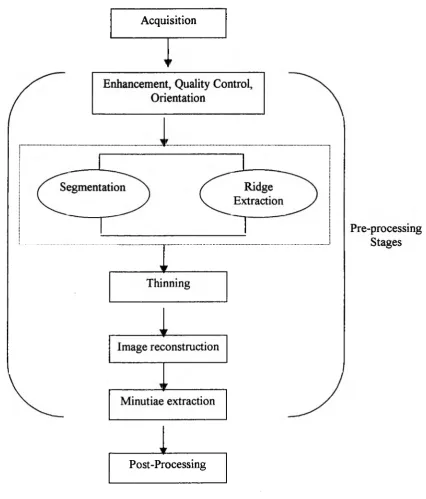
Figure 1.3 : Schematic Block diagram of fingerprint image processing
PERPUSTAKAAN SULTANAH ZANARIAH Universiti leknologi M alaysia
3 G 0 !j u 7
Although the fingerprint image is scanned through Biometric Scanner-Veridicom Passprint, not all the images are in a good quality. Skin elasticity or dirt on the
scanner screen may effect in a bad quality and hence introduce noise or distortion to fingerprint image. And if the rolled fingerprint is to be used, the problem is the intensity level of the ink on the rolled fingerprint also may occur. Thus, the
development of a fast, accurate and robust recognition system in the pre-processing stage is very important with the goal to create an effective database for fingerprint matching and retrieving. Focus area of the research is on the segmentation and ridge extraction process. This process is done after image enhancement, quality control and image orientation process (Azmi, 2000) and before the next stages i.e. thinning, minutiae extraction and post-processing can be undertaken.
1.7 Scope of the study
Main focus area of this research project is on the segmentation process. But to end up with the process, the fingerprint image must be pre-processed through the following steps :
i. Fingerprint image is live-scanned through a biometric device and manual scanned which restricted to 50 images in TIFF (Tagged Image File Format).
ii. The quality of image is then enhanced by conducting the process of noise removal using Median Filtering 3x3 technique and also through the process of image sharpening using High Boostl filtering (Azmi, 2000) and High Passl filtering.
iii. Histogram is then plotted and thereafter, the process o f quality control is done to attain a good image.
v. Then, segmentation is done by considering two techniques which are
Hierarchical technique by (Jain, et al., 1997) and Region Growing by pixel aggregation technique by (Alobaidi, 1998).
1.8 Definition of terms
Arch The pattern in which the ridges enter on one side, rise in the middle and flow out from the other side
Biometric Biometric refers to unique physical traits of an individual such as a fingerprint, retina, or palm print. At this time, the fingerprint is the biometric identifier of choice.
Central point/core Approximately the centre of loop fingerprint located within or on innermost recurve
Delta The point of spreading apart of two parallel ridges. The ridges must surround the pattern area and converge at the other side o f the pattern
Feature extraction Converts the original data to a suitable form (feature vectors) for use as input to the decision processor for classification
Filtering The process of removing the undesired noise to preserve the true ridge/valley structure
Left loop
Minutiae
Pattern recognition
Ridge bifurcation
Ridge ending
Ridges/valleys
Right loop
Segmenting
Tented arch
It is used in image recognition and computer vision.
The pattern in which a ridge recurve (loop) to the left angle, touching a line drawn from the delta to the central point (same as right loop except to the left)
Specified term for ridge ending and ridge bifurcation
Consist of basically 3 phases which are data acquisition, data pre-processing and decision classification
The point where a ridge forks or diverges into branch ridges.
The end point of a ridge or the point where a ridge end abruptly
Furrows on the surface of a fingertips
The pattern in which a ridge recurve (loop) to the right angle, touching a line drawn from the delta to the central point. There is exactly one delta in the pattern
The process of isolating between the foreground and the background of the fingerprint image with the purpose to identify the ridge line.
Thinning The process to extract and apply additional constraints on the pixel elements that are to be preserved so that linear
structure of the input image will be recaptured without destroying its connectivity.
Whorl The pattern in which contains at least two deltas and one recurving ridge such as a spiral or a variation of a circle
1.9 Summary
BIBLIOGRAPHY
Alobaidi, B. M. K. (1998) “Fingerprint Image Enhancement.” Faculty of Computer Science & Information System, University Of Technology Malaysia (UTM ): Thesis MSc.
Amengual, J.C., Juan, A., Perez, J.C., Prat, F., Saez, S., and Vilar, J.M., 1997. “Real time Minutiae Extraction in Fingerprint Images ” 6th International Conference on Publication, Vol. 2, pp. 871 - 875.
Azmi, Kamis. (2000) “Pengecaman Cap J a ri: Peningkatan Kualiti Imej” Faculty of Computer Science & Information System University Of Technology Malaysia (UTM) : Thesis BSc.
Bowen, J. D. 1992. “Automatic Fingerprint Pattern Classification Using Neural Networks.” DEE Colloquium on Neural Network for Image Processing Applications (Digest No. 186).
Dzulkifli, Mohamad. (1997) “The Identification of Trademark Symbols based on Modeling Techniques” Faculty of Computer Science & Information System, University Of Technology Malaysia (UTM ): Thesis Phd.
Halici, U., and Ongun, G. 1996. “Fingerprint Classification Through Self Organizing Feature Map Modified to Treat Uncertainties.” Proceedings of the IEEE 84, no. 10, pp. 1497-1512.
Hussain, Z. (1991) “Digital Image Processing : Practical Applications of Parallel Processing Techniques.” Ellis Horwood Limited, USA.
Jain, A. K., Hong, L., Pankanti, S., and Bolle, R. 1997. “An Identity - Authentication System Using Fingerprint .” Proceedings of the IEEE. Vol. 85, No. 9, pp.
1365- 1388.
Kamijo, M. 1993. “Classifying Fingerprint Images Using Neural Network : Deriving the Classification State.” IEEE International Conference of Neural Network 3, pp. 1932- 1937.
Kasaei, S., Deriche, M., and Boashash, B. 1997. “Fingerprint Feature Extraction Using Block-Direction On Reconstructed Images.” IEEE Tencon of Speech Technologies for Computing & Telecommunication, pp. 303 - 306.
Kasaei, S., Deriche, M., and Boashash, B. 1997. “Fingerprint Feature Enhancement Using Block-Direction On Reconstructed Images.” 1st IEEE International Conference on Communication & Signal Processing, ICICS ‘97, pp. 721 - 725.
Maio, D., and Maltoni, D. 1996. “A Structural Approach to Fingerprint
Classification.” Proceedings of 13th International Conference on Pattern Recognition, Vol. 3, pp. 578 - 585.
Moscinska, K., and Tyma, G. 1993. “Neural Network Based Fingerprint Classification.” Proc. Of EEE 3rd International Conference On Neural Network, pp. 229 - 232.
Myler, Harler, R., and Weeks, Arthur, R. (1993) “The Pocket Handbook Of Image processing Algorithms In C.” Prentice H a ll: Englewood Cliffs, New Jersey.
Uchida, K., Kamei, T., Mizoguchi, M., and Temma, T. 1998. “Fingerprint Card Classification with Statistical feature Integration.” Proceedings 14th International Conference Pattern recognition 2, pp. 1833 - 1839.
Umbaugh, Scott, E. (1998) “Computer Vision and Image Processing : A Practical Approach Using CVIPtooIs (International Edition).” Prentice-Hall
International, Inc., USA.
10 11 12 13 14 15 16 17
PR O JECT I
23 Preliminary study
E3 Literature review and data collection
£■! Writing the proposal (Project I)
EH Presentation of the proposal
PROJECT II
s / Analyze possible segmentation technique a
> /’ Preparation of image samples
Design & Coding
V Build a system prototype
V Implementation - processing code with sarr
E i Testing and evaluation
V Write-up thesis draft
V Presentation for Project II
V Modification of the draft
- / Submit thesis
98 days Mon 12/6/99 Tue 3/28/00
19 days Mon 12/6/99 Mon 12/27/99
54 days Tue 12/28/99
Wed 3/1/00
V
22 days
2 days Mon 3/27/00
Mon 2/28/00
Sat 3/25/00
Tue 3/28/00
55 days
3 days
3 days
20 days
5 days
5 days
4 days
9 days
1 day
3 days
1 day
Wed 3/29/00
Wed 3/29/00
Sat 4/1/00 Wed 4/5/00 Sat 4/29/00 Fri 5/5/00 Thu 5/11/00 Tue 5/16/00
Fri 5/26/00
Sat 5/27/00
Wed 5/31/00
Wed 5/31/00
Fri 3/31/00 Tue 4/4/00 Thu 4/27/00 Thu 5/4/00 Wed 5/10/00 Mon 5/15/00 Thu 5/25/00 Fri 5/26/00 Tue 5/30/00 Wed 5/31/00
Project: Proposal Date: Thu 6/1/00
Task
Split
Progress
Milestone
i l;!®i ITi Summary Rolled Up Task
Rolled Up Split
Rolled Up Milestone <(y>
Rolled Up Progress
External Tasks
Project Summary
Rolled Up Task
Rolled Up Split
Rolled Up Milestone <Q>
APPENDIX B
FINGERPRINT PATTERN TYPES
Arch Tented Arch
^ 8 ^
' • / \ \ \
y '' / / ' C' 1 \ \
, / y y j ) \ \
® V-___
Left Loop Left Loop
V — -— ~ ~ ~ r ~r
...
APPENDIX C
5(3Y)
6(4X)
&v.~.
7(4 Y)
8(5X)
APPENDIX F
SAMPLE ORIGINAL IMAGE REGION GROWING
1(1X)
1!
r?
j
2(1Y)
c
3(2X) C? • *1
4(3X)
5(3Y)
I P S
•
VWt
P .
JM & -:. 0 ^ y :;v :«
6(4X)
.'s: :
£&V<.. • • ’.1
7(4Y)
®
"" "
8(5X)
iiii'
^ s F ^ ^ w Ibi ^ " - ' ^
9(6X)
APPENDIX G
SAMPLES OF 42 GOOD FINGERPRINT IMAGES
SAMPLE IMAGE SAMPLE IMAGE
I . • ><v. ... >jf> 2
f t
3 1 • •• • v<
. J J U f c
id
^ * ' * 14
1
5 6
7
I I I
8
| 1 -
19 20
1 '/$ |
21
:• if* •'
22
23 24
, r~-"’s'^<vU^CV vNiV'ot' V" ’’■,''. '**'*oi'*«w£^>y -.<;:
25 ;
•,.. ^jfs: .y
r?:,gj*&
>•■ ?. ' v26
I ^ S 1 |
27
•/4'-"• i'-.'-.;\.»Sy •;, 28 :,
i i t S P
i i .
I p
t t l i l t
APPENDIX H
SAMPLES OF 8 POOR FINGERPRINT IMAGES
SAMPLE IMAGE SAMPLE IMAGE
1
v-• v • A. / *•
\
%>■. / » .?v:V-v- ?:> S:x>->AVv
• ., • . . : v - y / 5 i J >5 * %. - :•;:>::
2
•■i. - y^v/1. Av./a-X^v^. -V . * •
^ h
t
*- ■^ ^ l ^ V" * « • • ***&*'• • V * / w- / • f
3
[
:•: .. .Xv.
4
1
5
... •' w.v‘..*-v;'•v*:v’ ■*.*
■ ;^vN\\\VVV
/sJ&S'Z&X
-:>>SSr\ >! >}'• »;! V T>a> ' •* • ■'• '• - V •\ ' ■; f«.?Ays. * • *&.
,;c ■
6 iVV\x. *
' »\\V.
'•, - *
• ~V;?T?5fc^ ::l
■<V: 0 $
7 8
APPENDIX I
SOURCE CODE FOR SEGMENTATION BY HIERARCHICAL TECHNIQUE
unit orientation;
interface
uses u n i t _ t i f f ,vicwin, childwin,dialogs,sysutils,forms,graphics;
type
Gxbuffer = a r r a y [1..300, 1..300] of integer;
Gybuffer = a r r a y [ l . .300, 1..300] of integer; ORbuffer = a r r a y [1..300, 1..300] of integer;
var
Gxbuf : Gxbuffer; Gybuf : Gybuffer; ORbuf : ORbuffer;
cl : real;
procedure divBlock(xl,yl,x2, y2 :integer); procedure Orient;
procedure correct;
implementation
uses hboost,thres,main;
procedure correct; var
m,n : integer; t :integer; begin
for n:= 1 to info.Length do begin
for m:= 1 to info.Width do begin
mnorder[n,m] := BoostOutBuf[m,n]; end;
end;
for n:= 1 to info.Length do begin
for m:= 1 to info.Width do begin
BoostOutBuf[m,n] := mnorderfm,n] end;
end;
c o r r e c t d o n e := t r u e ; end;
var theta
deg,deg2, z m, n, gx, gy u, v, x, y count
ml, m2, nl, n2
i , j
vx,vy, ve
// cl
begin
vx :=0; vy := 0; ve := 0; count :=1; ml := xl; m2 := x 2 ; nl := yl; n2 := y2;
i : =0;
j :=0;
for n := nl to n2 do //baca piksel 16x16
begin
j : = j + l ;
for m := ml to m2 do {kira Gradient Gx dan Gy) begin
i:=i+l;
gx := (BoostOutBuf[m-1,n+1]) + 2 * (BoostOutBuf[m,n+l]) + (BoostOutBuf[m+1,n+1]);
gx := gx - (BoostOutBuf[m-1,n-1] + 2 * (BoostOutBuf[m,n-1]) + B o o stOutBuf[m+1,n-1]);
gy := (BoostOutBuf[m+1,n-1] + 2 * (BoostOutBuf[m+1,n]) + BoostOutBuf[m+1,n+1]);
gy := gy - 1,n-1] + 2 * (BoostOutBuf[m-l,n]) + BoostOutBuf[m-1,n+1]);
GxBuf[i,j] := gx; GyBu f [ i , j ] := gy; end;
i : =1;
end;
for v := 1 to blok do begin
for u:= 1 to blok do begin
vx := vx + (2 * gxbuf[u,v] * gybuf[u,v]);
vy := vy + (sqr(gxbuf[u,v]) - sqr(gybuf[u, v ] )) ;
ve := ve + (sqr(gxbuf[u,v]) + sqr(gybuf[u,v])); end;
end;
if ve<>0 then begin
cl := sqrt ((sqr(vx) + sqr(vy))/(ve * blok * blok)); : real;
: real; : integer; : integer; : integer; : integer; : integer; : r e a l ;
end else cl := 0;
{for n := nl to n2 do begin
for m := m l to m2 do begin
if cl < thresholdvalue then begin
BoostOutBuf[m,n] := 255;
setpixelcolor(TMDIChild(MainForm.ActiveMDIChild).Vicimage,m,n,0); end; end; end; ) //mainform.Memol.Lines.Add(floattostr(cl));
if vy<>0 then begin
theta := 0.5 * a r c t a n (v x / v y ) ; deg := 180.0 / 3.142 * theta; if (deg < 0) and (deg >=-180) then begin
deg := deg + 180; end;
end;
if vy=0 then begin
theta:=0; end
else if vy > 0 then begin
theta := theta + 3.142; end
else if vx > 0 then begin
theta := theta + (3.142/2); end
else if vy < 0 then begin
theta := theta + (3.142/2); end
else
theta := theta;
with TMDIChild(MainForm.ActiveMDIChild).image6.Canvas do begin
pen.Width:=2; p e n .C o l o r :=clred;
x := trunc(hipo * cos(theta)); y := truncfhipo * sin(theta));
wi t h TMDIChild( M a i n F o m . A c t i v e M D I C h i l d ) .image5.Canvas do begin
pen.Width:*2; p e n .C o l o r :*clred;
cos (theta) ) ; y := trunc(hipo * s i n ( theta));
m o v e t O d i V 2) +x,nl+ (blok div 2)-y);
lineto(ml+(blok d i v 2)-x,nl+(blok d i v 2)+y); end;
end;
p rocedure Orient; var
xblock, xbal, yblock, ybal :integer; xcount, ycount :integer;
xl,yl :integer; begin
yblock:=info.Length div blok; ybal:=info.Length m o d blok; xblock:=info.width div blok; xbal:=info.width m o d blok;
//mainform.Memol.Lines.Add ('length : 1+inttostr(info.Length)); / / m a i n f o r m . M e m o l .Lines.Add
/ / m a i n f o r m . M e m o l .Lines .Add / / m a i n f o r m . M e m o l .Lines.Add / / m a i n f o r m . M e m o l .Lines.Add / / m a i n f o r m . M e m o l .Lines.Add
xl:=l; yi:=l;
('width : '+inttostr(info.width) ('xblock : '+inttostr(xblock)) ; ('xbal : '+inttostr(xbal)); (’yblock : '+inttostr(yblock)); ('ybal : '+ i n t tostr(ybal));
do
for ycount:=1 to yblock do begin
for xcount:=1 to xblock do begin
with T M D IChild(MainForm.ActiveMDIC hild).i m a g e 2 .canvas
begin
//p e n .C o l o r := c l b l u e ;
// rectangle(xl,yl,xl+16,yl+16); //pen.Color:=clblue;
//Pixels[xl+8,yl+8]:=clblue; divBlock(xl,yl,xl+blok,yl+blo k); end;
APPENDIX J
SOURCE CODE FOR SEGMENTATION BY REGION GROWING BY PIXEL AGGREGATION TECHNIQUE
unit region_grow;
interface
uses sysutils, unit_tiff, main, childwin, vicwin, math,
Windows, Messages, Classes, Graphics, Controls, Forms, Dialogs, StdCtrls;
//uses sysutils, unit_tiff, main, childwin, vicwin, math;
const
xseed = 3 0 ; yseed = 30;
type
inbuffer = a r r a y [1..600, 1..600] of integer; outbuffer = a r r a y [1..600, 1..600] of integer; GrayLevel = a r r a y [ 0 . .255] of integer;
procedure RegionGrowing(name : string); procedure growfx, y, threshold :integer); procedure Bacalmej(Vicimage : imgdes); procedure BacaMedian(Vicimage : imgdes); procedure BacaHPass(Vicimage : imgdes); procedure BacaHBoost(Vicimage : imgdes); procedure BacaAdaptive(Vicimage : imgdes); procedure DisplaySegment;
function IntToBinary(value, d i g i t :i n t e g e r ) :i n t e g e r ; procedure RGData;
var
RGinbuf : inbuffer;
RGoutbuf: outbuffer;
total, count : integer; Nl, Ml : integer;
N2, M2 : integer; GV : G r a y L e v e l ; fb : textfile;
threshold : integer; threshvalue : integer;
implementation //Region Growing
uses median, hpass, hboost, adaptive, histo_grow;
procedure RegionGrowing(name : string); var
x, endx, y, endy : integer; threslnput : string;
begin
N2 := width; M2 := height; endx := N2-1; endy := M2-1;
// xseed := 50; yseed := 50;
// threslnput := I n p u t B o x ('Region G r o w i n g 1, 'Enter Threshold
Value', threslnput);
// threshold := strtoint(threslnput);
for y := 1 to endy do for x := 1 to endx do
RGoutbuf[y][x] := 1;
total := 0; count := 0;
for y := yseed - 5 to yseed + 5 do for x := xseed - 5 to xseed + 5 do
if ( (x>l) and (y>l) and (x<endx) and (y<endy)) then begin
count := count + 1;
total := total + RGinbu f [ y ] [ x ] ; end;
g row (xseed, yseed, th r e s h o l d ) ; Displ a y S e g m e n t ;
end;
procedure grow (x, y, threshold : i n t e g e r ) ;
var
diff, mea n : real;
begin
if RGoutbuf[y][x] = 1 then begin
mean := total/count;
diff := RGinbuf[y][x] - mean; if (diff < 0) then
diff := -diff;
if (diff < threshold) then begin
total := total + RGinbuf [ y ] [ x ] ; count := count + 1;
RGoutbuf[y][x] := 0 ;
if (x = 3) and (y = 1) then begin
for y := Ml+1 to M2-1 do begin
for x : = Nl+1 to N2-1 do begin
if RGoutbuf[y][x] = 1 then begin
mean := total/count;
diff := RGinbuf[y][x] - mean;
if (diff < 0) then diff := -diff;
if (diff < threshold) then begin
total := total + RGinbuf [ y ] [ x ] ; count : = count + 1;
mean := total/count; end;
end; end; end;
exit; end;
if (x > 1) then
grow(x-l, y, threshold); if (y > 1) then
grow(x, y-1, threshold);
end; end; end;
procedure Bacalmej(Vicimage : im g d e s ) ; var
i, j, y : integer; begin
for i := 1 to Info.Length do begin
for j := 1 to Info.Width do begin
y := TData f i ] A [j] ; RGinbuf[i][j] := y; end;
end; end;
procedure BacaMedian(Vicimage : imgdes) var
i, j, y : integer;
begin
for i := 1 to Info.Length do begin
for j := 1 to Info.Width do begin
y := MedOutBuf[i][j] ; R Ginbuf[i][j] := y; end;
end; end;
procedure BacaHPass(Vicimage : imgdes); var
i, j, y : integer;
begin
for i := 1 to Info.Length do begin
for j := 1 to Info.Width do begin
y := P a s s O u t B u f [ i ] [j ] ; RGinbuf[i][j] := y; end;
end; end;
procedure BacaHBoost(Vicimage : imgdes) var
begin
for i := 1 to Info.Length do begin
for j := 1 to Info.Width do begin
y := BoostOutBuf[i][j] ; RGi n b u f [ i ] [ j ] := y; end;
end; end;
procedure BacaAdaptive(Vicimage : imgdes); var
i, j, y : integer;
begin
for i := 1 to Info.Length do begin
for j := 1 to Info.Width do begin
y := AdapOutBuf[i][j] ; R G i n b u f [ i ] [ j ] := y; end;
end; end;
procedure DisplaySegment; var
i, j : integer; begin
for i := 1 to Info.Length do begin
for j := 1 to Info.Width do begin
if RGoutbuf[i][j] = 0 then begin
RGoutb u f [ i ] [ j ] := 255;
setpixelcolor(TMDIChild(MainForm.ActiveMDIChild) .Vicimage,j , i, 255); end
else
if RGoutbuf[i][j] = 1 then begin
RGoutbu f [ i ] [ j ] := 0;
setpixelcolor(TMDIChild(MainForm.ActiveMDIChild).Vicimage,j,i , 0); end;
end;
TMDIChild(MainForm.ActiveMDIC hild).i m a g e l .refresh; end;
R G D a t a ; end;
| CHECK DATA
j
procedure RGData; var
i, j, k : Integer; begin
k : = 0;
for i:= 1 to Info.Length do begin
for j:= 1 to Info.Width do begin
if k * Info.Width then begin
Writeln (fb, IntToBinary(RGOutBuf[i][j],1)); k:= 0;
end else
Write (fb, IntToBinary(RGOutBuf[i][j ] ,1)); k:= k + 1;
end; end;
Writel n ( f b ) ;
Writeln(fb, 'End Of T e x t 1); C l o s e F i l e (fb);
end;
{ ***************+*+++***** BINARY FUNCTION
function IntToBinary(value, d i g i t : integer):integer; begin
case value of
0 : IntToBinary := 1; 255 : IntToBinary := 0; end;
end;