Static Detection of API Error-Handling Bugs
via Mining Source Code
Mithun Acharya and Tao Xie
Department of Computer Science
North Carolina State University
Raleigh NC USA 27695
{
acharya, xie
}
@csc.ncsu.edu
Abstract
Incorrect handling of errors incurred after API invoca-tions (in short, API errors) can lead to security and robust-ness problems, two primary threats to software reliability. Correct handling of API errors can be specified as formal specifications, verifiable by static checkers, to ensure de-pendable computing. But API error specifications are of-ten unavailable or imprecise, and cannot be inferred eas-ily by source code inspection. In this paper, we develop a novel framework for statically mining API error specifi-cations automatically from software package repositories, without requiring any user input. Our framework adapts a compile-time push-down model-checker to generate inter-procedural static traces, which approximate run-time API error behaviors. Data-mining techniques are used on these static traces to mine specifications that define the correct handling of errors for relevant APIs used in the software packages.The mined specifications are then used to uncover API error-handling bugs. We have implemented the frame-work, and validated the effectiveness of the framework on 82 widely used open-source software packages with approx-imately 300KLOC in total1.
Submission Category: Testing, Verification, and Valida-tion.
Keywords: Software Reliability, Mining, Static Traces, Specifications, API Error-Handling, Robustness
1
Introduction
A software system interacts with third-party libraries through various APIs (Application Programming Inter-faces). Incorrect handling of errors incurred after API
in-1This work is supported in part by NSF grant CNS-0720641 and ARO grant W911NF-07-1-0431. Contact Author: Mithun Acharya, Tel: +1 919 515 2858.
vocations (in short, API errors) can lead to security and robustness violations in complex software systems. These violations often lead to system crashes, leakage of sensi-tive information, and complete security compromises. Ro-bustness is formally defined as the degree to which a soft-ware component behaves correctly in the presence of ex-ceptional inputs or stressful environmental conditions [1]. API errors are usually caused by stressful environment con-ditions, which may occur in forms such as high compu-tation load, memory exhaustion, process related failures, network failures, file-system failures, and slow system re-sponse. Stressful conditions, and hence API errors, however rare, should be gracefully handled. Traditional software testing focuses on correctness of functionality and is often insufficient for assuring the absence of API-level robustness violations. Robustness testing approaches [10, 11, 15] con-sider the target applications or operating systems as a black box, and send random or exceptional input values through their APIs. However, robustness testing approaches can-not easily generate implicit return exceptions through APIs, which are an important type of sources for robustness prob-lems.
Correct handling of API errors can be specified as for-mal specifications verifiable by static checkers to ensure the absence of error-handling bugs. Writing such specifica-tions, which are usually temporal in nature, requires identi-fying API details such as (1) the relevant APIs that fail with errors, (2) different error-checks that should follow such APIs (depending on different API error conditions), and (3) proper error-handling or clean-up in the case of program exits. Furthermore, APIs in error-handling blocks might de-pend on the APIs called prior to the error being handled. As these API details are often inter-procedurally scattered and not always correctly coded by the programmers, manually inferring specifications from source code becomes hard and inaccurate, necessitating automatic specification inference.
spec-ifications, we develop a novel framework for statically min-ing API error-handlmin-ing specifications directly from soft-ware package repositories, without requiring any user in-put. Our framework adapts a trace generator to approxi-mate run-time API behaviors. The trace generator uses a compile-time push-down model-checker to generate inter-procedural static traces. Data mining techniques are used on these static traces to mine specifications that define cor-rect handling of errors for relevant APIs used in the software packages. The mined specifications are then formally veri-fied against the same software packages (or other software packages, which use these relevant APIs) to uncover API error-handling bugs.
Two of our previous approaches [2,3] used the trace gen-erator, adapted in this work for mining API error specifica-tions, for different tasks. One approach [3] uses the trace generator to infer API details such as return values on API failure and success. As opposed to intra-procedural trace generation in our previous approach [3], in this paper, both trace generation and bug checking are inter-procedural. The inter-procedural analysis allows our framework to mine API error-check and clean-up details (and hence bugs) scaterred across different procedures. The other approach [2] uses the trace generator to mine API usage scenarios and speci-fications using a partial-order miner [18]. API usage scenar-ios dictate how a given set of APIs are used for a particular task. Both specifications and usage scenarios mined by our previous approach [2] were ordering requirements between multiple, user-specified APIs only, and not error checks. To capture different possible orderings (summarized as partial orders) among user-specified set of APIs, the static traces generated were from the start-to-end of the analyzed pro-gram. To detect API error-handling bugs, our framework in this paper adapts the trace generator to generate traces around relevant API error paths (described in Sections 3.2 and 3.3). Both our previous approaches require users to specify the APIs of interest. In contrast, the framework pro-posed in this paper automatically infers the relevant APIs, the APIs that fail with errors. Finally, the framework pro-posed in this paper employs sequence mining to infer proper API clean-up in case of program exits, not mined by our previous approaches. Frequent-sequence mining [23] (as opposed to the more costly partial-order mining) sufficed as error checking and cleaning up are unique for a given API along error paths. In summary, this paper makes the follow-ing main contributions:
Static approximation of run-time API error behav-iors. We adapt previous trace generation framework to stat-ically approximate run-time API error behaviors. Our tech-niques allow mining of open source systems for API error-handling bugs without requiring environment setup for sys-tem executions or availability of sufficient syssys-tem tests. Fur-thermore, our framework to detect API error-handling bugs
expects no user input in the form of specifications, program-mer annotations, profiling, instrumentation, random inputs, or a set of relevant APIs.
Specification Extraction. We present novel applica-tions of frequent-sequence mining [23] on static traces to mine specifications that dictate correct handling of API er-rors.
Implementation and Experience. We implement the framework and validate the effectiveness of the framework on 82 widely used open-source software packages with ap-proximately 300K LOC in total.
The remainder of this paper is structured as follows. Sec-tion 2 starts with an example that motivates our frame-work. Section 3 describes the various components of our framework in detail. Section 4 presents the implementation details and evaluation results. Section 5 discusses related work. Finally, Section 6 concludes.
2
Example
This section illustrates how our framework automatically detects API error-handling bugs via mining program source code, without requiring any user-input. The only input to our tool is compilable source code of a single software or a set of software packages. Figure 1(a) shows a simple code snippet in C that uses APIs from a header file, say
<abcdef.h>, namely,a,b,c,d,e, andf. Next, we ex-plain the various components of our framework on the sam-ple code snippet at a high level, after defining a few terms used throughout the paper. The formal details of the frame-work are described in Section 3.
Definitions. We identify two types of specifications that determine correct handling of API errors along all paths in the program: error-check specifications and multiple-API specifications. Error-check specifications ensure that error-check conditionals exist after each call site of an API before its return value is used or themainprocedure returns. Error-check conditionals Error-check the API return value and error flag (such as errno) value against their possible error values. We classify an API error (return-value error or error-flag error) to be critical, if the program should not proceed af-ter the critical error and has to exit (through anexit(0)
call, for example). Critical API errors are caused because of stressful environment conditions such as network fail-ures, disk failfail-ures, and memory exhaustion. We classify a conditional checking against any critical API error as criti-cal check conditional (CCC; we use CCC(a) to denote CCC of API a). In this paper, we restrict the scope of error-check specifications to the presence of critical error-check con-ditional after an API call before its return value is used or themainprocedure returns. For example, the POSIX API
setuidreturns -1 on failure, with possible error values of
call-vo idfa tal(){ exit (0 ) ;/ /EB}
vo ider ror (){
if( e
r rn o==EI N VAL)
//CC C e
xit(0 );// EB}
.…,a ,T( ,faal ,…,e xi 2 .…,a () ,F( i <0)
,T( e rr no
< 0) ,er r
o r
( ) ,T(e
r rno = EI NV AL)
,e xi
t( 0) 3
.…,a ()
,F( i <0)
,F( e rr no < 0) ,b ( i ) ,d ( j) ,e ( j), T( j = 1 ) ,p ( ) ,…,a
() , F( z= 1 ) ,T(e r r no=
E IGVAL) ,d ( y) ,e ( y) ,e xi t( 0) 1 2 3
vo idp ()
{ intx
,y ,z ; y = c() ; x=a( ) ; if( z == 1 ){
if( z <0) z += 1
;}; ( b
)S h o rt e ste x
i tt ra ces Re le vant AP Is , R = { a} Cr itica le rr orr
e turnva
l u
e sfo ra:<
0 Cr itica
le rr n ova
l u
e sfo ra:EI
GVAL , EIN VAL Pro bab le c le an wupAPIs , PC = { d , e } 4 5 6 7 8 9 ( ){ ( ) } if( e rr no==EI
GVAL ) / /Er ro rf
l a gc h
e c k , CCC {
/ /Exitb l oc k (EB ) d ( y ) ; e ( y ) ; e xit( 0) ; } d( y ) ; e ( y ) ;f (
y )
;b (x ) ;f(x ) ; } a b c d e c d e f a b f 10 11 12 13 14 15 } voidq (){
in tr=c( )
;d(r ) ; e ( r ) ;} # inc l ud e <abcd e f .h > in t mai n() { a b f c d e a b c d e F r e qu e nts e qu e nc e , supp or t=
3 / 4 , le ngth= 3
:a b , c d e Re le van t AP Is= { a , b , c , d , e };C le anwup AP Is= { b , d , e } 16 17 18 19 { in ti
,j ; j =c( ) ; i = a() ; if(i < 0 ) / /r
e tur nwva l u e ch e c k , CCC fata l ( ) ; If( e r rn o<
0 ) //Err orf
l a gc h
e c k CCC ( c )I
n dep en dents cen ari osf r o
mra n do mn o n ¡ e x i
tt race s af t ersc en ari oe xtraction
E r ro r
¦ c h e c kb ug s 19 20 21 22 23 24 25 If( e
r rn o< 0 )
//Err or wf l
agc h e c k , CC C e
rr o r( ) ; b( i
) ;d (
j ) ; e ( j ) ; if( j = = 1 ) p (); el s e () E r ro r
c h e c kb ug s Missing r e turnvalu e ch e ck f or a ( ) atlin e8 Missing (e r rno==
EIGVAL) ch e ck f or a () a tlin e22 Missing (e r rno==
EINVA L) ch e ck f or a ( ) atlin e8 Mult iple ¦ A P Ibugs m
a i n( ),
… , a ( ),. .. , er r o r (), e
xit(0 )// b
notcal l ed ; d an de notcall ed m a i n( ),
… , a ( ), … , fa t al ( ), e xit(0)// b
notcal l ed ; d an d e notcal l
ed 25 26 27 28 29 30 31 q (); } ( a )E xa mp l ec od
e–In pu ts o u rce ( d)V e r i f i c at io nres u
l
t s–AP Ierr o r ¡ h an dl i ng b ug s ( ), , ( ), , ( ), () ; m a i n ( ), … , p ( ), … , a ( ), … , T( e
rr no=EIGVAL) ,…,e
xi t(0)//
b notcal l
ed
31 32
Figure 1. A simple example for illustrating our framework
site ofsetuidand these critical error conditions should be handled appropriately. Critical check conditionals should be followed by exit blocks (EB; we use EB(a) to denote EB of API a). Exit blocks handle the error and executes an exit call. Multiple-API specifications ensure that the right clean-up APIs are called in the exit blocks. Clean-up APIs are APIs called in the exit blocks, which may share a temporal relationship with any API called prior to the exit block. For example, the display pointer produced by the X11 API,XOpenDisplay, should be consumed by
theXCloseDisplayAPI along all paths. Hence, each exit
block reachable from a call toXOpenDisplayshould have a call toXCloseDisplay(clean-up API). We define rele-vant APIs as APIs that can fail with critical errors, clean-up APIs, and APIs that share temporal relationship with clean-up APIs. Our framework automatically mines relevant APIs from the source code, and then generates specifications. A trace in a program is the print of all statements that exist along some control flow between any two statements, say S1 and S2. In our analysis, we restrict such traces to those that can be captured by a Finite State Machine (details in Section 3). An exit trace is any trace from the entry to the
mainprocedure to some exit point in the program (through
anexit(0)call, for example). A non-exit trace is any trace
from the entry of themainprocedure to the return of the
mainprocedure.
To infer error-check specifications, our framework first gathers APIs that fail with critical API errors from the source code. Our framework generates the shortest exit trace for each exit path (in the program) that contains a critical check conditional. Figure 1(b) shows three shortest exit traces. For a predicateP,T(P)means that the predi-cateP is true, andF(P)means that the predicate is false. Hence T(i<0)in trace 1 means that the predicatei<0 is true. For Trace 3,T(z==1)in procedurepimplies a longer trace, which is not output by our framework. Since the crit-ical check conditionals in exit traces pertain to APIa,ais added to the set of relevant APIs (set R). Critical API er-rors are inferred from critical check conditionals present in exit traces. For a, critical API errors for the return value are all negative integer values, and EINVAL andEIGVAL
are critical API errors for the error flag. Error-check spec-ifications are then generated with the knowledge of criti-cal API errors. The APIs present in the exit blocks for
non-exit traces until an upper limit is reached on the number of traces. Figure 1(c) shows non-exit traces generated by our framework after scenario extraction (see Section 3.4), with an upper limit of seven. Scenario extraction generates in-dependent scenarios from non-exit traces. An inin-dependent scenario in a non-exit trace is a sequence of APIs that are related through some data-flow dependency. For example, one non-exit trace in the example code hasj=c(),i=a(),
b(i),d(j),e(j),y=c(),x=a(),d(y), ande(y)as an
API invocation sequence. There are three independent sce-narios in this non-exit trace, namely, (j=c(),d(j),e(j)),
(i=a(),b(i)), and (y=c(), d(y),e(y)). Multiple-API
specifications are derived from these traces using frequent-sequence mining. Based on the observation by Weimer and Necula [24], exit traces are not used to infer multiple-API specifications because programmers tend to commit mis-takes along exit paths when using clean-up APIs. The fre-quent sequences (shown in Figure 1(c)) are mined from ran-dom non-exit traces with support 3/4, and they imply that APIsb should always be called aftera, and thatd ande
should be called after APIc. The error-check and multiple-API specifications are then verified against the source code to detect API error-handling bugs. Figure 1(d) shows the detected API error-handling bugs. Our framework outputs the shortest path for each bug in the program, instead of all buggy traces, thus making bug inspection easier for the users.
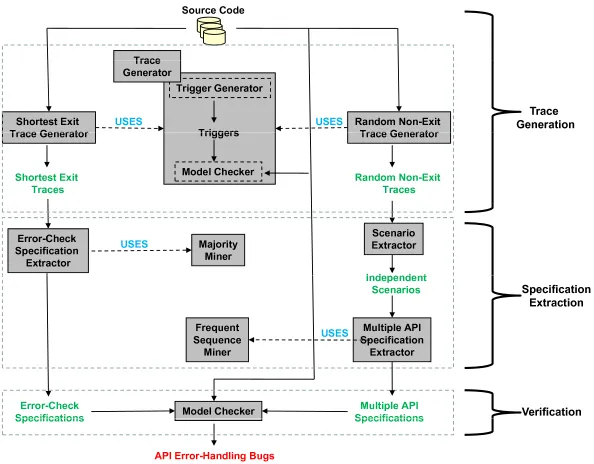
3
Framework
A high-level overview of our framework is shown in Fig-ure 2. The only input to our framework is compilable source code of a single software package or a set of software pack-ages. Our framework then finds API error-handling bugs, if any, in the source code. There are three main stages in our framework: trace generation, specification extraction, and verification, as shown by dotted boxes in the figure. The trace generation stage generates two types of traces, short-est exit traces and random non-exit traces. The specifica-tion extracspecifica-tion stage generates two types of specificaspecifica-tions, error-check specifications and multiple-API specifications, inferred from the traces using different mining algorithms. In the verification stage, the inferred specifications are veri-fied against software packages to detect API error-handling bugs. Section 3.1 introduces the trace generation mecha-nism, also used by our previous approaches [2, 3]. Sec-tions 3.2 and 3.3 explain how our framework adapts trace generation to generate API exit and non-exit traces. Sec-tions 3.4 and 3.5 describe the specification extraction and verification stages, respectively.
3.1
Trace Generation
Our framework mines error-check specifications from exit traces and multiple-API specifications from random non-exit traces. Trace generation forms the basis for gen-erating exit and non-exit traces. Informally, a trace is a sequence of program statements between two points in a program along some control-flow path. However, generat-ing all traces along all execution paths is an uncomputable problem and a trace can be of infinite size. Furthermore, a generated trace can be infeasible. These problems will be addressed in subsequent sections. Here we first formal-ize the problem of trace generation as below. The problem is to generate traces between two points in a program and then to extract relevant statements (such as API invocation, return-value checks, and exits) from each trace. To describe trace generation, we assume that the user wants to extract API (from a known set of APIs) invocation sequences from traces. We then summarize the Push-Down Model Check-ing (PDMC) process [7, 9], which we adapt for trace gener-ation. Next, we introduce the concept ofT riggersrequired for trace generation. Finally, we discuss the soundness and complexity of trace generation.
Let us assume thatAis a set of APIs. To simplify the definitions, let us assume that all APIs inAare empty meth-ods, do not take any arguments, and return void, so that they do not have any data dependencies with other state-ments. We show how to generate sequences of API (from setA) invocations along different program paths. Formally, letΣbe the set of valid program statements in the given pro-gram source code. A tracet∈Σ∗, a sequence of statements
executed by a pathp, is feasible if pathpis feasible in the program. LetT⊂Σ∗ be the set of all feasible traces in the
program. For a givent∈T, letA(t)∈A∗be the API
invoca-tions along the tracetexpressed as a string.A(t)can be an empty string iftdoes not have any invocation of APIs from the setA. LetT′⊆T be the set of all feasible traces such
that ift∈T′,A(t)is not empty. However, the setT′is
un-computable andt∈T′can be of infinite size. A computable
approximation of T′ is generated from the program. A(t)
is extracted for alltin the approximate set, using Triggers (explained later in this section). We now describe PDMC process required to understand Triggers.
3.1.1 Push-Down Model Checking (PDMC)
Given a property represented using a Finite State Machine (FSM), PDMC [9] checks to see if there is any path in the program that puts the FSM in its final state. For example, if the property FSM is specified as shown in Figure 3, PDMC reports all program paths in whichais followed by eitherb
T r ace
T
r igge rG ene ra t o
r
Tr igg er s T
r ace G ener a t o
r
Sh o r testEx it T
r aceGe ner at o
r R
a n do
mN o
nçExit T
r aceGe ner a t o
r US
E
S US
E
S T
race G
ener at i o
n Tr igg er s
Mode lChecker T
r aceGe ner at o
r
T r aceGe ner at
o r
Sh or test Ex it T
r ac es R
a ndomNon ç
Exit T
ra ce s
Error ç
Check Speci fica tion Extr ac t
o r
M a
jo ri ty M
i ner
Id d t
US E
S
Sce nar io Extr ac tor
Mul tipleAPI Speci fica tion Fr e quen t
Sequenc e
I n
d e
p e n
d e nt S
ce nar i o
s
USES
S peci ficati on Ext r acti on
Ex tra ct o
r M
ine r
M ulti
p leA
PI Sp
eci ficati o
ns Er r
o rçC
h e c
k Sp
ec ific ati o
n s
Mo d elC
h ec
k er
Veri ficati on
Sp eci ficati
o ns Sp
ec ific ati o
n s
APIEr ror ç
Ha ndling Bugs
Figure 2. Our framework for detecting API error-handling bugs
the program PDA and the property FSM to generate a new PDA; the new PDA is then model checked to see if any final configuration in the PDA is reachable. A configuration of a PDA Pis a pairc = hq, ωi, whereq is the state in which the PDA is in andωis a string of stack symbols in the PDA stack at that state. A configuration is said to be a final configuration, if qbelongs to the set of final states in the FSM. If a final configuration is reachable, PDMC outputs the paths (in the program) that cause the resultant PDA to reach this final configuration. The resulting trace can either be feasible or infeasible because of data-flow insensitivity (being incomplete). However, if there is a program trace that puts the FSM in the final state, PDMC reports it (being sound). We next describe our Triggers technique [2] that adapts PDMC to generate API invocation sequences in a program.
3.1.2 Triggers
Our goal is to generate the set T′⊆T from the
pro-gram and extract A(t) for all t∈T′, A(t)∈A∗, A =
{a1, a2, a3, ..., ak}. Let us assume that we give the FSM
shown in Figure 4 to PDMC to be verified against a pro-gram P. The FSM in Figure 4 accepts any string of the forme(Pi=1,2,...,kai)∗x, whereeandxare any two points
in the program. Given this Trigger FSM, PDMC outputs all program paths that begin witheand end withxin the program.
LetB ⊆ Σ∗ be all sequences of program statements in
P that put the FSM in Figure 4, say F, in its final state. As defined earlier,T⊂Σ∗is the set of all feasible traces in
start aCalled
end1
end2 a
b
c
Figure 3. A property FSM with end1 and end2 as final states
a1Called end
x start e
a1,a2, a3, … , ak
Figure 4. Trigger FSM that accepts the regular languagee(a1+a2+...+ak)∗x
empty or not. SinceL(F)is a regular language andL(P) is a context-free language,L(F)∩L(P)can be captured by a PDA, say P, and hence the final state of F is unreach-able if and only if the PDA P accepts the empty language. There are efficient algorithms to determine if the language accepted by the PDA is empty [14]. Once P is constructed, PDMC checks to see if any final configuration is reachable in P. Chen and Wagner [8] use the preceding analysis to adapt PDMC for light-weight property checking. We use the preceding analysis for static trace generation. We call the FSMs such as the one used in Figure 4 as Triggers. By using Triggers, we have achieved two purposes:
• We have producedTex, the set of traces in the program
that begin witheand end withxinstead ofT′⊆T.
• The knowledge ofA ={a1, a2, a3, ..., ak}allows us
to extractA(t)from anyt∈Tex. Similarly, other
state-ments like return-value checks, error-flag checks can also be retrieved from the traces.
3.1.3 Soundness
The consequence of using a context-free language for T introduces imprecision but retains the soundness of anal-ysis. Infeasible traces might occur (being incomplete) be-cause of data-flow insensitivity of the PDMC process, but all the program traces that put the FSM in its final state are reported (being sound). Since determining if T∩B = φ is undecidable, no tool can be sound and complete at the same time. Consequently, there could be some infeasible API sequences. The model-checker that we use is data-flow insensitive. We implement simple data flow extensions to the PDMC process as described in Section 4. However, we do not implement a potentially expensive pointer or alias analysis. We intend to explore data-flow-sensitive model-checkers in future work for trace generation. Also, along some feasible paths, the implicit API ordering rules might be violated and APIs could be used incorrectly (producing buggy traces with actual errors). Hence the API sequences might contain certain wrong API sequences. However, we assume that most programs that we analyze are well written. Hence, we expect only few feasible paths to be buggy, if at all. We expect to handle buggy traces by selecting an appro-priatemin supvalue. The traces generated by PDMC with Triggers can still be of infinite size (for example if there is a loop). We address this problem in Section 4.
3.1.4 Complexity
PDMC constructs PDAPfrom the program Control Flow Graph (a directed graphG= (N, E)) where each node rep-resents a program point and each edge reprep-resents a valid program statement. PDMC takesO(E)time to construct
the PDA Pfrom the CFGG, takesO(E× |Q|)(Qis the number of states in the FSA) for computingP, the product of FSAFand PDAP, takesO(|Q|2×E)for deciding if the PDAPis empty andO(|Q|2)×lg|Q| ×E×lgN for backtracking. The derivations are shown by Chen [7].
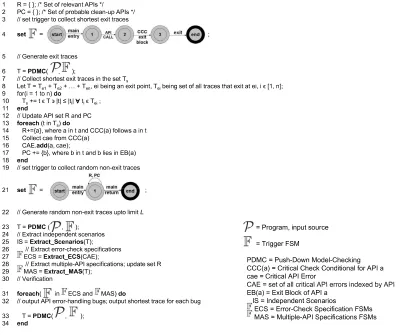
Our framework has four components: the shotest exit-trace generation, random non-exit exit-trace generation, specifi-cation extraction, and verifispecifi-cation, described in subsequent sections. Figure 5 lists the algorithm used by our framework to detect API error-handling bugs. The algorithm summa-rizes the various steps in each of our framework compo-nents.
3.2
Shortest Exit Trace Generation
Our framework generates the shortest trace for each exit path (in the program) that contains a critical check condi-tional (CCC). We useP to denote the input program andF
to denote the Trigger FSM. CCC(a) denotes CCC for API
a. Line 4 in Figure 5 sets the Trigger to collect the shortest exit traces. A path from the entry of themain procedure to an exit point in the exit block of an API must always go through CCC for that API. Hence, in generating exit traces, we collect CCCs for APIs that fail with critical errors. Crit-ical errors (return-value errors and error-flag errors) for an API are inferred from the CCCs of that API. We generate the shortest exit traces instead of enumerating all exit traces (or generating traces randomly with an upper limit) because, for an API, saya, which can fail with a critical error, pro-gram statements between themain’s entry and the invoca-tion ofado not yield additional information to infer critical errors fora. To collect critical API errors, it suffices to gen-erate program statements between CCC(a) and the program exit in the exit block ofa, EB(a). The shortest exit traces for a given trigger are generated by computing the shortest path from source to sink nodes in the graph obtained after satu-rating PDA P [7]. When genesatu-rating the shortest exit traces, all APIs that fail with critical errors are added to the set of relevant APIs (set R). Also, APIs in the exit blocks of APIs that fail with critical errors are flagged as potential clean-up APIs (set PC), which could share temporal relationship with any API called prior to the exit block.
3.3
Non-Exit Trace Generation
cap-s PC={} ;/*Se tofp ro bableclean upAPI
s */ // sett ri gg e r toco l l
ectsh o r
teste x i tt r ace s se t = ; 2 3 4
//Gen e r ate exit t r ace s
T=PD MC( , ); //C
o l l
e ctsho r
teste x i tt
r ace s
i nth eset
T s L
e t T=T
e1+ T
e2+…+ T en , e i b e i n g anex i t p o i nt ,T ei be i n g seto f a ll t r acesthatex
i tate
i,i?[1, n ]
; f
o r (i=1
ton )d o 5 6 7 8 9 f o r (i=1
ton )d o T
s+ =
t ?TI|
t |K|
t i | t i ?T ei ; en d //Up d
ateA PI set R an dPC fo r e ach ( t inT s )d o R
+ = {a},where
a in
t
andC C C (a)fol lows a in t C o l l
e ctcae fr
o m C C C (
a ) 9 10 1 1 12 13 14
15 ()
C A E. a d d( a , cae ); PC + ={ b },w he r eb i
ntan d b li e s i n EB( a ) en d // sett ri gg e r toco l l ect r an d
omn on ex i tt r ace s se t = ; 16 17 18 19 21 se t = ; //G en e r ate r an d omn on ex
i tt
r ace su
p to l i m i tL
T=PD MC( , ); //E xt r act i n d e p en d ents cena ri os = P
r o g ra m ,in pu tsour ce 21
2 2
2 3
2 4 p
IS=E xt r act _S ce na rio s (T); //Extr act
error checkspe cifications EC S=Extrac t
_ EC S (CAE); //E xt r actmu l t ipl e A
PI s p e c ifi cat i ons ; u pd atese t
R M
A S=E
xt r ac t _ MA S (T); //V e rifi cat i o n = T
rig g e rF S M
PDM C =
Push {D own
Mo d e l{Che ckin g CCC( a ) = C r i t ica l Ch e ck C on d i
t io n alfo rA
PI a ca e = C ri t
ica lA PIE
r ro r C A E = s e t
ofa llcri t
ica lA PI
e rr o r s
in d exedbyA PI 2 5 2 6 2 7 2 8 2 9 3 0 fo r e ac h( i n EC S an d M A
S)d o // out p ut APIe r r o r han dling bugs; out p utsho r testt r ace f o r each bug
T=P DMC( , ); en d C A E = s e t ofa llcri
t ica lA
PI e r ro r
s
ind exe dbyA P I EB( a ) = E xit B
lo ckofA PI
a IS
=
Ind e p e nd e ntSce n ar ios EC
S =
E r ro r
{Ch
e ckS p ecifica t
io nFS Ms M AS = M ul t ip le { A PI S p ecifica
t io n s F S Ms 31 3 2 3 3 3 4
Figure 5. Algorithm for Detecting API Error-Handling Bugs
tured in the generated non-exit traces. As APIs related to R and PC could occur anywhere in the program, we gener-ate random traces instead of shortest non-exit traces (in fact there is only one shortest trace from the entry of themain
procedure to the return of themainprocedure). Based on the observation by Weimer and Necula [24], exit traces are not used to infer multiple-API specifications because pro-grammers tend to make mistakes along exit paths when us-ing clean-up APIs. We next describe how specifications are extracted from traces.
3.4
Specification Extraction
Error-check specifications are derived from the shortest exit traces. In generating the shortest exit traces, we col-lect CCCs for APIs that fail with critical errors. Critical errors (return-value errors and error-flag errors) for an API are inferred from the CCCs of that API. Error-check speci-fications are derived from the inferred critical API errors.
Multiple-API specifications are derived from non-exit traces. A single non-exit trace generated by the model checker might involve several API clean-up scenarios,
be-ing often interspersed. A clean-up scenario in a non-exit trace consists of an API and its corresponding clean-up APIs in the right sequence. We have to separate different API clean-up scenarios (or match each API with its corre-sponding clean-up APIs) from a given non-exit trace, so that each clean-up scenario can be fed separately to the miner. We use the usage scenario extraction algorithm [2], which is based on identifying producer-consumer chains among APIs in the trace. The algorithm is based on the assump-tion that an API and its corresponding clean-up APIs have some form of data dependencies between them such as a producer-consumer relationship. Each producer-consumer chain is output as an independent clean-up scenario. For example, in Figure 1,ais the producer API, whilebis the consumer API for a. Also, APIsd ande are consumers for the producer APIc. fis the consumer API once fora
(in procedurep) and once forc(in proceduremain). Sep-arate producer-consumer chains are output as independent scenarios.
extraction algorithm over random non-exit traces. LetISbe the set of independent scenarios. We apply a maximal se-quence mining algoirthm [23] on the setISwith user spec-ified supportmin sup(min sup∈[0,1]), which outputs a setF Sof frequent sequences that occur as subsequences in at leastmin sup× |IS|sequences in the setIS. Here we consider maximal subsequences, that is, every sequence in F Sis not a subsequence of any other sequence inF S.
3.5
Verification
In Section 3.1, the PDMC process was used for trace generation. Here we use the same PDMC process for prop-erty verification. The specifications inferred by our frame-work represent the properties to be verified at this stage. The error-check and multiple-API specifications are verified against the software packages to detect API error-handling bugs, using the Push-Down Model Checker. The inferred specifications can also be used to verify correct API usage in other software packages, which use these relevant APIs. Our framework outputs the shortest path for each bug in the program, instead of all buggy traces, thus making bug in-spection easier for the users.
4
Implementation and Evaluation
To generate static traces, we adapted a publicly available model checker called MOPS [8]. We used BIDE [23] to mine frequent sequences. The process of generating error traces from a final configurationhq, ωi(ωis the stack con-tent containing a list of return addresses) of PDAPis called backtracking [7]. Multiple program paths (and hence graph paths) can violate a given property specified by a FSM (such as the one shown in Figure 3), and many such violations could be similar because they indicate the same program-ming error. So instead of reporting all program traces that violate a given property, the MOPS model checker clusters similar traces and reports the shortest trace as a candidate trace for each violation. This mechanism would save the user’s time considerably because the user has to review each trace manually. However, for our purposes, given a Trigger, we need all the traces in the program that contain the APIs specified in the Trigger. We modified the backtracking al-gorithm of MOPS, wherein, instead of clustering traces, we consider all program paths that satisfy the Trigger, and out-put a random number of traces by random walking the graph generated by the PDMC process.
Because the basic MOPS static checker is data-flow in-sensitive, it assumes that a given variable might take any value. Therefore, it assumes that both branches of a condi-tional statement may be taken and that a loop may execute anywhere between zero to infinite iterations. Data-flow in-sensitivity causes MOPS to output infeasible traces.
Fur-thermore, the trace size and the number of traces can be in-finite due to loops. MOPS monitors backtracking and aborts if it detects a loop. We wrote extensions to the MOPS pat-tern matching [8]; these extensions make it possible to track the value of variables that take the return status of an API call along the different branches of conditional constructs. For each possible execution sequence, our extensions asso-ciate a value to the variable that is being tracked using pat-tern matching. MOPS patpat-tern matching allows our frame-work to correlate two program statements related by pro-gram variables (as an example,FILE* fp = fopen(...)
andfread(fp)are related through the file pointer variable,
fp). Our extensions enable our framework to mine proper-ties such as “If APIareturnsNULL, then APIbshould al-ways be called along theNULLpath”. The basic trace gen-erator was also used in our previous approaches [2, 3], and here we adapt it for generating exit and non-exit traces. Our current implementation does not consider aliasing.
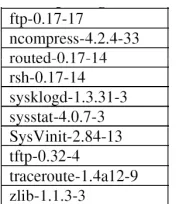
We have applied our framework on 10 open source pack-ages (approximately, 100,000 LOC), mostly from the Red-hat 9.0 distribution, and 72 clients (approximately, 200,000 LOC) of X11 APIs from theX11R6.9.0distribution. Fig-ure 6 lists the packages used in our evaluation. Our frame-work mined about 100 APIs that fail with critical errors from the source code. Error-check specifications were gen-erated for these critical APIs and verified against the soft-ware packages. 56 error-check violations were reported. We manually inspected the violations (by inspecting the source code) and found 49 violations to be real bugs, while 7 were false positives. False positives are caused because of the lack of sophisticated data-flow analysis in our model checker. Multiple-API specifications were mined as fre-quent sequences from non-exit traces, with a min sup value of0.8. 11 multiple-API specifications (9 real, 2 false) were mined resulting in 27 multiple-API violations (all vio-lations being real bugs) in the packages used in our eval-uation. We did not use the 2 false specifications in the verification phase after we verified the mined specifications against POSIX manual in UNIX and X11 Inter-client Com-munication Conventions Manual (ICCCM) [21] from the X Consortium standards. We next present an example of a multiple-API bug from xrdb/xrdb.c. Our framework mines a specification which dictates that the display pointer produced by the X11 API,XOpenDisplay, should be con-sumed by theXCloseDisplayAPI along all paths. How-ever, our framework detects an exit path in the program where the specification is violated; fdopen is called
af-ter XOpenDisplayalong this path, and the exit block of
fdopen (reached inter-procedurally through a call to an
error-handling procedure,fatal(...)) forgets to invoke
XCloseDisplaybefore a program exit. At the time of this
ck e sfromRe s tr ton
(b)X11 cl
i
ent sfromX11 R 6 .9.0di
str i bu
t i
on
Figure 6. Open source packages used in our evaluation
expect the number of API error-handling bugs that we re-port to increase.
5
Related Work
Previous work has mined API properties from program execution traces. For example, Ammons et al. [5] mine API properties as probabilistic finite state automata from execu-tion traces. Perracotta developed by Yang et al. [26] mines temporal properties (in the form of pre-defined templates involving two API calls) from execution traces. These ap-proaches require setup of runtime environments and avail-ability of sufficient system tests that exercise various parts of the program. Furthermore, stressful environment condi-tions need to be simulated to expose API-error behaviors. Such simulations of stressful environment conditions might not sufficiently expose API errors. In contrast, our new framework mines properties related to correct error han-dling from static traces without suffering from the preceding issues.
Related approaches developed by other researchers also mine properties from static source code for finding bugs. For example, PR-Miner developed by Li and Zhou [16] mines programming rules (involving multiple code ele-ments such as function calls) from source code. DynaMine developed by Livshits and Zimmermann [17] mines simple rules (involving mostly function-call pairs) from software revision histories. Ramanathan et al. [19, 20] mine function preconditions or function precedence protocols (involving function-call pairs) from static traces. Both Chang et al. [6] and Thummalapenta and Xie [22] detect missing condition-als by mining source code. None of these previous
ap-proaches find bugs related to API error handling as targeted by our new framework. A detailed comparison of our new framework with our previous approaches [2, 3] was already given in Section 1.
From exception-handling code in Java applications, Weimer and Necula [24] mine temporal safety rules that involve pairs of API calls used in Java’s exception han-dling. In contrast, our new framework focuses on C appli-cations and mine multiple-API specifiappli-cations (as frequent sequences) in error handling beyond pairs of API calls. In addition, our framework mines error-check specifications, not being mined by their approach.
A number of approaches [4, 13, 25] apply static analysis or model checking on the API implementation code to syn-thesize permissive API usage patterns that are allowed by the API implementation. Different from these approaches, our framework analyzes API client code (rather than API implementation code) and applies a miner on static traces extracted from the client code. Mining from API client code is complementary to mining from API implementa-tion code, and mining API client code can be applied where API implementation code is not available.
6
Conclusions and Future Work
relevant APIs used in the software packages. The mined specifications are then formally verified against the same (or other) software packages to uncover API error-handling bugs. We have implemented our framework, and validated the effectiveness of the framework on 82 widely used open-source software packages with approximately 300K LOC in total. The model checker used in our framework is data-flow-insensitive. This limitation leads to infeasible traces. In future work, we plan to explore the utility of data-flow-sensitive model checkers such as BLAST [12] for trace gen-eration. Although we have applied our framework on clients written in C, the basic idea is generally applicable to even object-oriented languages such as Java and C#.
References
[1] IEEE Computer Society, IEEE Standard Glossary of
Soft-ware Engineering Terminology, IEEE STD 610.12-1990.
December 1990.
[2] M. Acharya, T. Xie, J. Pei, and J. Xu. Mining API pat-terns as partial orders from source code: From usage sce-narios to specifications. In Proc. 6th joint meeting of the
European Software Engineering Conference and the ACM SIGSOFT Symposium on the Foundations of Software Engi-neering (ESEC/FSE), pages 25–34, 2007.
[3] M. Acharya, T. Xie, and J. Xu. Mining interface specifi-cations for generating checkable robustness properties. In
Proc. International Symposium on Software Reliability En-gineering (ISSRE), pages 311–320, 2006.
[4] R. Alur, P. Cerny, P. Madhusudan, and W. Nam. Synthesis of interface specifications for Java classes. In Proc.
Sym-posium on Principles of Programming Languages (POPL),
pages 98–109, 2005.
[5] G. Ammons, R. Bodik, and J. Larus. Mining
specifica-tions. In Proc. Symposium on Principles of Programming
Languages (POPL), pages 4–16, 2002.
[6] R. Y. Chang and A. Podgurski. Finding what’s not there: A new approach to revealing neglected conditions in software. In Proc. International Symposium on Software Testing and
Analysis (ISSTA), pages 163–173, 2007.
[7] H. Chen. Lightweight Model Checking for Improving
Soft-ware Security. PhD thesis, University of California,
Berke-ley, 2004.
[8] H. Chen and D. Wagner. MOPS: an infrastructure for ex-amining security properties of software. In Proc. ACM
Con-ference on Computer and Communications Security (CCS),
pages 235–244, 2002.
[9] J. Esparza, D. Hansel, P. Rossmanith, and S. Schwoon. Ef-ficient algorithms for model checking push down systems. In Proc. International Conference on Computer Aided
Veri-fication (CAV), pages 232–247, 2000.
[10] J. Forrester and B. P. Miller. An empirical study of the ro-bustness of Windows NT applications using random testing. In Proc. USENIX Windows Systems Symposium, pages 69– 78, 2000.
[11] J. Haddox, G. Kapfhammer, C. Michael, and M. Schatz. Testing commercial-off-the-shelf software components. In
Proc. International Conference and Exposition on Testing Computer Software, 2001.
[12] T. Henzinger, R. Jhala, R. Majumdar, and G. Sutre. Soft-ware verification with BLAST. In Proc. Workshop on Model
Checking Software, pages 235–239, 2003.
[13] T. A. Henzinger, R. Jhala, and R. Majumdar. Permissive in-terfaces. In Proc. European Software Engineering
Confer-ence and the ACM SIGSOFT Symposium on the Foundations of Software Engineering (ESEC/FSE), pages 31–40, 2005.
[14] J. Hopcroft and J. Ullman. Introduction to Automata Theory,
Languages and Computation. Addison-Wesley, 1979.
[15] P. Koopman and J. DeVale. The exception handling effec-tiveness of POSIX operating systems. IEEE Trans. Softw.
Eng., 26(9):837–848, 2000.
[16] Z. Li and Y. Zhou. PR-Miner: automatically
extract-ing implicit programmextract-ing rules and detectextract-ing violations in large software code. In Proc. European Software
Engineer-ing Conference and the ACM SIGSOFT Symposium on the Foundations of Software Engineering (ESEC/FSE), pages
306–315, 2005.
[17] B. Livshits and T. Zimmermann. DynaMine: finding com-mon error patterns by mining software revision histories. In
Proc. European Software Engineering Conference and the ACM SIGSOFT Symposium on the Foundations of Software Engineering (ESEC/FSE), pages 296–305, 2005.
[18] J. Pei, H. Wang, J. Liu, K. Wang, J. Wang, and P. Yu. Discovering frequent closed partial orders from strings.
IEEE Transactions on Knowledge and Data Engineering,
18(11):1467–1481, 2006.
[19] M. K. Ramanathan, A. Grama, and S. Jagannathan.
Path-sensitive inference of function precedence protocols. In
Proc. International Conference on Software Engineering (ICSE), pages 240–250, 2007.
[20] M. K. Ramanathan, A. Grama, and S. Jagannathan. Static
specification inference using predicate mining. In Proc.
Conference on Programming Language Design and Imple-mentation (PLDI), pages 123–134, 2007.
[21] D. Rosenthal. Inter-client communication Conventions
Manual (ICCCM), Version 2.0. X Consortium, Inc. 1994.
[22] S. Thummalapenta and T. Xie. NEGWeb: Static defect de-tection via searching billions of lines of open source code. Technical Report TR-2007-24, North Carolina State Univer-sity Department of Computer Science, Raleigh, NC, August 2007.
[23] J. Wang and J. Han. BIDE: Efficient mining of frequent
closed sequences. In Proc. International Conference on
Data Engineering (ICDE), pages 79–90, 2004.
[24] W. Weimer and G. C. Necula. Mining temporal specifica-tions for error detection. In Proc. International Conference
on Tools and Algorithms for the Construction and Analysis of Systems (TACAS), pages 461–476, 2005.
[25] J. Whaley, M. C. Martin, and M. S. Lam. Automatic ex-traction of object-oriented component interfaces. In Proc.
International Symposium on Software Testing and Analysis (ISSTA), pages 218–228, 2002.
[26] J. Yang, D. Evans, D. Bhardwaj, T. Bhat, and M. Das. Per-racotta: Mining temporal API rules from imperfect traces. In Proc. International Conference on Software Engineering