Copyright to IJIRSET www.ijirset.com 3500
PARAMETER ESTIMATION OF METAL
BLOOMS USING IMAGE PROCESSING
TECHNIQUES
Avadhoot R. Telepatil
1, Shrinivas A.Patil
2PG student, Department of Electronics Engineering, Textile and Engineering Institute, Ichalkaranji, Maharashtra, India1 Professor, Department of Electronics & Telecommunication Engineering, Textile and Engineering Institute,
Ichalkaranji, Maharashtra, India2
Abstract: Bloom is a mass of iron, steel, or other metal hammered or rolled into a thick bar for further work. In Industry blooms of different diameter, are manufactured on large scale and kept in bunch. These blooms can be used in future for different applications. Traditionally parameters of blooms such as bloom diameter are measured using venire calliper and number of blooms in a bunch is counted manually. In this technique most of the time manual counting leads to mismatch in the number of actual blooms and counted one. Human errors are responsible for wrong diameter measurement. The work presented in this paper deals with image processing approach to estimate bloom parameters such as bloom diameter and total number of these blooms in bunch. To estimate these parameters gradient based circular Hough transformation technique is implemented using MATLAB.
Keywords: circular bloom detection, Circular Hough Transform [CHT], diameter and count calculation.
I. INTRODUCTION
Bloom is a mass of iron, steel, or other metal hammered or rolled into a thick bar for further work. In ware house the bloom diameter measurement and count calculation is done manually which may leads to mismatch in final result due to human errors. The proposed system aims to bring automation in this estimation of bloom parameter process using image processing approach.
One of the major challenges in computer vision is determining the shape, location, or quantity of instances of a particular object [1]. An example is to find circular objects from an input image. While numerous feature extraction techniques are openly available for circle detection, one of the most robust and commonly used methods is the Circular Hough Transform (CHT) [2] [3]. Implementation of extracted circular Hough transform and Circle Defect Detection Algorithm to detect defect in a circular pattern that occurs in hard disk drive is proposed [4].Though CHT became a common method for circle detection in numerous image processing applications, because of its drawback such as computational time and required space several suggestions have been suggested[5] .The gradient based circular Hough transformation is used in many application after simple pre-processing and gain considerable improvement in performance against the traditional Circular Hough Transformation method[6].
To determine diameter of a bloom, gradient based Circular Hough Transformation method is used in which gradient of image pixels is calculated and depending upon magnitude of these gradient pixels circle detection and diameter estimation is done. The diameter value returned at the end is in terms of pixels. To convert pixel count into it‟s „millimetre (mm) a standard known diameter bloom is kept in image and considered as reference to obtain diameter values for remaining circles.
ISSN: 2319-8753
I
nternational
J
ournal of
I
nnovative
R
esearch in
S
cience,
E
ngineering and
T
echnology
(ISO 3297: 2007 Certified Organization)
Vol. 2, Issue 8, August 2013
Copyright to IJIRSET www.ijirset.com 3501
II. PROPOSED METHOD
Proposed method is implemented on various images of blooms in which all the blooms are kept in same plane with proper alignment. Images are taken from a fixed distance; background is kept uniform in all images.
The block diagram of the proposed method is shown in fig 1.
Read image of
bloom
Pre-processing
Circle detection and count
calculation algorithm
Display result
Convert RGB
image to
gray scale
Fig. 1 block diagram of proposed method
Step 1. Read image of bloom:
In first stage, individual image is read from database and used for further pre-processing operations.
Fig. 2 RGB bloom image with uniform background.
Step 2. Convert RGB image to gray scale:
Copyright to IJIRSET www.ijirset.com 3502
Fig 2.Gray scale bloom image
Step 3: Pre-processing:
Image pre-processing is a process to condition or enhance an image in order to make it suitable for further processing. The key function of pre-processing is to improve the image such that it increases the chances of success for other processes.
Noise is tremendously destructive for further processing [7]. Therefore assuming that the input image might be a noisy, it is essential to reduce salt and pepper noise and additive white Gaussian noise in order to prepare image for further processing stages. So for same 3x3 Gaussian low-pass filter and median filters to remove additive white Gaussian noise and salt and pepper noise respectively.
(a) (b) (c) (d)
Fig 3 (a) Image corrupted by additive white Gaussian noise (b) Image corrupted by salt and pepper noise (c) Gaussian filtered image (d) median filtered image
Fig 3 (a) and (b) illustrates images corrupted by additive white Gaussian noise and salt and pepper noise respectively. Fig 3 (c) and (d) Represents image after filtering process. These results shows that applying Gaussian low pass filter and median filtering over an image, additive white Gaussian noise and salt and pepper noise could be reduced to a great extend.
Step 4: Circular bloom detection and count calculation
Though CHT became a common method for circle detection in numerous image processing applications, due to its drawbacks such as required computational time and space, several improvements have been suggested [6].
In proposed application to detect circular bloom in image and estimate its diameter along with count calculation, gradient based Circular Hough Transformation technique is used.
ISSN: 2319-8753
I
nternational
J
ournal of
I
nnovative
R
esearch in
S
cience,
E
ngineering and
T
echnology
(ISO 3297: 2007 Certified Organization)
Vol. 2, Issue 8, August 2013
Copyright to IJIRSET www.ijirset.com 3503
1. Read input gray scale image.
2. Built accumulator array of size equal to original size of image. 3. Compute gradient magnitude of image pixels.
4. Get linear indices as well as subscript of pixels whose gradient magnitude is greater than given threshold value. 5. Update accumulator array with gradient magnitude at indices values obtained in step 4.
6. Search local maxima from accumulator array. 7. Group local maxima using 8-point connectivity.
8. Compute centroid position of each group and consider this centroid as center of detected circle.
9. Estimate radius for detected circle and using standard equation of circle draw circle around detected blooms. Finally diameter value in mm of remaining blooms is estimated by comparing with standard bloom image whose diameter is known.
III. SIMULATION RESULT
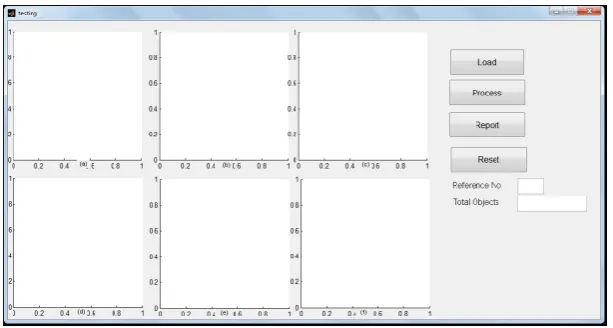
Use of Graphical User Interface (GUI) in program makes application user-friendly and speed up the user's work, GUI of discussed method is as shown in fig 4.
Fig 4. Graphical User Interface (GUI) of discussed method
Developed GUI contains six different windows which shows, original RGB image, intermediate pre-processing stages, final detected output and 3-d view of accumulator space. Using „Load‟, „Process‟ and „Report‟ pushbuttons one can read RGB image from database, process an image, generate report respectively. Bloom whose diameter is known is considered as reference object, and its number is entered to get actual diameter of remaining blooms in suitable unit i.e. in mm.
Discussed algorithm has been applied on various images of bloom in which distance between blooms and camera is kept constant with uniform background.
Copyright to IJIRSET www.ijirset.com 3504
Fig 5, Window (a) RGB image of blooms, Window (b), (c), (d) Intermediate pre-processing stages. Window (e) Illustrate detected blooms and Window (f) Shows the 3-D view of accumulator cell.
Bloom number 2 in fig 5(a) is considered as reference to calculate diameter of remaining blooms in image. In fig 5 Total number of blooms and date and time of processing are shown in edit box of GUI. Details generated report for fig 5 is shown table 1,
Table I No of detected blooms and its diameter in terms of mm (for Image with isolated blooms)
Sr. No Actual
Diameter (in mm)
Measured Diameter (in mm)
1 22 22
2 22 22
3 25.4 25.14
4 27.8 27.23
5 25.4 24.04
6 27.8 26.19
7 25.4 25.14
8 27.8 27.23
9 27.8 27.23
10 25.4 24.04
11 27.8 26.19
12 27.8 27.28
13 20 19
14 25.4 24.09
15 27.8 27.33
ISSN: 2319-8753
I
nternational
J
ournal of
I
nnovative
R
esearch in
S
cience,
E
ngineering and
T
echnology
(ISO 3297: 2007 Certified Organization)
Vol. 2, Issue 8, August 2013
Copyright to IJIRSET www.ijirset.com 3505
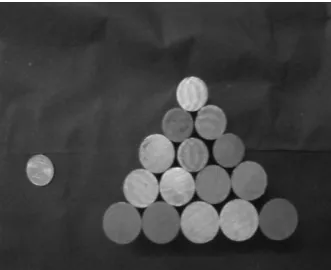
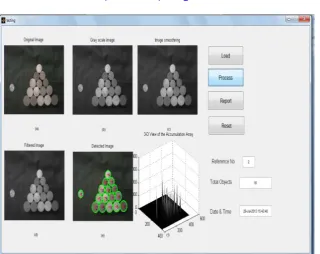
Fig 6 Window (a) RGB image of blooms, Window (b), (c), (d) Intermediate pre-processing stages. Window (e) Illustrate detected blooms and Window (f) Shows the 3-D view of accumulator cell.
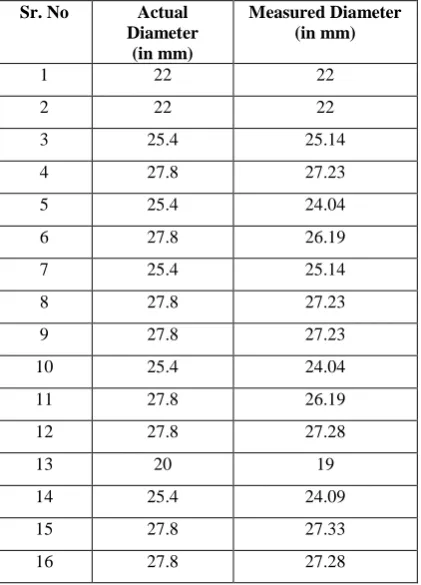
Bloom number 9 is considered as reference to calculate diameter of remaining blooms in image shown in fig 6. In this fig blooms are arranged in triangular shape. Total number of blooms with date and time of processing is shown in edit box of GUI. Detail generated report for fig 6 is shown table 2,
TABLE II No of detected blooms and its diameter in terms of mm (for Images with attached blooms kept in triangular shape)
Sr. No Actual Diameter
(in mm)
Measured Diameter (in mm)
1 20 20
2 27.8 28
3 25.4 25
4 25.4 25
5 27.8 28
6 25.4 25
7 25.4 23
8 22 22
9 22 22
10 27.8 28
11 25.4 23
Copyright to IJIRSET www.ijirset.com 3506
14 27.8 28
15 25.4 26
16 27.8 28
Fig 7 Window (a) RGB image of blooms, Window (b), (c), (d) Intermediate pre-processing stages. Window (e) Illustrate detected blooms and Window (f) Shows the 3-D view of accumulator cell.
In fig 7, bloom number 3 is considered as reference to calculate diameter of remaining blooms. In this fig blooms are arranged in a random shape. Total number of blooms with date and time of processing is shown in edit box of GUI. Detailed generated report is shown in table 3.
Table III No of detected blooms and its diameter in mm (for Image with attached blooms)
Sr. No Actual
Diameter (in mm)
Measured Diameter (in mm)
1 20 19
2 27.8 27
3 22 22
4 25.4 26
5 25.4 24
6 27.8 28
7 27.8 27
8 25.4 25
9 25.4 26
10 27.8 27
ISSN: 2319-8753
I
nternational
J
ournal of
I
nnovative
R
esearch in
S
cience,
E
ngineering and
T
echnology
(ISO 3297: 2007 Certified Organization)
Vol. 2, Issue 8, August 2013
Copyright to IJIRSET www.ijirset.com 3507
IV. CONCLUSION
In this paper, circle detection and diameter calculation algorithm with its implementation in MATLAB is presented. Algorithm is applied on the various images in which blooms are kept in different arrangement. For each arrangement accurate results have been received, like detection of blooms, number of blooms present in a bunch and diameter of each bloom. Each image contains blooms of different diameter. In an image if a bloom having same diameter as that of reference bloom, then estimated values are seen to be more accurate. For other, the diameter values are varying by ±1mm from actual value.
REFERENCES
[1] J. Illingworth, “surveys on Hough transform," Computer Vision, Graphics and Image Processing, vol. 44, p. 1988.
[2] Richard O. Duda and Peter E. Hart “Use of the Hough Transformation to detect lines and curves in pictures” graphics and image processing Communication of the ACM, Volume 15, Number 1, pp 11-15, January 1972.
[3] Fatoumata Dembele “Object Detection using Circular Hough Transform” ECE –Design team 3 documentation.
[4] Sirisak Liangwongsan, Boonraung Marungsri, Ratchadaporn Oonsivilai, Anant Oonsivilai “Extracted Circle Hough Transform and Circle defect detection algorithm” World Academy of Science, Engineering and Technology, pp 432-436, 2011.
[5] Simon Just Kjeldgaard Pedersen “Circular Hough Transform” Aalborg University,ision, Graphics, and Interactive Systems, November 2007.
[6] Ali Ajdari Rad1, Karim Faez, and Navid Qaragozlou1 “Fast Circle Detection Using Gradient Pair Vectors” Proc. VIIth Digital Image Computing:
Techniques and Applications, Sydney, 10-12 Dec. 2003, pp -879-887.
[7] R.C.Gonzalez, R.E.Woods “Digital Image Processing” 3rd edition, pp.322-335.
BIOGRAPHY
Avadhoot R. Telepatil, completed BE in Electronics and Telecommunication Engineering from Shivaji university in 2009.Currently pursuing ME in Electronics Engineering from Shivaji University. His research interests include Image Processing, Embedded system design. Total publications & presentations on credit are about 4.