ISSN(Online): 2319-8753 ISSN (Print): 2347-6710
I
nternational
J
ournal of
I
nnovative
R
esearch in
S
cience,
E
ngineering and
T
echnology
(An ISO 3297: 2007 Certified Organization)
Vol. 4, Issue 12, December 2015
Digital Image Compression using
Super-Resolution Scheme: A Review
Bandi Prathyusha1,V.Sujini Goud 2
Assistant Professor, Dept. of ECE, Malla Reddy Engineering College for Women, Hyderabad, Telangana, India1,2
ABSTRACT: In this paper we can observe the idea of image compression and have a look at approximately the varioustechnologies implemented on the image compression. Alsohighlight the sanctifications of the image compression.In image compression the inappropriate information iseliminated from the image maintaining in thoughts that the data isstored in an adequate form. By doing this the data from theunique image is occasionally is lost. Based on this, inside thereview paper the desires, its precept and numerous reportformats of image compression are mentioned. The paperadditionally focuses on algorithms of image compression the use of super resolutionthat is used to provide higher resolution andit prevents image distortion while zooming process.
KEYWORDS: Super resolution, compression ratio, Lossless compression, Lossy compression
I. INTRODUCTION
Super-resolution (SR) algorithms try and generate asingle high resolution (HR) image from one or more low-resolution (LR) images of the equal scene. The predominant assignmentis to recover the high-frequency information that become misplaced inthe system of producing the low-resolution inputs. If the low-resolution images were directly captured by using a camera, forinstance, this information changed into eliminated by way of the band-limitingfilter of the imagesystem due to imperfections in theoptics and integration over the pixels of the sensor. If the low-resolution images had been the result of software program down sampling,these data become misplaced through the filtering process ofanti-aliasing. The aim of the SR algorithms is to get betterthis lacking statistics in a manner that approximates theunique high-decision image as intently as possible. This is acritical trouble in numerous communities and has applicationswhich encompass object reputation, video transmission, imagecompression, and so forth.
Traditionally, SR approaches have used a fixed oflow-resolution images that have been captured with sub-pixel accuracyto try to resolve for the missing excessive-frequency data [1].Recently, however, there was developing interest in recuperating these facts from asingle, low-decision photo,a place of studies additionally called image hallucination [2]or image up sampling [3]. The “single-image amazing-decision”problem is mainly important due to the fact there are numeroussystems in which most effective a single, low-decision imageis available and the up sampling need to be carried out as a post process.
II. RELATED WORK
ISSN(Online): 2319-8753 ISSN (Print): 2347-6710
I
nternational
J
ournal of
I
nnovative
R
esearch in
S
cience,
E
ngineering and
T
echnology
(An ISO 3297: 2007 Certified Organization)
Vol. 4, Issue 12, December 2015
However, the computational burden has expanded, in evaluation paper [5], K. J. Kothari, Dr. D. D. Vyas, Dr. D. R. Bhojani show that the quantitative and visual outcomes are displaying the superiority of the proposed method over the conventional and kingdom-of-artwork image decision enhancement techniques. The computational complexity may be progressed by using parallel implementation to increase response time. Finally conclude that this approach can be prolonged to brilliant resolution of color films.In evaluate paper [6], Mrs. Preet Kaur, Geetu lalit show that image compression is a technique through which we can reduce thestorage space of photographs, motion images in order to beneficial to increase storage and transmission method’s performance. In imagecompression, we do now not simplest concentrate on reducing size but additionally focus on doing it with out dropping first-rate and facts of image.
In assessment paper [7], Michael Elad and Arie Feuer conclude that in the notable resolution recovery problem, an improveddecision photo is restored from several geometrically warped, blurred, and noisy and down sampled measured images. Hybrid approach is used for boom the speed. In this context, the ML, the MAP, and the POCS techniques are all proven to be without delay and in reality applicable to terrific decision recuperation with equivalencies among those methods.In overview paper [8], Hasan Demirel and Gholamreza Anbarjafari say that an image decision enhancement approach based totally on interpolation of the high frequency subband images obtained through discrete wavelet rework (DWT) and the enter image. The edges are enhanced by introducing an intermediate degree through using stationary wavelet rework (SWT).This technique improves that generate IDWT.In evaluation paper [9], Neeraj Kumar Atul Kumar finish that Peak signal to Noise ratio (PSNR) and Mean Square Error(MSE) are the 2 elements for measuring the first-rate of various denoising strategies. Main goal of the denoisingalgorithms is to dispose of noise even as preserving as a lot as possible the crucial image functions.
In evaluation paper [10], Mr. G.M. Khaire, Prof. R.P.Shelkikar says that method involves calculation of DWT sub bands. Highfrequency sub bands are interpolated to double their length. DWT loses a few data within themethod of interpolation; it's farcorrected with the assist of SWT. IDWT with unique image and high frequency additives provide terrific resolution image.
III. NEED OF IMAGE COMPRESSION
In general, data compression is the process of reducing thedata needed to represent a given quantity of information.The goal of image compression is to diminish the datarequired to represent a digital image.When a digital image is saved as a file on a web browser,it is basically saving it as a sequence of bits. Each pixel inthe image consists of one byte and each byte is made fromeight bits. If the image measures M*N pixels, then MNbytes is needed to accumulate the image. There are 256different bytes each of which has its own base 2representation. So for a web browser to display a storedimage, it must have the sequence of bits that describes thebit representation of each byte.
ISSN(Online): 2319-8753 ISSN (Print): 2347-6710
I
nternational
J
ournal of
I
nnovative
R
esearch in
S
cience,
E
ngineering and
T
echnology
(An ISO 3297: 2007 Certified Organization)
Vol. 4, Issue 12, December 2015
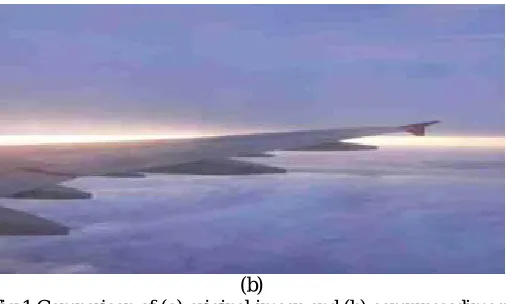
(b)
Fig 1 Comparison of (a) original image and (b) compressedimage
Table.1 Results showing variations in dimensions oforiginal image to compressed image having 99.7% savings in file size
PARAMETERS Original Compressed
Width 2448 pixels 400 pixels
Height 3264 pixels 533 pixels
File Size 2,196.8 kb 5.9 kb
The purpose of image compression is to lessen the size ofdigital images to save storage space or transmission time.The image with dimensions 512*512*3 = 786,431 pixelsrequires only 41,909 bytes when compressed in JPEGformat. The question that arises is how the space can besaved while maintaining most of the content. The ratio ofsizes tells us about the effectiveness the image. The termdefining this is known as the compression ratio.
Compression ratio = (Size of an original image)/(Size of the compressed image)
A. Lossless compression
Lossless compression [1] is a compression algorithm inwhich the original image can be reconstructed from the
compressed image i.e. after compression, reconstructedimage is numerically identical to the original image. Someof the image files formats use lossless compressions arePNG or GIF.
Fig 2 Lossless Compression
There are the following technique are included inlossless compression.
Run length encoding
Huffman coding
LZW coding
Area coding
Run length encoding: - The run length compressiontechnique is useful in case of repetitive data. In thistechnique the sequence identical symbol or pixel isreplace and it is known as run by shorter symbol. The runlength code gray scale
image is represented by asequence (Vi, Ri).where Vi is the intensity of pixel and Riis the no of consecutive pixel with
intensity as shown infig Original
image
Lossless-Compression
ISSN(Online): 2319-8753 ISSN (Print): 2347-6710
I
nternational
J
ournal of
I
nnovative
R
esearch in
S
cience,
E
ngineering and
T
echnology
(An ISO 3297: 2007 Certified Organization)
Vol. 4, Issue 12, December 2015
Fig3 Run length encoding
Huffman coding: - Huffman coding is based on theprobabilities or statistical occurrence frequencies. In theHuffman encoding each pixel are treated as a symbol.The symbols which have frequency are assigned asmaller number of bits while the symbol which has lessfrequency is assigned a relative large number of bits.While the symbol which has less frequencies are assigneda relative large no of bits.
Lempel-Ziv-Welch (LZW): - It is a very usefulcoding. It is used in computer industries, and inimplemented as a computer on UNIX. It is dictionarybase coding. LZW is basically of two type, Static anddynamic. In static dictionary coding, when the code isassigned (encoding) and in decoding process. Dictionaryis not change. Dictionary is fixed in both processes. Butin thedynamic dictionary coding updated on fly.
Area Coding: - Area coding is enhanced foam of runlength coding of lossless compression. The significant oflossless method is that this technique over the other, ifreflecting two dimension character of images. Thiscoding uses an array of sequence building up a twodimension object. The algorithms for this coding try tofind rectangular region with the same characteristics andthese regions are coding in a descriptive form as anelement with two points and a certain structure. Theproblem with this coding is that, it cannot beimplemented in hardware because of non-liner method.
B. Lossy compression:
In lossy compression, redundant information ispermanently removed. When an image is uncompressed, only a part of the original image exists and the rest ispermanently removed which is unnoticeable to the user.Most commonly used image file formats include JPEGimage file.
Fig 4 Lossy Compression
There are the following Lossy compression technique include followingscheme
Transformation coding
Vector quantization
Fractal coding
Block truncation coding
Sub band coding
Transformation coding: - transformation coding is alossy compression technique resulting in a lower qualitycopy of
original signal. This scheme is used for „natural‟data like audio signal or biomedical image.In transformation coding
less bandwidth is required. Inthis coding scheme transform such as DFT (discreteFourier transform) and DCT (discrete coding transform)are used to change the pixel in the original image into
Original image
Lossy-Compression
ISSN(Online): 2319-8753 ISSN (Print): 2347-6710
I
nternational
J
ournal of
I
nnovative
R
esearch in
S
cience,
E
ngineering and
T
echnology
(An ISO 3297: 2007 Certified Organization)
Vol. 4, Issue 12, December 2015
frequency domain coefficients. These coefficients haveseveral desirable properties; one is the energycompression property that results in most of the energy ofthe original data being concentrated in only a few of thesignificant transform coefficient. This is the basic ofachieving the compression only few significantcoefficients are selected and remaining are discarded.The selected coefficient are further quantization and
entropy encoding. DCT coding has been the mostcommon approach to transform coding and also adopted in the JPEG image compression standard
Vector Quantization:- In vector quantization adictionary of fixed-size vectors, is to be develop, calledcode vectors. A vector is usually a block of pixel values.So image is then partitioned into non-overlapping blocks (vectors) called image vectors. Then for each in thedictionary is determined and its index in the dictionary is used as the encoding of the original image vector. Thus,each image is represented by a sequence of indices that can be further entropy coded.
Fractal Coding: - In Fractal Coding decompose theimage into segments by using standard image processing techniques such as edge detection, color separation, andspectrum and texture analysis. Then each segment is looked up in a library of fractals. The library actuallycontains codes called iterated function system (IFS)codes, which are compact sets of numbers. Using asystematic procedure, a set of codes for agiven image aredetermined, such that when the IFS codes are applied to asuitable set of image blocks yield an image that is a veryclose approximation of the original. This scheme ishighly effective for compressing images that have good
regularity and self-similarity.
Block truncation coding:- In this scheme, the imageis divided into non-overlapping blocks of pixels. For eachblock, threshold and reconstruction values aredetermined. The threshold is usually the mean of thepixel values in the block. Then a bitmap of the block isderived by replacing all pixels whose values are greaterthanor equal (less than) to the threshold by a 1 (0). Thenfor eachsegment (group of 1s and 0s) in the bitmap, thereconstructionvalue is determined. This is the average ofthe values of thecorresponding pixels in the originalblock.
Sub band coding:- In this scheme, the image isanalyzed to produce thecomponents containingfrequencies in well-defined bands, theSub bands.Subsequently, quantization and coding is applied to eachof the bands. The advantage of this scheme is thattheQuantization and coding well suited for each of thesub bands can be designed separately.
V. CONCLUSION
This paper represent the idea of image compressionand various technologies used inside the image compressionevaluating the overall performance of compression techniquesame data units and overall performance measure are used. In this paper we studied image compression based onfantastic decision technique, need and precept. We alsofocused on numerous imaging report codecs and compressionstrategies of lossy and lossless image compression. Wethereby concluded that super resolution technique is themaximum efficient approach of photograph compression because itcombines multiple low decision images to form an excessiveresolution picture. The prime benefit of the usage of superresolution approach is that it could fees much less and thepresent low decision image may be nevertheless being applied.
REFERENCES
[1] Sapan Naik, Nikunj Patel (2013). Single Image Super Resolution In Spatial and Wavelet Domain. The International Journal of Multimedia & ItsApplications (IJMA) Vol.5, No.4.
[2] Sapan Naik, Viral Borisagar,(2012) A novel Super Resolution Algorithm Using Interpolation and LWT Based Denoising Method. International Journal ofImage Processing (IJIP), Volume .6, Issue 4.
[3] Mathew .K, Dr. S. Shibu (2011) Wavelet based Technique for Super Resolution Image Reconstruction. International Journal of Computer Applications(0975 – 8887) Volume 33– No.7.
[4] Deepa K Davis & Rajesh Cherian Roy (2012). Hybrid Super Resolution using SWT and CT. International Journal of Computer Applications (0975 – 8887)Volume 59– No.7.
ISSN(Online): 2319-8753 ISSN (Print): 2347-6710
I
nternational
J
ournal of
I
nnovative
R
esearch in
S
cience,
E
ngineering and
T
echnology
(An ISO 3297: 2007 Certified Organization)
Vol. 4, Issue 12, December 2015
[6] Mrs. Preet Kaur, Geetu lalit (2012) .Comparative Analysis of DCT, DWT &LWT for Image Compression. International Journal of Innovative Technologyand Exploring Engineering (IJITEE), Volume-1, Issue-3, ISSN: 2278-3075.
[7] Michael Elad and Arie Feuer((1997). Restoration of a Single Super resolution Image from Several Blurred, Noisy, and under sampled Measured Images.IEEE TRANSACTIONS ON IMAGE PROCESSING, VOL. 6, NO. 12.
[8] Hasan Demirel and Gholamreza Anbarjafari (2011).Image Resolution Enhancement by Using Discrete and Stationary Wavelet Decomposition, IEEETRANSACTIONS ON IMAGE PROCESSING, VOL. 20, NO. 5.
[9] Neeraj Kumar Atul Kumar (2014) Image Denoising Techniques in Spatial Domain and Wavelet Domain. International Journal of Engineering Research &Technology (IJERT) Vol. 3 Issue 2, ISSN: 2278-0181
[10] Mr. G.M. Khaire, Prof. R.P.Shelkikar (2013). Resolution Enhancement of images with Interpolation and DWT-SWT Wavelet Domain Components.International Journal of Application or Innovation in Engineering & Management (IJAIEM), Volume 2, Issue 9.
BIOGRAPHY
Bandi Prathyusha completed her M.Tech (Embedded Systems), she is having teaching experience of 7 months. Presently working as Assistant Professor, ECE Dept, Malla Reddy Engineering College for Women, Hyderabad, Telangana, India.