Copyright2000 by the Genetics Society of America
Computational and Experimental Characterization of Physically Clustered
Simple Sequence Repeats in Plants
Linda Cardle, Luke Ramsay, Dan Milbourne, Malcolm Macaulay,
David Marshall and Robbie Waugh
Scottish Crop Research Institute, Dundee DD2 5DA, Scotland, United Kingdom Manuscript received January 31, 2000
Accepted for publication June 26, 2000
ABSTRACT
The type and frequency of simple sequence repeats (SSRs) in plant genomes was investigated using the expanding quantity of DNA sequence data deposited in public databases. In Arabidopsis, 306 genomic DNA sequences longer than 10 kb and 36,199 EST sequences were searched for all possible mono- to pentanucleotide repeats. The average frequency of SSRs was one every 6.04 kb in genomic DNA, decreasing to one every 14 kb in ESTs. SSR frequency and type differed between coding, intronic, and intergenic DNA. Similar frequencies were found in other plant species. On the basis of these findings, an approach is proposed and demonstrated for the targeted isolation of single or multiple, physically clustered SSRs linked to any gene that has been mapped using low-copy DNA-based markers. The approach involves sample sequencing a small number of subclones of selected randomly sheared large insert DNA clones (e.g., BACs). It is shown to be both feasible and practicable, given the probability of fortuitously sequencing through an SSR. The approach is demonstrated in barley where sample sequencing 34 subclones of a single BAC selected by hybridization to the Big1gene revealed three SSRs. These allowed Big1 to be located at the top of barley linkage group 6HS.
T
HE ubiquity of simple sequence repeats (SSRs) in assessed by oligonucleotide hybridization, and sucheukaryotic genomes and their usefulness as genetic studies have suggested figures in the range of one SSR markers has been well established over the last decade. every 65 kb to 80 kb (Panaud et al. 1996; Echt and
In mammalian systems, in particular, SSRs have been Maymarquardt1997). These results contrast sharply
the marker of choice for several years, and well-devel- with those for humans, with an estimate of one SSR oped SSR-based linkage maps are available for a number every 6 kb on average (BeckmannandWeber1992). of species (Dibet al.1996;Dietrichet al.1996;Sverd- Despite this relative difference in abundance, the per-lovet al.1998). A high level of SSR informativeness has ceived advantages of SSRs as markers are such that plant also been demonstrated for a variety of plant species geneticists have resorted to screening large numbers of and this has prompted the initiation of SSR discovery clones (Ro¨ deret al.1995;Liuet al.1996;Bryanet al.
programs for the majority of agronomically important 1997) or developing selective SSR enrichment
tech-crops (Weisinget al.1989;ConditandHubbell1991; niques (Edwards et al. 1996; Milbourneet al. 1998) Akkaya et al. 1992; Zhao and Kochert 1992; Mor- to generate sufficient numbers of SSRs for implementa-gante and Olivieri 1993; Wu and Tanksley 1993; tion in genetic research (e.g.,Pagliaet al.1998;Ro¨ der Ro¨ der et al.1995; Liuet al. 1996;Panaudet al. 1996; et al. 1998). Given the interest of the plant genetics Provanet al. 1996; Senior et al. 1996;Milbourne et community in SSRs as genetic markers, we have been al.1997, 1998). However, to date, a number of limita- particularly concerned to establish methods of rapidly tions have existed with SSR discovery in plants, including identifying robust and informative SSRs linked to genes
a lack of DNA sequence in databases, a perceived low of agronomic significance. Compared with
genome-abundance of SSRs (compared to mammals), and
differ-wide isolation approaches, gene-targeted strategies are ences in the most common types of repeat found.
more likely to yield SSRs that are relevant to the goals Previous analyses of plant DNA sequence database
of marker-assisted selection and germplasm assessment. entries for all possible SSR motifs have revealed
frequen-In the former, linkage disequilibrium between an SSR cies ranging from one every 29 kb to 50 kb, depending
and a gene is fortuitous and frequently insufficient for on species (Lagercrantz et al. 1993;Morgante and
transfer to other germplasm of interest. Oliveiri1993). SSR frequency in plants has also been
Given these objectives, we have reassessed the fre-quency of SSRs in plant genomes, taking advantage of the significant number of long contiguous sequences
Corresponding author:Robbie Waugh, Scottish Crop Research
Insti-(⬎10 kb) recently deposited in international sequence
tute, Invergowrie, Dundee DD2 5DA, United Kingdom.
E-mail: [email protected] databases. The use of such data includes the intergenic
of 25l, incubated at 14⬚overnight]. One microliter of each
regions that, even in Arabidopsis, make up about half
ligation was transformed into DH5␣competent cells by
elec-the genome and would reduce elec-the bias toward coding
troporation. Recombinant clones were picked off LB
ampicil-regions inherent in previous studies. lin (50g/ml), isopropylthio--d-galactoside, X-gal plates,
col-ony purified, plasmid prepped by standard approaches, and sequenced in one direction (using PE “BigDye” sequencing
MATERIALS AND METHODS reagents and the M13 forward primer).
Sequence homology searches, SSR primer design, and analy-Sequence data sources and analysis of SSR content:
Se-sis:The sequences obtained were checked against public data-quences were acquired through a Sequence Retrieval System
bases using BLASTN and BLASTX search algorithms (Altschul search of EMBL and EMBL updates [on 10/08/98 for
geno-et al.1997). Following the SSR analysis procedures given above, mic (⬎10 kb long) and Arabidopsis expressed sequence tags
primers were designed to sequences flanking SSRs using the com-(ESTs) and on 22/06/99 for other ESTs]. To locate SSRs in
puter program PRIMER (v 3.0; E. Lander, Cambridge, MA). For the sequence data, we used the C-program Sputnik (by Chris
the experimental verification, three primer pairs were designed Abajian at Washington University,
http://www.abajian.com/sput-to SSRs found in subclone sequences, BAC84c21_s02; forward (5⬘ -nik), which finds SSRs of between 2 and 5 bases long,
incorpo-TACAGGTAAAGGTTACTTGACG-3⬘) and reverse (5⬘-ATGAAA rating a scoring system to detect imperfections in the pattern.
ACAAACGA GAAAAGA-3⬘), BAC84c21_s34; forward (5⬘-CATG In the subsequent calculations, only those SSRs with a perfect
GGCTAATCGTGCTT-3⬘) and reverse (5⬘-TGATTTTAACCTAT repeat pattern were included. The GCG (version 8.1-UNIX)
TGAGCTTTT-3⬘) and BAC84c21_s33; forward (5⬘-AATCCCTCT program FINDPATTERNS was used to locate mononucleotide
TCATAAATTAGTG-3⬘) and reverse (5⬘-TTCAAATCACTGAA repeats in the Arabidopsis genomic and EST sequences.
CAAAAAC-3⬘). In addition, two primer pairs were designed to For the searches, we define SSRs as being mononucleotide
SSRs found in the sequence of Big1(AF166121); AF166121A; repeats⬎15 bp, dinucleotide repeats⬎14 bp, trinucleotide
forward (5⬘-TTATGCTTCACACGGTGTAC-3⬘) and reverse (5⬘ -repeats⬎15 bp, tetranucleotide repeats⬎16 bp, and
penta-GGCACAAAAAGACTGAAATAG-3⬘) and AF166121B; forward nucleotide repeats⬎20 bp. For comparison with other
compu-(5⬘-ATAAAGAAAGCTGGAGTACCC-3⬘) and reverse (5⬘-AACTT terized searches for SSRs in plant genomic sequence, we also
GTTGGTTGTACTCTGG-3⬘). used the criteria of SSR motifs of 20 bp and over (Lagercrantz
PCR reactions, using the direct incorporation of fluorescent et al. 1993; Wang et al.1994). A series of Perl5 scripts was
oligonucleotides, were performed in a total volume of 15l written to analyze and summarize the SSR data obtained from
following manufacturer’s instructions (Perkin-Elmer, Nor-Sputnik and FINDPATTERNS. We calculated the frequency
walk, CT) and were run on a PE 9600. A PE 377 DNA sequencer of occurrence of SSR motifs from mono- to pentanucleotide
with GeneScan software was used to visualize the results. Some in barley, rice, tomato, potato, and Arabidopsis genomic and
reactions giving ambiguous results were confirmed by re-Arabidopsis EST sequences and di- to pentanucleotides in
peating the PCR reactions on a PE 9600 in a total volume of rice, maize, poplar, tomato, and soybean EST sequences. We
10l and consisted of 20 ng genomic DNA, 1⫻PCR buffer, also classified all repeat types from mononucleotide to
tetranu-0.3 unitsTaqpolymerase (both from Boehringer Mannheim), cleotide, taking sequence complementarity into account, and
200mdNTPs, and 0.3mof forward and reverse primers, examined their occurrence in Arabidopsis genomic DNA and
the reverse primer being end-labeled with [␥-33P]ATP. An equal Arabidopsis ESTs (Table 1 and Figure 1). We found 51
Arabi-volume of 95% formamide electrophoresis loading buffer was dopsis thalianaEMBL entries that had features tables that were
added to the samples, which were then denatured, snap cooled sufficiently detailed to estimate the occurrence of SSR motifs
on ice, and electrophoresed in 6% Easigel (Scotlab) according within exons and introns (Figure 1). This subset of the
geno-to standard procedures. An M13 sequencing marker was run mic sequences totaled 5,597,709 bp and included 7141 exons
to estimate product sizes and visualization of results was totaling 1,759,177 bp (31% of total length) and 5844 introns
achieved by exposure of fixed, dried gels to X-ray film. totaling 1,286,007 bp (23%).
Linkage analysis of the Lina⫻Hordeum spontaneumCanada
Bacterial artificial chromosome (BAC) isolation, subcloning,
Park population was carried out by combining the segregation
and sequencing:The first 73,728 clones of a 7⫻BAC library of
data with existing mapping data (Ramsay et al. 2000) and barley cv. Morex (http//www.genome.clemson.edu—R. Waugh,
performed using Joinmap (version 2.0; P. Stam and J. W. Van R. Wing and J. Tomkins, personal communication) were
Ooijen, Wageningen: CPRO-DLO). screened using a 363-bp fragment of theBig1gene (courtesy
of J. Hargreaves, IACR).Big1shows high homology to leucine-rich repeat (LRR) motifs found in many resistance gene
ana-RESULTS logues (Jones and Jones 1997). A single BAC clone
(BAC84c21), the most strongly hybridizing from a total of 24, Frequency, type, and distribution of SSRs inA. thali-was purified using a QIAGEN (Chatsworth, CA) plasmid midi
ana: A total of 306 nonredundant genomic DNA
se-kit according to a protocol modified by the manufacturers for
quences longer than 10 kb and 36,199 EST sequences
the isolation of BAC DNA. A total of 20g purified BAC DNA
in a volume of 200l dH2O was fragmented by sonication in were retrieved from the EMBL nucleotide database
(re-an MSE (Sussex, UK) 150-W ultrasonic disintegrator with a lease 24/06/98) and searched for the presence of SSR nominal frequency of 20 kc/sec, using five 1-sec, 15-m ampli- motifs. All but one of the long genomic DNA sequences tude pulses. Fragments of 1–3 kb were size selected on a 1%
contained at least one SSR. Figure 1a shows the
distribu-agarose minigel, electroeluted, and resuspended at a
concen-tion of number of SSRs per sequence from 198 P1 and
tration of 50 ng/l in dH2O. The ends of 1.0 g sonicated
DNA were “polished” using the Klenow fragment of DNA BAC clones. The SSR content shows a normal
distribu-polymerase I by incubation at room temperature for 10 min tion around a mean of 10 SSRs per clone. In contrast, followed by 75⬚ for 10 min (in 50 mmTris-HCl pH 7.2, 10 only 3% of ESTs contained an SSR, which is similar to mm MgSO4, 0.1 mm dithiothreitol, 20 g/ml BSA, 40 m
the proportion previously found in rice (Akagi et al.
dNTPs, 5 units Klenow) and ligated into SmaI cut pUC18
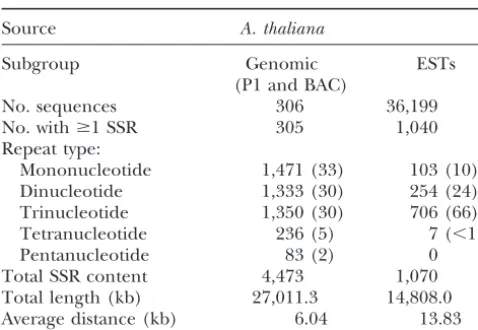
1996). Table 1 shows the frequency of occurrence of
[5 ng pUC18, 500 ng sonicated DNA, 0.25 units Ligase, 1⫻
Figure 1.—Frequency of SSRs in Arabidopsis. (a) Ac-tual number of SSRs in a collection of P1 and BAC clones. (b) Number and type of SSRs/100 kb of genomic and EST sequence. (c) Num-ber of SSRs of different re-peat lengths in intron, exon, and intergenic sequence.
For Arabidopsis genomic DNA, the average distance The most common motif found in the Arabidopsis
genomic DNA was the mononucleotide A/T, which between SSRs wasⵑ6.04 kb compared to 14 kb for ESTs.
Compound repeats, which, if frequent, would affect the comprises 32% of all SSRs found (Figure 1b). AT/TA repeats comprised 16% of the total SSR content, AAG/ overall average, were surprisingly rare. Twenty-seven
cases were found where two repeat regions were immedi- TTC, 14%, and AG/TC, 10%. Dividing the SSRs into
repeating unit size classes, the SSR content was almost ately adjacent and 47 where two repeats were within 5
bp of each other. These constitute only 3.3% of the equally divided between mono- (33%), di- (30%), and
trinucleotides (30%). The proportion of SSR repeat SSRs found, making little difference to the average
TABLE 1 proportions found within the data examined indicated that over 40% of all trinucleotide repeats are exonic in
SSR survey of Arabidopsis genomic
Arabidopsis.
and EST sequence data
The results of the SSR searches were used to extract flanking sequences to allow the design of primer pairs
Source A. thaliana
to over 4000 Arabidopsis SSRs for a range of annealing
Subgroup Genomic ESTs
temperatures and product sizes. These primer
se-(P1 and BAC)
quences and associated information will be lodged at
No. sequences 306 36,199
Arabidopsis Genome Resource at (http://synteny.nott.
No. withⱖ1 SSR 305 1,040
ac.uk/agr/agr.html).
Repeat type:
Mononucleotide 1,471 (33) 103 (10) SSR distribution in other plants:Of 52 genomic DNA
Dinucleotide 1,333 (30) 254 (24) sequences over 10 kb in length from species other than
Trinucleotide 1,350 (30) 706 (66) Arabidopsis, 38 were found to have at least one SSR
Tetranucleotide 236 (5) 7 (⬍1)
motif. The overall average distance between SSRs for
Pentanucleotide 83 (2) 0
these species was 6.8 kb (38 SSRs in a total of 1075 kb),
Total SSR content 4,473 1,070
almost identical to that found in Arabidopsis alone. As
Total length (kb) 27,011.3 14,808.0
with Arabidopsis, the most common motifs were A/T
Average distance (kb) 6.04 13.83
and AT/TA for mono- and dinucleotides; however, AAT
Numbers in parentheses show percentage of total SSR
con-was the most common trinucleotide motif. In the 52
tent.
sequences, only 7 out of the 33 possible tetranucleotide repeat motifs were found, most of which were AT-rich: (AAAG), (AAAT), (ACCC), (AATT), (ACAT), (AGAT), and (ATGC).
repeats were trinucleotides (AAG/TTC, 29% and ATC/
TAG, 17%) followed by the dinucleotides (AG/TC, A number of contiguous sequences of over 30 kb were
available for inclusion in this study (from barley, tomato, 20%), and the mononucleotide A/T(10%). In both
ge-nomic DNA and ESTs, AAG/TTC repeats comprised rice, and potato). Using all available data from these
species, the estimated SSR frequency is one every 7.4 45% of the total trinucleotide content, followed by
ATC/TAG (26% in genomic, 15% in EST). In genomic kb in barley, 7.1 kb in tomato, 7.4 kb in rice, and 6.4
kb in potato genomic DNA. Despite the relatively small DNA the most common dinucleotide was AT/TA (in
stark contrast to the total absence of any CG/GC re- number of sequences available, the similarity in SSR frequency with Arabidopsis suggests that one every 6–7 peats). In ESTs, AG/TC repeats were almost eight times
as frequent as the AT/TA repeats. In genomic DNA, the kb may be a good general estimate for SSR frequency in the type of plant DNA sequence studied here (i.e., AT-rich tetranucleotide repeats were more common than
CG-rich repeats, with 13 tetranucleotide motifs never oc- large insert DNA clone sequences containing a gene of interest).
curring: (CCCG), (CCGG), (AACG), (AAGT), (ACCG),
(ACCC), (ACGG), (AGCC), (AGGC), (ATCC), (ACGC), The highest frequency of the EST-derived SSRs
(ex-cluding mononucleotide motifs) was found in rice at and (AGCG) (i.e., 9 out of 10 possible CG-rich motifs).
The ESTs contained virtually no tetranucleotide repeats. 3.4 kb between SSRs (which agrees closely with the esti-mate ofAkagiet al.1996) followed by soybean (7.4 kb), By examining the detailed features tables available
for 51 of the 306 Arabidopsis genomic sequences, a maize (8.1 kb), tomato (11.1 kb), poplar (14.0 kb), and cotton (20.0 kb). The overall average for these species considerable difference in the distribution of SSR motifs
was found between introns, exons, and intergenic re- was one SSR every 5.4 kb (7193 SSRs found in 38,502
kb of sequence). gions (Figure 1c). Almost two-thirds of SSRs were found
in intergenic regions (608 out of total of 961), and the Targeted SSR isolation: theBig1gene of barley:Given a known average inter-SSR distance, it is possible to majority of these were either mono- or dinucleotides.
A total of 14% (132/961) of the SSRs were found in construct a simple model to calculate the probability of finding an SSR in a contiguous DNA sequence as a exons and 23% (221/961) in introns.
Of the exonic SSRs, 91% were trinucleotides reflecting simple function of the average DNA sequence read length and thereby calculate the probability of uncov-repetitive amino-acid sequence motifs, although there was
no simple pattern of motifs in relation to different pro- ering an SSR as a function of read length and the num-ber of sequencing runs performed.
tein classes. The remaining 9% were made up of 10
dinucleotides, one mono-, and one pentanucleotide re- To test this hypothesis, a single barley BAC clone, chosen on the basis of hybridization screening with an peat. A more diverse range was found in introns (40%
mono-, 32% di-, 23% tri-, 3% tetra-, and 3% penta- LRR-containing gene fragment of the Big1 gene, was
chosen for sample sequencing. A total of 36 random nucleotides) with similar proportions of repeat types
being found in intergenic regions, (36% mono-, 38% subclones were sequenced from one end with each
sequences showed homology to known cereal retroele- At present,ⵑ100 SSRs in Arabidopsis have been de-scribed previously [A. thalianaGenome Center (http://cbil. ments, mostly LTR copia elements,e.g., BARE-1 (
Manni-nenand Schulman1993) at the nucleotide level and humgen.upenn.edu/ⵑatgc/SSLP_info/), Depeiges et al. 1995;Loridonet al.1998], making the 5000 SSRs found three additional hits to plant retrotransposon
polypro-during this study a very considerable increase in the tein/integrase domains using translations of the
se-number of available genetic markers. Even if a stricter quences. Nine other sequences showed homology to
definition of length ofⱖ20 bp is used (BellandEcker regions upstream of known cereal genes. However, on
1994), these new SSRs still represent an increase of closer inspection six of these homologies were due to
greater than an order of magnitude in the number of the presence of miniature inverted repeat transposable
SSRs available. It is noteworthy, however, that 5 of the elements, mostly of the Stowaway type (Bureau and
12 SSRs found to be polymorphic over four accessions Wessler 1994). Two sequences showed homology to
by Depeiges et al. (1995) were compound/imperfect regions upstream of theg1 andOst1 genes present in
SSRs of⬍20 bp in length. the 60-kb contig around the mlo gene (Panstrugaet
The analysis of large genomic sequences from other al. 1998). The other subclone (BAC84c21_s24) showed
plant species demonstrated that the frequency of SSRs identity to a region upstream of the barley Big1 gene
in Arabidopsis (every 6–7 kb) holds for other plants as (AF166121) that was the source of the PCR fragment
well. Our findings agree with previous studies that the used for the hybridization with the BAC library (Y.
most common SSR motifs in plants are A/T rich. The Tokunaga, J. P. R. KeonandJ. A. Hargreaves,
unpub-most common dinucleotide repeat (AT/TA followed lished results).
by AG/CT; Lagercrantz et al. 1993; Morgante and
The sequences of the subclones were analyzed for the
Olivieri1993;Wanget al.1994;Smulderset al.1997) presence of SSRs as described above. Three subclones
contrasts with the most common (AC/TG) found in of the 36 sequenced showed the presence of an SSR,
mammals (HamadaandKakunaga1982;Stallingset
with BAC84c21_s02 containing (CTT)6, BAC84c21_s34,
al.1991). Direct comparisons between estimates of SSR (AT)6, and BAC84c21_s33, (T)10. In addition, two SSRs
frequency in this and other studies are rendered diffi-were discovered within the sequence (AF166121)
up-cult by differing minimal motif length criteria. Our stream of the Big1 gene: (A)10 at position 2073–2082
slightly less stringent criteria are based on our experi-(named AF166121A) and (CTT)5at position 2845–2859
ence that primers designed to the motif lengths we (named AF166121B). Primers designed to the flanking
outline are generally successful in revealing polymor-regions were tested on the parents of a mapping
popula-phism. Although these different criteria affect the abso-tion (Lina⫻H. spontaneumCanada Park) with both
mono-lute and relative frequency of the motifs found, it is nucleotide SSRs, BAC84c21_s33 and AF166121A, showing
clear that past estimates have also been affected by the polymorphism. These two primer pairs were tested on the
bias in sequences lodged in databases. F1doubled haploid population derived from these parents
The study reported here has made use of the recent with both SSRs mapping to the same position on the short
submission of a large volume of contiguous DNA se-arm of 6H, 11 cM from the distal end.
quence emerging from the Arabidopsis genome se-quencing project to allow an estimate to be made on sequence that is not skewed toward coding regions. This,
DISCUSSION
together with the detailed annotation on a large propor-The results presented here show that SSRs in plant tion of the data, has shown that not only are SSRs at a
genomic DNA are much more common than previous higher frequency than previously estimated but also that
estimates suggest, indicating a frequency of 1 SSR every the frequency of the SSRs varies within the genome, 6–7 kb, which is equivalent to that described in mam- with exonic and intronic sequences making up roughly
mals (Beckmann and Weber 1992). The revision of 55% of the genomic sequence but containing only 37%
this estimate is due to the recent submission of a large of the SSRs. This is particularly evident in exons that
volume of contiguous DNA sequence emerging from make up 31% of the genomic sequence but contain
the Arabidopsis genome sequencing project, allowing only 14% of the SSRs, 91% of which are trinucleotide. our search to be carried out on over 27,000 kb of geno- This corresponds well with the finding of this study and mic sequence. PreviouslyWanget al.(1994) proposed that ofAkagiet al.(1996) of a lower frequency of SSRs an average frequency of 1 SSR every 42.4 kb in Arabi- in EST sequences with a preponderance of trinucleotide dopsis on the basis of the presence of 10 SSRs in the repeats. It also explains some of the differences between Arabidopsis sequence available at the time. The actual the absolute and relative frequencies of various repeat frequency is close to an order of magnitude higher, with motifs in Arabidopsis found in this study and earlier over 5000 Arabidopsis SSRs identified by our search estimates based mainly on coding regions (Depeigeset criteria. These markers provide a rich resource of infor- al.1995).
TABLE 2
SSR survey of rice, maize, poplar, tomato, cotton, and soybean EST sequences
Source Rice Maize Soybean Tomato Cotton Poplar
Di 657 (13) 140 (18) 147 (30) 84 (21) 53 (22) 38 (28)
Tri 3,747 (73) 478 (61) 311 (63) 289 (72) 157 (66) 83 (61)
Tetra 498 (10) 126 (16) 30 (6) 24 (6) 21 (9) 14 (10)
Penta 230 (4) 46 (6) 9 (2) 2 (1) 8 (3) 1 (1)
Total SSR 5,132 790 497 399 239 136
No. sequence 45,033 14,950 9,611 9,100 8,083 4,809
Average length 380 430 380 490 590 390
Total length (kb) 17,304 6,411 3,675 4,444 4,788 1,880
Average distance (kb) 3.4 8.1 7.4 11.1 20.0 14.0
Numbers in parentheses show percentage of total SSR content.
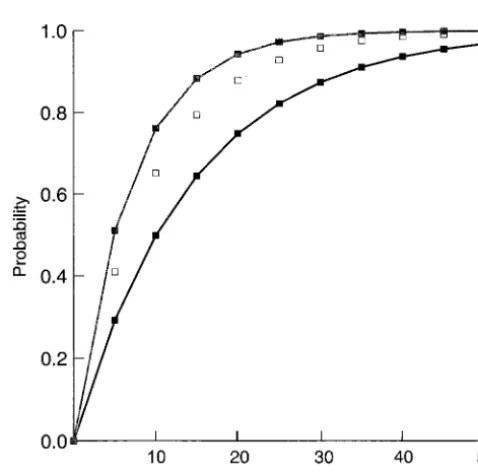
in both the absolute and relative frequencies (Table 2). ofNsequencing runs, where the probability of finding Unfortunately, insufficient large contiguous genomic an SSR per run isp, the probability of finding no SSRs sequences are available in the same species to determine is given by (1⫺ p)N and the probability of finding at
whether these differences relate to artifacts of library least one SSR is 1⫺ (1⫺ p)N. Thus, from sequencing
construction (e.g., tissue specificity, library redundancy, 20 different subclones, a simple calculation based on etc.) or to differences between species in SSR motif fre- the SSR frequency indicated that a high probability of
quency generally. The estimate of total SSR frequency revealing an SSR (P ⫽ 0.75–0.973) can be achieved
in plant species other than Arabidopsis presented here from average reads of 400–1000 bp, assuming a random indicates similarity across plant species and therefore occurrence of one SSR every 6.04 kb (Figure 2). This implies other factors (such as codon usage or nucleotide probability compares favorably to the attrition rate of
ratios) could be important. current SSR isolation procedures (Bryan et al. 1997;
It is possible that, as earlier estimates of SSR frequency Ro¨ der et al.1998), particularly given the opportunity were skewed by the preponderance of coding sequence to identify multiple, clustered SSRs and the ability to in the databases, the estimates presented here are biased choose which BAC or P1 to sequence by prior selection
by the prevalence of low-copy sequences surrounding with molecular markers to identify a known
chromo-coding regions. This is particularly relevant when con- somal position. sidering large genome species that contain a high
pro-portion of repetitive DNA. Arabidopsis is atypical, given its general lack of high-copy number genomic DNA. In contrast, 70–80% of the genome content of large genome cereals is composed mainly of multiple copies of retrotranspons (San Miguelet al. 1996). Although SSRs are present in this highly repeated portion, it is possible that their frequency differs from that in low-copy regions. Indeed, Ramsay et al. (1999) found an intimate association between the SSRs and certain re-gions of retrotransposons and repetitive elements, im-plying that the distribution and frequency of SSRs in these high-copy regions of the genome might be con-strained by these regions’ retrotranspositional structure and evolution. It is, therefore, possible that the frequency of SSRs might be higher in the older gene-containing low-copy portion of such genomes, explaining the difference in the estimates of SSR frequency presented here and those based on random whole genome sequencing in maize (Morganteet al.1999) and wheat (W. Powell, personal communication).
The high frequency found in these gene-rich areas allowed us to develop and test the hypothesis that
se-Figure2.—Probability of sequencing through a simple
se-quencing random subclones (from,e.g., a BAC clone) quence repeat in a random collection of subclones from a provides an effective strategy for identifying single or selected BAC or P1 clone with 400-, 600-, and 800-bp runs
(shown by the bottom, middle, and top squares, respectively).
In demonstrating the approach in barley, only one most SSR discovery programs that focus on AG/TC and AC/TG, which, in this study, represent⬍10% of those SSR (CTT)6met our “repeat length” definition and two,
(AT)6and (T)10, were slightly short. Nevertheless, poly- available. Here, all possible motifs are accessible,
includ-ing the previously elusive AT/TA class, which has gener-morphism of the (T)10SSR enabled the BAC clone to
be mapped to chromosome 6HS and this position was ally been suggested to be the most polymorphic. The
sequencing necessary could be reduced by prescreening confirmed by the use of another short SSR, (A)10, known
to be upstream of the gene sequence (AF166121). The selected BACs through hybridization with suitable oligo-nucleotides (e.g.,Creganet al.1999). The use of hybrid-discovery of one SSR that meets the criteria above in
36 runs of 400 bp represents a frequency of one SSR ization might preclude the discovery of (AT)n SSRs
(Depeigeset al.1995) but could preferentially bias the every 14.4 kb, somewhat lower than the value used in
the calculation above. This may reflect the simplicity of finding of longer repeats (Creganet al.1999). The findings presented here demonstrate that SSR the assumption of a random distribution of SSRs
be-cause the database survey indicated constraints on the frequency in plants is considerably higher than previous estimates with a frequency of one SSR every 6–7 kb, distribution of SSRs in coding regions in comparison
to that of intergenic regions. Moreover, roughly a third which is equivalent to that described in mammals ( Beck-mann and Weber 1992). However, differences in the of the subclones showed homology to retrotransposons,
which implies that a substantial proportion of the BAC absolute and relative frequency have been found be-tween different regions of Arabidopsis, relating presum-used is composed of high-copy sequence. Importantly,
repeats of lengths shorter than the criteria used for the ably to differing evolutionary constraints. Although the frequency of SSRs in gene-rich regions of other plant sequence searches still prove useful in the discovery and
confirmation of the map position of the PCR fragment species appears to be similar to that of Arabidopsis, it is anticipated that genomic regions containing high-ofBig1, which was used to screen the BAC library. The
polymorphism found with these short SSRs and others copy-number DNA will have a different profile. In addi-(WhiteandPowell1997;Milbourneet al.1998) im- tion, differences between SSR frequency and motifs in plies that the minimum repeat length used for the available EST data suggest that there are particular ge-search of public databases was possibly too conservative. nome-specific constraints in coding regions. Simple se-In species where BAC or P1 libraries are already avail- quence repeats are a manifestation of the deeper non-able, they represent a ready source of SSRs that are random nature of genomic sequences, with both direct
intrinsically “high value” for several reasons: BACs tandem and symmetrical repeats being
over-repre-linked to genes of interest can be selected by hybridiza- sented in eukaryotic genomes (CoxandMirkin1997) tion directly or to any closely linked low-copy, DNA- and with the constraints on the type and frequency of based marker, and locus-specific SSRs can be developed such repeats being, to some extent, genome specific
quickly and efficiently by the sample sequencing ap- (AntezanaandKreitman1999). Outside these
struc-proach described. Currently, the common apstruc-proach to tural or evolutionary considerations, the reported find-generating PCR-based markers for widespread applica- ings have immediate practical value, with the develop-tion is to convert restricdevelop-tion fragment length polymor- ment of a strategy for the targeted isolation of single
phism or amplified fragment length polymorphism or multiple, physically clustered SSRs near any mapped
markers into cleaved amplified polymorphic se- gene of interest. This will impact on genetic studies of
quences—but these are generally of limited informa- the increasing number of plant species for which large tiveness, frequently losing their diagnostic potential insert libraries are available.
when transferred to germplasm other than that in which We thank Dr. John Hargreaves from IPSR for the use of the probe they were developed (Niewohner et al. 1995). Even DNA and prepublication information, and Drs. W. Stiekema, H. Sand-when the actual sequence of the target gene is known, brink, and E. Van der Vossen from CPRO, Wageningen, for searching an unpublished potato BAC sequence for SSR repeats. In addition,
using this approach may produce SSR markers more
we thank Jane Davidson and Peter Davie for excellent technical
sup-easily deployable than markers based on the actual gene
port. The work reported here has been supported by grants from the
sequence.
Biotechnology & Biological Sciences Research Council (BBSRC), PAG
In addition, the presence of multiple linked SSRs on 04430, GAT 09066, and EU CT95-0003, and through a grant-in-aid a single BAC or P1 clone facilitates the detection of from the Scottish Executive Rural Affairs Department.
multiple SSR “haplotypes.” Haplotypes are considerably more descriptive than single markers and are particu-larly suited for applications such as marker-assisted
se-LITERATURE CITED
lection and many other areas of biology such as
biodiver-Akagi, H., Y. Yokozeki, A. InagakiandT. Fujimura,1996
Microsa-sity assessment and population genetics with multiple
tellite DNA markers for rice chromosomes. Theor. Appl. Genet.
multi-allelic SSRs giving comparable discrimination to 93:1071–1077.
Akkaya, M. S., A. A. BhagwatandP. B. Cregan,1992 Length
that of single nucleotide polymorphisms in analyses
polymorphisms of simple sequence repeat DNA in soybean.
Ge-(Chakrabortyet al.1999).
netics132:1131–1139.
Another advantage of the use of large insert libraries Altschul, S. F., T. L. Madden, A. A. Schaffer, J. Zhang, Z. Zhang
et al., 1997 Gapped BLAST and PSI-BLAST: a new generation
of protein database search programs. Nucleic Acids Res.25:3389– Morgante, M., B. C. Meyers, D. R. Argentar, M. Ramaker, M. Dolanet al., 1999 Analysis of 2Mb of random DNA sequence 3402.
Antezana, M. S.,andM. Kreitman,1999 The nonrandom location repeats structural and organisational features of the corn ge-nome. Poster 506, Plant and Animal Genome, San Diego, p. 208, of synonymous codons suggests that reading frame-independent
forces have patterned codon preferences. J. Mol. Evol.49:36–43. Abstracts.
Niewohner, J., F. SalaminiandC. Gebhardt,1995 Development
Beckmann, J. S.,andJ. L. Weber,1992 Survey of human and rat
microsatellites. Genomics12:627–631. of PCR assays diagnostic for RFLP marker alleles closely linked to alleles gro1 and h1, conferring resistance to the root
cyst-Bell, C. J.,andJ. R. Ecker,1994 Assignment of 30 SSR loci to the
linkage map ofArabidopsis.Genomics19:137–144. nematodeGlobodera rostochiensisin potato. Mol. Breeding1:65–78.
Paglia, G. P., A. M. OlivieriandM. Morgante,1998 Towards
Bryan, G. J., A. J. Collins, P. Stephenson, A. Orry, J. B. Smithet
al., 1997 Isolation and characterization of microsatellites from second-generation STS (sequence-tagged sites) linkage maps in conifers: a genetic map of Norway spruce (Picea abiesK.). Mol. hexaploid bread wheat. Theor. Appl. Genet.94:557–563.
Bureau, T. E.,andS. R. Wessler,1994 Stowaway: a new family of Gen. Genet.258:466–478.
Panaud, O., X. L. ChenandS. R. McCouch,1996 Development inverted repeat elements associated with genes of both
monocoty-ledonous and dicotymonocoty-ledonous plants. Plant Cell6:907–916. of microsatellite markers and characterization of simple sequence length polymorphism (SSLP) in rice (Oryza sativaL.). Mol. Gen.
Chakraborty, R., D. N. Stivers, B. Su, Y. X. ZhongandB. Budowle,
1999 The utility of short tandem repeat loci beyond human Genet.252:597–607.
Panstruga, R., R. Bu¨ schges, P. PiffanelliandP. Schulze-Lefert,
identification: implications for development of new DNA typing
systems. Electrophoresis20:1682–1696. 1998 A contiguous 60 kb genomic stretch from barley reveals molecular evidence for gene islands in a monocot genome.
Nu-Condit, R.,andS. P. Hubbell,1991 Abundance and DNA-sequence
of 2-base repeat regions in tropical tree genomes. Genome34: cleic Acids Res.26:1056–1062.
Provan, J., W. PowellandR. Waugh,1996 Microsatellite analysis of 66–71.
Cox, R.,andS. M. Mirkin,1997 Characteristic enrichment of DNA relationships within cultivated potato (Solanum tuberosum). Theor. Appl. Genet.92:1078–1084.
repeats in different genomes. Proc. Natl. Acad. Sci. USA94:
5237–5242. Ramsay, L., M. Macaulay, L. Cardle, M. Morgante, S. Degli Ivan-issevichet al., 1999 Intimate association of microsatellite
re-Cregan, P. B., J. Mudge, E. W. Fickus, L. F. Marek, D. Daneshet
al., 1999 Targeted isolation of simple sequence repeat markers peats with retrotransposons and other repetitive elements in bar-ley. Plant J.17:415–425.
through the use of bacterial artificial chromosomes. Theor. Appl.
Genet.98:919–928. Ramsay, L., M. Macaulay, S. Degli Ivanissevich, K. MacLean, L. Cardleet al., 2000 A simple sequence repeat-based linkage
Depeiges, A., C. Goubely, A. Lenoir, S. Cocherel, G. Picardet al.,
1995 Identification of the most represented motifs inArabidopsis map of barley. Genetics (in press).
Ro¨ der, M. S., J. Plaschke, S. U. Konig, A. Borner, M. E. Sorrells
thalianamicrosatellite loci. Theor. Appl. Genet.91:160–168.
Dib, C., S. Faure´, C. Fizames, D. SamsonandN. Drouot,1996 A et al., 1995 Abundance, variability and chromosomal location of microsatellites in wheat. Mol. Gen. Genet.246:327–333. comprehensive genetic map of the human genome based on
5,264 microsatellites. Nature380:152–154. Ro¨ der, M. S., V. Korzun, K. Wendehake, J. Plaschke, M. H. Tixier
et al., 1998 A microsatellite map of wheat. Genetics149:2007–
Dietrich, W. F., J. Miller, R. Steen, M. A. MerchantandD.
Dam-ron-Boles et al., 1996 A comprehensive genetic map of the 2023.
San Miguel, P., A. Tikonov, Y.-K. Jin, N. Motschoulskaia, D.
Zakh-mouse genome. Nature380:149–152.
Echt, C. S.,andP. Maymarquardt,1997 Survey of microsatellite arovet al., 1996 Nested retrotransposons in the intergenic re-gions of the maize genome. Science274:765–768.
DNA in pine. Genome40:9–17.
Edwards, K. J., J. H. A. Barker, A. Daly, C. JonesandA. Karp, Senior, M. L., E. C. L. Chin, M. Lee, J. S. C. SmithandC. W. Stuber,
1996 Simple sequence repeat markers developed from maize 1996 Microsatellite libraries enriched for several microsatellite
sequences in plants. Biotechniques20:758–760. sequences found in the GENEBANK database: map construction. Crop Sci.36:1676–1683.
Hamada, H., andT. Kakunaga, 1982 Potential Z-DNA forming
sequences are highly dispersed in the human genome. Nature Smulders, M. J. M., G. Bredemeijer, W. Rus-Kortekaas, P. Arens
andB. Vosman,1997 Use of short microsatellites from database
298:396–398.
Jones, D. A.,andJ. D. G. Jones,1997 The role of leucine-rich repeat sequences to generate polymorphisms amongLycopersicon esculen-tumcultivar and accessions of otherLycopersiconspecies. Theor. proteins in plant defences. Adv. Bot. Res.24:89–167.
Lagercrantz, U., H. EllegrenandL. Andersson,1993 The abun- Appl. Genet.97:264–272.
Stallings, R. L., A. F. Ford, D. Nelson, D. C. Torney, C. E.
Hilde-dance of various polymorphic SSR motifs differs between plants
and vertebrates. Nucleic Acids Res.21:1111–1115. brandet al., 1991 Evolution and distribution of (GT)nrepetitive
sequences in mammalian genomes. Genomics10:807–815.
Liu, Z.-W., R. M. BiyashevandM. A. Saghai Maroof,1996
Devel-opment of simple sequence repeat markers and their integration Sverdlov, V. E., O. I. Dukhanina, B. HoebeeandJ. P. Rapp,1998 Linkage mapping of fifty-eight new rat microsatellite markers. into a barley linkage map. Theor. Appl. Genet.93:869–876.
Loridon, K., B. Cournoyer, C. Goubely, A. DepeigesandG. Picard, Mamm. Genome9:816–821.
Wang, Z., J. L. Weber, G. ZhongandS. D. Tanksley,1994 Survey 1998 Length polymorphism and allele structure of trinucleotide
microsatellites in natural accessions ofArabidopsis thaliana.Theor. of plant short tandem repeats. Theor. Appl. Genet.88:1–6.
Weising, K., F. Weigand, A. J. Driesel, G. Kahl, H. Zischer et
Appl. Genet.97:591–604.
Manninen, I.,andH. A. Schulman,1993 BARE-1, a copia-like re- al., 1989 Polymorphic simple GATA/GACA repeats in plant genomes. Nucleic Acids Res.17:10128.
troelement in barley (Hordeum vulgareL.). Plant Mol. Biol.22:
829–846. White, G.,andW. Powell,1997 Isolation and characterization of
Milbourne, D., R. Meyer, J. E. Bradshaw, E. Baird, N. Bonar microsatellite loci inSwietenia humilis(Meliaceae): an endangered
et al., 1997 Comparison of PCR-based marker systems for the tropical hardwood species. Mol. Ecol.6:851–860.
analysis of genetic relationships in cultivated potato. Mol. Breed- Wu, K.-S.,andS. D. Tanksley,1993 Abundance, polymorphisms ing3:127–136. and genetic mapping of microsatellites in rice. Mol. Gen. Genet.
Milbourne, D., R. C. Meyer, A. J. Collins, L. D. Ramsay, C. Geb- 241:225–235.
hardtet al., 1998 Isolation, characterisation and mapping of Zhao, X. P.,andG. Kochert,1992 Characterization and genetic-simple sequence repeat loci in potato. Mol. Gen. Genet.259: mapping of a short, highly repeated, interspersed DNA-sequence 233–245. from rice (Oryza sativaL.). Mol. Gen. Genet.231:353–359.
Morgante, M.,andA. M. Olivieri,1993 PCR-amplified SSRs as