The Effect of Ceramic Coating on
Performance of Diesel Engine Using Diesel
and Blend of biodiesel
S. Prakash, R. Suresh, P. Senthilkumar
Lecturer, Department of Mechanical Engineering, Valivalam Desikar Polytechnic College, Nagapattinam,
Tamilnadu, India
ABSTRACT: In the present investigation, the combustion chamber inner wall, head of piston, exhaust and inlet valves of a four stroke direct injection and single cylinder diesel engine has been coated with 200µm thickness ceramic material of Al2O3 by using plasma spray-coating method. Diesel and blends of neem oil were used in both coated and
uncoated Engines. The performance results were compared with the uncoated engine. It was concluded that the indicated power, brake power, friction power and mechanical efficiency of diesel and blends of neem oil was improved compared with uncoated engine.
KEYWORDS: Ceramic material, Al2O3, Diesel, Neem oil, Mechanical efficiency.
I. INTRODUCTION
Now a day, diesel engines are widely used as power sources in transportation, power generation, agricultural sector, marine applications because of their lower fuel consumption and unburned hydrocarbons (HC) compared with gasoline engines. However, the limited reserve of fossil fuel and deteriorating environment have made scientists seek to alternative fuels for diesel while keeping the high efficiency of diesel engine. There is a need to search and find ways of using substitute fuels, which are preferably renewable and also produce low levels of gaseous and particulate pollutants in IC engines. Bio-fuels are gaining worldwide acceptance as a solution to environmental problems, energy security, reducing imports, rural employment and improving agricultural economy. Produce of biodiesel is very easy by using vegetable oil. Mostly Bio diesel is prepared from oils seeds like neem, polanga, rice bran and jatropha in India. The diesel fuel cannot be replaced totally by the vegetable oils because of the low cetane number, high viscosity, high ignition temperature and incomplete combustion leading to increased emissions and decreased performance.
Diesel engine rejects about two thirds of the heat energy of the fuel, one-third to the coolant, and one third to the exhaust, leaving only about one-third as useful power output. According to the second law of thermodynamics, coating of the combustion chamber of an internal combustion engine theoretically results in improved thermal efficiency. The combustion chamber temperatures of ceramic-coated engines are higher than those of uncoated engines, it may be possible to use lower-quality fuels. The ceramic material that has very low thermal conductivity, good strength, and low thermal expansion coefficient similar to metals, and it is able to withstand much higher temperature than metals.
Many researchers studied and reported the use of biodiesel and coatings in the internal combustion engines. S. Santhanakrishnan et al[1] investigated the performance and emission characteristics of Al2O3 coated LHR engine
operated with mahua oil biodiesel blend. The ceramic coating was done on the piston surface, cylinder head and valves of the engine to convert the conventional engine into low heat rejection engine. It was observed that the heat transferred to the coolant and surrounding was reduced well due to the thermal barrier coating. S.P. Sivapirakasamet al[2] studied the effect of Al2O3 coating on diesel engine performance, combustion, and emission characteristics fueled by pongamia
the performance and exhaust emissions of a rice bran oil biodiesel fuelled low heat rejection direct injection diesel engine. The piston, cylinder head, exhaust and inlet valve of test engine were coated with 0.5 mm thickness of zirconia through plasma spray method. They reported that improved efficiency and reduced fuel consumption in the coated engine compared with that of the uncoated engine. Can Haşimoğlu et al [4] investigated the performance characteristics
of a low-heat rejection diesel engine operating with sunflower oil. The cylinder head and valves of the test engine were coated with a Y2O3 _ ZrO2 (yttriastabilized zirconia) layer of 0.35 mm thickness over a NiCrAl bond coat of 0.15 mm
thickness. They reported that brake-specific fuel consumption and brake thermal efficiency were improved with biodiesel usage and thermal barrier coating application. G.Bharath Goud et al[5] investigated the effects of yttrium stabilized zirconia coating on diesel engine performance and emission characteristics using diesel and palm stearin methyl ester. They reported that the coated engine has better brake thermal efficiency and better BSFC compared to the baseline engine. Mechanical efficiency is also improved at all loads and speed in TBC coated engine.
1.1 Objective
The objective of this study is to understand the effect of ceramic coating on the diesel engine performance with the use of diesel and blends of Neem bio-diesel. The experiments were conducted on both diesel fuel and blends of neem oil at different load conditions at constant speeds.
II. EXPERIMENTAL SETUP
Vertical diesel engine is chosen as the appropriate experimental set up shown in figure-1.
Figure-1: Experimental set up.
The engine used in this study was single cylinder, four-stroke, water-cooled, constant speed, vertical and direct injection diesel engine, and the details of which are given in Table-1.
Table-1: Specifications of the engine
Make Kirloskar Oil Engines
Limited
Details Single cylinder, Four stroke, constant speed, vertical DI, Water cooled Bore & Stroke 87.50mm &110.00mm Compression ratio 17.5:1
III. RESULTS AND DISCUSSIONS
Experimental work is carried out to evaluate the basic engine performance measuring parameters like indicated power, brake power, friction power and mechanical efficiency have been obtained for 10% blends of neem oil with pure diesel fuels in uncoated and coated engine. Also the graphs plotted between load vs brake power, indicated power, friction power and mechanical efficiency.
3.1 Indicated Power
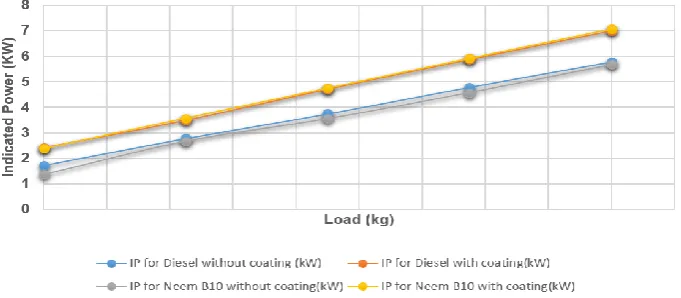
Figure 2 shows the indicated power at different loads in uncoated and coated engine. The indicated power increases with increase in load. The engine with ceramic coating had higher indicated power than the engine without coating both blends of neem oil and pure diesel.
Figure 2: Comparison of indicated power at different loads in uncoated and coated engine.
3.2 Brake Power
Figure 3 shows variations of brake power depending on the load of the engine. The brake power increases with increase in load. From the Figure 3, it is clear that the brake power of the engine increase after coating both pure diesel and blends of neem oil.
3.3 Friction Power
Figure 4 compares the variation of friction power of the engine at varying load (kg) for uncoated engine and ceramic coated engine fuelled with diesel and blends of neem oil. It was observed that friction power of ceramic coated engine was higher value at all points when compared to that of uncoated engine.
Figure 4: Comparison of friction power at different loads in uncoated and coated engine.
3.4 Mechanical Efficiency
Figure 5: Comparison of mechanical efficiency at different loads in uncoated and coated engine.
IV. CONCLUSIONS
Experiments were conducted successfully in a single cylinder, four stroke engine with and without coating the engine components such as combustion chamber inner wall, piston, exhaust and inlet valves using diesel and blends of neem oil as fuel. It was concluded that coated engine has highest indicated power, brake power, friction power and mechanical efficiency compare then uncoated engine both pure diesel and blends of neem oil.
REFERENCES
1. S. Santhanakrishnan, K.Vijayaraj, N. Arumugam, G. Lakshmikanth and G. Arunkumar, “Performance and emission characteristics of Al2O3
coated LHR engine operated with mahua oil biodiesel blend,” International Journal of Research in Engineering and Technology, Vol: 02, Issue: 11, pp:25-28, Nov-2013.
2. S.P. Sivapirakasam, M. Mohamedmusthafa, M. Udayakumar, and K.R. Balasubramanian, “Effects of Al2O3 Coating on Diesel Engine
Performance, Combustion, and Emission Characteristics Fueled by Pongamia Methyl Ester and Its Blends with Diesel,” Environmental Progress & Sustainable Energy, Vol:31, No:1, pp:147-156, April 2012.
3. G.Arunkumar, A.Santhoshkumar, M.Vivek, L. Anantha Raman, G.Sankaranarayanan and C.Dhanesh,“Performance and emission
characteristics of low heat rejection diesel engine fuelled with rice bran oil biodiesel,” Advanced Materials Research, Vol:768, pp:245-249,2013.
4. Can Haşimoğlu, Murat Ciniviz, Adnan Parlak, İbrahim Özsert and Yakupİçingür, “Part Load Performance Characteristics of a Low-Heat
Rejection Diesel Engine Fueled with Biodiesel,” Journal of Energy Engineering, Vol: 137, No: 2, pp:70-75, June 1, 2011.
5. G BharathGoud and C T Dheeraj Kumar Singh, “Investigation of CI diesel engine emission control and performance parameters using