Copyright 0 1989 by the Genetics Society of America
The Heritable Activation
of c y p t i c Suppressor-mutator
Elements by an
Active Element
Nina
FedoroffDepartment of Embryology, Carnegie Institution of Washington, Baltimore, Maryland 21210
Manuscript received August 15, 1988
Accepted for publication November 21, 1988
ABSTRACT
A weakly active maize Suppressor-mutator (Spm-w) element is able to heritably activate cryptic Spm
elements in the maize genome. The spontaneous activation frequency, which is 1-5 X in the present genetic background, increases by about 100-fold in the presence of an Spm-w and remains an order of magnitude above the background level a generation after removal of the activating Spm-w.
Sectorial somatic reactivation of cryptic elements can be detected phenotypically in kernels. Selection of such kernels constitutes an efficient selection for plants with reactivated Spm elements. Analysis of the reactivation process reveals that it is gradual and proceeds through genetically metastable intermediates that exhibit different patterns of element expression during plant development. Newly reactivated elements tend to return to an inactive form. However, the probability that an element will remain in a heritably active state increases when the element is maintained in the presence of an active s p m element for several generations.
I
T has been evident for some time that the maize genome contains genetically cryptic transposable elements. MCCLINTOCK’S studies (1 945-1 948) on transposable elements commenced from the observa- tion that new unstable mutations occur frequently in plants with broken chromosomes. Both MCCLINTOCKand DOERSCHUG later showed that the activation of
cryptic elements could be enhanced systematically by the introduction of broken chromosomes into the genome (MCCLINTOCK 1950; DOERSCHUG 1973). It has subsequently become increasingly apparent that agents and manipulations that cause chromosome damage, either directly or indirectly, stimulate the activation of cryptic elements. These include X-,
UV-, and y-irradiation, tissue culture, virus infection and mutagenic chemicals, such as EMS (NEUFFER
1966; SPRACUE and MCKINNEY 1966, 197 1 ; BIANCHI, SALAMINI and RESTAINO 1969; FRIEDMANN and PE-
TERSON 1982; PETERSON and FRIEDMANN 1983; DEL- LAPORTA et al. 1984; PESCHKA, PHILLIPS and GENGEN- BACH 1985; WALBOT 1988; BURR and BURR 1988). T h e results of molecular studies on maize transposable elements have begun to provide evidence that element sequence methylation is central to the molecular mechanism by which elements are maintained in a genetically silent state (FEDOROFF, WESSLER and
SHURE 1983; BENNETZEN 1985; SCHWARTZ and DEN-
NIS 1986; CHANDLER and WALBOT 1986; CHOMET,
WESSLER and DELLAPORTA 1987; FEDOROFF et al. 1988; BANKS, MASSON and FEDOROFF 1988).
O u r recent studies have focused on the Suppressor- mutator (Spm) element of maize (MASSON et al. 1987;
FEDOROFF et al. 1988; FEDOROFF and BANKS 1988;
Genetics 151: 591-608 (March, 1989)
BANKS, MASSON and FEDOROFF 1988). MCCLINTOCK’S
genetic studies on the Spm element family, as well as those of PETERSON on the cognate Enhancer ( E n )
element, revealed the existence of different types of interactions between the fully functional element of the Spm family and genes with mutations caused by the insertion of transposition-defective Spm (dSpm) elements (reviewed in MCCLINTOCK 1965; FEDOROFF
1983). Most mutant alleles with dSpm insertions be- long to one of two groups of alleles, which we have designated Spm-suppressible and Spm-dependent (MAS-
SON et al. 1987). These designations reflect the ability of the inserted dSpm element to mediate either the inhibition or activation, respectively, of expression of the mutant gene in the presence of a trans-acting, fully functional Spm element. T h e results of studies on Spm-dependent alleles of the a locus suggested that the element encodes a positive autoregulatory gene product which maintains the element in a genetically active form (MASSON et al. 1987).
In order to test this hypothesis, we undertook stud- ies on the genetic mechanism responsible for both differential patterns of element expression in devel- opment and the genetically stable, albeit reversible, inactivation of the element (MCCLINTOCK 1957, 1958,
1965, 197 1; PETERSON 1966; FOWLER and PETERSON
1978). We reported that the genetic mechanism un- derlying the element’s developmental control com- prises two components, one of which determines the element’s phase of activity (active or inactive), and the other of which determines the heritability of the ele- ment’s activity phase, as well as when, where and at what frequency the phase will be reversed during
development (FEDOROFF and BANKS 1988). In these studies, we characterized three element forms: (1) a stably active form, (2) a stably inactive form, termed cryptic, and (3) an unstable form termed programmable, in which the element displays one of a variety of heritable developmental expression programs (FEDO-
ROFF and BANKS 1988; BANKS, MASSON and FEDOROFF 1988). We reported that cryptic, inactive programmable and active elements differ in the methylation level of cytosine residues within a short sequence in the im- mediate vicinity of the element’s transcription start site, but not elsewhere in its sequence (BANKS, MASSON and FEDOROFF 1988).
T h e results of these studies also provided direct evidence for the existence of an element-encoded positive regulator which is able to trans-activate the transcription of an inactive programmable element, but not that of a cryptic element (FEDOROFF and BANKS 1988; BANKS, MASSON and FEDOROFF 1988). We fur- ther observed that exposure of an inactive program- mable Sprn to a n active element had the effect of markedly reducing methylation of the element’s 5’ end and increasing the probability that the trans- activated element would remain in a heritably active form after segregating from the active element (BANKS, MASSON and FEDOROFF 1988). We found that although fully methylated cryptic Sprn elements were not transcriptionally trans-activated by an active ele- ment, they nonetheless exhibited a partial and variable reduction in the extent of methylation in the presence of the active element. This observation suggested that an element-encoded gene product can directly inter- fere with the maintenance of the cryptic element’s methylation level. If there is a causal connection be- tween the extent of methylation of the element’s 5‘ end and its genetic activity, a trans-activating element should promote the conversion of a cryptic element to an active element, albeit at a much lower frequency than it is able to activate an Spm element in the labile inactive programmable form (BANKS, MASSON and
FEDOROFF 1988).
To test the foregoing hypothesis, I investigated the ability of a weakly active Sprn (Spm-w) to affect the probability of activation of cryptic elements in the maize genome. I present evidence that the presence of an Spm-w element enhances the probability of acti-
vation of a cryptic element by 2-3 orders of magnitude and that this effect of the Spm-w element persists after the activating element is removed by genetic segre- gation. I further show that the activation of a cryptic element is gradual, occurring over several generations in the presence of a trans-activating Spm-w, and pro- ceeds through the labile, readily trans-activatable, pro- grammable forms identified in earlier studies (FEDO- ROFF and BANKS 1988; BANKS, MASSON and FEDOROFF
1988). I have identified newly activated elements with
different developmental expression programs and show that a given program is subject to further mod- ification. My results suggest that genetic activation of a cryptic Sprn is a gradual process that proceeds through a series of genetically metastable states and provide evidence that an element-encoded gene prod- uct promotes the transition from the cryptic to the active form.
MATERIALS AND METHODS
Genetic strains: All of the a-m5w lines used in the present study were derived from a single culture obtained from B.
MCCLINTOCK (1962). The a-m5w allele was derived by
MCCLINTOCK from the original a m 5 allele (MCCLINTOCK,
1962) and has a weakly active Spm element inserted within
the coding sequence at the a locus (N. FEDOROFF and J. A.
BANKS, unpublished data). The frequency at which the allele
reverts to A or mutates to either a pale or colorless stable
allele is CO. 1 % (FEWROFF 1986). Most of the plants used in
the present study had the genetic constitution a-m5w Sh2la
sh2 and were homozygous for the wx-m8 allele of the waxy
(wx) locus. The recombination frequency between the a and
shrunken 2 (sh2) loci is <0.2%. The Sh2 allele therefore
served as a segregation marker for the a-m5w allele. The
two tester alleles with transposition-defective Spm (dSprn)
insertion mutations used were the wx-m8 allele of the wx
locus and the a-ml-5719Al allele of the a locus (MC-
CLINTOCK 1951, 1961). Both have dSpm insertions that are
excised in the presence of a trans-acting Spm-s or Spm-w
element (Figure 1 h). T h e wx-m8 allele has a null phenotype
in the absence of a trans-acting Spm element, while the a-
mI-5719AI allele is an Spm-suppressible allele (MASSON et al.
1987) and exhibits a level of pigmentation intermediate
between the wild-type, deeply pigmented A allele and the
recessive null a allele (Figure le). The backcross tester
parents used in the present study were all homozygous for the wx-m8 allele and for one of the following chromosome
3 constitutions: a sh2, a-ml-5719Al Sh2, or a-ml-5719Al
sh2. None of the alleles used in these studies is in standard inbred backgrounds. All of the maize genomic DNA samples tested contain many copies of sequences with homology to
the Spm element
(J.
BANKS and N . FEDOROFF, unpublisheddata), but their content of full length, genetically silent Sprn
elements is not known.
Scoring of ears: Ears obtained as a result of the crosses described in the figure legends were analyzed for evidence of Spm-s activity. The Sh2 class of kernels, essentially all of which received the closely linked a-m5w allele, were exam- ined for the presence of either sectors or full kernels with
the high frequency of excision (Hfe) phenotype characteris-
tic of the a-m5w allele in the presence of a standard Spm
(Spm-s; FEDOROFF and BANKS 1988). Kernels without and
with increasingly large Hfe sectors in the aleurone layer are
shown in Figure 1, a-c. Kernels exhibiting Hfe sectors
covering more than approximately
‘h
of the kernel surfacewere assigned to the “Hfe sector” category (Figure IC), while
those showing the Hfe phenotype throughout the aleurone were assigned to the “Hfe” category (Figure Id). For the
purposes of determining the percentage of kernels with Spm-
s activity, the Hfe and Hfe-sector categories were summed.
Kernels that did not receive the a-m5w allele after meiotic
segregation were assessed for the presence of Spm activity
after crosses to either an a-ml-5719A1, wx-m8 tester or an
a, wx-m8 tester. Kernels having the a-ml-5719Al allele were
Activation of cryptic Sprn Elements
I ~~~ ~ - 1
593
- TI
a.
e.
b.
C.d .
f .
h.
FIGURE 1.-Phenotypes of the aleurone layer in kernels carrying the a-m5w allele or the a-ml-5719AI allele. a, a-m5w; b and c, a-m5w
with small and large Hfe sectors indicative of Spm-s activity; d. a-m5w exhibiting the Hfe phenotype throughout the aleurone layer, indicating early activation of a cryptic Spm-s
_. .
element; e, a-ml-5719AI, no Spm; f and g, a-ml-5719AI with Spm-s activity in sectors of the aleurone; h.a-ml-5719Al with a fully active Spm-s.
revertant A sectors (Figure 1, f and g). Kernels having only the wx-m8 allele were either examined visually for the pres- ence of translucent Wx sectors or cut and stained with an iodine-potassium iodide solution to detect deeply staining
Wx sectors. For the purposes of the present analysis, all
kernels which showed more than one revertant sector were assigned to the category exhibiting Sprn activity. T h e results are expressed as the percentage of kernels in each of the classes defined by the segregating a-m5w allele that exhibit evidence of Spm activity. A single Sprn element located on a chromosome other than chromosome 3 will give Sprn activity in 50% of each kernel class defined by the segregation of
the a-m5w allele.
RESULTS
Spontaneous reactivation of cryptic Sprn elements is an infrequent event: T h e spontaneous activation of genetically cryptic elements can be monitored con- veniently using a mutant allele with a transposition- defective Sprn element (dSpm) insertion. Because an
Sprn element can trans-activate excision of a dSpm
element, excision of the inserted dSpm element per- mits the detection of a newly activated element any- where in the genome. In the present study, we have used the a-ml-5719AI allele of the a locus (Figure 1, e and h) and the wx-m8 allele of the waxy (wx) locus, both of which are expressed in kernel endosperm tissue and therefore permit the evaluation of large numbers of progeny.
Among the 59 ears (1 9,8 16 kernels) carrying the a-
ml-5719AI tester allele that were examined, one ker-
nel exhibited a single small sector of the colorless, variegated phenotype characteristic of the tester allele in the presence of an active Sprn (Figure If). All of the remaining kernels had the uniformly palely pig- mented phenotype of the allele in the absence of a trans-activating Sprn element (Figure le). In a previous study, t w o kernels with weakly active Sprn elements
(Spm-w) were recovered from among the more than
100,000 kernels examined (FEDOROFF 1986). Al- though the number of activation events is too low to provide an accurate measure of the spontaneous reac- tivation frequency, it appears to be in the range of 1- 5 X in the present genetic background. BURR
and BURR (1988) have reported a similar value in a somewhat different genetic background.
The activation of cryptic elements can be moni- tored using an Spm-w element: Spm-w elements were first identified by MCCLINTOCK (1957) as derivatives of a standard S p t (Spm-s) that transposed and pro- moted transposit m of dSpm elements less frequently and much later il development than the parent Spm-
s. T h e results of molecular analyses of two Spm-w
elements showed them to be internally deleted (MAS- SON et al. 1987; GIERL et al. 1988). I t has also been reported that the element’s major 2.5-kb transcript is much less abundant in tissue of plants with an Spm-w
element than of plants with an Spm-s element (MASSON et al. 1987; BANKS, MASSON and FEDOROFF 1988). T h e genetic property of an Spm-w element that is important in the present context is that it exhibits an extremely low frequency of germinal transposition. Among the several alleles with Spm-w insertions used in the present study, the a-m5w allele was used most extensively. T h e phenotype of this allele is shown in Figure la. The Spm-w insertion in this allele is quite stable. Germinal excision of the element to give either revertant A alleles or colorless, stable a alleles occurs at a frequency of less than 0.1 % (FEDOROFF 1986).
Many kernels on ears of plants that carry the a-m5w
that gave rise to the pigmented cell clone, the in- creased density of variegation signals an increase in the number of cells in which excision has occurred. Moreover, kernels and kernel sectors showing a high frequency of excision of the Spm element residing at the a locus also show an increase in the excision frequency of the dSpm element insorted at the wx locus in the wx-m8 allele present in all of the plants.
The high frequency of excision (Hfe) phenotype observed occasionally on ears carrying the a-m5w al- lele is regularly observed when an Spm-s element is present together with the a-m5w allele. This is because the Spm-s element trans-activates excision of the Spm- w element, just as it can trans-activate excision of a dSpm element (MCCLINTOCK 1962; FEDOROFF and BANKS, 1988). Thus the regular, albeit infrequent, appearance of Hfe kernels on ears of plants carrying only the a-m5w allele may signal the reactivation of cryptic Spm elements in the genome. T o investigate this possibility, plants were grown from kernels as- signed to three different phenotypic categories based on the Hfe phenotype. These were (1) kernels that exhibited either no Hfe sectors or sectors occupying less than roughly '1s of the kernel surface, (2) kernels with large Hfe sectors, occupying more than l/a, but not all of the kernel surface, and (3) fully Hfe kernels. Kernels were selected from pla.ltc that carried the dominant Sh2 allele of the sh2 1 0 ~ 1 1 3 , 1: aked to the a-
m5w allele of the a locus. T h e selectc.?! kernels were also heterozygous for the recessive a and .h2 alleles (a-m5w Sh2/a sh2) and homozygous for the wx-m8 allele. Plants grown from such kernels were crossed to and by testers that were either homozygous for the a, sh2 and wx-m8 alleles, or for the a-ml-5719A1, sh2,
and wx-m8 alleles. T h e resulting ears were scored for the percentage of Hfe kernels and kernels with large Hfe sectors in the a-m5w Sh2 class (+Spm-w), as well as kernels showing variegation for the dSpm allele pres- ent in the sh2 class (-Spm-w).
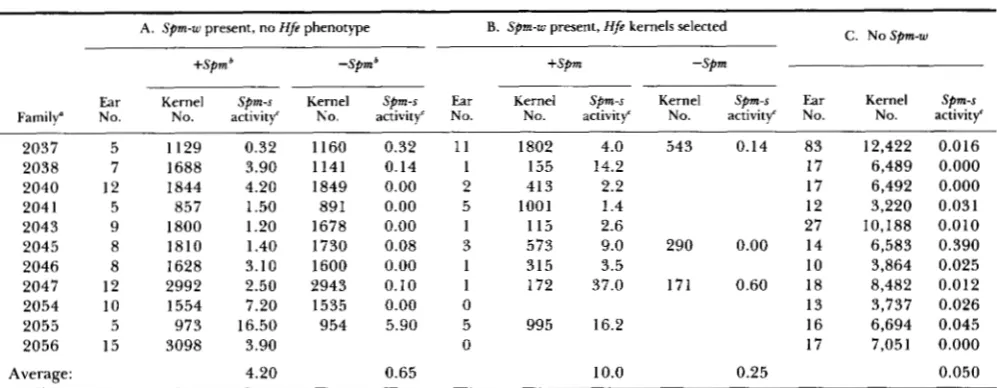
Ears produced on plants grown from kernels show- ing no Hfe sectors or only small Hfe sectors are similar to the parent ears from which they were selected. That is, most kernels exhibit either no Hfe sectors or a few small Hfe sectors. A small fraction of kernels exhibits large Hfe sectors and a few kernels show the Hfe phenotype throughout the aleurone layer. The fraction of such kernels varies from plant to plant within a family of plants grown from kernels selected from a single ear, as well as among sibling families. T h e average fraction of kernels with a full Hfe phe- notype or large Hfe sectors is given in Table 1A for 11 different families of plants. As is evident from the average values, there is a heritable component in the variation. The tendency to produce ears with a large fraction of Hfe kernels is observed in two families (2054, 2055), while one family showed almost no such
kernels (2037). Most families had an average of 1-4% Hfe or Hfe-sectored kernels.
Data for the 96 ears (19,373 +Spm-w kernels) ana- lyzed in the experiment reported in Table 1A were grouped by the percentage of kernels on each ear exhibiting Spm-s activity, as judged by the appearance either of large Hfe sectors or the Hfe phenotype throughout the aleurone layer. T h e resulting histo- gram is shown in the left panel of Figure 2a. Most of the ears (92.9%) exhibit a low frequency (<lo%) of Hfe and Hfe-sectored kernels. A small fraction of the ears (7.1 %) exhibited higher frequencies of such ker- nels, although the frequency did not exceed 35% in any of the ears examined.
Within the same families of plants, the frequency of kernels that did not receive the Sh2 allele after meiotic segregation, but show evidence of Spm activity is low. It is nonetheless sporadically well above the range expected for recombination between the a and sh2
loci (<0.2%). Family 2055 (Table 1A) was exceptional in this regard, showing variegated sectors or a fully variegated phenotype in 5.9% of the kernels. T h e pooled data from the 86 ears (1 5,98 1 kernels) in which the class of kernels not receiving the Spm-w element at the a locus was examined for Spm activity are summarized in the right histogram of Figure 2a. When the right and left panels of Figure 2a are compared, it is apparent that fewer ears (2.5%) gave evidence of Spm activity in the class of kernels that did not receive the a-m5w allele (right panel, -Spm- w), than in the class of kernels that received the allele (7.1%; left panel, +Spm-w). In no case did the fre- quency of variegated kernels exceed 16% in the class of kernels that did not receive the Spm-w element.
Activation of cryptic Spm Elements 595
TABLE 1
Frequency of Spm-s activation in the presence and absence of a trans-acting Spm-w element
A . Spm-w present, no Hfe phenotype B. Spm-w present, Hfe kernels selected
+Spm -Spmb +Spm -Spm
C . N o S p m - w
Ear Kernel Spm-s Kernel Spm-s Ear Kernel Spm-s Kernel Spm-s Ear Kernel Spm-s
Family" No. No. activity' No. activity' No. No. activity' No. activity' No. No. activity'
2037 5 1129 0.32 1160 0.32 11 1802 4.0 543 0.14 83 12,422 0.016
2038 7 1688 3.90 1141 0.14 1 155 14.2 17 6,489 0.000
2040 12 1844 4.20 1849 0.00 2 413 2.2 17 6,492 0.000
204 1 5 857 1.50 891 0.00 5 1001 1.4 12 3,220 0.031
2043 9 1800 1.20 1678 0.00 1 115 2.6 27 10,188 0.010
2045 8 1810 1.40 1730 0.08 3 573 9.0 290 0.00 14 6,583 0.390
2046 8 1628 3.10 1600 0.00 1 315 3.5 10 3,864 0.025
2047 12 2992 2.50 2943 0.10 1 172 37.0 171 0.60 18 8,482 0.012
2054 10 1554 7.20 1535 0.00 0 13 3,737 0.026
2055 5 973 16.50 954 5.90 5 995 16.2 16 6,694 0.045
2056 15 3098 3.90 0 17 7,051 0.000
Average: 4.20 0.65 10.0 0.25 0.050
Each family comprised plants grown from kernels selected from a single ear. All of the families consisted of plants grown from kernels on ears of plants that had the genetic constitution a-m5w Sh2/a sh2, wx-m8/wx-m8 and had been backcrossed by plants that were homozygous for the a , sh2 or Sh2 and wx-m8 allele. The first part of each family, reported in part A of the table, comprised kernels that were variegated for a and wx expression, but showed the late and infrequent pattern of somatic reversion characteristic of the a-m5w allele (Figure la). The second part of each family, reported in part B, comprised the few kernels on each of the parental ears that showed the Hfe phenotype throughout the kernel aleurone and also showed frequent reversion of the wx-m8 allele (Figure Id). The third part of each family, reported in art C, comprised kernels that were colorless and showed no reversion of the wx-m8 allele to Wx (no Sprn).
'The +Spm and -Spm columns report the Spm-s activity in the kernels of backcrossed progeny ears that did and did not receive the o -
m5w allele. The backcross parent used in part C was homozygous for the a-ml-5719A1, Sh2 and wx-m8 alleles, while the backcross
r,..
~ ~ I I Iused in part A was homozygous for the a - m l - 5 7 1 9 A 1 , sh2 and wx-m8 alleles. Two backcross parents were used in part B. These were homozygous for either the a or the a - m l - 5 7 1 9 A l alleles and both were homozygous for the sh2 and wx-m8 alleles.
' The percentage of kernels with Spm-s activity comprises the sum of kernels showing Hfe sectors occupying more than about '/R of the kernels aleurone layer and kernels with an Hfe phenotype throughout the aleurone for those kernels that received the a-m5w allele. Among the kernels that did not receive the a-m5w allele (all of those in part C, as well as half of those in parts A and B), the percentage showing Spm-
s activity included all kernels that showed reversion of either the wx-m8 allele or the a - m l - 5 7 1 9 A l allele in either a kernel sector or throughout the kernel endosperm or aleurone.
receive the a-m5w allele (Figure 2b, right panel). But the few ears that showed significant levels of Spm
activity all exhibited Spm activity in 40-60% of the kernels, suggesting the presence of an Spm-s element segregating independently of the Spm-w at the a locus. Among the 22 progeny ears produced on plants grown from kernels exhibiting the Hfe phenotype throughout the aleurone layer, 20 (91%) exhibited the Hfe phenotype in more than 10% of progeny kernels (Figure 2c, left panel). Moreover, the fraction of Hfe kernels for all of these ears fell in the 40-60% range, again indicating the presence of an independ- ently segregating Spm-s element. T h e fraction of ears showing Spm activity in more than 10% of the kernels was comparable in this group of plants for the classes of kernels that did and did not receive the Spm-w
element of the a-m5-w allele (Figure 2c, left and right panels). Nonetheless, only 58% of the ears exhibited
Spm activity in 50-60% of the sh2 kernels, while 33.3% of the ears showed Spm activity in 20-40% of kernels. That is, within a given ear, Spm-s activity is detectable in a larger percentage of the kernels that received the segregating a-m5w allele than of those that did not receive it.
T h e results obtained from comparable analyses of
plants grown from fully Hfe kernels, but without an intermediate generation of Hfe sector selection, are similar to those obtained with plants grown from Hfe- sectored kernels after an intermediate selection step (Figure 2b). Data for the plants grown from such Hfe kernels are given in Table 1B. Despite the considera- ble variation from family to family, it is evident that the family averages are higher for plants grown from Hfe kernels than for plants grown from kernels with- out Hfe sectors (Table 1, A and B). At the same time, none of the 31 plants obtained from Hfe kernels in this group of families exhibited the Hfr phenotype in more than 37% of the kernels receiving the a-m5w
allele.
Taken together, these results indicate that the Hfe sectors appearing on kernels carrying the a-m5w allele are sectors within which a cryptic Spm-s element has been activated. They further suggest that the Spm-w
element of the a-m5w allele promotes the activation of the Spm-s element. Thus, for example, sectors with
an Spm-s phenotype appear on kernels containing an
Spm-w element at a much higher frequency than they
596
a.
E
3
r 0
8
b.
E
I
r 0
8
C.
E
3
8
c
0
+Spm-w
60
40
20
0
0 2 0 4 0 6 0 8 0 1 0 0
100
80
60
E
r 0 4 0
8
20
0
f
0
0
r
8
-Spmw
i
i
L
0 2 0 4 0 6 0 8 0 100
0
264
e o s o 1 W% active Spm
I
Activation of cryptic Spm Elements 597
implication that a gene product encoded by the Spm- w element promotes the appearance of such sectors of apparent Spm activation. Selection of kernels which show the putative Spm-s activity in a large fraction of the aleurone layer or throughout the aleurone layer results in a rapid increase in the fraction of plants that exhibit the Hfe phenotype in about half of the kernels that receive the Spm-w element. This is the expected outcome if the selected plants contain an active Spm-s
element that is located on a chromosome other than that containing the a-m5w allele. Since the parental plants showed no evidence of an independently seg- regating Spm-s, it follows that the origin of the element is likely to be in the conversion of a cryptic Spm element residing in the genome to an active element. This conjecture is supported by the reproducibility of the phenomenon in different genetic backgrounds and with different Spm-w elements (N. FEDOROFF, unpub- lished data). It is also supported by the observation that kernels with an Hfe phenotype are more likely to yield plants with an independently segregating Spm
element than are kernels which exhibit only sectors of the Hfe phenotype in the aleurone layer. This is be- cause Hfe sectors arise after meiosis, while an Hfe phenotype throughout the kernel aleurone layer im- plies a genetic change at or before meiosis and there- fore one that is likely to be represented in both the zygotic and endosperm genomes.
However, in all cases, fewer kernels exhibit Spm
activity in the kernel class that did not receive the
Spm-w element of the segregating a-m5w allele than in
the kernel class that received it (Table 1, Figure 2). This implies that the newly activated Spm-s element is in an intermediate form whose activity is dependent on the presence of a trans-activating element. This observation, in turn, suggests that the newly activated element resembles the readily trans-activatable inac- tive programmable form identified in previous studies
on Spm inactivation (BANKS, MASSON and FEDOROFF
1988).
The Spm-w element can heritably enhance the spontaneous activation frequency of a cryptic ele- ment: T o determine whether a trans-activating ele- ment has a heritable effect on a cryptic genomic element, the spontaneous activation frequency of
cryptic elements was determined in a large population of plants grown from kernels selected from ears on plants containing the a-m5w allele, but which did not receive the homolog bearing the Spm-w element fol- lowing meiotic segregation. On the assumption that the genome of these plants contains a single cryptic element that is segregating independently of the a locus, half of such kernels would be expected to re- ceive the cryptic element. Ears of plants grown from the selected kernels were crossed to and by plants homozygous for the a - m l - 5 7 1 9 A l and wx-m8 tester alleles. T h e tester plants were taken from a group that had previously been determined to have a fre- quency of spontaneous element activation of 5 X 1 0-5
or less. T h e results of these tests are reported in Table 1
c.
Among the 194 ears (75,221 kernels) examined, the average family frequency of kernels with Spm
activity was 2-5 X In 10 of the 1 1 families, the averages ranged from 0 to 0.045%, and a single family had an average of 0.39%. T h e average for the first 10 families was 1.7 X while the average for all 11 families was 5 x Thus the frequency of spontaneous element activation in the generation fol- lowing the segregation of the activating Spm-w ele- ment remains higher than the spontaneous activation frequency observed in the same genetic background. Nonetheless, this value is about an order of magnitude lower than that observed in the segregating genera- tion (Table 1A). It appears, therefore, that exposure of a cryptic Spm element to an active one can predis- pose it to spontaneous activation. T h e effect of expo- sure to an active Sprn element is lower in the genera- tion after the activating element is eliminated from the genome of a plant containing a cryptic element than in the segregating generation, but still above the background activation frequency (Table 1, A and C).
This implies that the influence of the trans-activating
Spm-w element persists for at least a generation.
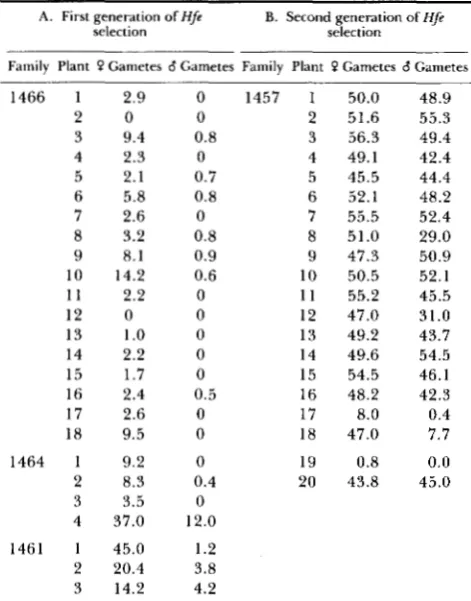
Newly activated elements are less efficiently transmitted through male germ cells than through female germ cells: Transmission of a newly activated element through the first ear produced on the main stalk and through pollen was compared for plants grown from single kernels showing the Hfe phenotype
FIGURE 2.-Activation of cryptic Spm elements in the presence of an Spm-w element. The histograms show the percentage of ears in each group of cultures which showed Spm-s activity in the indicated percentage of kernels (percent active Spm). The percentages are shown separately in the left and right panels for the classes of kernels that received the a-m5w allele (+Spm-w) and those that did not (-Spm-w)
following meiotic segregation. The plants on which the ears were produced all had the genetic constitution a-m5w ShP/u sh2, wx-m8/wx-m8.
Data are shown for the first ear produced on each plant and backcrossed to a tester that was either homozygous for the a - m l - 5 7 1 9 A I . sh2
N. Fedoroff
TABLE 2
Percentage of Hfe kernels among progeny of plants grown from Hfe kernels and used as female and male parents"
A. First generation of Hfe selection
B. Second generation of Hfe selection
Family Plant '? Gametes 6 Gametes Family Plant 0 Gametes 6 Gametes
-
1466 1 2 3 4 5 6 7 8 9 10 11 12 13 14 15 16 17 18
1464 1
2 3 4
1461 1 2 3 2.9 0 9.4 2.3 2.1 5.8 2.6 3.2 8.1 14.2 2.2 0
1
.o
2.2 1.7 2.4 2.6 9.5 9.2 8.3 3.5 37.0 45.0 20.4 14.2
0 1457 1
0 2
0.8 3
0 4
0.7 5
0.8 6
0 7
0.8 8
0.9 9
0.6 10
0 1 1
0 12
0 13
0 14
0 15
0.5 16
0 17
0 18
0 19
0.4 20
0 12.0 1.2 3.8 4.2 50.0 51.6 56.3 49.1 45.5 52.1 55.5 51.0 47.3 50.5 55.2 47.0 49.2 49.6 54.5 48.2 8.0 47.0 0.8 43.8 48.9 55.3 49.4 42.4 44.4 48.2 52.4 29.0 50.9 52.1 45.5 31.0 43.7 54.5 46.1 42.3 0.4 7.7 0.0 45.0
a Data are shown only for the first ear produced on the main
stalk of the plant carrying the a-m5w allele (Q gamete column) or on a tester plant that received pollen from the same plant (8 gamete column).
throughout the aleurone. T h e selections were carried out in four different families of plants, all of which were derived from two plants belonging to a single progenitor family carrying the a-m5w allele. Families
1461, 1464 and 1466 were grown from Hfe kernels taken from ears on plants grown from kernels that did not have prominent Hfe sectors (Table 2A), while family 1457 comprised plants grown from Hfe kernels selected from ears produced by plants that had been grown from selected Hfe kernels in the previous gen- eration (Table 2B). Thus family 1457 represents the results obtained when selection for the Hfe trait was carried out in two successive generations.
A smaller percentage of kernels exhibited the Hfe phenotype when the a-m5w allele was transmitted through the pollen parent than when it was transmit- ted through the egg parent (Table
2).
T h e asymmetric transmission of the newly activated element was much greater in the first generation of selection for the Hfe phenotype (Table 2A) than in the second generation of selection (Table 2B). Moreover, the fraction of kernels exhibiting the Hfe phenotype was higher after two generations of selection than after a single gen- eration of selection. After two generations of selec- tion, most ears (90%) exhibited theHfe
trait in about half of the kernels, the value expected if the ear contains a single active Spm-s element located on a chromosome other than the one bearing the a-rn5wallele. These observations suggest that newly activated elements tend to return to an inactive state in the first generation, particularly upon transmission of the ele- ment through male gametes. T h e effectiveness of a second round of selection for kernels with the Hfe trait implies that the activation process is progressive and that complete activation of a cryptic Spm element requires more than a single generation.
A newly activated Spm element can exhibit the properties of a Modi;fier element: One plant (1 466A-
2) grown from a kernel with an Hfe phenotype subse- quently proved to contain an independently segregat- ing element with properties resembling those of the Modzjier element described by MCCLINTOCK (1957).
In the first generation, the plant produced two ears on the main stalk. On the first and second ears, 45.6%
and 16.1 % of the kernels receiving the a-m5w allele had an Hfe phenotype, respectively. T h e same plant was used as a male parent in two crosses to ears on tester plants. There were almost no kernels (0.5%)
with an Hfe phenotype on either ear. Moreover, in all four ears obtained, Spm-s activity was detected only in kernels that also received the Spm-w element of the a-
m5w allele. Thus the element appeared to be active only in the presence of the Spm-w element, as is characteristic of previously isolated Modzjier elements (MCCLINTOCK 1957). However, the Modfzer-like trait was detectable only when it was transmitted through the egg parent.
T o assess the heritability of the Modijier-like trait, plants were grown from Hfe kernels selected from the
a.
e
0
al 0
w
ae
b.
E
a Q) 0 wae
C.
e
a 0 )0
w
a?
100-
-"W
ear 1
80-
1
spm
60-
I
v
40-
20
-
0 I I I I
0 20 40 60 8 0 1 0 0
Activation of cryptic Spm Elements
100
80
60
40
20
+sPm-w
ear 2
I
v
1
100-
80-
60-
40-
20-
0 - p
I
v
" W
0 2 0 4 0 6 0 8 0 1 (
%
active
Spm
599
loo
8
-spm-w80-
60-
40-
20
-
0 -
,
I I I 0 2 0 4 0 6 0 8 0 1loo
9
mlntroctucecear 1
+spm-w
80-
1 spm
60-
I
v
40-
20
-
0 I I I
Fedoroff
first and second ears on the plant, as well as from kernels on tester ears that had received the a-m5w
allele through the male gametes. Since only two a- m5w kernels on the tester ear showed the Hfe pheno- type throughout the aleurone layer, kernels exhibiting small Hfe sectors were selected and grown to deter- mine whether the trait was heritable, even if not expressed in kernels receiving the newly activated element through male germ cells. Plants comprising the families grown from the three groups of kernels were backcrossed to and by dSpm testers (see MATE- RIALS AND METHODS). The ears resulting from the crosses were analyzed to determine (1) whether the element was active only the presence of the Spm-w
element and (2) whether the element was expressed in kernels that received it through male gametes. T h e results of the first analysis for the three families are shown in the three panels of parts a and b of Figure 3.
Hfe kernels selected from ear 1 of plant 1466A-2 gave plants that showed the Hfe phenotype in 50% of progeny kernels receiving the Spm-w element of the
a-m5w allele (Figure 3a, left panel). None of the ker-
nels on any of the ears produced on these plants showed Spm activity in the class of kernels not receiv- ing the Spm-w element (Figure 3b, left panel). When plants belonging to this family were used as pollen parents, the results were consistent with those ob- tained in the previous generation. Only 3 of the 12 ears (25%) obtained in such tests showed any Hfe
kernels (not shown). Those that did, had very few Hfe
kernels (0.4, 0.6 and 2.2%). That the genetic prop- erties of this element are quite heritable was demon- strated by selecting second-generation Hfe kernels and growing a third plant generation. T h e results obtained with ears produced on such plants (6 families, 36
plants) are displayed in the left and central panels of Figure 3c and resemble those obtained in the previous generation (Figure 3, a and b). Moreover, as in the
t w o previous generations, the Hfe phenotype was ob-
served in very few kernels on tester ears receiving pollen from such plants. Hfe kernels appeared on only half of the 20 tester ears receiving pollen from these plants and none of these showed more than 1.5% Hfe
kernels (not shown).
The results obtained when Hfe kernels were selected from the second ear of plant 1966A-2 were compa- rable to those obtained with plants grown from ker- nels selected from the first ear (Figure 3, a and b, middle panels), except that a larger fraction of the ears on plants grown from the selected kernels had less than 20% Hfe kernels. None of the kernels that did not also receive the segregating Spm-w element showed Spm activity (Figure 3b, middle panel) and there were very few Hfe kernels on tester ears receiv- ing pollen from these plants (not shown). Comparable
results were also obtained with plants grown from kernels on tester ears that received pollen from plant 1466A-2, but which exhibited only small Hfe sectors (Figure 3, a and b, right panels). However, an even larger fraction (63.6%) of the ears in this family showed less than 10% Hfe kernels (Figure 3a, right panel). These results establish that the newly activated element in these plants, although very infrequently expressed in kernels receiving it through male germ cells, can nonetheless be transmitted through the male germline. However, they also suggest that the element reverts to the inactive form much more frequently when it is transmitted through male germ cells than when it is transmitted through female germ cells.
The observation that only half of the kernels re- ceiving the a-m5w allele exhibit an Hfe phenotype among the progeny of plant 1466A-2 (Figure 3a, left panel) suggests the presence of an independently seg- regating Modijier element. If this is the case, then the element should also be present in half of the kernels that did not receive the Spm-w element of the a-m5w
allele. T o determine whether an independently seg- regating Modijier element is present, kernels that did not receive the a-m5w allele were selected from the same second-generation ears used for the Hfe selec- tions for which the results are given in the first two panels of Figure 3c. Plants grown from these kernels were tested for the presence of a Modijier element by crossing them to and by plants containing an Spm-w
element. T h e results obtained for the 6 families ana- lyzed appear in the right panel of Figure 3c. Only one (1.4%) of the 67 ears obtained exhibited evidence of Modzfier activity in more than 10% of the kernels and none showed Modijier activity in more than 20% of the kernels. Thus, unlike the Modijier element de- scribed by MCCLINTOCK (1957), the newly activated Modzjier-like element readily reverts to a form in which it cannot be trans-activated upon segregation away from the active Spm-w element of the a-m5w
allele.
Two cryptic elements can be activated in the same genome: Some of the plants in family 1466 and its progeny gave ears with an unexpectedly large fraction of Hfe kernels. A slight skewing of the distribution to higher Hfe frequencies is evident in the middle panel of Figure 3a and is quite pronounced in the next generation, for which comparable results are shown in the middle panel of Figure 3c. Two possible expla- nations for these observations are (1) that the element undergoing activation in these cultures is linked to
the a-m5w allele and (2) that there is a second cryptic
Activation of cryptic Spm Elements 60 1
received pollen from plant 1466A-2. On the single ear of this plant (1890-l), 76.5% of the kernels that received the a-m5-Spm-w allele showed the Hfe phe- notype and 47.2% of the kernels that did not receive the a-m5w allele gave evidence of Sprn activity, as judged by the excision of the dSpm element from the wx-m8 tester allele. These values suggested the pres- ence of both the original Modijier-like element and a second, independently segregating Spm-s element.
T o determine whether plant 1890-1 had two inde- pendently segregating elements, plants grown from Hfe kernels were backcrossed to and by dSpm tester plants. T h e percentages of Hfe kernels observed in the kernel class receiving the a-m5w allele and of kernels with Sprn activity in the kernel class not re- ceiving the a-m5w allele are compared for individual plants used as both egg and pollen parents in Figure 4a. Comparable data for several individual plants grown from Hfe kernels selected from the first ear of plant 1466A-2 are shown for comparison in Figure 4b. As described above, the activity of the Modzjier- like element is detectable only in kernels receiving the a-m5w allele through the egg parent (Figure 4b).
Among the 5 plants grown from Hfe kernels of plant 1890-1 and for which appropriate crosses were made, one exhibited the Modijier-like behavior char- acteristic of the newly activated element in the parent plant 1466A-2 (Mod in Figure 4a). Two plants showed comparable fractions (40-60%) of Hfe kernels in the a-m5w class when used as either pollen or egg parent and comparably high frequencies of kernels with Spm activity in the class of kernels not receiving the a-m5w allele (Spm in Figure 4a). These two plants therefore appear to be segregating a single Spm-s element un- linked to the a-m5w allele. T h e last two plants show segregation ratios consistent with the presence of both the Modijier-like element and an Spm-s element (Mod and Sprn in Figure 4a). That is, 7 5 4 0 % of the kernels receiving the a-m5w allele through female gametes and 45-50% of those receiving it through male ga- metes exhibit the Hfe trait. In addition, half of the kernels not receiving the a-m5w allele show Sprn activ- ity. T h e segregation ratios observed with these two plants are the same as that observed in the previous generation (see above). Thus the Hfe phenotype of one of the two Hfe kernels obtained when plant 1466A-2 was used as a male parent is attributable to the simultaneous activation of a second, independ- ently segregating Spm-s element. Moreover, the ob- servation that there is an increasing number of plants with more than 50% Hfe kernels in the second gen- eration progeny derived from plant 1466A-2 (Figure 3c, middle panel) is consistent with the progressive activation of the second cryptic element in some plants.
The Modifier-like element is an intermediate in
the activation of a cryptic Spm element: Although the Hfe phenotype of the Modijier-like element in plant 1466A-2 and its progeny is almost never expressed in kernels receiving it through male gametes, one of the two fully Hfe kernels appearing on a tester ear that received pollen from plant 1466A-2 gave a plant
(1 890-2) that carried the Modijier-like element. Analy- sis of its progeny provided further insight into the properties of the Mod$er-like element. Unlike any of the Hfe kernels that received the Modijier-like element from plant 1466A-2 through female gametes (Figure 3b, left and central panels), the single ear produced on plant 1980-2 had Spm-s activity in 4.3% of the kernels not receiving the a-m5w allele. Among the kernels that received the a-m5w allele, 33.9% exhib- ited the Hfe phenotype.
Four types of kernels were selected for further analysis from the ear produced on plant 1890-2. These were (1) kernels that showed Spm-s activity, but had no Spm-w element; (2) kernels that received the a-m5w allele, but had few or no Hfe sectors; (3) fully
Hfe kernels in which the revertant A sectors were small and the wx-m8 allele showed a late pattern of dSpm excision, as judged by the small size of revertant Wx
sectors; and (4) fully Hfe kernels in which the revertant
A sectors were moderately large and the wx-m8 allele showed an early pattern of frequent dSpm excision, giving many Wx sectors, some of which were large.
Kernels that did not receive the a-m5w element, but showed Spm-s activity, were grown and tested for the presence of an Spm-s element. None of the six plants analyzed contained an active Spm-s element. Five of the six plants gave ears with no variegated kernels and the sixth had just a few such kernels (0.3%). These observations suggest that exposure to an active ele- ment can preset an element to be expressed after removal of the activating element, but that the preset element tends to return to an inactive form during development.
T h e six plants grown from kernels that received the a-m5w allele, but showed few or no Hfe sectors (Figure
la) gave ears whose phenotypes were entirely consist- ent with earlier results. T h e number of kernels with
Hfe
sectors varied from 0 to 1.4%. These plants re- ceived only the a-m5w allele.100
80
60
40
20
1
00
80
60
40
20
1890-1
b.
100
80
60
20
+
Spm-spm
+Spm -Spm?
P
d
d
d.
1890-2
100
80
60
40
20
+
Spm - s F m + ~ p m - e m?
?
d
d
1466A-2
9
1890-2
+
Spm -Spm +Spm-
SpmActivation of cryptic Spm Elements 603
of the kernels that received the a-m5w allele showed the Hfe phenotype. Segregating kernels on the same ears that did not receive the a-m5w allele showed no
Spm activity. These observations suggest that the Mod- zfier-like element in these two plants has been altered in a way that increased its ability to be expressed in kernels that received it through male germ cells. Fi- nally, two of the six plants analyzed showed less than
10% Hfe kernels among those that received the a-m5w
allele. This is consistent with the observation that the Modzjier-like element is less often transmitted in an active form through male than female germ cells from the original plant (1466A-2, Figure 3a, right panel).
Seven plants were grown from Hfe kernels showing an early reversion pattern at both a and wx loci. Similar results were obtained with all of them and data for five of the seven plants are shown in Figure 4d. Among the plants selected for an early reversion pattern, expression of the
Hfe
phenotype in kernels that received the Modzfier-like element through male germ cells is further enhanced. Three of the six plants that were used as a pollen parent gave ears on which 30-44% of the a-m5w kernels showed the Hfe pheno- type. Moreover, there was a marked increase in the fraction of segregating kernels (no a-m5w) that showedSpm-s activity. These observations suggest that al-
though the genetic behavior of the Modzfier-like ele- ment originally identified in plant 1466A-2 is rela- tively stable, it is also subject to further changes that increase its resemblance to a standard Sprn element. T h e genetic change that permitted its expression in a kernel that received it through a male gamete prob- ably occurred late in the development of plant 1466A- 2. T h e alteration was transmitted through the ear parent in the next generation (plant 1890-2) and was reflected in the increased expression of the Hfe phe- notype received through the male germline in the following generation (Figure 4, c and d). T h e most striking property of the Modzfier-like element is that its expression is dependent on the presence of an activating Spm element. Hence, as has been observed in other studies, the Spm element can exist in a herit- able, metastable form in which its expression is induc- ible by a gene product encoded by the element itself
(MCCLINTOCK 1958, 1971; BANKS, MASSON and
FEDOROFF 1988).
Cryptic elements can be heritably reactivated: In order to determine whether newly activated elements remain subject to inactivation when the trans-activat- ing element is removed or whether they become stably active, selections were made from ears in which the segregation ratios were those expected for a fully active, independently segregating Spm-s element. T h e families within which the selections were made arose from three plants: 1466A-1, 1473A-1, and 1466B-4. The first two were grown from fully Hfe kernels appearing on parental ears carrying the a-m5w allele and themselves showing a low frequency of Hfe kernels and kernel sectors. Plant 1466B-4 was grown from a kernel selected from the same ear as that giving rise to plant 1466A-1, but which had a large Hfe sector in the kernel aleurone layer. Progeny ears from test crosses to and by plants 1466A-1 and 1473A-1 gave evidence of the presence of a fully active Spm-s ele- ment segregating independently of the a-m5w allele. That is, half of the kernels that received the a-m5w
allele showed the Hfe phenotype and half of the ker- nels that did not receive the a-m5w allele showed Spm-
s activity, as judged by excision of the dSpm element of the wx-m8 allele. Plant 1466B-4 was used only as a male parent and gave 0.3-1.696 Hfe kernels in a-m5w
class in the several test ears that received pollen from the plant.
Fourteen progeny plants were grown from Hfe ker- nels selected from ears on plants 1466A-1 and 1473A- 1 and all of them showed the segregation ratios ex- pected for the presence of an independently segregat-
ing Spm-s. About half (44.7-55.9%) of the a-m5w class
of kernels exhibited the Hfe phenotype and about half (40.0-57.9%) of the kernels that did not receive the
a-m5w allele showed Spm-s activity. Two of the three
plants grown from the three Hfe kernels on one of the ears that received pollen from plant 1466B-4 gave Hfe
and Spm-s segregation ratios consistent with the pres-
ence of a fully active, independently segregating Spm- s element, while the third gave no evidence of an Spm- s element. Kernels that did not receive the a-m5w
allele, but did receive an active Spm-s element, as judged by the reversion of the wx-m8 allele in kernel
FIGURE 4,"Progeny analysis of plants grown from Hfe kernels appearing on a tester ear receiving pollen from plant 1466A-2. Ears produced by plants 1890-1 and 1890-2, grown from 2 Hfe kernels on a tester ear that received pollen from plant 1466A-2, were the source of the Hfe kernels selected for growth and subsequent analysis (parts a , c and d). a, The results obtained from progeny of plant 1890-1. b, The results of conlparable progeny testing on plants grown from Hfe kernels produced on the parental plant 1466A-2. c, T h e results of progeny testing on plants grown from Hfe kernels produced on plant 1890-2 and which exhibited late, frequent excision of the Spm-w and
dSpm insertions at the a and wx loci, respectively; d, T h e results of progeny testing on Hfe kernels selected from the ear produced by plant 1890-2, b u t which showed e x l y and frequent reversion at both a and wx loci. Each line connects the percentages of kernels with Spm-s
activity 011 the firsr ear of 21 given plant (female transmission, 0 ) and on a tester that received its pollen (male transmission, 6). T h e first value
i l l earl1 p i r is the percentage of Hfe and Hfe-sectored kernels (percent active S p m ) in the class receiving the a-m5w allele (+Spm) and the
a.
IP
1 Sprn 2 SpmI
I
10
0
1466A-1
&d 146684 1473A-1
0 20 40 60 80 100
%
active Spm
20
d
1 spm 2 SpmI
I
7
7
10
0
0 20 4 0 60 80
Yo
active Spm
endosperm tissue, were subsequently selected from the ears produced by the second generation of plants and grown to determine whether the Spm-s had been heritably activated. I t should be emphasized that i n two of the three lineages, those derived from plants
1466A-1 and 14'73A-1, a newly activated, independ- ently segregating element had been present for two generations, while in the third lineage, derived from plant 1466R-4, the ears from which kernels were selected were the first ones to give evidence of ;I fully
active Spm-s element.
Plants grown from the selected kernels exhibiting
Spm-s activity were crossed b y and to testers that were
homozygous for the a - m l - 5 7 1 9 A 1 and wx-m8 dSpm
alleles. T h e resulting ears were scored for the per- centage of kernels exhibiting Spm-s activity. T h e data obtained for the families descended from the three grandparental plants are represented by different shading patterns in the histograms shown in Figure 5,
;I and b. T h e distributions obtained when the test
plants were used a s either pollen or egg parents are trimodal, with peaks at 0, 50 and T5% Spm-s-contain-
ing kernels per ear (Figure 5 ) . T h e peak at i.3% Spm-
s-containing kernels per ear consists only of ears re- sulting from crosses involving plants descended from family 1466. Ears containing two independently scg- regating Spm-s elements would be expected r o show
variegation i n 75% of the kernels. Evidence has a l -
ready been presented, based on the analysis of the progeny of plant 1466.4-2, that there are two inde- pendently segregating cryptic elements returning t o
an active state in this f i l m i l y (Figure 4).
Plants belonging to the same family, but differing by the number of generations since f u l l reactivation of the cryptic element differed m;u-kedly i n the her- itability of the newly activated element (Figure 3 ) . I n the progeny of plant 1466A-1, 1 Oand ..i7.6% of the ears receiving the newly activated element through female and male gametes, respectively, sllowed Spm-s
activity i n less than 20% of the kernels. By contrast,
62.5 and
.io%,
respectively, of ears receiving the newly activated element from progeny of plant1466B-4 through female and nlale g;lmetes showed