Copyright1998 by the Genetics Society of America
Second-Site Noncomplementation Identifies Genomic Regions Required for
Drosophila Nonmuscle Myosin Function During Morphogenesis
Susan R. Halsell and Daniel P. Kiehart
Department of Cell Biology, Duke University Medical Center, Durham, North Carolina 27710 Manuscript received September 19, 1997
Accepted for publication December 10, 1997
ABSTRACT
Drosophila is an ideal metazoan model system for analyzing the role of nonmuscle myosin-II (henceforth, myosin) during development. In Drosophila, myosin function is required for cytokinesis and morphogene-sis driven by cell migration and/or cell shape changes during oogenemorphogene-sis, embryogenemorphogene-sis, larval development and pupal metamorphosis. The mechanisms that regulate myosin function and the supramolecular struc-tures into which myosin incorporates have not been systematically characterized. The genetic screens described here identify genomic regions that uncover loci that facilitate myosin function. The nonmuscle myosin heavy chain is encoded by a single locus, zipper. Contiguous chromosomal deficiencies that represent approximately 70% of the euchromatic genome were screened for genetic interactions with two recessive lethal alleles of zipper in a second-site noncomplementation assay for the malformed phenotype. Malforma-tion in the adult leg reflects aberraMalforma-tions in cell shape changes driven by myosin-based contracMalforma-tion during leg morphogenesis. Of the 158 deficiencies tested, 47 behaved as second-site noncomplementors of zipper. Two of the deficiencies are strong interactors, 17 are intermediate and 28 are weak. Finer genetic mapping reveals that mutations in cytoplasmic tropomyosin and viking (collagen IV) behave as second-site noncom-plementors of zipper during leg morphogenesis and that zipper function requires a previously uncharacter-ized locus, E3.10/J3.8, for leg morphogenesis and viability.
T
T
HE elaboration of complex structures is a hallmark formation of the fruiting body requires myosin function of metazoan development. This elaboration occurs (De LozanneandSpudich1987;KnechtandLoomis incrementally, initiating with pattern formation and cell 1987;Mansteinet al. 1989). Disruption of the myosin fate determination and proceeding through succeeding gene does not block the early stages of this morphoge-waves of cellular communications and inductions, cellu- netic process, but formation of the stalk does not pro-lar differentiation, and ultimately, the generation of ceed past the mound stage. Recent microscopic analyses mature forms via morphogenetic movements. Morpho- suggest that myosin-based contraction may be important genesis requires a link between signaling molecules and in generating cell shape changes during Dictyostelium the structural molecules that carry out the actual work. morphogenesis (KnechtandShelden1995;Shelden Genetic, molecular, biochemical and experimental em- and Knecht 1996). Although a function has not yet bryological analyses in many animal systems have ex- been demonstrated, myosin has been identified within panded our understanding of the signaling events, but the cilium of rat photoreceptor cells, a structure that is we are only beginning to elucidate the connection be- the site of new disk membrane morphogenesis ( Wil-tween signaling and downstream cell biological effects. liamset al. 1993). Finally, a recent analysis of the mor-Further, elucidation of the supramolecular structure of phogenetic process of ventral enclosure of the hypoder-the cytoskeleton required for movement during mor- mis in Caenorhabditis elegans is suggestive of a role for phogenesis is in its early stages. myosin-based contraction (Williams-Masson et al. Nonmuscle myosin-II (henceforth referred to as myo- 1997). Laser ablation and cytochalasin treatments sug-sin) plays a key role in morphogenesis throughout phy- gest that movement of the ventral epidermis occurs via logeny. It drives cell shape changes required for cyto- a two step mechanism: first, a quartet of cells migrate kinesis, tissue remodeling and cellular locomotion. ventrally and this is followed by an actin-based purse Myosin heavy chain has been identified in Saccharomyces string contraction at the leading edge of the epidermis,cerevisiae, and mutations in the MYO1 gene result in which brings the remainder of the cell sheet to the
aberrations in cytokinesis and cell growth (Wattset al.
ventral midline. 1987; Sweeneyet al. 1991). In Dictyostelium discoideum,
Using the available genetic and molecular tools, the role of myosin during Drosophila morphogenesis has been particularly well characterized. Myosin function
Corresponding author: Daniel P. Kiehart, Duke University Medical has been identified at many stages during the life cycle,
Center, Department of Cell Biology, Research Drive, 307 Nanaline
including oogenesis, embryogenesis and adult metamor-Duke Bldg., Durham, NC 27710.
E-mail: [email protected] phosis. Single-copy genes encoding the myosin heavy
chain [zipper (zip)], regulatory light chain [spaghetti- events (Younget al. 1991;von Kalmet al. 1995), strongly support the hypothesis that myosin-based contraction
squash (sqh)] and essential light chain have been cloned
(Kiehart et al. 1989; Karess et al. 1991; Edwards drives these cell shape changes.
Genetic modifier screens have been used to identify
et al. 1995). In embryos, myosin is subcellularly
lo-calized in many tissues undergoing cell shape change, a series of gene products required in a number of func-tional processes. For example, such screens have proven including the cleavage furrows of the cellularizing
embryo, the apical end of cells that form the ventral particularly powerful in identifying gene products that function during Drosophila eye development. An exam-furrow during gastrulation and the leading edge of the
epidermis during dorsal closure (Young et al. 1991; ple of one such screen is exemplified by a study which utilized a temperature-sensitive mutation in sevenless, Younget al. 1993). Strong alleles of zip are embryonic
lethal, and mutant embryos have defects in head involu- sevB4(Simonet al. 1991). These flies are exquisitely
sensi-tive to changes in function of other gene products re-tion, axon guidance and defects in epithelial sheet
movement during dorsal closure (Coteet al. 1987;Zhao quired in the sevenless pathway. In the screen, EMS-induced mutations were tested for genetic interactions
et al. 1988;Younget al. 1993;J. Pederson, J. Mahaffey
andD. Kiehart,unpublished data). Mutations in sqh with sevB4, just below its restrictive temperature. Seven E(sev) loci were identified in this screen and included
result in defective cytokinesis and growth of third instar
larvae (Karesset al. 1991;EdwardsandKiehart1996). mutations in Ras, Son of Sevenless, Hsp83 and cdc37 (Simon et al. 1991; Cutforth and Rubin 1994). In Experimental manipulation of sqh expression has
re-vealed additional requirements for myosin function. addition to conducting genetic modifier screens with EMS-induced mutations, a series of contiguous chromo-These experiments include the generation of germline
clones in the ovary (Wheatleyet al. 1995) and stage- somal deficiencies are available from the Bloomington Stock Center for systematic screening. Chromosomal dependent depletion of myosin by removing flies
car-rying a heat shock-sqh rescue construct from heat shock deficiencies have been successfully utilized to identify genomic regions required for such divergent processes (Edwards and Kiehart 1996). These studies reveal
that myosin function is required during oogenesis for as DNA replication during embryogenesis (Smithet al. 1993), embryonic midgut morphogenesis (Bilderand appropriate somatic follicle cell migrations and
ingressi-ons and nurse cell cytoplasmic transport. It is also re- Scott1995) and germline sex determination and dif-ferentiation (Pauli et al. 1995). While mapping the quired for nuclear migrations in cleavage stage embryos
(Wheatleyet al. 1995). During later stages of the life location of the Ebr locus, Gotwals and Fristrom (1991) identified two chromosomal deficiencies that cycle, myosin is required for proper morphogenesis of
the adult eye and leg (von Kalm et al. 1995;Edwards behave as second-site noncomplementors of zip during imaginal disc leg elongation. Their observations indi-andKiehart1996). Presumably, these examples
repre-sent only a subset of morphogenetic processes that rely cated that a systematic screen to identify modifiers of
zip function could be developed utilizing chromosomal
on myosin-based contraction.
Analysis of the Broad-Complex (Br-C ) suggests that it deficiencies.
In this study, we have utilized second-site noncom-regulates myosin function during imaginal disc
morpho-genesis. Molecular genetic analysis shows that zinc-fin- plementation (SSNC) screens utilizing chromosomal deficiencies to identify genomic regions required for ger transcription factors encoded by Br-C are critical for
imaginal disc morphogenesis (Kisset al. 1988;DiBello zip function. These screens assay for the malformed phenotype (mlf ). This approach was chosen because:
et al. 1991). A screen for enhancers of a Br-C family
member, broad1, identified several loci that function dur- (1) it is an F1 adult viable screen and mlf is readily
scorable with a dissecting scope, (2) utilization of the ing leg imaginal disc morphogenesis (Gotwals and
Fristrom 1991). Ebr is an EMS-induced enhancer of chromosomal deficiencies allow screening ofz70% of the euchromatic genome in a relatively small number
broad1 (Gotwals and Fristrom 1991). Subsequent
analysis utilizing a cosmid bearing a zipper transgene of crosses, and (3) redundant usage of gene products throughout development makes it likely that genes iden-(Young et al. 1993) verified that Ebr is a mutation in
the myosin heavy chain locus (zipEbr; Gotwals 1992). tified in this screen will function in additional
morpho-genetic processes. A total of 158 deficiencies on the X, Defects in leg morphogenesis give rise to the malformed
phenotype (Figure 1; Gotwals and Fristrom 1991). second and third chromosomes have been tested. Forty-seven deficiencies interact genetically with zip, resulting The malformed phenotype reflects aberrations in cell
shape changes during morphogenesis in pupal leg imag- in variable penetrance of mlf. Analysis of the overlap between these deficiencies and the behavior of the ge-inal discs (Condicet al. 1990; reviewed invon Kalmet
al. 1995). The malformation ranges in severity from a netic interactions suggests there are at least 39 SSNC loci uncovered in these screens. Mutations in several small deformation in the femur (Figure 1B) to extreme
twisting and gnarling of the femur and tibia (Figure genes uncovered by SSNC deficiencies, including cyto-plasmic tropomyosin, viking [collagen a2(IV)] and a 1C). The genetic behavior of myosin, and the
obser-vation that myosin is subcellularly localized during previously identified but uncharacterized locus, E3.10/
J3.8, also behave as a SSNC of zip. This finer genetic
mapping and the identification of cTm as a SSNC vali- site noncomplementation (data not shown), and this is consistent with the observations found in the deficiency dates the efficacy of this screening approach. Since
myo-sin function is so well conserved throughout phylogeny, screens described here (see below). Based on these ob-servations, zipEbrand zip6.1were used in the second-site
it is likely that gene products identified in these screens
will function similarly in other animals. noncomplementation screens described here. The choice of zip6.1instead of zip2.1was arbitrary.
Malformed flies are observed at low levels in the zipEbr
MATERIALS AND METHODS
stock. This is not the case with the zip6.1stock. In order
Stocks: The Deficiency Kit stocks and l(2)01209 were ob- to determine the background level of mlf in flies hetero-tained from the Bloomington Stock Center (Bloomington,
zygous for zipEbr, zipEbr/SM5 virgins were crossed to either
IN). Cytology is based on Lindsley and Zimm (1992) and
Oregon-R wild-type males or to males carrying a CyO FlyBase (http://cbbridges.harvard.edu.7081/). The zip6.1
al-lele was from theKiehartlab (Younget al. 1993), and zipEbr balancer chromosome. In flies outcrossed to Oregon-R
(GotwalsandFristrom1991) was obtained fromJim Fris- wild type (zipEbr/1), malformed legs are seen in 53/848
trom(University of California, Berkeley).Bill Saxton
(Indi-adult progeny (6% mlf ). In trans to a CyO balancer ana University) provided khc8, D2.33, D8.13, E3.10, E3.27 and
chromosome (zipEbr/CyO), 3% of the adults are
mal-E6.17 (Saxton et al. 1991), and Ruth Steward (Rutgers
formed (2626 flies). Based on these observations, the University) provided J3.8. vkgBLK, vkgICO and vkgSAK were
ob-tained fromDeborah Kimbrell(University of Houston;Ro- genetic interactions observed between zip and the chro-driguezet al. 1996). E74P[neo]and E74DL-1were obtained from mosomal deficiencies were arbitrarily classified as weak Carl Thummel (University of Utah;Fletcheret al. 1995).
(mlf penetrance 10–24%), intermediate (mlf penetrance
cTmeg9and cTmer4were obtained fromAnne Ephrussi(EMBL,
25–75%) or strong (mlf penetrance.75%). Heidelberg;Erde´ lyiet al. 1995).
Deficiency screens: The Bloomington Stock Center
Second-site noncomplementation screen:For the autosomal
deficiencies, four to five zipEbr/SM5 or zip6.1/CyO virgin females Deficiency Kits were used for F1 adult viable,
second-were mated to three to four Deficiency/Balancer males in 4–5 site noncomplementation screens in order to identify day broods at either 188or 258. At least 20 adult flies of the genomic regions required for zipper (zip) function. zipper double heterozygous zip; Deficiency genotype (e.g., zip/1; Df/
1) were scored for the malformed phenotype (mlf ) ( Got-walsandFristrom1991). A similar mating scheme was used
for the X chromosome deficiencies, except virgin females bear-ing the X chromosome deficiencies were mated with zip males and only adult female progeny were scored. The penetrance of mlf in the double heterozygotes was compared directly to the penetrance in their siblings heterozygous for the defi-ciency (e.g., Balancer/1; Df/1). A penetrance of mlf greater than 10% but less than 25% in the double heterozygotes and not attributable to the deficiency alone was classified as weakly interacting. Intermediate second-site noncomplementing defi-ciencies show a penetrance of mlf between 25–75% and strong interactors have a penetrance in excess of 75%.
Leg mounting:The malformed phenotype was scored under the dissecting scope. For photography, malformed adults were preserved in 70% ethanol. Individual legs were dissected and mounted in CMPC10 (PolySciences Inc., Warrington, PA). The mounted legs were observed by brightfield microscopy using a 53Neofluar objective (0.15 NA) on a Zeiss Axioplan microscope. Images were captured with a Hamamatsu CCD cam-era and Metamorph software. Contrast was adjusted using Adobe Photoshop software and the images were then exported to a Canvas file for montaging and labeling (Kiehartet al. 1994).
Figure 1.—Malformed phenotype. Defects in cell shape
RESULTS
changes driven by myosin-based contraction during pupal leg
Pilot screens:Pilot screens with previously identified, morphogenesis give rise to the malformed phenotype (mlf)
(Condicet al. 1990;von Kalmet al. 1995). The greatest degree
EMS-induced second-site noncomplementors (SSNCs)
of cell shape change occurs within those cells that will compose of zipEbrshowed that strong, embryonic lethal zip alleles,
the femur and tibia, and the third leg pair is most sensitive such as zip2, did not give rise to the malformed
pheno-to perturbation. (A) In a wild-type adult, the femur and tibia type in double heterozygous mutant adults (J.
Fris-are elongated and slender structures. (B) A weakly mlf leg is trom, S. Halsell and D. Kiehart, unpublished re- evident in a Df(2R)M41A1/1zipEbrdouble heterozygous fly.
The dent in the femur (open arrow) is characteristic of mlf, sults). Instead, the post-embryonic lethal alleles, zip2.1
and there is a slight thickening of the tibia. (C) In severely and zip6.1(Young et al. 1993), are sensitive to such
ge-mlf legs observed in a Df(2R)Jp81/1zipEbradults, the structure
netic interactions (data not shown). In the assay for the
of the leg is grossly affected. The femur is gnarled and twisted malformed phenotype, the zip2.1and zip6.1alleles behave
upon itself (open arrow) and the tibia is also shortened and with similar characteristics. In the pilot screens, zipEbris
twisted. The presence of weakly mlf legs was considered diag-nostic in these screens.
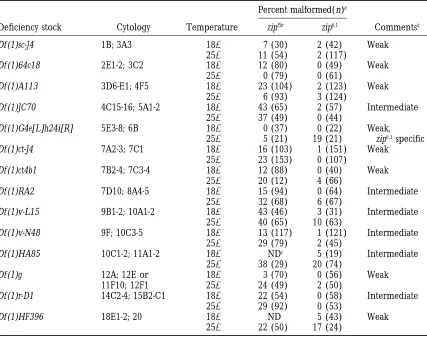
second-encodes the Drosophila nonmuscle myosin-II heavy give rise to mlf adults with a penetrance of at least 10% chain gene (Younget al. 1993). A total of 163 contiguous (Tables 1–3). Expressivity of mlf may be weak or strong deficiency stocks are available for the X, second and (cf. Figure 1B to 1C), but it is not necessarily correlated third chromosomes, and they uncover approximately with the degree of penetrance. A weak mlf phenotype 70% of the euchromatic genome (FlyBase). Excluding is considered diagnostic. Generally, SSNC is observed exceptionally weak stocks and those that uncover zipper, with greater penetrance with zipEbr than with zip6.1
. Of
158 of the deficiency stocks were tested for genetic inter- those deficiencies tested at 258and 188, 22 show a higher actions with zipEbrand zip6.1. Second-site
noncomplemen-penetrance of mlf at 258, 8 are more severe at 188and tation of zip is indicated by the incidence of the mal- 13 show no significant temperature sensitivity. Analysis formed phenotype (mlf ) in the adult leg (Figure 1; of the relationship between these deficiencies and their GotwalsandFristrom1991). Initially, at least 20 adult genetic behavior suggests that a minimum of 39 loci progeny double heterozygous for zip and the tested de- behave as second-site noncomplementors (SSNC) of ficiency were scored. In those cases where at least 10% zipper. The genetic interactions observed between these of the flies were mlf, the cross was repeated and at deficiencies and zip are detailed below.
least 50 additional flies were scored. Alternatively, those deficiencies that did not show an interaction with zip
X Chromosome but overlap deficiencies that did show an interaction,
There are 42 deficiency stocks available in the Defi-were rescreened to confirm this observation.
ciency Kit for the X chromosome. The data for the SSNC Of the 158 tested stocks, 47 deficiencies, when double
heterozygous with at least one of the tested zip alleles, deficiencies are shown in Table 1 and Figure 2, and
TABLE 1
X chromosome deficiencies that act as second-site noncomplementors of zipper
Percent malformed(n)a
Deficiency stock Cytology Temperature zipEbr zip6.1 Commentsb
Df (1)sc-J4 1B; 3A3 188 7 (30) 2 (42) Weak
258 11 (54) 2 (117)
Df (1)64c18 2E1-2; 3C2 188 12 (80) 0 (49) Weak
258 0 (79) 0 (61)
Df (1)A113 3D6-E1; 4F5 188 23 (104) 2 (123) Weak
258 6 (93) 3 (124)
Df (1)JC70 4C15-16; 5A1-2 188 43 (65) 2 (57) Intermediate
258 37 (49) 0 (44)
Df (1)G4e[L]h24i[R] 5E3-8; 6B 188 0 (37) 0 (22) Weak,
258 5 (21) 19 (21) zip6.1specific
Df (1)ct-J4 7A2-3; 7C1 188 16 (103) 1 (151) Weak
258 23 (153) 0 (107)
Df (1)ct4b1 7B2-4; 7C3-4 188 12 (88) 0 (40) Weak
258 20 (12) 4 (66)
Df (1)RA2 7D10; 8A4-5 188 15 (94) 0 (64) Intermediate
258 32 (68) 6 (67)
Df (1)v-L15 9B1-2; 10A1-2 188 43 (46) 3 (31) Intermediate
258 40 (65) 10 (63)
Df (1)v-N48 9F; 10C3-5 188 13 (117) 1 (121) Intermediate
258 29 (79) 2 (45)
Df (1)HA85 10C1-2; 11A1-2 188 NDc 5 (19) Intermediate
258 38 (29) 20 (74)
Df (1)g 12A; 12E or 188 3 (70) 0 (56) Weak
11F10; 12F1 258 24 (49) 2 (50)
Df (1)r-D1 14C2-4; 15B2-C1 188 22 (54) 0 (58) Intermediate
258 29 (92) 0 (53)
Df (1)HF396 18E1-2; 20 188 ND 5 (43) Weak
258 22 (50) 17 (24)
aPercent of malformed flies double heterozygous for the deficiency and the indicated zip allele (Df/1;
zip/1). n is the total number of flies of this genotype that were scored.
bStrength of interactions is based on penetrance of the malformed phenotype in the double heterozygous
flies and is defined as: weak (10–24% mlf), intermediate (25–75% mlf) and strong ($75% mlf).
those deficiencies which fail to interact in these screens Intermediate, second-site noncomplementing X chro-mosome deficiencies: 4C15-16; 4F5: Overlapping
defi-are shown in appendix a. A total of 14 deficiencies on
the X chromosome behave as SSNCs of zip, six with ciencies Df(1)A113 and Df(1)JC70 interact with zipEbrbut
not zip6.1. At 188, Df(1)JC70 ; zip double heterozygotes
an intermediate penetrance (25–75% penetrance), and
the remaining eight as weak interactors (penetrance of exhibit mlf with a penetrance of 43% and a similar penetrance of 37% at 258. The penetrance of mlf with 10–24%). There are no strong interacting deficiencies
on the X chromosome. Df(1)A113 is lower (23% mlf), but this may be an
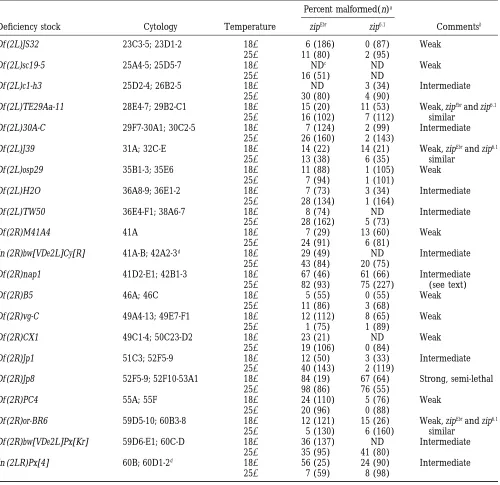
under-TABLE 2
Second chromosome deficiencies that act as second-site noncomplementors of zipper
Percent malformed(n)a
Deficiency stock Cytology Temperature zipEbr zip6.1 Commentsb
Df (2L)JS32 23C3-5; 23D1-2 188 6 (186) 0 (87) Weak
258 11 (80) 2 (95)
Df (2L)sc19-5 25A4-5; 25D5-7 188 NDc ND Weak
258 16 (51) ND
Df (2L)c1-h3 25D2-4; 26B2-5 188 ND 3 (34) Intermediate
258 30 (80) 4 (90)
Df (2L)TE29Aa-11 28E4-7; 29B2-C1 188 15 (20) 11 (53) Weak, zipEbrand zip6.1
258 16 (102) 7 (112) similar
Df (2L)30A-C 29F7-30A1; 30C2-5 188 7 (124) 2 (99) Intermediate
258 26 (160) 2 (143)
Df (2L)J39 31A; 32C-E 188 14 (22) 14 (21) Weak, zipEbrand zip6.1
258 13 (38) 6 (35) similar
Df (2L)osp29 35B1-3; 35E6 188 11 (88) 1 (105) Weak
258 7 (94) 1 (101)
Df (2L)H2O 36A8-9; 36E1-2 188 7 (73) 3 (34) Intermediate
258 28 (134) 1 (164)
Df (2L)TW50 36E4-F1; 38A6-7 188 8 (74) ND Intermediate
258 28 (162) 5 (73)
Df (2R)M41A4 41A 188 7 (29) 13 (60) Weak
258 24 (91) 6 (81)
In (2R)bw[VDe2L]Cy[R] 41A-B; 42A2-3d 188 29 (49) ND Intermediate
258 43 (84) 20 (75)
Df (2R)nap1 41D2-E1; 42B1-3 188 67 (46) 61 (66) Intermediate
258 82 (93) 75 (227) (see text)
Df (2R)B5 46A; 46C 188 5 (55) 0 (55) Weak
258 11 (86) 3 (68)
Df (2R)vg-C 49A4-13; 49E7-F1 188 12 (112) 8 (65) Weak
258 1 (75) 1 (89)
Df (2R)CX1 49C1-4; 50C23-D2 188 23 (21) ND Weak
258 19 (106) 0 (84)
Df (2R)Jp1 51C3; 52F5-9 188 12 (50) 3 (33) Intermediate
258 40 (143) 2 (119)
Df (2R)Jp8 52F5-9; 52F10-53A1 188 84 (19) 67 (64) Strong, semi-lethal
258 98 (86) 76 (55)
Df (2R)PC4 55A; 55F 188 24 (110) 5 (76) Weak
258 20 (96) 0 (88)
Df (2R)or-BR6 59D5-10; 60B3-8 188 12 (121) 15 (26) Weak, zipEbrand zip6.1
258 5 (130) 6 (160) similar
Df (2R)bw[VDe2L]Px[Kr] 59D6-E1; 60C-D 188 36 (137) ND Intermediate
258 35 (95) 41 (80)
In (2LR)Px[4] 60B; 60D1-2d 188 56 (25) 24 (90) Intermediate
258 7 (59) 8 (98)
aPercent of malformed flies double heterozygous for the deficiency and the indicated zip allele (Df 1/1zip). n is the total
number of flies of this genotype that were scored.
bStrength of interactions is based on penetrance of mlf in the double heterozygous flies and is defined as: weak (10–24%
mlf), intermediate (25–75% mlf) and strong ($75% mlf).
cND, not determined.
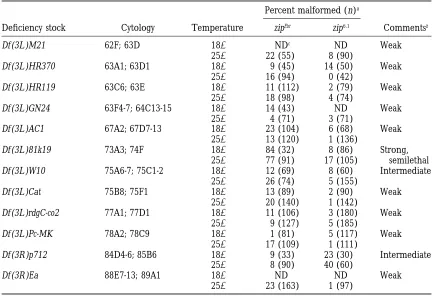
TABLE 3
Third chromosome deficiencies that act as second-site noncomplementors of zipper
Percent malformed (n)a
Deficiency stock Cytology Temperature zipEbr zip6.1 Commentsb
Df (3L )M21 62F; 63D 188 NDc ND Weak
258 22 (55) 8 (90)
Df (3L )HR370 63A1; 63D1 188 9 (45) 14 (50) Weak
258 16 (94) 0 (42)
Df (3L )HR119 63C6; 63E 188 11 (112) 2 (79) Weak
258 18 (98) 4 (74)
Df (3L )GN24 63F4-7; 64C13-15 188 14 (43) ND Weak
258 4 (71) 3 (71)
Df (3L )AC1 67A2; 67D7-13 188 23 (104) 6 (68) Weak
258 13 (120) 1 (136)
Df (3L )81k19 73A3; 74F 188 84 (32) 8 (86) Strong,
258 77 (91) 17 (105) semilethal
Df (3L )W10 75A6-7; 75C1-2 188 12 (69) 8 (60) Intermediate
258 26 (74) 5 (155)
Df (3L )Cat 75B8; 75F1 188 13 (89) 2 (90) Weak
258 20 (140) 1 (142)
Df (3L )rdgC-co2 77A1; 77D1 188 11 (106) 3 (180) Weak
258 9 (127) 5 (185)
Df (3L )Pc-MK 78A2; 78C9 188 1 (81) 5 (117) Weak
258 17 (109) 1 (111)
Df (3R )p712 84D4-6; 85B6 188 9 (33) 23 (30) Intermediate
258 8 (90) 40 (60)
Df (3R )Ea 88E7-13; 89A1 188 ND ND Weak
258 23 (163) 1 (97)
aPercent of malformed flies double heterozygous for the deficiency and the indicated zip allele (zip/1;
Df/1). n is the total number of flies of this genotype that were scored.
bStrength of interactions is based on penetrance of the malformed phenotype in the double heterozygous
flies and is defined as: weak (10–24% mlf ), intermediate (25–75% mlf ) and strong ($75% mlf ).
cND, not determined.
estimation because the stock carries a duplication for (2–3% mlf ). The smallest overlap between these regions is cytologically 4C15-16; 4F5, although the higher pene-region 3C2; 5A1-2 (Dp(1;2)w[1]) that cannot be
fol-lowed phenotypically; thus, the scored class includes trance with Df(1)JC70 indicates that it might uncover a second locus. Alternatively, these deficiencies may flies that carry this duplication. However, this
duplica-tion cannot be responsible for the appearance of mlf uncover the same locus, but the duplication in the
Df(1)A113 stock masks the full penetrance of mlf in
because 50% of the zip heterozygotes (1/1; zipEbr/1)
or deficiency heterozygotes (Df/1; 1/1) would also these flies.
7D10; 8A4-5: Df(1)RA2 uncovers the cytogenetic
inter-be heterozygous for the duplication, but mlf is not seen
in these flies. Neither deficiency interacts with zip6.1 val 7D10; 8A4-5 and acts as a SSNC of intermediate
Figure2.—Second-site noncomplementing deficiencies on the X chromosome. Of the tested X chromosome linked deficiencies,
14 behave as SSNCs of zip. This represents a minimum of 11 loci. Six of the deficiencies act as intermediate SSNCs (green boxes), and eight are weak SSNCs (yellow boxes; Table 1). Tested, noninteracting deficiencies are indicated by the white boxes (appendix a). Of the available deficiencies, no strong SSNC deficiencies were identified on the X chromosome. The chromosome
penetrance with zipEbrat 258 (32% mlf ) and a weaker Df(1)sc-J4 but not by Df(1)64c18 . A deficiency specific
for the Broad-Complex, npr 1, is also a weak SSNC of zipEbr
penetrance at 188 (15% mlf ). There is no observed
interaction with zip6.1 (6% mlf ). An overlapping defi- (GotwalsandFristrom1991). This genetic behavior
is similar to that observed with Df(1)sc-J4. ciency, Df(1)KA14 does not interact genetically with zip
(7% mlf ). Based on the cytology, the interacting locus 5E3-8; 6B: A single deficiency, Df(1)G4e[L]h24i[R]
un-covers region 5E3-8; 6B and interacts with zip6.1(19%
is confined to 7D10; 7F1-2.
9B1-2; 11A1-2: Cytogenetic interval 9B1-2; 11A1-2 is mlf ) but not with zipEbr(5% mlf ). This is only one of
two cases in which zip6.1exhibits a higher penetrance of
uncovered by three overlapping deficiencies,
Df(1)v-L15, Df(1)v-N48 and Df(1)HA85, all of which behave as mlf than zipEbr. The interaction with zip6.1 is weak and
occurs at 258. Df(1)5D and Df(1)JF5 do not interact with intermediate SSNCs. Each deficiency displays a slightly
different interaction with zip. Df(1)v-L15 shows a pene- either zip allele, therefore, the smallest interacting inter-val is 5E8; 6B.
trance of mlf of approximately 40% with zipEbr at both
temperatures, and a weak interaction with zip6.1at 258 7B2-4; 7C1: Weak SSNC is observed with overlapping
deficiencies Df(1)ct-J4 and Df(1)ct4b1 and zipEbr(23% and
(10% mlf ). Df(1)v-N48 overlaps Df(1)v-L15 between 9F;
10A1-2, but shows a slightly weaker penetrance with zipEbr 20% mlf, respectively). Temperature sensitivity is not
observed in either case. The smallest interval uncovered (29% mlf at 258) and no interaction with zip6.1(2% mlf ).
This may reflect either genetic background differences by these deficiencies is 7B2-4; 7C1.
12A; 12E and 18E1-2; 20: Two additional genetic
re-in the stocks or it may re-indicate that Df(1)v-L15 uncovers
an interacting locus not uncovered by Df(1)v-N48. Given gions are defined by single deficiencies which act as weak SSNCs. Df(1)g uncovers 12A; 12E and at 258, in-that Df(1)C52 does not interact with zip (6% mlf ), this
second possible SSNC locus is confined to 9C-D; 9F. teracts with zipEbr with a penetrance of 24%.
Overlap-ping deficiency Df(1)RK2 does not interact (3% mlf ), More proximally, Df(1)HA85 also acts as an intermediate
SSNC with zipEbr(38%) and a weak SSNC with zip6.1(20% so the smallest defined interval is 12A; 12D2. At 258,
Df(1)HF396 acts as a weak SSNC with zipEbr(22% mlf ) and
mlf ). Again, this genetic behavior differs from
Df(1)v-N48, and may reflect the presence of a SSNC locus zip6.1(17% mlf ). Noninteracting deficiencies
Df(1)DCB1-35b (1% mlf ) and Df(1)A209 (4% mlf ) further subdivide
in region 10C3-5; 11A1-2. Operationally, the overlap
between these three deficiencies defines a minimum this interval to 18E1-2; 19F1-2.
Two genes, regulatory light chain (spaghetti-squash; number of interacting loci as two, but the differences
observed in their interactions with the zip alleles indicate Karesset al. 1991) and essential light chain (Edwards et al. 1995), are critical for myosin function and map to
that there may be three or more separate loci.
14C2-4; 15B2-C1: In cytogenetic interval 14C2-4; 15B2- the X chromosome. None of the deficiencies available in the deficiency kit uncover the essential light chain, C1, a single deficiency, Df(1)r-D1, interacts with zipEbr
to give a mlf penetrance of 29% at 258. This stock is but two deficiencies, Df(1)N73 and Df(1)5D, should un-cover spaghetti-squash (sqh). Neither deficiency, however, heterozygous for Dp(1;4)r[1], an unmarked duplication
covering interval 14A1-2; 16A7-B1, and this duplication interacts with zip (3% mlf). Therefore, a reduction in the gene dosage of sqh is not sufficient to elicit the may affect the occurrence of mlf flies. However, the
presence of the duplication does not result in mlf in malformed phenotype in combination with zip. the zip heterozygous (1/1; zipEbr/1) or deficiency
het-erozygous (Df/1; 1/1) siblings (see above, 4C15-16;
Second Chromosome
4F5). Based on these observations, it is likely that the
penetrance observed in the Df(1)r-D1; zipEbrdouble het- Fifty-six deficiency stocks on the second chromosome
are available for analysis. Twenty-one deficiencies on erozygotes is an underestimate.
Weak, second-site noncomplementing X chromosome the second chromosome behave as SSNCs of zip (Figure
3; Table 2;appendix b). This represents a greater
pro-deficiencies: 1B; 3C2: Cytological region 1B; 3C2
con-tains a weakly interacting SSNC. Two deficiencies within portion of SSNCs deficiencies on the second some than those available on the X or third chromo-this interval, Df(1)sc-J4 and Df(1)64c18 interact with zipEbr
with a weak penetrance of mlf (11% and 12% mlf, re- somes. One of the deficiencies acts as a strong SSNC nine exhibit an intermediate penetrance of mlf, and spectively). Deficiencies Df(1)BA1 and Df(1)JC19 do not
interact genetically with either zip allele (3% mlf); there- the remaining 11 are weak SSNCs.
Strong, second-site noncomplementing second
chro-fore, the interacting locus may be confined to
cytologi-cal region 2E1-2; 2F6. Alternatively, each deficiency may mosome deficiency: 52F5-9; 52F10-53A1: On the right
arm of the second chromosome, within cytological inter-uncover separate loci, one confined to 2A; 2E1-2 and a
second to 3A3; 3C2. The lack of interaction seen with val 52F5-9; 52F10-53A1, lies a locus that is a strong SSNC of zip. At 258, 98% of Df(2R)Jp8 1/1 zipEbr flies are
Df(1)JC19 could result if a suppressor(s) of mlf lies on
the chromosome outside the deficiency. It is more likely malformed and the penetrance is 76% in trans to zip6.1.
In addition to displaying mlf with a high penetrance, that two loci in the region act as SSNCs of zip because
Figure3.—Second-site noncomplementing deficiencies on the second chromosome. Of the tested second chromosome-linked
deficiencies, 21 behave as SSNCs of zip. This represents a minimum of 17 loci. One deficiency, Df(2R)Jp8, behaves as a strong SSNC deficiency (red box), nine of the deficiencies act as intermediate SSNCs (green boxes), and 11 are weak SSNCs (yellow boxes; Table 2). Tested, noninteracting deficiencies are indicated by the white boxes (appendix b). The chromosome map is
modified fromLefevre(1976).
4). Df(2R)Jp81/1 zipEbrflies are recovered at 55% of of J3.81/1zipEbrdouble heterozygous flies are mlf, and
are observed with only 53% of the expected Mendelian the expected Mendelian frequency. Df(2R)Jp8 uncovers
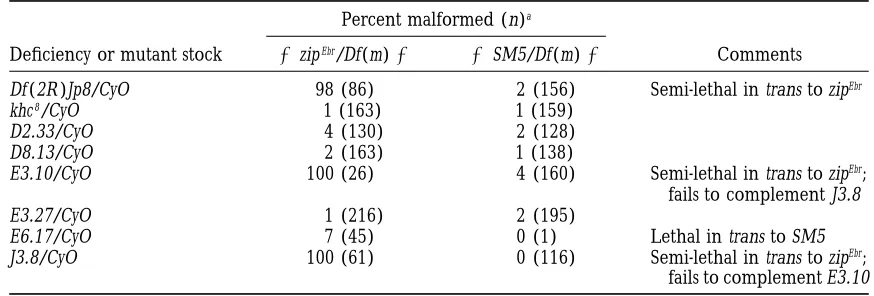
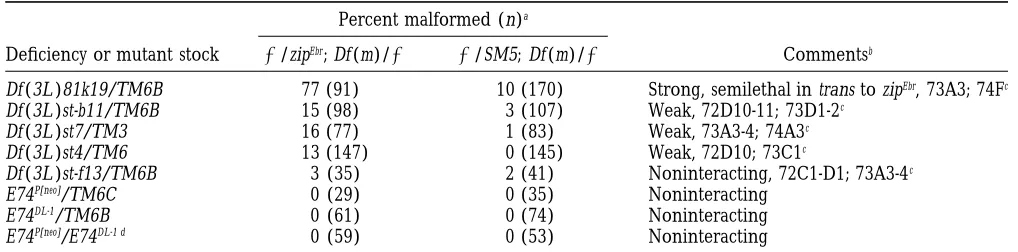
the kinesin heavy chain (khc) locus (Saxtonet al. 1991). frequency. E3.10 and J3.8 are recessive lethals that fail to complement each other (data not shown;R. Steward, We tested a strong kinesin heavy chain mutation, khc8,
and six additional EMS mutations uncovered by Df(2R)Jp8 personal communication) Taken together, it is likely that the genetic interaction seen with Df(2R)Jp8 is spe-for genetic interaction with zipEbr at 258 (Table 4; R.
Steward, personal communication; B. Saxton, per- cific to the interval uncovered by the deficiency and that E3.l0 and J3.8 are mutations in the locus responsible sonal communication; Saxton et al. 1991). The khc8
allele does not interact with zipEbr (,1% mlf ) nor do for this interaction. Further characterization of E3.10/
J3.8 is underway.
four of the six other EMS mutations. Mutations E3.10
and J3.8, however, do interact with zipEbrwith characteris- 51C3; 52F5-9: Abutting the interval uncovered by
Df(2R)Jp8 is a second deficiency, Df(2R)Jp1, that behaves
tics similar to those observed with Df(2R)Jp8. Flies
dou-ble heterozygous for zipEbr and E3.10 are semi-viable as an intermediate SSNC of zipEbr. This deficiency
uncov-ers a locus other than E3.10/J3.8 based on the following: (16% of expected Mendelian frequency) and 100% of
the escaper adults exhibit mlf. One hundred percent First, the interaction seen with Df(2R)Jp1 is specific to
TABLE 4
Second-site noncomplementation of zipper at 258in the cytogenetic region uncovered by Df (2R )Jp8
Percent malformed (n)a
Deficiency or mutant stock 1zipEbr/Df(m)1 1SM5/Df(m)1 Comments
Df (2R )Jp8/CyO 98 (86) 2 (156) Semi-lethal in trans to zipEbr
khc8/CyO ,1 (163) ,1 (159)
D2.33/CyO 4 (130) 2 (128)
D8.13/CyO 2 (163) ,1 (138)
E3.10/CyO 100 (26) 4 (160) Semi-lethal in trans to zipEbr;
fails to complement J3.8
E3.27/CyO 1 (216) 2 (195)
E6.17/CyO 7 (45) 0 (1) Lethal in trans to SM5
J3.8/CyO 100 (61) 0 (116) Semi-lethal in trans to zipEbr;
fails to complement E3.10
aPercent of malformed flies double heterozygous for the indicated deficiency or mutation and zipEbr(Df or
TABLE 5
Second-site noncomplementation of zipper at 258in the cytogenetic region uncovered by Df (2L )sc19-5
Percent malformed (n)a
Mutant stock 1zipEbr/m1 1SM5/m1 Comments
l (2)01209/CyO 15 (66) 0 (51) Fails to complement viking
vkgBLK/CyO 6 (49) 2 (40)
vkgICO/CyO 10 (49) 0 (66)
vkgSAK/CyO 5 (62) 0 (73)
aPercent of malformed flies double heterozygous for the indicated mutation and zipEbr(m1/1zipEbr). n is
the total number of flies of this genotype that were scored.
zipEbrand penetrance of mlf is lower (40%) and is seen 36E1-2 and 36E4-F1; 38A6-7, respectively. Each shows
only at 258. Also, no reduction in viability is seen in an intermediate penetrance of mlf of 28% with zipEbrat
these flies (data not shown). Finally, the mutagenesis 258. This reveals at least two SSNCs loci. Df(2L)TW137 that generated E3.10 was designed such that the muta- (6% mlf ) is noninteracting and overlaps each of these tion is uncovered by Df(2R)Jp8 but not uncovered by deficiencies, and noninteracting Df(2L)TW84 (0%)
Df(2R)Jp1 (Saxtonet al. 1991). Therefore, an additional overlaps the proximal end of Df(2L)TW50. Thus, at least SSNC locus of zip falls in interval 51C3; 52F5-9. The one interacting locus is confined to 36A8-9; 36C2-4 and myosin light chain kinase maps to this interval (Kojima the other is restricted to 37B9-C1; 37F5-38A1.
et al. 1996; Tohtong et al. 1997; M. Champagne, K. 41A; 42B1-3: Df(2R)nap1 maps cytogenetically to Edwards and D. Kiehart, unpublished results), but
41D2-E1; 42B1-3. It is an apparent strong SSNC of both mutations in the gene are not currently available for zipEbrand zip6.1. At 258, mlf is seen in 82% of flies double
analysis. heterozygous for the deficiency and zipEbr and in 75%
Intermediate, second-site noncomplementing second of the flies carrying zip6.1. A caveat to the interpretation
chromosome deficiencies: 25A4-5; 26B2-5: An interme- of this data is that the deficiency chromosome shows
diate penetrance of 30% of mlf is seen between Df(2L)c1- dominance for mlf since flies that are singly
hetero-h3 and zipEbr
. This deficiency uncovers interval 25D2-4; zygous for the Df(2R)nap1 also display mlf (Table 6).
26B2-5. Df(2L)sc19-5 overlaps this interval between The appearance of mlf in the Df(2R)nap1 heterozygotes 25D2-4; 25D5-7, and it behaves as a weak SSNC. Based on
is dependent on genetic background. In crosses to its cytological location, viking [vkg, encoding collagen
zipEbr/SM5, mlf is seen in approximately 45% of the
a2(IV);Yasothornsrikulet al. 1997] should be
uncov-Df(2R)nap1/SM5 flies (Table 6), while the penetrance
ered by Df(2L)sc19-5 but not by Df(2L)c1-h3. Mutations
is 65–82% in Df(2R)nap1/CyO flies (data not shown). If in the vkg locus have been tested for second-site
non-the penetrance of mlf in non-the case of non-the zipEbris strictly
complementation with zipEbr (Table 5). l(2)01209 is a
additive, then the penetrance of mlf in the Df(2R)nap1
P-element insertion that fails to complement vkg (data
1/1 zipEbr double heterozygotes would be
approxi-not shown). In trans to zipEbr, 15% of the l(2)01209
het-mately 40% at 258. It is unlikely that the genetic interac-erozygous flies are mlf. Additionally, vkgICOacts as a weak
tion seen with zipEbr and Df(2R)nap1 is a manifestation
SSNC of zip (10% mlf ), although two additional alleles,
of only the genetic background of the deficiency stock,
vkgBLKand vkgSAK(6% and 5% mlf, respectively) do not
because an overlapping deficiency present in chromo-interact with zipEbr by our criteria. The differences in
somal rearrangement In(2R)bw[VDe2L]Cy[R] (41A-B; SSNC behavior of these vkg alleles with zip may reflect
42A2-3) also behaves as an intermediate strength SSNC differences in their strength, although previous
comple-of zipEbr, exhibiting mlf in 43% of the flies at 258(Tables
mentation analysis does not address this issue directly
2 and 6). Flies heterozygous for In(2R)bw[VDe2L]Cy[R] (Rodriguezet al. 1996).
also exhibit mlf in the absence of zip (10–12%; Table 6) but
29F7-30A1; 30C2-5: Cytogenetic interval 29F7-30A1;
with considerably lower penetrance than Df(2R)nap1. 30C2-5 is uncovered by Df(2L)30A-C. This deficiency is
Based on cytology, one of the loci encoding cytoplasmic a SSNC of zipEbr, with a phenotypic penetrance of 26%,
actin (Act42A) maps to 42A (Fyrberget al. 1981), but but does not interact with zip6.1(2% mlf ). The genetic
it is unlikely to be the SSNC because Df(1)nap9 (42A1-interaction is only seen at 258. No additional deficiencies
2; 42E6-F1) should also uncover Act42A but is not a within the Deficiency Kits overlap this interval, so the
SSNC (appendix b). Assessing the data observed with focus of the interaction has not been mapped any more
these three stocks shows at least one interacting locus finely.
falls within 41D2-E1; 42A1-2. Additionally, Df(2R)M41A4
36A8-9; 36E1-2 and 36E4-F1; 38A6-7: Two adjacent
TABLE 6
Second-site noncomplementation of zipper at 258in the cytogenetic region uncovered by Df (2R )nap1 and In (2R )bw[VDe2L]Cy[R]
Percent malformed (n)a
Deficiency stock 1zipEbr/Df1 1SM5/Df1 Comments
Df(2R )nap1/In (2LR)Gla, Dp(2;2)BG 82 (93) 42 (127) Df heterozygotes display mlf
Df(2R )nap9/In (2LR)Gla, Dp(2;2)BG 4 (73) 9 (90)
In (2R)bw[VDe2L]Cy[R]/In (2LR )Gla, Dp(2;2)BG 43 (84) 10 (85) Df heterozygotes display mlf
aPercent of malformed flies double heterozygous for the indicated deficiency and zipEbr(Df1/1zipEbr). n is the total number
of flies of this genotype that were scored.
interval 41A-F contains at least two loci that interact with zipEbrat 188 and 258 (15–16% mlf) and also with
zip6.1at 188(11% mlf ).
with zip.
31A; 32C-E: Df(2L)J39 uncovers 31A; 32C-E and also 59D5-9; 60D: The tip of the right arm of the second
interacts with zipEbrand zip6.1(13–14% mlf ).
chromosome is represented by several SSNC
deficien-35B1-3; 35E6: In cytological location 35, Df(2L)osp29
cies that do not uncover zip, verified by their ability
uncovers a locus that behaves as a weak SSNC of zipEbr
to complement the two zip alleles, but do uncover a
at 188 (11% mlf ). Df(2L)b87e25 and Df(2L)r10 do not number of interacting loci. Flies heterozygous for
interact with zip (1% and 6% mlf, respectively);
there-Df(2R)bw[VDe2L]Px[Kr] have blistered wings. In
addi-fore this locus is restricted to 35B10-C1; 35E1. tion to the blistered wings, flies double heterozygous
On the right arm of the second chromosome, there for the deficiency and either zipEbror zip6.1display mlf with
are four weak SSNC deficiencies in addition to Df(2R)or-a penetrDf(2R)or-ance rDf(2R)or-anging from 35–41% Df(2R)or-and no temperDf(2R)or-ature
BR6.
sensitivity. Df(2R)or-BR6 overlaps the proximal region of
46A; 46C: Df(2R)B5 uncovers interval 46A; 46C. At Df(2R)bw[VDe2L]Px[Kr] between 59D5-9; 60B3-8. Unlike
258, Df(2R)B5; zipEbr double heterozygous flies exhibit
Df(2R)bw[VDe2L]Px[Kr], Df(2R)or-BR6 interacts with zipEbr
mlf at 11% penetrance. and zip6.1only at 188and results in a weak penetrance
49A4-13; 50C23-D2: In the genomic region 49A4-13;
of mlf (12–15%). Distally, the deficiency uncovered by
50C23-D2, two overlapping deficiencies, Df(2R)vg-C and
In(2LR)Px[4] overlaps Df(2R)bw[VDe2L]Px[Kr] between
Df(2R)CX1, act as weak SSNCs of zipEbr, although they
60B; 60D1-2. In(2LR)Px[4] is an intermediate SSNC of
behave with slightly different characteristics. Df(2R)vg-C
zipEbrand zip6.1at 188(56% and 24% mlf, respectively),
shows the interaction only at 188(12% mlf ) while the consistent with the results seen previously byGotwals
interaction shows both a higher penetrance and no andFristrom(1991) with zipEbr. Taken together, these
temperature sensitivity in the case of Df(2R)CX1 (19– results suggest there are at least two interacting loci
23% mlf ). Either each deficiency uncovers interacting uncovered by these deficiencies. One locus interacts
loci within the nonoverlapping regions, or differences specifically at 188and would fall into 60B1-8, the region
in the genetic background of these stocks affect the overlapped by Df(2R)or-BR6 and In(2LR)Px[4]. At least
specificity of the interactions. one additional locus would fall in interval 60B3-8; 60D.
55A; 55F: Finally, Df(2R)PC4 uncovers interval 55A; GotwalsandFristrom(1991) identified two loci that
55F, and it interacts specifically with zipEbrbut not zip6.1
interact with zipEbrin this interval: bs and l(2)B485.
Con-with a penetrance of 20–24%. The more proximal de-trary to their observations, an interaction was not
ob-ficiencies Df(2R)Pc17B and Df(2R)Pc111B (4% and 1% served between Df(2R)PX2 and zip.
mlf ) do not interact, therefore the interacting locus is
Weak, second-site noncomplementing second
chro-mapped to 55C1-3; 55F.
mosome deficiencies:In addition to the three weakly
interacting deficiencies on the second chromosome
de-Third Chromosome
scribed above, there are eight additional deficiencies,
each defining a separate genomic region, that are also Of the 65 deficiencies available on the third chromo-weakly interacting. On the left arm of the second chro- some, 12 behave as SSNCs of zip (Figure 4; Table 3; mosome, there are four additional weak SSNC deficien- appendix c). One deficiency behaves as a strong SSNC cies in addition to Df(2L)sc19-5. and in combination with zipEbr shows reduced viability.
23C3-5; 23D1: Df(2L)JS32 uncovers interval 23C3-5; Two deficiencies behave as intermediate SSNCs and the 23D1 behaves as a weak SSNC (11% mlf ). remainder interact weakly. A minimum of 11 interacting
28E4-7; 29B2-C1: Genomic region 28E4-7; 29B2-C1 is loci can be inferred.
Strong, second-site noncomplementing third
Figure 4.—Second-site noncomplementing deficiencies on the third chromosome. Of the tested third chromosome-linked
deficiencies, 12 behave as SSNCs of zip. This represents a minimum of 11 loci. One deficiency, Df(3L)81k19, behaves as a strong SSNC deficiency (red box), two of the deficiencies act as intermediate SSNCs (green boxes), and nine are weak SSNCs (yellow boxes; Table 3). Tested, noninteracting deficiencies are indicated by the white boxes (appendix c). The chromosome map is
modified from Lefevre(1976).
some deficiency: 73A3; 74F: In the presence of zipEbr, with the initiation of the major cell shape changes that
occur during the morphogenesis of the leg (Condicet Df(3L)81k19 (cytogenetic interval 73A3; 74F) behaves
as a strong SSNC at both 188 and 258, exhibiting a al. 1990;FristromandFristrom1993). Finally, it has been shown to interact genetically with the Broad-Com-penetrance of mlf in 77–84% of the flies. There is a
decrease in viability of double heterozygous mutant plex (FletcherandThummel1995), members of which are also known to interact genetically with zip (Gotwals flies, as compared to their SM5/1; Df(3L)81k19/1
sib-lings (53% of expected Mendelian frequency; Table 7). andFristrom1991). E74 is a complex locus, encoding two overlapping transcripts with separate promoters, At 258, flies with the deficiency in trans to zip6.1show a
17% penetrance of mlf. The locus encoding an ecdy- and two mutations, E74P[neo]and E74DL-1, affect each
tran-script independently and complement each other ge-sone-responsive ets domain transcription factor, E74, lies
within this interval (Burtiset al. 1990). Circumstantial netically (Burtis et al. 1990; Fletcher et al. 1995). Because E74 appeared to be a good candidate for acting evidence that favors E74 as a SSNC is as follows. First,
E74 is uncovered by Df(3L)81k19 (data not shown; as the SSNC, we tested it, but found it did not interact genetically with zip. Each E74 mutation was tested with Fletcher et al. 1995). Second, it is expressed at late
third larval instar (Thummel et al. 1990), coincident zip for second-site noncomplementation (Table 7). For
TABLE 7
Second-site noncomplementation of zipper at 258in the cytogenetic region uncovered by Df (3L )81k19
Percent malformed (n)a
Deficiency or mutant stock 1/zipEbr; Df (m)/1 1/SM5; Df (m)/1 Commentsb
Df (3L )81k19/TM6B 77 (91) 10 (170) Strong, semilethal in trans to zipEbr, 73A3; 74Fc
Df (3L )st-b11/TM6B 15 (98) 3 (107) Weak, 72D10-11; 73D1-2c
Df (3L )st7/TM3 16 (77) 1 (83) Weak, 73A3-4; 74A3c
Df (3L )st4/TM6 13 (147) 0 (145) Weak, 72D10; 73C1c
Df (3L )st-f13/TM6B 3 (35) 2 (41) Noninteracting, 72C1-D1; 73A3-4c
E74P[neo]/TM6C 0 (29) 0 (35) Noninteracting
E74DL-1/TM6B 0 (61) 0 (74) Noninteracting
E74P[neo]/E74DL-1 d 0 (59) 0 (53) Noninteracting
aPercent of malformed flies double heterozygous for the indicated deficiency or mutation and zipEbr(zipEbr/1; Df (m)/1). n is
the total number of flies of this genotype that were scored.
bStrength of interactions is based on penetrance of the malformed phenotype in the double heterozygous flies and is defined
as: noninteracting (,10% mlf ), weak (10–24% mlf ), intermediate (25–75% mlf ) and strong ($75% mlf ).
cCytology uncovered by deficiency.
each allele independently, no interaction was seen with chromosome deficiencies: Two regions on the third chromosome contain loci that interact intermediately
zipEbr (0% mlf). Df(3L)81k19, however, should remove
both E74 transcripts. In order to eliminate both tran- with zip.
75A6-7; 75F1: Two deficiencies, Df(3L)W10 and
scripts from the flies, a double heterozygous stock was
constructed, zipEbr/SM5; E74P[neo]/TM6C, and males from Df(3L)Cat, define one of these regions. They overlap
between 75B8; 75C1-2. Each deficiency interacts with this stock were crossed to E74DL-1/TM6C virgin females.
The malformed phenotype was then assessed in flies zipEbr but not with zip6.1, and a slight increase in the
penetrance of mlf is seen at 258. The highest observed heterozygous for zipEbrand transheterozygous for both
E74 alleles. Again, no malformed flies were observed penetrance of mlf is 26% with Df(3L)W10 and 20% with
Df(3L)Cat.
(0% mlf). Therefore, it is clear that E74 does not interact
genetically with zip. 84D4-6; 85B6: Df(3R)p712 defines a unique interval,
84D4-6; 85B6. In all but one other case, zipEbrproves to
Since Df(3L)81k19 uncovers a strong SSNC of zip, finer
genetic mapping was pursued (Figure 5; Table 7). Re- be the more sensitive allele in these screens. Df(3R)p712, however, interacts with zip6.1but not with zipEbr. There is
ported deficiencies that overlap Df(3L)81k19 are
con-fined to the proximal side of the deficiency. A weakly a slight temperature sensitivity observed, so at 258, 40% of the double heterozygous flies are mlf as compared interacting genetic region has been identified between
73A3-4; 73C1. Df(3L)st-bll, Df(3L)st7 and Df(3L)st4 inter- to 23% at 188. Df(3R)Hu, Df(3R)Ant17 and Df(3R)p-Xt103 (8% mlf) are noninteracting deficiencies that overlap act with zipEbr, giving rise to mlf flies in 13–16% of the
cases. Df(3L)st-f13 defines the proximal limit of this re- the proximal and distal breakpoints of Df(3R)p712. Thus the SSNC locus is confined to 84F1; 85A2.
gion because it does not interact (3% mlf). The low
penetrance of mlf observed with these deficiencies sug- Weak, second-site noncomplementing third
chromo-some deficiencies:Six regions on the third chromosome
gests that at least one other SSNC locus of zip, falls
within the interval 73C1; 74F, and perhaps, based on possess weak SSNC loci of zip.
62F; 63D: One region is defined at 63D1. Three
the distal breakpoint in Df(3L)st7, the locus is actually
confined to 74A3-74F. Unfortunately, no published de- overlapping deficiencies, Df(3L)M21, Df(3L)HR370 and
Df(3L)HR119 overlap at 63D1 and each interacts with
ficiencies subdivide this region. Eighteen lethal
P-ele-ment insertions collected by the Berkeley Drosophila zipEbrwith a penetrance between 11–22%.
63F4-7; 64C13-15: Neighboring this interval, Df(3L)
Genome Project (University of California, Berkeley, CA)
fall within 73A-74F have been tested for SSNC of zip, GN24 also shows mlf with zipEbrwith a penetrance of 14%
at 188. Two noninteracting deficiencies, Df(3L)GN50 but none of them interact (data not shown). In sum,
we have yet to identify the locus or loci responsible and Df(3L)ZN47 (5% mlf ), overlap this region, so the interacting locus is likely to be confined to 64C. for the strong SSNC observed when the Df(3L)81k19
chromosome is put in trans to zip. 67A2; 67D7-13: Df(3L)AC1 uncovers 67A2; 67D7-13
and is a weak SSNC of zipEbr at 188 and 258 (23% and
Intermediate, second-site noncomplementing third
13% mlf, respectively). Comparing the cytology of this deficiency with the noninteracting deficiency Df(3L)29A6 (7%), the locus lies within 67B1; 67D7-13.
77A1; 77D1 and 78A2; 78C9: Distally on the
chromo-some arm 3L, nonoverlapping deficiencies,
Df(3L)rdgC-co2 (11% mlf ) and Df(3L)Pc-Mk (17% mlf ), interact
weakly with zipEbr
. Df(3L)ri-79C is noninteracting and
overlaps each of these deficiencies. Taken together,
Df(3L)rdgC-co2 uncovers a locus in interval 77A1; 77B-C
that interacts with zipEbrat 188with a penetrance of mlf
of 11%. Screening with Df(3L)Pc-Mk reveals a weakly interacting locus mapping to 78A; 78C9.
88E7-13; 89A1: Df(3R)Ea behaves as a weak SSNC of zipEbr. Testing at 258shows that Df(3R)Ea interacts
spe-cifically with zipEbr. The penetrance of mlf in these flies
Figure5.—Finer genetic mapping of the zipper SSNC region
is 23%. The genetic interactions observed with this defi-73A3; 74F. Df(3L)81k19 is a strong SSNC of zip (red box).
ciency are consistent with results obtained when muta-To more finely map the regions responsible for this genetic
interaction, additional deficiencies were tested for SSNC of tions in the cytoplasmic tropomyosin (cTm) locus are tested
zip. Df(3L)st-b11, Df(3L)st7 and Df(3L)st4 behave as weak SSNCs (Table 8). Df(3R)Ea uncovers cTm, and maternal effect (yellow box), but Df(3L)st-f13 does not interact genetically with and lethal mutations specific for cTm have been identi-zip (white box; Table 7). This maps a weakly interacting region
fied (Erde´ lyiet al. 1995;Tetzlaffet al. 1996). A mater-to interval 73A3-4; 73C1. Based on these observations, region
nal effect allele of cTm, cTmeg9, was generated by
P-ele-74A3; 74F may also include a locus or loci that behave as SSNC
TABLE 8
Second-site noncomplementation of zipper at 258in the cytogenetic region uncovered by Df(3R)Ea
Percent malformed (n)a
Deficiency or mutant stock 1/zipEbr; Df (m)/1 1/SM5; Df (m)/1 Comments
Df(3R)Ea 23 (163) 2 (197)
cTmeg9/TM3 34 (41) 2 (40) Maternal effect allele
cTmer4/TM3 26 (76) 0 (64) Lethal allele
aPercent of malformed flies double heterozygous for the indicated deficiency or mutation and zipEbr(zipEbr/
1; Df (m)/1). n is the total number of flies of this genotype that were scored.
by imprecise excision of the P-element (Erde´ lyi et al. R)bw[VDe2L]Cy[R] overlap in region 41A, and Df(2R)or-BR6, Df(2R)bw[VDe2L]Px[Kr] and In(2LR)Px[4] overlap
1995). Both cTm alleles behave as SSNCs with zipEbrbut
not with zip6.1(Table 8; data not shown). The penetrance in cytogenetic interval 60B-D. Thus, the SSNC
deficien-cies that interact with both zipEbr and zip6.1 define 10
of mlf with each allele and zipEbris similar to each other
and to Df(3R)Ea (26–34% mlf ). Thus, Df(3R)Ea defines regions of the genome that are required for zip function and represent strong candidates for pursuit in the fu-at least one locus thfu-at acts as a SSNC of zipEbr, and cTm
appears responsible for the interaction. ture. In addition, the 12 deficiencies that act as interme-diate SSNCs, 11 of which interact with zipEbr and one
that interacts with zip6.1, are also strong candidates for
DISCUSSION future analysis.
Second-site noncomplementing loci generally map to
Second-site noncomplementation of zipper: Our
the deficiencies: Operationally, it is possible that the
screens for second-site noncomplementation of zipper
SSNC seen between the deficiency stocks and zip could with deficiencies from the Bloomington Stock Center
map to a region of the chromosome other than that Deficiency Kits assay for the malformed phenotype.
area that is uncovered by the deficiency. In all cases for These screens reveal 47 deficiencies on the X, second
which appropriate data are currently available, this is and third chromosomes that act as SSNCs of zip, and
not the case. In these instances multiple stocks are avail-111 that do not. The relative strength of the genetic
able for screening. In the strongest case arguing against interactions has been assigned based on the penetrance
the interacting loci mapping outside the deficiency, of mlf in zip; Df double heterozygous flies. Two of the
overlapping deficiency stocks derived from different pa-47 interacting deficiencies, Df(2R)Jp8 and Df(3L)81k19,
rental lines show a genetic interaction with zip, behaving are classified as strong SSNCs, with an observed
pene-with similar characteristics. Eight chromosomal regions trance of mlf in excess of 75%. Intermediate strength
are defined by overlapping SSNC deficiencies derived penetrance (25–75% mlf ) is seen with 17 of the
defi-from different parental chromosomes (Table 9). In ciency stocks, and weak interactions (penetrance of 10–
cases where overlapping deficiencies have not been 24%) are seen with 28 of the stocks. The two strong
tested, the identification of individual SSNC mutations interacting deficiencies also affect the viability of flies
that are uncovered by the deficiency provide alternate that are double heterozygous with zipEbr
. Expressivity of
evidence that the SSNC is due to loci uncovered by the mlf is not always correlated with the degree of
pene-deficiency. In this study, we identified three mutations, trance. Temperature sensitivity was assessed for 43 of
E3.10/J3.8, vkg, and cTm, that are uncovered by SSNC
the SSNC deficiency stocks. Thirteen of the stocks
deficiencies and are themselves, SSNCs of zip. showed no significant temperature sensitivity while
Genetic background affects the penetrance of mlf. eight deficiencies exhibited cold sensitivity at 188, and
When zipEbr/SM5 is outcrossed to second chromosome
22 exhibited temperature sensitivity at 258. Generally,
deficiency stocks, mlf is observed in an average of 3% the zipEbrallele is more sensitive in these screens, such
of the zipEbr/CyO progeny. When outcrossed to
Ore-that SSNC is seen only with zipEbr, or SSNC is observed
gon-R wild-type flies, mlf is seen in 6% of the zipEbr/
with both zip alleles, but with a lower penetrance when
1 progeny. We expect the observed variation in the in trans to zip6.1. The only exceptions to this are seen in
penetrance arises from genetic differences that could tests with Df(1)G4e[L]h24i[R] and Df(3R)p712. In each
be present on any of the chromosomes within the stocks. of these cases, SSNC is observed only when double
het-The influence of genetic background is of greatest con-erozygous with zip6.1. Thirteen of the deficiencies
inter-cern for those deficiencies that interact with zip with act with both zipEbrand zip6.1, and they include the two
weak penetrance (10–24% mlf ), particularly those with strong SSNCs, five of the intermediate SSNCs and six
an observed penetrance of 10–15%. Indeed, our selec-weak SSNCs. Among this collection of 13 stocks, five
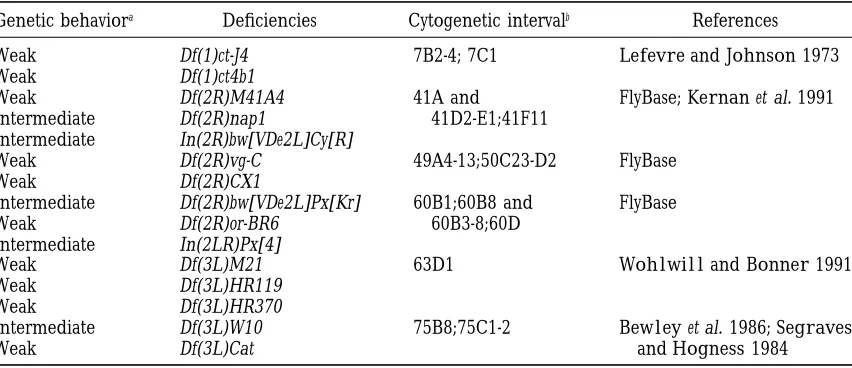
de-TABLE 9
Origins of overlapping deficiencies that act as second-site noncomplementors of zipper
Genetic behaviora Deficiencies Cytogenetic intervalb References
Weak Df(1)ct-J4 7B2-4; 7C1 LefevreandJohnson1973
Weak Df(1)ct4b1
Weak Df(2R)M41A4 41A and FlyBase;Kernanet al. 1991
Intermediate Df(2R)nap1 41D2-E1;41F11
Intermediate In(2R)bw[VDe2L]Cy[R]
Weak Df(2R)vg-C 49A4-13;50C23-D2 FlyBase
Weak Df(2R)CX1
Intermediate Df(2R)bw[VDe2L]Px[Kr] 60B1;60B8 and FlyBase
Weak Df(2R)or-BR6 60B3-8;60D
Intermediate In(2LR)Px[4]
Weak Df(3L)M21 63D1 WohlwillandBonner1991
Weak Df(3L)HR119
Weak Df(3L)HR370
Intermediate Df(3L)W10 75B8;75C1-2 Bewleyet al. 1986;Segraves
Weak Df(3L)Cat andHogness1984
aStrength of interactions is based on penetrance of the malformed phenotype when double heterozygous
with zip and is defined as: weak (10–24% mlf ), intermediate (25–75% mlf ) and strong ($75% mlf ).
bSSNC genomic region that is uncovered by the indicated deficiencies.
fining interaction is somewhat arbitrary, but we believe temporal and spatial function of myosin. Players in this process may include the following: cell surface receptors it is valid. Genetic background is unlikely to be
re-sponsible for the observed interaction with all of the and their ligands that respond to developmental cues; intercellular signaling molecules; transcription factors weakly penetrant deficiencies. First, of the 28 identified
weak class deficiencies, only 11 interact with a pene- that direct the synthesis of factors required upstream of myosin function; structural factors, such as other trance of 10–15%. The influence of genetic background
on the interaction has been tested, albeit indirectly, for cytoskeletal proteins and extracellular matrix proteins, involved in the appropriate targeting and maintenance five of these 11 deficiencies. For example, deficiencies
Df(2L)TE29Aa-11, Df(2L)J39 and Df(2R)or-BR6 interact of myosin within the cell; and direct, myosin regulatory proteins, such as myosin light chain kinase, that regulate with both zipEbr and zip6.1 (Table 2). Because each of
these zip alleles was derived independently from differ- the activity of myosin-based contractions. In this study, the mlf leg phenotype provides the assay for this screen. ent parental stocks (Gotwals and Fristrom 1991;
Young et al. 1993) the genetic background for these Therefore, the genomic regions identified in these screens must include loci that are required to collabo-interacting deficiencies was varied in the double
hetero-zygotes, and yet each deficiency is interacting. Further, rate with myosin during imaginal leg disc elongation. It is expected that some of the identified loci will be
Df(2R)vg-C and Df(2R)CX1 are weakly interacting,
over-lapping SSNC deficiencies derived from different paren- specific for adult leg morphogenesis, but other loci will encode gene products that are used throughout all tal stocks that behave similarly in this assay (Table 9).
Thus, genetic background is unlikely to solely account stages of development for cell shape change driven mor-phogenesis. To date, our analysis of loci uncovered by for the observed interactions between these deficiencies
and zip. SSNC deficiencies demonstrates that a gene encoding
a cytoskeletal protein and one encoding an extracellular Overall, the general applicability of this genetic
screen holds strong. To date, based on the criteria listed matrix protein are each required in concert with myosin for proper imaginal leg disc morphogenesis. In addi-above, of the 47 SSNC deficiencies, 11 SSNC genomic
regions have been definitively mapped, and one addi- tion, analysis of interactions between zip and E74 reveals that the function of myosin during leg morphogenesis tional interval is likely to be specific for SSNC with zip.
Clearly, verification that SSNC maps to the deficiency may not be under general transcriptional control of ecdysone-induced transcription factors. Finally, a cur-and not elsewhere in the genome is a first step in
pursu-ing the identification of individual SSNC loci. rently uncharacterized EMS-induced mutation that be-haves as a strong SSNC of zip has been identified.
Molecular basis of second-site noncomplementing
loci:The expectation of this screen is that loci that are Cytoskeletal and extracellular matrix loci:This screen
implicates a function for cytoplasmic tropomyosin dur-required for myosin function during morphogenesis