Copyright2000 by the Genetics Society of America
Synthetic Genetic Interactions With Temperature-Sensitive Clathrin in
Saccharomyces cerevisiae
: Roles for Synaptojanin-Like Inp53p and
Dynamin-Related Vps1p in Clathrin-Dependent Protein Sorting
at the
trans
-Golgi Network
Eric S. Bensen, Giancarlo Costaguta and Gregory S. Payne
Department of Biological Chemistry, School of Medicine, University of California, Los Angeles, California 90095 Manuscript received July 12, 1999
Accepted for publication September 15, 1999
ABSTRACT
Clathrin is involved in selective protein transport at the Golgi apparatus and the plasma membrane. To further understand the molecular mechanisms underlying clathrin-mediated protein transport path-ways, we initiated a genetic screen for mutations that display synthetic growth defects when combined with a temperature-sensitive allele of the clathrin heavy chain gene (chc1-521) in Saccharomyces cerevisiae. Mutations, when present in cells with wild-type clathrin, were analyzed for effects on mating pheromone a-factor precursor maturation and sorting of the vacuolar protein carboxypeptidase Y as measures of protein sorting at the yeast trans-Golgi network (TGN) compartment. By these criteria, two classes of mutants were obtained, those with and those without defects in protein sorting at the TGN. One mutant with unaltered protein sorting at the TGN contains a mutation in PTC1, a type 2c serine/threonine phosphatase with widespread influences. The collection of mutants displaying TGN sorting defects includes members with mutations in previously identified vacuolar protein sorting genes (VPS), including the dynamin family member VPS1. Striking genetic interactions were observed by combining temperature-sensitive alleles of CHC1 and VPS1, supporting the model that Vps1p is involved in clathrin-mediated vesicle formation at the TGN. Also in the spectrum of mutants with TGN sorting defects are isolates with mutations in the following: RIC1, encoding a product originally proposed to participate in ribosome biogenesis; LUV1, encoding a product potentially involved in vacuole and microtubule organization; and INP53, encoding a synaptojanin-like inositol polyphosphate 5-phosphatase. Disruption of INP53, but not the related INP51 and INP52 genes, resulted in a-factor maturation defects and exacerbated a-factor maturation defects when combined with chc1-521. Our findings implicate a wide variety of proteins in dependent processes and provide evidence for the selective involvement of Inp53p in clathrin-mediated protein sorting at the TGN.
E
UKARYOTIC cells contain multiple membrane- Coat proteins constitute a class of molecules associatedwith the cytoplasmic face of organelles and transport bounded compartments, each with a distinct
com-position and cellular function. To maintain the integrity vesicles. Coat protein complexes are believed to drive
membrane deformation during vesicle formation and of each organelle, the cell selectively transports proteins
to the appropriate resident compartment. Examples of impart specificity to protein transport reactions by
se-lecting appropriate proteins for incorporation as cargo such selective transport occur in the secretory pathway.
into nascent transport vesicles (Schekman and Orci
Proteins that reside in secretory pathway organelles can
1996; Robinson 1997). Distinct coat complexes have
be actively retained and/or retrieved from subsequent
been defined, including COPI, COPII, and clathrin compartments, while secreted and plasma membrane
coats. COPI and COPII coats have well-characterized
proteins traverse the pathway (RothmanandWieland
roles in selective transport at the early stages of the
1996;Kaiser et al. 1997). Further sorting occurs at
or-secretory pathway and probably participate in other se-ganelles such as the trans-Golgi network (TGN) where
cretory and endocytic steps (Barlowe1998;Loweand
pathways branch to multiple destinations (Trauband
Kreis1998). In contrast, clathrin coats are involved in Kornfeld1997). The complex molecular mechanisms
receptor-mediated endocytosis, localization of resident necessary for different steps in selective protein
trans-membrane proteins to the TGN, and transport of pro-port remain incompletely defined.
teins to the lysosome/vacuole (Wilsbach and Payne
1993a;Schmid1997;Molloyet al. 1999).
Clathrin and clathrin adaptors (APs) are the major Corresponding author: Gregory S. Payne, UCLA School of Medicine,
structural components of clathrin coats (Schmid1997).
Department of Biological Chemistry, 33-247 CHS, P.O. Box 951737,
Los Angeles, CA 90095-1737. E-mail: [email protected] Clathrin is a three-legged molecule, termed a triskelion,
made up of heavy (Chc) and light chains (Clc). Triskeli- that confer lethality in a chc1D strain, yielding lesions
in numerous loci (Munn et al. 1991). However, the
ons assemble together to form the outer polyhedral
shell of the coat. Clathin APs are heterotetramic com- specificity of the mutations was uncertain because of
the possibility that subtle defects in pathways unrelated plexes that bridge the clathrin shell to the membrane.
APs act in recruitment of clathrin to appropriate mem- to clathrin could cause inviability when present in
al-ready debilitated chc1Dcells. To circumvent this issue,
branes and in cargo selection during vesicle formation.
At least two distinct AP complexes interact with clathrin, we have taken advantage of the properties of cells
ex-pressing the temperature-sensitive chc1-521 allele to AP-1 at the TGN and AP-2 at the plasma membrane
(Hirst and Robinson 1998). Whether the newly de- characterize clathrin-dependent pathways. In these
cells, the severity of growth and protein transport defects scribed AP-3 complex participates in clathrin-coated
ves-icle formation is currently unclear (Simpsonet al. 1996; depends on the incubation temperature (Seegerand
Payne 1992a). At the permissive temperature of 248, dell’Angelicaet al. 1998). In addition to APs, a
grow-ing list of accessory proteins has been identified that chc1-521 cells grow at wild-type rates and display little
or no abnormality in clathrin-mediated protein traffic. associate with clathrin coats and/or function in
clathrin-coated vesicle formation (PishvaeeandPayne1998). At 308, mutant cells continue to grow at near wild-type
rates, but compromised clathrin function is evidenced Recent studies in yeast demonstrate clathrin function
in the absence of AP complexes (Huang et al. 1999; by the partial mislocalization of TGN membrane
pro-teins. Incubation at 378is required to produce growth
Yeung et al. 1999). These findings further implicate
the participation of additional factors in clathrin-coated and trafficking defects approximating those of chc1D
cells. This graded response to temperature suggested vesicle formation.
The yeast Saccharomyces cerevisiae contains a single that the chc1-521 allele would sensitize cells to mutations
in other components of clathrin-dependent pathways. clathrin heavy chain gene (CHC1) and a single clathrin
light chain gene (CLC1; Payne and Schekman 1985; In support of this idea, disruptions of genes encoding
subunits of the AP-1 complex, which have no observed Silveiraet al. 1990;Lemmonet al. 1991). Strains lacking
clathrin heavy chain (chc1D) grow slowly or, in certain detrimental effects alone, accentuate growth and TGN
genetic backgrounds, are inviable (PayneandSchek- membrane protein localization defects in chc1-521 cells
man 1985; Lemmon and Jones 1987). In addition to (Phan et al. 1994; Rad et al. 1995; Stepp et al. 1995;
slow growth, phenotypes of viable chc1Dstrains include Yeunget al. 1999). Consistent with a specific, if subtle,
mislocalization of TGN membrane proteins and re- role for AP-1 at the Golgi apparatus, AP-1 subunit gene
tarded receptor-mediated endocytosis (Payne et al. disruptions do not influence endocytosis in chc1-521
1988;PayneandSchekman1989). To characterize the cells.
immediate effects of inactivating clathrin heavy chain, Here we describe isolation and characterization of
a recessive, temperature-sensitive allele of CHC1, chc1- mutations that cause severe growth defects when
com-521, was generated previously. At the nonpermissive bined with chc1-521 at the semipermissive temperature
temperature, chc1-521 cells rapidly exhibit protein traf- of 308. This type of genetic interaction in yeast, where
ficking defects commensurate with those in chc1Dcells, two mutations in combination result in significantly
and over time also grow slowly (Seeger and Payne greater defects than either alone, is referred to as
syn-1992a;Tanet al. 1993). These results support roles for thetic (Guarente1993). Accordingly we have termed
clathrin in Golgi membrane protein localization and the mutations tcs (t emperature-sensitive c lathrin s
yn-receptor-mediated endocytosis. In contrast to chc1D thetic mutation). The collection of tcs mutations defines
cells, which sort newly synthesized soluble vacuolar pro- a set of gene products that may participate in
clathrin-teins from the TGN at near wild-type levels, chc1-521 dependent transport pathways. Identification of tcs
mu-cells display an immediate sorting defect leading to se- tations in the genes encoding the dynamin-related
cretion of vacuolar protein precursors (Seeger and GTPase Vps1p and the synaptojanin-like
inositol-5-phos-Payne1992b). However, by an undefined mechanism, phatase family member Inp53p prompted a more
ex-vacuolar protein sorting gradually recovers in chc1-521 tensive examination of their genetic interactions with
cells incubated at the nonpermissive temperature, clathrin. The results offer functional evidence
support-reaching efficiencies observed in chc1D and wild-type ing roles for Vps1p and Inp53p in clathrin-mediated
cells. Taken together, the combined phenotypes of chc1 protein trafficking at the TGN.
mutants argue that clathrin is required for protein sort-ing at the TGN and receptor-mediated endocytosis at
the plasma membrane. MATERIALS AND METHODS
Screens for mutations that enhance specific
pheno-Plasmids and nucleic acid techniques:Plasmid constructions types in a sensitized mutant background can be an
effec-were performed using standard molecular biology techniques
tive strategy to identify genes whose products act in the (Sambrook et al. 1989). pULE-CHC1, carrying the LYS2,
same pathway (Guarente 1993). Previously, this type URA3, and CHC1 genes, was constructed as follows. An
pRS316 (SikorskiandHieter1989) to create pRS316-LYS2A. AGTAGCTATGATTGTACTGAGAGTGCACC-39, 59-GGCGC AAATCCTGATCCAAAC-39 and 59-GTAACACAATTTAATT A ClaI-SalI fragment with the 59 end of CHC1 and a ClaI
fragment with the 39end of CHC1 from pCHCc102 (Payne GGGGTCGCAAGGCTTCAATGGATGAACATCTGTGCGGT ATTTCACACCG-39, 59-CGGCTGGTCGCTAATCGTTG-39 us-et al. 1987) were sequentially inserted into pRS316-LYS2A to
produce pULE-CHC1. A 6.9-kb SmaI-SalI fragment containing ing pRS303 as template. INP52 was disrupted with the TRP1 gene using the primer pairs 59-ACGCAAAGGCAGCAGAAT
CHC1 was removed from pCHC-XS (Munn et al. 1991) and
ligated into pRS423 (Christiansonet al. 1992) to create p423- CAAAAACAAATACTCAGTAGCTATGATTGTACTGAGAGT GCACC-39, 59-GGTATTCTTGCCACGACTCATC-39 and 59 -CHC1. YIpCHC521DCla contains the ClaI-SalI fragment of the
chc1-521 allele (SeegerandPayne1992b) in the integrating GTAACACAATTTAATTGGGGTCGCAAGGCTTCAATGGAT
GAACATCTGTGTGGTATTTCACACCG-39, 59-CAGAATGT plasmid YIp5 (URA3). To generate p6-2(15a)BP, a 4.5-kb
PvuII-BamHI fragment containing the RIC1 open reading GCTCTAGATTCGg-39 using pRS304 (Sikorskiand Hieter
1989) as template. frame was isolated from a genomic library clone (the BamHI
fragment was generated by ligation of the Sau3A-cleaved geno- RIC1 was disrupted to generate GPY1480 by transforming SEY6210 with pric1-D1 digested with XhoI. Similarly a SalI-mic fragment to the BamHI-cleaved vector) and subcloned
into the BamHI and SacI sites in pRS315 (SikorskiandHieter BamHI fragment from ptcs3-D1 was used to disrupt LUV1, and an EcoRI fragment from pptc1-D1 was used to disrupt PTC1. 1989) after converting the SacI end to a blunt form with T4
DNA polymerase (blunt-end). p426-RIC1 resulted by ligation To create a ptc1 hog1 double mutant (GPY1371), a ClaI-BamHI fragment from pDHG16 (provided by H. Saito, Harvard Medi-of a BamHI-XbaI fragment and an XbaI-HindIII fragment from
p6-2(15a)BP into pRS426 (Christiansonet al. 1992) cleaved cal School, Boston, MA) was transformed into a strain carrying the ptc1 allele found in our screen which had been backcrossed with BamHI and HindIII. A SalI-NotI fragment containing RIC1
was subcloned from p426-RIC1 into pRS315 to form p315- to a wild-type strain. All disruptions were verified by Southern blot analysis or by PCR. Strains bearing a chromosomal copy of RIC1. pric1D1 is pBluescript II KS1(Stratagene, La Jolla, CA)
containing a 4.0-kb HindIII-BamHI RIC1 fragment from p6- the vps1-ts allele were constructed with pCAV40, an integrating vector containing the vps1-ts allele (provided by T. Stevens, 2(15a)BP where a 2.2-kb EcoRI-SpeI fragment containing most
of the RIC1 coding sequence is replaced by the TRP1 gene. University of Oregon, Eugene, OR). pCAV40 was digested with EcoRI and transformed into CHC1 cells (GPY1100) or A 3.6-kb BamHI-SalI genomic fragment containing YDR027c/
LUV1 was subcloned into pRS315 to produce p45-5(SB). ptcs3- chc1-521 cells (GPY418). Ura1transformants were plated onto
5-FOA-containing media, and resulting colonies were assayed D1 is pBluescript II KS1containing the 3.6-kb YDR027c/LUV1
fragment where a 2.5-kb BglII-ClaI fragment containing most for secretion of carboxypeptidase Y (CPY) at 378. A collection of VPS mutants was kindly provided by B. Horazdovsky (The of the LUV1 coding sequence is replaced by the TRP1 gene.
pPTC1-2 was constructed by subcloning a 1.26-kb EcoRI-BamHI University of Texas Southwestern Medical Center, Dallas, TX). YPD medium is 1% Bacto-yeast extract, 2% Bactopeptone, genomic fragment containing PTC1 into pRS314 (Sikorski
andHieter1989). pptc1-D1 is pBluescript II KS1containing and 2% dextrose. SD is 0.67% yeast nitrogen base without amino acids and 2% dextrose. Supplemented SD is SD with the 1.26-kb PTC1 fragment where a 0.81-kb NdeI-BamHI
frag-ment containing most of the PTC1 gene was replaced with 40 mg/ml adenine, 30mg/ml leucine, 30 mg/ml lysine, 20 mg/ml histidine, 20mg/ml uracil, and 20mg/ml tryptophan. TRP1. p313-INP53 contains a 4.6-kb HincII-XbaI genomic
frag-ment which includes the INP53 open reading frame subcloned SD2ura, SD2his, and SD2trp are supplemented SD without uracil, histidine, or tryptophan, respectively. SD CAA medium into pRS313 (SikorskiandHieter1989) cleaved with EcoRV
and XbaI. The 4.6-kb fragment from p313-INP53 was liberated is supplemented SD with 5 mg/ml vitamin assay casamino acid mix. SD CAA2ura is SD CAA without uracil. SDYE is by cleavage with XhoI and SacI and ligated into pRS315 to
generate p315-INP53. supplemented SD with 0.2% yeast extract. 5-FOA anda -amino-adipate (a-AA) media were prepared as described previously Strains, media, and genetic techniques:Strains used in this
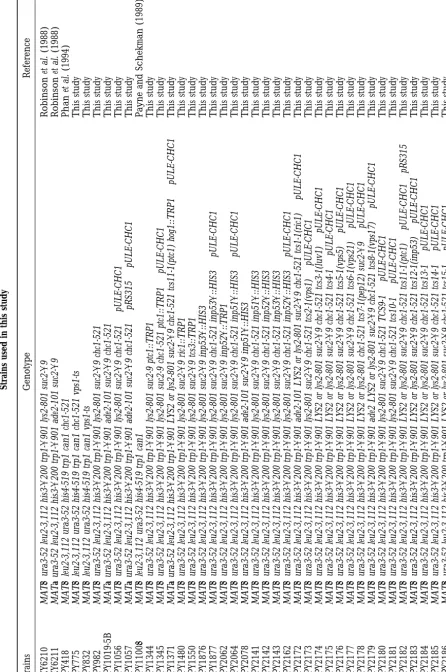
study are shown in Table 1. GPY982 was constructed by trans- (Roseet al. 1990). Cell densities in liquid culture were mea-sured in a 1-cm plastic cuvette using a Beckman Instruments forming SEY6210 with YIpCHC521DCla linearized with XbaI
and selecting for integrants on SD 2ura medium. Loss of DU-62 spectrophotometer (Beckman Instruments, Fullerton, CA). One A500unit is equivalent to 2.33107cells/ml. URA3 along with the wild-type 39end of CHC1 was selected on
5-fluoroorotic acid (5-FOA) medium. GPY1010-5B is a meiotic Standard techniques for yeast mating, sporulation, and tet-rad analysis were used (GuthrieandFink1991). DNA trans-progeny from a cross of SEY6211 and GPY982.
To generate a disruption in the INP53 gene, the primer formations were performed as previously described (Gietz
andSchiestl1995). pairs 59-TGGGGCGAAGAATATCTAGTTATCCACTCCTTCA
TAGAATGATTGTACTGAGAGTGCACC-39, 59-GGCGCAAAT Mutagenesis and genetic screen fortcsmutants:The plasmid loss strategy relied on the toxic effects of 5-FOA anda-AA in CCTGATCCAAAC-39 and 59-CATTTTGGGGTCAATGGCTG
CCATGAGTCTAAAGTCATATCATCTGTGCGGTATTTCAC cells that express the URA3 and LYS2 products, respectively (Basson et al. 1987). GPY1056 was grown at 308in SD CAA ACCG-39, 59-CGGCTGGTCGCTAATCGTTG-39 were used to
generate two overlapping PCR products using pRS303 (Sikor- 2ura medium to stationary phase and plated at a density of 1000 cells/plate. Plates were exposed to UV irradiation, and
skiandHieter1989) as the template. These PCR products
were cotransformed into SEY6210, GPY982, and/or GPY1056. irradiated cells were allowed to recover at 308. This treatment resulted in 16% cell viability. Approximately 16,000 UV-irradi-Disruption of the INP53 locus by homologous recombination
was confirmed by Southern blot analysis and/or PCR. Strains ated colonies were replica plated onto a-AA medium and incubated at 308. Colonies that did not grow ona -AA-con-disrupted at the INP51 locus were generated in a similar
fash-ion using the primer pairs 59-GTTGTGTTAATCGTATGAA taining medium were patched onto YPD agar, allowed to grow at 308, and replica plated onto 5-FOA-containing medium. TTCGAAGCACATTTCACTACAATGATTGTACTGAGAGTG
CACC-39, 59-GGCGCAAATCCTGATCCAAAC-39 and 59-GTG Out of 77 potential tcs mutants, 25 remained unable to grow on 5-FOA when transformed with a HIS3 CHC1 plasmid, indi-GCTCATCTTCGTTCTCAACGAATGGATTGGGATCTCCA
TCTGTGCGGTATTTCACACCG-39, 59-CGGCTGGTCGCTA cating that these mutants are sensitive to 5-FOA even when expressing wild-type CHC1. The remaining 52 mutants were ATCGTTG-39in PCR reactions using pRS303 as the template.
INP52 was disrupted with the HIS3 gene similarly using primer successively backcrossed to GPY1056 or GPY1057 three times.
except for tcs2, TCS9-1, and tcs10 for which the original mu- ual open reading frames followed by complementation analy-sis on 5-FOA-containing medium.
tagenized strains were used.
Filter overlay blot:Secretion of p2CPY was assessed using a filter overlay blot assay performed essentially as described
previously (Wilsbach and Payne 1993b) except antibody RESULTS
against p2CPY was used (provided by T. Stevens).
Metabolic labeling and immunoprecipitation:For metabolic Isolation of mutations that display synthetic lethality
labeling ofa-factor, cells were grown to midlogarithmic phase with chc1-521: A plasmid loss strategy was adopted to in SD CAA2ura at 248or 308. Labeling and immunoprecipita- identify tcs mutations in chc1-521 cells at 308. For this tion was performed as described bySeegerandPayne(1992b)
approach, a centromere-containing plasmid carrying except that labeling time was as indicated in figure legends.
wild-type CHC1, URA3, and LYS2 genes was introduced a2-Macroglobulin (10mg/ml) was added to experiments shown
in Figure 7 to stabilize secreted pheromone. into cells with chc1-521, ura3, and lys2 mutant alleles at FM4-64 labeling:Yeast cells were labeled with FM4-64 essen- the chromosomal loci. Previously, we observed that via-tially as described byVidaandEmr(1995). Cells growing in ble chc1Dcells transformed with a URA3 CHC1 plasmid midlogarithmic phase were incubated in the presence of 40
were inviable on 5-FOA, presumably because the 5-FOA mmFM4-64 at a cell concentration of 23108to 43108cells/
selection procedure imposes sufficient stress to inhibit ml for 15 min at 308. Cells were harvested by centrifugation
the growth of debilitated clathrin-deficient cells that at 7003g for 3 min, resuspended at 13108to 23108cells/
ml in fresh medium, and allowed to internalize dye for 45 lose the plasmid (G. Payne,unpublished results). On min at 308. Cells were then collected by centrifugation, resus- the basis of this finding we anticipated that if a tcs muta-pended at 53107to 13108cells/ml, and viewed on
concanav-tion together with chc1-521 at 308 causes a severe loss
alin-A-coated microscope slides using a Nikon FX-A Microphot
of clathrin function, then the mutant cells should be microscope.
inviable on 5-FOA ora-AA.
Cloning tcs mutants: tcs mutants were transformed with a
To isolate tcs mutants, plasmid-containing cells were single copy genomic library (no. 77162; American Type
Cul-ture Collection, Manassas, VA), and transformants were mutagenized with ultraviolet irradiation and allowed to screened for growth on 5-FOA-containing medium. DNA from grow into colonies, and the colonies were screened for 5-FOA-resistant transformants was prepared as described pre- growth on a-AA- and 5-FOA-containing medium. Of viously (Roseet al. 1990), and plasmids were introduced into
16,000 colonies formed from mutagenized cells, 52 tcs Escherichia coli by electroporation. Genomic inserts were
identi-candidate strains were backcrossed three times to the fied by DNA sequencing. The minimal complementing region
of each genomic clone was determined by subcloning individ- parental strain, and those that yielded 2:2 segregation
TABLE 2
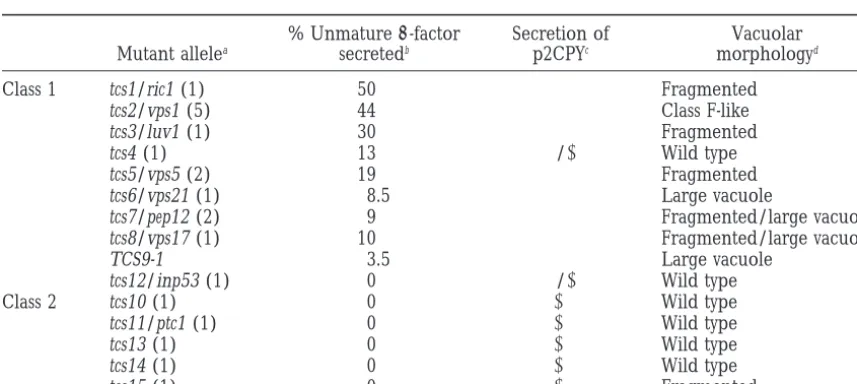
tcsmutants
% Unmaturea-factor Secretion of Vacuolar
Mutant allelea secretedb p2CPYc morphologyd
Class 1 tcs1/ric1 (1) 50 11 Fragmented
tcs2/vps1 (5) 44 111 Class F-like
tcs3/luv1 (1) 30 11 Fragmented
tcs4 (1) 13 1/2 Wild type
tcs5/vps5 (2) 19 111 Fragmented
tcs6/vps21 (1) 8.5 111 Large vacuole
tcs7/pep12 (2) 9 111 Fragmented/large vacuole
tcs8/vps17 (1) 10 111 Fragmented/large vacuole
TCS9-1 3.5 111 Large vacuole
tcs12/inp53 (1) 0 1/2 Wild type
Class 2 tcs10 (1) 0 2 Wild type
tcs11/ptc1 (1) 0 2 Wild type
tcs13 (1) 0 2 Wild type
tcs14 (1) 0 2 Wild type
tcs15 (1) 0 2 Fragmented
aNumber of alleles isolated is indicated in parentheses.
bThe experiment shown in Figure 1 was subjected to phosphorimage analysis and quantified using a Molecular Dynamics phosphorImager and ImageQuaNT software. Percentage of unmature a-factor was calculated by dividing the amount of highly glycosylated precursor plus intermediate cleavage products by the total amount ofa-factor. Values were normalized to wild type.
cQualitative assessment of experiment shown in Figure 2.
of the 5-FOA-sensitive phenotype were analyzed further. amino-acida-factor peptide migrates to the bottom of the gel, while the highly glycosylated form remains near Complementation tests defined one dominant mutation
(TCS9-1) and 14 recessive tcs complementation groups the top (Figure 1). Incompletely processed forms of
a-factor can also be observed migrating immediately (Table 2). The majority of complementation groups
contained a single isolate, indicating that the screen was above the mature form. Of the 15 mutant strains, 9
secreted detectable levels of highly glycosylateda-factor
subsaturating (Table 2).
A subset oftcsmutants affects clathrin-mediated pro- precursor, ranging from a severe defect in tcs1-3 mutants
to a minor defect in the TCS9-1 mutant (Figure 1; Table
tein trafficking events:The effect of tcs mutations in a
CHC1 background on clathrin-dependent protein trans- 2). These data suggest that tcs1 through TCS9-1 muta-tions affect localization of the TGN membrane protein port processes was assessed. First, maturation of the
mating pheromonea-factor precursor was examined as Kex2p.
The integrity of vacuolar protein transport was deter-a medeter-asure of proper locdeter-alizdeter-ation of the TGN membrdeter-ane
protein Kex2p. Kex2p is responsible for the cleavages mined by monitoring biosynthesis of the vacuolar
hy-drolase, CPY. Newly synthesized CPY is translocated into
that initiate proteolytic maturation of thea-factor
pre-cursor in the TGN (Fuller et al. 1988). In cells with the endoplasmic reticulum and core glycosylated to
form a 67-kD species (p1CPY). Upon transit through defective clathrin heavy chain, Kex2p is mislocalized
to the cell surface (Payneand Schekman1989). The the Golgi apparatus, p1CPY is further glycosylated to
form a 69-kD species (p2CPY;Stevenset al. 1982). In
resulting depletion of TGN-localized Kex2p leads to
inefficienta-factor precursor maturation and secretion the TGN, p2CPY is recognized by a receptor, Pep1p/
Vps10p, and diverted from the secretory pathway into of the highly glycosylated form of pheromone. Other
mutations, such as vacuolar protein sorting (vps) mu- vesicles targeted to endosomes. In prevacuolar
endo-somes, Pep1p/Vps10p is thought to dissociate from tations, that affect trafficking between the TGN and
endosomes can also lead to Kex2p mislocalization and p2CPY allowing vesicle-mediated retrieval of Pep1p/
attendant defects in a-factor precursor maturation Vps10p to the TGN (Marcussonet al. 1994; Cooper
(WilsbachandPayne1993b). Therefore, secretion of andStevens1996). Dissociated p2CPY continues to the
highly glycosylateda-factor precursor serves as a conve- vacuole where proteolytical maturation generates a
61-nient and reliable indicator of Kex2p mislocalization. kD species (Stevenset al. 1982). Inefficient localization
Secreted forms ofa-factor were detected by radiolabel- of Pep1p/Vps10p to the TGN and/or defects in the
ing tcs cells with [35S]methionine, immunoprecipitating TGN to endosome to vacuole pathway result in secretion
a-factor from the culture supernatant, and subjecting of p2CPY (BryantandStevens1998). The tcs mutants
the immunoprecipitates to SDS-PAGE. The mature
13-Figure1.—Maturation ofa-factor is incomplete in a subset
of tcs mutants. Wild-type (WT, GPY1056) and tcs1-15 mutant Figure 2.—p2CPY is secreted by a subset of tcs mutants. Wild-type (WT, GPY1056) and tcs mutant strains (GPY2172-strains (GPY2172-GPY2186) carrying the chc1-521 allele and a
plasmid-borne copy of CHC1 and URA3 were grown in SD GPY2186) carrying the chc1-521 allele and a plasmid with CHC1 and URA3 were grown in SD CAA2ura media to saturation CAA2ura overnight at 308. tcs13 was grown in SDYE media
overnight at 248and shifted to 308before metabolic labeling at 248. Cells were diluted to 1 3106cells/ml, and 3 ml was spotted onto YPD agar. After 2 days of growth at 248, cells due to poor growth in SD CAA2ura at 308. Cells were
metabol-ically labeled with [35S]methionine/cysteine for 45 min at 308. were replica plated onto YPD agar, overlaid with a nitrocellu-lose filter, and incubated overnight at 308. Filters were probed a-Factor was immunoprecipitated from the culture
were tested for secretion of p2CPY using a filter overlay sorting suggest that products of the class 1 TCS genes influence protein transport pathways between the TGN and immunoblotting with a p2CPY-specific monoclonal
antibody. Missorting of p2CPY was detected in tcs1 and endosomes.
tcs mutations in VPS genes: Studies of vps mutants
through TCS9-1 and in tcs12 strains (Figure 2).
Qualita-tively strong defects were apparent in tcs2, tcs5, tcs6, tcs7, that missort p2CPY have resulted in identification of
.50 genes involved in vacuolar protein transport from tcs8, and TCS9-1 strains (Figure 2; Table 2). tcs1 and
tcs3 strains exhibited milder phenotypes, while tcs4 and the TGN to vacuoles (BryantandStevens1998). To determine whether tcs mutations occurred in previously tcs12 strains secreted slight but reproducible levels of
p2CPY (Figure 2; Table 2). Except for tcs12 (but see known VPS genes, p2CPY secretion was used as an assay
in complementation tests between tcs mutants and a
below), the same set of mutants were defective in
a-factor precursor maturation and p2CPY sorting, though gallery of vps mutants. Diploids from
noncomplement-ing crosses were induced to undergo meiosis and sub-the relative extent of sub-the defects in each process differed
between strains (Table 2). We define this set as class 1 jected to linkage analysis. By these criteria vps1(tcs2),
vps5(tcs5), pep12/vps6(tcs7), vps17(tcs8), and vps21(tcs6) mutants. The synthetic growth defects of tcs mutations
with the chc1-521 allele and effects of the class 1 muta- were present in the class 1 tcs collection (Table 2).
Trafficking defects in vps strains can result in
morpho-tions by themselves ona-factor maturation and p2CPY
logical changes to the vacuole. On the basis of vacuole morphology, the vps mutants have been classified into
six groups, A–F (Raymondet al. 1992). The vps mutants
identified in the tcs screen represent three classes, B, D, and F. Class B (vps5, vps17) is characterized by frag-mented vacuoles, class D (pep12, vps21) by large single vacuoles, and class F (vps1) by large vacuoles encircled by smaller vacuoles. Vacuolar morphology in the tcs collection was visualized with the lipophilic vital dye
FM4-64, which stains the vacuole membrane (Vidaand
Emr 1995). In general, the vacuole morphology of
strains with tcs mutations in known VPS genes corre-sponded to earlier classifications of vps mutants. Highly fragmented vacuoles, similar to class B vps mutants, were also observed in tcs1, tcs3, and tcs15 cells (Figure 3). In addition, TCS9-1 cells displayed an abnormally large percentage of cells containing single, large vacuoles (Figure 3). An increase in cell size was also observed in the TCS9-1 strain (Figure 3, compare DIC panel with other panels). The vacuole morphology defects ob-served in tcs strains are consistent with a role of these gene products in membrane traffic to the vacuole.
Of the three tcs mutant strains exhibiting both strong
Figure3.—A subset of tcs mutants displays abnormal vacuo-lar morphology. Wild-type (WT, GPY1056), tcs1 (GPY2172), tcs3 (GPY2174), TCS9-1 (GPY2180), and tcs15 (GPY2186)
strains were grown overnight at 308in SD CAA2ura to mid- Figure4.—A temperature-sensitive allele of VPS1 accentu-ates the growth defect of chc1-521 cells. Wild-type (WT, logarithmic phase. Cells were incubated with FM4-64 for 15
min and resuspended in fresh medium devoid of dye and GPY1100), chc1-521 (GPY418), vps1-ts (GPY832), and chc1-521 vps1-ts (GPY775) strains were grown overnight to saturation allowed to internalize the dye for 45 min at 308before viewing.
FM4-64 fluorescence (left) and differential interference con- at 248 in YPD. Serial dilutions of each culture were spotted on YPD agar and incubated at 248or 378.
a-factor maturation and CPY sorting defects (tcs1, tcs2, A single open reading frame containing RIC1 comple-mented all mutant phenotypes of tcs1 mutants (Figure tcs3), only tcs2 represented a known vps locus, vps1. VPS1
encodes a member of the dynamin family of GTPases 6; data not shown). A mutant allele of RIC1 was
identi-(Vater et al. 1992). In mammalian cells, dynamin is fied by Mizuta et al. (1997) in a screen for genes
in-involved in scission of invaginated clathrin-coated pits volved in ribosome synthesis. This ric1 mutant was
re-at the plasma membrane to form free clre-athrin-core-ated ported to be temperature sensitive for growth and to
vesicles (Schmid1997;Schmidet al. 1998). By analogy, exhibit reduced levels of transcripts encoding both
ri-Vps1p and clathrin could function together at the TGN bosomal protein genes and ribosomal RNA after shift
in yeast. Consistent with this idea, similar defects in TGN to the nonpermissive temperature (378; Mizuta et al.
membrane protein localization have been described in 1997). However, many secretory pathway mutants
dis-vps1 and chc1-521 mutants (Wilsbach and Payne play similar ribosome synthesis defects, raising the
possi-1993b;Nothwehret al. 1995). To probe the relation- bility that reduced synthesis of ribosome components
ship of Vps1p and clathrin in more detail, we con- in ric1 cells is a secondary consequence of a defect in
structed a strain containing chc1-521 and a temperature- protein trafficking (seediscussion;Mizutaand
War-sensitive allele of VPS1 (vps1-ts; Vater et al. 1992). ner 1994). The primary sequence of the
1056-amino-Growth and a-factor maturation were evaluated in the acid Ric1 protein reveals no significant homology to
double mutant, congenic single mutants, and the wild- known proteins or motifs. Disruption of RIC1 (ric1D)
type strain. At 248, growth of the single mutants was produced phenotypes identical to those of the ric1
mu-commensurate with the wild-type strain, but the double tant isolated in the tcs screen (data not shown). A cross
mutant grew at a slightly slower rate. At 378, the chc1-ts between the ric1Dstrain and a strain carrying the ric1/
cells grew somewhat more slowly than the vps1-ts and tcs1 allele resulted in a diploid which displayed ric1
mu-wild-type strains. Compared to the single mutants, tant phenotypes, providing further evidence that the
growth of the double mutant was severely affected at mutant locus in the tcs1 strain is RIC1.
378(Figure 4). A striking synthetic effect of the double Complementation of the tcs3 mutant resulted in
isola-mutant combination ona-factor precursor maturation tion of LUV1/RKI1. Introduction of LUV1 on a
centro-was also apparent (Figure 5). At 308, only mature
a-fac-tor was secreted by the wild-type and vps1-ts strains. The congenic chc1-521 strain used in this comparison secreted a minor amount of highly glycosylated precur-sor and intermediate cleavage products (16%). In con-trast, the double mutant secreted a substantial level of precursor forms (47%). The synergistic effects of CHC1 and VPS1 conditional alleles indicate a sensitive func-tional interdependence of Vps1p and clathrin in cell growth and Kex2p localization in the TGN. These re-sults, together with the identification of tcs mutations in other VPS genes whose products are known to func-tion in transport between the TGN and endosomes, demonstrate that the tcs screen can be an effective ap-proach to define proteins which act in clathrin-depen-dent transport pathways.
RIC1 and LUV1/RKI1 are class 1 TCS genes: Four
class 1 tcs mutants (tcs1, tcs3, tcs4, and TCS9-1) did not correspond to a previously identified vps complementa-tion group. Two of these mutants, tcs1 and tcs3, displayed growth defects at elevated temperatures (378) as well as a-factor maturation defects and CPY sorting defects at
lower temperatures (248and 308). On the basis of the
relatively severe a-factor maturation defects in these
strains, we focused on identifying the mutant loci. To isolate wild-type versions of tcs1 and tcs3, mutant strains
were transformed with a genomic library carried by a Figure5.—Thea-factor maturation defect of chc1-521 cells
is enhanced by the vps1-ts allele. Wild-type (WT, GPY1100), centromere-containing plasmid. The resulting
trans-chc1-521 (GPY418), vps1-ts (GPY832), and trans-chc1-521 vps1-ts formants were screened for the ability to grow on
me-(GPY775) strains were incubated at 248 to midlogarithmic
dium containing 5-FOA. Genomic DNA fragments com- growth. After a 2-hr shift to 308, cells were metabolically labeled
plementing the 5-FOA growth defect were subsequently at 308 for 45 min, anda-factor was immunoprecipitated as
sufficient for rescue of the 5-FOA growth defect (Figure
6). A cross between a ptc1Dchc1-521 strain carrying a
CHC1 URA3 plasmid and a tcs11 chc1-521 strain also carrying this plasmid resulted in a diploid unable to grow on 5-FOA-containing medium. The lack of comple-mentation argues that tcs11 is a mutant allele of PTC1. PTC1 encodes a type 2C serine/threonine phosphatase implicated in multiple cellular functions, including os-motic stress response, tRNA biosynthesis, and
mitochon-drial inheritance (van Zylet al. 1989;Maedaet al. 1993,
1994; Roeder et al. 1998). A strain with a disrupted
copy of PTC1 displayed normala-factor maturation, CPY
sorting, endocytosis as assayed by a-factor
internaliza-tion, and vacuolar morphology (data not shown). Therefore, at present the only connection between PTC1 and protein trafficking is the synthetic growth defect with chc1-521.
We considered the possibility that synthetic growth defects of ptc1 and chc1-521 derive from the role of Ptc1p
Figure6.—Complementation of tcs mutants with genomic
in osmotic stress response. Cells challenged by high DNA fragments. Strains carrying tcs mutant alleles were
trans-formed with plasmids containing the indicated gene isolated external osmolarity increase internal osmolarity by acti-from a genomic library or the parental vector (1 vector). vating a MAP kinase signal transduction pathway (the Transformants were grown to saturation at 248 in medium
HOG pathway) that includes the MAP kinase Hog1p selecting for the appropriate plasmid, and serial dilutions were
and the MAP kinase kinase Pbs2p (Brewster et al.
spotted onto supplemented SD (25-FOA) and
5-FOA-con-1993). Genetic experiments suggest that Ptc1p can taining media (15-FOA) and allowed to grow at 308 for 3
days. downregulate the HOG pathway through activities on
Hog1p and/or Pbs2p (Maeda et al. 1994). Thus, the
absence of Ptc1p could allow increased basal activity of
meric plasmid was sufficient for complete complemen- the HOG pathway MAP kinase, leading to an increase
tation of the tcs3 mutant phenotypes (Figure 6; data not in internal osmolarity. If plasma membrane
composi-shown). LUV1 also has been isolated through a screen tion was altered by the defect in clathrin, an increase
for mutations that cause synthetic growth defects with in internal osmolarity might lead to cell lysis. As a test
a calcineurin mutant (M. ConboyandM. Cyert,per- of this possibility, Hog1p was eliminated by gene
disrup-sonal communication) and (as RKI1) in a screen for tion in the ptc1Dchc1-ts strain carrying the CHC1 URA3
mutations affecting microtubules (Smithet al. 1998). plasmid. As a control, HOG1 was also disrupted in a
LUV1 encodes an open reading frame that has the po- chc1-521 carrying the CHC1 URA3 plasmid. Disruption
tential to encode a 101.5-kD protein with a predicted of HOG1 did not suppress the 5-FOA growth defect in
coiled-coil domain. A BLAST database search with the the ptc1Dchc1-ts strain and did not itself cause synthetic
Luv1p amino acid sequence identified two related open growth defects with chc1-521. These findings argue
reading frames of unknown function in other organ- against the idea that synthetic lethality caused by ptc1
isms: Schizosaccharomyces pombe (E value 5 4 3 10212,
is due to upregulation of the HOG pathway.
accession no. CAB16266) and Arabidopsis thaliana (E INP53is aTCSgene:The library fragment that
com-value5331029, accession no. CAA16926; Altschul
plemented tcs12 carried INP53/SJL3/SOP2, one of three et al. 1997). We constructed a strain carrying a disrup- genes (INP51, INP52, or INP53) encoding
synaptojanin-tion of TCS3. The phenotypes of this strain mirrored like inositol polyphosphate 5-phosphatases (Srinivasan
those of the original tcs3 mutant, including a growth et al. 1997;Singer-Krugeret al. 1998;Stolzet al. 1998;
defect at elevated temperatures, secretion of highly gly- Guo et al. 1999). INP53 was identified previously in a
cosylated a-factor, and secretion of p2CPY (data not screen for mutations that suppress vacuolar targeting
shown). Mutant phenotypes were not complemented in of a mutant form of the plasma membrane ATPase (Luo
a diploid from a cross between a tcs3D strain and a andChang1997). The mutant allele of INP53 identified
strain carrying the original tcs3 allele. We conclude that in the screen, designated sop2, caused a subtlea-factor
mutation of the evolutionarily conserved product of maturation defect at 248. The tcs12 mutant allele isolated
LUV1/RKI1 is responsible for the phenotypes caused in our screen was originally assigned to class 2 based
by tcs3. on the absence of ana-factor maturation defect at 308.
PTC1is a class 2TCSgene:A genomic fragment was Recognition of tcs12 as inp53 prompted us to reevaluate
also isolated that rescued the chc1-521-dependent 5-FOA the a-factor maturation phenotype of inp53 cells and
Figure7.—Low temperature and the chc1-521 allele accentuate thea-factor maturation defect of inp53D cells. (A) Wild-type (WT, SEY6210),
inp51D (GPY2078), inp52D (GPY2062), and
inp53D (GPY1876) strains were grown at 248 to
midlogarithmic phase, shifted to 208or 308for 15 min, and labeled with [35S]methionine/cysteine for 45 min at 208or 30 min at 308.a-Factor was immunoprecipitated from the culture superna-tant and subjected to SDS-PAGE and autoradiog-raphy. (B) Wild-type (WT, SEY6210), chc1-521 (GPY982), inp51D (GPY2078), chc1-521 inp51D (GPY2141), inp52D(GPY2062), chc1-521 inp52D (GPY2142), inp53D (GPY1876), and chc1-521
inp53D(GPY2143) strains were grown to
midlog-arithmic phase in SDYE media and metabolically labeled with [35S]methionine/cysteine for 45 min at 248.a-Factor was immunoprecipitated from the culture supernatant and subjected to SDS-PAGE and autoradiography.
this purpose, isogenic strains were generated carrying ally disrupted in a chc1-521 strain carrying the CHC1
URA3 plasmid. As shown in Figure 8A, only the combina-disruptions of either INP51, INP52, or INP53. We
exam-ineda-factor maturation after shifting cells from 248to tion of inp53D with chc1-521 resulted in inviability on
5-FOA medium at 308. Combining inp51D with chc1-ts
either 308or 208, choosing 208by reasoning that a defect
in a process involving the lipid bilayer might be exagger- did not prevent growth on 5-FOA, but the colonies were
smaller than those from the chc1-521 control strain. The ated at lower temperatures. Wild-type, inp51D, and
inp52Dstrains secreted exclusively maturea-factor at 308 inp52D allele had no effect when combined with chc1-521. As an alternative approach to examining synthetic (Figure 7A). At this temperature, a minor maturation
defect was apparent in the inp53D strain (Figure 7A). growth defects, a diploid strain heterozygous for inp53D
and homozygous for chc1-521 was induced to sporulate,
At 208, the defect in inp53Dcells was more pronounced,
whereas the other two inp mutants were essentially unaf- and the meiotic progeny were subjected to tetrad
analy-sis. Each tetrad yielded four viable segregants, indicating fected by this temperature shift (Figure 7A). These
re-sults prompted reassignment of tcs12 as a class 1 muta- that the inp53 chc1-521 combination is not lethal when
double mutants are obtained by this method. This find-tion and suggest a specific role for Inp53p in Kex2p
localization. ing was not totally unexpected given earlier findings
with chc1Dstrains, indicating that loss of a
complement-To explore the specificity of genetic interactions
be-tween inp53 and chc1-521, the INP genes were individu- ing plasmid on 5-FOA is a more stringent growth
condi-Figure 8.—inp53D accentuates the growth defect of chc1-521 cells. (A) chc1-521 (GPY1056), chc1-521 inp51D (GPY2064),
chc1-521 inp52D (GPY2162), and chc1-521
inp53D(GPY1877) strains, all of which carry
tion than direct incubation of a mutant on standard by the presence of a domain related to the yeast protein Sac1p, a protein implicated in phospholipid metabolism
medium (see above). The viability of inp53D chc1-521
meiotic progeny encouraged us to disrupt the individual and vesicular trafficking (Cleveset al. 1989;Whitters
et al. 1993). Recently, the Sac1 domain was found to INP genes directly in chc1-521 haploids, generating a set
of congenic double mutants. Growth of each double encode a novel polyphosphoinositide phosphatase
activ-ity, indicating that this subgroup of type II Inps has the
mutant at 248was equivalent to the wild-type growth of
the parental chc1-ts strain (Figure 8B). A striking growth potential to express two distinct inositol phosphatase
activities from one polypeptide (Guoet al. 1999).
Synap-defect was observed when the inp53Dchc1-521 strain was
incubated at 308 and 378 (Figure 8B). Growth of the tojanin, the founding member of the Sac1
domain-containing INP subfamily, has been proposed to act inp51Dchc1-521 strain was also compromised at the
ele-vated temperatures but less than growth of the inp53D in clathrin-dependent endocytosis in nerve terminals
(McPhersonet al. 1996; Haffneret al. 1997). Of the
chc1-521 strain. The inp52Dchc1-521 strain mimicked the
chc1-521 parental strain at 308 and 378. The specificity four yeast proteins with homology to INPs, three, Inp51– 53, also carry an N-terminal Sac1p domain and are alter-of the inp chc1-521 interactions was probed further by
analyzing a-factor maturation in each double mutant natively referred to as synaptojanin-like (Sjl;Srinivasan
et al. 1997;Singer-Krugeret al. 1998;Stolzet al. 1998).
at the permissive growth temperature, 248(Figure 7B).
Little or no defect was apparent in any of the single However, the Sac1-like domain in Inp51p is catalytically
inactive (Guoet al. 1999). Systematic analyses of
endo-mutants (Figure 7B). In the double endo-mutants, pairing
chc1-521 with either inp51Dor inp52Dhad only a mar- cytic and vacuolar sorting pathways in strains with indi-vidual disruptions of the INP genes have been carried
ginal effect ona-factor maturation, but combining
chc1-521 and inp53Dproduced a strong pheromone matura- out. These studies revealed only subtle vacuolar mor-phology anomalies in inp52 or inp53 cells, but no defects tion defect (42% precursor forms). These results are
consistent with effects of the individual inp mutations in CPY sorting or in endocytic uptake of the lipophilic
endocytic tracer FM4-64 (Srinivasan et al. 1997;
ona-factor maturation and point to a specific role for
Inp53p in clathrin-mediated TGN localization of Kex2p. Singer-Krugeret al. 1998;Stolzet al. 1998). Double
mutant combinations have no effect on CPY sorting but It remains to be determined whether, like inp53, viable
combinations of other class 2 tcs mutations with chc1- result in varying levels of endocytic defects; the inp51
inp52 combination is more detrimental than inp52 521 can be isolated and whether such combinations
display TGN sorting defects. inp53, while the inp51 inp53 pair is innocuous
(Sriniva-sanet al. 1997;Singer-Krugeret al. 1998;Stolzet al. 1998). Although results from double mutants offer some DISCUSSION
distinction between the Inps, particularly with respect to endocytosis, the absence of informative phenotypes As a genetic strategy to identify proteins involved in
clathrin-dependent protein transport pathways, we car- in single mutants has hindered functional definition of
specific roles for any of the individual Inps in vesicular ried out a screen for mutations that cause synthetic
growth defects in a strain expressing a partially func- transport events. Our results indicate that, of the three
synaptojanin-like INP genes, only disruption of INP53 tional clathrin heavy chain. The tcs mutations recovered
in this screen divide into two classes based on their results in ana-factor maturation defect at 208and 308,
accentuation ofa-factor maturation defects when
com-effects on protein trafficking in the TGN/endosome
system. Class 1 mutations cause defects ina-factor matu- bined with chc1-521 at 248, and an inability to grow on
5-FOA when introduced into chc1-521 cells carrying a ration, a reliable signature of Kex2p mislocalization,
and defects in biosynthetic sorting of CPY to the vacuole. CHC1 URA3 plasmid. Additionally, on standard media,
the combination of inp53D with chc1-521 showed
Measurements of Kex2p stability in selected class 1
mu-tants indicate higher than normal rates of Kex2p vacuo- stronger synthetic growth defects than either inp51Dor
inp52D. These findings argue that Inp53p specifically lar degradation (data not shown), supporting
conclu-sions based on the a-factor maturation assay. Class 2 affects the clathrin-dependent TGN to endosome traffic
pathway. Our studies confirm and extend the work of mutations do not affect Kex2p localization or CPY
sorting. Luo andChang(1997), who detected minor levels of
secreted a-factor precursor and marginally decreased
One of the genes represented in the tcs collection
was INP53, encoding a type II inositol polyphosphate steady-state levels of Kex2p in inp53 cells at 248, but did
not analyze mutations in other INP genes. By analogy 5-phosphatase. Classification of Inps is based primarily
on substrate specificity of animal cell enzymes, and type to the proposed function of synaptojanin in endocytic
clathrin-coated vesicle traffic, we suggest that Inp53p II Inps characteristically are able to hydrolyze the C5
phosphate from the inositol moiety of both phosphati- participates in clathrin-coated vesicle traffic from the
TGN.
dylinositol 4,5-bisphosphate (PI[4,5]P2) and
phosphati-dylinositol 3,4,5-trisphosphate (PI[3,4,5]P2) (Erneuxet The synthetic growth defect of chc1-521 inp51Dcells,
although less severe than that of chc1-521 inp53Dcells,
suggests that Inp51p could also participate in a clathrin- are proposed to act in targeting and fusion of
TGN-derived vesicles with endosomes (Horazdovsky et al.
dependent transport process. Since inp51Dalone, or in
combination with chc1-521, did not altera-factor matu- 1994; Bechereret al. 1996). Interestingly, Vps5p and
Vps17p form a subcomplex within a multimeric assem-ration, Inp51p is more likely to be involved in
endocyto-sis. In support of this idea, inp51 causes synthetic lethal- bly of Vps proteins thought to constitute a vesicle coat
essential for endosome to TGN traffic (Horazdovsky ity when combined with a temperature-sensitive allele of
PAN1 (WendlandandEmr1998). Mutations in PAN1 et al. 1997;Seamanet al. 1998). Considering the current model that clathrin functions in vesicular transport be-affect endocytosis, and the Pan1 protein is homologous
to the mammalian clathrin accessory protein, Eps15 tween the TGN and endosomes, it is not surprising to
find genetic interactions between chc1-521 and
muta-(Wendlandet al. 1996;Tanget al. 1997). Furthermore,
inp51 combined with inp52 causes severe endocytosis tions that affect other stages of TGN-endosome mem-brane trafficking. Since the tcs screen was not carried
defects (Singer-Krugeret al. 1998). Unlike inp51 and
inp53, inp52 did not display synthetic effects with chc1- out to saturation, a more systematic examination will be needed to determine whether the vps/tcs mutations 521. Thus, if Inp52p is involved in clathrin-dependent
transport, its contribution is not substantial enough to identify a subset of VPS genes particularly sensitive to
clathrin deficiencies or whether genetic interactions be detected by our assays.
A number of class 1 tcs mutations occurred in known with chc1-521 will prove to be a ubiquitous VPS feature.
Two class 1 genes, RIC1 and LUV1/RKI1, have not VPS genes, including VPS1. The genetic interaction
be-tween VPS1 and CHC1 extends to temperature-sensitive been implicated previously in vesicular transport. RIC1
was originally identified in a screen for temperature-alleles, which produce synthetic defects in growth and
a-factor maturation, suggesting a strong connection be- sensitive mutants with reduced synthesis of ribosome
components. At the elevated temperature, transcript tween the functions of Vps1p and clathrin. Vps1p is a
member of the dynamin family of GTPases (Vater et levels of both ribosomal proteins and RNA were lowered
(Mizuta et al. 1997). However, a similar reduction in
al. 1992). In mammalian cells, dynamin assembles into
a ring around the necks of invaginated clathrin-coated ribosomal protein and rRNA synthesis has been
docu-mented for ts mutations affecting different stages of
pits at the plasma membrane (Takei et al. 1995). It is
generally agreed that GTP hydrolysis is necessary to the secretory pathway, revealing a regulatory pathway
connecting secretory pathway defects to ribosome bio-sever the connection between the nascent vesicle and
plasma membrane, though the model that dynamin it- synthesis (MizutaandWarner1994). Several
observa-tions suggest that the defects in synthesis of ribosomal self is the severing agent has been recently challenged
(SweitzerandHinshaw1998;Severet al. 1999). Given components in ric1 cells are similarly indirect, stemming
from a primary defect in vesicle trafficking. First, al-the interaction of dynamin and clathrin in mammalian
cell endocytosis, it is reasonable to posit a similar rela- though the ric1/tcs1 strain is temperature sensitive for
growth, we observed a-factor maturation defects, CPY
tionship between Vps1p and clathrin. Consistent with
this view, vps1 and chc1 cells share a similar, and distinc- missorting, and vacuole fragmentation at permissive
growth temperatures where no obvious defects in pro-tive, defect in TGN membrane protein localization. In
both types of mutant cells, TGN membrane proteins tein synthesis were apparent. Second, in the genetic
background used in the tcs screen, disruption of RIC1, or are mislocalized to the cell surface. In chc1 cells, the
additional endocytic defect causes accumulation at the introduction of the ric1 allele identified in the ribosome
synthesis screen, yielded the same spectrum of traffick-cell surface, whereas in vps1 traffick-cells the TGN proteins are
internalized and delivered to the vacuole (Seegerand ing defects at permissive growth temperatures that were
detected in the ric1/tcs1 cells (E. BensenandG. Payne,
Payne1992b;Nothwehret al. 1995). Since TGN
mem-brane protein localization involves cycling between the unpublished results). The primary sequence of Ric1p
does not offer clues about molecular function. Further TGN and endosomes, plasma membrane
mislocaliza-tion in vps1 and chc1 cells suggests that these mutamislocaliza-tions experiments analyzing ric1 mutants and the Ric1 protein
are in progress. block the endosome-targeted pathway at the TGN. The
observation of synthetic effects ona-factor maturation TCS3/LUV1/RKI1 (which we will refer to as LUV1)
has been identified in multiple screens. In our studies, by temperature-sensitive alleles of VPS1 and CHC1 now
establishes a functional connection between the gene the original tcs3 allele and a LUV1 disruption cause a
substantiala-factor maturation defect, CPY missorting,
products in TGN membrane protein localization.
Addi-tional experiments, particularly subcellular localization and vacuole fragmentation at permissive growth
temper-atures, suggesting a role for Luv1p in vesicle traffic be-of Vps1p and clathrin, will be needed to test for physical
links. tween the TGN and endosomes. A luv1 allele was also
isolated in a screen for mutations that cause synthetic Mutant alleles of four other well-characterized VPS
genes were identified in the tcs screen (vps21, pep12/ growth effects with a disruption of the regulatory
sub-unit of calcineurin encoded by CNB1 (M. Conboyand
vps6, vps5, and vps17). Vps21p, a small GTPase of the
dem-onstrated vacuole fragmentation in luv1 cells, partial role of Hog1p in Golgi membrane protein localization
secretion of the Golgi form of CPY, and sensitivity of (Reynoldset al. 1998). Thus, given the pleiotropic
activ-cell growth to a variety of ions (M. Conboy and M. ities of Ptc1p, a direct role for this phosphatase in
Cyert, personal communication). In addition, Luv1p clathrin-dependent trafficking is possible but remains
has been implicated recently in microtubule function. to be established.
Cells harboring luv1D/rki1D are hypersensitive to mi- In summary, characterization of tcs mutants
demon-crotubule-depolymerizing drugs, and at the nonpermis- strates that the screen for mutations that cause synthetic
sive growth temperature they display a loss of microtu- growth interactions with chc1-521 constitutes a robust
bule structures. Furthermore, Luv1p can bind to Rbl2p, method for identifying proteins that influence
clathrin-a protein clathrin-associclathrin-ated with freeb-tubulin subunits in cells dependent transport pathways. Our findings strengthen
(Archeret al. 1995;Smithet al. 1998). The pleiotropic connections between Vps and clathrin function, offer
defects in cells lacking Luv1p make it difficult to ascribe new insights into the specificity of inositol
polyphos-a direct role for the protein in polyphos-any one of the polyphos-affected phate 5-phosphatases, and raise the possibility of
mem-processes. It may be that Luv1p provides a single cellular brane-trafficking roles for proteins thought to act in
function that impacts multiple aspects of cell physiology. other processes. These results provide a genetic
founda-Alternatively, the protein may directly function in dis- tion to guide molecular analysis of the proteins
identi-tinct pathways. For example, the view that Rbl2p acts fied through the tcs screen, and suggest that further
in managing assembly of tubulin heterodimers could application of the screen will allow novel insights into
indicate a general function for Luv1p in regulating as- clathrin-mediated traffic routes.
sembly of multimeric protein assemblies. Isolation of a We thank Bruce Horazdovsky, Haruo Saito, and Tom Stevens for
conditional allele of LUV1 and further examination of providing strains, plasmids, and antibodies. We acknowledge Cara
Luv1p-interacting partners may allow these possibilities Capuano and Kevin Roberg for assistance with cloning the tcs
muta-tions. We are also grateful to Mike Juvet, Ken Oyadomari, and Audrey
to be distinguished.
Nakamura for technical assistance. We thank Dan Rube for critically
The class 2 tcs mutation in the gene encoding the
reading the manuscript. This work was supported in part by the
Pre-type 2C serine/threonine protein phosphatase Ptc1p
doctoral Training Program in Genetic Mechanisms at UCLA
(T32-caused synthetic growth defects with chc1-521 but did GM07104) and a UCLA Dissertation Year fellowship to E.S.B. and
not affect TGN-endosome protein transport. Synthetic National Institutes of Health grant GM-39040 to G.S.P.
effects can result from mutations in genes whose prod-ucts act in the same process or pathway, but they can also occur when mutant proteins function in distinct
LITERATURE CITED
processes (Guarente1993). Particularly when
consid-Altschul, S. F., T. L. Madden, A. A. Schaffer, J. Zhang, Z. Zhang
ering effects on cell growth, the possibility of indirect
et al., 1997 Gapped BLAST and PSI-BLAST: a new generation
interactions cannot be minimized. For class 1 mutations, of protein database search programs. Nucleic Acids Res. 25: 3389–
autonomous effects on clathrin-mediated trafficking 3402.
Archer, J. E., L. R. VegaandF. Solomon,1995 Rbl2p, a yeast
steps link the products of these TCS genes to protein
protein that binds to beta-tubulin and participates in microtubule
sorting at the TGN. For class 2 mutations, connections
function in vivo. Cell 82: 425–434.
to clathrin are more tenuous. One possibility is that Barlowe, C.,1998 COPII and selective export from the
endoplas-mic reticulum. Biochim. Biophys. Acta 1404: 67–76.
these mutations affect endocytosis, but preliminary
ex-Basson, M. E., R. L. Moore, J. O’RearandJ. Rine,1987 Identifying
periments do not indicate strong effects on the
traffick-mutations in duplicated functions in Saccharomyces cerevisiae:
ing of the mating pheromone a-factor receptor (E. Ben- recessive mutations in HMG-CoA reductase genes. Genetics 117:
645–655.
sen, unpublished results). Published studies of Ptc1p
Becherer, K. A., S. E. Rieder, S. D. EmrandE. W. Jones,1996 Novel
function do not offer significant clues to the basis of its
syntaxin homologue, Pep12p, required for the sorting of lumenal
synthetic effects with chc1-521. Ptc1p has been proposed hydrolases to the lysosome-like vacuole in yeast. Mol. Biol. Cell
to participate in a multitude of cellular functions, in- 7:579–594.
Brewster, J. L., T. de Valoir, N. D. Dwyer, E. WinterandM. C.
cluding osmoregulation, tRNA synthesis, DNA
recombi-Gustin,1993 An osmosensing signal transduction pathway in
nation, cell wallb-glucan assembly, and mitochondrial yeast. Science 259: 1760–1763.
inheritance (van Zyl et al. 1989; Maeda et al. 1994; Bryant, N. J.,andT. H. Stevens,1998 Vacuole biogenesis in
Sac-charomyces cerevisiae: protein transport pathways to the yeast
HuangandSymington1995;Jianget al. 1995;Roeder
vacuole. Microbiol. Mol. Biol. Rev. 62: 230–247.
et al. 1998). It was possible that the synthetic growth Christianson, T. W., R. S. Sikorski, M. Dante, J. H. SheroandP.
defects in ptc1 chc1-521 cells are due to upregulation of Hieter,1992 Multifunctional yeast high-copy-number shuttle
vectors. Gene 110: 119–122.
basal osmotic stress response (HOG) pathway activity,
Cleves, A. E., P. J. NovickandV. A. Bankaitis,1989 Mutations
thereby eliciting an increase in internal osmolarity that in the SAC1 gene suppress defects in yeast Golgi and yeast actin
could indirectly intensify defects caused by the chc1-521 function. J. Cell Biol. 109: 2939–2950.
Cooper, A. A.,andT. H. Stevens,1996 Vps10p cycles between the
allele. However, disruption of HOG1 did not restore
late-Golgi and prevacuolar compartments in its function as the
growth to chc1-521 ptc1 cells, making this scenario
un-sorting receptor for multiple yeast vacuolar hydrolases. J. Cell
likely. This experiment also suggests that the effects of Biol. 133: 529–541.
Dell’Angelica, E. C., J. Klumperman, W. Stoorvogeland J. S.