Concept Maps: Theory, Methodology, Technology Proc. of the Second Int. Conference on Concept Mapping A. J. Cañas, J. D. Novak, Eds. San José, Costa Rica, 2006
A PROPOSAL TO REFINE CONCEPT MAPPING FOR EFFECTIVE SCIENCE LEARNING
Meena Kharatmal & Nagarjuna G., Homi Bhabha Centre For Science Education (TIFR), India Email: [email protected], [email protected], www.hbcse.tifr.res.in
Abstract. Concept maps are found to be useful in eliciting knowledge, meaningful learning, evaluation of understanding and in studying the nature of changes taking place during cognitive development, particularly in the classroom. Several experts have claimed the effectiveness of this tool for learning science. We agree with the claim, but the effectiveness will improve only if we gradually introduce a certain amount of discipline in constructing the maps. The discipline is warranted, we argue, because science thrives to be an unambiguous and rigorously structured body of knowledge. Since learning science may be seen as a process where a novice is expected to be transformed into an expert, we use the context of learning science for making the proposal. Further, we identify certain anomalies in the evaluation of concept maps, and suggest that the evaluation should be based on semantics of the linking words (relation types) and not on graphical criteria alone.
1 Introduction
Concept maps are two-dimensional graphical representation of one's knowledge of a domain (Novak & Gowin, 1984), based on Ausubel's theory of meaningful learning in the classroom (Ausubel et al., 1978). Over the past three decades, the tool has been used in research studies for depicting and evaluation of knowledge. Though it was mostly used by researchers in education, often it has also been used in other domains, such as, business management. In this paper, we look at the use of concept maps in science education, and point out certain problems in their use. However, we suggest, if the method of making and evaluating the maps is modified, then it can become a very effective tool for learning as well as for evaluation.
Concept maps are used affectively for knowledge elicitation in research studies for meaningful learning, for recording the changes taking place during instruction, for recording conceptual change in longitudinal as well as cross-age studies, for mapping the differences in knowledge structuring between experts and novices. In a review study based on about 150 studies on concept mapping, the authors conclude that concept mapping helps students gain meaningful learning, and enhance the integration and retention of knowledge (Mintzes et. al., 1997, pg. 428). These conclusions are based on the use of the mapping technique for recording the changes before and after instruction. By comparing successive concept maps researchers documented and explored the conceptual change in a group of biology students as they gained mastery of the domain (Carey, 1986; Wallace & Mintzes, 1990). The studies indicate a change in the use of more number of critical concepts and propositions, more intricate hierarchical structure, branching patterns and occurrence of cross-linkages (Wallace & Mintzes, 1990, pg. 1038). Concept maps are used to depict expert-novice differences in knowledge structures on the basis of the frequency of concept descriptors and propositions that appear in a map (Mintzes, in press). Longitudinal studies on students' understanding of the particulate nature of matter (from grade 2 to 12) were conducted using concept maps (Mintzes et. al., 1998). The maps revealed students' knowledge structures over a period of time and the maps served to record the changes in their conceptual framework. Thus, concept mapping has been a very useful tool to elicit subjects' understanding and to study the nature of restructuring in cognitive development, particularly in the classroom context.
Our research employed the concept mapping technique for studying the structure and dynamics of knowledge, particularly of conceptual change in science. We noticed that the technique needed some refinements in order to make it more effective for science education. We felt that the existing specifications of the technique are unsuitable for science education, though the tool itself is eminently suitable. Hence we sought to identify the issues as carefully as possible, and we now bring them to the notice of the concept mapping community. Before we exemplify and discuss the problems, it is apt here to mention a set of assumptions that drove us to the conclusions reported here.
well as educationists (Carey, 1986; Nersessian, 1998; Vosniadou & Ioannides, 1998). The nature and dynamics of these transitions are still an active area of research, and obtaining at this stage a unitary picture of this discourse is very difficult. However, there are a few characteristics that distinguish the knowledge representation before and after such transitions. Since these characteristics have a bearing on the discussion that follows, we state them briefly here.
Folklore, though not devoid of abstractions, is less abstract than scientific knowledge. Folklore depends on
implicit meaning gained mostly by use, while the terms used in scientific language thrive to gain their meaning from
explicit definitions, mostly by operational definitions. Folklore tolerates ambiguous usage of terms, while scientific terms being well defined are least ambiguous. Scientific language also tends to be parsimonious. The objective of this paper is not to argue in favor of these assumptions, we proceed assuming their validity (Nagarjuna, working paper). If we assume that science tends to be the least ambiguous and the most explicit body of knowledge, then we expect that during science education when students are undergoing a cognitive transition from folk language to scientific language, there occurs a process of redefining and re-representing knowledge structures. If we assume that the objective of science education is to help in this restructuring, then we need to identify some methodological principles that will drive such a transition. Though we agree that the fuller context of the transition from folklore to science is too complex, we can at least begin to identify some of the principles. Based on these, we can suggest some refinements in concept mapping methodology. The objective of this paper is to point out some refinements based on the assumptions outlined above.
The strategy is to take few examples of concept maps from the literature, and point out the problems in their evaluation. Therefore we will be conducting the discussion centered around the scoring of the maps and in the process identify the problems. Traditionally, concept maps are evaluated for structural complexity and propositional validity. While scoring the concept maps, various elements – concepts, propositions, hierarchy, branching, cross-links – are assigned scores. The Novakian scoring model is the most widely used (Novak & Gowin, 1984, pg. 37) for evaluating concept maps, though some researchers have further modified the Novakian scoring rubric (Arnaudin et. al., 1984; Markham et. al., 1994; Wallace & Mintzes, 1990). According to the modified rubric, each proposition represented in a map is assigned a score of 1 if the concepts are linked via the linking words. Each level in a hierarchy is given a higher score of 5, because it represents subsumption, and a branch is assigned a score of 1 point for the first branch and 3 points for the successive branches, because it represents progressive differentiation. Cross-links showing valid relationships between two distinct segments of the map are assigned the highest score of 10 points, because it represents integrative reconciliation. Examples are assigned a score of 1 if these are used via the linking word `e.g.' and are placed at the terminal end of the concept map. Informed readers will realize that according to Ausubel, meaningful learning occurs in the form of subsumption, progressive differentiation and
integrative reconciliation (Ausubel et. al., 1978). These measures do capture the nature of knowledge structures, however, we shall show how this measure is insufficient for a comprehensive appraisal of the cognitive restructuring that happens in the context of learning science.
In what follows, we begin by identifying how the existing rubric is inefficient in capturing and comparing the knowledge structures of novices and experts. In the process we also propose refinements, so that concept mapping can be used as an efficient tool for teaching, learning and assessment.
2 Problems in Measuring Cognitive Restructuring During Learning
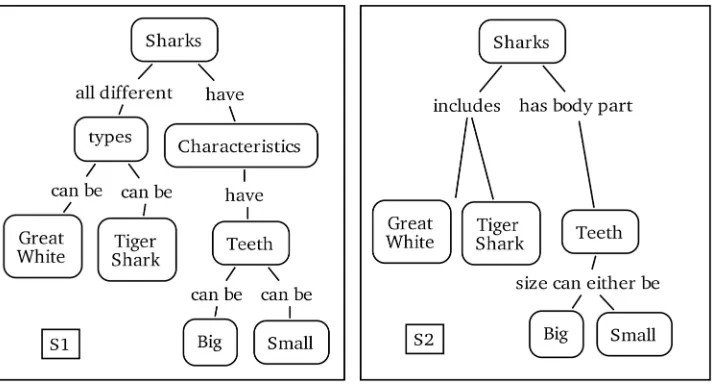
Figure 1. Concept maps on sharks drawn by S1 and S2.
2.1 Accuracy of linking words
Consider the concept maps on sharks (Thompson & Mintzes, 2002) as shown in Figure 1. To indicate the problems related to linking words we have taken the map on the left side from published literature and redrew, and the right side one is made by us. If we use the Novakian scoring method the map drawn by S1 gets a higher score since, the number of nodes (concepts), and the number of propositions are more than in the map by S2. The map of S1 uses the linking phrase “can be” ambiguously: it is used to represent an inclusion relation, and also for possible attributes. The linking phrase “have” is also used ambiguously. The map of S2 is clearly more accurate, and says everything that the map S1 does. This example, illustrates the problem with the rubric, since the map of S2 is closer to an expert, but scores less than the novice's.
Figure 2. Concept maps on living things drawn by S1 and S2.
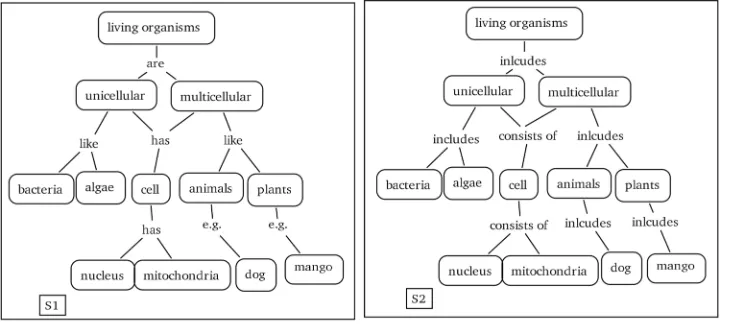
may be noted that the usage of the linking word `e.g.' in the first proposition is imprecise because the actual relation between the concepts should be either `includes', or `subclass-of' or `subtype-of'. The second and third propositions depicts the class-instance relation and hence the linking word `e.g.' is appropriate. This usage is possible only after restructuring due to training. Should not we find a way of giving additional score for such an accurate and explicit use of the linking words displaying more mature representation?
To cite another instance from a concept map on sharks (Thompson & Mintzes, 2002) S1 has a proposition <carnivorous like rays, sharks>, and <sharks have teeth, fins>. S2's map has a proposition <carnivorous includes sharks, rays> and <sharks consists of teeth, fins>. Both the maps of S1 and S2 according to traditional scoring method get equal score. But S2 deserves an extra score because the linking word `includes', and `consists of' depict a mature understanding. The map of S2 carefully distinguishes between the two kinds of inclusion relations (class-subclass and part-whole). Shouldn't we take care of this subtle restructuring that could have happened in S2?
The above examples illustrate that when a novice is becoming an expert, the same domain knowledge gets re-represented by more accurate linking words. Therefore it is necessary to distinguish such a structure from that of a novice, and we should find a way of providing additional score for maps made by S2.
2.2 Validating Hierarchies
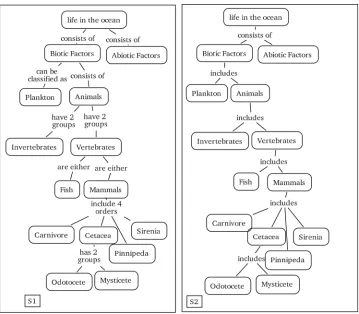
Hierarchical organization of knowledge has been appraised as one of the distinguishing characters of scientific knowledge since the time of Plato and Aristotle. Ausubel's theory accommodates for it nicely under subsumption. We strongly agree with Novak that meaningful learning proceeds most easily when new concepts or concept meanings are subsumed under broader concepts. More inclusive concepts, should be at the top of the map, with progressively more specific, less inclusive concepts arranged below them. Though, theoretically the points were well taken, in the practice of concept mapping we found some serious anomalies.
Figure 3. Concept maps on life in the ocean drawn by S1 and S2.
3 Discussion
Based on the examples that were considered above, we think, there is a need to attend to the problems, which can be handled properly by the concept mapping methodology, so that the restructuring will happen while extending the folk language to scientific language. Most of the problems can be resolved by focusing on the problem of choosing the right kind of linking words. Ambiguity in linking phrases and lack of rigor in concept mapping is already reported by other researchers (Costa et al., 2004). In the Artificial Intelligence (AI) community concept maps are considered as non-rigorous in methodology (Kremer, 1995; Sowa, 1984; Sowa, 2006), and the maps lack in Knowledge Representation (KR) formalisms (Cañas & Carvalho, 2004). This point of critique is cited in the works of Cañas, et. al. (2004) from IHMC to show that concept maps and AI (or KR) are not compatible.
Despite the fact that there is freedom in selecting linking words, and though it gives an unlimited expressive power, it gives rise to ambiguity in concept maps. Most often the linking words used, are borrowed from the natural language, and may lead to ambiguity. The purpose of concept maps to help in meaningful learning is not achieved when the resulting concept maps are ambiguous and lead to vague understanding. While acknowledging that students begin with a rich tapestry of folk language, when they begin to learn science they are required to weed out expressions. The requirement by the AI community to weed out ambiguity is somewhat related to this, since computing systems cannot handle implicit knowledge. Similarly, scientific language strives to be as explicit as possible. If we recall what happened in each of the great scientific revolutions, we will realize that so much effort was spent by the masters, such as Galileo, in conceptual cleansing. In fact it was argued that revolutionary changes took place due to change in conceptual schemes (see the case studies in Nagarjuna, 1994). Therefore, we think that during the process of learning science, we need to create an opportunity to restructure the concept maps drawn while learning in any domain so that the students reach as close to the expert's knowledge structure as possible.
let us focus on what we can do here. Though we may think that there can be innumerable number of linking words, if we look closely into any expert domain in any science, we realize that the number of kinds of linking words is limited, and does not increase as the knowledge advances. Let us call the kinds of linking words as relation types.
Take any large concept map of any domain, and take a measure of the number of relation types used to re-represent the knowledge. We hypothesize that the number reaches very quickly a constant figure for each domain of knowledge and does not increase any further. Our hypothesis has already some support from the preliminary evidences of Fisher's work. A biology network created by a team revealed 67 relations used to link about 2,300 concepts (Fisher, 1990, pg. 1003). Our ongoing research further substantiates our hypothesis, and we will report the results on another occasion. In a study conducted by us, a chapter from the Class VIII science textbook was re-represented as a concept map by carefully choosing accurate relation types. We found that the entire knowledge of the chapter needed only 6 relation types in a network of about 70 propositions (Kharatmal, 2006). If our argument that experts tend to use less number of relation types has any weight, then while using concept mapping technique in science education we should make a special effort to inculcate discipline in choosing the right kind of relation types. It may not be inappropriate to give a higher score for choosing the right kind of relation type while making the maps. If accurate use of relation type is a good index of expertize and restructuring of knowledge, every valid relation type should be given a higher score. We are not proposing a specific value for the score yet, and may be decided by experts in knowledge mensuration. Our purpose is to initiate a discussion.
Figure 4. Concept maps on living organisms drawn by S1 and S2.
By taking care of appropriate relation types, the problem reported above on the hierarchy also gets resolved. Consider the maps drawn in Figure 4. By the traditional method the map drawn by S1 has three levels of hierarchy. However, the same map is re-represented by us as S2 using our proposed discipline. We see two distinctly valid hierarchies, one for the relation type 'consists of' which has two levels, and the other using the relation type 'includes' which has three levels. Clearly the former one is a hierarchy of part-whole relation, and the latter is of class-subclass relation. This rigor, we think, is necessary for science education, and reflects the restructuring that takes place while becoming an expert.
In this paper we have identified certain anomalies in the existing concept mapping and scoring methodology, particularly keeping in mind the use of concept mapping for science education. We have attempted to show that the traditional rubric is inefficient in capturing and comparing the knowledge restructuring during the transition from the novice to an expert. We have proposed that if concept mapping methodology is refined by attending to the problems and by following a few suggestions made in this paper, it can become a more effective tool in studying the structure and dynamics of knowledge.
4 References
Ausubel, D., Novak, J., and Hanesian, H. (1978). Educational Psychology: A Cognitive View. New York: Holt, Rinehart and Winston.
Cañas, A. J., & Carvalho, M. (2004). Concept Maps and AI: an Unlikely Marriage? In Proceedings of SBIE 2004: Simpósio Brasileiro de Informática Educativa. Manaus, Brasil: SBC.
Carey, S. (1986). Conceptual change and science education. American Psychologist, 41(10), 1123--1130.
Costa, J. V., Rocha, F. E., & Favero, E. L. (2004). Linking phrases in concept maps: A study on the nature of inclusivity. In A. J. Canas, J. D. Novak, & F. M. Gonzalez (Eds.), Concept Maps: Theory, Methodology, Technology. Universidad Publica de Navarra, Pampalona, Spain.
Fisher, K. (1990). Semantic networking: The new kid on the block. Journal of Research in Science Teaching, 27(10), 1001--1018.
IHMC CmapTools (2004). The Website of CmapTools. http://cmap.ihmc.us.
Kharatmal, M. (2006). Concept map on cell structure and function. At IHMC Public Cmaps \ Meena (India) \ Cell Structure and Function \ Cell Structure and Function.
http://skat.ihmc.us/servlet/SBReadResourceServlet?rid=1139090479160_113084903_8482&partName=htmlte xt
Kremer, R. (1995). The design of a concept mapping environment for knowledge acquisition and knowledge representation. Proceedings of the 9th International Knowledge Acquisition Workshop.
Kuhn, T. (1962) The Structure of Scientific Revolutions. USA: University of Chicago Press.
Markham, K. M., Mintzes, J. J. & Jones, M. G. (1994). The concept map as a research and evaluation tool: Further evidence of validity. Journal of Research in Science Teaching, 31(1), 91—101.
Martin B. L., Mintzes, J. J., & Clavijo, I. E. (2000). Restructuring knowledge in biology: Cognitive processes and metacognitive reflections. International Journal of Science Education, 22(3), 303-323.
Mintzes, J. J. (In Press). Knowledge restructuring in biology: Testing a punctuated model of conceptual change. International Journal of Science and Mathematics Education.
Mintzes, J. J., Wandersee, J., & Novak, J., (Eds.). (1998). Teaching Science for Understanding --- A Human Consctructivist View. USA: Academic Press.
Mintzes, J. J., Wandersee, J. H., & Novak, J. D. (1997). Meaningful Learning in Science: The Human Constructivist Perspective. In Gary D. Phye (Ed.), Handbook of Academic Learning: Construction of Knowledge (pp. 405-47). USA: Academic Press.
Nersessian, N. J. (1998). Conceptual change. In W. Bechtel, & G. Graham (Eds.), A Companion to Cognitive Science. Blackwell, Malden, MA. 155-166.
Nagarjuna, G. (working paper). From Folklore to Science. Paper presented at the Eighth International History, Philosophy, Sociology & Science Teaching Conference, Leeds, UK, July 15-18, 2005.
Nagarjuna, G. (1994). The Role of Inversion in the Genesis, Development and the Structure of Scientific Knowledge. Ph.D. Thesis, Department of Humanities and Social Sciences, Indian Institute of Technology, Kanpur, India. http://cogprints.org/4340/
Novak, J. D., & Gowin, D. B. (1984). Learning How to Learn. New York: Cambridge University Press.
Sowa, J. (2006). Concept mapping. Talk presented at the AERA Conference, San Francisco. http://www.jfsowa.com/talks/cmapping.pdf
Sowa, J. (1984). Conceptual Structures: Information Processing in Mind and Machine. USA: Addison-Wesley Publishing Company.
Thagard, P. (1992). Conceptual Revolutions. USA: Princeton University Press.
Thompson, T. L., & Mintzes, J. J. (2002). Cognitive structure and the affective domain: On knowledge and feeling in biology. International Journal of Science Education, 24(6), 645-600.
Vosniadou, S. & Ioannides, C. (1998). From conceptual development to science education: A psychological point of view. International Journal of Science Education, 20(10), 1213-1230.