Informational warfare
1Nicole C. Hess1* and Edward H. Hagen2
1
Department of Anthropology, University of California, Santa Barbara, CA 93106 [email protected]
2
Institute for Theoretical Biology, Humboldt-Universität zu Berlin
*To whom correspondence should be addressed
Abstract
Recent empirical and theoretical work suggests that reputation was an important mediator of access to resources in ancestral human environments. Reputations were built and maintained by the collection, analysis, and dissemination of information about the actions and capabilities of group members—that is, by gossiping. Strategic gossiping would have been an excellent strategy for manipulating reputations and thereby competing effectively for resources and for cooperative relationships with group members who could best provide such resources. Coalitions (cliques) may have increased members’ abilities to manipulate reputations by gossiping. Because, over evolutionary time, women may have experienced more within-group competition than men, and because female reputations may have been more vulnerable than male
reputations to gossip, gossiping may have been a more important strategy for women than men. Consequently, women may have evolved specializations for gossiping alone and in coalitions. We develop and partially test this theory.
Keywords: Evolutionary psychology, gossip, female coalitions, reputation
1
We thank Don Symons, Don Brown, Leda Cosmides, Peter Hammerstein, John Tooby, members of the Center for Evolutionary Psychology, members of the Institute for Theoretical Biology, Berlin, and
Introduction
An important and influential survey situating human social organization within the broader matrix of primate social organization found that, in contrast to other primates, males have a virtual monopoly on individual and coalitional violence in human societies. Though there is some evidence for individual aggression by women, there is almost no evidence that women form coalitions to attack other women (Rodseth, Wrangham, Harrigan, and Smuts 1991a; see also Keeley 1996). Rodseth et al.’s survey concluded that women’s relationships, unlike those of females in other primates,
seem to be characterized by high degrees of noninterference mutualism, i.e., cooperation that does not impose a cost on any ‘third party.’ This varies little with residence pattern, so that even unrelated women in the most extreme patriarchal societies…regularly engage in peaceful cooperation toward common goals with close and enduring friendships (e.g., Abu-Lughod 1986). Such an observation would seem mundane if it were not for the striking contrast with dispersing females in other primates.
We present here a theory at some variance with this view. Although we agree that women seldom cooperate to physically attack other women, we will argue that they regularly cooperate to attack other women’s reputations and to defend their own
reputations. As Rodseth et al. (1991b) briefly noted, both men and women may “[gang] up verbally rather than physically on third parties,” an observation that we expand upon considerably here. We will develop our theory, summarize the existing evidence, present new evidence in support of it, and finally compare it to similar and opposing theoretical approaches.
Reputation, information, and competition
Recent empirical studies suggest that reputation—information about an individual based on his or her past behavior—may be an important mediator of access to resources in small, kin-based societies (e.g., Chagnon 1988; Gurven, Allen-Arave, Hill, and
Hurtado 2000; Hawkes 1991, 1993; Hawkes, O’Connell & Blurton Jones, 2001; Marlowe 1999; Patton, 2000; Smith & Bliege Bird 2000; Sosis 2000; Sugiyama and Chacon 2000). Reputation has also been shown to predict contributions in experimental economics games (e.g., Milinski, Semmann, Bakker, and Krambeck 2001; Milinski, Semmann, and Krambeck 2002; Wedekind and Milinski 2000).
Reputation is central to several theories of human sociality. In the indirect reciprocity theories (Alexander 1987; Leimar and Hammerstein 2001; Nowak and Sigmund 1998), benefits are provided to an individual based on information about her past contributions to others in the group—generous individuals are rewarded by receiving benefits from group members. In the ‘health-insurance’ theories (Gurven et al. 2000; Sugiyama and Chacon 2000), individuals can increase the likelihood that they will be taken care of when ill or injured by generously providing benefits to group members when they are well. In the ‘show-off’ or ‘costly-signaling’ theories (Gintis et al. 2001; Hawkes 1991, 1993; Smith & Bliege Bird 2000), individuals engage in behavior—such as big-game hunting—that reliably signals their quality as mates or social partners, and consequently reap valuable mating or social benefits.2
2
In each of these models, as several authors have noted (e.g., Enquist and Leimar 1993; Leimar and Hammerstein 2001), information about key behaviors (such as generosity to others or a successful hunting expedition) must be reliably transmitted to group members. The show-off/costly signaling and health insurance models assume that the key behaviors will be directly observed by those who ultimately provide benefits. Although direct observations are obviously informative in the indirect reciprocity models, key behaviors may also be communicated to other group members by the few observers of individual acts of generosity. Even in the show-off/costly signaling models, most group members will not directly observe who killed the elephant, but will have to rely on reports (as well as seeing the dead elephant) to properly assign credit to the successful hunter(s). Further, although the health insurance models posit that beneficiaries of past generosity will have a fitness interest in caring for providers when they are injured, it would be reasonable to extend this model in the following way: it would be in the fitness interests of all potential beneficiaries to care for an injured provider (even if some had not been personal beneficiaries in the past), because they could benefit from the future generosity of the provider when she is well. In this extended version, information about individual acts of generosity must be transmitted to other group members by observers of these acts.
Reputation can also play an important role in reciprocal altruism models (e.g., Cox, Sluckin, and Steele 1999; Enquist and Leimar 1993; Pollock and Dugatkin 1992). It would obviously be beneficial for individuals to know whether future social partners had defected or cooperated in the past with other social partners. In more sophisticated versions of these models, if the values of benefits that individuals provide vary, then individuals should attempt to cooperate with those who can provide the greatest benefits at the lowest cost. Because cooperation with one individual may necessarily preclude cooperation with another, individuals may have to compete for cooperative partners, resulting in a market for cooperators (Bull and Rice 1991; Nöe 1992; Nöe and Hammerstein 1994; Nöe, Van Schaik, and Van Hoof 1991); these markets have been argued to be particularly important in humans (e.g., Dugatkin 1995; Gilbert 1997; Hagen 1995; Henrich and Gil-White 2001; Tooby and Cosmides 1996). Thus, providers of valuable benefits can themselves be commodities over which individuals compete. To maximize the benefits one can acquire from others, one must achieve and maintain a reputation for being able to provide valuable benefits to others; this process requires that information about one’s capabilities be transmitted to other group members. Note that individuals may have different reputations in different markets; for example, a woman may be avoided as a foraging partner, but sought after as a political partner. Reputation is multidimensional.
Both theory and empirical studies strongly suggest that, within groups, access to resources provided by others is mediated by reputation; we therefore propose that
individuals can compete for scarce resources using information to attack their opponents’ reputations and defend their own.3 We term this informational aggression. We further propose that groups of individuals may be more effective than lone individuals in
3
Access to group resources can also be mediated by claims that are not based on reputation per se, but are still vulnerable to attack by the strategies that we propose here. For example, a boy might claim a ‘right’ to a group resource because he is the son of the late headman. Such a claim could be undermined by
attacking and defending reputations. We term a coordinated effort to use information to attack and defend reputations informational warfare. Though informational warfare may occur between communities, we will focus on informational warfare by coalitions, or cliques, within communities.
Because some actions can benefit one individual at a cost to another—such as cheating on a spouse—having a reputation as, say, a faithful wife, would serve not only to maintain access to resources but also to avoid the severe costs that the injured party, such as the husband, might impose. Thus, a successful attack on a competitor’s reputation could not only deny them resources, but also expose them to severe costs. Among the Jivaro, for example, punishment of infidelity customarily included execution of the paramour and gashing the wife’s head with a machete blade (Harner 1973:107, 175; Newman 1983:169; cited in Dean 1995; see also Daly and Wilson 1988:202-208).
Informational aggression
Individuals’ abilities to provide benefits are not always easily discerned by other group members, but must be inferred from information that, in many instances, is scarce. For example, evaluating a mate’s potential fidelity requires information relevant to fidelity, such as number of prior sex partners, flirtatiousness, prior fidelity, etc.,
information that could be acquired by gossip. Like Barkow (1992), we view ‘gossip’ as information that had implications for individuals’ fitness-relevant social strategies in the environment of evolutionary adaptedness (EEA). For the purposes of this paper,
however, we will more narrowly operationalize gossip as the collection, analysis, and strategic dissemination of information relevant to reputation, with the aim of increasing one’s reputation relative to one’s competitors (we will use the terms ‘gossip’ and ‘informational aggression’ interchangeably). If reputation mediated access to social partners and the resources they provided, there would have been a strong selection pressure for the evolution of adaptations to attack and defend reputations with gossip by providing information to resource providers that impugned the reputation of competitors or enhanced one’s own reputation, and by withholding information that enhanced the reputation of competitors or damaged one’s own. It has long been recognized that gossip is used to attack competitors’ reputations in small-scale societies:
[P]rimitive people are indeed among the most persistent and inveterate of gossips. Contestants for the same honours, possessors of the sacred rites of the tribe, the authorized narrators of legends, all leave you in little doubt as to the character and proficiency of their colleagues. “Ignoramus,” “braggart,” and not infrequently “liar” are liberally bandied about. (Radin 1927:177-8; cited in Gluckman 1963)
Why gossip was (usually) true
We propose that gossip in the EEA was genuinely valuable; if so, this placed an important constraint on one of its qualities: honesty. For gossip strategies to evolve, most gossip would have had to be accurate; otherwise it would have had no value to recipients. Because it would have been in resource providers’ interests to have accurate information about potential beneficiaries, providers were likely to punish gossipers who made false claims (e.g., Lachmann, Szamado, and Bergstrom 2001; Silk, Kaldor, and Boyd 2000; and references therein). Thus, a gossip psychology should be designed to exploit
and relationships with high quality partners (accordingly, we conceptualize gossip as
information rather than simply manipulation; see Dawkins and Krebs, 1978). Gossip
psychology should also be designed to exploit accurate information simply because there was a greater chance of finding supporting evidence for true claims than false claims.
In the uncommon circumstances, however, when the average fitness benefits of spreading false gossip about a competitor outweighed the average fitness costs of lying (such as punishment and loss of reputation), gossipers should have lied. Consequently, gossip evaluators should have co-evolved a system for paying attention to cues that are correlated with gossip accuracy, one hypothesis we test here.
Informational aggression: a better within-group competitive strategy than physical aggression
In the EEA, group members provided valuable reproductive, kinship, political, economic, military, and other benefits to fellow group members. If one group member physically injured another, he or she reduced that individual’s ability to provide these benefits to most other members of the group. Consequently, group members should usually have discouraged physical aggression directed towards other group members. As Knauft (1991) notes, in hunter-gatherer bands “interpersonal aggression and violence tend to be unrewarded if not actively devalued by men and women alike.” In contrast, gossip was, by and large, accurate and important information that would have often benefited other group members. Consequently, group members should not have
discouraged the communication of such information about other group members, at least not as much as they would have discouraged physical aggression. Because, as we will document next, gossip is a competitive strategy, and competition can obviously undermine group cohesion and the authority of leaders, leaders can be expected to denigrate and/or discourage gossip. Among the Ashanti, for example, gossiping against high-status individuals was punished by cutting off the perpetrator’s lips (Stirling 1956; cited in Fine and Rosnow 1978).
Despite possible sanctions against gossiping, gossip is greatly enjoyed by people everywhere (Gluckman 1963). We believe, with Barkow (1992), that this is because it is genuinely valuable. Brenneis’ (1984) description of talanoa (gossip) in a rural village (Bhatgaon) of Hindi-speaking Fiji Indians captures both the negative and positive feelings that villagers have about this pastime:
As the private, essentially illicit discussion and evaluation of others, talanoa is regarded by many villagers as fakutiya bat (“worthless doings”). This negative evaluation extends to the language of talanoa as well, as it draws on the forms and vocabulary of local, rustic Fiji Hindi rather than on those of the Standard Fiji Hindi used for public occasions. Despite these negative features, villagers clearly delight in talanoa and relish both the scandals themselves and the highly stylized ways in which they are discussed.
Evidence that gossip is used competitively and aggressively
There is considerable evidence that gossip is used competitively and aggressively. As Brenneis (1984) notes about Bhatgaon:
subject of a gossip session has an important constraining effect upon the form of those sessions. Reputation management is a constant concern in disputes, for conflict often arises from apparent insult, and the remedy lies in the public rebalancing of one’s reputation with that of one’s opponent. In their study of college women, Holland and Eisenhart (1990:114) present
“Rosalind’s” account of what another woman did in order to attract Rosalind’s boyfriend; this account clearly illustrates the use of negative (and in this case apparently false) gossip to attack a competitor’s reputation in order to obtain a valued resource—a mate:
That girl would do anything in her power to spite me...She’s always trying to get something against me...[the authors ask what the woman would do] Well, to start off she likes [my boyfriend]. And she’ll tell him things [lies] about me.…And she'll come over to [my neighbor’s] room. You can hear right through the walls. She’ll even open the door...and she’ll strike up a conversation about me. She calls me every name in the book...trying to provoke me into fighting her...and trying to make [my boyfriend] think that I’m lying to him...[She’ll be] telling him that some [other] man paged me...or came and picked me up...[when] no guy called me that morning...or picked me up. (brackets in the original)
Eder and Enke (1991), who define gossip as “evaluative talk about a person who is not present” found in their study of US adolescents that most gossip sessions began with a negative evaluation, and that the dynamics of the session tended to promote the initial negative evaluation, sometimes beyond what many participants might have actually felt. McAndrew and Milenkovic (in press)—who also conceptualize gossip as an evolved, competitive strategy—found that subjects were more likely to pass on negative
information about potential adversaries than positive information, and, in contrast, that subjects were quite likely to share positive information about friends and relatives, but not negative information.
Much of the evidence on gossip, albeit mostly from North American studies, also suggests a sex difference in the propensity to use gossip. Early research on sex differences in aggression seemed to show that men were overwhelmingly more aggressive than women (see Eagly and Steffen’s 1986 meta-analysis). This perception was challenged when social psychologists began to study non-physical forms of
aggression (see Bjorkqvist and Niemela, 1992, for a review). Recent work has contrasted aggression that involves physical and verbal assault (i.e., hitting and yelling) with other forms of aggression—forms that prominently feature gossip. These forms of non-physical aggression have been given different names, such as relational aggression, indirect aggression, and social aggression. We present evidence on these forms of aggression here in support of our view that gossip is a competitive strategy, and then offer a theoretical account for the evident sex differences below.
Grotpeter and Crick (1996) contrast overt (physical) aggression with relational
aggression among children and adolescents:
Overt aggression consists of behaviors that are intended to harm another through physical damage or the threat of such damage (e.g., hitting, shoving, threatening to beat up a peer). These types of aggressive acts have been shown to be more characteristic of boys than of girls (Block, 1983; Parke and Slaby, 1983). In contrast, relational aggression includes behaviors that inflict harm on others by manipulating their peer relationships (e.g., by giving a peer the silent treatment, maliciously spreading lies and rumors about a peer to damage the peer’s group status) (Crick & Grotpeter, 1995). These behaviors have been shown to be more characteristic of girls than of boys.
...a kind of social manipulation: the aggressor manipulates others to attack the victim, or, by other means, makes use of the social structure in order to harm the target person, without being personally involved in the attack. Thereby, the aggressor stands a greater chance of going unnoticed and avoiding retaliation.
Galen and Underwood (1997) describe social aggression as, “directed toward damaging another's self-esteem, social status, or both, and may take direct forms such as verbal rejection, negative facial expressions or body movements, or more indirect forms such as slanderous rumors or social exclusion.”
Most work on these non-physical forms of aggression has focused on children and adolescents. (In this section, we will adhere to the terminologies used by the authors of the summarized studies.) Preschool-aged girls have been found to aggress relationally more than boys (Crick, Casas, and Mosher 1997), and are more likely to become victims of relational aggression than boys (Crick, Casas, and Ku 1999). Older children display similar patterns (Grotpeter and Crick 1996), and older adolescents and young adult women have been found to engage in relational aggression (Werner and Crick 1999).
Owens, Shute, and Slee (2000a) used focus groups and individual interviews to collect data on indirect aggression among female Australian teenagers. They found that indirect aggression involved ostracism, gossip, breaking confidences, talking just loudly enough for others to hear negative information about a victim, using code names in discussing victims, and criticism of a victim's clothing, appearance, or personality. This indirect aggression had “devastating” effects on victims. Indirect aggressors reported that their reasons for victimizing others included creating excitement, getting attention, using it to gain inclusion in a particular group or maintain a position in a group, alleviating boredom, using it to avoid being victimized oneself, and retaliation (Owens, Shute, and Slee 2000a, 2000b). Girls suggested that a failure to derogate others was associated with being derogated oneself, and that indirect aggression was necessary to avoid rejection. Jealousy over physical appearance, school grades, same-sex friends, and boys was a frequent trigger for indirect aggression, and it was “expressed through envious chatting behind the other’s back” (Owens, et al. 2000b). Galen and Underwood (1997) reported that elementary, middle, and high school girls rated socially aggressive females in videos as more angry than male students did. In a second study, girls rated socially aggressive behaviors as more hurtful than boys did, suggesting that females may have a heightened responsivity to social aggression.
In a study of Argentine adults, Hines and Fry (1994) found that women were very competitive with one another, mainly over men; that they were more likely to aggress indirectly; and that they were perceived by both sexes as more indirect in their modes of competition. Although some informants thought men and women gossiped equally, none thought that men gossiped more whereas several thought women gossiped more.
take into account whether gossiping was taking place between same-sex or cross-sex friends, and that this might explain their failure to find a sex difference.
Although it is beyond the scope of this article to address the massive literature on witchcraft, it is worth noting that witchcraft accusations have much in common with gossip (e.g., Bleek 1976). Like gossip, witchcraft commonly occurs where conflict develops in close, local, relationships (Nash 1973). Among the Tibetan Nyinba, for example, witchcraft accusations “are believed to be prompted by intra-community irritations and discord” (Levine 1982), and several authors have emphasized the political dimensions of witchcraft accusations (e.g., Marwick 1965; Mitchell 1956; Turner 1954; cited in Bleek 1976). It has also been pointed out that witches are often women (Bleek 1976; Levine 1982). Betzig (1989) notes that “witchcraft, broken taboos, and bad omens or dreams are intimately linked to infertility,” a critical dimension of female reputation.
Reputation is so important to women that the relatively rare instances of female-female physical aggression are often instigated by a desire to defend one’s reputation against negative gossip! Campbell (1995) found, for example, that, among British schoolgirls, 73% of the sample had been in a physical fight with another girl, often over “accusations of promiscuity, false accusations, and gossiping behind her back” (see also Laidler and Hunt 2001). Physical aggression among women also typically occurs over access to resources or resource providers (Burbank 1987; Campbell, Muncer, and Bibel 2001; Hanna 1999; Schuster 1983).
Sex differences in gossiping
Evidence that we reviewed above suggests that there is a sex difference in the
propensity to gossip. We offer the following two tentative explanations for the evolution of a sex difference in gossip psychology, if, in fact, it exists.
1. Women experienced more within-group competition than men in the EEA
Cross-cultural evidence from contemporary societies graphically illustrates the competition that new female group members often face from resident women. Kenyon (1994) suggested that, among patrilocal Sudanese women, a great deal of tension existed between mothers and their daughters-in-law, and the relationship was described as inherently hostile. Newcomers to groups often have difficulties forming alliances and being accepted by established members, and they often encounter negative gossip. In professional communities, Liang (1993) noted that “gossip preserves professional exclusivity and enhances one’s status; newcomers, not yet conversant with the ‘in’ gossip, can be put in their place.” In their vivid description of female-female conflict among Australian teenagers, Owens, et al. (2000a) reported that victims of indirect aggression were often characterized as being “new.” Haviland (1977), described gossip among Zinacanteco Indians from highland Chiapas as a form of within-group
competition. He reported that “[a] new bride, introduced to her husband’s household, represents a serious potential breach of confidentiality; her in-laws begrudge her to even occasional visits to her own mother, where she can leak out family secrets and gossip about her new household to an outsider.” Haviland (1988) also reports of this group that a newly-married woman’s unmarried, coresiding sisters-in-law can “make life unbearable for a young woman who has never before lived away from her own hearth”—a young woman whom they view as “incompetent and an intolerable spy in their midst.”
Campbell (1995) addressed the effects that novel females had on members of established, mixed-sex groups:
Girls in mixed sex groups are acutely sensitive to incursions by other females who by virtue of their novelty have an inbuilt advantage over the home group of women. Fights can occur when new females seek to enter the group or to establish relations with males whom the home team of girls regard as their pool of resources.
Patrilocality can also result from raiding. Peters (1998:116-117) described the experiences of recently-kidnapped Yanomamö women in their captors’ village: “Other women will belittle her for non-Xilixana behavior or her peculiar accent. Her status improves with time, after she integrates and bears children.” Helena Valero, a Spanish woman kidnapped by a Yanomamö group when she was a child, provided a first-hand account of the conflict engendered by wife capture, an account that also illustrates the conflicts commonly associated with polygyny (Valero 1965:44):
Every woman of the shapuno said to her husband’s female prisoner: ‘Now you’ll do as I say. You’ll have to go gather wood for me, and water in the igarape for me. If you don’t do it, I’ll beat you.’ One woman replied, ‘I came because your husband brought me; I should have run away at once.’ The husband said: ‘Stop talking, else I’ll give you both a beating.’ The wife went on: ‘No, I will kill her and then you will burn her by yourself; I will run off with other men.’
Similarly, Shostak (1981:170) writes of tension among cowives in polygynous marriages among the Ju/’hoansi:
Most women, however, do not want to become involved with such relationships. Many become furious when their husband suggests it. They claim that sexual jealousy, rivalry, subtle (and not so subtle) favoritism, and disputes over chores and other responsibilities make the polygynous life a very unpleasant one.
to get water, but she never tells that to me” (p. 170). Shostak reported that senior wives had the power to make the lives of a new cowife and the husband miserable to the point that the new wife opted to leave the marriage. Senior wives also appear to have more children and healthier children than junior wives in small-scale, polygynous societies (e.g., Hagen, Hames, Craig, Lauer, and Price 2001; Sellen 1999; Strassman 1997). The benefits of seniority may result from greater authority granted to them by husbands and in-laws due to their demonstrated success in the ability to provide reproductive, social, and political benefits, as well as the stronger coalitions of senior wives.
Psychiatric evidence also suggests that, in the EEA, women may have experienced (or continue to experience) more within-group competition. Walston, Blennerhassett, and Charlton (1998) reviewed cases of people who experienced persecutory delusions, looking for sex differences that would reflect differences in the types of threats men and women anticipated in ancestral environments. As predicted, more women identified familiar people as their persecutors, and more men reported strangers.
2. Information about women’s reputations was more difficult to verify
As we noted above, reputation is multidimensional. It may be easier to manipulate some dimensions of reputation than others. Dimensions of reputation that are easily and quickly proven are difficult to manipulate. Physical attractiveness, for example, can be easily assessed by any group member, and thus it cannot be impugned by gossip. In contrast, dimensions of reputation that are difficult to prove are much more vulnerable to inaccurate gossip.4 If the most important dimensions of reputation differed for women and men, and if these different dimensions were differentially vulnerable to inaccurate gossip, then one sex might have experienced stronger selection pressures to gossip effectively against competitors.
Dimensions of reputation can be difficult to assess—and thus be vulnerable to inaccurate gossip—for the following reasons. First, collecting relevant information can be time consuming. Events that are informative about a particular dimension of reputation may be rare, and/or one may need to observe several of them to form an accurate assessment about that dimension. Assessing someone’s relative vulnerability to infectious disease, for example, would require observations over months or years. Second, information that might diminish one’s reputation, like sexual infidelity, can often be concealed. Third, certain kinds of information may be available only to certain individuals—perhaps only a man’s wife may know that he is impotent. Fourth, once obtained, it is often necessary to process information in order to determine how it impacts a person’s reputation, and this processing can be costly.
We believe that, although both men and women were equally vulnerable to accurate gossip, women in the EEA may have been, on average, more vulnerable to inaccurate gossip. In the EEA, several aspects of male and female reputation were equally important, and equally easy or difficult to ascertain, such as political abilities, medical abilities, kinship ties, etc. Three important aspects of male and female reputation were, however, equally difficult to ascertain, but, arguably, constituted a greater fraction of female reputation: fertility, fidelity, and childcare ability. Indirect aggression has been found to increase dramatically around the onset of puberty (age 11) for girls, but not for
4
boys (Bjorkqvist, Lagerspetz, and Kaulkanian, 1992), consistent with the idea that informational aggression often targets aspects of female mate value.
Assuming patrilocality and alliance-by-marriage characterized the EEA, then, if a male were infertile, his wife could have often married another group member—perhaps a brother—and, other than the original husband, no one would have suffered a fitness cost. If a wife were infertile, however, because female reproductive capacity was not easily replaced, she, her husband, both families, and other group members who benefited from the alliance would all have paid a fitness cost. Similarly, because males invested less in offspring, male sexual infidelity would have been less likely to decrease the inclusive fitness of in-laws, and less likely to threaten an alliance, than a woman’s infidelity. A woman’s willingness and ability to invest in offspring, including gestation, lactation, and other critical forms of direct care, had a larger and more direct impact on offspring survivorship than a man’s willingness and ability to invest in offspring (although men may have varied more along these dimensions than women—see La Cerra 1995); thus ability and willingness to parent is a more important determinant of female reputation than male reputation.
Patrilocality also presented women with the problem of making large economic and political contributions to individuals they were not related to (especially before they had children), and who might not reciprocate. Information about a woman’s intentions to cooperate with affines on matters of reproduction, divisions of labor, allocation of resources, etc., may have been a more important aspect of female reputation than male reputation. In addition, patrilocality would have meant that women frequently found themselves with strangers who were unfamiliar with the woman’s abilities, many of whom would have been competitors with her for group resources, and who would therefore be motivated to call her abilities into question.
Male fighting ability and hunting ability might have been more important
determinants of male reputation than female reputation. In contrast to important and difficult-to-ascertain elements of female reputation, both of these components of
reputation were relatively easy to assess, and thus not vulnerable to inaccurate gossip. A man either comes home with game on a regular basis, or he doesn’t. When challenged, a man either fights and wins, or he doesn’t. Of course, information about fighting and hunting ability will be gossiped about. But, an inaccurate representation of these skills can be easily corrected. These views are consistent with the observations of other researchers. In a study of high school students, Proveda (1975) pointed out that reputation has different meanings for males and females:
Reputation may be regarded as a function of both a person’s actual behavior and of the information distribution about the person. It is suggested that in the girl’s social system, reputation is achieved (or lost) largely through the manipulation of information about people. In the boys social system, earning a reputation is much more a function of actual behavior.…[T]he boys are not so vulnerable to this secret and sometimes vicious manipulation of information about persons since their behavior may be publicly tested. The behavior and social identities that are rooted in being a good athlete, a good fighter, or a good student may be relatively easily confirmed or refuted. On the other hand, how is it possible to test whether one is a “slut” or a “whore”? (emphasis in the original) Similarly, Campbell (1999) writes:
him. A girl, however, is unable to demonstrate in any convincing and public way that the accusation is false. Her best hope is to successfully repel anyone who so accuses her and thus minimize the chance of anyone else repeating such a reputational attack.
Because gossip is an excellent strategy for within-group competition, and because it is effective in attacking and defending difficult-to-assess aspects of reputation, gossip may have been a more effective weapon in female intrasexual competition than it was in male intrasexual competition, increasing selection for psychological adaptations for
informational aggression in females. It follows that women should be better than men at informational aggression and more sensitive to threats of informational aggression. In a closely related point, if men competed not only through their ability to enhance their reputation, but also by their ability to impose costs on others using physical aggression, then gossip would have been a less useful competitive strategy for men in any case. Additionally, if men benefited more than women from between-community competition, they would have paid a higher cost for the divisive effects of within-community
competition.
Language skills and gossip
We are not suggesting that men do not have adaptations for gossiping. Rather, in the same way that males are somewhat specialized for physical aggression, females may be somewhat specialized for informational aggression. Specifically, women should be specialized to communicate more information more accurately and in shorter periods of time. Numerous studies have documented superior female language abilities that may be related to such specialization (Geary 1998:261-268). About two out of three women produce more words in a given period of time than the average man (Halpern & Wright 1996; Hyde & Linn 1988), about three out of four women commit fewer speech errors such as retrieving the wrong word than does the average man (Hall 1984), and about nine out of ten women outperformed the average man in their ability to discriminate basic language sounds (Block et al. 1989). In contrast, nearly nine out of ten men had more frequent pauses in their utterances than did the average women (Hall 1984).
Even small, innate differences in gossip psychology between males and females could lead to important behavioral differences. If, during development, females were merely more inclined to engage in informational aggression, and males were more inclined to engage in physical aggression, then, even if males and females had equal potential to acquire gossiping skills, this small bias could result in developmental trajectories that diverge significantly with experience. Females could become significantly better gossipers because they were more inclined to practice as children.
Women cannot afford to compete physically
however, that informational aggression is only a less risky substitute for physical aggression. Rather, it is a form of aggression that functioned most effectively in the domains of within-group competition and attacks on difficult-to-ascertain aspects of reputation. These domains may have been particularly relevant to female fitness.
Informational warfare: the coalitional use of gossip
Theory
Tooby and Cosmides (1988), among others, have suggested that male coalitional behavior may be grounded in psychological adaptations for physical warfare. We propose that coalitional behavior may also be grounded—in part—in psychological adaptations for informational warfare. For the reasons discussed in the previous section, there may have been stronger selection pressures on females to cooperate in attacking and defending reputations using gossip; we therefore focus here on the female coalitional use of gossip (although similar arguments should also apply to male or mixed sex groups).
In contrast to other primates, human females are notable for forming strong affiliative relationships even with non-kin (Rodseth et al. 1991). As Rodseth et al. point out
Female gorillas or hamadryas baboons, for example, while living in close proximity to other females, develop only rudimentary relationships with them, devoting most of their attention to the breeding male in their group (Kummer 1968, Sigg 1980, Harcourt and Stewart 1983, Stewart and Harcourt 1987). Female chimpanzees, while sharing a community range, spend as much as two thirds of their time alone with infants (Wrangham and Smuts 1980) and again interact more with males in their group than with females (Wrangham, Clark, and Basuta 1991). One species in which female transfer is suspected—the bonobo or pygmy chimpanzee (Kano 1982)—exhibits female homosexual behavior (Kuroda 1980, Thompson-Handler, Malenky, and Badrian 1984, Kano 1989) and perhaps more complex social relationships among females than among males (White 1988, 1989; White and Burgman n.d.). Yet humans are unique in the extent to which both males and females form affiliative relationships, with nonkin as well as kin, both within and between groups. Why do women have such strong affiliative relationships with non-kin? We propose that female coalitions (and by coalitions we mean dyads or cliques within a community) might have been more effective than solitary females in both the offensive and defensive dimensions of informational warfare for several reasons. First, coalitions could have provided more eyes and ears through which to collect accurate information on
competitors. The more individuals there were trying to collect information that was rare and difficult to obtain, the more likely it was to be found.
Second, coalitions could more thoroughly analyze information. Multiple individuals could have (a) provided additional, relevant information; (b) offered different
interpretations of the same piece of information; (c) more effectively synthesized various pieces of information into a complete account; (d) more effectively assessed the costs and benefits of disseminating the information; (e) devised better strategies for disseminating the information, by, for example, emphasizing or exaggerating aspects of a gossip item by repeating them or stating them in a way that draws attention to them, by inserting plausible inferences into a story such as “she was smiling too much at your husband...she may want to steal him,” by strategically omitting information, or by adding descriptions of events that, when compared to the gossip, make the gossip look worse.
Third, coalitions could also have provided more vectors (mouths) to strategically
might have had special relationships with key individuals that allowed them to help coalition members by passing information to those key individuals.
Fourth, gossip reported by more than one person may have been more believable. Information can be degraded during communication due to random error (noise). Any account of an event can contain a random error, but the probability that multiple accounts contain the same random error decreases rapidly. Thus, multiple, independent sources for a particular piece of information greatly increase its reliability. Gossip reported by more than one person may also have been more believable because the costs and benefits of lying were unlikely to be equal for different individuals. Whereas the benefits of lying might have outweighed the costs for one person, it was less likely that they did so for more than one person. The probability that two people benefited by telling the same lie was smaller than the probability that one person did so. Consequently, if two individuals told the same story, it was more likely to be true. We test the hypothesis that
believability of gossip increases with the number of informants.
Fifth, coalitions may have protected individuals by providing alibis and by providing evidence against accusations. Coalitional threats of gossip could have also deterred an individual from competing with a member of a coalition in the first place.
The distinction between collecting and analyzing information on the one hand, and disseminating information on the other, is important, and can be illustrated by drawing on an analogy between physical warfare and informational warfare. In physical warfare, groups rarely actually fight because group violence can be so costly to both sides. Groups spend considerable time preparing for physical warfare, however, by building weapons, patrolling boundaries, solidifying coalitional ties, sharing information about enemies, and reviewing past battles. A well-prepared group can effectively deter attacks, and therefore not have to fight at all. Similarly, because informational warfare can be so costly, we would expect coalitions to rarely engage in reputational battles. Rather, we expect coalitions to spend considerable time readying themselves for informational warfare by collecting and analyzing relevant information. We expect that much, if not most, coalitional activity related to informational warfare will consist of the collection and, particularly, the analysis of information. We also expect that one of the essential benefits of belonging to a coalition is that it will effectively deter attacks on one’s reputation, another hypothesis tested here.
This difference between physical and informational warfare, as well as the fact that we conceive of informational aggression as primarily a within-community competitive strategy, suggest that coalitions formed for the purpose of informational warfare will be considerably smaller than those formed for the purpose of physical warfare. Researchers have consistently found that girl’s play groups are smaller than boy’s play groups (Laosa and Brophy 1972, Omark and Edelman 1973, Lever 1974; cited in Eder and Hallinan 1978; Goodwin 1990b:38-39; Waldrop and Halverson 1975). And, at least for females, we would expect outsiders to be frequently viewed as threats to existing friendship dyads rather than as potential contributors to a larger coalition. In a study of children, Eder and Hallinan (1978) found that, because of the exclusivity of dyadic female friendships, newcomers had a hard time making friends. Eder and Hallihan also report that girls’ triadic friendships were more exclusive than boys’ triadic friendships, and that girls had more exclusive triadic friendships than they did nonexclusive triadic friendships. Similarly, Feshbach and Sones (1971) reported that adolescent girls made less favorable judgments of newcomers than did adolescent boys. Owens et al. (2000b) reported that jealousy over female friends was particularly intense, and described the phenomenon of “a girl ‘poaching’ [stealing] another’s best friend,” sometimes using negative gossip:
I reckon that Brooke and her were good friends and very close and probably somebody, another girl in the group, wants to be very close to Brooke and she goes and spreads something about Jo. We expect friend guarding behavior (analogous to mate guarding behavior) to occur when one member of a coalition perceives that her friend status is being threatened; i.e., when she perceives that her friend is being poached. A school official reported his view of this phenomenon in a discussion of jealousy among girls: “They just want to have a friend. ‘You can be my friend or no one’s friend.’ It's amazing how girls want to be like that, to be so smothering of some of their friends.” This evidence is also consistent with our claim that relationships themselves are a resource over which individuals compete.
Evidence from existing literature in support of informational warfare
There is clear evidence that women gossip in groups, and a primary objective of such gossiping is to diminish the reputations of other women. Laidler and Hunt (2001), for example, observed of female gangs in the San Francisco Bay Area:
As in Lees’ study of English girls (1997), we find gang girls spending a great deal of energy ‘bitching’ or casting doubt on others’ reputations. This cross-cultural process operates not only as a mechanism of social control, but also of distancing and confirming one’s own reputation.
Leaper and Holliday (1995) showed that women use gossip to promote solidarity in an “us vs. them” manner. Gottman and Mettetal (1986) similarly found that four and five year olds tend to gossip in a way that creates an atmosphere of “we against others.” An example is provided in which two children discuss the doings of a third child that they disapprove of. The authors report that one child would say something about the absent subject of the gossip; the other child would agree with each statement and reflect it (by making a similar statement). This process led to amplification of the opinion extremity of each discussant against the third child.
members of neighborhood playgroups took the form of structured, coalitional, verbal confrontations. Girls presented their stories in such a way that hearers became aligned with speakers, then formed a consensus against absent parties (Goodwin 1990a). Whereas boys tended to emphasize rank in their groups, “[g]irls affirm the organization of their social group through assessing the behavior of absent parties. The alliances they form in the process of discussing others mark who is included and excluded from the social group of the moment, rather than relative rank.” Goodwin (1990a) described how girls strategically distributed gossip and recruited allies against a third party:
Among the girls, storyteller skillfully works to align hearer with teller against an absent third party. A coalition of what the girls call “two against one” (storyteller and hearer against absent third party) is established in the immediate interaction. From the teller’s perspective, the offended party’s alignment is important for bringing forth a future confrontation. From the recipient’s perspective the fact that at least two parties agree on a particular version of an event provides a warrant for bringing action against a third party. (italics in the original)
Goodwin (1982) also suggests that when verbal confrontations among girls occur, the accuser usually wins, due, in part, to the winner’s alliances.
In contrast to the general assumption that girls tend to avoid conflict, Goodwin (1990a) suggested that they in fact compete fiercely with other girls, and that the competition reveals a coalition structure among girls:
As the data presented here vividly show, within the he-said-she-said storytelling event, girls react with righteous indignation when they find that their character has been maligned. They display an intense interest in initiating and elaborating disputes about their rights (not to be talked about behind their backs) that differentiate offending and offended parties. Alignments taken up during such disputes clearly demarcate who stands within the bounds of an inner circle of friends, as well as who is regulated to that circle’s periphery. (emphasis added)
Proveda (1975) suggested that gossip is the weapon by which girls manipulate information, and that this manipulation of social information appears to explain how girls’ coalitions differ from boys’ coalitions:
Gossip, of course, is the major weapon which girls use to regulate information about each other. This method of informal social control accounts for the tighter clique structure among girls than boys, as well as the nature of peer group solidarity among girls. Girls frequently describe other girls as friendly and well-liked within their own group, but unfriendly to outsiders. It is apparent that the clique is crucial in the regulation of information about peers. What is known to one member of a clique is known to all; therefore, it is important to control and limit the association patterns of the clique. The vulnerability of girls to revealing or not revealing information about the self makes girls much more sensitive to social criticism than boys. In this sense, the girl’s fate rests with the fate of the clique….
Work by Owens, et al. (2000a, 2000b) on indirect aggression showed that “intimacy” was achieved within groups of female friends when non-members were derogated, and that derogating others was often needed to gain acceptance into (or maintain a position in) a particular group, suggesting the group nature of female competition. Other aggressive tactics identified by Owens, et al., such as ostracism, breaking confidences, and discussing victims, are all inherently cooperative forms of competition (i.e., at least two aggressors are required). Supporting our suggestion that coalitions facilitate the dissemination of information, Owens, et al. (2000b) also found that
The coalitional use of gossip requires that coalition members agree on their interpretations of, and attitudes towards, gossip items. Describing gossip among
Polynesian Nukulaelae, which is most commonly a female activity, Besnier (1989) wrote, “In order to create a successful gossip session, gossips must ensure that their audience shares their own feelings and attitudes toward the specific topic of the gossip.” Besnier argued that collusion was a main feature of gossip among the Polynesian Nukulaelae, and showed how gossipers delayed the introduction of a key element of the gossip so that their listeners took an active role in the co-production of gossip. Similarly, Eder and Enke (1991) found that a supporting response to an initial negative gossip statement about another resulted in other participants in the conversation subsequently making only negative comments in agreement with this evaluation (early challenges to the evaluation, which were relatively infrequent, led to less conformity). Eder and Enke note that this pattern “helps to explain the overwhelmingly negative tone of most gossip episodes.”
In sum, existing research shows that women and girls clearly compete with one another, both singly and in small groups, using non-physical forms of aggression such as attacks on reputation and ostracism, and collude in these activities starting at a very young age. This competition can be over mates, resources, reputation, or female allies, and it has negative consequences for victims.
Self disclosure
Because, within coalitions, every individual is potentially a competitor with every other, and because effective attacks upon, and defenses of, reputation require frank discussion of information that could be damaging to the reputations of coalition members, a mechanism is required to prevent one coalition member from using ‘proprietary’ information against another (a problem that bears obvious resemblance to the ‘commitment problem’, e.g., Frank 1988). Holland and Eisenhart (1990), for example, provided several examples from their ethnographic work among women in US colleges of how women have “fragile ties” with other women, and how they competed with each other over men. Gossip played an important role in this process. One girl they interviewed said “Girls are better off if they don’t talk about their business to other girls...if [others] know, they can boss you” (p. 114). The authors suggested that the need to avoid being manipulated may have actually prevented many female friendships from becoming solid, and that “[t]here was a collective assumption that others—even some who posed as friends—might use information against a woman to take advantage of her if they could” (p. 116). Goodwin has also reported that “when girls talk about other girls they frequently do so in a guarded fashion, being mindful of the possibility that the present listener could report to the talked-about party what was said in her absence” (1982:803). Proveda (1975) noted that “[t]he senior girls who were part of my research constantly complained about the ‘back-stabbing’ and about the other ‘two-faced’ girls. There was a conspicuous absence of such expressions among the senior boys.”
a conflict. If each member provided such information to other members (but not to non-members), no member could easily afford to attack another member.
Self-disclosure—the revealing of personal information to others—is a well-documented phenomenon that closely resembles the foregoing (see Derlega, Metts, Petronio, and Margulis 1993 for a review). Self-disclosure appears to be an important aspect of female friendships, but not male friendships. We propose that the reciprocal revealing of increasingly personal information is important when women form
competitive coalitions. In addition to solving the commitment problem, initial exchanges of personal information would also allow women to determine if they are a good
coalitional ‘match’,5 and continued revealing of such information would be required of each member who wishes to remain part of the coalition. Research has shown that, among girls, friendships have less conflict when participants self-disclose (e.g., Kiraly 2000). It has also been shown that women who score high on instruments designed to assess ‘Machiavellianism’ (defined as a cynical view about nature and a willingness to employ manipulative strategies in social interactions) are also more willing to self-disclose, whereas the opposite pattern is true for men (Domelsmith and Dietch 1978; Brown and Guy 1983). This suggests that self-disclosure may be an important component of women’s competitive social strategies. Sharing personal information would also enhance the ability of coalition members to collect and analyze information that would be helpful to fellow members.
Experiments
Though previous studies largely support our view of informational aggression and warfare, these studies do not address predictions specifically derived from our theory. Further, they were not experimental studies. Studies using observations and interviews have the advantage of exploring actual behavior in the real world, but they have the disadvantage that it is difficult to control the conditions of the study in order to explore the effects of specific variables on subjects’ perceptions and actions. Experiments can also provide evidence of causation, as opposed to mere correlation.
Experiments one and two were designed to test predictions regarding the psychology of informational aggression and it’s relationship to competition and coalitions.6
Experiments three, four, and five were designed to address the psychology of gossip collection and evaluation.
5
Laidler and Hunt (2001) report that women worry that the poor conduct of their friends will reflect poorly on them. Thus, determining the history of a potential ally should be an important aspect of coalition formation. See also Stombler (1994) on the collective sexual reputation of fraternity little sisters.
6 Generally, whereas it is easy to manipulate the coalitional status of a fictional woman in an experimental
scenario to determine its impact on subjects’ psychology and behavior, it is difficult to manipulate subjects’ coalitional status to the same end. Subjects obviously have considerable experience of their own actual social environments, experience which would undoubtedly profoundly influence their responses to our experimental scenarios. Although we could ask them to imagine that they either did, or did not have friends in a particular situation, we doubt that simply asking them to imagine this would effectively induce the corresponding psychological state. Testing hypotheses that require manipulation of subjects’
General Procedures
Students from several undergraduate classes were handed packets that contained one or more of the following experiments. Each experiment involved several conditions; we therefore describe the methods and results of each experiment together in separate subsections in order to enhance the clarity of this presentation. Counterbalancing was used to ensure that the conditions of one experiment did not vary systematically with those of another. The average female age was 20.8 and the average male age was 21.0. Ages ranged from 18-55.
Experiment One: Sarah
Overview
Female subjects read a fictional account of a female classmate, Sarah, who either was or was not competitive with the subject for a high grade, and who either did or did not have a close female friend in the class. Subjects then indicated their likelihood of reporting positive and negative information about this woman to one of their own real-life female friends; i.e., they were given the opportunity to engage in informational aggression against Sarah.
Method: Phase One
In phase one of the experiment, we asked 173 male and female subjects to read a list of twenty gossip statements that we composed, and then to rate each of the statements on a 9-point Likert scale that ranged from ‘bad’ to ‘neutral’ to ‘good’. The twenty
statements described aspects of the personality, sociality, health, and skills of a fictional woman named Sarah. Examples of these statements included, “Sarah is a person who is well-respected in her home town,” “Sarah is a person who is a slow and inefficient worker at her job,” “Sarah is a person who has an unpleasant personality,” and “Sarah is a person who is an excellent cook.” In order to minimize content effects, we used two versions of the list (A and B) which differed in the following way: each statement that was presented positively on list A was presented negatively on list B, and each statement that was presented negatively on the list A was presented positively on list B. For example, “Sarah has an unpleasant personality” on list A would correspond to “Sarah has a pleasant personality” on list B.
Visual inspection of a scatterplot of each statement’s mean rating when present on list A vs. its mean rating in the opposite form on list B revealed that sixteen of the twenty statements were clearly rated by subjects as ‘good’ when presented positively, and ‘bad’ when presented negatively. Four of the twenty statements were viewed as neither good nor bad, and were excluded from further analyses.
Method: Phase Two
In phase two, a separate group of 143 female subjects was first asked to think about one of their real-life female friends who was about the same age, and someone with whom they talked with frequently. They then read the following basic scenario:
many Cs, and a few Ds and Fs. Because the class is so small, you might do poorly simply because one or two other people do just a little better than you. One woman in the class is named Sarah.
Dependent variable
After reading the scenario in one of four possible conditions (based on two, two-level independent variables which will be described momentarily), each subject read either list A or list B of the sixteen statements about Sarah described above, and was told that all of the statements were known to be true. To eliminate order effects, each subject received a unique, randomly-ordered version of list A or list B. Each subject was then asked to indicate how likely she would be to tell each statement to her real-life friend using the following 5-point scale: 0 = I definitely would not tell my friend about this; 1 = I
probably would not tell my friend about this; 2 = There is a chance I would tell my friend about this; 3 = I probably would tell my friend about this; 4 = I definitely would tell my friend about this. The dependent variable, called DIFFERENCE, was the sum of each subject’s tendency to tell her friend about each positive statement minus the sum of her tendency to tell her friend about each negative statement; the possible range of the DIFFERENCE score was -80 to +80.
Independent variables and predictions
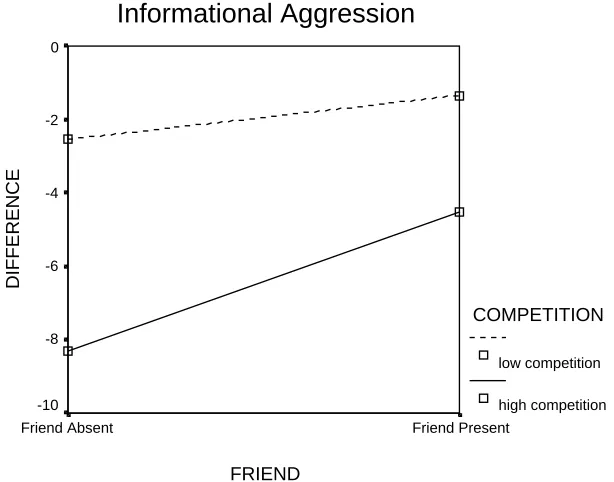
The first independent variable (COMPETITION) varied the degree of competition (high or low) between the subject and Sarah. For high competition, we added the sentence “[s]he [Sarah] wants to get the highest grade in the class, and has an obvious rivalry with you, but not with anybody else in the class” to the basic scenario. For low competition, the sentence was omitted. We predicted that a female subject’s perceived high competition with a target woman would increase the subject’s tendency to report negative gossip relative to positive gossip about that woman.
The second independent variable (FRIEND) varied whether Sarah had a close friend in the class. For the friend present condition, we added the sentence “Sarah seems to have one close female friend in the class, and she talks frequently with this woman” to the basic scenario; in the friend absent condition, the sentence was omitted. We predicted that that the target woman’s having a close female friend would decrease female subjects’ tendencies to report negative gossip relative to positive gossip about the woman.
Results
A 2 X 2 univariate ANOVA was conducted to evaluate the effects of
absent condition reported significantly more negative DIFFERENCE scores (M = -8.32, SD = 7.21) than those in the friend present condition (M = -4.53, SD = 8.69), t (70) = 2.00, p = .025 (one-tailed). Results are summarized in figure 1.
Informational Aggression
FRIEND
Friend Present Friend Absent
D
IF
F
E
R
E
N
C
E
0
-2
-4
-6
-8
-10
COMPETITION
low competition
high competition
Figure 1: DIFFERENCE score by FRIEND and COMPETITION
Experiment Two: Informational Aggression
Overview
Each subject read a scenario that placed him or her in a fictional classroom setting. Each subject had to decide whether or not to tell the professor that a classmate had cheated to win a competition with one of the subject’s real-life friends. The cheater, recognizing that the subject might tell, threatens to use informational aggression against the subject. We varied the coalitional status of the cheater: the cheater either did or did not have a group of friends in the class.
Method
in a cross-sex context. After answering questions about a friend, subjects then read the following basic scenario (this is the female version):
Imagine that you and this friend are in a seminar-style debate class here at UCSB. This class is very small, and it is graded on a curve, such that students are very competitive with one another for a small number of As and Bs. Each week, a different pair of students must debate one another on a particular political issue, and each of the two students is assigned to research and argue one side of this issue. Each student’s grade is based on being able to effectively persuade the other students in the class that his or her side is correct. The students evaluate each of the two debaters, reporting which one they thought was more persuasive, and then turn in those evaluations to the professor. The professor then uses ONLY these evaluations in assigning grades. He does this because he wants students to learn to deal with the real-world consequences of debates. So far in the class, everyone has learned that success in persuasion relies very heavily on one debater’s being able to anticipate what the opposing debater will be arguing.
You are sitting in class on a Tuesday, and your friend is going to be debating Melissa the next day. Your friend has put a lot of work into this debate, and has outlined her debate on paper to help keep her thoughts organized during the debate. At the end of Tuesday’s class, as people are packing up their notebooks, you glance over at Melissa. You see that Melissa has a copy of your friend’s outline in her backpack. This could sabotage your friend’s chances of winning the debate.
Melissa sees you looking at the copy of your friend’s outline as she puts it into her backpack. She throws you a threatening glance, and whispers, ‘If you tell the professor, I’ll make sure everyone else in this class gives you a bad evaluation when you debate.’
After you and your friend walk out of the room, you tell your friend what happened. Your friend has no idea how Melissa got a copy of her outline. Your friend is very worried because there is not enough time to put together a whole new set of arguments for the debate the next day. Your friend doesn’t want to tell the professor because your friend knows that Melissa will simply deny that she ever saw the outline, and the professor might think your friend is just trying to make Melissa look bad right before the debate.
This scenario portrays the subject as a potential victim of informational aggression: bad evaluations (information) decrease the friend’s standing in the class relative to other students (reputation); thereby decreasing the friend’s ability to get a good grade in the class (a scarce resource). Coalitions are important because the ability to effectively inflict the cost (hurting the friend’s reputation) is enhanced when there are more coordinated negative evaluators.
Dependent variable
The dependent variable, TELL, was measured by asking subjects:
How likely are you to tell the professor that Melissa looked at your friend’s outline without your friend’s permission? [this is the female version]
Subjects answered on a 9-point Likert scale (1 = I definitely would NOT tell; 5 = not sure; 9 = I definitely WOULD tell).
Independent variable and prediction
The independent variable COALITION was the coalitional status of the debater; the debater either did or did not have friends in the class. This was manipulated by including or omitting the sentence (female version):
We predicted that subjects in the coalition present condition would be less likely to tell.
Results
An independent samples t-test was conducted to evaluate the effect of having a coalition on subjects’ likelihood of telling. The results for the t-test indicated a significant difference in the predicted direction, t (135) = 2.32, p = .01 (one-tailed). Subjects in the coalition absent condition (M = 6.63 SD = 2.14) were significantly more likely to tell than subjects in the coalition present condition (M = 5.72, SD = 2.43).
Experiment Three: Reiteration Effect and Gossip
Previous research and prediction
Previous studies have shown that repeated statements are more believed than
unrepeated statements, whether or not the statements are actually true (e.g., Bacon 1979; Hasher, Goldstein, and Toppino 1977; Hertwig, Gigerenzer, and Hoffrage 1997;
Schwartz 1982), a phenomenon referred to as the “truth” or “reiteration” effect. This effect has been demonstrated for “trivia” statements—possible factual statements about the non-social world such as “the Eiffel Tower is 986 feet tall,” but it has not been shown for gossip statements—possible factual statements about the social world such as “Tony Blair has an illegitimate child.” If the reiteration effect applied to gossip statements, it might partially explain why coalitions would have an advantage over individuals in gossip competitions—more disseminators would increase the repetition of gossip and thus increase its believability. However, we were skeptical that mere repetition would significantly increase truth ratings of gossip statements. If gossip were an important source of information in the EEA, people should be expected to have evolved
psychological mechanisms to avoid being easily manipulated by others who use simple and easily identified strategies like repetition. Consequently, although we predicted that reiteration of gossip by multiple independent sources should increase believability (a hypothesis we test next), we predicted that gossip statements, unlike trivia statements, might not be vulnerable to the reiteration effect when the number or nature of the sources was not specified.
Overview
Subjects first read eight gossip statements and rated how interesting each was immediately after reading it. After spending several minutes completing other
experiments, subjects read 16 additional gossip statements and rated them for truth value; eight of these were novel statements and eight were the same statements that they had previously read and then ranked for interestingness. The cumulative truth score for the eight novel, i.e., unrepeated, statements was compared to the cumulative truth score for the eight repeated statements.
Method