The Moderating Effect Of Integrity On The
Relationship Of Triangle Fraud Elements And
Fraud: Evidence In Indonesia
Ramadona Simbolon, Sri Elviani, Enny Trisna, Ronal H.T. Simbolon, Safrida, Usman Nasution
Abstract: Purpose - This paper aims to identify the relationship between triangle fraud elements and fraud occurrence and to examine the effect of moderating integrity on its relationship with the triangle fraud element and fraud occurrence. Design/methodology/approach - Data are collected using the questionnaire distributed to Office executive in the Government of North Sumatra Province and the City Government of Medan totaling 189 people. Data analysis was performed using multiple regression and moderated regression analysis using an interaction approach. Finding - The results of this paper indicate that the triangle element of fraud (pressure, opportunity and rationalization) and integrity has a negative affects to the occurrence of fraud and there is a moderating influence on the relationship between the triangle fraud element and the occurrence of fraud. Research limitations/implications - This paper uses questionnaire that caused existence of bias personal, the analysis of this research only uses triangle fraud element and integrity, without considering other indicators. This research is performed at the Government of North Sumatra Province and also Medan City which cannot be generated to the other local governments in Indonesia. Practical implications - This study also has implications for fraud prevention models to prevent and reduce fraud in the Government, especially the Government of North Sumatra Province and Medan City Government. Originality/value – This paper contributes to the literature by investigating fraud using fraud triangle elements and integrity. Integration of integrity and fraud triangle elements will improve practitioners' understanding and provide a model for all relevant parties to prevent and reduce fraud, especially in Indonesia.
Keywords: Pressure, Opportunity, Rationalization, Integrity, Fraud.
————————————————————
1
I
NTRODUCTIONFraud is the most critical problem so that it becomes a challenge in the running of the organizational environment (Smith et al. 2005). Cheating activities in the private and public sectors among employees still occur, without regarding the actions taken by the government and professional bodies to minimize fraud (ACFE 2012)[1]. KPMG conducted a survey in Australia from April 2010 to September 2016 and reported that the average number of fraud cases increased by 16 percent compared to 2010[2], 813 cases (KPMG 2010)[3]. The same survey in Singapore, the data revealed that the total fraud that occurred in 2014 increased to 29 percent, compared to 2011, which was only 22 percent (KPMG 2014)[4]. Fraud activity has also become a serious problem in Indonesia (Association of Certified Fraud Examiners 2016). International Transparency revealed that the score of corruption perception index (CPI) in Indonesia is 34 and ranking at 107 out of 175 countries measured (Transparency International 2014).[5][6][7] Cheating encompasses various ways of human ingenuity that are designed to use others with false pretexts (Crawford and Weirich 2011)[8] . The Association of Certified Fraud Examiners (ACFE) classifies fraud into 3 (three) schemes called the fraud tree, namely corruption, asset misuse, and fraud in financial statements (Association of Certified Fraud Examiners 2016)[9]. Several fraud cases involving large organizations in the world include Enron, Satyam, Parmalat and other large organizations. This encourages researchers to conduct research related to fraud. Skousen, C.J., Smith, K.R and Wright (2009) and Manurung & Hadian (2013) find that fraud is caused by three factors, namely the pressure, Opportunity and rationalization.[10][11] A person's integrity also has a relationship to an act of fraud. A person with integrity will tend to be honest, trustworthy and has high-performance, thus, he will be hindered from fraudulent activities [12]. Integrity has a negative relationship to fraud and is an important value in minimizing fraud [13]. If someone has an integrity, then the triangle fraud element has no effect on fraud, and vice versa. If someone has no integrity in himself, then the triangle fraud elements will affect the occurrence of
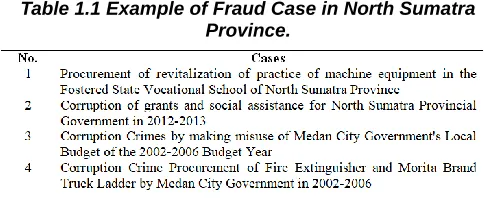
fraud within an organization.[14] Various policies have been made by the Government to eradicate corruption, including by forming a Corruption Eradication Commission, but they have not shown significant changes. This is proved by the large number of state officials involved in fraud. It happens in North Sumatra Province and Medan City. The Forum for Budget Transparency records that North Sumatra is the province that has the most corruption cases in Indonesia. Some cases of fraud that occurred in North Sumatra Province are:
Table 1.1 Example of Fraud Case in North Sumatra Province.
This study will evaluate the impact of the triangle dimension of fraud on fraud and examine the effect of moderating integrity on the relationship of triangle fraud elements and fraud. The results of this study are expected to provide methods or policies to prevent / minimize fraud so that it can be a reference for other regions in Indonesia.[15][16][17]
2.
L
ITERATURER
EVIEWan observable element because opportunity is related to an internal control in the organization which can be observed by an auditor (Dorminey et al. 2010). Opportunities can be caused by lack of training, lack of supervision, lack of policies and procedures, or lack of anti-fraud programs (Dorminey et al. 2010). Long (2009) states that a weak system of internal control will provide opportunities for fraud. Long (2009) also stated that a strong internal control system does not prevent fraud, but it will reduce fraud or make a criminal difficult to commit fraud. Rationalization occurs when fraud perpetrators justify their behavior before or after fraud conducts (Dorminey et al. 2010). Rationalization is an unobservable element because an auditor cannot observe the mind of the perpetrator of fraud (Dorminey et al. 2010). Rationalization is the third component of the fraud triangle that is the most difficult component to measure because it is related to a person's behavior and character (Skousen, C.J., Smith, K.R and Wright 2009). In fact, that behavior is an important factor when compared to pressures and opportunity that are sometimes ignored by researchers (Heiman-Hoffman, Vicky, B., Morgan, Kimberly P., Patton 1996). The number of fraud practices that occur causes management to do the same thing and assumes that fraud is something that is commonly done (Dellaportas 2013). Many studies have tested the theory, but can they be used as an indicator for each organization to prevent fraud. Dellaportas (2013) conducted an interview with fraud perpetrators and found that the triangle fraud element, which consists of pressure, opportunity and rationalization is a factor that causes someone to commit fraud. A study conducted by Said, Alam, Ramli, & Rafidi (2017) analyzed the factors that determine fraud behavior. The study found that pressure, opportunity and rationalization have a positive effect on fraud in asset abuse. Maria & Gudono (2017) also agree that pressure, opportunity and rationalization have a positive effect on fraud. Triangle element fraud states that all three elements of triangle fraud are factors for fraud, if one element does not exist, then fraud will not occur or will be prevented by the organization's internal control (Cendrowski, Martin, and Petro 2008). (Nakashima 2017) found that pressure, opportunity, and rationalization affect the occurrence of financial statement fraud. The results of the analysis show that pressures, opportunities, and rationalization are significantly related to financial statement fraud. Triangle fraud element provides a comprehensive view of the occurrence of fraud in an organization (Mui and Jennifer 2015). Choo & Tan (2009) explores the effect of triangle fraud (pressure, opportunity, and rationalization) on students' tendency to commit fraud. This study found that each triangle fraud factor affects the tendency of students to commit fraud. These three factors also influence students' tendency to commit fraud. Triangle fraud is also useful for auditors to increase auditor awareness about the importance of understanding the motives of fraud during a fraud risk assessment task. So that auditors can improve audit quality, because the fraud element triangle has a significant relationship to fraud risk assessments conducted by auditors (Mohd-sanusi, Khalid, and Mahir 2015). LaSalle (2007) also states that the fraud triangle can help the auditor to conduct a better risk assessment.
H1. There is a positive influence between triangle fraud element and fraud
2.1. Integrity and Fraud
Integrity has been widely discussed in the world, including in Indonesia. There are many concepts about integrity. Etymologically, the word integrity comes from Latin word, which is an integer, which means whole (a whole) or a whole number, a number without fraction (Irianto et al. 2012). Something with integrity is something that is intact in its entirety, something that is not divided, where the nuances of wholeness or roundness cannot be eliminated. Although something with integrity consists of many elements, its integrity or roundness is always maintained as a result of strong reciprocal relationships between its elements. Integrity is generally associated with virtue (Audi and Murphy 2006). Integrity is a virtue, a character both of human or good culture of the organization, which gives rise to the driving force for its owners to realize decisions and actions for goodness (Komisi Pemberantasan Korupsi 2017). Integrity in an organization is very important to prevent fraud activities (Hanim et al. 2017). There are many studies that agree that leadership integrity will help organizations avoid unethical behavior among their employees. Chen, Cumming, Hou, & Lee (2013) stated that executives who have low integrity are indicated by a greater level of manipulation. That means that the lower the integrity of a person, the higher the fraud that occurs in an organization. Hanim et al. (2017) evaluated the integrity of asset abuse and found that there was a negative relationship between integrity and fraud. Dikolli, Mayew, & Steffen (2013) found that CEOs with high integrity reduced cheating on financial statements. The study also shows that high integrity owned by CEOs presents better actuality in cash flow reports and build better financial governance than CEOs with low integrity. Organizations that act with integrity will improve performance, reduce supervision, and get the best employees (Global Fraud Survey 2018). Sabau, Sendroiu, & Sgardea (2013) identifies the main element that supports much a success of anti-fraud strategies is seen from the work environment with high integrity and ethical organizational culture. This study found that the main factor influencing fraud is the culture of ethics and integrity developed within the organization. Continuous evaluation and improvement are requirements for organizational governance and prerequisites for the development of a work environment that is not corrupted, with a proactive attitude in combating fraud.
H2. There is a negative influence between integrity and fraud
2.2. Integrity as moderating variable
employee must own integrity (Jensen 2003). Hanim et al. (2017) found that integrity plays an important role as a moderating variable on the triangle relationship of element fraud and fraud. His research found that there was a negative relationship between integrity and misuse of assets. If the employees have integrity, the fraud element triangle does not affect fraud, and vice versa, if the employee does not have integrity, then the element of fraud triangle will affect the occurrence of fraud within an organization.
H3. There is an influence of moderating integrity on the relationship of triangle fraud element and against fraud.
3.
M
ETHODOLOGYThis research was carried out in all North Sumatra Province and Medan City Regional Government Offices. The sample was chosen based on purposive, namely all existing services in the Regional Government of North Sumatra Province and Medan City, because the two Governments are those who have APBD with the largest fraud cases in North Sumatra. The respondents of this study were the executives of the North Sumatra Provincial Office and the City of Medan who had knowledge about finance and had the authority to use the budget. They are Head of Service, Service Secretary, and Head of Division in each Service Office in North Sumatra Province and Medan City. Data collection techniques in this study were carried out using a questionnaire. The party who will be given the questionnaire is the Office executive in the Government of North Sumatra Province and the City Government of Medan totaling 189 people. Data analysis was performed using multiple regression and moderated regression analysis using an interaction approach.
4.
R
ESULTThe questionnaire in this study was distributed to 198 respondents, who met the criteria. The number of returned questionnaires was 79 copies of all that was distributed. All returned questionnaires were used as an analysis unit in this study. Based on the data obtained, the demographic section, the questions consist of gender and education level. The most respondents in this study were male as many as 60 people (58.7%) and female as many as 19 people (19.3%). The level of education of respondents in this study showed that the respondents with the most S1 education were 39 people or 48.0%, with S2 education of 30 people or 40.0%.
Validity and reliability
Based on the validity test, it can be concluded that all question items to measure each research variable are valid. After testing the validity, the next step is to test the reliability of the data to find out if the instrument is reliable. Based on the results obtained, it can be seen that the results of the reliability test shows that the instrument is reliable. The classic assumption test conducted in this study shows that the data of this study are normally distributed, there is no multicollinearity between the independent variables in the regression model and there is no heteroscedasticity.
Regression Analysis
Regression analysis is performed to identify the linear relationship of the independent variable, namely the triangle fraud element and integrity and the dependent variable (the occurrence of fraud). Based on table 1, it was found that the
5.
DISCUSSION
AND
CONCLUSION
This research consists of three goals, those are to identify the relation between triangle fraud element and integrity to the forming of fraud. This study also aims at identifying the influence of moderating integrity on the relation between triangle fraud element and the forming of fraud. The first goal of this research is to identify the relation between triangle fraud element and fraud, which proposed hypothesis states that there is a positive relation between triangle fraud element and fraud. The result of this research is not supportive to the hypothesis, which is triangle fraud element negatively influences the fraud. This result is not in line with researches by Dellaportas (2013) and Hanim et al. (2017) which found that triangle fraud element positively influence on the forming of fraud. This study shows that fraud in the Government of North Sumatra Province and also Medan City currently dropped, although pressure, weak internal control system and rationalization exist in the organization. This means that the eradication of fraud in Indonesia is more effective. The performance of Indonesia Government, through Corruption Eradication Commission (KPK) is better. KPK has more power and strength in the eradication of corruption. It can be seen that the Governors and some members of Local House of Representatives (DPRD) are decreed as the corruptor. The strengthening of KPK can also be seen from the development of facilities and infrastructure and also human resources. The effectiveness of KPK increasingly raises deterrent effect for the parties involved in the government operations in Indonesia, especially the Government of North Sumatra Province and also Medan City. The second goal is to identify the relation between integrity and fraud, which proposed hypothesis states that there is negative relation between triangle fraud element and fraud. The research result support the hypothesis that integrity has negative influence on fraud. Therefore, this research result is in line with research by (Hanim et al. 2017) which found that integrity has negative influence on the forming of fraud. It is also in line with (Chen et al. 2013) which found that weak integrity will raise the forming of fraud. Integrity can prevent the leader and employee of an organization in committing to fraud. Someone who has integrity will has honesty values and will always follow the rules and procedures applied in an organization. He will prevent himself to commit to fraud. The third is to identify the influence of integrity moderating on the relation between triangle fraud element and fraud, which hypothesis proposed is that there is the influence of integrity moderating on the relation between triangle fraud element and fraud. This research result is supportive to hypothesis which indicates that there is the influence of integrity moderating on the relation between triangle fraud element and fraud. Therefore, this research result does not support the result of research done by (Hanim et al. 2017) which found that integrity has no moderating influence on the relation between triangle fraud element and fraud. If someone has integrity and faced on pressure, it will prevent him in committing to fraud and in the activity of fraud although rationalization exist in himself and the organization has a weak internal control system. There are some limitations in this research. The first is the existence of bias personal. This research uses questionnaire that caused the possibility of the respondent in answering the questions inappropriately and incorrectly. The second, the analysis of this research only uses triangle fraud element and integrity, without considering other indicators. The third, this research is
performed at the Government of North Sumatra Province and also Medan City which cannot be generated to the other local governments in Indonesia.
R
EFERENCES[1]. ACFE. 2012. ―Report To The Nations 2012 Global Fraud Study Letter from the President & CEO.‖ [2]. Association of Certified Fraud Examiners. 2016.
―Report to the Nation on Occupational Fraud & Abuse.‖ Global Fraud Study, 1–92.
[3]. Audi, Robert, and Patrick E. Murphy. 2006. ―The Many Faces of Integrity.‖ Business Ethics Quarterly 16 (01): 3–21. doi:10.5840/beq20061615.
[4]. Cendrowski, Harry, James P Martin, and Louis W Petro. 2008. The Fraud Triangle. University of Michigan.
[5]. Chen, Jiandong, Douglas Cumming, Wenxuan Hou, and Edward Lee. 2013. ―Executive Integrity , Audit Opinion , and Fraud in Chinese Listed Fi Rms ☆.‖ Emerging Markets Review 15. Elsevier B.V.: 72–91. doi:10.1016/j.ememar.2012.12.003.
[6]. Choo, Freddie, and Kim Tan. 2009. ―Advances in Accounting Education‖ 10. doi:10.1108/S1085-4622(2009)10.
[7]. Crawford, Rodney L, and Thomas R Weirich. 2011. ―Article Information :‖
[8]. Cressey, Donald, R. 1950. ―Criminal Violation Of Financial Trust.‖ Indiana University.
[9]. Dellaportas, Steven. 2013. ―Conversations with Inmate Accountants: Motivation, Opportunity and the Fraud Triangle.‖ Accounting Forum 37 (1). Elsevier Ltd: 29–39. doi:10.1016/j.accfor.2012.09.003.
[10]. Dikolli, Shane S, William J Mayew, and Thomas D Steffen. 2013. ―Honoring One ’ s Word : CEO Integrity and Accruals Quality.‖ 36 Th Annual Congress of the European Accounting Association.
[11]. Dorminey, Jack W., Arron Scott Fleming, Mary Jo Kranacher, and Richard A Riley. 2010. ―Beyond the Fraud Triangle.‖ CPA Journal 80 (7).
[12]. Erhard, Werner H, Michael C Jensen, and Steve Zaffron. 2009. ―Integrity : A Positive Model That Incorporates The Normative Phenomena of Morality, Ethics, and Legality That Incorporates The Normative.‖ FR 08-05.
[13]. Global Fraud Survey. 2018. ―Integrity in the Spotlight.‖ [14]. Hanim, Haniza, Mustafa Bakri, Jamaliah Said, and Norazidah Mohamed. 2017. ―Mitigating Asset Misappropriation Through Integrity And Fraud Risk Elements : Evidence Emerging Economies.‖ Journal of Financial Crime 24 (2). doi:10.1108/JFC-04-2016-0024.
[15]. Heiman-Hoffman, Vicky, B., Morgan, Kimberly P., Patton, James M. 1996. ―The Warning Signs of Fraudulent Financial Reporting.‖ Journal of Accountancy.
[16]. Irianto, Gugus, Novianti Nurlita, Kristin Rosalina, and Yuki Firmanto. 2012. ―Integrity, Unethical Behaviour, and Tendency of Fraud.‖ Jurnal Ekonomi Dan Keuangan 16 (2).
[17]. Jensen, Michael C. 2003. ―Professional Forum Paying People to Lie : The Truth about the Budgeting Process‖ 9 (3): 379–406.
Tahunan 2016 Hingga Ke Bawah Permukaan,‖ 1– 266. https://www.kpk.go.id/id/publikasi/laporan-tahunan.
[19]. KPMG. 2010. ―Fraud and Misconduct Survey 2010.‖ [20]. ———. 2014. ―Singapore Fraud Survey 2014.‖ [21]. LaSalle, Randall E. 2007. ―Effects of the Fraud
Triangle on Students’ Risk Assessments.‖ Journal of Accounting Education 25 (1–2): 74–87. doi:10.1016/j.jaccedu.2007.03.002.
[22]. Long, Michelle L. 2009. Internal Controls for Small Businesses to Reduce the Risk of Fraud. Intuit Academy.
www.intuit.com/files//pdf/InternalControls_2011.pdf. [23]. Manurung, Daniel T H, and Niki Hadian. 2013.
―Detection Fraud of Financial Statement with Fraud Triangle.‖ Proceedings of 23rd International Business
Research Conference, 978–1.
doi:10.13140/RG.2.1.1736.6806.
[24]. Maria, Evi, and Gudono. 2017. ―Empirical Test of Fraud Triangle Theory on Local Government (Evidence from Indonesia).‖ International Journal of Applied Business and Economic Research 15 (4): 233–48.
[25]. Mathenge, Githui Donatus. 2014. ―An Empirical Study to Measuring Corruption and Integrity in Kenyan Police Agency : An Ethical Perspective.‖ Public Policy and Administration Research 4 (2): 67–79.
[26]. Mohd-sanusi, Zuraidah, Nurliyana Haji Khalid, and Amilin Mahir. 2015. ―An Evaluation of Clients ’ Fraud Reasoning Moti Ves in Assessing Fraud Risks : From the Perspective of External and Internal Auditors.‖ Procedia Economics and Finance 31 (15). Elsevier B.V.: 2–12. doi:10.1016/S2212-5671(15)01126-0. [27]. Mui, Grace, and Mailley Jennifer. 2015. ―A Tale of
Two Triangles: Comparing the Fraud Triangle with Criminology’s Crime Triangle.‖ Accounting Research
Journal 28 (1): 45–58.
doi:http://dx.doi.org/10.1108/MRR-09-2015-0216. [28]. Nakashima, Masumi. 2017. ―Can The Fraud Triangle
Predict Accounting Fraud? : Evidence from Japan,‖ 1– 37.
[29]. Sabau, Elena M, Cleopatra Sendroiu, and Florinel M Sgardea. 2013. ―Corporate Anti-Fraud Strategies-Ethic Culture And Occupational Integrity.‖ Cross-Cultural Management Journal XV (2): 59–65.
[30]. Said, Jamaliah, Md. Mahmudul Alam, Masitah Ramli, and Marhamah Rafidi. 2017. ―Integrating Ethical Values into Fraud Triangle Theory in Assessing Employee Fraud: Evidence from the Malaysian Banking Industry.‖ Journal of International Studies 10 (2): 170–84. doi:10.14254/2071-8330.2017/10-2/13. [31]. Skousen, C.J., Smith, K.R and Wright, C.J. 2009.
―Detecting and Predicting Financial Statement Fraud: The Effectiveness Of TheFraud Triangle And SAS No.99.‖ Corporate and Firm Performance Advances in Financial Economics 13 (99): 53–81.
[32]. Smith, Malcolm, Normah Haji Omar, Syed Iskandar Zulkarnain Sayd Idris, and Ithnahaini Baharuddin. 2005. ―Auditors’ Perception of Fraud Risk Indicators. Malaysian Evidence.‖ Managerial Auditing Journal 20 (1): 73–85. doi:10.1108/02686900510570713.
[33]. Transparency International. 2014. ―Transparency International Corruption Perceptions Index 2014