Quality Assessment Of Orange Fruit Using Svm
Classifier And Gray Level Co-Occurrence Matrix
Algorithm.
Kavitakomal,Dr.SoniaAbstract: To process information which is in the form of pixels is stored, the image processing method is used. this work process is associated with the orange fruit nature or quality evaluation .The orange fruit nature or quality evaluation have the numerous phases e.g. pre-processing, feature extraction and classification. Navie bayes classifier is used in the existing approach that gives cheap accuracy and execution time for the quality and nature of the orange fruit evaluation. In this work process, the navie bayes classification approach is changes with support vector machine for quality and nature of orange fruit evaluation .The current approach is compared with previous approach in the form of accuracy, execution time, specificity & sensitivity .After the analization, it is observe that the execution time is low as it is comparing with the previous approach and another parameters like- accuracy, specificity & sensitivity of current approach is high for the orange fruit nature evaluation .The gray level co-occurrence matrix algorithm is used for feature extraction.
Keywords: Support vector machine classifier, Navie bayes classifier, gray level co-occurrence matrix algorithm. Region based segmentation.
————————————————————
I. INTRODUCTION
The image processing is the technique which is used for analyze the input image and to improve the quality of the orange fruit assessment. The number of pictures are captured for various purposes in the daily cycle. The collection of images can be acquired from the cameras and setup on jet, satellites and space shuttles. In the some few previous years the number of image processing techniques have been advanced. The numerous techniques are researched for image processing and are captured from army field, scout flights and skyrockets. In the popularity of image processing approach graphic software, uncomplicated approachability of prevalent organization processors and immense dimensional equipments play a essential role. The image processing technique find out its usefulness in different areas like for publish business, film industry, article consignment, army field, non deadly evaluation. In image processing the various phases are include like image development or advancement, image storing, image examination and image clarification or illustration. [2]. The technique of digital image processing involves various functions. This technology is becoming very popular these days. This technology is very important in daily life. This technology has shown vast growth in the generation of graphic data for special research purposes and processing of future data for independent system analysis. Remote sensing, image and data storage in manufacturing fields, medicinal imaging, audio imaging, forensic science, etc are some of the areas in which technology is used. The images captured by satellite are used to track the earth resources, environmental mapping, and analysis of agricultural production, urban population calculation, weather forecasting, flood and other natural disasters. It includes one more application called space imaging is included in digital image processing as well. The objects having images obtained from the space probes are detected and analyzed by the space imaging technique X-rays, ultrasonic scanning, electron micrographs, MRI, NMR
etc. are some of the medical applications in which these techniques are very important. [3].
vegetable images appropriated from the camera. The scheme of fruit recognition, convinced elements like uncertain and irregular brightness resources in the field background, odd and various awning structure and uncertain shade, integer, quality of the fruit affects the correctness of fruit classifying and localization[7]. SVM classifier is a machine learning algorithm. It is supervised method. It is develop predicative model that is based on input and output work and due to the higher plane SVM classifier is the best classifier. In SVM classifier at the time data classified into two classes that is called minion SVM classifier and the data is classified into more classes that is called multi-SVM classifier.[8] K-means clustering is considered an inclusive unsupervised classification method . As a learning algorithm, K-means clustering divides the key information sample into dissimilar clusters on the basis of their intrinsic detachment amid one another. This approach also reduces the sum of distance amid entities and particular cluster hubs. This approach causes the movement of entities amid clusters till the minimization of sum. Therefore, this approach is considered iterative.[9] Bayesian classifier is considered a probabilistic classifier which relies on Bayesian theorem. This approach creates arithmetical explanation on the basis of previous information. Several factors like minimization of Bayesian risk, minimization of probability error, or maximization of posteriori probability are the base of Bayesian classifier approach. The Bayesian classifier uses a priori prospect . In this approach, mean and covariance values of red, green, blue (RGB) colors and backdrop pixels are used for classification.[10] KNN clustering: As a supervised learning method, KNN clustering is extensively utilized in categorization and deterioration phenomena. This approach is utilized for the classification of unidentified characteristic vector to the level which consist most frequent assets, various K number of nearest neighbor is utilized. A number of investigators have used and are using KNN clustering approach for the classification of oranges.[11]. Artificial Neural Network is a supervised learning approach. In this algorithm, an iterative training procedure is used for the learning of surroundings. ANN approach performs better. This approach employs interlinks for transferring information from one area of network to the other for the computation of outcomes from key input. On the basis of network difficulty, the layers of input or output neurons are utilized in neural network for identifying the oranges based on the basis of color textures.
II. RELATED WORK
SimranBhagat, (2016): stated that the diseases within the fruits were detected by the image processing techniques. On the other hand, neural network pattern restructuring toolbox in MATLAB was used to classify the fruit diseases [24]. The K-means clustering algorithm for image segmentation and Speeded up Robust Features (SURF) approach for feature extraction was used by the projected technique. In this work, different image processing techniques were analyzed. In order to do clustering, the K-means clustering algorithm was the common choice. One more clustering algorithm called Fuzzy c-means also showed good performance. EmnyHarnaYossy, et.al (2017):proposed a mango sorting scheme for the prediction of mango maturity level. ―HarumManis‖, ―Apple‖, ―Gincu‖
(near-infrared spectroscopy) [37]. The tested results depicted that visual geometry was decisive for escalating the light trail span. The recognition accuracy of little and spatially dispersed faults could enhance with the usage of longer light path lengths. Sashuang Sun, et.al (2018): presented a research work for resolving the issues related to differentiation of green apples in analogous backdrop regions like leaves [38]. In this study, a combination of fuzzy set theory and the manifold ranking algorithm (FSMR) was used. In the initial phase, the authentic pictures were improved in a rough manner for making the apple objective more important in HSI shade space. In the second phase. The tested outcomes demonstrated that projected technique could efficiently remove the genuine curve and achieved excellent fluke with the border lines representing that the detection outcomes were quite precise. SajadSabzi, et.al (2018): proposed a fresh technique of fruit recognition in mechanical manner. The proposed approach was applied on three different mango breeds such as Thomson, Payvandi and Bam [39] After this, three dissimilar classification approaches were compared. The investigational results show that the hybrid methods outperformed the outcomes of other approaches. Kun Zhang, et.al (2018): presented that with the computer vision technology in the image processing has been widely used, which for the automatic classification of fruit provides a research space [41]? This paper mainly uses the method of computer vision, combined with the problem of grade quality detection of agricultural products in agricultural research hotspots. Taking tropical fruit of Hainan as the research object, taking mango as the experimental object, extracting the characteristics of fruit image, explore the differences in the external size and color of different types of fruits, and establish a visual quality inspection technology for tropical fruits based on computer vision.
III. SUBSTANCE AND TECHNIQUES
The research work is depend on orange quality of fruit assessment. The orange quality of fruit assessment can be implement by the local segmentation process. In the local segmentation method two types of segmentation used, one is region based segmentation and another is threshold segmentation. It consist of background removal, binarization, image morphological modification, image subtraction. In this work SVM classifier is used. SVM classifier find the defective area in the percentage form that means how much area can be defective in percentage and also detect or classify defective and non defective regions.
3.1 Pre-processing
In this process, input image (RGB) is applied and remove the background. In this process input image will be cleaned using the de-noising method. After this process the image will be further prepared for the local segmentation method.
3.2 Description and Procedure
The RGB (red, green, blue) picture is converted into the HIS model to do segmentation. In this process two techniques are generally used to detect the diseased part of the fruit, that techniques are called edge detection and stain detection, in which eight connectivity of the pixels are used for the boundary detection. After the boundary detection implement the algorithm.
3.2.1 Threshold Segmentation
The threshold segmentation is always be applied to gray level image. Threshold segmentation calculate the image pixel intensity values. The threshold segmentation is always used for fixed values. In threshold segmentation suppose fixed value is 20 then the value is always below or above from the fixed value. After that ROI selection is used. If the ROI is increased then detect the defective increased part area.
3.2.2 Texture features
In the research work, the third phase is the texture features. In texture features Gray Level Co-occurence Matrix (GLCM) algorithm is used. GLCM algorithm is used because it calculate the texture features of the image. Texture features like contrast, energy, mean, standard deviation, RMS, smoothness etc. GLCM algorithm essence the 13 features of the image.
Energy =√∑
Where, Pi, j - is the probability of the colour intensity at point ( i, j)
N-1 - The total no.of pixels in the image is N and we have executed loop N-1 because starting value is 0.
Entropy= ∑
pi- is the pixel no. whose log is taken to calculate the entropy value.
Contrast=
Imax - Maximum pixel intensity of the image Imin - Minimum pixel intensity of the image.
3.2.3 Region based segmentation
In this research work, region based segmentation is used to applied for ROI (Region of Interest) selection. After the ROI selection feature extraction is done using GLCM algorithm. In this process, the Outh's segmentation method is applied for the segmentation. Region based segmentation will be applied which will segment the defective and non defective regions from the RGB examine image.
No
Yes
Figure 1:
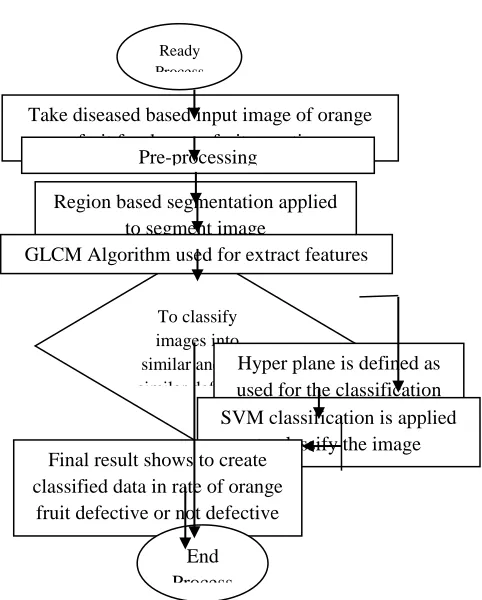
Current FlowchartFollowing steps:
1. Ready Process: To ready the process .
2. Take Input Image Take the diseased input image of orange fruit.
3. Pre-processing: In this process input image will be cleaned using the de-noising method. After this process the image will be further prepared for the local segmentation method.
4. Region based segmentation is applied to segment image:Region based segmentation is used to applied for ROI (Region of Interest) selection. In this process, the Outh's segmentation method is applied for the segmentation. Region based segmentation will be applied which will segment the defective and non defective regions from the RGB examine image.
5. GLCM Algorithm : In texture features Gray Level Co-occurrence Matrix (GLCM) algorithm is used. GLCM algorithm is used because it calculate the texture features of the image.
6. Data classification : To classify images into similar and disimilar defective area.
7. hyper-plane: Hyperplane is defined as,used for the classification.
8. SVM Classification: SVM Classification is applied for to classified the image.
9. Final Results: Final result shows to create classified data in rate of orange fruit defective or not defective.
10. End Process: To get the end results.
3.2.5 Bilateral filter used : It is non- linear filter.To remove impulsive noise from an image and to reduce blurring images.
IV. SIMULATION RESULTS
The current research is implemented in MATLAB and figure out the results by comparing current and previous methods with respect to absolute performance parameters. In this research work, implement the process step by step, following are 5 steps:
Step:1.Take the input or original image of orange fruit into the data set and run in matlab, this research work is relevant to quality assertion of the orange fruit.
:
Figure 2 :Input Image
As shown in figure this is the input defective diseased image of the orange fruit in which we want to detect the orange quality using RGB colour space.
Step 2 : The second step is remove the background because of background area is not detectable.
Figure 3: Remove Background
In these process region based segmentation take no. of segments in input you want to form that is called K-mean
segmentation.
Step3: The third step is gray level image binarization is used. The threshold segmentation is always be applied to gray level image. Threshold segmentation calculate the image pixel intensity values. The threshold segmentation is always used for fixed values.
Ready Process
Take diseased based input image of orange fruit for damage fruit assertion
Pre-processing
Region based segmentation applied to segment image
To classify images into similar and dis-similar defective
Hyper plane is defined as used for the classification SVM classification is applied
to classify the image Final result shows to create
classified data in rate of orange fruit defective or not defective
GLCM Algorithm used for extract features
Figure 4 : Gray level image
In threshold segmentation suppose fixed value is 20 then the value is always below or above from the fixed value. After that ROI selection is used. If the ROI is increased then detect the defective increased part area.
Step 4: Again take the input image of orange fruit to detect the disease portion.
Figure 5: Original Image
Step:5 Final step,In this process to find out how much portion of orange fruit is damaged.
Figure 6 : Disease Image
The defective disease portion is shown in the form of percentage.In which ROI selected and find out defective or non defective orange fruit.
In the above figures support vector machine classifier is used. This research work is about to nature forecast of the orange fruit.
It is used for to segment the image and it take the input as number of segments. This procedure is achieved by using gray level binarization.
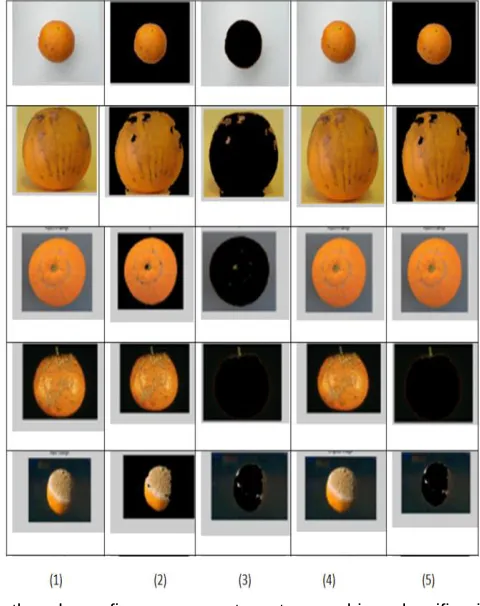
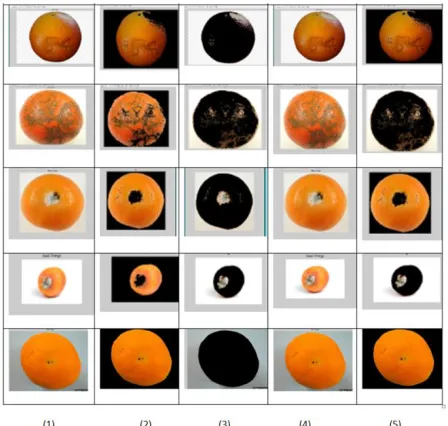
Figure 7: dissimilar stages of the current segmentation process.(1)Input image (2) Remove background.(3) Gray level binary image.(4) Original image.(5) resultant diseases image.
Figure 8: Accuracy Analysis
It is define, as the amount of points perfectly classified separated by total amount of points multiplied by 100, as shown
Accuracy = *100
Because of SVM classification is used in current technique so, the current technique is high as compared to previous technique for the defective area detection.
Figure 9 :Execution Analysis
It is define, as distinction of last time when algorithm end performing and begin time when algorithm begin performing as shown in formula:
Execution time = End time of algorithm- start of the algorithm
The execution time of the current technique is low as compared to previous technique because the complication of the previous classification is relatively high. In the current technique execution time is low which quickly decrease execution time .
Figure 10: Sensitivity Analysis
Sensitivity: In pattern recognition data recover and binary classification, precision (also known as positive predictive value) is the portion of applicable instances along with the recoverd instances.
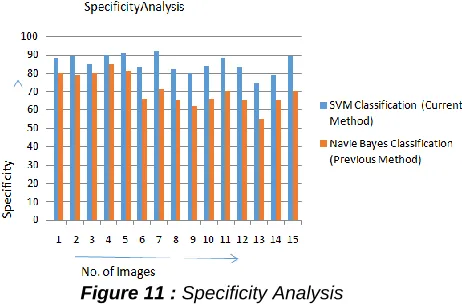
Figure 11 : Specificity Analysis
Specificity: It is the portion of applicable instances that have been retrieved above the sum amount of applicable instances.
Because of SVM classification is used in current technique so, the current technique is high as compared to previous technique for the defective area detection.
V. CONCLUSION
In image acquisition is convert visual images into a set of arithmetical data. This data can be generated on a processor. In image acquisition process generally three steps there are following: first step is region based segmentation is used in image segmentation that is called K- mean segmentation. Second step is Gray level co-occurrence matrix algorithm is used for to calculate the textual features. Third step is that support vector machine classifier is apply for quality assessment of fruits. In this work, the current classifier parameters is compared to previous parameters. Parameters like- accuracy, execution time, sensitivity & specificity . So using SVM classifier, it is analyzed that current classifier is get better to previous classifier 8-10% improved.
REFERENCES
[1] D.Lee, J.Archibald, and G.Xiong, ―Rapid Color Grading for Fruit Quality Evaluation Using Direct Color Mapping‖, IEEE Transactions OnAutomation Science and Engineering, Vol 8, No.2, pp.292-302, April 2011. [2] H. Dang, J. Song and Q. Guo, ―A Fruit Size Detecting and Grading System Based on Image Processing‖ 2010 Second International Conference on Intelligent Human-Machine systems and Cybernetics, pp.83-86.
[2] M. Alfatni , A. Shariff , M. Abdullah , M Hamiruce B. Marhaban , Osama M. Ben Saaed , ―The application of internal grading system technologies for agricultural products Review‖, Journal of Food Engineering 116(2013), pp.703-725. [4] M.Dadwal and V. Banga, ―Color Image Segmentation for Fruit Ripeness Detection: A Review‖, 2nd International Conference on Electrical Electronics and Civil Engineering (ICEECE‘ 2012) Singapore, April 28-29, 2012, pp.190-193. [5] H. Alimohamadi, A Ahmadyfard, ―Detecting Skin Defect of Fruits Using Optimal Gabor Wavelet Filter‖, International
Conference on Digital Image Processing, pp.402-406. [6] Y. Wang, Y. Cui, G. Huang, P. Zhang, S. Chen, ―Study on Fruit Quality Inspection Based on Its Surface Color in Produce Logistics‖,2010 International Conference on Manufacturing Automation,pp.107-111. [7] B. Ojeda- Magana, R. Ruelas, J. Quintanilla-Domingvez and D. Andina, ― Colour Image Segmentation by Partitional Clustering Algorithms‖, pp.2828-2833
[3] ] C. Lin , C. Su, H. Haung and K. fan , ― Colour Image Segmentation Using Relative Values of RGB in Various Illumination Circumstances‖, International Journal of Computers, Issue 2, Vol-5, 2011,pp.252-261. [9] S. Khoje, S. Bodhe, A. Adsul, ― Automated Skin Defect Identification System for Fruit Grading Based on Discrete Curvelet Transform‖, International Journal of Engineering and Technology (IJET). Vol 5, No.4, pp.3251-3256, Aug-Sept 2013.
[4] R. Mahendran, GC Jayashree, K Alagusundaram, ―Application of Computer Vision Technique on Sorting and Gradinng of Fruits and vegetables‖,Abd El-Salam et al..,J Food Process Technol 2011, pp.1-7.
[5] Dameshwari Sahu, Chitesh Dewangan, ―Identification and Classification of Mango Fruits Using Image Processing‖, 2016, International Journal of Scientific Research in Computer Science, Engineering and Information Technology, Volume 2, Issue 2
[6] Manali R. Satpute, Sumati M. Jagdale, ―Automatic Fruit Quality Inspection System‖, 2016, International Conference on Inventive Computation Technologies (ICICT)
[7] Simran Bhagat, ―A Review of Infected Part Detection of Apple Fruit Using Various Segmentation Techniques in MATLAB‖, 2016, International Journal of Computer Science Trends and Technology (IJCST) – Volume 4 Issue 3. [8] Emny Harna Yossy, Jhonny Pranata, Tommy
Wijaya, Heri Hermawan, Widodo Budiharto, ―Mango Fruit Sortation System using Neural Network and Computer Vision‖, 2nd International Conference on Computer Science and Computational Intelligence 116(2017) 596-603. [9] Yuzhen Lu, Renfu Lu, ―Histogram-based automatic
thresholding for bruise detection of apples by structured-illumination reflectance imaging‖, Biosystems Engineering 160(2017) 30-41.
[10] M.A. Momin, M.T. Rahman , M.S. Sultana , C. Igathinathane , A.T.M. Ziauddin , T.E. Grift, ―Geometry-based mass grading of mango fruits using image processing‖, Information Processing in Agriculture 4 (2017) 150-160.
[11] Kaveh Mollazade, Arman Arefi, ―Optical analysis using monochromatic imaging-based spatially-resolved technique capable of detecting mealiness in apple fruit‖, Scientia Horticulturae225(2017) 589-598.
Computing Method‖, Springer International Publishing AG,vol.541,( 2017).
[13] Dian Rong, Yibin Ying, Xiuqin Rao, ―Embedded vision detection of defective orange by fast adaptive lightness correction algorithm‖, Computers and Electronics in Agriculture 138(2017) 48-59.
[14] Prof. S.M.Shirsath, Mr. Sumit S. Telang, ―Fruit Quality Inspection using Image Processing‖, 2017, IJARIIE, Vol-3 Issue-5
[15] Akshaay Deshpande, J. K. Singh, ―Fruit quality inspection using machine vision‖, 2017, International Journal Of Engineering, Education And Technology (ARDIJEET), volume 5, issue 3 [16] Prof. M.K.Nivangune, Jyoti Mahadik, Shreya Patel,
Nidhi Punmiya, Snehal Wani, ―FRUIT QUALITY DETECTION USING IMAGE PROCESSING TECHNIQUE‖, 2017, International Engineering Research Journal (IERJ), Volume 2 Issue 9 Page 3367-3369
[17] Lorenzo A. Saraiva, Florence P. Castelan, Bruna L. Gomes, Eduardo Purgatto, Beatriz R. Cordenunsi-Lysenko, ―Thap Maeo bananas: Fast ripening and full ethylene perception at low doses‖, Food Research International 105 (2018) 384-392. [18] Jason Sun, Rainer Künnemeyer, Andrew McGlone,
Nathan Tomer, ―Investigations of optical geometry and sample positioning in NIRS transmittance for detecting vascular browning in apples‖, Computers and Electronics in Agriculture 155(2018) 32-40. [19] Sashuang Sun, Qian Wu, Lin Jiao, Yan Long,
Dongjian He, Huaibo Song, ―Recognition of green apples based on fuzzy set theory and manifold ranking algorithm‖, Optik 165 (2018) 395-407. [20] Sajad Sabzi, Yousef Abbaspour-Gilandeh, Gine´s
Garcı´a-Mateos, ―A new approach for visual identification of orange varieties using neural networks and metaheuristic algorithms‖, 2018, Information Processing in Agriculture 5 (2018) 162-172.