Licensed under Creative Common Page 94 http://ijecm.co.uk/
WORLD EXPERIENCE IN THE DEVELOPMENT OF
PENSION SYSTEMS: GLOBAL TRENDS AND
DIFFERENCES ACROSS COUNTRIES
Zayniddinov Fakhriddin Sharofiddinovich
Scientific Researcher of Department of Finance
Tashkent Institute of finance, Republic of Uzbekistan
Abstract
The pension system and the mechanism for managing its finances require changes that are
adequate to the current economic, social and demographic conditions, taking into account the
advanced world experience gained by financial science. This necessitates a deep scientific
analysis of the problems associated with the implementation of the pension reform, its
consequences, the functioning of the pension system and, most importantly, the activities of the
state pension fund. The article describes the development of pension systems in the world: the
models of pension financing, the structure of pension systems in the world are analyzed. The
purpose of the study is to study the economic foundations of the formation of pension systems
in foreign countries, identifying the main trends in pension reforms in developed and developing
countries in the face of demographic changes.
Keywords: Tax burden, pension assets, economic growth, stagnation, GDP, capital market,
credit system
INTRODUCTION
The transition to a market economy demanded radical reforms, both in the field of economics
and in the sphere of social policy. The new system of social protection of the population
includes state social guarantees, social insurance and social assistance. With the transition to
Licensed under Creative Common Page 95 formation of new social legislation, the development of the main directions of social policy during
the transition period, the implementation of targeted social programs and the creation of new
social protection for the population.
Questions of pensions are the most important issues in the field of socio-economic
policy of any state. The reconciliation of the various interests of disabled members of society
with the rest of it, which directly creates wealth, expresses retirement benefits.
Pension systems emerged about a hundred years ago, and in the process of their
development and improvement, they went through more than one stage of reform and
development. To date, the problems of pensions, even in developed countries, have again
become seriously aggravated. The increasing exacerbation of these problems may be due to
the socio-demographic factors of a particular state, which have not always been taken into
account when pursuing pension reform policies in the past. In the future, these factors should be
taken in the implementation of the reform of pension systems.
Social security systems and pension funds
Almost all countries in the world have established various social security systems to meet the
need of the aging population. The accumulated size of pension funds varies under different
systems and policies. There are primarily five types of pension systems in terms of whether the
funds are accumulated and how they are accumulated (Zheng, 2005).
Table 1. Different social security models
Anglo American model
Continental
model Nordic model Chilean model
Singaporean model
USA, UK, Canada, Ireland
France, German, Spain
Austria, Iceland, Switzerland
Chile, Peru,
Argentina Singapore
The Anglo-American model: in countries such as the US and the UK, the national pension
scheme takes low fees and therefore provides a low substitution rate. The majority of pension
funds come from corporate voluntary annuities.
The Continental model: in European countries as represented by Germany and France,
the national public pension funds are pay-as-you-go. There is little surplus, and the retirement
pension is frequently substituted. The corporate annuity contribution is relatively small; thus, the
size of the accumulated funds is limited.
The Nordic European model: in the northern countries, aside from the corporate annuity,
Licensed under Creative Common Page 96 which accumulate large pension funds. This system can be considered a mandatory pension
model.
The Chilean model: in Latin America, the Middle East and Eastern Europe, the social
security system requires people to have a personal account and to accumulate on a compulsory
basis. The funds are completely tradable in the markets. In these countries, pension funds come
from self accumulated personal accounts. The Singaporean model: the government has both a
national and a personal pension system. The central government controls the interest and
announces it regularly, but the interest cannot reflect the real return. The Singaporean pension
system is fully funded.
Reforming the pension system
In most developed countries of the world, the demographic situation is characterized by a
slowdown in the growth rate of the total number of the working age population or its decline
(Ignatov, 2001). In connection with the current demographic problems, it is necessary to identify
the main ways to solve the problems posed during the study.
In this case, there is a noticeable tendency for an increase in the number of people aged
over 60 or more than 80 years, which undoubtedly causes an increase in the number of
disabled members of society and people with disabilities, that is, an increase in the total number
of pensioners.
The increase in the number of pensioners should be accompanied by the necessary
number of pension payments. The development of the economy and the rise in the standard of
living of the population in most developed and developing countries are the reason for the
formation of new demographic factors that influence the development of the state pension
system and form a new pension structure that meets modern principles.
Among them, first of all, such factors as: an increase in the life expectancy of the
population while reducing the birth rate, which undoubtedly is the cause of the imbalance of
contributions and payments, as there is a process of shortage of pension contributions for
further payments to the incapable population; a sufficiently early retirement, resulting in a
decrease in the labor period and the term for the payment of contributions, which also
determines the presence of an insufficient number of pension payments; increase the
dependency ratio and the load on the working population. Increasing the value of this ratio is a
negative factor affecting the level of state pension.
The main factors determining the specificity of the choice of the pension system and the
Licensed under Creative Common Page 97 value and GDP per capita, the size of state budget revenues, inflation and wages, the level and
state of life of citizens the state of the capital market (securities market) and credit system.
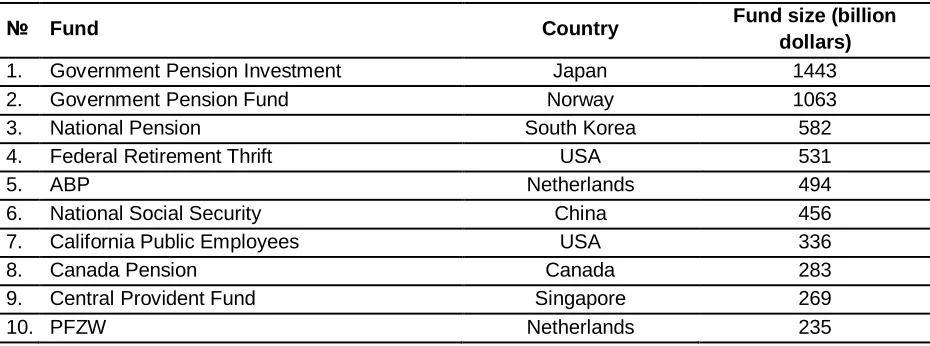
Table 2. The world's largest state-owned pension funds in 2017 (Pensions & Investments, 2017)
№ Fund Country Fund size (billion
dollars)
1. Government Pension Investment Japan 1443
2. Government Pension Fund Norway 1063
3. National Pension South Korea 582
4. Federal Retirement Thrift USA 531
5. ABP Netherlands 494
6. National Social Security China 456
7. California Public Employees USA 336
8. Canada Pension Canada 283
9. Central Provident Fund Singapore 269
10. PFZW Netherlands 235
Based on these social and economic factors, the availability of a certain economic source of
reform and the level of government opportunities, the size of expenditures on the payment of
state pensions and GDP, and the level of the wage replacement rate by pension are
determined. These indicators are of great importance for assessing the level of sustainability of
the pension system and its compliance with the requirements of the modern development of
society.
More than 60% of working Americans are ready to postpone retirement in order to
replenish personal savings that have become thinner from financial turmoil. Experts believe that
with the restoration of stock markets, people will forget about their plans.
Canadian insurer Sun Life Financial interviewed American citizens and found out that
65% of respondents decided to quit at least a year later than planned. This figure has grown by
11% since the first survey was conducted in January of this year.
The same trend is noted in its study by financial company Prudential Financial.
According to its analysts, 66% of respondents aged 45 and over said they would have to
postpone their retirement, although they had not thought to stay at work before.
Investment company Vanguard Group conducted a similar survey among private
investors and found out that 45% of respondents consider retirement delay quite possible, and
among 50-year-olds this figure was even higher - 54%.
Official statistics confirms the general trend. In the six months since the beginning of this
year, 4.6% of all participants in the American pension program 401 (k) have stopped donating
Licensed under Creative Common Page 98 participants in this program took their money in 2008 due to financial problems, but in the first
half of this year, their number dropped to 1.8%.
At the end of XX century pension reforms were spread in almost all countries of the
world. The purpose of such reforms was to build and reform in each individual state a renewed
pension system that would take into account the changed economic, political and
socio-demographic situation and would correspond to the main established global requirements and
trends. Pension system reform can take place in three main areas:
1. transition to the modernization of the distributive pension system without the introduction of
savings schemes and principles;
2. the transition to the cumulative schemes and a sharp restriction in this distribution sector;
3. adoption of the option combining distribution and accumulative principles.
The third option was chosen in most of both developed and developing countries. By the
end of XX century. only five states: Mexico, Chile, El Salvador, Kazakhstan and Bolivia
completely abandoned the distribution system and made the transition to cumulative principles.
According to the official documents of the European Union, specific goals have been set for the
transition to the accumulative system, which cover the time period from 1998 to 2020.
The study of the world experience of pension reform showed that the accumulative
system in modern conditions is more preferable, since:
1. there is an increase in aggregate national savings, which is the reason for the increase in
investment and economic growth;
2. does not depend on demographic problems that threaten the formation and development of
the distribution system;
3. provides a sufficient level of differentiation of the size of the pension depending on the
amount of earnings and the effectiveness of the use of pension savings.
In the modern sense of the pension fund is an organization that is engaged in diverse
activities. This activity is a process of accumulating money and using it to pay benefits and
pensions to each participant.
The first state pension fund was established in Germany in 1889. At the end of the 20th
century, pension funds were established in Denmark in 1891, in France in 1895, in Italy in 1898.
In the United States in 1935, the Federal Pension Fund Social Security was established.
Accumulated international experience shows that the most progressive way of
accumulating pension payments is private pension funds. This provision is confirmed by the fact
that some countries have already fully switched to the system of private pension funds. Others
Licensed under Creative Common Page 99 an increase in the number of people who have entrusted their pension savings to non-state
funds.
Pension systems are in constant flux, and their reforms are driven by shifting objectives,
moving reform needs, and changing enabling environments. Over recent decades, this has led
to a number of redirections and innovations throughout the world, including: the introduction or
22 strengthening of basic protection for the vulnerable elderly; the move towards funded and
unfunded mandated DC schemes; and increased nudging by governments to encourage benefit coverage and ―top-ups‖ under voluntary and funded provisions (Robert, 2017).
ANALYSIS AND RESULTS
In almost all developed countries, pension funds, along with various insurance and
investment companies, are the main institutional investors in securities markets. Funds
necessary for pension investments should have such properties as reliability, profitability
and liquidity.
So in the UK the size of shares in portfolios of pension funds is about 77%, in the
USA - about 63%, while in France and Switzerland, shares account for only 15% of
investments, while the bulk of funds relate to government securities and bonds - 37% and
68% respectively.
According to the statistical office of the European Union, by 2050, the total number of
people who have reached working age from 15 to 64 years old will decrease by 52 million, or
17%, in the region. At the same time, over the same 45 years, the number of elderly people 65
years and older will double, making up about a third of the total population of the European
Union.
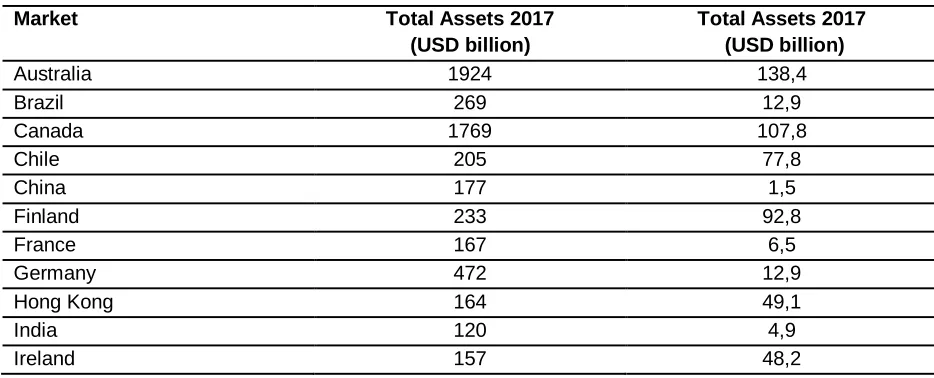
Table 3. The ratio of assets to GDP of 2017 countries (Global Pension Assets Study, 2018)
Market Total Assets 2017
(USD billion)
Total Assets 2017 (USD billion)
Australia 1924 138,4
Brazil 269 12,9
Canada 1769 107,8
Chile 205 77,8
China 177 1,5
Finland 233 92,8
France 167 6,5
Germany 472 12,9
Hong Kong 164 49,1
India 120 4,9
Licensed under Creative Common Page 100
Italy 184 9,6
Japan 3054 62,5
Malaysia 227 73,4
Mexico 177 15,5
Netherlands 1598 193,8
South Africa 258 75,1
South Korea 725 47,4
Spain 44 3,3
Switzerland 906 133,1
UK 3111 121,3
US 25411 131,2
Total 41355 67,0
The 22 largest pension systems in the world, whose total assets are more than $ 41355 billion
and make up 67% of the GDP of their economies. The pension systems of such countries are
analyzed: Australia, Canada, Brazil, France, Germany, Hong Kong, Ireland, Japan, the
Netherlands, South Africa, Switzerland, Great Britain, Mexico, Chile, India, Malaysia, Spain,
South Korea, and the USA.
A more detailed study is devoted to seven of the above listed countries (let's call it the ―Big Seven‖), excluding seven smaller markets (Australia, Canada, Japan, the Netherlands,
Switzerland, the United Kingdom, the USA).
The analysis includes: the volume of assets, the dynamics of their growth, the ratio of
the volume of assets to GDP and liabilities.
Asset allocation (by investment instruments).
The distribution of assets by type of pension plans: with defined payments (DB) and
established contributions (DC).
The share of private and public sector in pension assets.
In 2017, global pension assets reached 41355 billion dollars, thereby an increase of 13.1%
compared with the previous year (assets increased 13.1% in 2017 from USD 36,571 bn the
previous year) (Global Pension Assets Study, 2018).
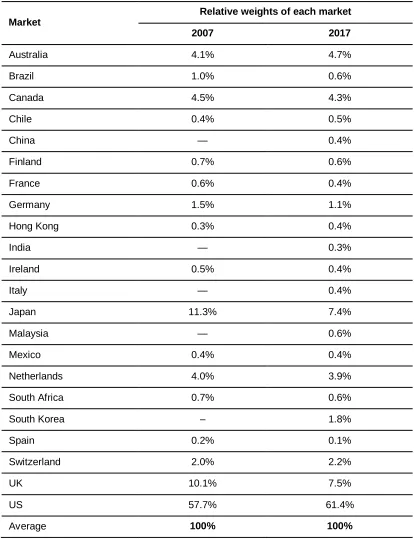
The US remains the largest market in terms of pension assets. The share of 61.4% of
P22 assets, followed by the UK and Japan with 7.5% and 7.4% respectively.
In 2017, global pension assets are estimated at USD 41.355 billion, an increase of over
13% in a year. The US is the largest pensions market followed by a significant distance, by the
UK and Japan. Together they account for over 76% of all pensions assets.
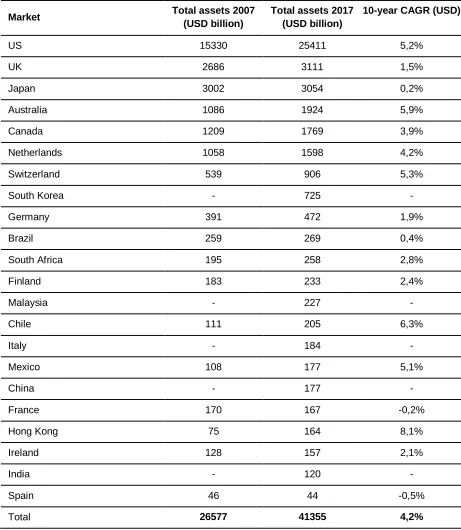
Licensed under Creative Common Page 101 Table 4. Development of pension systems 2007-2017
in billions of dollars (Global Pension Assets Study, 2018)
Market Total assets 2007
(USD billion)
Total assets 2017 (USD billion)
10-year CAGR (USD)
US 15330 25411 5,2%
UK 2686 3111 1,5%
Japan 3002 3054 0,2%
Australia 1086 1924 5,9%
Canada 1209 1769 3,9%
Netherlands 1058 1598 4,2%
Switzerland 539 906 5,3%
South Korea - 725 -
Germany 391 472 1,9%
Brazil 259 269 0,4%
South Africa 195 258 2,8%
Finland 183 233 2,4%
Malaysia - 227 -
Chile 111 205 6,3%
Italy - 184 -
Mexico 108 177 5,1%
China - 177 -
France 170 167 -0,2%
Hong Kong 75 164 8,1%
Ireland 128 157 2,1%
India - 120 -
Spain 46 44 -0,5%
Total 26577 41355 4,2%
The markets with the smallest pension assets remain (in descending order): Ireland, India, and
Spain.
Hong Kong (8.1%), Chile (6.3%) and Australia (5.9%) in USD terms. France and Spain
Licensed under Creative Common Page 102 Table 5. Relative weights of each market (Global Pension Assets Study, 2018)
Market
Relative weights of each market
2007 2017
Australia 4.1% 4.7%
Brazil 1.0% 0.6%
Canada 4.5% 4.3%
Chile 0.4% 0.5%
China — 0.4%
Finland 0.7% 0.6%
France 0.6% 0.4%
Germany 1.5% 1.1%
Hong Kong 0.3% 0.4%
India — 0.3%
Ireland 0.5% 0.4%
Italy — 0.4%
Japan 11.3% 7.4%
Malaysia — 0.6%
Mexico 0.4% 0.4%
Netherlands 4.0% 3.9%
South Africa 0.7% 0.6%
South Korea – 1.8%
Spain 0.2% 0.1%
Switzerland 2.0% 2.2%
UK 10.1% 7.5%
US 57.7% 61.4%
Average 100% 100%
Over the past decade, the share of pension assets of Brazil, Canada, France, Germany, Japan
and the UK has declined relative to other markets covered in this study.
Since 1997, bonds, equities and cash allocations have reduced to varying degrees while
Licensed under Creative Common Page 103 Pension fund assets managed by the top 100 alternative asset managers rose to USD 1,612 billion in 2017 according to Willis Towers Watson’s Global Alternatives Survey.
Figure 1. Aggregate P7 asset allocation from 1997 to 2017
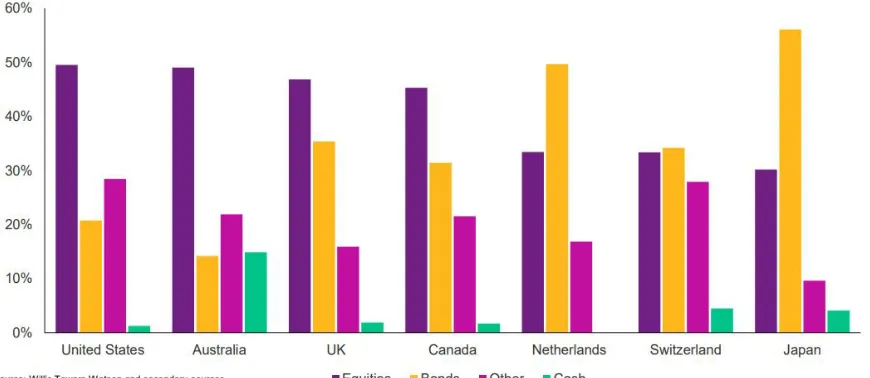
In 2017, Australia, Canada, the UK and the US continued to have above average equity
allocations.
The Netherlands and Japan have above average exposure to bonds, while Switzerland
has the most even allocations across equities, bonds and other assets.
Licensed under Creative Common Page 104 All developed countries can be divided into two main categories: countries with a predominant
level of private pension coverage (Australia, Finland, Denmark) and with a predominant level of
government pension coverage (countries such as Belgium, Germany, Italy, and the USA).
Private pensions in the first group of countries are obligatory either by law or according to the
concluded tariff agreements, which determines a certain level of deep integration into the overall
pension system. In the second group of countries, participation in the pension system is
voluntary, therefore only a small part of the working population receives a private pension for
hire.
In contrast to the developed countries, in which the present-day pension system is
adequate, the developing countries create something new in the course of the reforms, which is
characteristic of the current development of each individual country. It should be noted that the
increase in economic development indicators and GDP indicators allowed certain countries
(Latin America, Central and Eastern Europe) to begin large-scale pension reforms or even
completely switch to a funded pension system (Kazakhstan, Chile). The results of pension
reforms carried out in these countries, we can learn in the future.
The main problem is that states may not be able to pay pensions to their senior citizens
and provide them with sufficient medical and social assistance. Economic growth in many
countries is not fast enough - the economy of Japan and Western Europe is in a state of
stagnation. There is a noticeable decline in the number of the working population, and,
accordingly, the number of consumers. In the near future, this process may gain momentum.
These factors further led to an increase in the overall level of the pension burden on
state budget bodies and raised to the top management the question of reducing the share of the
distributive pension system and increasing the share of the accumulative, for which certain
favorable conditions must be created. The experience of different countries shows that
reforming the pension system often leads to social discontent, as it can be associated either
with an increase in the retirement age, or with the rejection of preferential pensions, or with an
increase in contributions to pension funds. All this adversely affects the overall level of pension
coverage (Roik, 2000).
Based on the foregoing, it can be concluded that there is a need for a comprehensive
study in the field of building pension systems with the definition of the main factors affecting
the level of pension insurance with justification of the most important criteria for choosing a
strategy for pension reform in countries with different levels of economic development
Licensed under Creative Common Page 105 CONCLUSION
The study made it possible to formulate the following main conclusions and recommendations:
1. The main tasks facing the pension system in modern demographic conditions are the
following: Providing people with a guaranteed income after retirement, so that withdrawal from
participation in the labor process does not mean an automatic decrease in living standards.
Protection of people of retirement age from increasing risks associated with various social and
economic, as well as moral and physical factors.
2. Based on the cross-country comparison and the development of classifications, the study
concluded that pension funds occupy a priority position in the structure of the pension system,
which are, in fact, a tool for the implementation of pension benefits. Today, a large number of
different types of pension funds exist and successfully operate in the world, while, based on
international experience, it becomes obvious that private pension funds are a more progressive
way of accumulating pension savings.
3. The reform of the pension system, as shown by the study, can take place in three main
areas: a) modernization of the existing distribution pension system without introducing savings
schemes; b) the transition to the cumulative schemes and the sharp limitation of the distribution
component (or even a complete rejection of it); c) the adoption of one or another mixed option,
meaning a combination of distribution and savings principles.
4. The analysis of the concepts of pension reforms and the discussions around them conducted
in the study made it possible to draw a number of conclusions:
- at the present stage, the reforms of the overwhelming majority of states are not based on the
replacement of the existing system, but on its modernization and the introduction of a parallel
multi-level scheme combining the state distributive pension system, the accumulative scheme
and voluntary pension insurance;
- the transition to the new system in all countries is happening gradually;
- individual elements of the transition, as well as the sources of its financing in each country
have specific features;
- the development of concepts of reforms, especially in developing countries, took place under
conditions of acute political struggle and often the plans of developers underwent significant
changes;
- in many countries there is a lack of development and incompleteness of individual moments of
reform;
- in most countries, pension reforms begin under the condition of certain conditions: economic
Licensed under Creative Common Page 106 The differences between countries in the concepts of pension reforms are due to different ways
and speed of maintenance of savings elements, as well as the nature of the combination of
distribution and savings pension systems.
Based on the analysis of the experience of pension reform in developed and developing
countries, the study recommended some areas for further reforming the pension system in
Uzbekistan: encouraging employers by applying tax rebates and investment incentives,
increasing pension contributions, increasing the number of possible placement of funds by
pension funds, subsidization of savings accounts by the state, etc.
The main task for the future is to ensure the efficiency and sustainability of the pension
system. This leads to the following policy options:
• It is necessary to gradually bring the pension system in line with the requirements of the
market, identify additional sources to cover the costs of pension payments, including at the
expense of non-state forms of pension insurance.
• Measures to stimulate employment in the labor market (employment programs, retraining
programs, etc.).
• Tax reform (reduction of tax burden, etc)
To improve the efficiency of the pension system, it is necessary to pay attention to the
proper maintenance of statistical reporting, making decisions on the appointment of pensions in
the prescribed manner, the calculation and length of service, observance of the terms for
granting pensions, and not requesting additional documents. Pension system reform can take
place in three main areas:
- the transition to the modernization of the distribution pension system without the introduction of
savings schemes and principles;
- implementation of the transition to the cumulative schemes and the sharp limitation of the
distribution sector;
- adoption of the option combining distribution and accumulative principles.
The main advantage of the pension system of Uzbekistan is the stability of its income
with a steady and moderate economic development, reliable protection from negative financial
disasters, as well as timely payment of pensions guaranteed by the state.
Thus, the main focus of the system of social protection of the population in our country is
to consistently ensure the well-being of citizens by constantly increasing the size of pensions
Licensed under Creative Common Page 107 REFERENCES
Ignatov A.V. Pension reform: there are alternative opportunities. // Social world. - 2001. - № 12. - p. 54.
Robert Holzmann. Global Pension Systems and Their Reform: Worldwide Drivers, Trends, and Challenges. Discussion Paper No. 6800 August 2012. P. 21.
Barr, Nicholas and Peter Diamond. 2008. Reforming Pensions: Principles and Policy Choices. Oxford University Press.et al.: Oxford. P. 7.
Roik V. Reforming pension systems: foreign experience. // Man and work. - 2000. - № 2. - p. 11.
Nikiforova A.A. Pension systems with a developed market economy. // Labor abroad. - 2001. - № 3. - p. 109.
Pensions & Investments / Thinking Ahead Institute world 300. P. 34. (https://www.willistowerswatson.com/en/insights/2018/09/the-worlds-300-largest-pension-funds-year-ended-2017). Global Pension Assets Study 2018. P. 9. (https://www.towerswatson.com).
Shouji Sun, Jiye Hu.The impact of pension systems on financial development: an empirical study. Risk governance & control: financial markets & institutions / Volume 4, Issue 3, 2014. P. 120-131.