O R I G I N A L R E S E A R C H
Doublet vs Single-Agent Maintenance Therapy in
the Treatment of Non-Small-Cell Lung Cancer: A
Meta-Analysis
This article was published in the following Dove Press journal: Drug Design, Development and Therapy
Jing Qi1
Xiuzhi Guo1
Aihua Li2
1Department of Respiration Medicine,
Tai’an Central Hospital, Tai’an,
2Department of Respiration Medicine,
Yankuang Group General Hospital, Jining, China
Background: Several published meta-analyses have confirmed that single-agent mainte-nance therapy in advanced non-small-cell lung cancer (NSCLC) can prolong time to disease progression and potentially increase overall survival (OS) in comparison to placebo. However, whether doublet maintenance therapy can improve the survival of advanced NSCLC remains undetermined.
Methods: We searched several databases for relevant trials. Prospective randomized con-trolled trials comparing doublet vs single-agent maintenance therapy in NSCLC patients were included for analysis. Outcomes of interest were OS, progression-free survival (PFS), and incidence of grade 3/4 toxicities.
Results: A total of 1,950 advanced-NSCLC patients from six trials were included for analysis. Our results showed that doublet maintenance therapy in NSCLC patients signifi -cantly improved PFS (HR 0.74, 95% CI 0.59–0.93;P=0.010), but not for OS (HR 0.95, 95% CI 0.85–1.07; P=0.40) in comparison with single-agent maintenance therapy. Subgroup analysis by maintenance regimen showed that pemetrexed plus bevacizumab maintenance therapy significantly improved PFS, but not OS. In addition, there was no significant risk difference between doublet and single-agent maintenance therapy in terms of grade 3/4 hematologic and nonhematologic toxicities.
Conclusion: Our study suggests that doublet maintenance therapy in advanced-NSCLC patients demonstrates PFS benefits, but not OS benefits, in comparison with single-agent maintenance therapy. Future trials are suggested to assess the long-term clinical benefit of doublet maintenance treatment in NSCLC patients and its impact on health-related quality of life.
Keywords:targeted agents, maintenance therapy, doublet, single agent, meta-analysis
Introduction
Lung cancer remains one of the most common malignancies in the world and is the leading cause of cancer-related deaths worldwide, accounting for 1.59 million deaths yearly.1 Non-small-cell lung cancer (NSCLC) accounts for 80%–85% of lung cancer cases, which can be divided further into several subgroups, eg, adeno-carcinoma, squamous-cell adeno-carcinoma, and large-cell carcinoma. Generally, NSCLC is often diagnosed at advanced stages, when treatment options are limited. Until now, platinum-based doublet chemotherapy remains the standard of care for advanced NSCLC, with good performance status, especially in those with tumors that are negative for sensitizingEGFRmutations, ROS1, and ALK.2However, most Correspondence: Aihua Li
Department of Respiration Medicine, Yankuang Group General Hospital, 560 Kuangjian East Road, Jining, Shandong 273500, China
Tel +86 537 536 7018 Fax +86 537 536 7017 Email [email protected]
Drug Design, Development and Therapy
Dove
press
open access to scientific and medical researchOpen Access Full Text Article
Drug Design, Development and Therapy downloaded from https://www.dovepress.com/ by 118.70.13.36 on 24-Aug-2020
patients will experience disease progression during or after first-line chemotherapy, demonstrating the need for new effective agents or treatment strategy.3
Maintenance therapy may prolong time to disease pro-gression and potentially increase overall survival (OS). As a result, maintenance therapy with different drugs is one strategy that has been evaluated extensively in recent years.4–6 Indeed, several published meta-analyses have confirmed that single-agent maintenance therapy in advanced NSCLC can prolong time to disease progression and potentially increase OS in comparison to placebo.7–9 To date, maintenance therapy with pemetrexed or erlotinib has demonstrated improved OS, resulting in US Food and Drug Administration approval for this indication.6 Recently, doublet maintenance therapy has been investi-gated in multiple prospective clinical trials, but the results are controversial. As a result, we conducted the present meta-analysis of all available randomized controlled trials to determine the overall efficacy and toxicity of doublet maintenance therapy in advanced NSCLC patients.
Methods
Data Sources
Several databases, including PubMed, Web of Science, and the Cochrane Library, were searched for relevant trials. The search keywords were maintenance therapy, erlotinib, gefitinib, pemetrexed, gemcitabine, targeted agents, non-small-cell lung cancer, and clinical trials. Additionally, relevant articles in the reference lists of recent meta-analyses that investigated maintenance ther-apy in NSCLC patients were also searched. In order to avoid duplication, only the most complete and recent trials were considered for analysis. All results were entered into Endnote X8 reference software (Clarivate Analytics, Philadelphia, PA, USA) for duplication exclusion and further reference management.
Study Selection
Clinical trials that met the criteria of prospective rando-mized controlled phase II or III trials involving NSCLC patients, randomized clinical trials comparing doublet vs single-agent maintenance therapy, and available survival and toxicity data on maintenance therapy in NSCLC patients were included. If multiple publications of the same trial were retrieved or there was a case mix between publications, only the most recent publication (and the most informative) was included.
Data Extraction
Two independent investigators conducted data abstraction, and any discrepancy between the reviewers was resolved by consensus. Information extracted for each study was first author’s name, year of publication, trial phase, num-ber of enrolled subjects, treatment arms, maintenance arms, median age, median progression-free survival (PFS), and median OS.
Outcome Measures
A formal meta-analysis was conducted using Comprehensive Meta Analysis software version 2.0. Outcome data were pooled and reported as HRs. The primary outcome of interest was OS and secondary out-comes PFS or severe toxicity in NSCLC patients receiving maintenance therapy. Toxicities were defined by the National Cancer Institute’s Common Terminology Criteria for Adverse Events during a clinical trial as a result of exposure to an experimental drug, which has been used widely in clinical cancer trials.10Between-study heterogeneity was estimated using the χ2-based Q statistic.11 Heterogeneity was considered statistically significant when Pheterogeneity<0.1. The presence of publi-cation bias was evaluated using Begg and Egger tests.12,13 P<0.05 was considered significant. Study quality was assessed using the Jadad scale based on the reporting of the studies’methods and results.14
Results
Search Results
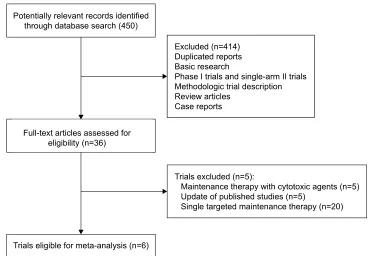
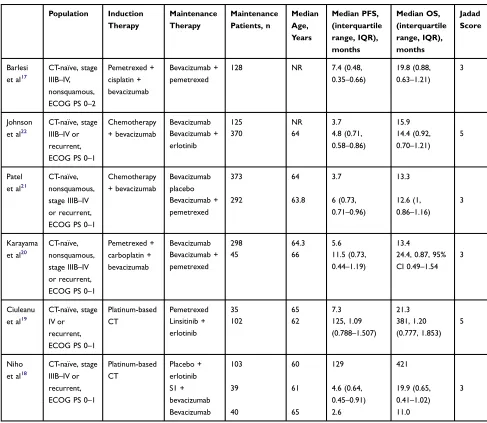
We performed the systematic review and meta-analysis in accordance with the PRISMA (preferred reporting items for systematic reviews and meta-analyses) statement.15 Our initial search yielded 450 potentially relevant reports. After exclusion of review articles, Phase I studies, case reports, meta-analyses, and observation studies, seven pro-spective randomized controlled clinical trials were included. After review of included trials, two were undated analyses of previously published trials16,17 and only the most recent publication (and the most informative) was included.17 Finally, a total of 1,950 advanced NSCLC patients from six trials were included for analysis (Figure 1).17–22 Table 1 lists the baseline characteristics of patients and studies. The quality of each study was roughly assessed according to the Jadad scale, and two of the six randomized controlled trials were double-blind placebo-controlled, and thus had a Jadad score of 5. The
Drug Design, Development and Therapy downloaded from https://www.dovepress.com/ by 118.70.13.36 on 24-Aug-2020
other three trials were open-label controlled, and thus had a Jadad score of 3.
Progression-Free Survival
All six trials reported PFS data for doublet vs single-agent maintenance therapy in NSCLC patients. The pooled HR for PFS demonstrated that doublet maintenance therapy in NSCLC patients significantly improved PFS (HR 0.74, 95% CI 0.59–0.93; P=0.010; Figure 2) in comparison with single-agent maintenance therapy. There was signifi -cant heterogeneity among trials (I2=67.6%,P=0.009), and the pooled HR for PFS was calculated using a random-effect model. Subgroup analysis according to maintenance regimen showed that pemetrexed plus bevacizumab main-tenance therapy (HR 0.67, 95% CI 0.46–0.98; P=0.0037) in NSCLC patients significantly improved PFS in compar-ison with single-agent maintenance therapy, but not for other doublet maintenance therapy (HR 0.79, 95% CI 0.59–1.05; P=0.104).
Overall Survival
Six trials reported OS data of doublet vs single-agent maintenance therapy in NSCLC patients. The pooled HR for OS indicated that doublet maintenance therapy in NSCLC patients did not significantly improve OS (HR 0.95, 95% CI 0.85–1.07;P=0.41;Figure 3) in comparison
with single-agent maintenance therapy. There was no sig-nificant heterogeneity between trials (I2=0, P=0.47), and the pooled HR for OS was calculated using afixed-effect model. We then performed subgroup analysis according to maintenance regimen, and found that both pemetrexed plus bevacizumab (HR 0.97, 95% CI 0.85–1.11; P=0.67) and other doublet maintenance-therapy agents (HR 0.91, 95% CI 0.74–1.12; P=0.37) did not significantly improve OS in comparison with single-agent maintenance therapy.
Toxicity
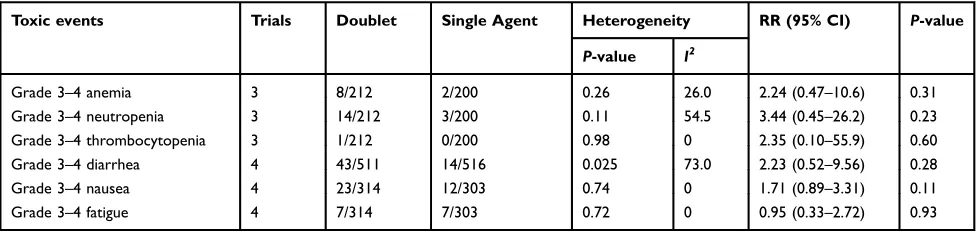
Pooled analysis of reported grade 3 and 4 adverse events of interest was also performed. There was no significant risk difference between doublet and single-agent mainte-nance therapy in terms of grade 3/4 hematologic (anemia, neutropenia, and thrombocytopenia) and nonhematologic toxicity (diarrhea, nausea, and fatigue;Table 2).
Publication Bias
Begg’s funnel plot and Egger’s test were performed to assess publication bias in the literature. The shapes of the funnel plots did not reveal any obvious asymmetry (P=0.85 for PFS and P=0.45 for OS). Egger’s test was used to provide statistical evidence of funnel-plot symme-try. The results suggested no evidence of publication bias for PFS or OS (P=0.60,P=0.38, respectively).
Figure 1Studies eligible for inclusion in the meta-analysis.
Drug Design, Development and Therapy downloaded from https://www.dovepress.com/ by 118.70.13.36 on 24-Aug-2020
Discussion
First-line platinum-based chemotherapy of four or six cycles has reached a plateau of effectiveness for the treatment of advanced NSCLC. Unfortunately, the prog-nosis of these patients is poor, with 5-year survival, 5%.23 Maintenance therapy has emerged as a novel treatment strategy for advanced NSCLC patients. Indeed, multiple clinical trials have demonstrated that single-agent erlotinib or pemetrexed maintenance ther-apy in advanced NSCLC provides superior PFS and OS in comparison with placebo, which led to the approval of erlotinib and pemetrexed as maintenance therapy in these patients.24–30 However, to the best of our knowl-edge, whether doublet therapy would improve efficacy
in comparison with single-agent maintenance therapy remains undetermined.
In the preset meta-analysis, 1,950 advanced NSCLC patients from six trials were included. Our results showed that doublet maintenance therapy in NSCLC patients sig-nificantly improved PFS (HR 0.73, 95% CI 0.60–0.89; P=0.002), but not OS (HR 0.95, 95% CI 0.85–1.07; P=0.40) in comparison with single-agent maintenance therapy. We then performed subgroup analysis according to maintenance regimen, and found that pemetrexed plus bevacizumab maintenance therapy significantly improved PFS, but not OS. In addition, the toxicity of doublet maintenance therapy was minimal and well tolerated. There was no significant risk difference between doublet Table 1Baseline Characteristics of Trials Included
Population Induction Therapy Maintenance Therapy Maintenance Patients, n Median Age, Years Median PFS, (interquartile range, IQR), months Median OS, (interquartile range, IQR), months Jadad Score Barlesi et al17
CT-naïve, stage IIIB–IV, nonsquamous,
ECOG PS 0–2
Pemetrexed + cisplatin + bevacizumab
Bevacizumab + pemetrexed
128 NR 7.4 (0.48,
0.35–0.66)
19.8 (0.88,
0.63–1.21)
3
Johnson et al22
CT-naïve, stage IIIB–IV or recurrent,
ECOG PS 0–1
Chemotherapy + bevacizumab
Bevacizumab 125 NR 3.7 15.9
Bevacizumab + erlotinib
370 64 4.8 (0.71,
0.58–0.86)
14.4 (0.92,
0.70–1.21)
5
Patel et al21
CT-naïve, nonsquamous, stage IIIB–IV or recurrent,
ECOG PS 0–1
Chemotherapy + bevacizumab
Bevacizumab placebo
373 64 3.7 13.3
Bevacizumab + pemetrexed
292 63.8 6 (0.73,
0.71–0.96)
12.6 (1,
0.86–1.16)
3
Karayama et al20
CT-naïve, nonsquamous, stage IIIB–IV or recurrent,
ECOG PS 0–1
Pemetrexed + carboplatin + bevacizumab
Bevacizumab 298 64.3 5.6 13.4
Bevacizumab + pemetrexed
45 66 11.5 (0.73,
0.44–1.19)
24.4, 0.87, 95%
CI 0.49–1.54
3
Ciuleanu et al19
CT-naïve, stage IV or recurrent,
ECOG PS 0–1
Platinum-based CT
Pemetrexed 35 65 7.3 21.3
Linsitinib + erlotinib
102 62 125, 1.09
(0.788–1.507)
381, 1.20 (0.777, 1.853)
5
Niho et al18
CT-naïve, stage IIIB–IV or recurrent,
ECOG PS 0–1
Platinum-based CT
Placebo + erlotinib
103 60 129 421
S1 + bevacizumab
39 61 4.6 (0.64,
0.45–0.91)
19.9 (0.65,
0.41–1.02)
3
Bevacizumab 40 65 2.6 11.0
Abbreviations:PFS, progression-free survival; OS, overall survival; CT, chemotherapy; ECOG, Eastern Cooperative Oncology Group; PS, performance status; NR, not reported.
Drug Design, Development and Therapy downloaded from https://www.dovepress.com/ by 118.70.13.36 on 24-Aug-2020
and single-agent maintenance therapy in terms of grade 3/4 hematologic and nonhematologic toxicity.
Given only modest improvement in PFS or OS obtained from maintenance therapy, quality of life (QOL) is another issue of concern for patients and physicians. However, none of the trials reported QOL results for doublet vs single-agent maintenance therapy in NSCLC patients. Several
single-agent maintenance trials incorporated QOL analysis into theirdesign, and found that QOL was not significantly worse with maintenance therapy and may have delayed time to pain or other disease-related symptoms.29,31 As a result, future studies are recommended to investigate the impact of doublet maintenance therapy on health-related QOL.
0.1 0.2 0.5
Favors doublet Favors single agent
1 2 5 10
Hazard ratio and 95% CI
0.920 1.200 0.650 0.910 0.880 1.000 0.870 0.972 0.953 Hazard ratio 0.700 0.777 0.412 0.740 0.635 0.861 0.491 0.851 0.853 Lower limit 1.210 1.853 1.025 1.118 1.220 1.161 1.542 1.109 1.066 Upper limit Statistics for each study Group by treatment regimen –0.597 0.822 –1.853 –0.899 –0.768 0.000 –0.477 –0.422 –0.840 Z-value 0.550 0.411 0.064 0.369 0.443 1.000 0.634 0.673 0.401 P-value Other Other Other Other Pem + bev Pem + bev Pem + bev Pem + bev Overall
Study
Johnson et al22 Ciuleanu et al19 Niho et al18
Barlesi et al17 Patel et al21 Karayama et al20
Figure 3Fixed-effect model of HR (95% CI) of OS in NSCLC treated with doublet vs single-agent maintenance therapy. Abbreviations:OS, overall survival; NSCLC, non-small-cell lung cancer; Pem, pemetrexed; Bev, bevacizumab.
0.1 0.2 0.5 1 2 5
Favors single agent Favors doublet
Hazard ratio and 95% CI Statistics for each study
10 Study
Johnson et al22 Ciuleanu et al19 Niho et al18
Barlesi et al17 Patel et al21 Karayama et al20
Group by treatment regimen Other Other Other Other Pem + bev Pem + bev Pem + bev Pem + bev Overall 0.001 0.602 0.013 0.104 0.000 0.019 0.215 0.037 0.010 P-value Upper limit 0.865 1.507 0.910 1.051 0.659 0.970 1.201 0.975 0.932 Lower limit 0.583 0.788 0.450 0.588 0.350 0.710 0.444 0.458 0.588 Hazard ratio 0.710 1.090 0.640 0.786 0.480 0.830 0.730 0.668 0.740 Z-value –3.408 0.521 –2.484 –1.627 –4.536 –2.341 –1.240 –2.089 –2.562
Figure 2Random-effect model of hazard ratio (95% CI) for PFS in NSCLC treated with doublet vs single-agent maintenance therapy. Abbreviations:PFS, progression-free survival; NSCLC, non-small-cell lung cancer; Pem, pemetrexed; Bev, bevacizumab.
Table 2Outcome of Grade 3 or 4 Toxicity Comparing Doublet vs Single-Agent Maintenance Therapy
Toxic events Trials Doublet Single Agent Heterogeneity RR (95% CI) P-value
P-value I2
Grade 3–4 anemia 3 8/212 2/200 0.26 26.0 2.24 (0.47–10.6) 0.31
Grade 3–4 neutropenia 3 14/212 3/200 0.11 54.5 3.44 (0.45–26.2) 0.23
Grade 3–4 thrombocytopenia 3 1/212 0/200 0.98 0 2.35 (0.10–55.9) 0.60
Grade 3–4 diarrhea 4 43/511 14/516 0.025 73.0 2.23 (0.52–9.56) 0.28
Grade 3–4 nausea 4 23/314 12/303 0.74 0 1.71 (0.89–3.31) 0.11
Grade 3–4 fatigue 4 7/314 7/303 0.72 0 0.95 (0.33–2.72) 0.93
Drug Design, Development and Therapy downloaded from https://www.dovepress.com/ by 118.70.13.36 on 24-Aug-2020
There are several limitations to this analysis. First, we included only published trials, and a meta-analysis of individual-level data might define treatment benefits in specific subgroups more clearly. Second, different doub-let maintenance regimens were included for analysis, which might have increased the heterogeneity among the trials. In addition, we could not answer which regi-men is the best choice. Third, the optimal timing and duration of maintenance therapies using different targeted agents still need to be defined in further studies. Finally, publication bias is an important issue in meta-analyses, because trials with positive results are more likely to be published. Our paper did not detect publication bias for PFS or OS.
Conclusion
Our study suggests that doublet maintenance therapy in advanced NSCLC patients demonstrates PFS benefits, but not OS benefits, in comparison with single-agent mainte-nance therapy. In addition, doublet maintemainte-nance therapy did not significantly increase the risk of severe toxicity when compared to single-agent maintenance therapy. Future trials are suggested to assess the long-term clinical benefit of doublet maintenance treatment in NSCLC patients and its impact onhealth-related QOL.
Disclosure
The authors report no conflicts of interest in this work.
References
1. Siegel R, Ma J, Zou Z, Jemal A. Cancer statistics,2014.CA Cancer J Clin. 2014;64(1):9–29.
2. Shepherd FA, Bunn PA, Paz-Ares L. Lung cancer in 2013: state of the art therapy for metastatic disease. Am Soc Clin Oncol Educ Book.
2013:339–346.
3. Blakely C, Jahan T. Emerging antiangiogenic therapies for non-small-cell lung cancer.Expert Rev Anticancer Ther.2011;11(10):1607–1618. 4. Minami S, Kijima T. Pemetrexed in maintenance treatment of advanced non-squamous non-small-cell lung cancer. Lung Cancer.
2015;6:13–25.
5. Lee JE, Chung CU. Update on the evidence regarding maintenance therapy.Tuberc Respir Dis.2014;76(1):1–7.
6. Gerber DE, Schiller JH. Maintenance chemotherapy for advanced non-small-cell lung cancer: new life for an old idea.J Clin Oncol.
2013;31(8):1009–1020.
7. Wang Q, Huang H, Zeng X, Ma Y, Zhao X, Huang M. Single-agent maintenance therapy for advanced non-small cell lung cancer (NSCLC): a systematic review and Bayesian network meta-analysis of 26 randomized controlled trials.Peer J.2016;4:e2550.
8. Hu X, Pu K, Feng X, et al. Role of Gemcitabine and Pemetrexed as Maintenance Therapy in Advanced NSCLC: A Systematic Review and Meta-Analysis of Randomized Controlled Trials.PLoS One.2016;11 (3):e0149247.
9. Lu S, Yu Y, Chen Z, Ye X, Li Z, Niu X. Maintenance Therapy Improves Survival Outcomes in Patients with Advanced Non-small Cell Lung Cancer: A Meta-analysis of 14 Studies.Lung.2015;193 (5):805–814.
10. NCI, Cancer Therapy Evaluation Program. CTC v 2.0 and common terminology criteria for adverse events criteria V3.0 (CTCAE);2006. Available from:http://ctep.cancer.gov/reporting/
11. Zintzaras E, Ioannidis JP. Heterogeneity testing in meta-analysis of genome searches.Genet Epidemiol.2005;28(2):123–137.
12. Yusuf S, Peto R, Lewis J, Collins R, Sleight P. Beta blockade during and after myocardial infarction: an overview of the randomized trials.
Prog Cardiovasc Dis.1985;27(5):335–371.
13. Begg CB, Mazumdar M. Operating characteristics of a rank cor-relation test for publication bias. Biometrics. 1994;50(4):1088– 1101.
14. Moher D, Pham B, Jones A, et al. Does quality of reports of rando-mised trials affect estimates of intervention efficacy reported in meta-analyses?Lancet.1998;352(9128):609–613.
15. Moher D, Liberati A, Tetzlaff J, Altman DG; PRISMA Group. Preferred reporting items for systematic reviews and meta-analyses: the PRISMA statement.PLoS Med.2009;6(7):e1000097.
16. Barlesi F, Scherpereel A, Gorbunova V, et al. Maintenance bevacizumab-pemetrexed after first-line cisplatin-pemetrexed-bevacizumab for advanced nonsquamous nonsmall-cell lung cancer: updated survival analysis of the AVAPERL (MO22089) randomized phase III trial.Ann Oncol.2014;25(5):1044–1052.
17. Barlesi F, Scherpereel A, Rittmeyer A, et al. Randomized phase III trial of maintenance bevacizumab with or without pemetrexed after
first-line induction with bevacizumab, cisplatin, and pemetrexed in advanced nonsquamous non-small-cell lung cancer: AVAPERL (MO22089).J Clin Oncol.2013;31(24):3004–3011.
18. Niho S, Ohe Y, Ohmatsu H, et al. Switch maintenance chemotherapy using S-1 with or without bevacizumab in patients with advanced non-small cell lung cancer: a phase II study.Lung Cancer.2017;108:66–71.
19. Ciuleanu TE, Ahmed S, Kim JH, et al. Randomised Phase 2 study of maintenance linsitinib (OSI-906) in combination with erlotinib com-pared with placebo plus erlotinib after platinum-based chemotherapy in patients with advanced non-small cell lung cancer.Br J Cancer.
2017;117(6):757–766.
20. Karayama M, Inui N, Fujisawa T, et al. Maintenance therapy with pemetrexed and bevacizumab versus pemetrexed monotherapy after induction therapy with carboplatin, pemetrexed, and bevacizumab in patients with advanced non-squamous non small cell lung cancer.Eur J Cancer.2016;58:30–37.
21. Patel JD, Socinski MA, Garon EB, et al. PointBreak: a randomized phase III study of pemetrexed plus carboplatin and bevacizumab followed by maintenance pemetrexed and bev-acizumab versus paclitaxel plus carboplatin and bevbev-acizumab followed by maintenance bevacizumab in patients with stage IIIB or IV nonsquamous non-small-cell lung cancer. J Clin Oncol.2013;31(34):4349–4357.
22. Johnson BE, Kabbinavar F, Fehrenbacher L, et al. ATLAS: rando-mized, double-blind, placebo-controlled, phase IIIB trial compar-ing bevacizumab therapy with or without erlotinib, after completion of chemotherapy, with bevacizumab forfirst-line treat-ment of advanced non-small-cell lung cancer. J Clin Oncol.
2013;31(31):3926–3934.
23. Sullivan I, Planchard D. Treatment modalities for advanced ALK-rearranged non-small-cell lung cancer.Future Oncol.2016;12 (7):945–961.
24. Genestreti G, di Battista M, Cavallo G, Bartolotti M, Brandes AA. Maintenance therapy in non-small cell lung cancer. Expert Rev Anticancer Ther.2015;15(7):839–846.
25. Gentzler RD, Patel JD. Maintenance treatment after induction therapy in non-small cell lung cancer: latest evidence and clinical implications.Ther Adv Med Oncol.2014;6(1):4–15.
Drug Design, Development and Therapy downloaded from https://www.dovepress.com/ by 118.70.13.36 on 24-Aug-2020
26. Zhang L, Ma S, Song X, et al. Gefitinib versus placebo as main-tenance therapy in patients with locally advanced or metastatic non-small-cell lung cancer (INFORM; C-TONG 0804): a multicentre, double-blind randomised phase 3 trial.Lancet Oncol.
2012;13(5):466–475.
27. Pérol M, Chouaid C, Pérol D, et al. Randomized, phase III study of gemcitabine or erlotinib maintenance therapy versus observation, with predefined second-line treatment, after cisplatin-gemcitabine induction chemotherapy in advanced non-small-cell lung cancer.
J Clin Oncol.2012;30(28):3516–3524.
28. Paz-Ares L, de Marinis F, Dediu M, et al. Maintenance therapy with pemetrexed plus best supportive care versus placebo plus best sup-portive care after induction therapy with pemetrexed plus cisplatin for advanced non-squamous non-small-cell lung cancer (PARAMOUNT): a double-blind, phase 3, randomised controlled trial.Lancet Oncol.2012;13(3):247–255.
29. Cappuzzo F, Ciuleanu T, Stelmakh L, et al. Erlotinib as maintenance treatment in advanced non-small-cell lung cancer: a multicentre, randomised, placebo-controlled phase 3 study. Lancet Oncol.
2010;11(6):521–529.
30. Ciuleanu T, Brodowicz T, Zielinski C, et al. Maintenance pemetrexed plus best supportive care versus placebo plus best supportive care for non-small-cell lung cancer: a randomised, double-blind, phase 3 study.Lancet.2009;374(9699):1432–1440.
31. Paz-Ares LG, de Marinis F, Dediu M, et al. PARAMOUNT: Final overall survival results of the phase III study of maintenance peme-trexed versus placebo immediately after induction treatment with pemetrexed plus cisplatin for advanced nonsquamous non-small-cell lung cancer.J Clin Oncol.2013;31(23):2895–2902.
Drug Design, Development and Therapy
Dove
press
Publish your work in this journal
Drug Design, Development and Therapy is an international, peer-reviewed open-access journal that spans the spectrum of drug design and development through to clinical applications. Clinical outcomes, patient safety, and programs for the development and effective, safe, and sustained use of medicines are a feature of the journal, which has also
been accepted for indexing on PubMed Central. The manuscript management system is completely online and includes a very quick and fair peer-review system, which is all easy to use. Visit http://www. dovepress.com/testimonials.php to read real quotes from published authors.
Submit your manuscript here:https://www.dovepress.com/drug-design-development-and-therapy-journal
Drug Design, Development and Therapy downloaded from https://www.dovepress.com/ by 118.70.13.36 on 24-Aug-2020