Multi-cell Resource Block Allocation
Frequency Reuse Scheme with Optimal Power
Vivek C Mohite1, Shilpa Lahane2
PG Student [Communication Network], Dept. of ECE, D.Y. Patil College of Engineering, Akurdi, Pune, India1
Assistant Professor, Dept of ECE, D.Y.Patil College of Engineering Akurdi, Pune, India2
ABSTRACT:In the wireless cellular systems, generally two things are most important; the one is shortage of spectrum and interference. 4G systems provides high bandwidth to the end user, but to achieve high bandwidth some problems has been arises, like intercell interference and this intercell interference affects the cell capacity and the overall system throughput. Some interference cancellation techniques are used to increase the cell user capacity but the main drawback of these techniques are power provided to the all user with in a cell remain same to every user. In this paper, we propose a multicell resource block allocation method, which dynamically optimizes subcarrier and power allocation of every user due to which system capacity got increased in multicell networks. To improve system capacity this algorithm is useful. Simulation results show that by the multicell resource block allocation algorithm we achieves increased network capacity and system achieves high throughput.
KEYWORDS:Next Generation Networks (NGN), Long Term Evolution (LTE), Soft Frequency Reuse (SFR), Fractional Frequency Reuse (FFR).
I.INTRODUCTION
To buy a wireless spectrum is very expansive and it comes with limitations, so during the design of NGN, the system capacity and spectrum efficiency are the two main criterions. LTE targets reuse factor 1. Year by year mobile communication systems are upgrading with new technologies, after starting of first generation cellular system. Now the world is moving towards fourth generation cellular systems. As the technology evolve the data rates also increase from kilobits per second to Megabits per second in most of the fourth generation systems including Wi-Max 802.16m. To improve spectrum efficiency and the interference in LTE system, generally two methods are used. One is the Fractional Frequency Reuse (FFR) and other one is Soft Frequency Reuse (SFR). We can control the intercell interference by adjusting the different power levels. In case of the single cell resource allocation, the first thing has been done is the assignment of major and minor subcarrier and the power allocations under previously defined data rates and this is done by exhaustic search andgreedy descent method by the X2 interface. The major and minor subcarriers information and their transmitting power is contained by the resource allocation message and by this we can understand whether the data rate required has been satisfied in cell center and cell edge regions.
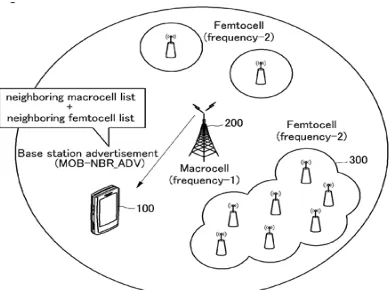
Fig 1 shows that, the structure of macro and femto cell in cellular network. Macro and femto cell have different frequencies, this structure is useful for this algorithm because we are going to divide each cell in to cell center user and cell edge user. And according to this the subcarrier and power allocation has been done in the given cellular network to achieve high throughput.
II.BACKGROUND
Proper management of radio spectrum by reuse with in cellular network, we often called it “Frequency Reuse”. If the reuse factor is one then radio spectrum will going to use once in the same cellular network reusing of same radio spectrum in cellular system. However the reuse factorincreases then the radio spectrum reuse will get increased. Frequency reuse is a one of the great solution to avoid the spectrum scarcity but still network will face the interference problem. As per the research done on interference problem, three techniques are evolved to minimise the interference problem in the cellular network. First technique is the Fast Frequency Reuse (FFR). In the FFR, dynamic subcarrier allocation done with fixed power allocation to every cell within system. The second technique is the soft frequency reuse, in which fixed subcarrier allocation but dynamic power allocation has been done for cell center and cell edge regions. The third technique is the combination of FFR and SFR, this technique works on both principles of SFR and FFR. The main difference between the SFR and FFR scheme is, cell center user can used whole spectrum but in the FFR scheme this is not available. In this Paper, we working on both subcarrier and power allocation in cell center and cell edge regions of the cellular network. This paper based on the joint subcarrier and power allocation soft frequency reuse scheme and this scheme is working on distributive manner. Our main objective in this paper is to maximize the system throughput.
III.SYSTEM MODEL
The main thing in the cellular networks is the spectrum allocation and spectrum management for the proper use and social benefits, the radio frequencies are being regulated and we called this process spectrum management. In case of the downlink transmission, the set of C cells then number of cells in C is C. N subcarrier can be generated by the dividing total spectrum where N={ 1, 2,…..N } and each cell i C can select N major i and N minor i subcarrier.
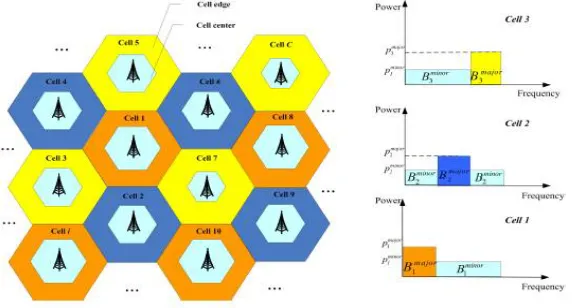
Fig. 2. Reference system layout and standard frequency planning for SFR
The transmitting power of major and minor subcarrier is denoted by P major i and P minor i cell center and cell edge are the two geographical regions at each cell. We assume that, there should be Ki users in cell i and also the KC i cell center users and KE i for the cell edge users, where we can say Ki== KC i + KE i. The minimum data rate requirement for user K in cell I is r min i, K. In the practical cellular network, it has been not possible for base station to exchange information and the reason behind it is the limited capacity backhaul network. As we know the basic law of wireless communication system is, we cannot use same frequencies in a limited geographical area and if still we are going to use this, and then there is possibility of interference, this will cause of interruption in communication.
In this paper, an exhaustic search method is used for Nmajor i and Nminor i combinations because these combinations gives cell i. After the resource allocation of (Nmajor i, Nminor i, Pminor i, Pmajor i) is obtained in
given cell i, then we randomly choose Nmajor i non overlapping subcarrier that satisfies with its adjacent cells as the major subcarrier group cell i. After this, we recalculate the cell center and cell edge data rates RVCi, RVEi for this cell. This major subcarrier allocation has been broadcasted with their transmitting power together with rate indicator of cell i to its adjacent cell. The value of the rate indicator will be 1 if both RVCtar i and RVEtar i are satisfied, otherwise it is 0. After updating the resource allocation in cell C, then each cell i evaluates the current cell center by using the rate indicator. If all adjacent cells data rates are satisfied, then we increase the cell center target data rate requirement in the next iteration as RVCtar i= max (RVCi, RVCtar i) otherwise the cell center target rate remains the same.
IV.PERFORMANCE EVALUATION
In this paper, we have used the both FFR and SFR schemes which is a joint subcarrier and power allocation scheme. But the several research happen on interference reduction schemes so during simulation of this algorithm, we need to consider the all the schemes which are used to reduce interference problem in the cellular network. While simulation of this algorithm we compare this method with FFR schemes and also with changing reuse factor and also we compare this algorithm with static frequency reuse scheme. This is necessary because the simulation results will different in the every scheme. During the performance evaluation on this SFR schemes, we have simulate this algorithm and gets the results related with the power assigned to the every cell as well as the throughput we achieved in this scheme. We are considering the multicell network so the performance evaluation is done on the multiple cells for every method. Also we have tested all method performances with the different traffic loads and compare all results with other so we can prove how the soft frequency reuse method is useful during interference management and capacity of cellular network. In this paper, during the performance evaluation we consider the delay happened in the every cell with the different population limits and observes the system performance.
V. SIMULATION RESULTS
We have tested the performances in multicell network, with different traffic loads as well as the different delay and different population and we observe the simulation regarding the subcarrier allocation and power assigned to the cell center user and cell edge user. We use the macro cells and femto cells network to observe the simulation results. We have tested the performance of this algorithm with different value and during this we kept during 20 MHz bandwidth and 64 QAM modulation techniques. 8dbm is the fixed power we kept in each cell, it is easy to calculate the power distributed in each cell and also to the every cell center and cell edge user. During the performance evaluation we get the satisfactory results as compared with the other reuse schemes like reuse 3 and fractional frequency reuse. Fig 3 (a) shows the cell structure of macro cell and femto cell. In these cell structure cells 3, 4, 5 are the femto cell and remaining hexagonals are the macro cell structure.
Fig 3(b) Power of cell 4
Fig 3(b) shows the power requirement of each algorithm in given cells. The power required for the ASFR for the femtocell structure and macro cell structure.
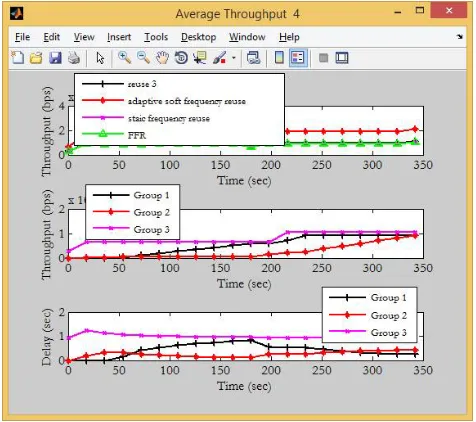
Fig 4(a) Average throughput of cell 4
Fig 4(b) Power achieved in cell 5
Fig 4(b) shows the simulation results and SFR requires the high power as compared with the other three algorithms. Then we found that SFR achieves the highest throughput. Power required by the ASFR for cell 5 is almost near to the 20 dbm but still the throughput achieved by algorithm is nearly about more than 2 bps.
Fig 5(a) Average throughput of cell 5
VI.CONCLUSION
In this paper, we have studied the multicell frequency reuse scheme which can solve subcarrier and power allocation problem in cellular network. Simulation results shows that the soft frequency reuse has achieves high throughput when power is near to the 20 dBm as compared with the reuse 3, static frequency reuse and fast frequency reuse in the cell. The delay factor is also minimum in case of ASFR. Due to the dynamic adjustment of subcarrier and power in the cell we can minimize the interference.
REFERENCES
[1]. S. Ohmori, Y. Yamao, and N. Nakajima, “The future generations of mobile communications based on broadband access technologies,” IEEE Trans.Commun., vol. 38, no. 12, pp. 134–142, Dec. 2000.
[2]. X. Zhang, C. He, L. Jiang, and J. Xu, “Inter-cell interference coordination based on softer frequency reuse in OFDMA cellular systems,” in Proc.IEEE Int. Conf. Neural Network. Signal Process. Jun. 2008, pp. 1–6.
[3]. Y. Zhou, J. Wang, T. S. Ng, K. Higuchi, and M. Sawahashi, “OFCDM: A promising broadband wireless access technique,” IEEE Commun. Mag., vol. 46, no. 3, pp. 39–49, Mar. 2008.
[4]. S. E. Elayoubi, O. Ben Haddada, and B. Fourestie, “Performance evaluation of frequency planning schemes in OFDMA-based networks,” IEEE Trans. Wireless Commun., vol. 7, no. 5, pp. 1623–1633, May 2008
[5]. T. Bonald and N. Hegde, “Capacity gains of some frequency reuse schemes in OFDMA networks,” in Proc. IEEE Global Telecomm.Conf., 2009, pp. 1–6
[6]. S. H. Ali and V. C. M. Leung, “Dynamic resource allocation in fractional frequency reused OFDMA networks,” IEEE Trans. Wireless Commun., vol. 8, pp. 4286–4295, Aug. 2009.
[7]. A. L. Stolyaret al., “Self-organizing dynamic fractional frequency reuse for best-effort traffic through distributed inter-cell coordination,” in Proc.IEEE INFOCOM, 2009, vol. 1–5, pp. 1287–1295.
[8]. K. Son, S. Chong, and G. de Veciana, “Dynamic association for load balancing and interference avoidance in multi-cell networks,” IEEE Trans.Wireless Commun., vol. 8, no. 8, pp. 3566–3576, Jul. 2009.
[9]. N. Himayat, S. Talwar, A. Rao, and R. Soni, “Interference management for 4G cellular standards [WIMAX/LTE UPDATE],” IEEE Commun. Mag., vol. 48, no. 8, pp. 86–92, Aug. 2010.
[10].T. Novlanet al., “Comparison of fractional frequency reuse approaches in the OFDMA cellular downlink,” in Proc. IEEE GLOBECOM, Dec. 2010, pp. 1–5.
[11].N. Ksairi, P. Bianchi, P. Ciblat, and W. Hachem, “Resource allocation for downlink cellular OFDMA systems—Part II: Practical algorithms and optimal reuse factor,” IEEE Trans. Signal Process., vol. 58, no. 2, pp. 735– 749, Feb. 2010.
[12].ManliQian,WibowoHardjawana,Yonghui Li, BrankaVucetic, Xuezhi Yang, Jinglin Shi, “Adaptive Soft Frequency Reuse Scheme for Wireless Cellular Networks”, IEEE Trans: on vehicular technology, vol. 64, no. 1, pp.118-130, Jan 2015