Smell,
Sight,
and Touch
to Forage
Selection
WILLIAM C. KRUEGER, WILLIAM A. LAYCOCK, AND DONALD A. PRICE
Highlight: Chemical impairment of taste, smell, and touch and physical obstruction of sight were studied in relation to forage preferences of sheep in a tall-forb plant community. Taste was the special sense most influential in direc- ting forage preference; the other senses appeared to supplement taste. Sheep preferred sour and sweet plants and generally rejected bitter plants, although some were palatable. Smell was of minor importance in selection. Touch and sight related to such specific plant conditions as succulence and growth form. Simultaneous impairment of all four senses did not result in completely random selection, but did increase preference for unpalatable plants and decrease prefer- ence for palatable ones.
Little is known of the effect of herbivores’ special senses in selection of their diet; however, it is commonly accepted that different plants within a plant community have varying palata- bilities for grazing sheep. Palatability of a plant species varies somewhat depending upon its association with different plant species, but many fac- tors interact to produce a selective response. This selective response has been termed “preference.” An excel- lent review of important factors involved in forage selection by rumi- nants has been presented by Marten (1970). The study reported here was undertaken to gain insight into the basis of forage preference.
Study Area and Methods Field sampling was conducted dur- ing the summer of 1968 on the U.S. Sheep Experiment Station summer range in the Centennial Mountains of
technician and La
y!$Zgeirs
l%Zt ZZ%gist , International Forest and Range Experiment Station, For- est Service, U.S. Department of Agriculture, Ogden, Utah; both stationed in Logan, Utah, at the Forestry Sciences Laboratory, main- tained in cooperation with Utah State Uni- versity. Presently, Krueger is assistant profes- sor, Rangeland Resources Program, Oregon State University, Corvallis. Price is research leader, U.S. Sheep Experiment Station, Ag- riculture Research Service, U.S. Dep. Agr., Dubois, Idaho.The report is part of a dissertation sub- mitted by the senior author in partial fulfill- ment of the PhD degree in range science at Utah State University.
The authors acknowledge Dr. R. L. Hurst, head, Department of Applied Statistics and Computer Science, Utah State University, for assistance with statistical procedures.
Manuscript received October 20, 1973.
258
southwestern Montana. The study area was 7,800 ft in elevation and domi- nated by tall forbs. Eight l/2-acre study pastures were located on a 20% slope that had a north aspect in a sticky geranium/northwest cinquefoil (Geranium viscosissim urn/P0 ten tilla gracilis) community. Two pastures were used in each of four grazing trials.
Forage production of each pasture was sampled immediately prior to each grazing treatment. Except in one instance, 30 plots, each 4.8 ft2, were located by a stratified random method in each pasture; prior to Trial 4, only
15 plots were sampled. Major plant species were clipped at ground level and weighed, and green weight of minor species was estimated. Samples of each plant species were collected and ovendried at 50°C to allow con- version of green weight to dry weight. Twenty-five esophageally fistulated sheep, that had similar breeding and experiences, were used in the study. Twenty were yearlings; the rest were 2-5 years old. Only 20 sheep were used during a sampling period. However, because of problems resulting from the fistulation, occasionally an unthrifty yearling was replaced by one of the older sheep. Sampling was begun at dawn and fistulated sheep collected samples for approximately 1 hour. Prior to sampling, sheep were fasted from dark until daybreak. During the sampling period, salt and water were removed from the pastures so that chemical analyses could be performed on the samples. Results of chemical analyses will be reported in another paper. Between trials, sheep were
placed in adjacent holding pastures with vegetation similar to that of the sampled pastures. Animals were allowed to graze untreated in holding pastures for 10 days prior to sensory impairment so they would become familiar with the vegetation.
Two pastures were each grazed five successive days in four different trials. Twenty sheep representing five treat- ments were sampled in each trial. The first trial compared forage preferences of untreated fistulated sheep with those of sheep that had a single sense impairment (Table 1). Trials 2-4 ex- amined forage preferences of sheep that had varying combinations of sen- sory impairment and compared prefer- ences with those of untreated sheep in each trial. Consequently, all possible combinations of treatments were included in the study.
Treatments to impair the senses of smell, taste, and sight were performed at least 4 days before sampling to allow sheep time to adjust to treat- ments. Suppression of the senses of taste and smell (ageusia and anosmia) was induced by topical application of a 2% solution of osmic acid (0~04). This chemical alters nerve endings, making them insensitive to stimuli for 6 months or longer (0~01 and Farrar, 1955). Control of smell and taste was tested after treatments were applied for several days and for several weeks. Untreated sheep reacted vigorously to fumes from household ammonia; anosmic sheep reacted to ammonia as they did to water. Salt consumption was measured for untreated and ageusic sheep. When salt was juxta- posed with pelleted alfalfa, ageusic sheep consumed 8.7 times as much salt as untreated sheep. When salt was physically displaced and sheep had to make a deliberate selection for salt, ageusic sheep consumed only half as much as untreated sheep. Sight was controlled (anopsia) by means of a blindfold (Fig. 1). Sheep in the initial anopsic group had blindfolds in combi- nation with other treatments through- out subsequent trials. Blindfold treat- ments varied for sheep that initially had other treatments (Table 1). The sense of touch in the lips was con- trolled (atactilia) by topical applica- tion of 5% xylocaine ointment. This treatment was applied daily immedi- ately prior to grazing. Xylocaine is a topical anesthetic commonly used in medical practice.
Fistula samples were placed in a 20-mesh sieve, washed in 5% acetic acid to remove saliva, and rinsed with water. The samples were then stored on dry ice and kept frozen until anal- yzed.
Plant species present in the diet were determined by a modification of Heady and Torell’s (1959) technique. Each sample was thawed, spread on a tray, and 100 points were examined through a stereoscopic microscope that had a crosshair mounted in one ocular. The plant fragment directly under the crosshair was identified from epidermal characteristics. Plant fragments that could not be identified at 15X were removed, mounted on a slide, and examined at 125X (Ward,
1970).
A relative preference index (RPI) was used to evaluate forage prefer- erences and to minimize confounding differences in preference that might result from varying availability of plant species (Krueger, 1972). The following formula was used to deter- mine relative preference for each plant species in each diet. Values were based on surface area of green “lants: _ .
fd X D Relative Preference Index = __
Where: fd = frequency in diet fr X R D = percent diet
fr = frequency on rangeland R = percent range composition
Frequency in diet was the percent- age of samples for each treatment in which a species occurred. Percent diet was the percentage of a plant species in each diet on a surface-area basis determined from microscopic point sampling. Frequency on rangeland was the percentage of plots in which a plant species occurred for each pasture grazed during each trial. Percent range
composition was determined from values for green weight converted to surface area by using a small stage photoelectric planimeter (Caldwell and Moore, 1971). Interception of trans- mitted light for known green weights of samples of each plant species was compared to a standard curve (r’ = 0.99) and surface area in relation to weight was determined. All green weight production figures were then converted to percent surface area for use in the preference index.
A subjective evaluation of coarse- ness, smell, and taste was based on human sensory perception. Coarseness was evaluated by chewing the different plants and assigning them to one of three categories (“high,” “moderate,” or “low” coarseness). It was difficult to assign a specific smell to each plant species, although there were many distinct odors among the various plants. Smell was classified as “strong,” “moderate,” or “faint.” Taste was classified as “bitter,” “sweet,” or “sour.” The categorization of these plant attributes may or may not be equivalent to the evaluation of
Treatment groups
Trial Date (19681 1 2 3 4 5
I July 22-26 f-4’ AS’
w
Ag’ Ati2 July 30.Aug. 3 N AP, AS AP> Ag As, Ag AP, At 3 Aug. 7-11 N As, At AP, Ag, As As, At, Ag Ag, At 4 Aug. 17-21 N As, Ap, At As,Ap,Ag,At - - - AP, At, Ag IN = control.
a plant by a sheep, but it did prove useful in interpreting the grazing pre- ference of the animals.
Statistical comparisons were made by “sing least-squares techniques (Draper and Smith, 1966) and planned contrasts (Ostle, 1963). Each treat- ment was compared to the control for the same sampling period; no statis- tical comparisons were made across periods or among other treatments. Differences were accepted as signifi- cant at P < 0.20. At P < 0.20 results of statistical testing were consistent and biologically explainable. At lower levels inconsistencies not biologically explainable began to appear in data analysis.
Results
All pastures sampled during the study were similar in amount of each plant species available to the grazing sheep. To help develop a perspective of the plant community structure. average composition on a green surface area basis for important plant species
is presented in Table 2. Sticky gera- nium made up about 50% of green production on a surface area basis and had a frequency “ear 100%. Northwest cinquefoil, second in availability, made up about 10% of the composition and had a frequency greater than 90%. Mountain brome (Bromus merginatus) made up about 8% of the composition and had a frequency about 90%. The most palatable plants in this commun- ity, mountain sorrel (Rumex paucifolius) and thickleaf grounds4 (Senecio cr~ssulus), made up about 1% of the composition and were lower in frequency than the more abundant species.
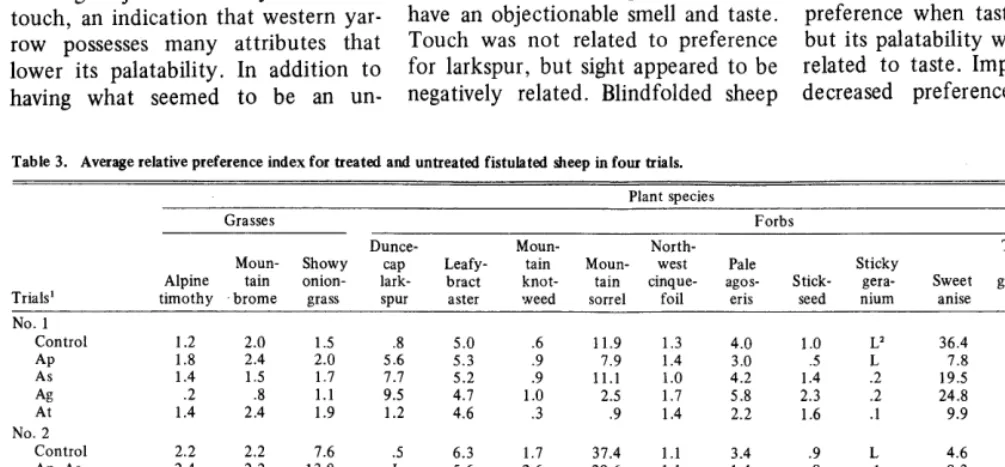
species studied in these pastures (Table 3). Buchanan et al. (1972) have pre- sented preference rankings for these plants from fistulated, but otherwise untreated, animals grazing the same range. Similar palatability relationships were found in their study when these were compared to forage preferences of control sheep in this study.
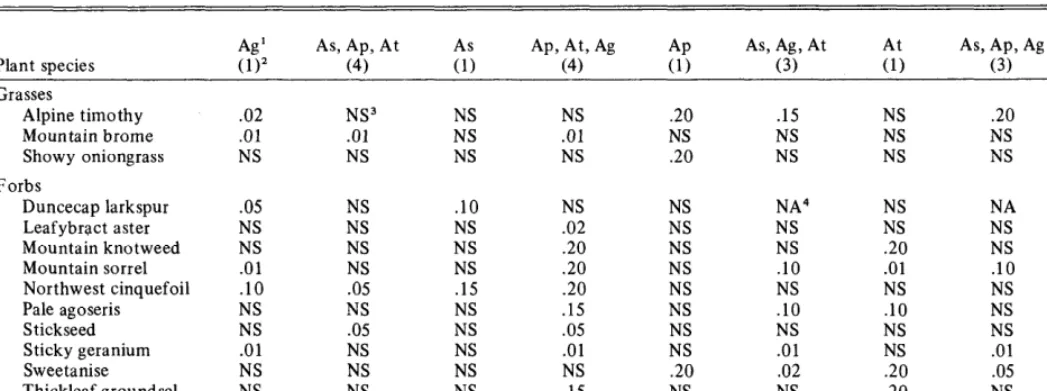
Although all senses were related to preference for some plant species, taste appeared to be the most impor- tant. Sticky geranium, classified as “bitter ,” was unpalatable. Compared to untreated sheep, ageusic sheep sig- nificantly preferred sticky geranium (Table 4). When all senses were im-
paired except taste, preference did not deviate significantly from that of con- trol animals. When either smell, sight, or touch was controlled, preference of sheep for geranium was not sig- nificantly different from that of untreated animals. However, when taste was impaired in combination with one, two, or three other senses, the sheep showed a significant increase in their acceptance of sticky geranium. Palatability of western yarrow (Achilles lanulosa) was also related to taste, but not as exclusively as that of sticky geranium. The only sense not eliciting rejection for yarrow was touch, an indication that western yar- row possesses many attributes that lower its palatability. In addition to having what seemed to be an un-
Table 2. Range composition (%) of major plant species based on green surface area, and total production (lb/acre, ovendry) by trials.
Measurement and
plant species Trial 1 Trial 2 Trial 3 Trial 4
Composition Grasses
Alpine timothy Mountain brome Showy onion grass Forbs
Duncecap larkspur Leafybract aster Mountain knotweed Mountain sorrel Northwest cinquefoil Pale agoseris Stickseed Sticky geranium Sweetanise Thickleaf groundsel Western valarian Western yarrow
3.8 2.4 1.2 1.2
8.1 7.9 9.9 8.5
2.4 .7 1.4 1.8
3.3 2.9 1.9 2.8
5.5 5.4 3.6 4.6
1.2 .8 .4 2.4
.8 .4 .2 .2
10.6 11.7 9.2 8.0
1.5 1.0 .4 .2
2.5 1.4 1.4 1.0
39.8 48.8 57.4 49.0
.6 .9 1.9 1.0
.6 1.4 1.2 1.0
3.7 .8 .7 .7
1.5 .9 .6 1.2
Total production 1,827 1,748 1,516 1,570
pleasant taste and smell, bitter-tasting western yarrow was also recognized by sight as being unpalatable.
Both duncecap larkspur (Delphinium occidentale) and northwest cinquefoil, both bitter-tasting plants, were more palatable when sheep had their sense of taste controlled. Because of the low availability of larkspur, valid statistical comparisons could not be made for all trials. Duncecap larkspur seemed to have an objectionable smell and taste. Touch was not related to preference for larkspur, but sight appeared to be negatively related. Blindfolded sheep
showed a preference for larkspur of 5.6 compared to 0.8 for control sheep in the same trial. When sheep could see, smell, or taste, regardless of com- bination of treatments, preference for larkspur appeared to be lower than when these senses were controlled. Frequently, however, no statistical dif- ference was found.
Northwest cinquefoil was another plant that significantly increased in preference when taste was controlled, but its palatability was not exclusively related to taste. Impairment of smell decreased preference for northwest
Table 3. Average relative preference index for treated and untreated fistulated sheep in four trials.
Grasses Forbs
Dunce- Moun- North- Thick-
Moun- Showy cap Leafy- tain Moun- west Pale Sticky leaf
Alvine tain onion- lark- timbthy brome
bract knot- tain cinque- agos- Stick- gera- Sweet ground- Western Western grass svur aster weed sorrel foil eris seed nium anise se1 valarian varrow
- Trials’
No. 1
Control 1.2 2.0
AP 1.8 2.4
As 1.4 1.5
Ag .2 .8
At 1.4 2.4
No. 2
Control 2.2 2.2
AP, As 2.4 2.2
AP, Ag 2.5 2.2
As, Ag 1.2 1.4
AP, At 2.3 2.1 No. 3
Control 18.5 2.1
As, At 1.2 1.8
As, AP, Ag 7.0 2.2 As, Ag, At 5.8 1.2
Ag, At 4.7 1.8
No. 4
Control 2.0 2.6
As, Ap, At 1.2 2.9
AP, At, Ag 2.4 2.6 As, Ap, Ag, At 2.4 2.8
1.5 .8 5.0 .6 11.9 1.3 4.0 1.0 LZ 36.4 55.7 1.7 L
2.0 5.6 5.3 .9 7.9 1.4 3.0 .5 L 7.8 45.8 1.6 .3
1.7 7.7 5.2 .9 11.1 1.0 4.2 1.4 .2 19.5 73.1 3.9 .3
1.1 9.5 4.7 1.0 2.5 1.7 5.8 2.3 .2 24.8 31.5 1.4 .2
1.9 1.2 4.6 .3 .9 1.4 2.2 1.6 .l 9.9 31.9 1.1 .l
7.6 13.8 9.2 7.8 9.6
3.7 3.0 4.9 3.8 4.4
2.2 2.8 3.4 3.1
.5 L .4 L L
L L 35.1 1.9 L
.3 .4 .l .3
6.3 1.7 37.4 1.1 3.4 .9 L 4.6 14.2 1.3 .2
5.6 2.6 29.6 1.1 1.4 .8 .l 8.3 10.0 3.5 .4
5.4 1.4 .2 1.5 1.8 .5 .l 5.5 6.6 1.0 .8
5.0 1.0 2.2 2.0 2.8 2.5 .l 5.9 5.6 3.7 .5
4.5 .3 11.4 1.1 .9 1.0 .l 17.8 2.9 .5 .2
9.6 3.7 69.6 2.0
7.8 8.2 61.4 1.4
7.5 4.8 2.4 1.8
9.4 2.4 9.1 2.1
9.6 4.3 5.3 1.4
25.6 .7 L
3.2 4.5 .l
13.2 .5 .2
3.5 3.5 .2
6.8 1.9 .l
14.6 12.2 2.0 8.2 13.9 .l 4.1 20.2 2.1 3.3 10.6 1.8 2.7 27.8 8.0
12.8 .8 2.4
11.9 1.3 1.8
5.7 .4 .5
2.1 1.2 1.7 1.0
2.4 1.9 L
1.9 .4 .l
.l .4
2.7 :: .3
2.5 2.4 .l 2.7
7.2 13.2 4.0 3.2
:: .l 1.4
.l .5 1.4 1.0 .3
.4 .2 2.1 2.1
8.0 1.6 .l
’ Symbols used are as follows: As = anosmia, sense of smell impaired; Ap = anopsia, sense of sight impaired; Ag = ageusia, sense of taste impaired; and At = atactilia, sense of touch impaired.
‘L = less than .l.
Table 4. Statistical relationships of relative preference indices for selected treatments of sheep when compared to control sheep. Values indicate the level of significance of difference when compared to control.
Plant species
Grasses
Alpine timothy Mountain brome Showy oniongrass
Forbs
Duncecap larkspur Leafybract aster Mountain knotweed Mountain sorrel Northwest cinquefoil Pale agoseris Stickseed Sticky geranium Sweetanise Thickleaf groundsel Western valarian Western yarrow
I
$2
.02 .Ol NS
.05 NS NS .Ol .lO NS NS .Ol NS NS NS .02
As, Ap, At As
(4) (1)
NS3 NS
.Ol NS
NS NS
NS .lO
NS NS
NS NS
NS NS
.05 .15
NS NS
.05 NS
NS NS
NS NS
NS NS
NS .lO
.15 .Ol
AP, At, Ag (4)
NS .Ol NS
NS .02 .20 .20 .20 .15 .05 .Ol NS .15 NS .20
AP (1)
.20 NS .20
NS NS NS NS NS NS NS NS .20 NS NS .Ol
As, Ag, At (3)
.15 NS NS
NA4 NS NS .lO NS .lO NS .Ol .02 NS NS .15
NS NS NS
NS NS .20 .Ol NS .lO NS NS .20 .20 NS NS
As, AP, Ag (3)
.20 NS NS
NA NS NS .lO NS NS NS .Ol .05 NS NS .02
As, AP,
Ag, At (4)
NS .02 NS
NS NS .05 .lO .lO NS .05 .Ol NS .20 NS .15
’ Symbols used are as follows: As = anosmia. sense of smell impaired; Ap = anopsia, sense of sight impaired; Ag = ageusia, sense of taste impaired; and Ai = atactilia, sense of touch impaired.
2 Trial number.
‘Not significant at P < .20. 4Not statistically tested.
’
cinquefoil; anosmic sheep had a prefer- ence value of 1 .O compared to 1.3 for control animals. However, the interac- tion of smell and taste suggested that taste was more influential in selection of this plant. When both smell and taste were controlled, the relative pre- ference index increased, which is the same response observed with impair- ment of taste alone, but opposite of the response observed when smell alone was impaired (Table 3). Although this difference was not significant, it did show a tendency for the effects of taste impairment to override the effects of smell impairment. Further evidence to suggest a more important influence of taste was found when all other senses were impaired. When this occurred, preference decreased signifi- cantly; animals that could only taste took less northwest cinquefoil than control animals. When senses except smell were controlled, sheep prefer- ence remained depressed, which indi- cated that selection on the basis of smell was dependent upon other sen- sory stimuli.
Preference for grasses was primarily related to taste and sight. Preference for alpine timothy (Phleum alpinum) and for mountain brome was signifi- cantly decreased when taste was impaired. Preference for showy onion- grass (Melica spectabilis) was not sig- nificantly altered by taste treatment. Preference for showy oniongrass and alpine timothy increased when sight
was impaired. This change was prob- ably related primarily to the change in feeding behavior of the sheep when blindfolded. Anopsic sheep tended to feed longer in a specific spot and lower in the vegetation. Grasses that tended to grow lower than most other vegeta- tion were more frequently en- countered by anopsic sheep than by untreated animals. Since these low- growing grasses did not have other o b j e c tionable characteristics, they were consumed more frequently by anopsic sheep than by sheep that had better access to higher growing vegeta- tion because of normal behavior. Changes in feeding behavior were only apparent for anopsic sheep.
Mountain sorrel was a forb strongly preferred because of its sour taste. When taste was impaired singly or in combination with other senses, prefer- ence for sorrel decreased. Mountain sorrel a tender, succulent plant, was also preferred on the basis of touch. However, taste seemed to be more influential, as indicated by results when all senses except touch were controlled. In this case, the preference index for treated sheep was 2.4 com- pared to 69.6 for untreated sheep. Preference remained depressed when all senses except touch were impaired. When all senses except taste were controlled, no significant differences were noted between treated and con- trol sheep.
Preference for other succulent
JOURNAL OF RANGE MANAGEMENT 27(d), July 1974
plants, such as thickleaf groundsel, swee tanise (Osmorhiza occiden talis), and pale agoseris (Agoseris glauca), was also positively related to the sense of touch. Mountain knotweed (Poly-
gonum montanum), not succulent but
rated low in degree of coarseness, decreased in preference when touch was controlled. No plants had charac- teristics producing sufficiently adverse tactile stimuli to cause significant decreases in preference. The role of touch in selection was not as influen- tial as that of other senses. Preference for thickleaf groundsel was more re- lated to interactions of smell and taste. Sheep with smell and taste controlled showed a significantly lower prefer- ence (5.6) than untreated sheep (14.2) with P < 0.01. Most bitter plants in this study were unpalatable; however, the bitter-tasting thickleaf groundsel was preferred when smell and taste functioned together. Since preference for groundsel decreased when only smell remained intact, it is probable that the bitter taste of this plant and its tenderness provide highly preferred stimuli for acceptance by sheep.
to palatability of sweetanise, which is a tall-growing plant. Sheep could see sweetanise plants from any area of the pasture and would actively seek them out unless blindfolded. Other plants of exceptionally high palatability were not as obvious to sheep at long dis- tances, and the animals did not signifi- cantly relate to sight of them.
Leafybract aster (Aster foliaceus) was both abundant and high in palata- bility. This aster has a faint bitter taste, but is still highly preferred by sheep on this range. Changes in prefer- ence for aster as a result of sensory impairment generally were not signifi- cant. Smell apparently was not of importance in selection of aster. Pre- ference decreased significantly when smell was the only sense intact, indi- cating that other senses related to preference but smell was neutral. It was suspected from results of treat- ment combinations that touch was influential in determining preference for leafybract aster, but no clearcut significant relationship could be estab- lished.
Stickseed (Hackelia j7oribunda) was selected nearly at random by the grazing sheep. No relationship to spe- cific senses could be established, although there were indications that sense alteration would change prefer- ence values.
Discussion
Results of this study indicated rela- tionships of the senses to forage selec- tion are complex. Taste appeared to be the primary sense used for selection of many species in the animals’ diet, although taste frequently interacted with other senses. However, taste of some plants had no apparent influence on their palatability. Arnold (1966b) found that sheep surgically treated to control the sense of taste were unable to differentiate between species and strains of plants as successfully as intact sheep. This work was done on improved pastures in Australia, but the basic relationships of taste seem to be the same as on rangeland in this study. Longhurst and Kepner (1968) studied the effect of impairment of smell and taste in selection of feed treated with extracts from plant leaves high in volatile oils. They found taste to be of less importance in preference than smell. However, when smell and taste were both controlled, the degree of selectivity was less than if smell alone
262
was controlled.
On the range studied, sticky gera- nium made up about half of dry weight production. Since selectivity of this plant was almost exclusively a function of taste, some change in the taste of this plant to improve palata- bility could almost double the carrying capacity. Perhaps a chemical substance could be applied to improve the taste of geranium or a fertilizer program might change palatability of this plant. The other senses appear to supple- ment the sense of taste. Smell was only of specific importance in selec- tion of northwest cinquefoil; in con- junction with taste, smell was influen- tial in selection of certain other plant species. Tribe (1949) suggested smell was only supplementary to other senses in influencing forage selection of sheep. Arnold (1966b) found smell to be of importance and closely related to selection of plant parts or specific phenological stages of plants. Longhurst and Kepner (1968) deter- mined that olfaction was the first sense used in making a selection and so had its greatest effect in initial forage selection.
Sight was related to selection of certain palatable plants, such as sweetanise. Other plants of high pala- tability, but low-growth form, could not be seen from distances greater than 10 or more feet. Consequently, no relationship to sight was shown. Arnold (1966a) found sight was not important for selection of plant species in grass-clover-alfalfa pastures, but did report changes in grazing behavior similar to those described in this paper. Arnold did not blindfold the sheep; he restricted their vision with “blinkers” that did not totally obstruct sight except at the point of forage selection.
Plants selected, at least in part, on the basis of touch were all categorized as “low” in coarseness; generally they were succulent. Overall, touch appeared primarily to supplement the sense of taste in selection of plant species.
When all four senses were impaired, sheep showed some interesting altera- tions in forage preference. Changes in preference did not result in completely random forage selection; however, plants of low palatability, such as geranium and western yarrow, in- creased in preference after impairment of all four senses. Plants of high
palatability, such as mountain sorrel and thickleaf groundsel, decreased in preference. Although sensory impair- ment was severe, some factors influ- encing forage selection, such as touch in the tongue and the common chemi- cal sense, were not controlled. Arnold (1966b) reported the control of smell, taste, and touch in combination did not completely alter animal forage preference in an area where sight was of minor importance. Longhurst and Kepner (1968) in feeding trials of sheep also found impairment of smell, taste, and touch in combination did not completely alter sheep forage pre- ferences.
Literature Cited
&mold, G. W. 1966a. The special senses in grazing animals. I. Sight and dietary habits in sheep. Aust. J. Agr. Res.
17:521-529.
Arnold, G. W. 1966b. The special senses in grazing animals. II. Smell, taste, and touch and dietary habits in sheep. Aust. J. Agr. Res. 17:531-542.
Buchanan, H., W. A. Laycock, and D. A. Price. 1972. Botanical and nutritive con- tent of the summer diet of sheep on a tall forb range in southwestern Montana. J. Anim. Sci. 35:423-430.
Caldwell, M. M., and R. T. Moore. 1971. A portable smallstage photoelectric planimeter for leaf area measurements. J, Range Manage. 24:394-395.
Draper, N. R., and H. Smith. 1966. Applied regression analysis. John Wiley and Sons, Inc., New York. 407 p.
Heady, H. F., and D. T. Torell. 1959. Forage preferences exhibited by sheep with esophageal fistulas. J. Range Manage. 12:28-33.
Krueger, W. C. 1972. Evaluating animal forage preference. J. Range Manage. 25:471475.
Longhurst, W. M., and R. E. Kepner. 1968. Strontium-90 and Cesium-137 food chain relationships to deer and sheep. V. Fac- tors influencing radionuclide accumula- tion. Progress Report. AEC Project No. UCD 34, p. 104-112. (68 p. mimeo.) Marten, G. C. 1970. Measurement and sig-
nificance of palatability. In: Proc. of National Conference on Forage Quality Evaluation and Utilization. Dl-D55. Nebraska Center for Continuing Educa- tion, Lincoln.
0~01, A., and G. E. Farrar, Jr. 1955. The dispensatory of the United States of America. J. B. Lippincott Co., Philadel- phia, Pa. 2139 p.
Ostle, B. 1963. Statistics in research, 2nd ed. Iowa State Univ. Press, Ames. 585 p. Tribe, D. E. 1949. The importance of the sense of smell to the grazing sheep. J. Agr. Sci. 39:309-312.
Ward, A. L. 1970. Stomach content and fecal analysis: Methods of forage identifi- cation. In: Range and wildlife habitat evaluation-a research symposium, p. 146-158. U.S. Dep. Agr. Misc. Publ. 1147.220 p.