Round-reduced Versions of SIMON
Danping Shi1,2, Lei Hu1,2?, Siwei Sun1,2, Ling Song1,2, Kexin Qiao1,2, Xiaoshuang Ma1,2
1
State Key Laboratory of Information Security, Institute of Information Engineering, Chinese Academy of Sciences, Beijing 100093, China
2
Data Assurance and Communication Security Research Center, Chinese Academy of Sciences, Beijing 100093, China {dpshi, hu, swsun, lsong, kxqiao13, xshma13}@is.ac.cn
January 5, 2015
Abstract. SIMON is a family of lightweight block ciphers designed by the U.S. National Security Agency (NSA) that has attracted much at-tention since its publication in 2013. In this paper, we thoroughly in-vestigate the properties of linear approximations of the bitwise AND operation with dependent input bits. By using a Mixed-integer Linear Programming based technique presented in Aasicrypt 2014 for automatic search for characteristics, we obtain improved linear characteristics for several versions of the SIMON family. Moreover, by employing a recent-ly published method for automatic enumeration of differential and linear characteristics by Sunet. al., we present an improved linear hull analysis of some versions of the SIMON family, which are the best results for linear cryptanalysis of SIMON published so far.
Specifically, for SIMON128, where the number denotes the block length, a 34-round linear characteristic with correlation 2−61 is found, which is the longest linear characteristic that can be used in a key-recovery attack for SIMON128 published so far. Besides, several linear hulls superior to the best ones known previously are presented as follows: linear hulls for the 13-round SIMON32 withpotential2−28.99versus pre-vious 2−31.69, for the 15-round SIMON48 withpotential 2−42.28 versus previous 2−44.11and linear hulls for the 21-round SIMON64 with poten-tial 2−60.72versus previous 2−62.53.
Keywords.SIMON, linear cryptanalysis, probability of success, linear hull, key recovery
1
Introduction
SIMON is a family of lightweight block ciphers presented by the U.S. Na-tional Security Agency [5] in 2013 with a feistel structure of different versions of block and key lengths, which performs well in hardware and software im-plementations. By far, SIMON has attracted many cryptanalysis such as dif-ferential analysis [6–10], linear cryptanalysis [11, 12], impossible difdif-ferential and zero-correlation linear hull cryptanalysis [11, 13].
We focus on the linear cryptanalysis in this paper. Linear cryptanalysis [14] presented by Matsui is an important cryptanalysis method on block ciphers. It aims at finding a linear expression involving bits of plaintexts, “ciphertexts” (including inner states) and subkeys that deviates from a random linear expres-sion. A key recovery attack can then be launched due to this non-randomness. Linear expressions are usually obtained by linear characteristics that consists of masks for each round state and applies the piling-up lemma to concatenate. This method has been extended to linear hull cryptanalysis by Nyberg [15] in 1995 when several linear characteristics with same input and output masks are used. In paper [16, 17], multiple linear cryptanalysis is introduced to reduce the data complexities. But Murphy in paper [18] shows that the statistical assump-tions used in paper [16, 17] may not hold. The problem about independence of approximations is solved in paper [19, 20]. After then multidimensional linear cryptanalysis is presented by Hermelin [21]. In 2008, Selcuk in paper [22] presents a ranking method of key candidates with a concept of advantage and a calcu-lation of the success probability with data complexity of Matsui’s Algorithm 2.
In this paper, we investigate linear characteristics with consideration of de-pendence of the S-boxes of the bitwise AND operation with dependent input bits. By the methods of automatic enumeration of differential and linear charac-teristics presented in [8, 9], some improved results about the linear (hull) crypt-analysis are obtained in this paper.
Specifically, the longest linear characteristic known previously for key recov-ery on SIMON128 shown in paper [12] is a 34-round linear characteristic with correlation 2−63 while we present one with correlation 2−61 in this paper.
Fur-thermore, the latter can be used to attack SIMON by Matsui’s Algorithm 2 with the complexity 2127 and probability of success 97% according to the
calculat-ing method in [22] with 8-bit advantage. Besides, for SIMON32 the best linear hull known previously is a 13-round one withpotential 2−31.69 in [12] while we give one with potential 2−28.99 in this paper. Moreover, a 15-round linear hull for SIMON48 with potential 2−42.28 is presented, whereas the 15-round linear hull with potential 2−44.11 proposed in paper [12] was the previous best result
for this version. We also find a 21-round linear hull with potential 2−60.72 and
a 22-round linear hull with potential 2−63.83 for SIMON64. The previous best
linear hull for SIMON64 is a 21-round linear hull withpotential2−62.53proposed
Table 1.Summary on improvement of the best linear characteristic/hulls.
Version ]Rounds Correlation Reference
SIMON128 34 2
−63 [12]
34 2−61 This paper
Version ]Rounds Potential Reference
SIMON32 13 2
−31.69 [12]
13 2−28.99 This paper
SIMON48 15 2
−44.11 [12]
15 2−42.28 This paper
SIMON64
21 2−62.53 [12] 21 2−60.72 This paper 22 2−63.83 This paper ] Rounds: Number of rounds for linear characteristic/hulls.
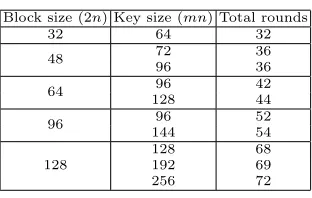
Table 2.Versions of SIMON
Block size (2n) Key size (mn) Total rounds
32 64 32
48 72 36
96 36
64 96 42
128 44
96 96 52
144 54
128
128 68
192 69
256 72
cryptanalysis on this version is a 28-round differential cryptanalysis shown in paper [10, 12]. The results of the linear hulls are summarized in Table 1.
The paper is organized as follows. Section 2 gives a brief description of the block cipher SIMON. Section 3 presents a linear cryptanalysis as well as a linear characteristic/hull searching method on SIMON. The improved results with the linear (hull) cryptanalysis are given in Section 4. We finally conclude the paper in Section 5.
2
Brief description of SIMON
The SIMON2n/mnis a feistel structure block cipher with (2n)-bit block length and (mn)-bit key length, wherencould be 16,24,32,48, or 64 andmis required to be 2,3,4. All versions of SIMON with corresponding number of rounds are listed in Table 2. Before a further description of SIMON, we give the notations used in the paper.
2.1 Notations
Kr: subkey for ther-th round
X[j]: the (j modn)-th bit ofX, whereX[1] is the MSB ofX nk: the length of the master key
X ≪i: left circular shift byibits ofX ⊕: bitwise XOR
∧: bitwise AND
2.2 Round function of SIMON
The round function of SIMON is shown as follows:
Lr+1=Rr⊕Kr⊕(Lr≪2)⊕((Lr≪1)∧(Lr≪8))
Rr+1=Lr
We only consider single key cryptanalysis in this paper and thus the key schedule is omitted here. More details on SIMON can be found in paper [5].
3
Linear cryptanalysis of SIMON
A linear approximation of bits in plaintexts, ciphertexts and subkeys is a Boolean function and we use correlation and bias to evaluate it. Let f : Fn2 → F2 be a
Boolean function. The correlationf off is defined by
2−n·(]{x∈Fn
2 :f(x) = 0} −]{x∈F n
2 :f(x) = 1})
andδf = 1/2·f is denoted as the bias off. We haveδf = 2−n(](f(x) = 0))−1/2. The higher the magnitude of the correlation |f| is, the fewer plaintexts are needed in a linear attack.
Nyberg defined thepotential of a linear hull with the input and output masks
αandβ for a block cipherC=f(P, K) in [15] as follows:
ALH(α, β) =X
γ
(P r(α·P+β·C+γ·K= 0)−1/2)2. (1)
Similarly, a linear hull with a higher potential value leads to a better linear attack as fewer plaintexts are required. To achieving probability of success 97% with 8-bit advantage, the data complexity of Matsui’s Algorithm2 will be 8·ALH−1
as shown in paper [22].
3.1 Linear approximation of bitwise AND
We denote the non-linear layer in the round function of SIMON by
Regarding each bitwise ∧ as a 2×1 S-box, the functionfN is composed of n
2×1 S-boxes with inputsLr[j+ 1] andLr[j+ 8], denoted by fjN(Lr[j+ 1], Lr[j+ 8]) =Lr[j+ 1]∧Lr[j+ 8].
Consider the linear approximation of the functionfiN with two input mask bits and one output mask bit. It is easily calculated that magnitude of the correlation of a linear approximation of a 2×1 S-box is 2−1if it is with a
non-zero output mask, is 0 if it is with the non-non-zero input mask and the non-zero output mask, and is 1 if it is with the all-zero input and output. Thus, the number of active S-boxes is the sum of the Hamming weights of output masks of the S-box layers for SIMON, where an active S-box means it is with a non-zero output mask.
3.2 Dependence of S-boxes
As shown in [9], the dependence of active S-boxes should be taken into consid-eration in linear cryptanalysis. Here we illustrate it by an example.
LetYr be the output value of the nonlinear functionfN in roundr,Ir 1 and Ir
8 be the input masks and Or the output mask. Suppose two S-boxesfjN and fN
j+7 are active in one round, we have a linear approximation
I1r[j]·Lr[j+1]⊕I8r[j]·Lr[j+8]⊕Yr[j]⊕I1r[j+7]·Lr[j+8]⊕I8r[j+7]·Lr[j+15]⊕Yr[j+7] (2) with correlation 0 or ±2−1, instead of ±2−2 by the piling-up lemma [14]. The
invalid application of the piling-up lemma is due to the dependence of the two S-boxes, namely both of them takeLr[j+ 8] as input. We should take the
de-pendence seriously as it may invalidate a linear characteristic by correlation 0. In the following, we scrutinize the relationship between the input variables of active S-boxes and the correlation of the corresponding expression.
Firstly, the input masks (I1r, I8r) offN determine whether the correlation of an
approximation is zero or not. For non-zero cases, the output mask determines the absolute value of the correlation. This property comes from a fact on quadratic Boolean functions as follows.
Consider a Boolean function
f :F2×F2× · · ·F2→F2
(x1, x2,· · · , xn)→Lx(x1, x2,· · ·, xn) +Bx(x1, x2,· · ·, xn),
where Lx(x1, x2,· · · , xn) is linear and Bx(x1, x2,· · ·, xn) is sum of quadratic
termsxi·xj andxi, xj∈F2. A new quadratic form g:F2×F2× · · ·F2→F2
(y1, y2,· · ·, yn)→Ly(y1, y2,· · · , yn) +By(y1, y2,· · · , yn),
retaining the same correlation is obtained fromf(x1, x2,· · ·, xn) by a
andBy(y1, y2,· · ·, yn) =yi1·yi2+yi3·yi4+· · ·+yi2s−1·yi2s with all subscripts i1, i2,· · · , i2s not coincident. The absolute value of the correlation of the linear
approximation of g is 0 if{j1, j2,· · ·, jt} \ {i1, i2,· · ·, i2s} is non-empty or 2−s
if {j1, j2,· · · , jt} ⊆ {i1, i2,· · ·, i2s}. In the latter case, therefore, less variables
involved in quadratic terms result in greater absolute value of correlation. The linear approximation of S-box layer in ther-th round of SIMON is
G:F2×F2× · · · ×F2→F2
(Lr[1], Lr[2],· · · , Lr[n])→LG(Lr[1], Lr[2],· · ·, Lr[n]) +BG(Lr[1], Lr[2],· · ·, Lr[n]),
where
LG(Lr[1], Lr[2],· · ·, Lr[n]) = n
X
j=1
(I1r[j]·Lr[j+ 1] +I8r[j]·Lr[j+ 8]),
BG(Lr[1], Lr[2],· · ·, Lr[n]) = n
X
j=1
Or[j]·(Lr[j+ 1]·Lr[j+ 8]).
and its correlation should be calculated following the above rules.
3.3 Description of automatic enumeration of characteristics with
MILP
Automatic search of differential characteristic for bit-oriented block ciphers by Mixed-integer Linear Programming (MILP) modelling was investigated by Sun
et al.[8], which is further extended to automatic search linear characteristic and linear hull in [9]. This kind of methods denotes each mask bit as a 0-1 variable and describes their propagation through the cipher as linear inequalities (constraints) subjected to which an optimized value of number of active S-boxes is returned. Specifically, the MILP model is as follows.
Constraints for linear operation.
These three constraints for linear operation can be directly obtained from paper [9,?].
1. For each bitwise XOR operation, (α1, α2) andβdenote the input masks and
output mask of⊕. The constraints of these mask bits are:
α1=α2=α3. (3)
2. For each branching in the cipher structure, let (α1, α2, α3) denote the masks
on three branches. The constraints of the masks are:
τ ≥α1, τ ≥α2, τ ≥α3; α1+α2+α3≥2τ; α1+α2+α3≤2.
(4)
3. For operation of left circular shift by i bits, letµ= (µ[1], µ[2],· · ·, µ[n]) and
ν= (ν[1], ν[2],· · · , ν[n]) be the input and output masks. The constraints of the masks are:
ν[j] =µ[j+i], j∈ {1,2,· · ·, n} (5)
Constraints for S-box.
The S-box in SIMON is bitwise AND and to get valid linear characteristics we only allow the active S-boxes with non-zero output masks and inactive S-boxes with all zero masks. This rule can be described as:
(
Or[j]≥I1r[j], Or[j]≥Ir
8[j],
(6)
where the symbols are as mentioned earlier. The constraint (6) also means that the output mask must be non-zero if the input mask is non-zero.
Constraints dealing with dependence of S-boxes.
As presented in Section 3.2, given the masks (Ir
1, I8r), Or for the S-box layer
in one round, a smaller number of variables involved in quadratic terms leads to a bigger absolute value of the correlation ofG. In this paper, we want to find the masks that lead to the least number of variables appearing in quadratic terms. To indicate the number of variables in quadratic terms of the linear approximation of fN, n new 0-1 variables Vr[j] (j ∈ {1,2,· · ·, n}) indicating whether Lr[j] exists in the quadratic terms are introduced in each round for SIMON. The constraints are
Vr[j]≥Or[j−1], Vr[j]≥Or[j−8],
Vr[j]≤Or[j−1] +Or[j−8].
(7)
Thus,
n
P
j=1
Vr[j] is the number of variables appearing in quadratic terms of the
linear approximation for one round and P
r n
P
j=1
Vr[j] is the number of variables
appearing in the linear approximation of SIMON. Note that linear characteristics with the same number of active S-boxes may have different correlations due to different cases of dependence of active S-boxes.
Objective function.
To get the minimum number of linearly active S-boxes, the objective function is set to be the sum of all output mask bits of S-box layers in [9]. However, it is the correlation of the linear characteristics that determines the effectiveness of the linear cryptanalysis. Therefore, considering the influence of the dependence
of active S-boxes on correlation, we set the objective function to beP
r n
P
Constraints for linear hulls.
To get linear hulls, we set the input and output mask bits as the ones in a known linear characteristic and get an amount of linear characteristics that form a linear hull.
4
Results
For each linear characteristic, we obtain the accurate absolute value of the cor-relation of the linear approximation for each round by nonsingular transform method shown in Section 3.2. After getting the correlation in each round, apply the piling-up lemma to obtain the absolute value of the correlation of the whole cipher since S-boxes from different rounds can be seen as independent ones with the effect of round keys. The results are as follows.
4.1 Linear characteristic
Experiments have been done on SIMON128. A 34-round linear characteristic of SIMON128 with bias 2−62 for a key recovery attack has been found. To the best of our knowledge, the best 34-round characteristic of SIMON128 known previously is presented in [12] and has the bias 2−64. What is more, all active
S-boxes in this characteristic are independent according to our test. Besides, this characteristic of SIMON128 with bias 2−62is the linear characteristic that
covers most rounds and simultaneously meets the condition ofδ≥2−n+2, which
indicates that the probability of success for key recovery is 0.997 [22]. The previ-ous best result that satisfies the condition is a 33-round characteristic with bias 2−60 in [12]. The linear mask (separated into left and right parts) is presented
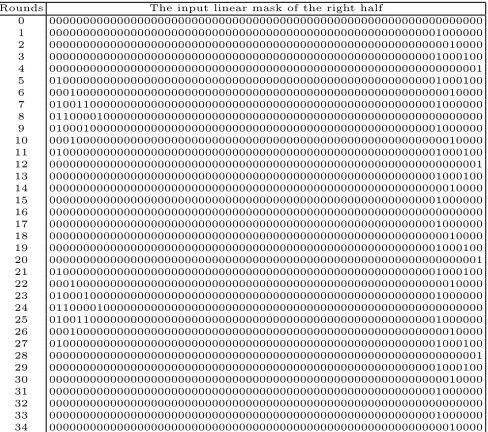
in Tables 5 and Table 6 in Appendix.
Our characteristic can be used to attack 36-round SIMON128 with data com-plexity 2124 and time complexity 2124 by Matsui’s algorithm 1 [14], and can be
further extended to attack 43 rounds with data complexity 2127with probability
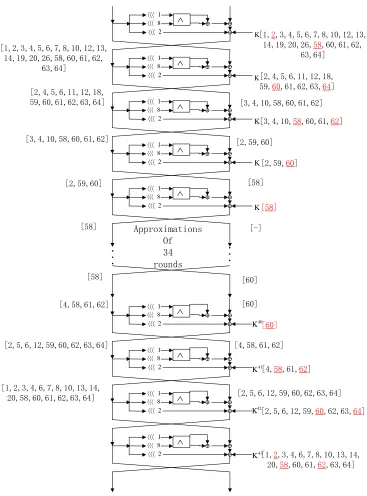
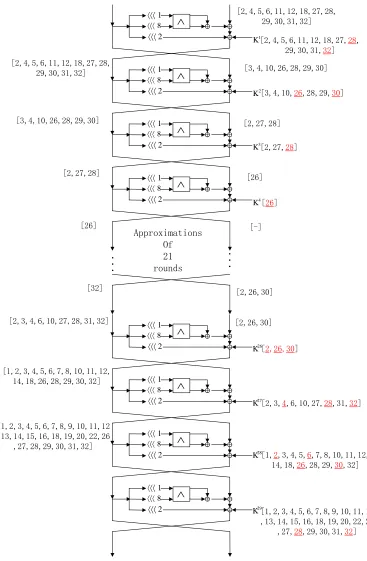
of success 0.997 by Matsui’s algorithm 2 [14, 22]. The latter is demonstrated in Figure 1 where the 60 bits of subkeys numbered in black need to be guessed and the red font with underline ones not.
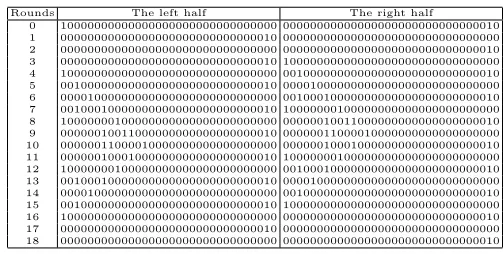
For SIMON64, a 18-round linear characteristic with bias 2−32 is listed in Table 7 in Appendix. The longest linear characteristic known previously with absolute value of bias no less than 2−32 is a 17-round linear characteristic with
bias 2−29presented in [12]. The comparison between our results and the results
presented in [12] is in Table 3. Characteristics for SIMON32, SIMON48 are listed in Tables 8-9 in Appendix.
4.2 Linear hull
By setting the input and output masks same as the characteristic in Table 8
with an added constraintP
r n
P
j=1
1
8
2
+ ++ K
1 8 2
+ ++ K
1 8 2
+ ++ K
1 8 2
+ ++ 40
K 1 8 2
+ ++ 41
K 1 8 2
+ ++ K42
1 8 2
+ ++ 43
K
.
.
.
..
.
Approximations Of 34 rounds [58] [58] [2,59,60] [58] [3,4,10,58,60,61,62] [60] [58] [60] 1 8 2 + ++ K
[-]
[1,2,3,4,6,7,8,10,13,14, 20,58,60,61,62,63,64]
[2,59,60]
[3,4,10,58,60,61,62] [2,4,5,6,11,12,18,
59,60,61,62,63,64]
[2,59,60]
[3,4,10,58,60,61,62] [2,4,5,6,11,12,18, 59,60,61,62,63,64]
[60] [4,58,61,62]
[4,58,61,62]
[4,58,61,62] [2,5,6,12,59,60,62,63,64]
[2,5,6,12,59,60,62,63,64]
[2,5,6,12,59,60,62,63,64]
[1,2,3,4,6,7,8,10,13,14, 20,58,60,61,62,63,64]
1
8
2
+ ++ K
[1,2,3,4,5,6,7,8,10,12,13, 14,19,20,26,58,60,61,62,
63,64]
[1,2,3,4,5,6,7,8,10,12,13, 14,19,20,26,58,60,61,62,
63,64]
Table 3.The comparison between this paper and others.
Version ]Rounds Bias Reference SIMON64 17 2
−29 [12]
18 2−32This paper SIMON128 34 2
−64 [12]
34 2−62This paper
]Rounds: Number of rounds for lin-ear characteristic.
potential 2−28.99 for SIMON32. To our knowledge, the best previously found
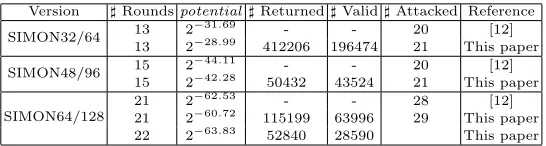
linear hull for SIMON32 was a 13-round linear hull presented in paper [12] with potential 2−31.69. Actually, 412206 linear characteristics are returned in
our model, among which only 196474 have non-zero correlation while others are zero due to the dependence of active S-boxes. Dependence of active S-boxes also exerts influence on valid characteristics. For example, the linear characteristic presented in Table 8 is with correlation 2−18but with 19 active S-boxes. Further,
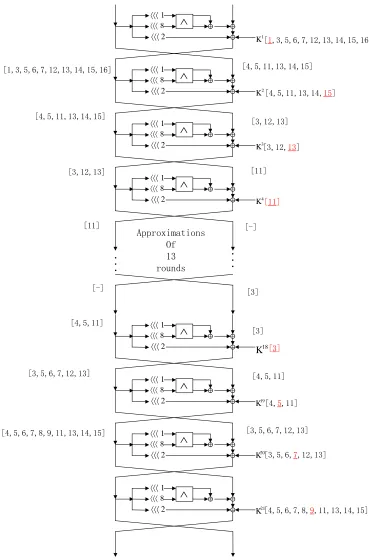
this linear hull can be used to attack 21 rounds for SIMON32/64 as Figure 2 shows with success probability 97%. The number of the bits guessed for the key is 32.
A 15-round linear hull with potential 2−42.28 for SIMON48 is obtained by
setting input and output masks same as the characteristic shown in Table 9,
with an additional constraintP
r n
P
j=1
Vr[j]≤59. As we know, the best previously
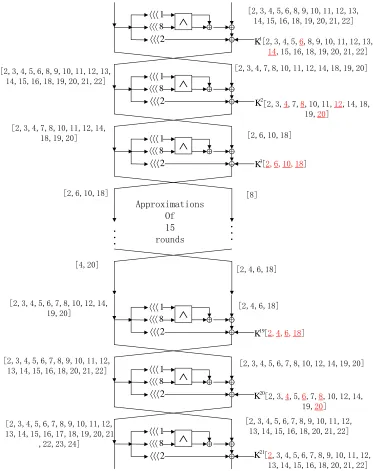
found linear hull for SIMON48 was a 15-round linear hull presented in paper [12] withpotential2−44.11. Actually, 50432 linear characteristics are returned among which only 43524 are valid. This linear hull can be used to attack 21 rounds for SIMON48/96 with success probability 97% as Figure 3 shows. The number of the bits guessed for the key is 51.
A 21-round linear hull withpotential2−60.72for SIMON64 is obtained where-as the previous best linear hull for this version is a 21-round linear characteristic withpotential 2−62.53 [12]. Among the 115199 linear characteristics found with additional constraint P
r n
P
j=1
Vr[j] ≤ 78, 63996 have non-zero bias. This linear
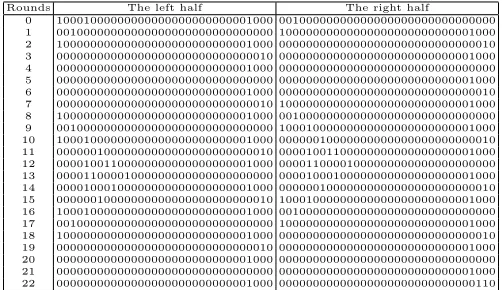
hull can be used to attack 29 rounds for SIMON64/128 demonstrated in Fig-ure 4 achieving success probability 97%. The number of the guessed bits of key is 63. The masks listed in Table 10 in Appendix is a linear characteristic with bias 2−36. Besides, a 22-round linear hull with potential 2−63.83 for SIMON64
is found in this paper, with the input and output masks same with the linear characteristic listed in Table 11 in Appendix.
1
8
2
+ ++ 2
K
1 8 2 + ++ 3
K
1 8 2 + ++ 4
K
1 8 2 + ++ K18
1 8 2 + ++ 19
K
1 8 2 + ++ 20
K
1 8 2 + ++ 21
K
..
.
.
..
Approximations Of 13 rounds [11] [11] [3,12,13] [11] [4,5,11,13,14,15] [3] [-] [3] 1 8 2 + ++ 1
K
[-] [4,5,6,7,8,9,11,13,14,15] [4,5,11] [3,5,6,7,12,13][3,12,13] [3,12,13]
[4,5,11,13,14,15] [4,5,11,13,14,15] [1,3,5,6,7,12,13,14,15,16]
[1,3,5,6,7,12,13,14,15,16]
[3]
[4,5,11]
[4,5,11]
[3,5,6,7,12,13]
[3,5,6,7,12,13]
[4,5,6,7,8,9,11,13,14,15]
1
8
2
+ ++ 1
K
1
8
2
+ ++ 2
K
1
8
2
+ ++ 3
K
1
8
2
+ ++ 19
K
1
8
2
+ ++ 20
K
1
8
2
+ ++ 21
K
..
.
..
.
Approximations Of 15 rounds [2,6,10,18]
[4,20] [2,4,6,18]
[8] [2,3,4,7,8,10,11,12,14,
18,19,20] [2,6,10,18]
[2,6,10,18] [2,3,4,5,6,8,9,10,11,12,13,
14,15,16,18,19,20,21,22]
[2,3,4,7,8,10,11,12,14,18,19,20]
[2,3,4,7,8,10,11,12,14,18, 19,20]
[2,3,4,5,6,8,9,10,11,12,13, 14,15,16,18,19,20,21,22] [2,3,4,5,6,8,9,10,11,12,13,
14,15,16,18,19,20,21,22]
[2,3,4,5,6,7,8,10,12,14, 19,20]
[2,3,4,5,6,7,8,9,10,11,12, 13,14,15,16,18,20,21,22]
[2,3,4,5,6,7,8,9,10,11,12, 13,14,15,16,17,18,19,20,21
,22,23,24]
[2,4,6,18]
[2,4,6,18]
[2,3,4,5,6,7,8,10,12,14,19,20]
[2,3,4,5,6,7,8,9,10,11,12, 13,14,15,16,18,20,21,22]
[2,3,4,5,6,7,8,9,10,11,12, 13,14,15,16,18,20,21,22] [2,3,4,5,6,7,8,10,12,14,
19,20]
1
8
2
+ ++ 2
K
1 8 2 + ++ 3
K
1 8 2 + ++ 4
K
1 8 2 + ++ 26
K
1 8 2 + ++ 27
K
1 8 2 + ++ 28
K
1 8 2 + ++ 29
K
..
.
.
..
Approximations Of 21 rounds [26] [32] [2,26,30] 1 8 2 + ++ 1
K
[-] [2,27,28] [3,4,10,26,28,29,30] [2,4,5,6,11,12,18,27,28, 29,30,31,32][26] [2,27,28]
[3,4,10,26,28,29,30] [2,4,5,6,11,12,18,27,28,
29,30,31,32]
[2,3,4,6,10,27,28,31,32] [1,2,3,4,5,6,7,8,10,11,12, 14,18,26,28,29,30,32] [1,2,3,4,5,6,7,8,9,10,11,12 ,13,14,15,16,18,19,20,22,26 ,27,28,29,30,31,32] [26] [2,27,28] [3,4,10,26,28,29,30] [2,26,30]
[2,26,30]
[2,3,4,6,10,27,28,31,32]
[1,2,3,4,5,6,7,8,10,11,12, 14,18,26,28,29,30,32]
[1,2,3,4,5,6,7,8,9,10,11,12 ,13,14,15,16,18,19,20,22,26
,27,28,29,30,31,32] [2,4,5,6,11,12,18,27,28,
29,30,31,32]
Table 4.Summary of results with linear hull.
Version ]Roundspotential]Returned]Valid]Attacked Reference SIMON32/64 13 2
−31.69 - - 20 [12]
13 2−28.99 412206 196474 21 This paper SIMON48/96 15 2
−44.11 - - 20 [12]
15 2−42.28 50432 43524 21 This paper
SIMON64/128
21 2−62.53 - - 28 [12]
21 2−60.72 115199 63996 29 This paper
22 2−63.83 52840 28590 This paper
]Rounds: Number of rounds for linear hull,]Returned: Number of char-acteristics returned by the model,]Valid: Number of characteristics with non-zero correlation,]Attacked: Number of attacked rounds.
5
Conclusion
In this paper, we considered the dependence of S-boxes in the evaluation of cor-relation of a linear approximation. With a method for automatic enumeration of the differential and linear characteristic, improved results on the linear (hull) cryptanalysis on SIMON were obtained. Simply, the 34-round linear characteris-tic with correlation 2−61on SIMON128 presented in this paper is the best linear
characteristic as we know. Besides, a 13-round linear hull withpotential 2−28.99
for SIMON32, a 15-round linear hull withpotential 2−42.28 for SIMON48, a 21-round linear hull withpotential 2−60.72and a 22-round linear hull with potential 2−63.83for SIMON64 were presented in this paper. All the results of linear crypt-analysis are best. And the 21-round linear hull for SIMON64 can be extended to the longest cryptanalysis of SIMON64.
References
1. Bogdanov A, Knudsen L R, Leander G, et al. PRESENT: An ultra-lightweight block cipher. Springer Berlin Heidelberg, 2007:450-466.
2. Wu W, Zhang L. LBlock: a lightweight block cipher. Applied Cryptography and Network Security. Springer Berlin Heidelberg, 2011: 327-344.
3. Guo J, Peyrin T, Poschmann A, et al. The LED block cipher. Cryptographic Hardware and Embedded SystemsCCHES 2011. Springer Berlin Heidelberg, 2011: 326-341.
4. Albrecht M R, Driessen B, Kavun E B, et al. Block CiphersCFocus on the Linear Layer (feat. PRIDE). Advances in CryptologyCCRYPTO 2014. Springer Berlin Heidelberg, 2014: 57-76.
5. Beaulieu R, Shors D, Smith J, et al. The SIMON and SPECK Families of Lightweight Block Ciphers. IACR Cryptology ePrint Archive, Report 2013/404, 2013.
6. Abed F, List E, Wenzel J, et al. Differential Cryptanalysis of round-reduced Si-mon and Speck. Preproceedings of Fast Software Encryption (FSE 2014)(2014, to appear), 2014.
8. Sun S, Hu L, Wang P, et al. Automatic security evaluation and (related-key) differ-ential characteristic search: Application to simon, present, lblock, des (l) and other bit-oriented block ciphers. Advances in Cryptology-ASIACRYPT 2014. Springer Berlin Heidelberg, 2014: 158-178.
9. Sun S, Hu L, Wang M, et al. Automatic Enumeration of (Related-key) Differen-tial and Linear Characteristics with Predefined Properties and Its Applications. Cryptology ePrint Archive, Report 2014/747, 2014.
10. Wang N, Wang X, Jia K, et al. Improved differential attacks on reduced SIMON versions. Cryptology ePrint Archive, Report 2014/448, 2014.
11. Alizadeh J, Alkhzaimi H A, Aref M R, et al. Cryptanalysis of SIMON Variants with Connections. Radio Frequency Identification: Security and Privacy Issues. Springer International Publishing, 2014: 90-107.
12. Alizadeh J, Alkhzaimi H A, Aref M R, et al. Improved linear cryptanalysis of round reduced SIMON. IACR Cryptology ePrint Archive, Reprot 2014/681, 2014. 13. Wang Q, Liu Z, Varici K, et al. Cryptanalysis of Reduced-round SIMON32 and
SI-MON48. Progress in Cryptology–INDOCRYPT 2014. Springer International Pub-lishing, 2014: 143-160.
14. Matsui M. Linear cryptanalysis method for DES cipher. Advances in Cryptolo-gyEUROCRYPT93. Springer Berlin Heidelberg, 1994: 386-397.
15. Nyberg K. Linear approximation of block ciphers. Advances in CryptologyEURO-CRYPT’94. Springer Berlin Heidelberg, 1995: 439-444.
16. Kaliski Jr B S, Robshaw M J B. Linear cryptanalysis using multiple approxima-tions. Advances in CryptologyCrypto94. Springer Berlin Heidelberg, 1994: 26-39. 17. Biryukov A, De Canniere C, Quisquater M. On multiple linear approximations.
Advances in CryptologyCCRYPTO 2004. Springer Berlin Heidelberg, 2004: 1-22. 18. Murphy S. The independence of linear approximations in symmetric cryptanalysis.
IEEE Transactions on Information Theory, 2006, 52(12): 5510-5518.
19. Baigneres T, Junod P, Vaudenay S. How far can we go beyond linear cryptanalysis. Advances in Cryptology-Asiacrypt 2004. Springer Berlin Heidelberg, 2004: 432-450. 20. Baigneres T, Vaudenay S. The complexity of distinguishing distributions (Invited talk). Information Theoretic Security. Springer Berlin Heidelberg, 2008: 210-222. 21. Hermelin M, Cho J Y, Nyberg K. Multidimensional linear cryptanalysis of reduced
round Serpent. Information Security and Privacy. Springer Berlin Heidelberg, 2008: 203-215.
22. Selcuk A A. On probability of success in linear and differential cryptanalysis. Jour-nal of Cryptology, 2008, 21(1): 131-147.
23. Bogdanov A, Rijmen V. Linear hulls with correlation zero and linear cryptanalysis of block ciphers. Designs, codes and cryptography, 2014, 70(3): 369-383.
Table 5.The left mask of 34-round linear characteristic for SIMON128
Rounds The input linear mask of the left half
0 0000000000000000000000000000000000000000000000000000000001000000 1 0000000000000000000000000000000000000000000000000000000000000000 2 0000000000000000000000000000000000000000000000000000000001000000 3 0000000000000000000000000000000000000000000000000000000000010000 4 0000000000000000000000000000000000000000000000000000000001000100 5 0000000000000000000000000000000000000000000000000000000000000001 6 0100000000000000000000000000000000000000000000000000000001000100 7 0001000000000000000000000000000000000000000000000000000000010000 8 0100110000000000000000000000000000000000000000000000000001000000 9 0110000100000000000000000000000000000000000000000000000000000000 10 0100010000000000000000000000000000000000000000000000000001000000 11 0001000000000000000000000000000000000000000000000000000000010000 12 0100000000000000000000000000000000000000000000000000000001000100 13 0000000000000000000000000000000000000000000000000000000000000001 14 0000000000000000000000000000000000000000000000000000000001000100 15 0000000000000000000000000000000000000000000000000000000000010000 16 0000000000000000000000000000000000000000000000000000000001000000 17 0000000000000000000000000000000000000000000000000000000000000000 18 0000000000000000000000000000000000000000000000000000000001000000 19 0000000000000000000000000000000000000000000000000000000000010000 20 0000000000000000000000000000000000000000000000000000000001000100 21 0000000000000000000000000000000000000000000000000000000000000001 22 0100000000000000000000000000000000000000000000000000000001000100 23 0001000000000000000000000000000000000000000000000000000000010000 24 0100010000000000000000000000000000000000000000000000000001000000 25 0110000100000000000000000000000000000000000000000000000000000000 26 0100110000000000000000000000000000000000000000000000000001000000 27 0001000000000000000000000000000000000000000000000000000000010000 28 0100000000000000000000000000000000000000000000000000000001000100 29 0000000000000000000000000000000000000000000000000000000000000001 30 0000000000000000000000000000000000000000000000000000000001000100 31 0000000000000000000000000000000000000000000000000000000000010000 32 0000000000000000000000000000000000000000000000000000000001000000 33 0000000000000000000000000000000000000000000000000000000000000000 34 0000000000000000000000000000000000000000000000000000000001000000
Table 6.The right mask of 34-round linear characteristic for SIMON128
Rounds The input linear mask of the right half
Table 7.The input mask of 18 rounds linear characteristic for SIMON64
Rounds The left half The right half
0 10000000000000000000000000000000 00000000000000000000000000000010 1 00000000000000000000000000000010 00000000000000000000000000000000 2 00000000000000000000000000000000 00000000000000000000000000000010 3 00000000000000000000000000000010 10000000000000000000000000000000 4 10000000000000000000000000000000 00100000000000000000000000000010 5 00100000000000000000000000000010 00001000000000000000000000000000 6 00001000000000000000000000000000 00100010000000000000000000000010 7 00100010000000000000000000000010 10000000100000000000000000000000 8 10000000100000000000000000000000 00000010011000000000000000000010 9 00000010011000000000000000000010 00000011000010000000000000000000 10 00000011000010000000000000000000 00000010001000000000000000000010 11 00000010001000000000000000000010 10000000100000000000000000000000 12 10000000100000000000000000000000 00100010000000000000000000000010 13 00100010000000000000000000000010 00001000000000000000000000000000 14 00001000000000000000000000000000 00100000000000000000000000000010 15 00100000000000000000000000000010 10000000000000000000000000000000 16 10000000000000000000000000000000 00000000000000000000000000000010 17 00000000000000000000000000000010 00000000000000000000000000000000 18 00000000000000000000000000000000 00000000000000000000000000000010
Table 8.The input mask of 13-round linear characteristic for SIMON32
Rounds The left half The right half 0 0000000000100000 0000000000000000 1 0000000000000000 0000000000100000 2 0000000000100000 0000000000001000 3 0000000000001000 0000000000100010 4 0000000000100010 1000000000000000 5 1000000000000000 0010000000100010 6 0010000000100010 0000100000011000 7 0000100000011000 0010001000100000 8 0010001000100000 0000000010000000 9 0000000010000000 0010001000000000 10 0010001000000000 0000100000000000 11 0000100000000000 0010000000000000 12 0010000000000000 0000000000000000 13 0000000000000000 0010000000000000
Table 9.The input mask of 15-round linear characteristic for SIMON48
Table 10.The input mask of 21-round linear characteristic for SIMON64
Rounds The left half The right half
0 00000000000000000000000001000000 00000000000000000000000000000000 1 00000000000000000000000000000000 00000000000000000000000001000000 2 00000000000000000000000001000000 00000000000000000000000000010000 3 00000000000000000000000000010000 00000000000000000000000001001100 4 00000000000000000000000001001100 00000000000000000000000000000111 5 00000000000000000000000000000111 01000000000000000000000001001100 6 01000000000000000000000001001100 00010000000000000000000000010000 7 00010000000000000000000000010000 01000100000000000000000001000000 8 01000100000000000000000001000000 01100001000000000000000000000000 9 01100001000000000000000000000000 01001100000000000000000001000000 10 01001100000000000000000001000000 00010000000000000000000000010000 11 00010000000000000000000000010000 01000000000000000000000001000100 12 01000000000000000000000001000100 00000000000000000000000000000001 13 00000000000000000000000000000001 00000000000000000000000001000100 14 00000000000000000000000001000100 00000000000000000000000000010000 15 00000000000000000000000000010000 00000000000000000000000001000000 16 00000000000000000000000001000000 00000000000000000000000000000000 17 00000000000000000000000000000000 00000000000000000000000001000000 18 00000000000000000000000001000000 00000000000000000000000000010000 19 00000000000000000000000000010000 00000000000000000000000001000100 20 00000000000000000000000001000100 00000000000000000000000000000001 21 00000000000000000000000000000001 01000000000000000000000001000100
Table 11.The input mask of 22-round linear characteristic for SIMON64
Rounds The left half The right half