A preliminary version of this paper appears in the proceedings of Eurocrypt 2015. This is the full version, appearing as IACR ePrint Archive Report 2014/876.
Resisting Randomness Subversion: Fast Deterministic and
Hedged Public-key Encryption in the Standard Model
Mihir Bellare1 Viet Tung Hoang2
November 13, 2015
Abstract
This paper provides the first efficient, standard-model, fully-secure schemes for some related and challenging forms of public-key encryption (PKE), namely deterministic and hedged PKE. These forms of PKE defend against subversion of random number generators, an end given new urgency by recent revelations on the nature and extent of such subversion. We resolve the (recognized) technical chal-lenges in reaching these goals via a new paradigm that combines UCEs (universal computational extractors) with LTDFs (lossy trapdoor functions). Crucially, we rely only on a weak form of UCE, namely security for statistically (rather than computationally) unpredictable sources. We then de-fine and achieve unique-ciphertext PKE as a way to defend against implementation subversion via algorithm-substitution attacks.
1
Department of Computer Science & Engineering, University of California San Diego, 9500 Gilman Drive, La Jolla, California 92093, USA. Email: [email protected]. URL:http://cseweb.ucsd.edu/~mihir/. Supported in part by NSF grants CNS-1116800 and CNS-1228890.
2
Contents
1 Introduction 3
2 Preliminaries 7
3 Efficient, fully IND secure D-PKE 10
4 Fully secure Hedged PKE 14
5 Efficiency and comparisons with prior schemes 19
6 Unique-ciphertext PKE 20
A Proof of Proposition 3.1 24
B Proof of Theorem 3.2 27
C Proof of Lemma 4.1 27
D Proof of Theorem 4.2 29
E Proof of Theorem 4.3 33
F Proof of Lemma 4.4 38
G Proof of Theorem 4.5 39
1
Introduction
Recent revelations about the prevalence of mass-surveillance and subversion raise new challenges for cryptography. This paper is concerned with subversion of public-key encryption (PKE). We first consider randomness-subversion attacks, namely ones that undermine randomness-generation processes. Forms of PKE resisting these have in fact already been defined, namely deterministic public-key encryption (D-PKE) [4] and hedged public-key encryption (H-(D-PKE) [5]. However, good schemes —we mean efficient ones providing full security in the standard model— are not only lacking but a recognized challenge [52]. With the new impetus and urgency arising from the subversion perspective, we revisit these goals to provide such schemes. We achieve our ends via a new PKE paradigm in which universal computational extractors (UCEs) [8] —of the weaker ilk requiring only statistical rather than computational unpredictability— are combined with lossy trapdoor functions (LTDFs) [47].
We then turn to defending against subversion of encryption implementations via algorithm-substitution attacks [11, 55]. Here we follow [11] to define the new goal of unique ciphertext public-key encryption (U-PKE) and then reach it generically and efficiently from D-PKE.
Deterministic PKE.Technically, conceptually and historically, D-PKE is the core goal in this domain, and we begin there. The encryption algorithm of a D-PKE scheme takes public encryption key ek and message m to deterministically return a ciphertext c. We use the IND formalization of [7] which they show equivalent to the PRIV formalization of [4]. These formalizations capture the best possible privacy, namely semantic security for unpredictable messages that do not depend on the public key.
The core IND requirement asks for privacy when messages are individually unpredictable but may be arbitrarily correlated. We call this full IND security for emphasis. Full security is important in practice. For example, I might upload an encrypted file, then make a small edit to the file, encrypt and re-upload, so that the messages underlying the successive ciphertexts are very similar. It is thus the desired goal.
TheEwH—encrypt with hash— D-PKE scheme of [4] encrypts messagemunder a (any) randomized IND-CPA scheme RE with the coins set to a hash of m. When the hash function is a random oracle, they showedEwHachieves full IND security. Achieving full IND security in the standard model however seemed out of reach. Many standard-model D-PKE schemes, using sophisticated techniques [16, 7, 18, 32, 10, 48, 29], have been proposed, but the security they achieve is not full. They only achieve security for block sources, where each message is assumed unpredictable even given prior ones, which is not realistic in practice.
The elusiveness of full security in the standard model was explained by Wichs [52], who showed that it could not be achieved under any single-stage assumption. To achieve full security one thus needs a multi-stage assumption. However most assumptions are single stage and it was not immediately clear what would even be a candidate for a suitable multi-stage assumption.
Such a candidate emerged with the UCE class of assumptions of security for hash functions of BHK1 [8]. The latter showed that the RO inEwHcould be securely instantiated with a function familyH
that is UCE[Scup] —UCE-secure forcomputationally unpredictable sources— to yield a standard model, fully IND secure D-PKE scheme. Unfortunately, soon after, Brzuska, Farshim and Mittelbach (BFM) [20] showed thatUCE[Scup]-security is not achievable if indistinguishability obfuscation (iO) [3, 33, 34] is pos-sible. BFM [20] and BHK1 [8] independently proposed to instead use UCE[Ssup]— UCE-security for statistically unpredictable sources. BFM [20] give some evidence that their attacks will not extend to
UCE[Ssup] and that this assumption is weaker.
This raises several questions. Can one show that EwH is secure under UCE[Ssup]? If not, can one provide a new, different D-PKE scheme that achieves full IND-security underUCE[Ssup]?
IND-CPA secure, but (2) An attack shows that the D-PKE scheme EwH[H,RE] given by the EwH transform is not IND-secure. The starting point is ideas of BFM [20], but several new ideas are needed, including several applications of a variable-output-length PRF to allocate randomness for the iO and a base PKE scheme in such a way that both (1) and (2) are possible. We note that the same negative result was obtained independently and concurrently by [21]. A general framework to obtain RO un-instantiability results via iO is given in [37] but it applies to single-stage games and thus doesn’t yield a result for D-PKE.
Let H be a UCE[Ssup] function family. Then our negative result rules out showing an analogue of BHK1 [8], namely that EwH[H,RE] is fully IND secure for any IND-CPA RE. But there is a loophole, namely that the negative result does not preclude showing this for a particular choice ofRE. We exploit this loophole to arrive at the desired goal of a fully IND secure D-PKE scheme underUCE[Ssup], as follows. We take the ROM BR93 PKE scheme [12], instantiate its trapdoor function with alossytrapdoor function (LTDF) [47, 31], and instantiate its RO with H, to get a standard-model PKE scheme RE. Next, we take the D-PKE schemeEwH[H,RE], which has two uses ofH, under two independent keys. Our D-PKE scheme DE1 is obtained by implementing these two uses of Hwith a single key. We prove that DE1 is fully IND secure assuming the LTDF is secure and His UCE[Ssup]. We remark that using a singleHkey is important to prove security under UCE[Ssup], not just an efficiency optimization.
The connection of LTDFs to D-PKE was first made by Boldyreva, Fehr and O’Neill (BFO) [16]. Their LTDF-based D-PKE schemes however only achieve security for block sources, not full IND security. The block source restriction seems quite inherent in their methods, and indeed due to Wichs [52] we do not expect to achieve fully IND secure D-PKE using LTDFs alone. Our approach combines LTDFs with
UCE[Ssup] to surmount this obstacle.
DE1is the first D-PKE scheme that is fully IND secure in the standard model. Beyond that, however, it has the following important practical attributes: it is competitive on short messages, very fast on long messages, and supports variable-length messages directly. These practical attributes are a first for standard-model D-PKE schemes.
LTDFs and UCE[Ssup] are a productive and (in retrospect) natural match. Intuitively, LTDFs allow us to move to a game with information-theoretic guarantees, at which point it becomes possible to exploit UCE under statistical unpredictability. We view DE1 as a relatively simple illustration of the power of the UCE+LTDF method. H-PKE brings new challenges, which we surmount via non-trivial extensions of the basic method. We believe the UCE+LTDF method will have applications beyond this as well.
Hedged PKE. The encryption algorithm of a H-PKE scheme takes public encryption key ek, message
m and randomnessr to deterministically return a ciphertext c. The H-IND requirement of BBNRSS [5] has two parts: (1) standard IND-CPA security if r is good, meaning uniform and independent across encryptions, and (2) semantic security of m if the pair (m, r) is unpredictable and does not depend on the public key. This second requirement is formalized as indistinguishability under chosen-distribution attack (IND-CDA) [5].
H-IND-secure PKE aims to provide the best possible privacy in the face of untrusted randomness. If the randomness is good, it does as well as standard IND-CPA encryption. But, whereas schemes providing only IND-CPA can fail spectacularly under poor randomness [19, 45, 5], H-IND PKE will not. It will compensate for poor randomness by also exploiting any available entropy in the message, protecting the latter as long as the message and randomness together are unpredictable. This is as good as it can get, since if the message-randomness pair is predictable, trial re-encryption on candidate pairs will recover the message underlying a target ciphertext. IND-CDA is an extension of IND that coincides with the latter if the randomness has no entropy at all.
In practice the most desirable form of IND-CDA is, again, full, meaning privacy when message-randomness pairs, although individually unpredictable, may be arbitrarily correlated. By full H-IND, we mean IND-CPA plus full IND-CDA. In the ROM, fully H-IND PKE is achieved by an extension of EwH
the standard model, things are more difficult. Providing a fully IND-CDA PKE scheme is harder than providing a fully IND D-PKE scheme because the unpredictability pertains to (m, r) not justmand also, more importantly, because IND-CDA is formalized in [5] as an adaptive requirement. Additionally, while IND-CPA is easy in isolation, it isnot in combination with IND-CDA. The reason is subtle, namely that IND-CDA breaks when m depends on the public key, but IND-CPA must remain secure in this case. This butting of heads of the IND-CPA and IND-CDA conditions doubles the challenge of achieving fully H-IND PKE compared to fully IND D-PKE.
These technical difficulties are reflected in the landscape of standard-model schemes, where fully H-IND PKE has not been achieved under any assumption. BBNRSS [5] build standard-model H-IND PKE schemes by composition of standard-model D-PKE and IND-CPA schemes, and also directly via anonymous LTDFs, but these schemes achieve IND-CDA only for block sources. (The latter now means that message-randomness pairs are assumed to be unpredictable even given prior ones.) It is instructive that full H-IND PKE has not even been achieved under UCE[Scup]. To elaborate, recall that BHK1 [8] showed thatUCE[Scup]-instantiating the RO inEwHresults in a fully IND secure standard-model D-PKE scheme. We can correspondingly UCE[Scup]-instantiate the RO in REwH. But, even if the resulting scheme can be shown fully IND-CDA, there seems no reason it is IND-CPA. The reason is the difficulty alluded to above. Namely, a UCE hash function may not provide security on messages that are a function of the hashing key, but the latter is part of the public key and IND-CPA requires security for messages depending on the public key.
But the bar for us is even higher: due to the BFM attacks [20] on UCE[Scup], we want to use the weakerUCE[Ssup] assumption, just as we did forDE1. We thus face at least two difficulties. The first is to achieve full IND-CDA underUCE[Ssup]. Here the main challenge is handling adaptivity. But beyond that the fundamental above-mentioned difficulty of achieving IND-CPA in the same scheme remains, because no form of UCE guarantees security for messages that depend on the hashing key.
Results for H-PKE.We surmount the technical difficulties discussed above to provide the first standard-model, fully H-IND PKE schemes. We specify three schemes, HE1,HE2and HE3. All efficiently achieve our security goals, the second and third handle variable-length messages, and the third further adds better concrete security.
Recall that we obtained DE1 as EwH[H,BR93[LT,H]], where H is UCE[Ssup] and LT is a LTDF. A natural idea is to similarly get H-PKE as REwH[H,BR93[LT,H]]. (In both cases we use one hash key rather than two.) We are able to show this achieves full IND-CDA. This is significant since handling adaptivity required anonymous LTDFs in [5] which we do not need. But we then hit the problem above, namely UCE[Ssup] security ofHmay not be enough to provide IND-CPA. We resolve this by building a particular, suitableUCE[Ssup] familyH. We first build a particular familyUof AU (almost universal) hash functions and then obtainHby applying theAU-then-Hashtransform of BHK2 [9] to a fixed-input-length
UCE[Ssup] family Hand our U. We refer to the resulting PKE scheme as HE1. We are able to show that it is full IND-CDA as well as IND-CPA assumingUCE[Ssup] security ofHand security of the LTDF.
This achieves, for the first time, the security goal of fully H-IND PKE in the standard model, which we consider already significant. But in terms of practicality, HE1is not ideal because it can only handle fixed-length messages. HE2efficiently encrypts variable and arbitrary length messages while retaining full H-IND security. It uses a variable-output-length PRF in addition to the primitives used byHE1. Finally,
HE3exploits some combinatorial techniques to obtain better security bounds, as a result of which it offers security for lower values of the message min-entropy than the other schemes.
Speed. Our D-PKE and H-PKE schemes are the first to achieve full security in the standard model, which we believe is a significant theoretical contribution. However, beyond that, they have important practical attributes, expanded on below and in Section 5.
symmetric key and then symmetrically encrypts the message under the latter, leading to cheap encryption of long messages. But for standard model D-PKE and H-PKE the hybrid encryption paradigm breaks down, because, with the constraint of being deterministic or not trusting the randomness, it is not clear how to even pick the per-message key. This difficulty is recognized and seems quite fundamental and hard to bypass. As a result, prior standard-model D-PKE and H-PKE schemes fix the message length and rely only on asymmetric operations. Their cost in asymmetric operations becomes exorbitant on long messages and they also cannot encrypt variable-length messages.
Our methods break these efficiency bottlenecks to recover hybrid-encryption like performance. Our
DE1,HE2 and HE3schemes handle messages of variable and arbitrary length, and the asymmetric cost is fixed independent of the message length, so that we pay only in hashing as the message length grows. Placing us in a particularly good position to exploit this is the speed of UCE[Ssup] functions. Direct constructions based on HMAC-SHA-256 [8, 44] are already efficient, but in fact still more efficient and even parallelizable constructions are given in BHK2 [9], along with software implementations and cost comparisons. Meanwhile LTDFs can be efficiently instantiated in a variety of ways [47, 31, 42, 39], making the asymmetric component competitive. This leads overall to performance comparable to existing IND-CPA schemes while providing protection against randomness subversion.
In practice concrete security is important to know how to set parameters. Good bounds are important so that one may use smaller parameters. (The cost of the asymmetric operations is usually cubic in the key length so cutting the latter by one-half yields a factor eight speedup.) For this reason we not only state in our theorems the concrete security bounds of the reductions but also try to obtain good ones.
Unique-ciphertext PKE.In an algorithm-substitution attack (ASA) [11, 55], the prescribed encryption algorithm is replaced with a malicious one that may attempt to leak information about the message to “big brother” based on a shared key. BPR [11] formalize the attacker goal in an ASA as compromising privacy without detection. BPR [11] and ACMPS [1] indicate that randomized encryption will be subject to successful attack. In the symmetric setting, BPR [11] show that ASAs can be protected against by a form of deterministic encryption they call unique-ciphertext symmetric encryption.
We analogously define unique-ciphertext PKE. U-PKE requires that for every key pair (ek,dk) and message m, there is at most one ciphertext c that decrypts to m under dk. A U-PKE scheme is thus deterministic, but not every D-PKE scheme is U-PKE. For example, appending to a D-PKE ciphertext a zero bit ignored by decryption leaves D-PKE intact but violates U-PKE. In Section 6 we show however how to achieve U-PKE in a simple and generic way from D-PKE. Combining this with our efficient D-PKE scheme above yields efficient U-PKE, allowing us to better defend against ASAs.
Discussion and related work. In a world of subversion, there are no panaceas. As with BPR [11], our goals are deliberately restricted in scope. We aim to provide better (not perfect) security in the face of some (not all) subversion threats. Thus, we restrict attention to randomness-subversion attacks and algorithm-substitution attacks. We assume that key-generation, being one-time, can leverage good randomness.
We might view IND-CPA as the optimistic view (the randomness is excellent, use it), D-PKE as the pessimistic view (the randomness may be bad so, to be safe, ignore it) and H-IND PKE as the pragmatic view (I don’t know how good the randomness is but I will just get the best out of it that I can). We would expect the extent and nature of randomness subversion to vary rather than be ubiquitous and total, in part because subversion will aim to evade detection. In this light H-IND PKE emerges as the best defense in the face of randomness subversion.
Failures of randomness-generation processes [23, 40, 43, 27, 28, 38] have in the past been attributed to error. Now we know better, namely that some should be attributed to subversion. This makes practical defenses more urgent and increases the motivation for work like ours that delivers such defenses.
work because they are not robust in the face of poor randomness. We pursue practical hedged encryption as a counter-measure.
We do not expect or aim to maintain, under subversion, the high level of security we can achieve in its absence. Security will unavoidably degrade. Our goal with H-IND PKE is for it to degrade as little as possible rather than disappear. This philosophy sets us apart from most of the related work on randomness subversion we will discuss in the next paragraph, which either aims to understand under what limitations on the class of attacks one can achieve the same security one would under perfect randomness, or shows that such security is not possible.
Yilek [54] studies randomness-reset attacks, where the randomness is uniform but the adversary can force its re-use across different encryptions. Paterson, Schuldt and Sibborn [46] introduce related-randomness attacks, where encryption is under adversary-specified functions of some initial uniform randomness, providing negative results, as well as positive results for some classes of attacks. Birrell, Chung, Pass and Telang [14] and Hemenway and Ostrovsky [39] study the encryption of randomness-dependent messages. Austrin, Chung, Mahmoody, Pass and Seth [1] show that encryption is insecure under even quite weak adversarial tampering of randomness. Authenticated key-exchange with bad randomness is studied in [53, 30]. Negative results for cryptography with imperfect randomness are provided by [26, 17, 25]. Kamara and Katz [41] study symmetric encryption providing semantic security under good coins in the face of chosen-plaintext attacks involving bad coins.
Ristenpart and Yilek [49] study the use of H-IND PKE in real systems. Brakerski and Segev [18] study D-PKE security in the presence of auxiliary information about messages. Raghunathan, Segev and Vadhan [48] study security of D-PKE when the message may depend on the public key. Vergnaud and Xiao [51] study IND-CDA when the message and randomness may depend on the public key. In the symmetric setting, Rogaway and Shrimpton’s misuse-resistant authenticated encryption [50] represents a form of hedging.
2
Preliminaries
We review basic notation and definitions including games, function families, VOL PRFs, LTDFs and UCE.
Notation.Byλ∈Nwe denote the security parameter. Ifn∈Nthen 1ndenotes its unary representation. We denote the size of a finite setXby|X|, the number of coordinates of a vectorxby|x|, and the length of a string x ∈ {0,1}∗ by |x|. We let ε denote the empty string. If x is a string then x[i] is its i-th bit and x[1, `] =x[1]. . . x[`]. By xky we denote the concatenation of stringsx, y. If X is a finite set, we let
x←$X denote pickingx uniformly at random fromX. Algorithms may be randomized unless otherwise indicated. Running time is worst case. “PT” stands for “polynomial-time,” whether for randomized algorithms or deterministic ones. If A is an algorithm, we let y ← A(x1, . . .;r) denote running A with randomness r on inputs x1, . . . and assigning the output to y. We let y←$A(x1, . . .) be the resulting of picking r at random and letting y ← A(x1, . . .;r). We let [A(x1, . . .)] denote the set of all possible outputs of A when invoked with inputsx1, . . .. We say that f :N→R is negligible if for every positive
polynomial p, there exists np ∈N such that f(n)<1/p(n) for all n > np. An adversary is an algorithm or a tuple of algorithms.
Games. We use the code based game playing framework of [13]. (See Fig. 1 for an example.) By GA(λ)⇒ywe denote the event that the execution of game G with adversary Aand security parameterλ
results in output y, the game output being what is returned by the game. We abbreviate GA(λ)⇒true
by GA(λ), the occurrence of this event meaning that A wins the game.
GameCPAAPKE(λ)
(ek,dk)←$PKE.Kg(1λ)
b←${0,1}
(m0, m1, t)←$A(1λ,ek)
c←$PKE.Enc(ek, mb)
b0←$A(1λ, t, c) Return (b=b0)
Game PRFAF(λ)
b←${0,1}; fk←${0,1}F.kl(λ)
b0←$ARR(1λ) ; Return (b=b0) RR(x,1`)
Ifb= 1 theny←F.Ev(1λ,fk, x,1`)
Elsey←${0,1}` Returny
Game LossyALT(λ)
(ek,dk)←$LT.EKg(1λ) lk←$LT.LKg(1λ)
b←${0,1}
Ifb= 1 thenK←ek ElseK←lk
b0←A(1λ, K)
Return (b0 =b)
Figure 1: Left: Game CPA defining IND-CPA security of a PKE schemePKE. Middle: Game PRF defining the PRF security of a variable-output-length function family F. Right: Game Lossy defining the security of a lossy trapdoor function LT.
that of the game rather than merely the adversary, and we let T(GA1,A2,...) denote the function ofλthat returns the maximum execution time of game G with adversaries A1, A2, . . . and security parameter λ, the maximum over all coins, and the time being all inclusive, meaning the time taken by game procedures to compute replies is included.
Function families. Our syntax for function families follows [8], in particular allowing variable output lengths. This is important in our applications to encrypt messages of variable length, which in turn is important in practice. A family of functionsHspecifies the following. On input the unary representation 1λof the security parameterλ∈N, key generation algorithmH.Kgreturns a keyhk∈ {0,1}H.kl(λ), where
H.kl: N→Nis the key length function associated toH. The deterministic, PT evaluation algorithmH.Ev
takes 1λ, key hk an input x ∈ {0,1}∗ with |x| ∈ H.IL(λ), and a unary encoding 1` of an output length
`∈H.OL(λ) to returnH.Ev(1λ,hk, x,1`)∈ {0,1}`. HereH.ILis the input-length function associated toH, so that H.IL(λ)⊆N is the set of allowed input lengths, and similarlyH.OLis the output-length function associated to H, so that H.OL(λ)⊆Nis the set of allowed output lengths. The latter allows us to cover
functions of variable output length. IfHhas fixed input length then letH.ildenote the function such that
H.IL(λ) ={H.il(λ)} for everyλ∈N. IfHhas fixed output length, defineH.ol likewise.
Variable output length PRFs. A variable output length (VOL) PRF is a function familyFsuch that
F.Kg returns a uniformly distributed key in {0,1}F.kl and Advprf
F,A(λ) = 2 Pr[PRF A
F(λ)]−1 is negligible
for every PT adversary A, where game PRFAF is defined in the middle panel of Fig. 1. In this game the adversary is given an oracle RR that either implements a random oracle or F.Ev(1λ,fk,·,·), where
fk←${0,1}F.kl(λ) is a random key. We assume that A doesn’t repeat a prior RR query, and any RR query (x,1`) must satisfy x∈ F.IL(λ) and `∈F.OL(λ). This extends [35] to VOL families. A practical construction of a VOL PRF from a blockcipher is given in [15].
Public-key encryption. A PKE scheme PKE defines PT algorithms PKE.Kg,PKE.Enc,PKE.Dec, the last deterministic. Algorithm PKE.Kg takes as input 1λ and outputs a public encryption key ek ∈ {0,1}PKE.ekl(λ) and a secret decryption key dk, where PKE.ekl:
N→N is the public-key length of PKE.
AlgorithmPKE.Enctakes as input 1λ,ekand a message mwith|m| ∈PKE.IL(λ) to return a ciphertextc, wherePKE.IL is the input-length function associated toPKE, so thatPKE.IL(λ)⊆Nis the set of allowed
input (message) lengths. AlgorithmPKE.Dectakes 1λ,dk, c and outputsm∈ {0,1}∗∪ {⊥}. Correctness requires thatPKE.Dec(1λ,dk, c) =mfor allλ∈N, all (ek,dk)∈[PKE.Kg(1λ)] allmwith|m| ∈PKE.IL(λ) and allc∈[PKE.Enc(1λ,ek, m)]. SchemePKEis IND-CPA secure [36] ifAdvPKEind-cpa,A(λ) = 2[CPAAPKE(λ)]−1 is negligible for every PT adversaryA, where game CPA is defined in the left panel of Fig. 1. We require that the messagesm0, m1output byAhave the same length|m0|=|m1| ∈PKE.IL(λ). LetPKE.rl: N→N
denote the randomness-length function ofPKE, meaningPKE.Enc(1λ,·,·) draws its coins at random from
{0,1}PKE.rl(λ). We say that PKE has input length PKE.il:
GameUCES,DH (λ)
b←${0,1};hk←$H.Kg(1λ)
L←$SHash(1λ)
b0←$D(1λ,hk, L) Return (b0=b)
Hash(x,1`)
IfT[x, `] =⊥then
Ifb= 0 then T[x, `]←${0,1}` ElseT[x, `]←H.Ev(1λ,hk, x,1`)
ReturnT[x, `]
Game PredPS(λ)
Q← ∅; L←$SHash(1λ)
Q0←$P(1λ, L) Return (Q0∩Q6=∅)
Hash(x,1`) IfT[x, `] =⊥then
T[x, `]←${0,1}`
Q←Q∪ {x}
ReturnT[x, `]
Game ResetRS(λ)
Dom← ∅; L←$SHash(1λ) ; b←${0,1} If b= 0 then // reset the arrayT
For all (x, `)∈Domdo
T[x, `]←${0,1}`
b0←RHash(1λ, L) ; Return (b0=b)
Hash(x,1`)
If T[x, `] =⊥thenT[x, `]←${0,1}` Dom←Dom∪ {(x, `)}; ReturnT[x, `]
Figure 2: Games UCE (left), Pred (middle), and Reset (right) to define UCE security. λ ∈ N, and refer to this as a PKE scheme that only allows fixed length messages. Our goal will be
to allow variable and arbitrary-length messages, ideally PKE.IL(·) = N, but at least some large subset
thereof.
Lossy trapdoor functions.A lossy trapdoor function [47]LTspecifies PT algorithmsLT.EKg,LT.LKg, LT.Ev,LT.Inv, the last two deterministic, as well as an input length LT.il: N→ Nand an output length LT.ol: N → N. Key-generation algorithm LT.EKg takes 1λ and returns an “injective” key ek and a
decryption key dk. Evaluation algorithm LT.Ev takes 1λ,ek and x∈ {0,1}LT.il(λ) to return an LT.ol(λ )-bit string. Inversion algorithm LT.Inv takes 1λ,dk and y ∈ {0,1}LT.ol(λ) to return a LT.il(λ)-bit string. The correctness requirement demands that LT.Inv(1λ,dk,LT.Ev(1λ,ek, x)) = x for every λ ∈ N, every (ek,dk)∈[LT.EKg(1λ)] and everyx∈ {0,1}LT.il(λ). AlgorithmLT.LKg, given 1λ, returns a “lossy” keylk. Let τ :N→Nbe a function such that 2−τ(·) is negligible. We say thatLTis τ-lossy if the size of the set
{LT.Ev(1λ,lk, x)|x∈ {0,1}LT.il(λ)} is at most 2LT.il(λ)−τ(λ) for every λ∈
N and everylk ∈[LT.LKg(1λ)].
Security of an LTDF demands two things. First, lossy and injective keys are indistinguishable. Formally,
AdvltdfLT,A(λ) = 2 Pr[LossyALT(·)]−1 must be negligible for every PT adversary A, where game Lossy is defined in the right panel of Fig. 1. Second, LTDF is τ-lossy for someτ such that 2−τ(·) is negligible. To simplify concrete security analyses, we assume that LT.LKg’s worst-case running time is at most that of
LT.EKg.
There are by now many constructions of LTDFs known [47, 31, 42, 39]. As an example, RSA is shown to be lossy [42] under the Φ-hiding assumption of [22]. For a 2048-bit modulus, one may choose τ = 430 for 80-bit security.
UCE. We recall the Universal Computational Extractor (UCE) framework of BHK1 [8]. Let H be a family of functions as defined above. Let S be an adversary called thesource and Dan adversary called thedistinguisher. We associate to them andHthe game UCES,DH (λ) at the left panel of Fig. 2. The source has access to an oracleHashand we require that any query (x,1`) made to this oracle satisfy|x| ∈H.IL(λ) and ` ∈ H.OL(λ). When the challenge bit b is 1 (the “real” case) the oracle responds via H.Ev under a key hk that is chosen by the game and not given to the source. When b = 0 (the “random” case) it responds as a random oracle. The source then leaks a stringLto its accomplice distinguisher. The latter does get the keyhk as input and must now return its guess b0 ∈ {0,1} for b. The game returnstrue iff
b0 =b, and the uce-advantage of (S, D) is defined forλ∈Nvia AdvuceH,S,D(λ) = 2 Pr[UCE S,D
H (λ)]−1. IfS
is a class (set) of sources, we say thatHisUCE[S]-secure ifAdvuceH,S,D(·) is negligible for all sourcesS ∈ S
and all PT distinguishers D. Trivial attacks from [8] show thatUCE[S]-security is not achievable ifS is the class of all PT sources. To obtain meaningful notions of security, BHK1 [8] impose restrictions on the source. There are many ways to do this; below we’ll focus on what they call statistically unpredictable and reset-secure sources.
Game INDADE(λ)
b←${0,1}
(ek,dk)←$DE.Kg(1λ) (m0,m1)←$A1(1λ) Fori= 1 to|m0|do
c[i]←DE.Enc(1λ,ek,m b[i])
b0←$A2(1λ,ek,c) Return (b=b0)
DE.Kg(1λ)
(ek,dk)←$RE.Kg(1λ) ; hk←$H.Kg(1λ) Return ((ek,hk),dk)
DE.Enc(1λ,(ek,hk), m)
r←H.Ev(1λ,hk,ekkm,1RE.rl(λ))
c←RE.Enc(1λ,ek, m;r) ; Returnc
DE.Dec(1λ,dk, c)
m←RE.Dec(1λ,dk, c) ; Returnm
GameIOAG(λ) (C0, C1, t)←$A(1λ)
b←${0,1}
P←$G.Ob(1λ, Cb)
b0←$A(t, P) Return (b=b0)
Figure 3: Left: Game defining IND security of D-PKE scheme DE. Middle: D-PKE scheme DE =
EwH[H,RE]. Right: Game defining iO security of an indistinguishability obfuscatorG.
random case of UCE game. Formally, letS be a source andP an adversary called a predictor. Consider game PredPS(λ) in the middle panel of Fig. 2. Given the leakage,P outputs a setQ0; we require that|Q0|
is polynomially bounded. The predictor wins if this set contains aHash-query of the source. For λ∈N
we let AdvpredS,P(λ) = Pr[PredPS(λ)]. We say that S is statistically unpredictable if AdvpredS,P(·) is negligible for all (even computationally unbounded) predictorsP. We say thatHisUCE[Ssup]-secure ifAdvuce
H,S,D(·) is negligible for all statistically unpredictable PT sources and all PT distinguishers.
The second restriction on sources from [8] is reset security. LetSbe a source andRan adversary called a reset adversary. The source again is executed with itsHashbeing a random oracle. The reset adversary is either given access to the same random oracle or to an independent one. The requirement is that it should not be able to tell which. Consider game ResetRS(λ) at the right panel of Fig. 2; we require thatR
make only polynomial number of queries to Hash. For λ∈ N we let AdvresetS,R(λ) = 2 Pr[ResetRS(λ)]−1. We say S is statistically reset-secure if AdvresetS,R(·) is negligible for all reset adversariesR. We say that H
is UCE[Ssrs]-secure if Advuce
H,S,D(·) is negligible for all statistically reset-secure PT sources and all PT distinguishers.
BHK1 [8] show that UCE[Ssrs]-security of H implies UCE[Ssup]-security of H. BFM [20] show that if indistinguishability obfuscation for all circuits is possible then UCE[Scup] —UCE for computationally unpredictable sources— is not achievable in the standard model. However UCE[Ssup] andUCE[Ssrs] are not subject to their attack and emerge as weaker and plausible assumptions. Moving to the statistical versions was independently suggested by BHK1 [8] and BFM [20]. These statistical assumptions will be the basis of our constructs.
WhileUCE[Ssup] andUCE[Ssrs] may seem like strong assumptions, we know that multi-stage assump-tions are necessary to reach our goals [52]. There are very few candidate multi-stage assumpassump-tions and amongst them the ones we use are the more plausible.
UCE[Ssup] andUCE[Ssrs] families may be efficiently instantiated via HMAC-SHA-256 [8, 44] or super-efficiently via [9], which we will exploit for efficient schemes.
3
Efficient, fully IND secure D-PKE
D-PKE and EwH.We say that a PKE schemeDEis a deterministic public-key encryption (D-PKE) [4] if the encryption algorithmDE.Encis deterministic. We use the IND formalization of security of BFOR [7], which they show equivalent to the PRIV formalization of [4]. Game IND defining the IND notion is shown in the left panel of Fig. 3. An IND adversary A = (A1, A2) is a pair of PT algorithms, where A1 on input 1λ returns a pair of message vectors (m0,m1). We require that (i) there be a polynomial v such that |m0| = |m1| ≤ v(λ) and |m0[i]| = |m1[i]| ∈ DE.IL(λ), for every i ≤ |m0|, and (ii) messages m0[1], . . . ,m0[|m0|] are distinct and also messages m1[1], . . . ,m1[|m1|] are distinct. The guessing probability GuessA(·) of A is the function that on inputλ∈ Nreturns the maximum, over all b, m, i, of Pr[mb[i] =m], the probability over (m0,m1)←$A1(1λ). We say thatA hashigh min-entropy if GuessA(·) is negligible. We let AdvindDE,A(λ) = 2 Pr[INDADE(λ)]−1 and say that DE is IND-secure if
AdvindDE,A(·) is negligible for all PTA of high min-entropy.
We stress that this definition capturesfull security because the messages in the message vectors may be arbitrarily correlated. This is what is needed in practice. In contrast, security for block sources [16] requires that each message in each vector has high min entropy even given prior ones. This is often not true in practice and security only for block sources is quite weak, yet prior standard-model schemes have only been able to achieve this.
EwH[4] is a simple and natural transform that takes a family of functionsHand a randomized PKE scheme RE to return the D-PKE scheme DE = EwH[H,RE] whose algorithms are shown in the middle panel of Fig. 3. We let DE.IL=RE.IL. We require thatRE.rl(λ)∈H.OL(λ) and RE.ekl(λ) +`∈H.IL(λ) for all λ∈Nand all `∈RE.IL(λ).
Indistinguishability obfuscation. We recall the definition of [33], which extends that of [3] to allow auxiliary information. We say that circuits C0 and C1 are functionally equivalent, denoted C0 ≡C1, if they have the same size, the same numbernof inputs, andC0(x) =C1(x) for every inputx∈ {0,1}n. An indistinguishability obfuscator (iO)Gdefines PT algorithmsG.Ob,G.Evand a randomness length function
G.rl: N→N. AlgorithmG.Obtakes as input 1λand a circuitC, and outputs a stringP using randomness
of lengthG.rl(λ). Deterministic algorithmG.Evtakes as input strings P, xand returnsy∈ {0,1}∗∪ {⊥}. We require that for any circuit C, any inputxforC anyλ∈N, and anyP ∈[G.Ob(1λ, C)], it holds that G.Ev(P, x) =C(x). An adversary Ais well-formed if Pr[C0 6≡C1: (C0, C1, t)←$A(1λ)] is negligible. We say thatGis iO-secure ifAdvioG,A(λ) = 2 Pr[IOAG(λ)]−1 is negligible for every PT well-formed adversaryA, where game IO is defined at the right panel of Fig. 3.
Implausibility of universal instantiation of EwH. BBO [4] showed that if H is implemented via a RO then EwH[H,RE] is IND-secure for any IND-CPA RE. A basic theoretical and practical question is whether the RO in this result can be securely instantiated. The most desirable instantiation is universal, by which we mean there is a function familyHsuch thatEwH[H,RE] is IND-secure for any IND-CPA RE. Here we show that if iO exists then there is no such universal instantiation. Given any function familyH
we build an IND-CPA PKE scheme REsuch thatEwH[H,RE] is not IND-secure. We stress that this does not preclude providing specific H,RE such that EwH[H,RE] is IND-secure, and indeed it is in this way that we will later obtain our positive result.
Our findings strengthen, and are consistent with, prior work. BHK1 [8] showed that a UCE[Scup] family will provide a universal instantiation ofEwH, butUCE[Scup] is ruled out under iO by BFM [20], so there is no contradiction. However, following BFM, it remained possible that some other class of function families might be able to universally instantiate EwH. Under iO, we rule this out.
We let H be a function family with input length H.il and output length H.ol. We will build the counter-example PKE scheme REfrom Hand the following auxiliary primitives: an arbitrary, base IND-CPA scheme RE, a VOL PRFF and an iO schemeG. The result is as follows.
Proposition 3.1 Let Hbe a function family with input length H.iland output length H.ol. Let F be a VOL PRF with F.IL=F.OL=N. Assume F.kl≤H.ol. Let RE be an IND-CPA PKE scheme with fixed
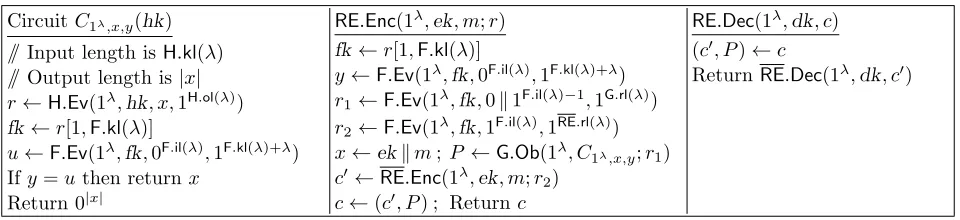
CircuitC1λ,x,y(hk)
// Input length isH.kl(λ) // Output length is|x| r←H.Ev(1λ,hk, x,1H.ol(λ)) fk←r[1,F.kl(λ)]
u←F.Ev(1λ,fk,0F.il(λ),1F.kl(λ)+λ)
Ify=uthen returnx
Return 0|x|
RE.Enc(1λ,ek, m;r)
fk ←r[1,F.kl(λ)]
y←F.Ev(1λ,fk,0F.il(λ),1F.kl(λ)+λ)
r1←F.Ev(1λ,fk,0k1F.il(λ)−1,1G.rl(λ)) r2←F.Ev(1λ,fk,1F.il(λ),1RE.rl(λ)) x←ekkm;P ←G.Ob(1λ, C
1λ,x,y;r1)
c0←RE.Enc(1λ,ek, m;r2)
c←(c0, P) ; Returnc
RE.Dec(1λ,dk, c)
(c0, P)←c
ReturnRE.Dec(1λ,dk, c0)
Figure 4: Middle, Right: Encryption and decryption algorithm of the counter-example PKE scheme
RE for Proposition 3.1. Left: Circuit constructed and obfuscated inRE.Enc.
scheme. Define PKE scheme RE as follows. Let RE.il=RE.il. Let RE.Kg =RE.Kg. Let the encryption and decryption algorithms of RE be as shown in Fig. 4. Then (1) EwH[H,RE] is not IND-secure, but (2) RE is IND-CPA secure.
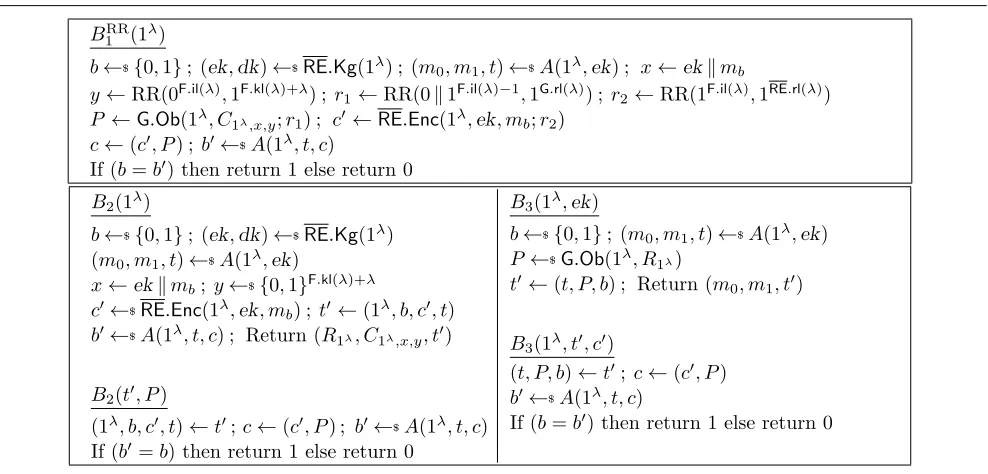
The proof of Proposition 3.1 is in Appendix A. Here we will sketch the ideas. An encryption c= (c0, P) of a message m under RE with public key ek will have two parts. The first, c0, is an encryption of m
under RE with ek. The second, P, is an obfuscated circuit that will (1) help attack DE = EwH[H,RE] yet (2) not compromise IND-CPA security of RE. The question is how to construct RE to ensure both properties. (Ensuring either alone is trivial.)
The starting idea, inspired by BFM [20], is to have RE.Enc, given 1λ,ek, m and coins r, create the following circuit:
C1λ,ek,m,r(hk) : If H(1λ,hk,ekkm,1RE.rl(λ)) =r then return melse return 0|m|.
The input to the circuit is a key hk for H, and the hardwired values 1λ,ek, m, r are the inputs to the algorithm RE.Enc that creates the circuit. NowRE.Enc letsP be an obfuscation of this circuit. Pretend for now that the obfuscation process is deterministic, which of course is not true, and also that no coins are used to create c0, which is also not true. Under these assumptions, if an attacker has anEwHciphertext (c0, P) = DE.Enc(1λ,(ek,hk), m), and also has the public key (ek,hk) of DE, then it can run P on hk
which, due to the structure of EwH and the construction of C1λ,ek,m,r, returns m, breaking the IND-security of DE. But there are a number of difficulties. One is that there seems no reason that this RE
retains IND-CPA security assuming only iO security of the obfuscation. Another is that the obfuscation and REare randomized, andREhas to provide coins for both fromr yet be able to createP to allow the attack when r is produced via the hash in EwH.
We will use the VOL PRFFto allocate pseudorandom coins for the obfuscation process andRE. The key forF will be a prefixfk←r[1,F.kl(λ)] of the coinsr provided toRE.Enc. Recall that in our definition of a VOL PRF, the key generation always samplesfk←${0,1}F.kl(λ), so ifris truly random then we giveF a correctly generated key. Instead of hardwiring r to the circuit, we hardwirey ←F.Ev(1λ,fk,0F.il(λ),1`) for an appropriate `. We also hardwire x = ekkm rather than ek, m separately. Our circuit C1λ,x,y is shown in the left panel of Fig. 4. We need (1) an attack on DE=EwH[H,RE] and (2) a proof that RE is IND-CPA. For (1) our claim is that if C1λ,ekkm,y is produced by RE.Enc within DE then C1λ,ekkm,y(hk) will return ekkm, and thus running an obfuscationP ofC1λ,ekkm,y on hkwill return the same. For (2), r is truly random so C1λ,ekkm,y as produced during encryption is indistinguishable from C1λ,ekkm,u withu a random `-bit string, by PRF security of F. To use iO security, we want that when u is random the probability that there exists a H.kl(λ)-bit z such that C1λ,ekkm,u(z) 6= 0|ekkm| is negligible. This is established via a counting argument which relies on having set`to be large enough. See Appendix A for details.
stan-DE1.Kg(1λ)
(ek,dk)←$LT.EKg(1λ) hk←$H.Kg(1λ)
Return ((ek,hk),(dk,hk))
DE1.Enc(1λ,(ek,hk), m)
r←H.Ev(1λ,hk, m,1LT.il(λ))
trap←LT.Ev(1λ,ek, r)
c←m⊕H.Ev(1λ,hk, r,1|m|)
Return (trap, c)
DE1.Dec(1λ,(dk,hk),(trap, c))
r←LT.Inv(1λ,dk,trap)
Returnc⊕H.Ev(1λ,hk, r,1|c|)
Figure 5: The algorithms of ourDE1D-PKE scheme.
dard model scheme under UCE[Ssup]. Let Hbe a UCE[Ssup] function family withH.IL(·) =H.OL(·) =
N.
From the above we know that EwH[H,RE] will not be IND for all IND-CPA RE. We consider instead a particular choice of IND-CPARE. Recall that BR93 [12] present a simple TDF-based PKE scheme proven IND-CPA in the ROM. We instantiate their TDF with a LTDF and then instantiate the RO with Hto get a standard-model PKE scheme we denote RE= BR93[LT,H]. We now consider the standard-model D-PKE scheme EwH[H,RE]. In this scheme,His used twice, with two independent keys. Our final DE1
D-PKE scheme is obtained by using the same key for both invocations of H. The algorithms of this scheme are shown in Fig. 5. Importantly, DE1.IL(·) =H.OL(·) =N, meaning we can encrypt messages of
arbitrary and varying length. We note that using a single H key is not only an optimization in key size but also avoids using multi-key variants of UCE [8] and is important to prove security underUCE[Ssup]. The following says that DE1 is IND-secure.
Theorem 3.2 Let LT be a lossy trapdoor function and H a UCE[Ssup] function family with H.IL(·) =
H.OL(·) =N. LetDE1 be constructed as in Fig. 5. Then Asymptotic result: DE1 is IND-secure.
Concrete result: LetA be an adversary andP a predictor. We can construct an adversaryB, a sourceS, and a distinguisherD such that
AdvindDE1,A(·)≤2AdvltdfLT,B(·) + 2AdvuceH,S,D(·) + 3v 2
2LT.il (1)
AdvpredS,P(·)≤ 1.5v
2
2LT.il +qv·GuessA(·) +
qv
2τ (2)
where q is the maximum of the size of P’s output in the execution of PredPS, v is the maximum of the size of A’s message vector in the execution of INDADE, and τ is the lossiness of LT. Furthermore,
T(UCES,DH )≤T(INDADE1);QHash
S ≤v; and T(Lossy B
LT)≤T(INDADE1).
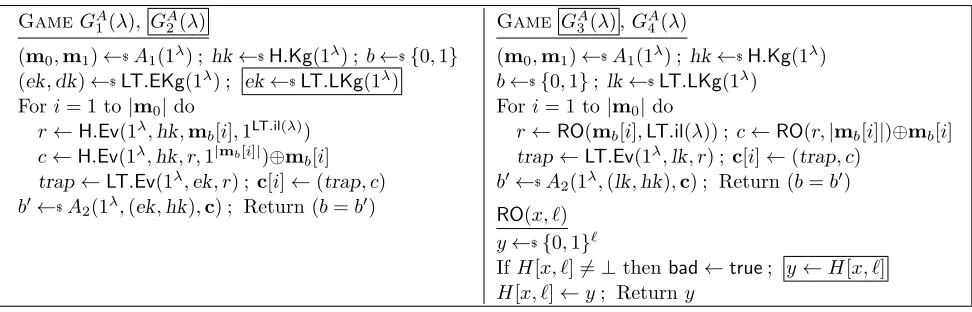
The proof is in Appendix B. Here we discuss some of the ideas. To construct a source S and a distin-guisher D, a naive method is to let them runA to simulate game INDADE1. However this won’t produce a statistically unpredictable source. The key idea is to let our source generate a lossy key lk. instead of an injective key ek as in game INDADE1. The statistical unpredictability of S then follows from the lossiness ofLT, as represented by Equation (2). On the other hand, game UCES,DH for challenge bit b= 1 no longer coincides with game INDADE1. Still, this gap can be bounded by constructingB attacking LT, so that Equation (1) holds.
In Section 5 we discuss how, under appropriate instantiations of theUCE[Ssup] family,DE1is extremely efficient compared to prior standard-model D-PKE schemes.
Game CDAAHE(λ)
(ek,dk)←$HE.Kg(1λ) ; b←${0,1}; t←$ALR2 (1λ) ; b0←$A2(t,ek) ; Return (b=b0) LR(d)
(m0,m1,r)←$A1(1λ, d)
Fori= 1 to |r|doc[i]←HE.Enc(1λ,ek,mb[i];r[i]) Return c
Figure 6: Game defining IND-CDA security of PKE schemeHE.
4
Fully secure Hedged PKE
In this section we provide the first fully H-IND PKE schemes in the standard model. Additionally our schemes are efficient. HE1is our base scheme encrypting fixed-length messages; HE2 encrypts variable-length messages;HE3has a tighter security analysis. Our schemes provide pragmatic and effective defense against subversion of encryption randomness.
Hedged PKE.To achieve standard IND-CPA security, PKE schemes demand truly random coins. Many well-known PKE schemes fail spectacularly, allowing message recovery from the ciphertext, if the latter is created with even somewhat weak coins [19, 45, 5]. BBNRSS [5] introduce security under chosen-distribution attack (IND-CDA) to provide meaningful security when bad randomness is used. A secure hedged PKE scheme must provide IND-CPA security when the coins are truly random, and fall back to IND-CDA security when bad coins are provided. Formally, for a PKE scheme HE, we say that HE is H-IND secure if (1)HEis IND-CPA secure, and (2)HEis CDA secure. Game CDA defining the IND-CDA notion is given in Fig. 6. An IND-IND-CDA adversary A= (A1, A2) is a pair of algorithms. In the first part of the attack, A2 can adaptively query oracleLR, each query taking a distribution-specifier stringd and returning a challenge ciphertext vector c. In this phase A2 does not get ek. Once this stage ends, it gets ek and must then render its decision. Algorithm A1 defines a distribution over triples (m0,m1,r) that is a function ofd. We require that (i) there be a polynomialvsuch that|m0|=|m1|=|r| ≤v(λ), (ii)
|m0[i]|=|m1[i]| ∈HE.IL(λ) and|r[i]|=HE.rl(λ) for everyi≤ |r|, and (iii) for eachb∈ {0,1}the|r|pairs (mb[i],r[i]) are distinct, where 1≤i≤ |r|. Let GuessA(·) be the function that on inputλ∈Nreturns the
maximum, over all b, i, m, r, d, of Pr[(mb[i],r[i]) = (m, r)], the probability over (m0,m1,r)←$A1(1λ, d). We say that A has high min-entropy if GuessA(·) is negligible. We say that HE is IND-CDA-secure if
AdvcdaHE,A(·) = 2 Pr[CDAAHE(·)]−1 is negligible for every PT adversary A of high min-entropy. We stress that this captures full IND-CDA since the messages in the message vectors may be arbitrarily correlated.
The HE1 scheme.Recall we obtained our D-PKE scheme DE1via a BR93-based instantiation of EwH. In analogy it is natural to try to obtain an H-IND scheme via a similar BR93-based instantiation of the REwH transform of BBNRSS [5]. This results in the candidate scheme Hedge[H,LT], associated to a function family H and LTDF LT, whose algorithms are shown in the left panel of Fig. 7. Here
Hedge[H,LT].IL(·) =H.OL(·), meaning we can encrypt messages of length matching the allowed output lengths ofH.
Hedge[H,LT].Kg(1λ)
hk←$H.Kg(1λ) (ek,dk)←$LT.EKg(1λ) Return ((ek,hk),(dk,hk))
Hedge[H,LT].Enc(1λ,(ek,hk), m;r)
x←H.Ev(1λ,hk, rkm,1LT.il(λ))
trap←LT.Ev(1λ,ek, x)
c←H.Ev(1λ,hk, x,1|m|)⊕m
Return (trap, c)
Hedge[H,LT].Dec(1λ,(dk,hk),(trap, c))
x←LT.Inv(1λ,dk,trap)
m←H.Ev(1λ,hk, x,1|c|)⊕c
Returnm
H.Kg(1λ)
uk←$U.Kg(1λ) hk←$H.Kg(λ) hk←(hk,uk) Returnhk H.Ev(1λ,hk, x,1`) (hk,uk)←hk
u←U.Ev(1λ,uk, x)
y←H.Ev(1λ,hk, u,1`) Returny
U.Kg(1λ)
uk←$U.Kg(1λ) mk←${0,1}U.ol(λ)
rk←$GF(2U.ol(λ))\{0U.ol(λ)} Return (uk,rk,mk)
U.Ev(1λ,(uk,rk), x)
If|x|<U.ol(λ) then
Returnmk⊕(xk10U.ol(λ)−|x|)
x1←x[1,U.ol(λ)]
x2←x[U.ol(λ) + 1,|x|]
y←U.Ev(1λ,uk, x
2)⊕(x1×rk)
Returny
Figure 7: Left: The PKE schemeHedge[H,LT] associated to function familyHand LTDFLT. Middle:
The H = AU-then-Hash[U,H] VIL UCE[Ssup] family built from an AU hash U and a FIL UCE[Ssup] family H. Right: The U = Hash-then-Mask[U] AU family built from an AU family U. The operator
× is multiplication in the finite field GF(2U.ol(λ)) and the string 0U.ol(λ) encodes the zero element of GF(2U.ol(λ)). HE1: OurHE1PKE scheme is obtained from an LTDFLT, a FILUCE[Ssup] familyHand an AU family UasHE1=Hedge[H,LT] withH=AU-then-Hash[U,H] and U=Hash-then-Mask[U].
But recall that H-IND requires also that Hedge[H,LT] is IND-CPA. But it is quite unclear why this would be true under UCE[Ssup] security ofH. The reason is that UCE guarantees nothing for inputs de-pending onhkbut messages in IND-CPA can depend on the public key, which containshk. This difficulty is quite fundamental and at first seemed impossible to circumvent within the UCE framework. We resolve it by using a particular UCE[Ssup] family H. LetHbe a fixed input lengthUCE[Ssup] family. Recall that the AU-then-Hash transform of BHK2 [9] takes an AU (almost universal) family U and H to return a variable input length family H=AU-then-Hash[U,H] that they show is itselfUCE[Ssup]. We will take an (arbitrary) AU familyUand construct another, special AU familyU=Hash-then-Mask[U] via a transform called Hash-then-Mask that we introduce. Then our UCE[Ssup] family is H=AU-then-Hash[U,H]. With this choice we will be able to show that HE1 = Hedge[H,LT] —this is our scheme— is IND-CPA. In conjunction with our prior claim, HE1is then H-IND as desired.
We now detail this. We recall some definitions from BHK2 [9]. LetVbe a fixed output length (FOL) function family. Let λ, m∈N. Let
Coll1V(λ, m) = max{Pr[y=V.Ev(1λ,vk, x)] : |y|=V.ol(λ) and|x| ≤m}
Coll2V(λ, m0, m1) = max{Pr[V.Ev(1λ,vk, x0) =V.Ev(1λ,vk, x1)] : |x0| ≤m0,|x1| ≤m1 and x06=x1}
CollV(λ, m0, m1) = max{Coll2V(λ, m0, m1),Coll1V(λ,min{m0, m1})} .
In the first and second equations, the probability is over vk←$V.Kg(1λ). A FOL family V is almost universal (AU) if for all polynomialsM0, M1: N→Nthe function fM0,M1 is negligible, where for λ∈N
we let fM0,M1(λ) =CollV(λ, M0(λ), M1(λ)).
Now let Ube a (FOL) AU family having U.IL=N. We introduce a transform calledHash-then-Mask
that given U returns the family U = Hash-then-Mask[U] defined in the right panel of Fig. 7. It has
U.ol=U.oland U.IL=N. Lemma 4.1 below shows that Uis itself an AU family.
Lemma 4.1 Let U be a (FOL) AU hash of U.IL = N. Let U = Hash-then-Mask[U]. Then for any λ, m, m0 ∈Nwe have (a)Coll1U(λ, m)≤Coll1U(λ, m)+2−U.ol(λ)and (b)Coll2U(λ, m, m0)≤Coll2U(λ, m, m0)
The proof of Lemma 4.1 is in Appendix C. Note that BHK2 [9] provide an extremely fast construction of an AU family U, running at 0.4 cycles per byte. Our Hash-then-Mask does not degrade speed much, and thus the familyU=Hash-then-Mask[U] used in our scheme is also fast.
Now letHbe a function family with FILH.iland withH.OL=N. LetUbe a FOL AU function family
with U.ol = H.il and with U.IL =H.OL = N. The AU-then-Hash transform of BHK2 [9] takes U,H and
returns the family H=AU-then-Hash[U,H] shown in the middle panel of Fig. 7. It hasH.OL=H.IL=N.
BHK2 [9] show that if His UCE[Ssup] then so is H.
We are finally ready to define our HE1 scheme. Let H be a function family with FIL H.il and with
H.OL = N. Let U be a (FOL) AU family having U.IL = N. Let LT be an LTDF. Let `: N → N be a
polynomial. Then let HE1=Hedge[H,LT] with H=AU-then-Hash[U,H] and U=Hash-then-Mask[U]. A subtle point is that we set HE1.il= `, meaning HE1 is restricted to encrypt messages of length`. Why this is needed is not evident from the scheme description but will be needed in the proof of security. We also set HE1.rl=U.ol. Theorem 4.2 below shows that HE1is H-IND secure. The concrete security statements refer to
AdvcollU (λ, p, σ) = maxn k
X
i=1 k0
X
j=1
CollU(λ, mi, m0j) : k≤p, k 0 ≤p,
k
X
i=1
mi≤σ, k0
X
i=1
m0i ≤σo .
Theorem 4.2 Let H be a UCE[Ssup] function family with FIL H.il and with H.OL =
N. Let U be a
(FOL) AU family having U.IL = N. Let LT be an LTDF. Let `: N → N be a polynomial. Let HE1 be
defined fromH,U,LT, ` as above.
Asymptotic result: HE1is H-IND secure.
Concrete IND-CPA result: LetA be an adversary andP be a predictor. We can construct a source S, a distinguisher Dand an adversary B such that
AdvindHE1-cpa,A(·)≤2AdvuceH,S,D(·) + 2AdvltdfLT,B(·) + 21−U.ol
Advpred
S,P(·)≤ √
q
2τ /2 + q
q·Coll2U(·,LT.il) + 2
√
q
2U.ol/2
where q is the maximum of the size of P’s output in the execution of PredPS andτ is the lossiness ofLT. Furthermore, T(LossyBLT),T(UCES,D
H ); andQ
Hash S = 2.
Concrete IND-CDA result: Let A be an adversary and P be a predictor. We can construct a source S, a distinguisher Dand an adversary B such that
AdvcdaHE1,A(·)≤2AdvltdfLT,B(·) + 2AdvuceH,S,D(·) + 2AdvcollU (·,2p, s) + 3p2·GuessA(·) +
19p2
2min{U.ol,LT.il}
Advpred
S,P(·)≤
q
2q·AdvcollU (·,2p, s) + 2ppq·GuessA(·) +
6p√q
2min{U.ol,τ}/2
where p is the maximum of the total number of messages thatA produces in the execution of CDAAHE1,
s=p·(U.ol+LT.il+`),q is the maximum of the size ofP’s output in the execution of PredPS, and τ is the lossiness of LT. Moreover,T(LossyBLT),T(UCES,D
H )≤T(CDA A
HE1); andQHashS ≤2p.
HE2.Enc(1λ,(ek,hk), m;r)
x←H.Ev(1λ,hk, rkm,1LT.il(λ))
trap←LT.Ev(1λ,ek, x)
seed←H.Ev(1λ,hk, x,1F.kl(λ)+U.ol(λ))
y←seed[1,U.ol(λ)] ; fk ←seed[U.ol(λ) + 1,|seed|] mask←F.Ev(1λ,fk,0F.il(λ),1|m|)
c←H.Ev(1λ,hk, y,1|m|)⊕mask⊕m
Return (trap, c)
HE2.Dec(1λ,(dk,hk),(trap, c))
x←LT.Inv(1λ,dk,trap)
seed←H.Ev(1λ,hk, x,1F.kl(λ)+U.ol(λ))
y←seed[1,U.ol(λ)] ; fk ←seed[U.ol(λ) + 1,|seed|] mask←F.Ev(1λ,fk,0F.il(λ),1|c|)
m←H.Ev(1λ,hk, y,1|c|)⊕mask⊕c
Returnm
Figure 8: Encryption and decryption algorithms ofHE2, whereUis an AU family, His a FILUCE[Ssup] family, Fis a VOL PRF, LTis a LTDF. HereU=Hash-then-Mask[U] and H=AU-then-Hash[U,H].
requires knowing|m|; it’s whyHE1can only handle fixed-length messages. For IND-CDA security, we can actually prove that Hedge[H,LT] is IND-CDA secure for any UCE[Ssup]H. The source will run A
1 and the first phase of A2 to create the ciphertexts via the Hash oracle. Note that during the first phase,A2 only receives what the source sees, and therefore doesn’t get to learn the hash key hk. UCE then allows us to switch to a game in which the adversary has to fight an RO-based scheme, and thus its adaptivity is futile. Moreover, it can only specify distributions, and thus despite the adaptivity, the chance that the source repeats aHashquery is aboutp2·GuessA. We again exploit the lossiness ofLTto allow statistical unpredictability.
The HE2 scheme. With HE1 we reach our goal of the first fully H-IND secure PKE scheme in the standard model. Additionally it is more efficient than prior standard-model schemes that only achieved non-full security. However, like prior standard-model schemes, it is FIL, meaning only encrypts messages of a fixed length. We now provide the HE2 scheme that retains the security properties of HE1 but additionally can encrypt messages of variable and arbitrary length. Furthermore it can do this with hybrid-encryption like performance, meaning the asymmetric cost is fixed as message length grows.
The additional tool that we need is a VOL PRFF—this meansF.OL(·) =N— such that λ∈F.IL(λ)
for every λ ∈ N. As before let H be a function family with FIL H.il and with H.OL(·) = N. Let U be a (FOL) AU family having U.IL(·) = N. Let LT be an LTDF. Let U = Hash-then-Mask[U] and H = AU-then-Hash[U,H]. The encryption and decryption algorithms of HE2 are specified in Fig. 8. The key-generation algorithm HE2.Kg is the same as HE1.Kg. We let HE2.rl = U.ol. But this time
HE2.IL(·) = N, meaning we can encrypt messages of any length. Theorem 4.3 below formally confirms
that HE2is H-IND secure.
Theorem 4.3 LetF be a PRF withF.OL(·) =Nand λ∈F.IL(λ) for everyλ∈N. LetHbe aUCE[Ssup]
function family with FIL H.il and with H.OL(·) =N. Let U be a (FOL) AU family having U.IL(·) =N.
Let LTbe an LTDF. LetHE2be defined fromF,H,U,LTas above.
Asymptotic result: HE2is H-IND secure.
Concrete IND-CPA result: LetA be an adversary andP be a predictor. We can construct a source S, a distinguisher D, adversaries B andC such that
AdvindHE2-cpa,A(·)≤2AdvuceH,S,D(·) + 2AdvltdfLT,B(·) + 2AdvFprf,C(·) + 21−U.ol
Advpred
S,P(·)≤ √
q
2τ /2 + q
q·Coll2U(·,LT.il) + 2
√
q
2U.ol/2
where q is the maximum of the size of P’s output in the execution of PredPS andτ is the lossiness ofLT. Furthermore, T(LossyBLT),T(UCES,D
H ),T(PRF C
Concrete IND-CDA result: Let A be an adversary and P be a predictor. We can construct a source S, a distinguisher D, adversaryB such that
AdvcdaHE,A(·)≤2AdvltdfLT,B(·) + 2AdvuceH,S,D(·) + 2AdvcollU (·,3p, s) + 5p2·GuessA(·) +
44p2
2min{U.ol,LT.il}
Advpred
S,P(·)≤
q
2qAdvcoll
U (·,3p, s) + 2.5p
p
q·GuessA(·) +
9.5p√q
2min{U.ol,τ}/2
wherepis the maximum of the total number of messages that Aproduces in the execution of CDAAHE2,s
is 3p·max{U.ol,LT.il}plus the maximum of the total length of messages thatAproduces in the execution of CDAAHE2,q is the maximum of the size ofP’s output in the execution of PredPS, and τ is the lossiness of LT. Moreover,T(LossyBLT),T(UCES,D
H )≤T(CDA A
HE2); andQHashS ≤3p.
The proof of Theorem 4.3 is in Appendix E. Here we give some intuition about why HE2 can securely handle variable-length messages. We’ll only discuss the IND-CPA case, in which the message length may depend on the public key. The source will be responsible for producing a PRF key fk, whose length is independent of the public key, and will leak it along with some other information. The UCE security is only used to ensure that fk looks random to the distinguisher. The task of generating the two pads
F.Ev(1λ,fk,0F.il(λ),1|m|) and H.Ev(1λ,hk, y,1|m|) is left to the distinguisher who runs A to get m. Note that the distinguisher always creates H.Ev(1λ,hk, y,1|m|) regardless of the challenge bit of game UCE. We then use the PRF security of F to ensure that the first pad looks random to A. Consequently, in the string (trap, c) that A receives, the first component is independent of the message, and the second component is indistinguishable from a random string.
The HE3 scheme. Consider theppq·GuessA(·) term in the concrete bound for IND-CDA security in Theorem 4.3. This is worse than the “optimal” bound p(q+p)·GuessA(·) if one uses a random oracle. Why does this gap matter? Asymptotically, we know that GuessA(·) is negligible, and hence this entire term is negligible too, under either of the two bounds. But concretely, the first bound means that we must have more min-entropy in the messages to get security. This is not desirable in practice. For example if we encrypt passwords, their min-entropy may be borderline. Thus it would be desirable to have a better bound. Moreover, it would also be desirable to give a simple construction based on ageneric UCE-secure hash. We achieve both goals with our HE3scheme.
The only ingredients we need this time are a PRFF (with fixed input lengthF.iland F.OL(·) = N),
a UCE[Ssrs] family H (with H.IL(·) = H.OL(·) =
N) and a LTDF LT. We letρ: N →N be a polynomial
that is a parameter of the scheme. The encryption and decryption algorithms of HE3 are shown in Fig. 9 and the key-generation algorithm HE3.Kg is the same as HE1.Kg. We letHE3.rl=ρ. We also let
HE3.IL(·) =N, meaning the scheme encrypts variable and arbitrary length messages. While the scheme is
quite simple it’s challenging to find an analysis to match the desired boundp(q+p)·GuessA(·) for the reset-advantage in the IND-CDA setting. A naive analysis will end up in an inferior bound q2p·GuessA(·). Let (m1, r1), . . . ,(mp, rp) be the message-coin pairs specified byA’s IND-CDA queries. The reset adversaryR is given a random oracle ROthat on input (x, `), returns a random string of length `. Let Bad be the event that Rqueriesy←RO(mk, ρ(λ)) and then queries RO(y⊕rk,F.kl(λ) +λ) for somek≤p. ForHE3 to be IND-CDA secure, Badmust not occur. Suppose that R queriesRO(x1, ρ(λ)), . . . ,RO(xbq/2c, ρ(λ)), and then queries RO(z1,F.kl(λ) +λ), . . . ,RO(zbq/2c,F.kl(λ) +λ). If there are i, j ≤ bq/2c and k ≤ p such that xi = mk and RO(xi, ρ(λ))⊕zj = rk then Bad occurs. This seems to happen with probability
q2p
4 GuessA(·), because R canadaptively choose zj after seeing RO(x1, ρ(λ)), . . . ,RO(xbq/2c, ρ(λ)).
To tackle this problem, we exploit a combinatorial technique on the coin lengthρ—a parameter that we fully control. From Lemma 4.4 below, the chance thatBadoccurs is at mostqp·GuessA(·) +q2p·2−ρ(λ)/3. Ifρ is large enough, sayρ(λ)≥4.5λfor every λ∈N, then this matches the optimal bound. The proof of Lemma 4.4 is in Appendix F.
HE3.Enc(1λ,(ek,hk), m;r)
w←H.Ev(1λ,hk, m,1|r|)⊕r
x←H.Ev(1λ,hk, w,1LT.il(λ)) trap←LT.Ev(1λ,ek, x)
seed←H.Ev(1λ,hk, x,1F.kl(λ)+λ)
y←seed[1, λ] ; fk←seed[λ+ 1,|seed|] mask←F.Ev(1λ,fk,0F.il(λ),1|m|)
c←H.Ev(1λ,hk, y,1|m|)⊕mask⊕m
Return (trap, c)
HE3.Dec(1λ,(dk,hk),(trap, c))
x←LT.Inv(1λ,dk,trap)
seed←H.Ev(1λ,hk, x,1F.kl(λ)+λ)
y←seed[1, λ] ; fk←seed[λ+ 1,|seed|] mask←F.Ev(1λ,fk,0F.il(λ),1|c|)
m←H.Ev(1λ,hk, y,1|c|)⊕mask⊕c
Returnm
Figure 9: Encryption and decryption algorithms ofHE3, whereHis aUCE[Ssrs] family,Fis a VOL PRF and LTis a LTDF.
maximum, over all u, v, of Pr[(U, V) = (u, v)], is at most . Let RO be a random oracle and let
W = RO(U, `)⊕V. For any adversary A that makes at most q queries to RO, the probability that the first component of one of A’sROqueries is W is at mostq+q2·2−`/3.
Theorem 4.5 below confirms that HE3 is H-IND secure with very good concrete security bounds. While UCE[Ssup] is enough for IND-CPA security, IND-CDA requires the strongerUCE[Ssrs] assumption. The proof is in Appendix G.
Theorem 4.5 Let F be a PRF with F.OL(·) = N and fixed input length F.il. Let H be a UCE[Ssrs]
function family with H.IL(·) = H.OL(·) = N. Let LTbe an LTDF such that LT.il(λ) ≥λ for all λ ∈N.
Let ρ: N→N be a polynomial such thatρ(λ)≥λfor allλ∈N. Let HE3be defined from F,H,LT, ρas
above.
Asymptotic result: HE3is H-IND secure.
Concrete IND-CPA result: LetA be an adversary andP be a predictor. We can construct a source S, a distinguisher D, adversaries B andC such that
AdvindHE3-cpa,A(·)≤2AdvuceH,S,D(·) + 2AdvltdfLT,B(·) + 2AdvprfF,C(·) + 21−ρ
AdvpredS,P(·)≤ 2q
2ρ +
q
2τ
where q is the maximum of the size of P’s output in the execution of PredPS andτ is the lossiness ofLT. Furthermore, T(LossyBLT),T(UCES,D
H ),T(PRF C
F)≤T(CPAAHE3);QRRC = 1; andQHashS = 2.
Concrete IND-CDA result: Let A be an adversary and R be a predictor. We can construct a source S, a distinguisher D, adversaryB such that
AdvcdaHE,A(λ)≤2AdvltdfLT,B(λ) + 2AdvuceH,S,D(λ) +p2·GuessA(λ) + 8p2
2λ +
12p2
2min{τ(λ),ρ(λ)}
AdvresetS,R(λ)≤p(p+q)·GuessA(λ) + 5p2
2λ +
6.5p2
2min{τ(λ),ρ(λ)} +
pq2
2ρ(λ)/3
where p is the maximum of the total number of messages thatA produces in the execution of CDAAHE3,
q = QHash
R , and τ is the lossiness of LT. Furthermore, T(LossyBLT),T(UCE S,D
H ) ≤ T(CDA A
HE3); and QHash
S ≤3p.
![Figure 3: ←Left: Game defining IND security of D-PKE scheme DE. Middle: D-PKE scheme DE =EwH[H, RE]](https://thumb-us.123doks.com/thumbv2/123dok_us/7904900.1312410/10.612.82.539.56.185/figure-left-game-dening-security-scheme-middle-scheme.webp)

![Figure 7:Left:Thean AU family The PKE scheme Hedge[H, LT] associated to function family H and LTDF LT](https://thumb-us.123doks.com/thumbv2/123dok_us/7904900.1312410/15.612.80.537.57.243/figure-thean-family-scheme-hedge-associated-function-family.webp)
![Figure 8:Encryption and decryption algorithms of HE2, where U is an AU family, H is a FIL UCE[Ssup]family, F is a VOL PRF, LT is a LTDF](https://thumb-us.123doks.com/thumbv2/123dok_us/7904900.1312410/17.612.78.550.57.168/figure-encryption-decryption-algorithms-family-ssup-family-ltdf.webp)
![Figure 9:Encryption and decryption algorithms of HE3, where H is a UCE[Ssrs] family, F is a VOL PRFand LT is a LTDF.](https://thumb-us.123doks.com/thumbv2/123dok_us/7904900.1312410/19.612.69.553.57.179/figure-encryption-decryption-algorithms-ssrs-family-prfand-ltdf.webp)
![Figure 10: U-PKE scheme UE = UniqueCtx[DE] constructed from D-PKE scheme DE.](https://thumb-us.123doks.com/thumbv2/123dok_us/7904900.1312410/21.612.75.529.56.140/figure-pke-scheme-ue-uniquectx-constructed-pke-scheme.webp)