
Verifiable Order Queries and Order Statistics on a List in
Zero-Knowledge
∗Esha Ghosh†1, Olga Ohrimenko‡2and Roberto Tamassia§1
1Department of Computer Science, Brown University
2Microsoft Research
Abstract
Given a listLwithnelements, an order query onLasks whether a given elementx∈Lprecedes or follows another elementy∈L. More generally, given a set ofmelements fromL, an order query asks for the set ordered according to the positions of the elements inL. We introduce two formal models for answering order queries on a list in a verifiable manner and in zero-knowledge. We also present efficient constructions for these models.
Our first model, calledzero-knowledge list(ZKL), generalizes membership queries on a set to order queries on a list in zero-knowledge. We present a construction of ZKL based on zero-knowledge sets and a homomorphic integer commitment scheme.
Our second model,privacy-preserving authenticated list(PPAL), extends authenticated data struc-tures by adding a zero-knowledge privacy requirement. In this model, a list is outsourced by a trusted owner to an untrusted cloud server, which answers order queries issued by clients. The server also re-turns a proof of the answer, which is verified by the client using a digest of the list obtained from the owner. PPAL supports the security properties of data integrity against a malicious server and privacy protection against a malicious client. Though PPAL can be implemented using our ZKL construction, this construction is not as efficient as desired in cloud applications. To this end, we present an efficient PPAL construction based on blinded bilinear accumulators and bilinear maps, which is provably secure and zero-knowledge (e.g., hiding even the size of the list). Our PPAL construction uses proofs ofO(m)
size and allows the client to verify a proof inO(m)time. The owner executes the setup inO(n)time and space. The server usesO(n)space to store the list and related authentication information, and takes
O(min(mlogn,n))time to answer a query and generate a proof. Both our ZKL and PPAL constructions have one round of communication and are secure in the random oracle model.
Finally, we show that our ZKL and PPAL frameworks can be extended to support fundamental sta-tistical queries (including maximum, minimum, median, threshold and top-telements) efficiently and in zero-knowledge.
Keywords: order queries, order statistics, zero-knowledge, integrity, authenticated data structures bilin-ear accumulators, leakage-free redactable signatures, cloud security, cloud-privacy
∗The full version of this work is available onhttp://eprint.iacr.org/2014/632and an early version (May 2014) appeared inhttp://arxiv.org/abs/1405.0962.
1 Introduction
Releasing verifiable partial information while maintaining privacy is a requirement in many practical sce-narios where the data being dealt with is sensitive. A basic case is releasing a subset of a set and proving its authenticity in a privacy-preserving way (referred to as zero-knowledge property) [MRK03, CHL+05, CFM08, LY10]. However, in many other cases, the information is stored in data structures to support richer type of queries. In this paper, we considerorder querieson two or more elements of a list, where the answer to the query returns the elements rearranged according to their order in the list. Order queries lie at the heart of applications where the order between queried elements is revealed and proved but the rank of the queried elements in the list and information about other elements in the list should be protected. We give three practical examples below.
Consider an auction with a single winner (e.g., online ad auction for a single ad spot) where every participant submits her secret bid to the auction organizer. After the top bidder is announced by the organizer, a participant wishes to verify that her bid was inferior. The organizer would then provide a proof without revealing the amount of the top bid, the rank of the participant’s bid, or any information about other bids.
Lenders often require an individual or a couple to prove eligibility for a loan by providing a current bank statement and a pay stub. Such documents contain a lot of sensitive information beyond what the lender is looking for: whether the bank account balance and salary are above given thresholds. A desirable alternative would be to provide a proof from the bank and employer that these thresholds are met without revealing exact figures and even hiding who of the two spouses earns more.
Consider yet another scenario where there are multiple regional sales divisions of a company distributed across three neighboring states. A monthly sales report contains the number of products sold by each of the divisions, arranged in non-decreasing order. Each monthly sales report is signed by the authority and stored on a cloud server. By the company’s access control policy, each sales division is allowed to learn how it did in comparison to the other units, but not anything else. That is, a division cannot learn the sales numbers of other divisions or their relative performance beyond what it can infer by the comparisons with itself. Thus, the cloud server would need to release the relevant information in such a way that the querying division can verify that the data came from the legitimate source but not learn anything beyond the query result.
The above examples can be generalized using order queries on an ordered set, aka list, that return the order of the queried elements as well as a proof of this order but without revealing anything more than the answer itself. We address this problem by introducing two different models: zero knowledge lists(ZKL) andprivacy-preserving authenticated lists(PPAL).
ZKL considers two party model and extends zero knowledge sets [MRK03, CHL+05] to lists. In ZKL a prover commits to a list and a verifier queries the prover to learn the order of a subset of list elements. The verifier should be able to verify the answer but learn no information about the rest of the list, e.g., the size of the list, the order of other elements of the list or the rank of the queried element(s). Here both the prover and the verifier can act as malicious adversaries. While the prover may want to give answers inconsistent with the initial list he committed to, the verifier may try to learn information beyond the query answer or arbitrarily deviate from the protocol.
PPAL considers three parties: the owner of the list, the server who answers list queries on behalf of the owner, and the client who queries the server. The privacy guarantee of PPAL is the same as in ZKL. For authenticity, PPAL assumes that the owner is trusted while the server and the client could be malicious. This trust model allows for a much more efficient construction than ZKL, as we will see later in the paper. PPAL has direct applications to outsourced services where the server is modeling the cloud service that the owner uses to interact with her clients.
been studied in this model and as a consequence, known ADS constructions leak information about the rest of the data through their proofs of authenticity. For example, the classic Merkle hash tree [Mer80, Mer89] on a set ofnelements proves membership of an element via a proof of size logn, thus leaking information about the size of the set. Also, if the elements are stored at the leaves in sorted order, the proof ofmembershipof an element reveals its rank.
In this paper, we define the security properties for ZKL and PPAL and provide efficient constructions for them. The privacy property against the verifier in ZKL and the client in PPAL is zero knowledge. That is, the answers and the proofs are indistinguishable from those that are generated by a simulator that knows nothing except the previous and current queries and answers and, hence, cannot possibly leak any information beyond that. While we show that PPAL can be implemented using our ZKL construction, we also provide a direct PPAL construction that is considerably more efficient thanks to the trust that clients put in the list owner. Let n be the size of the list andm be the size of the query, i.e., the number of list elements whose order is sought. Our PPAL construction uses proofs ofO(m)size and allows the client to verify a proof inO(m)time. The owner executes the setup in O(n)time and space. The server usesO(n)
space to store the list and related authentication information, and takesO(min(mlogn,n))time to answer a query and generate a proof. In contrast, in the ZKL construction, the time and storage requirements have an overhead that linearly depends on the security parameter. Note that ZKL also supports (non-)membership queries. The client in PPAL and the verifier in ZKL require only one round of communication for each query. Our ZKL construction is based on zero knowledge sets and homomorphic integer commitments. Our PPAL construction uses a novel technique of blinding of accumulators along with bilinear aggregate signatures. Both constructions are secure in the random oracle model.
2 Problem Statement, Models, Related Work, and Contributions
In this section, we state our problem, outline our models, review related work, and summarize our contribu-tions. Formal definitions, constructions, and security proofs are in the rest of the paper.
2.1 Problem Statement and Models
We start by defining order queries and its applications, introduce our adversarial model and security proper-ties, and discuss our efficiency goals.
2.1.1 Query
Let
L
be a linearly ordered list of distinct elements. Anorder queryonL
is defined as follows: given a pair of elements(x,y)ofL
, return the pair with its elements rearranged according to their order inL
and a proof of this order. For example, ifyprecedesxinL
, then the pair(y,x)is returned as an answer. For generality, we define abatch order query: given a list of query elementsδ, each fromL
, return the permutation ofδaccording to the ordering of the elements in
L
and a proof of the order. Both models we introduce, PPAL and ZKL, support this query. ZKL, in addition to order queries, supports provable membership and non-membership queries. As a response to a (non-)non-membership element query the prover returns a boolean value indicating if the element is in the list and a corresponding proof of (non-)membership. Beside providing authenticity, the proofs are required not to leak any information beyond the answer.2.1.2 Adversarial model and security properties
In this section we present adversarial models and security properties of ZKL and PPAL.
ZKL The ZKL model considers two parties: prover and verifier. The prover initially computes a commit-ment to a list
L
and makes this commitment public (i.e., the verifier also receives it). Later the verifier asks membership and order queries onL
and the prover responds with a proof. Both the prover and the verifier can be malicious:• The verifier may try to learn from the proofs additional information about
L
beyond what he has inferred from the answers. E.g., if the verifier has performed two order queries with answersx<y andx<z, he may want to find out whethery<zorz<y. Here,x<ydenotes thatxappears beforey inL
.The security properties of ZKL, completeness, soundnessandzero-knowledge, guarantee security against malicious prover and verifier. Completeness mandates that honestly generated proofs always satisfy the ver-ification test. Soundness states that the prover should not be able to come up with a query, and corresponding inconsistent (with the initial commitment) answers and convincing proofs. Finally, zero-knowledge means that each proof reveals the answer and nothing else. In other words, there must exist a simulator, that given only oracle access to
L
, can simulate proofs for membership and order queries that are indistinguishable from real proofs. We discuss the security properties of ZKL in more detail in Section 4.2.PPAL The PPAL model considers, instead, three parties: owner, server and client. The owner generates list
L
and outsources it to the server. The owner also sends (possibly different) digest information with respect toL
to the server and the client. Given an order query from the client, the server, using the server digest, builds and returns to the client the answer and its proof, which is verified by the client using the client digest. Both the server and the client can be malicious:• The server may try to forge proofs for incorrect answers to (order) queries, e.g., prove an incorrect ordering of a pair of elements of
L
.• The client, similar to the verifier in ZKL, may try to learn from the proofs additional information about list
L
beyond what he has inferred from the answers.Note that in typical cloud database applications, the client is allowed to have only a restricted view of the data structure and the server enforces an access control policy that prevents the client from getting answers to unauthorized queries. This motivates the curious, possibly malicious, behavior from the client where he tries to ask ill-formed queries or queries violating the access control policy. However, we assume that the server enforces client’s legitimate behavior by refusing to answer illegal queries. Hence, the security model for PPAL is defined as follows.
The properties of PPAL,Completeness,SoundnessandZero-Knowledge, guarantee security against ma-licious server and client. They are close to the ones of ZKL except for soundness. For PPAL it enforces that the client does not accept proofs forged by the server for incorrect answers w.r.t. owner’s list. PPAL’s owner and server together can be thought of as a single party in ZKL, the prover. Hence, ZKL soundness protects against the prover who tries to give answers inconsistent with her own initial commitment. In the PPAL model, the owner and the server are separate parties where the owner is trusted and soundness protects against a malicious server only. We discuss the security properties of PPAL in more detail in Section 5.2.
To understand the strength of the zero-knowledge property, let us illustrate to what extent the proofs are non-revealing. This property guarantees that a client, who adaptively queries a static list, does not learn anything about ranks of the queried elements, the distance between them or even the size of
L
. The client is not able to infer any relative order information that is not inferable by the rule of transitivity from the previously queried orders. It is worth noting that in the context of leakage-free redactable signature schemes, privacy property has been defined using game-based definitions in transparency[BBD+10, SPB+12] and privacy[CLX09, KAB12]. However, our definition of simulatability of the query responses, or the zero-knowledge property, is a simpler and more intuitive way to capture the property of leakage-freeness.2.1.3 Efficiency
We characterize the ideal efficiency goals of our models as follows, where
L
is a list ofnitems andmis the query size:Storage space The space for storing list
L
and the auxiliary information for generating proofs should beO(n), irrespective of the number of queries answered.Proof size The proof of the answer to a query should haveO(m)size.
Query time Processing a query to generate the answer and its proof should takeO(m)time. Verification time Verifying the proof of an answer should takeO(m)time.
2.1.4 Applications of order queries to order statistics
Our PPAL order queries can be used as a building block to answer efficiently and in zero knowledge (i.e., the returned proofs should be simulatable) many interesting statistical queries about a list
L
withn elements. Let a pair order proof denote the proof of the order of two elements fromL
. Then a PPAL client can send the server a subsetS
ofmlist elements and request the server to return themaximum, minimum, or themedianelement ofS
w.r.t. the order of the elements in the list. This can be done by providingmpair order proofs. Order queries also can be extended to return thetop t elements ofS
by means oft(m−t)pair order proofs, or onlym−1 pair order proofs if the order between the toptelements can be revealed, where t<m. Finally, given an elementainL
, the server can return the elements ofS
that are above (or below) the thresholdvalueaby means ofmpair order proofs. It is important to note that neither of these queries reveal anything more than the answer itself. Moreover, the size of the proof returned for each query is proportional to the query size and is optimal for the threshold query where the proof size is proportional to the answer size. We note that these statistical queries are also supported by ZKL and are defined formally in Section 8.2.2 Related Work
We discuss related literature in three sections. First, we discuss work on data structures that answer queries in zero knowledge. Our ZKL is the first extension of this work to lists and order queries. We then mention signature schemes that can be used to instantiate outsourced data structures that require privacy and integrity to be maintained. However, such instantiations are not efficient since they are based on different models of usage and underlying data. Finally, we outline leakage-free redactable signature schemes for ordered lists and other structured data. These signature schemes are are not as efficient as our construction and their definitions are game-based as opposed to our intuitive zero-knowledge definition.
Zero Knowledge Data Structures Zero-knowledge dictionary and range queries have received consider-able attention in literature [MRK03, CHL+05, CFM08, LY10, ORS04]. Our proposed ZKL model is the first generalization of this line of work that supports order queries.
The model of zero knowledge set (ZKS) (more generally, zero knowledge elementary database) was introduced by Micaliet al.[MRK03] where a prover commits to a finite setSin such a way that, later on, she will be able to efficiently (and non-interactively) prove statements of the formx∈Sorx∈/ Swithout leaking any information aboutS beyond what has been queried for, not even the size of S. The security properties guarantee that the prover should not be able to cheat by proving contradictory statements about an element. Chaseet al.[CHL+05] abstracted the above solution and described the properties a commitment scheme should possess in order to allow a similar construction. This work introduced a new commitment scheme, calledmercurial commitment, which was later generalized to q-trapdoor mercurial commitments in [CFM08] and further improved in [LY10]. A q-trapdoor mercurial commitment allows a committer to commit to an ordered sequence of message and later open messages with respect to specific positions. A closely related notion of vector commitments was proposed in [CF13], where the authors show that a (concise) q-trapdoor mercurial commitment can be obtained from a vector commitment and a trapdoor mercurial commitment.
The above zero knowledge set constructions [MRK03, CHL+05, CFM08, LY10] use an implicit ordered q-way hash tree (q≥2) built on the universe of all N possible elements. and the proof size for (non-)membership for an individual element is O(logqN). Kateet al. [KZG10] suggested a weaker primitive
callednearly-zero knowledge setbased onpolynomial commitment[KZG10] where the proof size for (non-)membership for an individual element isO(1)but the set size is not private.
pro-vides answers range queries that are provably consistent with the commitment. They also consider adding privacy to this protocol. However their construction uses interaction (which can be avoided in the random oracle model) and requires the prover to keep a counter of past queries. Also, their use of NP-reductions and probabilistically checkable proofs makes their generic construction expensive. The authors also provide a simpler construction based on an explicit-hash Merkle Tree. However, this construction that does not hide the size of the database since the proof size isO(logN)whereNis the upper bound on the size of the dataset. We note that a recent work on DNSSEC zone enumeration by Goldberget al.[GNP+14] uses a model re-lated to our PPAL model and is independently developed. The framework supports only set (non-)membership queries and answers them in f-zero knowledge. This property ensures that the information leaked to the ver-ifier is in terms of a function f on the set, e.g., f is the set size in [GNP+14]. The authors also propose a weaker definition: selective membership security.
Signature Schemes A three party model where the owner digitally signs a data document and outsources it to the server and the server discloses to the client only part of the signed document along with a legitimately derived signature on it (without the owner’s involvement), can be instantiated with a collection of signature schemes, namely,content extraction, quotable, arithmetic, redactable, homomorphic, sanitizable and tran-sitive signatures[SBZ01, JMSW02, MHI06, MR02, Yi06, CH12]. Additionally, if the signatures reveal no information about the parent document, then this approach can be used to add privacy to outsourced data structure queries. However the generic instantiation, with signature schemes that do not specifically address structured data, is inefficient for most practical purposes.
Ahnet al. [ABC+12] present a unified framework for computing on authenticated data via the notion of slightly homomorphic orP-homomorphic signatures, which was later improved by [Wan12]. This broad class of P-homomorphic signatures includes quotable, arithmetic, redactable, homomorphic, sanitizable and transitive signatures. This framework allows a third party to derive a signature on an objectx0 from a signature on another parent objectxas long asP(x,x0) =1 for some predicatePthat captures the authenti-catable relationshipbetweenxandx0. A derived signature reveals no extra information about the parentx, referred to asstrong context hiding. This privacy definition was recently refined by [ALP12].
The authors propose a computationally expensive scheme based on the RSA accumulator. The cost of signing depends on the predicate P and the size of the message space and is O(n2) for a n-symbol message space. Computing am-symbol quote from an-symbol message requires timeO(n(n−m))and the verification of am-symbol quote takes timeO(m2). Predicates for specific data structures are not considered. Also, this line of work cannot be directly used for privacy preserving data structures where efficiency is an important requirement and quadratic overhead may be prohibitive depending on the application.
Chase et al. [CKLM13] give a definition and construction of a malleable signature scheme, where given a signatureσ on a messagex, it is possible to efficiently derive a signature σ0 on a messagex0 such that
x0=T(x)for anallowabletransformationT without access to the secret key. Their definition of simulation context hiding requires transformed signatures to be indistinguishable from freshly simulated signatures on the transformed messages. This definition is stronger than that of [ABC+12] as it allows for adversarially-generated keys and signatures.
Leakage-Free Signature Schemes for Structural Data A leakage-free redactable signature scheme (LRSS)allows a third party to remove parts of a signed document without invalidating its signature. This action, calledredaction, does not require the signer’s involvement. As a result, the verifier only sees the remaining redacted document and is able to verify that it is valid and authentic. Moreover, the leakage-freeness property ensures that the redacted document and its signature do not reveal anything about the content or position of the removed parts. In this section, we discuss the leakage-free redactable signature schemes present in the literature that specifically looks at structural data and ordered lists in particular. We will see that PPAL outperforms known LRSS constructions. Another, significant difference in our definition of privacy. We require simulatability of the query responses, or the zero-knowledge property, as opposed to the game based definitions in the LRSS literature [BBD+10, SPB+12]. Our definition is much more intuitive and simple in capturing the leakage-freeness property.
Kundu and Bertino [KB08] introduced the idea of structural signatures for ordered trees (subsuming or-dered lists) that support public redaction of subtrees by third-parties. This work was later extended to undi-rected graphs and DAGs [KB13]. The notion was later formalized asLRSSfor ordered trees in [BBD+10] and subsequently several attacks on [KB08] were also proposed in [BBD+10, PSPDM12]. The basic idea of the LRSS scheme presented in [BBD+10] is to signall possible ordered pairsof elements of an ordered list. So both the computation cost and the storage space are quadratic in the number of elements of the list.
Building on the work of [BBD+10], [SPB+12] proposed a LRSS for lists that has quadratic time and space complexity. Poehlset al.[PSPDM12] presented a LRSS scheme for a list that has linear time and space complexity but assumes an associative non-abelian hash function, whose existence has not been formally proved. Kunduet al.[KAB12], presented a construction that uses quadratic space at the server and is not leakage-free. We discuss the attack in Section 5.
Changet al.[CLX09] presented a leakage-free redactable signature scheme for a string (which can be viewed as a list) that hides the location of the redacted or deleted portions of the string at the expense of quadratic verification cost.
2.3 Contributions and Organization of the Paper
Our contributions are novel models and efficient constructions. They are summarized below.
• After reviewing preliminary concepts and cryptographic primitives, in Section 3, we introduce the zero-knowledge list (ZKL) model. We describe our ZKL construction, its security and efficiency in Section 4.
• In Section 5, we introduce the privacy-preserving authenticated list (PPAL) model. An efficient PPAL construction based on bilinear maps, its performance and security properties are given in Section 6 and the proof of security is given in Section 7. Finally, in Section 8, we extend order queries to support many interesting statistical queries on a list in zero-knowledge.
In Table 1, we compare our ZKL and PPAL construction with previous work in terms of performance and assumptions. We specifically indicate which constructions satisfy the zero-knowledge property. We include a construction based on our new primitive, ZKL, and our direct construction of PPAL. We note that ZKL model is a two party model but can be adapted to a three party model of PPAL (see Section 6 for details). Our PPAL construction outperforms all previous work that is based on widely accepted assumptions [BBD+10, SPB+12].
3 Preliminaries
3.1 Data Type
We consider alinearly ordered list
L
as a data structure that the owner wishes to store with the server. A list is an ordered set of elementsL
={x1,x2, . . . ,xn}, where eachxi∈ {0,1}∗,∀x1,x2∈L
,x16=x2 and eitherWe denote the set of elements of the list
L
asElements(L
). A sublist ofL
,δ, is defined as:δ={x|x∈Elements(
L
)}. Note that the order of elements inδmay not follow the order ofL
. We denote withπL(δ)the permutation of the elements ofδunder the order of
L
.L
(xi)denotes the membership of elementxiinL
, i.e.,L
(xi) =trueifxi∈L
andL
(xi) =falseifxi∈/L
.For allxisuch that
L
(xi) =true,rank(L
,xi)denotes the rank of elementxiin the list,L
.3.2 Cryptographic Primitives
We now describe a signature scheme that is used in our construction and cryptographic assumptions that underlie the security of our method. In particular, our zero knowledge list construction relies on homo-morphic integer commitments (Section 3.2.1), zero knowledge protocol to prove a number is non-negative (Section 3.2.2) and zero knowledge sets (Section 3.2.3), while the construction for privacy preserving lists relies on bilinear aggregate signatures andn-Bilinear Diffie Hellman Inversion assumption (Section 3.3).
3.2.1 Homomorphic Integer Commitment Scheme
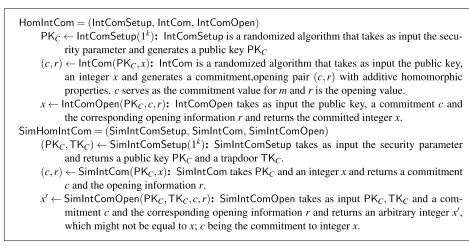
We use a homomorphic integer commitment scheme HomIntCom that is statistically hiding and compu-tationally binding [Bou00, DF02]. The latter implies the existence of a trapdoor and, hence, can be used to “equivocate” a commitment (i.e., open the commitment to any message using the trapdoor). We de-note a commitment to x asC(x;r) where r is the randomness used for the commitment. For simplicity, we sometimes drop r from the notation and useC(x) to denote the commitment tox. Homomorphic in-teger commitment scheme is defined in terms of three algorithmsHomIntCom={IntComSetup,IntCom,
IntComOpen}and the corresponding trapdoor commitment (we call it a simulator) as: SimHomIntCom=
{SimIntComSetup,SimIntCom,SimIntComOpen}. We describe these algorithms in Figure 1. The homo-morphismofHomIntComis defined asIntCom(x+y) =IntCom(x)×IntCom(y). For specific constructions ofHomIntComsee Figure 8 in Appendix.
3.2.2 Proving an integer is non-negative in zero-knowledge
We use the following (interactive) protocol between a prover and a verifier: the prover sends a commitmentc to an integerx≥0 to the verifier and proves in zero-knowledge that the committed integer is non-negative, without openingc. We denote this protocol asP↔V(x,r:c=C(x;r)∧x≥0)(Figure 2). In our construc-tion, we will use the commitment schemeHomIntComdescribed in Figure 1 and use the algorithmIntCom
to computec.
3.2.3 Zero Knowledge Set scheme
LetDbe a set of of key value pairs. If(x,v)is a key, value pair ofD, then we writeD(x) =vto denotev is the value corresponding to the keyx. For the keys that are not present inD,x∈/D, we write D(x) =⊥. A Zero Knowledge Set scheme (ZKS) [MRK03] consists of three probabilistic polynomial time algorithms,
This paper
[SBZ01] [JMSW02] [CLX09] [BBD+10] [SPB+12] [PSPDM12] [KAB12] ZKL PPAL
Zero-knowledge X X X X X
Setup time nlogn n n n2 n2 n n nlogN n
Storage Space n n n n2 n2 n n2 nlogN n
Query time m nlogn n mn m n n mlogN min(mlogn,n)
Verification time mlognlogm mlogn n2 m2 m2 m m mlogN m
Proof size m mlogn n m2 m2 m n mlogN m
Assumption RSA RSA SRSA,
Division EUCMA ROM,
nEAE AnAHF
ROM, RSA
ROM, FC, SRSA
ROM, nBDHI
Figure 1: Homomorphic Integer Commitment Model.
HomIntCom= (IntComSetup,IntCom,IntComOpen)
PKC←IntComSetup(1k): IntComSetupis a randomized algorithm that takes as input the secu-rity parameter and generates a public keyPKC
(c,r)←IntCom(PKC,x): IntComis a randomized algorithm that takes as input the public key, an integerx and generates a commitment,opening pair (c,r) with additive homomorphic properties.cserves as the commitment value formandris the opening value.
x←IntComOpen(PKC,c,r): IntComOpen takes as input the public key, a commitment cand the corresponding opening informationrand returns the committed integerx.
SimHomIntCom= (SimIntComSetup,SimIntCom,SimIntComOpen)
(PKC,TKC)←SimIntComSetup(1k): SimIntComSetup takes as input the security parameter and returns a public keyPKCand a trapdoorTKC.
(c,r)←SimIntCom(PKC,x): SimIntComtakesPKCand an integerxand returns a commitment cand the opening informationr.
x0←SimIntComOpen(PKC,TKC,c,r): SimIntComOpentakes as input PKC,TKC and a com-mitmentcand the corresponding opening informationrand returns an arbitrary integer x0, which might not be equal tox;cbeing the commitment to integerx.
Figure 2: Protocol to prove non-negativity of an integer
P↔V(x,r:c=C(x;r)∧x≥0): We use this notation to concisely represent an (interactive) protocol between two parties P andV: P sends a commitment c to a non-negative value x to V and proves, without openingc, that x≥0. The symbol c=C(x;r) denotesc is the commitment toxandr is the corresponding opening information. Note thatris not sent toV.
ZKS= (ZKSSetup,ZKSProver= (ZKSP1,ZKSP2),ZKSVerifier), and queries are of the form “is key x
inD?”. We describe the algorithms in Figure 3. For our construction of zero knowledge lists we pick a ZKS construction of [CHL+05] that is based on mercurial commitments and describe it in more details in Figure 11 in Appendix A.3.
3.2.4 Bilinear Aggregate Signature Scheme
We use bilinear aggregate signature scheme developed by Boneh et al.[BGLS03] for our PPAL scheme. Given signaturesσ1, . . . ,σn ondistinct messagesM1, . . . ,Mn fromndistinct usersu1, . . . ,un, it is possible
to aggregate these signatures into a single short signatureσsuch that it (and thenmessages) convince the verifier that the n users indeed signed the n original messages (i.e., user isigned message Mi). We use
the special case where a single user signsn distinctmessagesM1, . . . ,Mn. The security requirement of an
aggregate signature scheme guarantees that the aggregate signatureσis valid if and only if the aggregator
used allσi’s to construct it.
Bilinear Aggregate Signature Construction A bilinear aggregate signature scheme is a 5 tuple of al-gorithm Key Generation, Signing, Verification, Aggregation, and Aggregate Verification. We discuss the construction for the case of a single user signingn distinct messagesM1,M2, . . . ,Mnin Figure 4. The
Figure 3: Zero Knowledge Set (ZKS) model
ZKS= (ZKSSetup,ZKSProver= (ZKSP1,ZKSP2),ZKSVerifier)
PKD←ZKSSetup(1k): TheZKSSetupalgorithm takes the security parameter as input and pro-duces a public keyPKD for the scheme. The prover and the verifier both take as input the stringPKDthat can be a random string (in which case, the protocol is in the common ran-dom string model) or have a specific structure (in which case the protocol is in the trusted parameters model).
(com,state)←ZKSP1(1k,PKD,D): ZKSP1 takes the security parameter, the public key, PKD
and the setDand produces a short digest commitmentcomforD.
(D(x),proofx)←ZKSP2(PKD,state,x): ZKSP2takes a queryxand produces the corresponding
value,v=D(x)and the corresponding proof of membership/non-membership,proofx.
b←ZKSVerifier(1k,PKD,com,x,D(x),proofx): Verifier takes the security parameter,PK,com
and a query x and an answer D(x) and a proof proofx and returns a bit b, where b= ACCEPT/REJECT.
in the scheme:
• G,G1are multiplicative cyclic groups of prime order p • gis a generator ofG
• eis computable bilinear nondegenerate mape:G×G→G1
• H:{0,1}∗→Gis a full domain hash function viewed as a random oracle that can be instantiated with a cryptographic hash function.
Figure 4: Bilinear Aggregate Signature Scheme
Key Generation: The secret keyvis a random element ofZpand the public keyxis set togv.
Signing: The user signs the hash of eachdistinct message Mi∈ {0,1}∗viaσi←H(Mi)v.
Verification: Given the user’s public key x, a messageMi and its signatureσi, accept if e(σi,g) =
e(H(Mi),x)holds.
Aggregation: This is a public algorithm which does not need the user’s secret key to aggregate the individual signatures. Let σi be the signature on a distinct message Mi ∈ {0,1}∗ by the user,
according to the Signing algorithm (i=1, . . . ,n). The aggregate signature σ for a subset ofk
signatures, wherek≤n, is produced viaσ←∏ki=1σi.
Aggregate Verification: Given the aggregate signatureσ,koriginal messagesM1,M2, . . . ,Mkand the
public keyx:
1. ensure that all messagesMi are distinct, and reject otherwise.
2. accept ife(σ,g) =e(∏ik=1H(Mi),x).
Bilinear Aggregate Signature Security The formal model of security is called the aggregate chosen-key security model. The security of aggregate signature schemes is expressed via the following game where an adversary is challenged to forge an aggregate signature:
Query:
A
adaptively requests signatures on messages of his choice.Response: Finally,
A
outputskdistinct messagesM1,M2, . . . ,Mk and an aggregate signatureσ.A
wins if the aggregate signatureσis a valid aggregate signature on messages M1,M2, . . . ,Mk underPK,andσis nontrivial, i.e.,
A
did not request a signature onM1,M2, . . . ,Mk underPK. A formal definition anda corresponding security proof of the scheme can be found in [BGLS03].
3.3 Hardness assumption
Letpbe a largek-bit prime wherek∈Nis a security parameter. Letn∈Nbe polynomial ink,n=poly(k).
Lete:G×G→G1 be a bilinear map whereG andG1 are groups of prime order p andg be a random generator of G. We denote a probabilistic polynomial time (PPT) adversary
A
as an adversary who is running in time poly(k). We useA
alg(input,...) to show that an adversaryA
has an oracle access to aninstantiation of an algorithmalgwith first argument set toinputand. . .denoting that
A
can give arbitrary input for the rest of the arguments.Definition 3.1 (n-Bilinear Diffie Hellman Inversion (n-BDHI) [BB04]) Let s be a random element ofZ∗p
and n be a positive integer. Then, for every PPT adversary
A
there exists a negligible functionν(.)suchthat: Pr[s←−$ Z∗p;y←
A
(hg,gs,gs2, . . . ,gsni):y=e(g,g)1s]≤ν(k).4 Zero Knowledge List (ZKL)
We generalize the idea of consistent set membership queries [MRK03, CHL+05] to support membership and order queries in zero-knowledgeon a list with no repeated elements. More specifically, given a to-tally ordered list of unique elements
L
={y1,y2, . . . ,yn}, we want to support non-interactively and inzero-knowledge, (proofs reveal nothing beyond the query answer, not even the size of the list) queries of the following form:
• Isyi∈
L
oryi∈/L
, i.e.,L
(yi) =trueorL
(yi) =false?• For two elementsyi,yj∈
L
, what is their relative order, i.e.,yi<yjoryj<yiinL
?We adopt the same adversarial model as in [MRK03, ORS04, CHL+05]. There are two parties: theprover and the verifier. The prover initially commits to a list of elements and makes the commitment (a short digest) public. We now formally describe the model and the security properties.
4.1 Model
A Zero Knowledge List scheme (ZKL) consists of three probabilistic polynomial time algorithms:(Setup,Prover= (P1,P2),Verifier). The queries are of the form(δ,flag)whereδ={z1, . . . ,zm},zi∈ {0,1}∗, is a collection
of elements,flag=0 denotes a (non-)membership query andflag=1 denotes an order query. In the follow-ing sections, we will usestateto represent a variable that saves the current state of the algorithm (when it finishes execution).
PK←Setup(1k)TheSetupalgorithm takes the security parameter as input and produces a public keyPK
for the scheme. The prover and the verifier both take as input the string PKthat can be a random string (in which case, the protocol is in the common random string model) or have a specific structure (in which case the protocol is in the trusted parameters model).
(com,state)←P1(1k,PK,
L
)P1 takes the security parameter, the public keyPKand the listL
, andpro-duces a short digest commitmentcomfor the list.
(member,proofM,order,proofO)←P2(PK,state,δ,flag)whereδ={z1, . . . ,zm}andflagdenotes the type
of query.P2produces the membership information of the queried elements,member={
L
(z1), . . . ,L
(zm)}flag=0: P2setsorderandproofOto⊥and returns(member,proofM,⊥,⊥).
flag=1: Let ˜δ={zi|i∈[1,m]∧
L
(zi) =true}.P2produces the correct list order among the elementsof ˜δ,order=πL(δ˜), and the proof of the order,proofO.
b←Verifier(1k,PK,com,δ,flag,member,proofM,order,proofO)Verifiertakes the security parameter, the
public keyPK, the commitmentcomand a query (δ,flag)andmember,proofM,order,proofOand
returns a bitb, whereb=ACCEPT/REJECT.
Example Let us illustrate the above functionality with a small example. Let
L
={A,B,C}and(δ,flag) =({B,D,A},1)be the query. Given this queryP2returnsmember={
L
(B),L
(D),L
(A)}={true,false,true},the corresponding proofs of membership and non-membership in proofM, order={A,B} and the
corre-sponding proof of order betweenAandBinproofO.
4.2 Security Properties
ZKL has three security properties. The first property, completeness, mandates that honestly generated proofs always satisfy the verification test.
Definition 4.1 (Completeness) For every list
L
, every queryδand everyflag,Pr[PK←Setup(1k);(com,state)←P1(1k,PK,
L
);(member,proofM,order,proofO)←P2(PK,state,δ,flag):
Verifier(1k,PK,com,δ,flag,member,proofM,order,proofO)=ACCEPT] =1
The second property, soundness, guarantees that the prover should not be able to come up with a query, and corresponding inconsistent (with the initial commitment) answers and convincing proofs.
Definition 4.2 (Soundness) For every PPT malicious prover algorithm, Adv, for every query δ and for
everyflagthere exists a negligible functionν(.)such that: Pr[PK←Setup(1k);
(com,member1,proof1M,order1,proof1O,member2,proof2M,order2,proofO2)←Adv(1k,PK):
Verifier(1k,PK,com,δ,flag,member1,proof1M,order1,proof1O) =ACCEPT∧ Verifier(1k,PK,com,δ,flag,member2,proof2M,order2,proof2O) =ACCEPT∧
((member16=member2)∨(order16=order2))]≤ν(k)
Finally, zero-knowledge property ensures that each proof reveals the answer and nothing else. In other words, there must exist a simulator, that given only an oracle access to
L
, can simulate proofs for member-ship and order queries that are indistinguishable from real proofs.Definition 4.3 (Zero-Knowledge) There exists a PPT simulator Sim= (Sim1,Sim2,Sim3) such that for
every PPT malicious verifierAdv= (Adv1,Adv2), there exists a negligible functionν(.)such that:
|Pr[PK←Setup(1k);(
L
,stateA)←Adv1(1k,PK);(com,stateP)←P1(1k,PK,L
):AdvP2(PK,stateP,·)
2 (com,stateA) =1]−
Pr[(PK,stateS)←Sim1(1k);(
L
,stateA)←Adv1(1k,PK);(com,stateS)←Sim2(1k,stateS):AdvSimL3(1k,stateS)
2 (com,stateA) =1]| ≤ν(k),
whereSim3has oracle access to
L
, that is, given a query(δ,flag),Sim3can query the listL
to learn onlythe membership/non-membership of elements inδand, ifflag=1, learn the list order of the elements ofδ
Intuition The construction uses zero knowledge set scheme, homomorphic integer commitment scheme, zero-knowledge protocol to prove non-negativity of an integer and a collision resistant hash functionH:
{0,1}∗→ {0,1}l, if the elements of the list
L
are larger thatlbits. In particular, given an input listL
theprover P1 creates a set Dwhere for every elementyj ∈
L
it adds a (key,value) pair(H(yj),C(j)).H(yj)is a hash ofyj andC(j)is a homomorphic integer commitment ofrank(
L
,yj)(assumingrank(L
,yj) = j,wlog). P1 sets up a zero knowledge set on D using ZKSP1 from Figure 3. The output of ZKSP1 is a
commitment toD,com, thatP1sends to the verifier.
P2operates as follows. Membership and non-membership queries of the form(δ,0)are replied in the
same fashion as in zero knowledge set, by invokingZKSP2on the hash of every element of sublistδ. Recall
that as a response to a membership query for a key,ZKSP2returns the value corresponding to this key. In
our case, the queried key isH(yj)and the value returned by ZKSP2,D(H(yj)), is the commitmentC(j)
where jis the rank of elementyj in the list
L
, ifyj∈L
. If yj∈/L
, the value returned is⊥. Hence, theverifier receives the commitments to ranks for queried member elements. These commitments are never opened but are used as part of order proofs for order queries.
For a given order query(δ,1), for every adjacent pair of elements in the returned order,order,P2gives a
proof of order. Recall thatordercontains the member elements ofδ, arranged according to their order in the
list
L
. P2proves the order between two elementsyiandyj as follows. Letrank(L
,yi) =i,rank(L
,yj) = j,andC(i),C(j)be the corresponding commitments and, wlog, leti< j. As noted above,C(i)andC(j)are already returned byP2as part of the membership proof. Additionally,P2returns a commitment to 1,C(1),
and its opening informationρ.
The verification of the query answer proceeds as follows.VerifiercomputesC(j−i−1):=C(j)/(C(i)C(1))
using the homomorphic property of the integer commitment scheme. P2 uses the zero knowledge
proto-colP↔V(x,r:c=C(x;r)∧x≥0) to convince VerifierthatC(j−i−1)is a commitment to value ≥0. Note that we use the non-interactive general zero-knowledge version of the protocol as discussed in Sec-tion 3.2.2. Hence, the query phase proceeds in a single round.
It is important to understand why we requireVerifierto verify thatj−i−1≥0 and not j−i≥0. By the soundness of the protocolP↔V(x,r:c=C(x;r)∧x≥0), the probability that a cheating proverAdvwill be able to convinceVerifierabout the non-negativity of a negative integer is negligibly small. However, since 0 is non-negative, a cheating prover can do the following: instead of the rank of an element store the same arbitrary non-negative integer for every element in the list. Then,C(j−i)andC(i−j)are commitments to 0 andAdvcan always succeed in proving an arbitrary order. To avoid this attack, we require the prove to hold forC(j−i−1). An honest prover can always prove the non-negativity ofC(j−i−1)as|j−i| ≥1 for any ranki,jof the list.
Also, we note that the commitments to ranks can be replaced by commitments to a strictly monotonic sequence as long as there is a 1:1 correspondence with the rank sequence. In this case, the distance between two elements will also be positive and, hence, the above protocol still holds.
4.3 ZKL Construction
LetHomIntCom= (IntComSetup,IntCom,IntComOpen)be the homomorphic integer commitment scheme defined in Section 3.2.1 andZKS= (ZKSSetup,ZKSProver= (ZKSP1,ZKSP2),ZKSVerifier) be a ZKS
scheme defined in Section 3.2.3. We denote the output of the prover during the non-interactive statistical zero knowledge protocolP↔V(x,r:c=C(x;r)∧x≥0) asproofx≥0. The construction also uses a hash
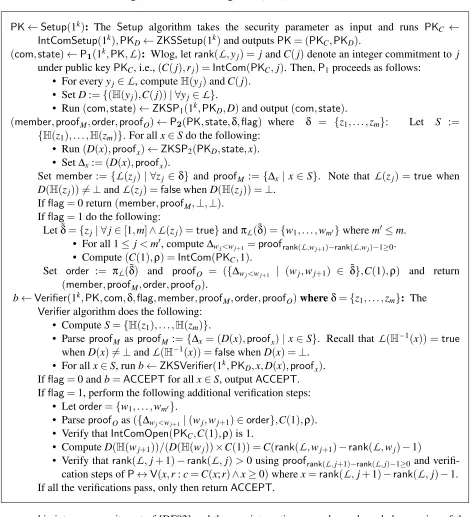
function, H:{0,1}∗→ {0,1}l. In Figure 5 we describe in detail our ZKL construction on an input list
L
={y1, . . . ,yn}.4.4 ZKL Efficiency
ho-Figure 5: Zero Knowledge List (ZKL) Construction
PK←Setup(1k): The Setup algorithm takes the security parameter as input and runs PKC ←
IntComSetup(1k),PKD←ZKSSetup(1k)and outputsPK= (PKC,PKD).
(com,state)←P1(1k,PK,
L
): Wlog, letrank(L
,yj) = jandC(j)denote an integer commitment to junder public keyPKC, i.e.,(C(j),rj) =IntCom(PKC,j). Then,P1proceeds as follows:
• For everyyj∈
L
, computeH(yj)andC(j).• SetD:={(H(yj),C(j))| ∀yj∈
L
}.• Run(com,state)←ZKSP1(1k,PKD,D)and output(com,state).
(member,proofM,order,proofO)←P2(PK,state,δ,flag) where δ = {z1, . . . ,zm}: Let S :=
{H(z1), . . . ,H(zm)}. For allx∈Sdo the following:
• Run(D(x),proofx)←ZKSP2(PKD,state,x).
• Set∆x:= (D(x),proofx).
Set member:={
L
(zj)| ∀zj ∈δ} and proofM :={∆x |x∈S}. Note thatL
(zj) =true whenD(H(zj))6=⊥and
L
(zj) =falsewhenD(H(zj)) =⊥.Ifflag=0 return(member,proofM,⊥,⊥).
Ifflag=1 do the following:
Let ˜δ={zj| ∀j∈[1,m]∧
L
(zj) =true}andπL(δ˜) ={w1, . . . ,wm0}wherem0≤m.• For all 1≤ j<m0, compute∆wj<wj+1=proofrank(L,wj+1)−rank(L,wj)−1≥0.
• Compute(C(1),ρ) =IntCom(PKC,1).
Set order := πL(δ˜) and proofO = ({∆wj<wj+1 | (wj,wj+1) ∈ δ˜},C(1),ρ) and return
(member,proofM,order,proofO).
b←Verifier(1k,PK,com,
δ,flag,member,proofM,order,proofO)whereδ={z1, . . . ,zm}: The Verifieralgorithm does the following:
• ComputeS={H(z1), . . . ,H(zm)}.
• Parse proofM asproofM:={∆x = (D(x),proofx)|x∈S}. Recall that
L
(H−1(x)) =truewhenD(x)6=⊥and
L
(H−1(x)) =falsewhenD(x) =⊥.• For allx∈S, runb←ZKSVerifier(1k,PKD,x,D(x),proofx).
Ifflag=0 andb=ACCEPTfor allx∈S, outputACCEPT. Ifflag=1, perform the following additional verification steps:
• Letorder={w1, . . . ,wm0}.
• ParseproofOas({∆wj<wj+1|(wj,wj+1)∈order},C(1),ρ).
• Verify thatIntComOpen(PKC,C(1),ρ)is 1.
• ComputeD(H(wj+1))/(D(H(wj))×C(1)) =C(rank(
L
,wj+1)−rank(L
,wj)−1)• Verify thatrank(
L
,j+1)−rank(L
,j)>0 usingproofrank(L,j+1)−rank(L,j)−1≥0 andverifi-cation steps ofP↔V(x,r:c=C(x;r)∧x≥0)wherex=rank(
L
,j+1)−rank(L
,j)−1. If all the verifications pass, only then returnACCEPT.momorphic integer commitment of [DF02] and the non-interactive general zero-knowledge version of the
Σ-protocol to prove non-negativity in [Lip03] in the random oracle model. Each of these constructions is
described in detail in Appendix. Mercurial commitment was later generalized by [CFM08, LY10] but the basic ZKS construction remains the same.
Recall thatkis the security parameter of the scheme,lis the size of the output of the hash functionH,n
is the number of elements in the list
L
andmis the number of elements in queryδ. Similarly to [CHL+05]we assume thatl=k. For every element in
L
, P1 hashes the element and computes a commitment to itsMembership (non-membership) proof of a single element consists ofO(k) mercurial decommitments. Using [LY10], we can have each mercurial decommitment constant size, i.e., O(1). The order proof be-tween two elements requires membership proofs for both elements andproofu−1≥0whereuis the absolute
difference between the rank of the corresponding elements. proofu−1≥0 is computed using P↔V(x,r:
c=C(x;r)∧x≥0) which takesO(log2n) =O(log2(poly(k))) expected time, sincen=poly(k). Hence, computing a membership proof for a single element takes timeO(k)and an order proof for two elements takes time O(k+log2(poly(k))) =O(k). More generally, the prover’s time for a query on sublist δ is
O(mk+mlog2(poly(k))) =O(mk), wherem=|δ|.
The verifier needs to verifyO(k)mercurial decommitments for every element in the queryδand verify
order between every adjacent pair of elements inδusing the verifications steps ofP↔V(u,r:c=C(u;r)∧
u≥0). Therefore, the asymptotic run time of the verification isO(mk).
4.5 ZKL Security Proofs
Proof of Completeness Completeness of the ZKL construction in Section 4.3 directly follows from the Completeness of Zero Knowledge Set and Completeness of the protocolP↔V(x,r:c=C(x;r)∧x≥0).
Proof of Soundness: To simplify the notation, first let us denote usingE1andE2the following two events:
E1= [PK←Setup(1k);
(com,member1,proof1M,order1,proof1O,member2,proof2M,order2,proof2O)←Adv(1 k
,PK):
Verifier(1k,PK,com,δ,flag,member1,proof1M,order1,proof1O) =ACCEPT∧ Verifier(1k,PK,com,δ,flag,member2,proof2M,order2,proof2O) =ACCEPT∧
(member16=member2)]
E2= [PK←Setup(1k);
(com,member1,proof1M,order1,proof1O,member2,proof2M,order2,proofO2)←Adv(1k,PK):
Verifier(1k,PK,com,δ,flag,member1,proof1M,order1,proof1O) =ACCEPT∧ Verifier(1k,PK,com,δ,flag,member2,proof2M,order2,proof2O) =ACCEPT∧
(order16=order2)]
Then, Definition 4.2 can be rewritten as
Pr[PK←Setup(1k);
(com,member1,proof1M,order1,proof1O,member2,proof2M,order2,proofO2)←Adv(1k,PK):
Verifier(1k,PK,com,δ,flag,member1,proof1M,order1,proof1O) =ACCEPT∧ Verifier(1k,PK,com,δ,flag,member2,proof2M,order2,proof2O) =ACCEPT∧
((member16=member2)∨(order16=order2))] =Pr[E1∨E2]≤Pr[E1] +Pr[E2]
Now, by the Soundness property of the ZKS in Section 3.2.3, Pr[E1]is negligible ink. Let Pr[E1] =ν1(k).
Let us consider the event E2. If the malicious prover is successful in outputting two contradictory
orders for a collection of elements, then there must exist at least one inversion pair, i.e., a pair of elements
(xi,xj)∈δsuch thatxi<xj inorder1andxj<xiinorder2. LetC(i)andC(j)be the commitments used as
values to prove the membership ofxi andxj, correspondingly. Then by the binding property of the integer
Verifierin the protocol). (Note that by the soundness property of ZKS, the probability thatAdvcan return two commitmentsC(i)andC(i0),C(i)=6 C(i0), whereC(i)andC(i0) are returned to prove membership of xi in proof1M and proof2M, respectively, is negligible w.r.t. the same commitment, com.) Then according
to the protocol, it must be the case that Adv could convinceVerifier that both C(i−j) andC(j−i) are commitments to positive integers wherei,jare two integers. However, due to the soundness of the protocol
P↔V(x,r:c=C(x;r)∧x≥0), the probability is negligible ink. Let Pr[E2] =ν2(k).
Therefore we have, Pr[E1∨E2]≤ν1(k) +ν2(k)≤ν(k), for some negligible function ν(.) Hence the
soundness error of the ZKL construction must be negligible ink.
Proof of Zero-Knowledge: Let SimHomIntCom= (SimIntComSetup,SimIntCom,SimIntComOpen)
be the simulator of HomIntCom defined in Figure 1. Let SimZKS = (SimZKSSetup,SimZKSProver=
(SimZKSP1,SimZKSP2),SimZKSVerifier)be the simulator for the ZKS in Figure 3.
Now let us defineSim= (Sim1,Sim2,Sim3), a simulator for ZKL (Definition 4.3), that has access to the
system parameterH.
• Sim1(1k)runs(PKD,TKD)←SimZKSSetup(1k)and(PKC,TKC)←SimIntComSetup(1k).Sim1(1k)
outputs{PK= (PKD,PKC),TK= (TKD,TKC)}. • Sim2runsSimZKSP1to generate commitmentcom.
• In response to membership queries(flag=0),Sim3does the following:
– Sim3 maintains a table of queried elements as tupleshxi,vi,riiwherexi is the queried element
andviis the value thatSim3has sent whenxiwas queried. We explain howriis computed next.
– For a queried element y, Sim3 checks the table. If y is not in the table and, hence, has not
been queried before,Sim3makes an oracle access to
L
on y. Ify∈L
,Sim3 computes a freshcommitment to 0,(C(0),r):=SimIntCom(0), and storeshy,C(0),ri. Ify∈/
L
, thenSim3storeshy,⊥,⊥i.
– Sim3responds to membership queries by invokingSimZKSP2 onH(y)and returning the same
output.
• For order queries (flag=1),Sim3additionally does the following. Letδbe the queried sublist.Sim3
makes an oracle access to
L
to get the correct list order of the elements ofδthat are present inL
. Letorder={y1, . . . ,ym}be the returned order.
• Sim3computes(C(1),ρ) =SimIntCom(PKC,1).
• Let{hy1,v1,r1i, . . . ,hym,vm,rmi}be the entries ofSim3’s table that correspond to elements inδ. Then
for every pair(yj,yj+1), Sim3 equivocates (vj+1/(vj×C(1))) using TKC to a commitment to any
arbitrary positive integeru. In other words, Sim3 equivocates the commitmentC(rank(
L
,yj+1)−rank(
L
,yj)−1)to a commitment to an arbitrary positive integeru. Finally,Sim3computesproofu≥0to prove the order between(yj,yj+1).
Sim3achieves the following. For every newly queried element that is in the list,Sim3generates and stores
a fresh commitment to 0, and sends it to the verifier. Hence,Sim3 setsrank=0 to all queried elements.
By the (statistical) hiding property of the integer commitment scheme, the commitments are statistically closely distributed to the commitments computed by the real prover,P1. Now, with the help ofTKC,Sim3
can equivocate a commitment to any value it wants. Hence, whenever he needs to prove order yi <yj, Sim3equivocates the commitment torank(
L
,yj+1)−rank(L
,yj)−1 to any arbitrary positive integeruandinvokes the protocolP↔V(u,r:c=C(u;r)∧u≥0)to computeproofu≥0. Since the protocolP↔V(u,r:
c=C(u;r)∧u≥0)is Zero Knowledge (statistical),Sim= (Sim1,Sim2,Sim3)simulates our ZKL scheme.
We note that the constructions with which we instantiate ZKL have the simulators assumed above. In particular, forSimZKS we use the simulator of the ZKS construction of [CHL+05]. ForSimHomIntCom
Theorem 4.1 The zero-knowledge list (ZKL) construction of Figure 5 satisfies the security properties of completeness (Definition 4.1), soundness (Definition 4.2) and zero-knowledge (Definition 4.3) in the random oracle model. The construction has the following performance, where n is the list size, m is the query size, each element of the list is a k-bit1string and N is the number of all possible k-bit strings:
• The prover executes the commitment phase in O(nlogN)time and space.
• In the query phase, the prover computes the proof of the answer in O(mlogN)time.
• The verifier verifies the proof in O(mlogN)time and space.
5 Privacy Preserving Authenticated List (PPAL)
In the previous section we presented a model and a construction for a new primitive called zero knowledge lists. As we noticed earlier, ZKL model gives the desired functionality to verify order queries on lists. However, the corresponding construction does not provide the efficiency one may desire in cloud computing setting where the verifier (client) has limited memory resources as we discuss in Section 5.3. In this section we address this setting and define a model for privacy preserving authenticated lists, PPAL, that is executed between three parties. This model, arguably, fits cloud scenario better and, as we will see, our construction is also more efficient.
5.1 Model
PPAL is a tuple of three probabilistic polynomial time algorithms(Setup,Query,Verify)executed between the owner of the data list
L
, the server who storesL
and answers queries from the client and the client who is-sues queries on the elements of the list and verifies corresponding answers. We note that this model assumes that the query is on the member elements of the list, i.e., for any query,δ,Elements(δ)⊆Elements(L
). Inother words, this model does not support proofs of non-membership, similar to other data structures that sup-port only positive membership proofs, e.g., [KB08, CLX09, CKS09, BBD+10, PSPDM12, KAB12, CF13].
(digestC,digestS)←Setup(1k,
L
) This algorithm takes the security parameter and the source listL
as inputand produces two digestsdigestC anddigestSfor the list. This algorithm is run by the owner. digestC
is sent to the client anddigestSis sent to the server.
(order,proof)←Query(digestS,
L
,δ) This algorithm takes the server digest generated by the owner,digestS,the source list,
L
, and a queried sublist, δ, as input, where a sublist of a listL
is defined as:Elements(δ) ⊆ Elements(
L
). The algorithm produces the list order of the elements ofL
, order=πL(δ), and a proof, proof, of the answer. This algorithm is run by the server. Wlog, we assume
|δ|>1. In the trivial case of|δ|=1, the server returns an empty proof, i.e.,(order=δ,proof=⊥).
b←Verify(digestC,δ,order,proof) This algorithm takesdigestC, a queried sublistδ,orderandproof and
returns a bitb, whereb=ACCEPTiffElements(δ)⊆Elements(
L
) andorder=πL(δ). Otherwise,b=REJECT. This algorithm is run by the client.
5.2 Security Properties
A PPAL has three important security properties. The first property isCompleteness. This property ensures that for any list
L
and for any sublistδofL
, if thedigestC,digestS,order,proofare generated honestly, i.e.,the owner and the server honestly execute the protocol, then the client will be always convinced about the correct list order ofδ.
Definition 5.1 (Completeness) For all lists
L
and all sublistsδofL
Pr[(digestC,digestS)←Setup(1
k
,
L
);(order,proof)←Query(digestS,L
,δ):Verify(digestC,δ,order,proof) =ACCEPT∧order=πL(δ)] =1
The second security property isSoundness. This property ensures that once an honest owner generates a pair
(digestC,digestS)for a list
L
, even a malicious server will not be able to convince the client of an incorrectorder of elements belonging to the list
L
. This property ensures integrity of the scheme.Definition 5.2 (Soundness) For all PPT malicious query algorithms Adv, for all lists
L
and all query sublistsδofL
, there exists a negligible functionν(.)such that:Pr[(digestC,digestS)←Setup(1
k
,
L
);(order,proof)←Adv(digestS,L
):Verify(digestC,δ,order,proof) =ACCEPT∧order6=πL(δ)]≤ν(k)
The last property is Zero-Knowledge. This property captures that even a malicious client cannot learn anything about the list (and its size) beyond what the client has queried for. Informally, this property involves showing that there exists a simulator such that even for adversarially chosen list
L
, no adversarial client (verifier) can tell if it is talking to a honest owner and honest server who knowL
and answer w.r.t.L
, or to the simulator that only has oracle access to the listL
.Definition 5.3 (Zero-Knowledge) There exists a PPT simulatorSim= (Sim1,Sim2)such that for all PPT
malicious verifiersAdv= (Adv1,Adv2), there exists a negligible functionν(.)such that:
|Pr[(
L
,stateA)←Adv1(1k);(digestC,digestS)←Setup(1k,L
):AdvQuery(digestS,L,.)
2 (digestC,stateA) =1]−
Pr[(
L
,stateA)←Adv1(1k);(digestC,stateS)←Sim1(1k):AdvSimL2(1k,stateS)
2 (digestC,stateA) =1]| ≤ν(k)
HereSim2has oracle access to
L
, that is given a sublistδofL
,Sim2can query the listL
to learn only thecorrect list order of the sublistδand cannot look at
L
.Attack on [KAB12]’s scheme The scheme of [KAB12] generates an0bit secure name, wheren0≥n, for each element of the list
L
of sizen. The secure name of elementx has one distinct bit that encodes the pairwise order betweenxand every other element inL
. To prove the order between two elements, the server sends their secure names to the client, who can easily identify and compute the bit that encodes the order between the corresponding elements. Hence non-transitive orders can be easily inferred as follows. Let {A<B<C}be the list order. The client issues order queries for(A,B)and(A,C), which returns the secure names forA,B,C. Now the client can find out the order betweenBandC, that was not queried for. Hence, the scheme is not zero-knowledge.5.3 Construction of PPAL via ZKL
We show how a PPAL can be instantiated via a ZKL in Theorem 5.1 and then discuss that the resulting construction does not yield the desired efficiency.
Theorem 5.1 Given a ZKL schemeZKL= (Setup,Prover= (P1,P2),Verifier), which supports queries of
the form(δ,flag)on a list
L
, we can instantiate a PPAL scheme for the listL
,PPAL= (Setup,Query,Verify),which supports queries of the formδ, whereδis a sublist of
L
, as follows:1. InvokeZKL.Setup(1k). LetZKL.Setup(1k) =PK
2. InvokeZKL.P1(1k,PK,
L
). LetZKL.P1(1k,PK,L
) = (com,state).3. SetdigestC= (PK,com),digestS= (PK,com,state)and output(digestC,digestS). PPAL.Query(digestS,
L
,δ)can be instantiated as follows:1. InvokeZKL.P2(PK,state,δ,1). LetZKL.P2(PK,state,δ,1) = (member,proofM,order,proofO)
2. Output(order,proof= (proofM,proofO))
PPAL.Verify(digestC,δ,order,proofM,proofO)can be instantiated as follows:
1. Set member={1,1, . . . ,1}such that|member|=|δ|=|order|(recall that in a PPAL scheme, the queryδ, is a sublist of
L
).2. InvokeZKL.Verifier(1k,PK,com,δ,1,member,proofM,order,proofO)(recall thatdigestC= (PK,com)).
3. Output bit b whereZKL.Verifier(1k,PK,com,δ,1,member,proofM,order,proofO) =b
Theorem 5.2 A PPAL scheme instantiated using a ZKL scheme,ZKL= (Setup,Prover= (P1,P2),Verifier)
has the following performance:
• The owner’s runtime and space are proportional to the runtime and space ofZKL.SetupandZKL.P1,
respectively.
• The server’s runtime and space are proportional to the runtime and space ofZKL.P2.
• The client’s runtime and space are proportional to the runtime and space ofZKL.Verifier.
The correctness of Theorems 5.1 and 5.2 follow from the definition of PPAL and ZKL models.
We estimate the asymptotic efficiency of a PPAL construction based on the construction of ZKL pre-sented inSection 4.3. From the discussion of efficiency of the ZKL construction in Theorem 4.1, the time and space complexity of each party in PPAL adaptation of ZKL readily follows.
Owner The owner runs in timeO(kn)andO(kn)space, assuming each element of the list isk-bits.
Server To answer a query of size m, the server runs in timeO(km). The space requirement at the server isO(kn)since he has to store theO(kn)commitments produced by the owner.
Client The verification time of the client isO(km). During the query phase, the client requiresO(km)space to store its query and its response with the proof for verification.
As we see, this generic construction is not very efficient due to the multiplicative factor O(k) and heavy cryptographic primitives. In Section 6, we present a direct PPAL construction which is a factor of O(k)
more efficient in space and computation requirements as compared to an adaptation of the ZKL construction from Figure 5.
6 PPAL Construction
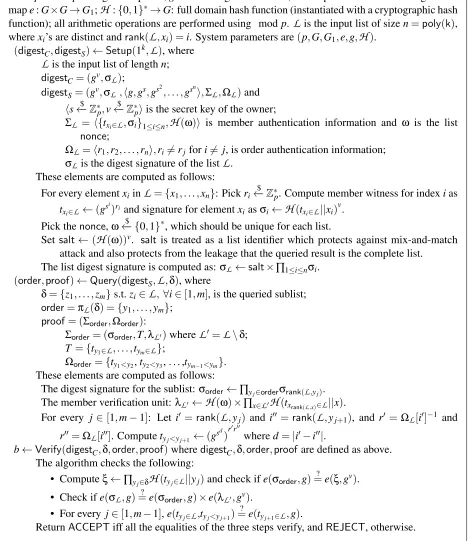
We present an implementation of a privacy preserving authenticated list in Figure 7. We provide the intuition of our method followed by a more detailed description.
The owner also sends to the server linear (in the list size) number of random elements used in the encoding of member witnesses. These random elements allow the server to compute the order witnesses on queried elements, without the owner’s involvement. The order witness encodes the distance between two elements, i.e., the difference between element ranks, without revealing anything about it. Together with member witnesses, the client can later use bilinear map to verify the order of the elements.
Construction Our construction forPPALis presented in Figure 7. We denotemember witnessforxi∈
L
astxi∈L. For two elementsxi,xj∈
L
, such thatxi<xj inL
,txi<xj is anorder witnessfor the order betweenxiandxj. The construction works as follows.
In theSetupphase, the owner generates secret key(v,s)and public keygv, wherevis used for signa-tures. The owner picks a distinct random elementri from the groupZ∗p for each element xi in the list
L
,i∈[1,n]. The element ri is used to compute the member witnesstxi∈L. Later in the protocol, together
withrj, it is also used by the server to compute the order witnesstxi<xj. The owner also computes
individ-ual signatures,σi’s, for each element and aggregates them into a digest signatureσL for the list. It returns
the signatures and member witnesses for every element of
L
inΣL and the set of random numbers picked for each index to be used in order witnesses inΩL. The owner sendsdigestC= (gv,σL)to the client and digestS= (gv,σL,hg,gs,gs2
, . . . ,gsni,ΣL,ΩL)and
L
to the server.Given a queryδ, the server returns a response list orderthat contains elements ofδ in the order they
appear in
L
. The server uses information inΣL to compute the digest signature for the sublist,σorder, and its membership verification unitλL0 which are part of theΣorder component of the proof. To compute theΩordercomponent of the proof, the server uses corresponding blinding values inΩLand elementsgsd where
d’s correspond to distances between ranks of queried elements.
The client first checks that all the returned elements are indeed signed by the owner using Σorder and then verifies the order of the returned elements usingΩorder. Hence, the client uses bilinear map for two purposes: first as part of member verification and then to verify the order.
Preprocessing at the Server For a queryδon the list
L
, of length mandn, respectively, the Queryal-gorithm in Figure 7 takes O(m) time to computeσorder and O(n−m) to compute λL0. The server can
precompute and store some products to reduce the overall running time of this algorithm toO(mlogn)when mn. The precomputation proceeds as follows.
Letψi=
H
(txi∈L||xi)for every element inL
={x1, . . . ,xn}. A balanced binary tree is built overnleaves,where theith leave corresponds toxi and storesψi. Each internal node of the tree stores the product of the
values stored at its children. Therefore the root stores the complete product∏ni=1ψi. (See Figure 6 for an
Figure 7: Privacy-Preserving Authenticated List (PPAL) Construction
Notation: k∈Nis the security parameter of the scheme; G,G1 multiplicative cyclic groups of prime orderpwherepis largek-bit prime;g: a random generator ofG;e: computable bilinear nondegenerate mape:G×G→G1;
H
:{0,1}∗→G: full domain hash function (instantiated with a cryptographic hashfunction); all arithmetic operations are performed using modp.
L
is the input list of sizen=poly(k), wherexi’s are distinct andrank(L
,xi) =i. System parameters are(p,G,G1,e,g,H
).(digestC,digestS)←Setup(1k,
L
), whereL
is the input list of lengthn;digestC= (gv,σL);
digestS= (gv,σL,hg,gs,gs
2
, . . . ,gsni,ΣL,ΩL)and
hs←−$ Z∗ p,v
$
←−Z∗
piis the secret key of the owner;
ΣL =h{txi∈L,σi}1≤i≤n,
H
(ω)i is member authentication information and ω is the list nonce;ΩL=hr1,r2, . . . ,rni,ri6=rj fori6= j, is order authentication information;
σL is the digest signature of the list
L
.These elements are computed as follows:
For every elementxiin
L
={x1, . . . ,xn}: Pickri←−$ Z∗p. Compute member witness for indexiastxi∈L←(g
si
)ri and signature for elementx
iasσi←
H
(txi∈L||xi)v
.
Pick thenonce,ω←− {$ 0,1}∗, which should be unique for each list.
Set salt←(
H
(ω))v. salt is treated as a list identifier which protects against mix-and-match attack and also protects from the leakage that the queried result is the complete list.The list digest signature is computed as:σL←salt×∏1≤i≤nσi.
(order,proof)←Query(digestS,
L
,δ), whereδ={z1, . . . ,zm}s.t.zi∈
L
,∀i∈[1,m], is the queried sublist; order=πL(δ) ={y1, . . . ,ym};proof= (Σorder,Ωorder):
Σorder= (σorder,T,λL0)where
L
0=L
\δ; T ={ty1∈L, . . . ,tym∈L};Ωorder={ty1<y2,ty2<y3, . . . ,tym−1<ym}.
These elements are computed as follows:
The digest signature for the sublist: σorder←∏yj∈orderσrank(L,yj).
The member verification unit:λL0←
H
(ω)×∏x∈L0
H
(txrank(L,x)∈L||x).
For every j∈[1,m−1]: Let i0 =rank(
L
,yj) and i00=rank(L
,yj+1), and r0 =ΩL[i0]−1 andr00=ΩL[i00]. Computetyj<yj+1 ←(g
sd
)r
0r00
whered=|i0−i00|.
b←Verify(digestC,δ,order,proof)wheredigestC,δ,order,proof are defined as above.
The algorithm checks the following:
• Computeξ←∏yj∈δH(tyj∈L||yj)and check ife(σorder,g) ?
=e(ξ,gv).
• Check ife(σL,g)=? e(σorder,g)×e(λL0,gv).
• For every j∈[1,m−1],e(tyj∈L,tyj<yj+1)
?
=e(tyj+1∈L,g).

![Figure 10.Figure 10: Proving non-negativity of an integer [Lip03]: P ↔ V(x,r : c = C(x;r)∧x ≥ 0)](https://thumb-us.123doks.com/thumbv2/123dok_us/7909909.1313379/31.612.73.537.345.643/figure-figure-proving-non-negativity-integer-lip-c.webp)
