Studying the effect of simultaneous variation in both of the
bias current and feedback strength on the output dynamics
of semiconductor laser with optoelectronic feedback
Hasan Ghassan AbedP 1
P
, Kadhim Abid HubeatirP 1
P
, Kais A. Al.NaimeeP 2, 3
P
1
P
Laser and Optoelectronic Engineering department, University of Technology, Baghdad, Iraq
P
2
P
CNR-Istituto Nazionale di Ottica Applicata, Largo E Fermi 6, 50125 Firenze, Italy
P
3
P
Physics Department, College of Science, University of Baghdad, Baghdad, Iraq
Abstract:
We report numerically the generation of spiking in semiconductor laser (SL) with an optoelectronic feedback. The evolution of nonlinear dynamics of semiconductor lasers with optoelectronic feedback by changing together two of the control system parameters (i.e. the variation of the dc bias current of SL and the feedback strength simultaneously) is investigated. In addition to the period-doubling scenario to chaos which shows the transition of nonlinear dynamics from periodic to quasi-periodic, then to chaotic state and eventually to Mixed-Mode Oscillations (MMOs) is shown, this paper demonstrated that the optimal selection of system parameters can eliminate the generated chaos or exploiting the chaos benefits.
Keywords
:
Chaos, laser, feedback, control.Introduction
The irregular oscillations for time evolutions in nonlinear dynamical systems are appeared clearly in their outputs as a deterministic manner and it’s different from random processes. These oscillations are called dynamical chaos. Chaos may indicate to any state of disorder or confusion [1]. Dynamic chaos is considered as a very interesting nonlinear phenomenon which has been intensively studied during the last four decades [2].
Chaos can be found in miscellaneous fields, such as engineering, physics, biology, chemistry, weather, and climate and even in economics [3, 4]. Nonlinear systems can also be observed in optics. Many optical devices and materials, such as the laser, exhibit nonlinear reaction to the optical field and this make it very strong candidates for nonlinear components in chaotic systems [5, 6]. One of the most significant characteristics of deterministic chaos is the dependence on the sensitivity of the initial conditions. Due to the fact of any small deviation in the initial condition of any dynamical system will cause an entirely different solution of the system output and to predict the future of chaotic evolutions (i.e. means short term prediction of the chaotic evolutions). The idea of chaos control is suggested for this purpose [6].
In several engineering applications, chaos is usually classified as an unwanted behavior. Chaos control refers to manipulating the dynamical behavior of a chaotic system, in which the goal is to suppress chaos when it is harmful (i.e. Restriction the operating range of several electronic and mechanical devices) or to enhance or create chaos when it is beneficial (i.e. in telecommunications to secure the information) [7]. Therefore, several techniques have been innovated for chaos control, which are required to stabilize fluctuations and chaotic instabilities in many kinds of nonlinear dynamical systems [8, 9].
The first important work by Ott, Grebogi, and Yorke (OGY) in 1990 in which they explained that small time-dependent changes in the control parameter of the system can convert a chaotic motion into a stable periodic motion, and there has been an attracted interest in this technique [8]. In this method, chaos can be avoided by the concept of stabilization of unstable periodic orbits (UPOs) involved within a strange attractor by the application of small perturbations to the nonlinear system by external forces [2]. The requirements for the necessary information about the attractors and their calculations prevent the application of the OGY algorithm for the control of high-dimensional chaotic systems, in spite of the efforts were made to adjust this method to experimental work to control high dimensional chaotic systems [6].
Then, an alternative method is proposed by Pyragas in 1992, which is called the time-delayed feedback.In this method the chaotic system output is divided into two parts: one of them is detected with a delay time that possess an intrinsic time of the period of chaotic attractor and the other emerge normally. Then the difference between the normal output and the delayed output is fed back to one of parameters of the system [8]. The stabilization of the (UPOs) involved within a strange attractor by the application of small perturbations to the nonlinear system by time-delayed feedback, shows an innovative method to eliminate chaos. And this method is easy and helpful for the application to real-world nonlinear dynamical systems [10].
The semiconductor lasers with delayed feedback have been studied widely in few last years, this is because the rich diversity of nonlinear phenomena they show and also because of their important applications [11, 12]. The most common perturbations are optical injection, optical feedback and optoelectronic feedback [9]. The latter one is the perturbation that utilized in this paper. Optoelectronic feedback is one of the perturbations that applied to the chaotic systems to convert the chaotic motion into periodic motion and vice versa [5]. The importance of semiconductor laser with optoelectronic delay feedback is in the phase of the laser radiation is a free parameter and for this reason it is not included in the defining of chaotic system dynamics [13].
The delay usually arises simply by the propagation time around the feedback loop [14]. Lasers are usually described by three variables: field, population inversion and polarization of matter, therefore they are utilized for chaotic systems [15]. In this paper, the numerical model is build to study the generation of spiking oscillations in a semiconductor laser with an ac-coupled optoelectronic delay feedback.
The dynamics of single-mode class-B lasers (semiconductor laser), is judged by two linked variables (field density and population inversion) because the polarization term is adiabatically eliminated, evolving with two very different characteristic timescales. The application of optoelectronic feedback establishes a third degree of freedom (and a third timescale), leads to a three-dimensional slow–fast system showing a transition from a periodic spiking sequences to chaotic oscillations as the dc-pumping current of SL and feedback strength is varied. However, in the concept of future experiments that related to synchronization in laser arrays, (SL) appears as a perfect candidate since they permit the fulfillment of a miniaturized chip of units optoelectronically coupled.
Dynamical model and numerical results
As previously mentioned that the (field density and population inversion) are two linked variables which be used to describe the complete dynamics in our system. These variables have two very different characteristics time-scales. The application of an optoelectronic feedback shows two benefits: firstly, adds a third degree of freedom in our system, secondly, adds a third much slower time-scale. The dynamics of the field density S and the population inversion N is characterized by rate equations of a single-mode semiconductor laser [16] in which properly modified in order to include the ac-coupled optoelectronic feedback:
𝑆̇= [ 𝑔 (𝑁 − 𝑁𝑡)− 𝛾0] 𝑆 (1)
𝑁̇= 𝐼0+ 𝑓 𝐹 (𝐼)
𝑒𝑉 − 𝛾𝐶𝑁 − 𝑔(𝑁 − 𝑁𝑡) 𝑆 (2)
𝐼̇= −𝛾𝑓𝐼+ 𝜅𝑆̇ (3)
where I represents the current of high-pass filtered feedback (before the nonlinear amplifier), 𝐼0 is the bias current, e the electron charge, 𝑓𝐹 (𝐼)≡ AI/(1+𝑠́I) is the feedback amplifier function,
V is the active layer volume, 𝑁𝑡 is the carrier density at transparency , g is the differential gain, ,𝛾0 is the photon damping and 𝛾𝐶 is population relaxation rate,𝜅 is a coefficient proportional to the photodetector responsivity and 𝛾𝑓 is the cutoff frequency of the high-pass filter. For analytical and numerical purposes, it is helpful to rewrite equations 1 in dimensionless form. For this purpose, we insert the new variables:
𝓍𝓍 = 𝛾𝑔
𝐶 𝑆,𝒴=
𝑔
𝛾0 ( 𝑁 − 𝑁𝑡), 𝓌𝓌 =
𝑔
𝜅𝛾𝐶 𝐼 − 𝓍𝓍 and the time scale 𝑡́ = 𝛾0t. where 𝑠 =
𝛾𝐶𝑠́ 𝜅 𝑔⁄ is the saturation coefficient, 𝛿0 = (𝐼0 − 𝐼𝑡)/(𝐼𝑡ℎ − 𝐼𝑡) is the bias current, f(𝓌𝓌 +
𝓍𝓍) ≡ 𝛼𝛼1+𝑠𝓌𝓌+𝓍𝓍( 𝓌𝓌+𝓍𝓍 ) ,(𝐼𝑡ℎ= 𝑒𝑉𝛾𝐶(𝛾0
𝑔 +𝑁𝑡) is the current of solitary laser threshold), 𝛼𝛼 =
𝐴𝜅⁄(𝑒𝑉𝛾0) is the strength of feedback, 𝜀 = 𝓌𝓌𝛾00 is the bandwidth at resonant frequency 𝓌𝓌0 ,
𝛾 = 𝛾𝐶
𝛾0 . To more simplifications of dimensionless equations 1, 2 and 3, let 𝑧𝑧= 𝓌𝓌 + 𝓍𝓍, therefore
the above equations can be reformulated as follows:
The rate equations then become [17]:
𝓍𝓍̇ = 𝓍𝓍(𝑦 − 1) (4a)
𝒴̇ = 𝛾 �𝛿0 − 𝑦 +𝛼𝛼 1+𝑠𝑧𝑧 − 𝓍𝓍𝑦� (4b)
𝑧𝑧̇= −𝜀𝑧𝑧+ 𝓍𝓍̇ (4c)
Where 4a equation represents the photon density of laser source while 4b equation represents the population inversion of carriers and 4c equation represents the effect of feedback.
Now the theoretical results have been done by the utilizing of the fourth-order Runge-Kutta integration scheme, and apply the above equations 4(a, b and c) in Berkeley Madonna software version 8.3.18 with time step dt = 1.The entire simulation time chosen depends heavily on the quantity of the temporal scales described by the parameters 𝛿0 and 𝛼𝛼 where 𝛿0 represents the bias current and 𝛼𝛼 is the amplifier gain of the feedback (feedback strength).
The first numerical part included the following procedure: the feedback strength 𝛼𝛼 has been fixed at (1) and the bias current𝛿0 is gradually increased, then the model is programmed with the following parameters𝜀 = 2 × 10⁻⁵, 𝑠 = 11, and 𝛾= 0.001 and with initial values of parameters x1, y1, and z1 are 0.022, 1, and 0.005 respectively. It was observed throughout the experiments that when the feedback photocurrent of low level, the laser is oscillated periodically and when the level of the injected photocurrent (in the feedback part) is increased, the time series shows chaotic behavior passing through a quasi-periodic state and finally shows MMOs.
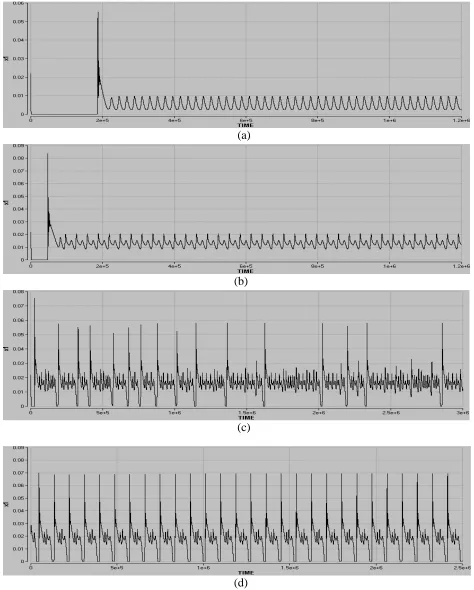
The corresponding dynamical sequence of the above procedure is illustrated in figures 1(a)-(d) that contain the time series at different dc bias current of the laser source. In figure 1(a) the time series illustrates the evolution of the laser intensity with time (i.e. unified amplitude height) and also shows a transition from steady state to periodic state at 𝛿0 equals 1.005 whereas figure 1(b) shows the period doubling state with high and low intensities due to the increasing in the bias current into 𝛿0 equals 1.013 ( i.e. quasi-periodic state). In figure 1(c), the chaotic dynamics appears clearly at dc bias current equals to 1.016, where the time series shows various heights in amplitudes which separated by unequal time intervals. As the current is gradually increased, a transition to periodic self-oscillations or Mixed-mode oscillations (MMOs) occurs; in this case the output often takes the form of complex temporal sequences known as MMOs. Typical time traces are characterized by a mixture of L large-amplitude relaxation spikes followed by S small-amplitude quasi-harmonic oscillations. This behavior appears clearly at 𝛿0 equals to 1.018 as shown in figure 1(d).
(a)
(b)
(c)
(d)
Figure (1) The numerical time series at dc bias current 𝛿0 (a) 1.005, (b) 1.013, (c) 1.016, (d) 1.018.
Then the second numerical part included the following procedure: the bias current 𝛿0has
been fixed at 1.0173 while the feedback strength 𝛼𝛼 is gradually increased, then the model is programmed with the following parameters𝜀 = 2 × 10⁻⁵, 𝑠= 11, and 𝛾 = 0.001 and with initial values of parameters x1, y1, and z1 are 0.022, 1, and 0.005 respectively. It was observed throughout the experiments that when the feedback strength of low level, the laser is oscillated periodically and when the level of the feedback strength is increased, the time series shows chaotic behavior passing through a quasi periodic state and finally shows MMOs.
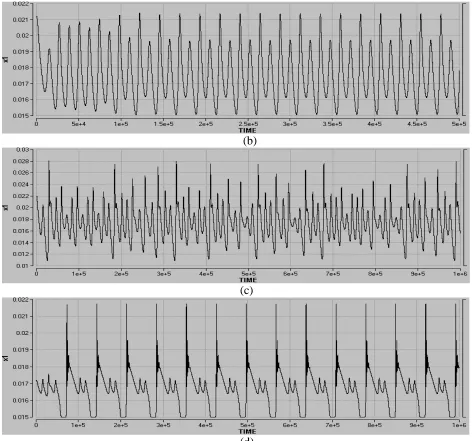
The corresponding dynamical sequence of the above procedure is illustrated in figures 2 (a)-(d) that contains the time series at different feedback strength values. In figure 2(a) the time series illustrates the evolution of the laser intensity with time (i.e. unified amplitude height) and also shows a transition from steady state to periodic state at 𝛼𝛼 equals to 0.987 whereas figure 2(b) shows the period doubling state with high and low intensities due to the increasing in the feedback strength into 𝛼𝛼 equals 0.993. In figure 2(c), the chaotic dynamics appears clearly at feedback strength equals to 0.997, where the time series shows various heights in amplitudes which separated by unequal time intervals. As the feedback strength is gradually increased, a transition to periodic self-oscillations or Mixed-mode oscillations (MMOs) occurs. This behavior appears clearly at 𝛼𝛼 equals to 1.001 as shown in figure 2(d).
The above two procedures show the period-doubling scenario to chaos which shows the transition of nonlinear dynamics from periodic to quasi-periodic, then to chaotic state and eventually to Mixed-Mode Oscillations (MMOs) as one of the system parameters is varied while the second one is fixed.
(a)
(b)
(c)
(d)
Figure 2. The numerical time series at feedback strength 𝛼𝛼 (a) 0.987, (b) 0.993(c) 0.997, (d) 1.001.
While the third numerical part included the simultaneous variation in both of the dc bias current
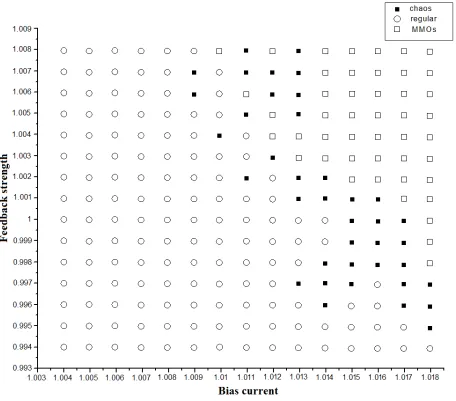
𝛿0 in the range (1.004-1.018) and the feedback strength 𝛼𝛼 in the range (0.994-1.008) and the model is programmed with the following parameters𝜀= 2 × 10⁻⁵, 𝑠 = 11, and 𝛾 = 0.001 and with initial values of parameters x1, y1, and z1 are 0.022, 1, and 0.005 respectively. In this case the numerical system shows different stability states (i.e. different signal transitions such as regular, chaotic and Mixed-mode oscillations) as shown in figure 3.
Figure 3. The map of theoretical model describes three states of signal transitions.
Figure 3 shows that at small values of both bias current and feedback strength the system oscillate periodically only and there is no chaotic oscillations, but with slow increasing in the system parameters, then the system begins to oscillate in different periodic, chaotic and MMOs forms.
This third procedure also shows the period-doubling scenario to chaos which shows the transition of nonlinear dynamics of SL from periodic to chaotic state and eventually to Mixed-Mode Oscillations (MMOs) as simultaneous variation in both of the system parameters ( i.e. 𝛿0 and 𝛼𝛼).
Conclusions
In this work, the main conclusions are as follows: The control parameters of laser system such as dc-pumping current and the feedback strength play fateful role in the generation of chaotic oscillation in the laser output, the simultaneous variations of the system parameters cause many variations in the system states stability. This variation can make the process of elimination of dynamic chaos is possible especially in several engineering applications where dynamic chaos
can affect the system performance and may be causes damaged effects (i.e. when the chaos is harmful) or can lead to generate chaos to exploit it in communications field such as information security (i.e. when the chaos is beneficial) and the effect of feedback strength variation is more powerful than the dc bias current variation.
Acknowledgments
H.G.A. would like to acknowledge the support of colleagues of physics department, college of science, university of Baghdad for their assistance.
References
[1] R. C. Hilborn, Nonlinear dynamics: an introduction for scientists and engineers,Second Edition, Oxford University Press Inc, (2000).
[2] K. Pyragas, Continous control of chaos by self-controlling feedback. Physics Letters A, 170, 421–428,(1992).
[3] K. Aihara, Chaos engineering and its application to parallel distributed\processing with chaotic neural networks. Proceedings of the IEEE, 90(5), 919–930, (2002).
[4] V. G. . T. T. I. Ivancevic, Complex nonlinearity: chaos, phase transitions, topology change, and path integrals. Springer, (2008).
[5] S. F. Abdalah, K. A. Al-Naimee, R. Meucci, N. Al Muslet, F. T. Arecchi, F. T. Experimental evidence of slow spiking rate in a semiconductor laser by electro-optical feedback : Generation and control. Applied Physics Research, 2(2), 170–175, (2010).
[6] J. Ohtsubo, Semiconductor lasers, Stability, instability and chaos. (Second), Springer, (2007).
[7] J. M. González-Miranda, J.M.. “Synchronization and Control of Chaos: An Introduction for Scientists and Engineers”, Imperial College Press, London, (2004).
[8] E. SchölL, Nonlinear spatio-temporal dynamics and chaos in semiconductors. Cambridge University Press, (2001).
[9] A. Uchida, Optical communication with chaotic lasers. Wiley-VCH, (2012).
[10] E. SchölL, H. G. Schuster, Handbook of Chaos Control. Wiley-VCH Verlag GmbH & Co. KGaA, (2008).
[11] V. Bejoy, S. Rajesh, & V. M. Nandakumaran, Analysis and simulation of semiconductor laser dynamics with optoelectronic. Turkish Journal of Physics, 39, 60–68, (2015).
[12] J. Ohtsubo, Feedback induced Instability and chaos in semiconductor lasers and their applications. Optical Review, 6(I), 1–15, (1988).
[13] P. Saboureau, J. P. Foing, P. S. Injection-locked semiconductor lasers with delayed optoelectronic feedback. IEEE - Quantum Electron, 33(9), 1582–1591, (1997).
[14] J.M. Saucedo Solorio, D.W. Sukow, D. R. Hicks, A. G., Bifurcations in a semiconductor laser subject to delayed incoherent feedback. Optics Communications, 214, 327–334, (2002).
[15] F.Kh. Abdullaev, S.A. Darmanyan, A.F. Fercher, J. Garnier, C.K. Hitzenberger, J. Ohtsubo, F.G. Omenetto, G. Petite, A. B. S. (2002). Progress in optics. Elsevier Science & Technology.
[16] W.W. Chow, S.W. Koch, M. Sargent, Semiconductor Laser Physics (Springer, Heidelberg, Berlin, 1994). [17] K. Al-Naimee, F. Marino, M. Ciszak, R. Meucci, and F. T. Arecchi, \Chaotic spiking and incomplete homoclinic scenarios in semiconductor lasers with optoelectronic feedback," New Journal of Physics, vol. 11, 2009.