POPE: Partial Order Preserving Encoding
Daniel S. Roche*,
Daniel Apon
†,
Seung Geol Choi*,
Arkady Yerukhimovich
‡*United States Naval Academy, Annapolis, Maryland, USA †
University of Maryland, College Park, Maryland, USA ‡
MIT Lincoln Laboratory, Lexington, Massachusetts, USA
{roche,choi}@usna.edu, [email protected], [email protected]
ABSTRACT
Recently there has been much interest in performing search queries over encrypted data to enable functionality while protecting sensi-tive data. One particularly efficient mechanism for executing such queries is order-preserving encryption/encoding (OPE) which re-sults in ciphertexts that preserve the relative order of the underlying plaintexts thus allowing range and comparison queries to be per-formed directly on ciphertexts. Recently, Popa et al. (S&P 2013) gave the first construction of an ideally-secure OPE scheme and Kerschbaum (CCS 2015) showed how to achieve the even stronger notion of frequency-hiding OPE. However, as Naveed et al. (CCS 2015) have recently demonstrated, these constructions remain vul-nerable to several attacks. Additionally, all previous ideal OPE schemes (with or without frequency-hiding) either require a large round complexity ofO(logn)roundsfor each insertion, or a large persistent client storage of sizeO(n), where nis the number of items in the database. It is thus desirable to achieve a range query schemeaddressing both issues gracefully.
In this paper, we propose an alternative approach to range queries over encrypted data that is optimized to support insert-heavy work-loads as are common in “big data” applications while still maintain-ing search functionality and achievmaintain-ing stronger security. Specifi-cally, we propose a new primitive called partial order preserving encoding (POPE) that achieves ideal OPE securitywith frequency hidingand also leavesa sizable fraction of the data pairwise in-comparable. Using onlyO(1)persistent andO(n)non-persistent
client storage for0< <1, our POPE scheme provides extremely fast batch insertion consisting of a single round, and efficient search withO(1)amortized cost for up toO(n1−)search queries. This
improved security and performance makes our scheme better suited for today’s insert-heavy databases.
1.
INTRODUCTION
Range queries over big data. A common workflow in “Big Data” applications is to collect and store a large volume of information, then later perform some analysis (i.e., queries) over the stored data. In many popular NoSQL key-value stores such as Google BigTable [14] and its descendants, e.g. [17, 41, 42, 43], the most important
Publication rights licensed to ACM. ACM acknowledges that this contribution was authored or co-authored by an employee, contractor or affiliate of the United States government. As such, the Government retains a nonexclusive, royalty-free right to publish or reproduce this article, or to allow others to do so, for Government purposes only.
CCS’16, October 24 - 28, 2016, Vienna, Austria
c
2016 Copyright held by the owner/author(s). Publication rights licensed to ACM.
ACM ISBN 978-1-4503-4139-4/16/10. . . $15.00
DOI:http://dx.doi.org/10.1145/2976749.2978345
query operation is arange query, which selects rows in a contigu-ous block sorted according to any label such as an index, times-tamp, or row id.
In order to support high availability, low cost, and massive scal-ability, these databases are increasingly stored on remote and po-tentially untrusted servers, driving the need to secure the stored data. While traditional encryption protects the confidentiality of stored data, it also destroys ordering information that is necessary for efficient server-side processing, notably for range queries. An important and practical goal is therefore to provide data security for the client while allowing efficient query handling by the database server.
In many big data scenarios,a moderate number of range queries over a huge amount of dataare performed. For example, a typi-cal application might be the collection of data from low-powered sensor networks as in [45], where insertions are numerous and hap-pen in real-time, whereas queries are processed later and on more capable hardware. In this work, we target this type of scenario.
Range queries with order-preserving encoding (OPE). A simple and efficient solution for performing range queries over encrypted data was recently proposed by Popa et al. [35] who showed how to build an order-preservingencoding(OPE) scheme1, which guaran-tees thatenc(x)<enc(y)iffx < y, allowing range queries to be performed directly over encoded values. Additionally, this scheme achieves theidealsecurity goal for OPE of IND-OCPA (indistin-guishability under ordered chosen-plaintext attack) [7] in which ci-phertexts reveal no additional information beyond the order of the plaintexts. This scheme differs from traditional encryption in two ways. First, the encoding procedure isinteractiverequiring multi-ple rounds of communication between the data owner (client) and the database (server). Second, the ciphertexts produced aremutable so previously encoded ciphertexts may have to be updated when a new value is encoded. This approach requiresO(logn)rounds of communication andO(1)client storage, wherenis the number of items in the database.
A different trade-off between client storage and communication is given by Kerschbaum and Schröpfer [30] achieving justO(1) communication to encode elements (from a uniform random distri-bution), but requiringO(n)persistentclient storage to maintain a directory providing the mapping between each OPE ciphertext to the corresponding plaintext — proportional to the storage require-ments on the remote database itself.
When used for range searches over encrypted data, these two schemes either require significant communication, or significant client storage. Moreover, in the second of these schemes the direc-tory in the persistent client storage depends on the full dataset. Thus
Comm. Rounds Amortized Client Storage Incomparable Insert Query Communication Working set Persistent Elements
Here 1 O(1) O(1) O(n) O(1) Ω
n2− m −n
Popa et al. [35] O(logn) O(logn) O(logn) O(1) O(1) 0 Kerschbaum & Schröpfer [30] 1 1 O(1) O(n) O(n) 0
Figure 1:Comparison of OPE-based range search schemes.nis the total number of inserts, andmis the total number of search queries. The communication complexity is given in number of encrypted elements. For our scheme we require at mostO(n1−)total number of queries. In [35] and ours, theO(1)
persistent storage is used for storing the encryption key. The incomparable elements refers to the number of element pairs (out ofΘ(n2)total) that cannot be
compared even aftermqueries are performed.
it is not easily amenable to a setting with multiple inserting clients, a common deployment scenario in big data applications (e.g., mul-tiple weak sensors encrypting and inserting data for analysis in the cloud), as the persistent storage has to be synchronized across all the clients.
Hence, we ask the following question:
In the scenario of a large number of insertions and a moder-ate number of range queries, can we design a secure range-query scheme with bothsmall, non-persistent client-side stor-ageandmuch lower communication cost?
Toward stronger security: frequency-hiding and more. As recently pointed out by Naveed et al. [33], security provided by OPE may be insufficient for many applications. Specifically, they showed attacks that use frequency analysis and sorting of cipher-texts to decrypt OPE encrypted values using some auxiliary infor-mation. To counter the first of these attacks, Kerschbaum [29] pro-posed a stronger notion of security (IND-FAOCPA) that also hides thefrequencyof OPE-encoded elements (i.e. hides equality). How-ever, even this does not address all known attacks on OPE. Hence, this paper asks the following question:
Can we design an efficient range query scheme with security better than frequency-hiding?
1.1
Our Work
Our contribution. In this paper we give a positive answer to both of the above questions, proposing an alternative range query scheme that we call partial order preserving encoding or POPE. Specifically, our POPE construction satisfies the following proper-ties when storingnitems usingO(1)persistent andO(n)working storage on the client and performing at mostO(n1−)range queries for any constant0< <1:
• Trivial insert operations consisting of 1 message from the client to the server and no computation for the server. Fur-thermore, a large number of data insertions can be performed only with a single round in a batch.
• O(1)-round (amortized) communication per range query.
• No persistent client storage between operations except the encryption key.
• Greater security than IND-FAOCPA. Our scheme leaks noth-ing beyond the order of (some of the) inserted elements while also hiding equality. Moreover, a fraction of plaintext pairs remain incomparable even after the queries.
See Figure 1 for how this compares to existing schemes. We have implemented our construction and tested it on a variety of workloads, comparing to other schemes and also measuring its
network performance. We find that our scheme is especially suit-able for typical big data applications where there are many more inserts than queries. As an example data point, with about one mil-lion insertions and one thousand range queries, our POPE scheme is 20X faster than the scheme by Popa et al.
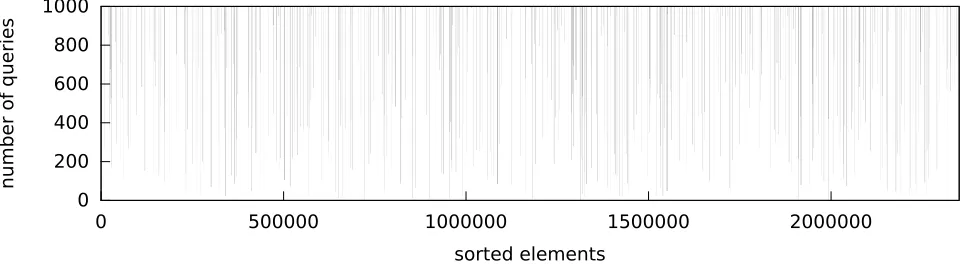
We also experimentally validate our claim of improved security by observing how many data items remain unsorted (i.e., the server cannot learn their relative order) after some number of queries are performed over real-world data. Specifically, we ran an experiment where we inserted over 2 million public employee salary figures from [1] and then performed 1000 random range queries. Figure 2 shows the server’s view of the salary data after various numbers of queries. The black lines indicate elements whose position in the global order the server knows (the shading of the lines indicates the fraction of comparable points in each value range with lighter shading indicating a lower fraction), while the contiguous white re-gions represent data points whose relative order is unknown. Note that for a typical OPE scheme, this image would be fully black (all order revealed).
See Section 5 for more details on our implementation and further experimental data.
POPE tree: no sorting when inserting data. Our main tech-nique to make this possible islazy indexing. Specifically, unlike OPE,we do not sort the encoded values on insert, instead only partially sorting values when necessary during query execution. If we regard the actual location in the search tree data structure as an implicit encoding of an encrypted value, our scheme gives a par-tially ordered encoding, and hence the name of our construction, POPE (partial order preserving encoding).
In particular, our scheme works by building anoveltree data structure (inspired by buffer trees [5]), which we call a POPE tree, where every node contains anunsorted bufferand a sorted list of el-ements. The invariant that we maintain is that the sorted elements of a node impose a partial order on both sorted and unsorted ele-ments of its child nodes. That is, all sorted and unsorted values at childiwill lie between valuesi−1andiin the parent’s sorted list. We stress that there is no required relation between unsorted elements of a node and the elements of its child nodes. In partic-ular, unsorted elements of the root node do not need to satisfy any condition. That said, one can simply insert a value by putting it in the unsorted buffer of the root node.
Having the server incrementally refine this POPE tree on range queries allows us to achieve both better efficiency and stronger se-curity. In particular,
0 200 400 600 800 1000
0 500000 1000000 1500000 2000000
number o
f queries
sorted elements
Figure 2:Server’s view of salary data whose order is incrementally revealed after inserting more than 2 million salary entries and then performing 1000 random range queries. The black lines indicate entries whose order is known by the server, while the white regions indicate entries that remain pairwise incomparable after some number of queries.
to parallelize this procedure maintaining the consistency of the tree structure.
• The cost of sorting encrypted elements can be amortized over the queries performed. In particular,on each query we only need to sort the part of the data that is accessed during the search, leaving much of the data untouched. This allows us to support range queries with much better efficiency and si-multaneously achieve stronger security by having some frac-tion of pairs of elements remain incomparable.
• Since encodings are sorted during searches, the cost of per-forming a batch of search queries is often much cheaper than performing these queries individually, as later queries do not need to sort any elements already sorted in earlier queries.
We now describe the key properties of our data structure in more detail. Intuitively, thanks to the required condition between sorted elements of a node and the elements of its child nodes, the sorted values at each node can serve as an array of simultaneous pivot elements for the elements in the child nodes, in the sense of Quick-sort [28]. To maintain this property we make use of client working-set storage to partition a working-set of unsorted elements according to the values at the parent. Specifically, we require the client to be able to read in a list ofO(n) encrypted values and then to partition a stream of other encrypted values according to these split points. Using this amount of client working-set storage we can ensure that the depth of the buffer tree remainsO(1), allowing for low amor-tized latency per client query. Note that any elements stored in the same unsorted buffer at the end of the procedure remain incompa-rable.
2.
PRELIMINARIES
2.1
Security with No Search Queries
The security definitions of OPE variants consider how much in-formation is revealed by the ciphertexts that are created when data is inserted. This measure is important since OPE ciphertexts must inherently reveal ordering information. The ideal security achiev-ableeven without any search queriesis revealing ordering infor-mation of the underlying plaintexts but nothing more. Our POPE scheme, however, gives much stronger guarantee of revealing no information about the underlying plaintexts during insertion. In-stead, ordering information isgradually leakedas more and more search queries are performed. In this section, we briefly discuss
the security guarantees that OPE variants and our scheme provide, before any search queries are performed.
Security of OPE. The security notion for OPE schemes is IND-OCPA (indistinguishability under ordered chosen-plaintext attack) [7, 35]: Ciphertexts reveal no additional information beyond the order of the plaintexts. However, Naveed et al. [33] demonstrated this level of security is sometimes insufficient, by showing how the revealed order can be used to statistically recover a significant amount of plaintext data in an OPE-protected medical database.
Security of frequency-hiding OPE. To address the above issue, Kerschbaum [29] proposed a stronger security notion, called indis-tinguishability under frequency-analyzing ordered chosen plaintext attack(IND-FAOCPA). Informally, the definition requires that ci-phertexts reveal no additional information beyond a randomized orderof the plaintexts. Arandomized orderY (some permutation of[n]forn-element sequences) of some sequenceXof possibly non-distinct elements is an ordering you can obtain from the se-quence by breaking ties randomly. For example, the randomized order ofX1 = (1,4,2,9)or X2 = (2,8,5,20)could only be Y1 = (1,3,2,4)(meaning “first in sorted order was inserted first, third in sorted order was inserted next,” and so on) becauseX1, X2 began totally ordered. However, the sequenceX3 = (1,2,2,3) has two possible randomized orders, namelyY2 = (1,2,3,4)and Y3= (1,3,2,4).
Note that for any randomized order, e.g.Y1= (1,3,2,4), there are many sequences that could map onto it (depending only on the domain of the sequence and the constraints imposed by known par-tial order information on the sequence). This property of a ran-domized order is useful for hidingfrequency. The motivating ex-ample for frequency-hiding security is a database that stores a large numbernof encodings for which the underlying label spaceL= {`1, ..., `T}is small, i.e.,T n. For example, [29] considered a
setting where each label is either`1= “female”(F)or`2= “male” (M),with the sequence (F, F, M, M) ideally encoded as, say, (2,1,3,4). Examining only(2,1,3,4)does not reveal if the under-lying sequence was originally (F, F, F, F),(F, F, F, M),(F, F, M, M),(M, F, M, M),or(M, M, M, M).
We use this approach to add frequency hiding in POPE. How-ever, even this stronger definition fails to protect against all known attacks as it still reveals the order between all distinct plaintexts in the database, allowing for sorting-based attacks.
Security of POPE. POPE, on the other hand, fully hides all in-serted plaintexts until search queries are performed. Looking ahead, our POPE scheme encrypts an item using semantically secure en-cryption. This implies in the POPE construction,ciphertexts reveal no informationabout the underlying plaintexts. Of course, it is not sufficient to just discuss security on insert without considering what happens on queries. Thus, we give a security definition below cap-turing what happens both on insertion and during search queries.
2.2
Security with Search Queries
We propose a simulation-based definition that captures both ideal OPE security and frequency-hiding even when considering what happens during the search procedure. Specifically, we require the existence of a simulator simulating the view of the protocol execu-tion given only a randomized order of (some of) the plaintexts. We model this by arandom orderoraclerordwhich just takes the in-dices of two data items and returns which item is larger according to some fixed randomized order. Since the simulated view is con-structed using only this oracle, the only information leaked in the real protocol corresponds to the oracle queries made to therord oracle, i.e., the randomized order on the queried plaintexts.
To formalize the simulation tasks, for a sequenceseqof inser-tion and search operainser-tions, we define the profileprofile(seq) of sequenceseqto be a sequence where each value inseqis replaced with a unique index (simply incrementing starting from 1) to iden-tify the operation. An example sequence and its profile can be:
seq: (insert10,insert100,range[8,20],insert41).
profile(seq) : (insert1,insert2,range[3,4],insert5).
DEFINITION 1. A range query protocolΠis called frequency-hiding order-preserving, for any honest-but-curious serverS, if there is a simulatorSimsuch that for any sequenceseqof inser-tions and searches, the following two distribuinser-tions are computa-tionally indistinguishable:
VIEWΠ,S(seq) ≈c Sim
rordseq(·,·)
Π (profile(seq)),
where the left-hand side denotes the real view ofSwhen executing the protocolΠwithseqas the client’s input, and the right-hand side is the output of the simulatorSimtaking as inputprofile(seq)
and referring to oraclerord. The oraclerordseq(·,·) works as
follows:
rordseq(i, j): It is initialized with a randomized orderπof the
labels inseqby breaking ties randomly. Then, for each query
(i, j), return whether theith label has a higher ranking than thejth, according toπ.
Since the simulator refers to only the profile and the oracle, we can say that for any protocol satisfying the above definition, the protocol transcript leaks to the server only the profile and the ran-domized order of the queried plaintexts. One benefit of this def-inition is it covers both non-interactive FH-OPE schemes and our interactive POPE scheme.
Leaking only a partial order. Recall that our POPE scheme grad-ually leaks the ordering information as more comparisons are made in order to execute the queries. To formally treat the amount of in-formation that remains hidden after some number of range queries, we introduce a definition that captures the number of points that remain incomparable even after some queries are performed.
First, we explain what we mean by the number of incomparable element pairswith transitivity. For example, consider a sequence of four labelslabels= (`1,`2,`3,`4). There are 42= 6initially unordered pairs: {`1, `2}, {`1, `3}, {`1, `4}, {`2, `3}, {`2, `4}, {`3, `4}. During query execution the order of some of these pairs may become known to the server, i.e., if it queries therordoracle on the indices of some such pair or if the order can be inferred from its previous queries. For example, giveninfo= (`1> `2,`2> `4), then due to transitivity, the server can infer`1> `4. However, the following pairs still remainincomparable:
{`1, `3},{`2, `3},{`3, `4}
Armed with this notion of incomparable pairs with transitivity, we give the following definition:
DEFINITION 2. Letn, mdenote the number of insertions and range searches respectively. A range query protocolΠis frequency-hiding partial order preserving withuincomparable element pairs with transitivity, if for any operation sequenceseqwithninserts andm range queries, the simulator successfully creates a simu-lated view required by Definition 1 while leaving at leastupairs of elements that are incomparable with transitivity based on the queries made by the simulator torord.
In this paper, whenever we consider incomparable pairs, we con-sider it with transitivity, and from now on, we will omit the phrase “with transitivity”. Note that both the OPE scheme by Popa et al. [35] and the FH-OPE scheme by Kerschbaum [29] have0 in-comparable element pairs for anyninserts, even with0searches. However, our POPE scheme shows a more gradual information leakage. We discuss this in more detail in Section 4.
3.
MAIN CONSTRUCTION
3.1
Overview
Our scheme consists of a client and a server, which we denote by ClandSerrespectively. Clholds an encryption key and performs insertions and range query operations through interactive protocols withSer. (In fact, only the range query operation is interactive, which is a key benefit of our construction!)
AsClisstatelessand needs to remember nothing (other than the secret key), all data is stored encrypted bySer. To organize this data and facilitate fast lookups,Sermaintains a POPE tree to hold the ciphertexts. The high-level structure of this tree is similar to a B-tree, where each node has a bounded number of children and all leaf nodes are at the same depth. In fact, the number of children of any POPE tree internal node is betweenL/2 + 1andL+ 1, where Lis the local temporary storage capacity ofCl.
Where the POPE tree differs from a standard B-tree is that ev-ery node contains an unsortedbufferof ciphertextswith unbounded size. The benefits of our construction, both in terms of efficiency and security, stem from the use of these unsorted buffers. For ef-ficiency, they allow to delay expensive sorting and data movement operations until necessary to execute a range query. Security ben-efits stem from the fact that the relative order of elements in the same unsorted buffer is not revealed to an attacker.
Before completing a range query,Serinteracts withCltosplit
the tree according to each of the two query endpoints. This sub-routine — the most sophisticated in our entire construction — has three stages. First, for all the internal POPE tree nodes along the search path for the query endpoint, the unsorted buffers are cleared out. This clearing of the buffers proceeds from root to leaf, and involves streaming all buffer ciphertexts back fromSertoCl, who responds for each one with the index of which child node that ci-phertext should flow down to. Recall that we maintain each internal node having at mostL+ 1children; this allows the operation to be performed efficiently byClwithout overflowing the client’s size-L local storage.
This initial stage of thesplitends at a leaf node. The second stage involves reducing the size of that leaf node’s buffer to at most L, the size ofCl’s local storage. This leaf node buffer reduction proceeds by selectingLrandom ciphertexts from the leaf node’s buffer, and usingClto split the single leaf intoL+ 1new sibling leaf nodes, according to these randomly-selected elements. These Lrandomly sampled ciphertexts are inserted into the parent node as partition elements between the new leaf nodes. This leaf node splitting procedure is repeated until the resulting leaf node has a buffer of size at mostL.
However, we may have inserted too many new children into the parent node, causing it to have more than the limit ofL+1children. So arebalanceoperation must finally be completed, from the leaf back up to the root node, creating new internal nodes as necessary until they all have at mostL+ 1children as required. Note that this stage does not require any further ordering or consultation withCl. After performing this split operation for both endpoints, the ac-tualrange querycan now be completed bySerreturning toCl all the ciphertexts in all buffers of nodes between the two query endpoints. Again, this does not require any further ordering infor-mation fromCl. Of particular importance for security is that there may be large unsorted buffers even after the range query completes, because all contents of those buffers lie entirely within or outside of the desired range. The server either returns all of none of the ciphertexts in these buffers, but still does not (and does not need to) learn their order.
Parameters. Recall that the parameternrepresents the total num-ber of items inserted into the database, and the parameterm rep-resents the total number of range query operations performed. The client can temporarily storeL+O(1)labels in its local memory for the duration of a given query. LetL=n
for constant0< <1.
Notation. To support realistic application scenarios, we distin-guish between two types of data thatSerholds: (i)labels`and
(ii)blocksthat are composed of a POPE-encoded label`and an arbitrary, encrypted payloadv`. This models the case when range
searches over POPE-encoded labels are used to retrieve the pay-loads. No searching directly over the payloads is supported.
We remark that, in principle, for every distinct label`, there could be many distinct blocks(`, v`1),(`, v`2), ...stored bySer. However, we will restrict to the special case when for each label` there is at most one block(`, v`)in order to convey the main ideas
more clearly. (Note this distinctness property holds w.h.p. if we use the tie-breaking procedure described in Section 2.1.)
3.2
Encryption of Labels
In our system, wheneverClcommunicates a label`toSerwe haveCl always send a ciphertext `¯to Ser, where `¯←Enck(`).
Besides an encryption of the label itself, this ciphertext must also encrypt (a) the tie-breaking random value necessary for frequency-hiding POPE and (b) an indication of the label’sorigin(left or right query endpoint, or insertion).
Tie-breaking randomness. Consider for example that the labels (1,2,2,3)have been inserted, followed by a range query for all values between2and3, requiring a total of six encryptions. From Section 2.1, tie-breaking randomness can be thought of as adding a random fractional part to each plaintext before encrypting, so for example we encrypt the labels(1.89,2.15,2.35,3.93)and the range query endpoints2.23and3.38.
Origin bits. This hides the repeated label2, but creates a new problem: the labels2.15and3.93which should be included in a range search between 2 and 3, would be excluded because of the tie-breaking. So we also include two bitsπfor theoriginof the plaintext:πl= 00andπr = 11for left and right query endpoints
respectively, andπm= 01for an insertion. These bits are inserted
between the actual label and the tie-breaking values, so (contin-uing the previous example), we would insert the encryptions of (1.01.89,2.01.15,2.01.35,3.01.93)and query endpoints2.00.23 and3.11.38. This forces the range search to return the three correct values.
Two-block ciphertexts. Even treating the two origin bits as part of the label, each plaintext becomes two blocks long, so that a straight-forward application of CTR or CBC mode encryption results in ciphertexts of three blocks. One can achieve better efficiency by not including the tie-breaking randomness but still enabling the re-ceiver to compute it. In particular, letfbe a PRP, and let:
• enck(mkπ): Choose a random string r. Return the pair
(r, fk(r+ 1)⊕(mkπ)).
• deck(c1, c2): Computemkπ←fk(c1+ 1)⊕c2 and the tie breaking randomnessu←fk(c1+ 2). Return(m, π, u), Note it’s just the CTR mode of encryption. Even though the ciphertext doesn’t explicitly contain the tie-breaking randomness, the reconstructeduserves for this purpose.
3.3
Server Memory Layout
Serstatefully maintains thePOPE treeT, which is a balanced L-ary tree with rootr.
• Eachnon-leafnodeu∈ T stores abufferand alist. • Eachleaf nodeu∈ T stores abufferonly.
A buffer stores an unbounded, unsorted set of (encryptions of) blocks{(`1, v`1),(`2, v`2), ..}, and aliststores at mostLsorted (encryptions of) labels(`1, ..., `L).
Main invariant of the POPE treeT. We will enforce the follow-ing, main order-invariant onSer’s treeT:
Let`j−1and`jbe the(j−1)th andjth sorted labels at some
(non-leaf) nodeuinT. Then, for all labels`in the sub-treeTuj
rooted at thejth childujofu, we have`j−1< `≤`j.
Intuitively, this guarantee of global partial ordering enables theL sorted labels`1, ..., `Lat each nodeuto serve as an array of
si-multaneouspivot elements, in the sense of Quicksort [28], for the L+ 1sub-trees rooted atu’s (at most)L+ 1childrenu1, ..., uL+1.
Looking ahead, we use this simple, parallel pivot idea in conjunc-tion with the parameter setting L = n, implyingT has depth d1/e= O(1), to enableSerto traverse and maintain the treeT with low amortized latency over repeated batches ofClqueries.
3.4
The POPE Protocol
Implementing Setup. AtSetup,ClandSerdo: Setup:
–Clgenerates private keys for label/block encryption. –SerinitializesT as a rootrwith empty buffer and list.
Implementing Insert. ToInsertablock(`, v),ClandSerdo: Insert(`, v):
–Clsends (encrypted) block(`, v)toSer.
–Serappends block(`, v)to the end of the current root node’s buffer.
AfterSetupand possibly manyInsertoperations (but noSearch
operations), the POPE treeT held bySerappears as in Figure 3.
Figure 3:The state ofSer’s treeT prior to anySearchqueries.
Implementing Search. ForCltoSearchfor the range of blocks held bySerinT between twolabels`leftand`right,ClandSerdo:
Search(`left, `right):
–ClandSerengage in an interactive protocolSplittwice, once for`leftand once for`right.
– After eachSplit,Clidentifies forSerthe leaf node
uleft(oruright) inT that matches the label`left(or`right).
–Sersends the blocks in[uleft, uright]toCl.
How to Split the POPE Tree. ForCltoSplitSer’s treeT at label `∈ {`left, `right},ClandSerengage in an interactive protocol. This
operation will return the leaf node whose buffer contains the given label with the guarantee that all nodes along the path from the root to that leaf have empty buffers.
IndividualSplitcalls always begin at the current rootr ∈ T. After any (non-leaf) nodeu ∈ T is split, Serlearns (from Cl) the indexi∈ [L+ 1]of the next childuiofuto beSplit. The
Splitprotocol proceedsrecursivelydown some path ofT,splitting subsequent childrenui, ui,j, ...until terminating at a leaf nodeu.
(For readability in what follows, we assume thatSeralways returns whole nodes toClfor eachSearchresponse.)
We break our description ofSplitinto two broad cases: (i)the
Splits ofinternal, i.e., non-leaf nodes, and(ii)theSplits ofleaf nodes.
Case (i) — Splits at internal nodes: For splits at internal nodesu with children denotedui,ClandSerdo:
Split(`)— for internal nodesu:
–SersendsL=u.listtoCl.
–Serstreams(`0, v0)∈u.buffertoCl. –Clsends thesortedindexi∈[L+ 1]
of each(`0, v0)inLtoSer.
–Serappendsblock(`0, v0)toui.buffer
During this operation,Cleither(a)sees the searched-for label `∈ {`left, `right}(and discovers nodeuito proceed to), or(b)
dis-covers the nodeuithat may contain label`based on its boundary
values.
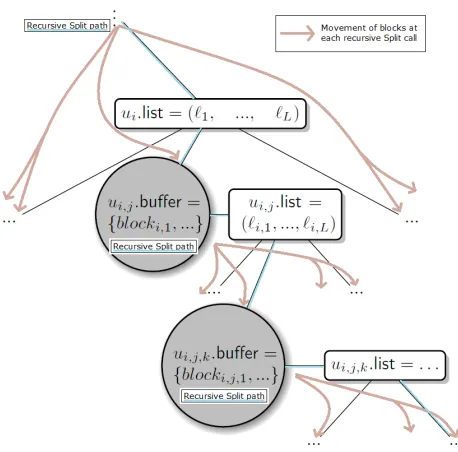
The block movement in splits at internal nodes is illustrated in Figure 4. (The outcomes of three “splits” are shown.)
Figure 4:The flow of blocks in recursiveSplit’s ofSer’s treeT.
Case (ii) — Splits at the leaves: For splits at leaf nodeuwith parent nodeu∗,ClandSerdo:
Split(`)— for leaf nodesu:
– If|u.buffer| ≤L,return.
–SersamplesLlabelsL={`1, ..., `L}fromu.buffer. –Sercreates new rootu∗ifuis the root node, or setsu∗to
u’s parent otherwise. –SersendsLtoCl.
–ClsortsLand returns it toSer.
–SerinsertsLnew sibling leaf nodesuiinto parentu∗ as well as new labelsLintou∗.listat the position previously occupied byu(nodeuis deleted after it is split).
–Serstreams(`0, v0)∈u.buffertoCl
–Clsends thesortedindexi∈[L+ 1]
of each(`0, v0)inu.buffertoSer. –Serinsertsblock(`0, v0)into sibling nodeu
i
–Clindicates toSerthe indexiof new leaf node matchingl
Note that if the size of the buffer is smaller than the local storage capacityLofCl, then this operation does nothing, and the split is complete. Otherwise, as in Case (i) ofSplit,Clwill learn which of the sibling leaf nodesuito recursivelySplitin order to find label
`. In this way, a singleSplitoperation may recursively result in multiple leaf nodeSplit’s, with smaller and smaller buffers.
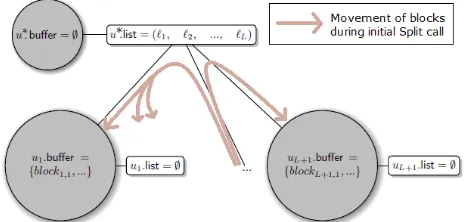
As an example, the new state ofSer’s treeT immediately after Cl’sfirstSplitcall (which splits the starting leaf node ofT, i.e. the root) is as depicted in Figure 5.
Clean-up Step: Rebalancing a Split POPE Tree. After complet-ing theSplitprotocol above, the resulting leaf node at whichSplit
terminates will have size at mostL, but some internal node’s sorted list may be larger thanLbecause of the insertions from their chil-dren — see case (ii) ofSplit. This would be problematic in future
Splitoperations on those internal nodes, as they would sendu.list
Figure 5:The state ofSer’s treeT after thevery firstSplitends: the new rootr:=u∗(empty buffer, full list), plusL+ 1leaves.
To fix this, after completing theSplitprotocol,Sercalls the fol-lowing operation on the parent of the resulting leaf node in order to rebalance the labels in the lists of the internal nodes. We empha-size thatRebalanceis purely a local data structure manipulation, and does not require interaction fromCl, since the unsorted buffer of the rebalanced nodes is empty due to priorSplit, having only sorted labels in the list.
More concretely, toRebalanceat nodeu(initially the parent of the leaf whereSplitended),Serdoes:
Rebalance(u):
– If|u.list| ≤L,return.
– Ifuhas no parentu∗, create a fresh root noderforT
and setu∗:=r.
– Partitionu.listinto sorted sublists of size at mostLeach by selecting
L= [every(L+ 1)’th element inu.list].
– Create|L|new sibling nodes and insert them as well as the new labels
Linto parent nodeu∗.
– CallRebalance(u∗).
This completes the description of our main POPE protocol.
4.
ANALYSIS
4.1
Cost Analysis
We analyze amortized costs on the round complexity and band-width per operation.
THEOREM 1. Afterninsertions andmquery operations with local storage of sizeL, our scheme has the following costs:
1. Insertalways requires a single round, andSearchrequires O(logLn)rounds in expectation.
2. The total expected bandwidth over all(n+m)operations (excluding the bandwidth necessary for sending the search results) is
O mLlogLn+nlogLm+nlogL(lgn)
.
The proof is found in Appendix 8.
Remark. With L = n,0 < < 1, Theorem 1 implies that
SearchtakesO(1)rounds in expectation. Moreover, whenL=n andm = O(n1−)as well,
the amortized bandwidth per opera-tion becomesO(1). This is exactly our target scenario of many insertions and relatively few searches.
4.2
Security Analysis
THEOREM 2. The POPE protocol is a frequency-hiding order-preserving range query protocol.
PROOF. We show that our POPE scheme satisfies Definition 1 by showing a simulator. The simulator is very simple. For each insert, the simulator sendsenck(0); due to semantic security of the
underlying encryption, the simulation is indistinguishable. To sim-ulate search queries, the simulator runs the adversarial server’s al-gorithm, and during the simulation, when the server needs to com-pare two encrypted labels, the simulator simply queries therord oracle to get the answer. It’s obvious that the simulated view is indistinguishable to the real view of the server.
Security with queries. Range query schemes leak some informa-tion of underlying plaintexts from adaptive search queries. In this case, one important security measure can be thenumber of pairs of incomparable elements. In any range query scheme, search queries reveal some partial order on the underlying plaintexts. Recall that apartial order≺on a set of elementsSis isomorphic to a directed acyclic graph, closed under transitive closure, whose nodes are el-ements ofSand whose edges encode the binary relation. A total order onnitems always has n2
edges. In any partial order, two elementsx, y ∈ Sare said to beincomparableiff neitherx≺ y nory≺x. In a total order (such as therandomized orderof [29]), no pair of elements is incomparable. In our POPE scheme, each search querygraduallyleaks the ordering information of the un-derlying plaintexts. In particular, with a small number of search queries, there will be many pairs of incomparable elements.
THEOREM 3. Afterninsertions andmquery operations with local storage of sizeL, wheremL∈ o(n), our POPE scheme is frequency-hiding partial-order-preserving withΩmLnlog2
Ln−n
incomparable pairs of elements.
PROOF. Note the simulator in the above proof uses oraclerord whenever the server algorithm needs to compare the elements. So, we can prove the theorem by using a counting argument on the number of labels that the server compares. We model the server’s view of the ciphertext ordering as somekciphertexts whose order is completely known, and where the remainingn−kciphertexts are partitioned into one ofk+ 1buckets according to thekordered ciphertexts. Essentially, this is a worst-case scenario where all in-ternal node buffers in the POPE tree are empty, the total size of all internal node sorted lists isk, and the remainingn−kciphertexts reside in leaf node buffers.
We focus on the round complexity for range queries (insertion gives no change in the number of comparable elements). From Theorem 1, the total rounds of communication for range queries, afterninsertions andmrange queries, isO(mlogLn). From the construction,each round of communication can add at mostLnew ciphertexts to those whose sorted order is completely known.
Therefore, in the worst case, the server hask=O(mLlogLn) ciphertexts in its sorted order, creatingk + 1 buckets in which the other values are placed. Thus, the worst-case split that mini-mizes the total number of incomparable elements is for the remain-ing values to be partitioned equally among these buckets. Thus, we have b = b(n−k)/(k+ 1)c ciphertexts in each unsorted bucket. Each bucket contains 2bincomparable items, for a total of(k+ 1)· b
2
= Ω(nk2−n)incomparable pairs.
by making sure that (1) all the ciphertexts that the server asks the client to compare are legitimate, that is, created by the client (to sure this, the labels should now be encrypted with IND-CCA2 en-cryption), and (2) the number of the server’s comparison requests should be within the bounds of Theorem 1.
Unfortunately, this augmented system doesn’t achieve full ma-licious security; in particular, a mama-licious server may omit some values from the query answers, although it cannot inject a fake re-sult due to IND-CCA2 security of the underlying encryption. Ef-ficiently achieving full malicious security is left as an interesting open problem.
5.
EVALUATION
5.1
Experimental setup
We have made a proof-of-concept implementation of our POPE scheme in order to test the practical utility of our new approach. The code is written in Python3 and our tests were performed using a single core on a machine with an Intel Xeon E5-2440 2.4 GHz CPU and 72GB available RAM. Our implementation follows the details presented in Section 3. The symmetric cipher used is 128-bit AES, as provided by the PyCrypto library. The full source code of our implementation is available at https://github.com/dsroche/pope.
Database size. While we performed experiments on a wide range of database sizes and number of range queries, our “typical” start-ing point is one million insertions and one thousand range queries. This is the same scale as recent work in the databases community for supporting range queries on outsourced data [31], and would therefore seem to be a good comparison point for practical pur-poses.
Parameters. In our experiments, we varied the total database size between one thousand and 100 million entries, each time perform-ing roughlym = n1/2
range queries and withL = n1/4 local client storage. That is,= 0.25in these experiments. The size of each range being queried was randomly selected from a geometric distribution with mean 100; that is, each range query returned on average 100 results.
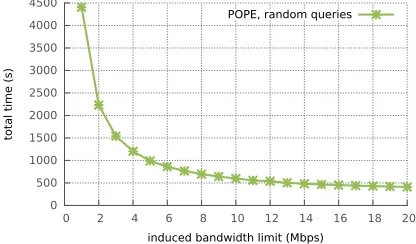
Network. Our main experiments were performed in a local setup, but with careful measurement of communication and under the as-sumption that network bandwidth (i.e., amortized communication size) and latency (i.e., round complexity) would be the bottlenecks of a remote cloud implementation. In particular, in our network experiments, we used thetc“traffic control” utility to add specific latency durations as well as bandwidth limitations. This allowed us to test the behavior under controlled but realistic network set-tings, when we throttled the network slower than 5ms of latency and 20Mbps bandwidth.
Comparison with Popa et al. We compared our construction ex-perimentally to that of Popa et al. [35], who had a setting most similar to ours. Further comparison benchmarks, such as to [30] or even to ORAMs, might provide further insight, and we leave this as future work.
For a fair comparison to prior work, we also implemented the mOPE scheme of [35] in Python3 along with our implementation of POPE. We followed the description in their work, using a B-tree with at most 4 items per node to store the encryptions. To get a fair comparison, we used the same framework as our POPE experi-ments, with the client that receives sorting and partitioning requests from the server. In the case of mOPE, each round of communica-tion consisted of sending a single B-tree node’s worth of cipher-texts, along with one additional ciphertext to be encoded, and re-ceiving the index of the result within that sorted order. We
acknowl-edge that our implementation is likely less tuned for efficiency than that of the original authors, but it gives a fair comparison to our own implementation of POPE. It is also important to note thatour communication cost measurements depend only on the algorithm and not on the efficiency of the implementation.
Measuring communication and running time. When our tests measured communication (in terms of rounds and total ciphertexts transferred) and running time, we did not include the cost of the server sending the search results; this is inherent in the operation being performed and would be the same for any alternative imple-mentation.
5.2
Experimental workloads
Local setting: huge data, various search patterns. In our main experiments, where we wanted to scale the number of database en-tries from one thousand up to 100 million enen-tries, we used synthetic data consisting of random pairs of English words for both label and payload values. For these experiments we also did not actually transfer the data over a network, but merely measured the theo-retical communication cost. This allowed us to test a much wider range of experimental sizes, as we found a roughly 10x slowdown in performance when running over a network, even with no throt-tling applied.
The actual size of each range being searched was, on average, 100 database entries. While the distribution of searches does not affect the running time of mOPE, for POPE we varied among three distributions of the random range queries: (i) uniformly distributed queries, (ii) search queries all “bunched” at the end after all in-sertions, (iii) a single, repeated query, performed at random inter-vals among the insertions. According to our theoretical analysis, the “bunched” distribution should be the worst-case scenario and the repeated query should be the best-case. In practice we did not see much difference in performance between bunched or random queries, though as expected, we observed improved performance for the repeated query case.
Networked setting: real salary data. To test performance over a realistic network with latency and bandwidth restrictions, we used the California public employee payroll data from 2014, available from [1], as a real dataset on which to perform additional experi-ments. This dataset lists payroll information for roughly 2.3 mil-lion public employees. We used the total salary field as our “label” value (on which range queries are performed), and the names as the payload values.
We were not able to complete any test runs of the mOPE using actual network communication over the salary dataset; based on partial progress in our experiment we estimate it would take several days to complete just one test run of this experiment using mOPE and actual network communication with our Python implementa-tion.
We were able to run experiments with POPE up to 100 million entries, limited only by the storage space available on our test ma-chine. We observed no significant change in per-operation perfor-mance after one million entries, indicating our construction should scale well to even larger datasets.
5.3
Local Setting
101 102 103 104 105 106 107 108 109
103 104 105 106 107 108
to ta l r o u n d s o f co m m u n ic a ti o n
number of entries mOPE
POPE, random queries POPE, bunched queries POPE, repeated queries
Figure 6:Total rounds of communication for POPE and mOPE, plotted in log/log scale according to total number of insertionsn. Lower is better. The number of range queries in all cases was√n.
0 10 20 30 40 50 60
103 104 105 106 107 108
ci p h e rt ex ts t ra n sf e re d p e r o p
number of entries mOPE
POPE, random queries POPE, bunched queries POPE, repeated queries
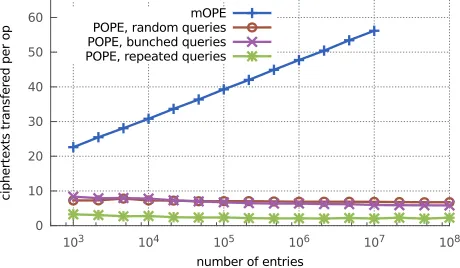
Figure 7:Amortized communication costs for POPE and mOPE, according to total number of insertionsn. Lower is better. The number of range queries in all cases was√n.
As these figures demonstrate, the round complexity for POPE, which is constantper range query, is several orders of magnitude less than that of mOPE. Furthermore, when averaged over all op-erations, the number of ciphertexts transferred per operation for POPE is roughly 7 in the worst case, whereas for mOPE this in-creases logarithmically with the database size.
Experimental running time. The per-second operations counts, for our main experiments withninsertions,m=√nrange queries, andL = n1/4 client-side storage, are presented in Figure 8. For POPE, the performance increases until roughly 1 million entries, after which the per-operation performance holds steadily between 50,000 operations per second with random, distinct queries, and 110,000 operations per second with a single, repeated query.
For one million entries and using our Python implementation without parallelization, we achieved over 55,000 operations per second with POPE vs. less than 2,000 operations per second for mOPE, without even accounting for the network communication.
Our POPE construction is well-suited particularly for problems with many more insertions than range queries; indeed, theO(1) theoretical performance guarantees hold only whenmL < n. Fig-ure 9 shows the effects of varying numbers of range queries on POPE performance. Although the performance of POPE clearly degrades with increasing numbers of queries performed, this ex-periment shows competitive performance compared to mOPE even whenm=n.
0 20 40 60 80 100 120 140 160
103 104 105 106 107 108
th o u sa n d s o f o p s p e r se co n d
number of entries POPE, repeated queries
POPE, bunched queries POPE, random queries mOPE
Figure 8:Operations performed per second for POPE and mOPE. Higher is better. The number of range queries in all cases was√n.
0 10 20 30 40 50 60
210 212 214 216 218 220
th o u sa n d s o f o p s p e r se co n d
number of queries
POPE mOPE
Figure 9: Degradation in POPE performance with increasing number of queries, measured in operations per second. Higher is better. In all experi-ments, the number of insertionsnwas fixed at 1 million, and the client-side storage atL= 32. For these choices,210 ≈√nqueries is as shown in
prior figures, and ourO(1)-cost analysis holds up tom≈215.
5.4
Experimental Network Effects
We tested the effects of varying network latency and bandwidth using the California public employees payroll data as described above. Our workload consisted of all 2,351,103 insertions as well as 1,000 random range queries at random points throughout the in-sertions. Each range query result size was fixed at 100 entries.
Figure 10 shows the effects of latency on the POPE implemen-tation. With less than 5ms of latency, the cost is dominated by that of the POPE computation and other overhead. Beyond this level, the total runtime scales linearly with the latency. Note that 10ms to 30ms represents typical server response times within the same continent over the Internet.
Figure 11 shows the effects of bandwidth limitations on our con-struction. Without any latency restriction, we limited the band-width between 1 and 20 megabits per second (Mbps), which is the typical range for 4G (on the low end) and home broadband Inter-net (on the high end) connections. We can see that, past roughly 10 Mbps, the other overhead of the implementation begins to dominate and there is no more significant gain in speed.
6.
RELATED WORK
Order-Preserving and Order-Revealing Encryption. Order-preserving encryption (OPE) [3, 7, 8] guarantees thatenc(x) <
400 600 800 1000 1200 1400 1600 1800 2000
0 5 10 15 20 25 30 35 40 45 50
total time
(s)
induced network latency (ms) POPE, random queries
Figure 10:Total running time for 2.3 million insertions and 1000 random range queries, running over a network with varying artificially-induced la-tency times.
0 500 1000 1500 2000 2500 3000 3500 4000 4500
0 2 4 6 8 10 12 14 16 18 20
total time
(s)
induced bandwidth limit (Mbps) POPE, random queries
Figure 11:Total running time for 2.3 million insertions and 1000 random range queries, running over a network with varying bandwidth limitations.
performed over the plaintext data. However, OPE comes with a security cost. None of the original schemes [3, 7] achieve the idealsecurity goal for OPE of IND-OCPA (indistinguishability un-der orun-dered chosen-plaintext attack) [7] in which ciphertexts reveal no additional information beyond the order of the plaintexts. In fact Boldyreva et al. [7] prove that achieving a stateless encryp-tion scheme with this security goal is impossible under reasonable assumptions. The existing schemes, instead, either lack formal analysis or strive for weaker notions of security which have been shown to reveal significant amount of information about the plain-text [8]. The first scheme to achieve IND-OCPA security was the order-preserving encoding scheme of Popa et al. [35].
A related primitive to OPE is order-revealing encryption (ORE) [7], which provides a public mechanism for comparing two en-crypted values and thus also enables range searches over enen-crypted data. (Note, OPE is the special case where this mechanism is lex-icographic comparison,) The first construction of ORE satisfying idealsecurity [10] was based on multi-linear maps [20] and is thus unlikely to be practical in the near future. An alternative scheme based only on pseudorandom functions [15], however, has addi-tional leakage that weakens the achieved security.
OPE alternatives. In addition to OPE there are several other lines of work that enable searching over encrypted data. Typically, these works provide stronger security than provided by OPE; in particu-lar they do not reveal the full order of the underlying data as hap-pens with OPE. However, the additional security guarantees come at a significant performance cost with even the latest schemes being one to two orders of magnitude slower than the latest OPE-based implementations [34, 19].
Symmetric searchable encryption (SSE) was first proposed by Song, Wagner, and Perrig [39] who showed how to search over encrypted data for keyword matches in sub-linear time. The first formal security definition for SSE was given by Goh [23], Curt-mola et al. [16] showed the first SSE scheme with sublinear search time and compact space, while Cash et al. [13] showed the first SSE scheme with sublinear search time for conjunctive queries. Recent works [34, 13, 19] achieve performance within a couple orders of magnitude of unencrypted databases for rich classes of queries in-cluding boolean formulas over keyword, and range queries. Of par-ticular interest is the work of Hahn and Kerschbaum [27] who show how to use lazy techniques to build SSE with quick updates. We refer interested readers to the survey by Bösch et al. [12] for an excellent overview of this area.
Oblivious RAM [24, 38, 40, 44] and oblivious storage schemes [26, 4, 18, 32] can be used for the same applications as OPE and POPE, but achieve a stronger security definition that additionally hides the access pattern, and therefore incur a larger performance cost than our approach.
Finally, we note that techniques such as fully-homomorphic en-cryption [22], public-key searchable enen-cryption [9, 11, 37], and secure multi-party computation [46, 6, 25] can enable searching over encrypted data while achieving the strongest possible security. However, these approaches would require performing expensive cryptographic operations over the entire database on each query and are thus prohibitively expensive. Very recently cryptographic primitives such as order-revealing encryption [10], as well as gar-bled random-access memory [21], have offered the potential to achieve this level of security for sub-linear time search. However, all constructions of these primitive either rely on very non-standard assumptions or are prohibitively slow.
Lazy data structures and I/O complexity. Our POPE tree is is similar in concept to the Buffer Tree of [5]. Their data structure de-lays insertions and searches in a buffer stored at each node, which are cleared (thus executing the actual operations) when they be-come sufficiently full. The main difference here is that our buffers contain only insertions, and they are cleared only when a search operation passes through that node.
We also point out an interesting connection to I/O complexity regarding the size of local storage. In our construction, as in [36], the client is treated as an oracle to perform comparisons of cipher-texts. If we think of the client’s memory as a “working space” of sizeL, and the server’s memory as external disk, then from [2] it can be seen that performingmrange queries on a database of size n≥mrequires a total transfer bandwidth of at leastΩ(mlogLm) ciphertexts. (This is due to the lower bound on the I/O complexity of sorting, and the fact thatmrange queries can reveal the order of a size-msubset.) In particular, this means that the mOPE con-struction from [36] cannot be improved without either limiting the number of queries, or increasing the client-side storage, both of which we do for POPE.
FA8702-15-D- 0001. Any opinions, findings, conclusions or recommenda-tions expressed in this material are those of the author(s) and do not necessarily reflect the views of the Assistant Secretary of Defense for Research and Engineering.
7.
REFERENCES
[1] California public employee payroll data, 2014. Source: Transparent California, http://transparentcalifornia.com/downloads/.
[2] Alok Aggarwal and Jeffrey Scott Vitter. The I/O complexity of sorting and related problems. InICALP 1987, volume 267 ofLNCS, pages 467–478. Springer Berlin Heidelberg, 1987.
[3] Rakesh Agrawal, Jerry Kiernan, Ramakrishnan Srikant, and Yirong Xu. Order-preserving encryption for numeric data. InACM SIGMOD 2014, pages 563–574, 2004.
[4] Daniel Apon, Jonathan Katz, Elaine Shi, and Aishwarya
Thiruvengadam. Verifiable oblivious storage. InPKC 2014, volume 8383 ofLNCS, pages 131–148. Springer, Heidelberg, March 2014. [5] Lars Arge. The buffer tree: A technique for designing batched
external data structures.Algorithmica, 37(1):1–24, 2003. [6] Michael Ben-Or, Shafi Goldwasser, and Avi Wigderson.
Completeness theorems for non-cryptographic fault-tolerant distributed computation (extended abstract). In20th ACM STOC, pages 1–10, 1988.
[7] Alexandra Boldyreva, Nathan Chenette, Younho Lee, and Adam O’Neill. Order-preserving symmetric encryption. In
EUROCRYPT 2009, pages 224–241, 2009.
[8] Alexandra Boldyreva, Nathan Chenette, and Adam O’Neill. Order-preserving encryption revisited: Improved security analysis and alternative solutions. InCRYPTO 2011, pages 578–595, 2011. [9] Dan Boneh, Giovanni Di Crescenzo, Rafail Ostrovsky, and Giuseppe
Persiano. Public key encryption with keyword search. In
EUROCRYPT 2004, volume 3027 ofLNCS, pages 506–522. Springer, Heidelberg, May 2004.
[10] Dan Boneh, Kevin Lewi, Mariana Raykova, Amit Sahai, Mark Zhandry, and Joe Zimmerman. Semantically secure order-revealing encryption: Multi-input functional encryption without obfuscation. InEUROCRYPT 2015, Part II, volume 9057 ofLNCS, pages 563–594. Springer, Heidelberg, April 2015.
[11] Dan Boneh and Brent Waters. Conjunctive, subset, and range queries on encrypted data. InTCC 2007, pages 535–554, 2007.
[12] Christoph Bösch, Pieter H. Hartel, Willem Jonker, and Andreas Peter. A survey of provably secure searchable encryption.ACM Comput. Surv., 47(2):18:1–18:51, 2014.
[13] David Cash, Stanislaw Jarecki, Charanjit S. Jutla, Hugo Krawczyk, Marcel-Catalin Rosu, and Michael Steiner. Highly-scalable searchable symmetric encryption with support for boolean queries. In
CRYPTO 2013, Part I, pages 353–373, 2013.
[14] Fay Chang, Jeffrey Dean, Sanjay Ghemawat, Wilson C. Hsieh, Deborah A. Wallach, Michael Burrows, Tushar Chandra, Andrew Fikes, and Robert Gruber. Bigtable: A distributed storage system for structured data. InOSDI 2006, pages 205–218, 2006.
[15] Nathan Chenette, Kevin Lewi, Stephen A. Weis, and David J. Wu. Practical order-revealing encryption with limited leakage. InFSE, pages 474–493. Springer, 2016.
[16] Reza Curtmola, Juan A. Garay, Seny Kamara, and Rafail Ostrovsky. Searchable symmetric encryption: improved definitions and efficient constructions. InACM CCS 06, pages 79–88, 2006.
[17] Giuseppe DeCandia, Deniz Hastorun, Madan Jampani, Gunavardhan Kakulapati, Avinash Lakshman, Alex Pilchin, Swaminathan Sivasubramanian, Peter Vosshall, and Werner Vogels. Dynamo: Amazon’s highly available key-value store. InSOSP 2007, pages 205–220, 2007.
[18] Srinivas Devadas, Marten van Dijk, Christopher W. Fletcher, Ling Ren, Elaine Shi, and Daniel Wichs. Onion ORAM: A constant bandwidth blowup oblivious RAM. Theory of Cryptography Conference, TCC ’16, 2016.
[19] Sky Faber, Stanislaw Jarecki, Hugo Krawczyk, Quan Nguyen, Marcel-Catalin Rosu, and Michael Steiner. Rich queries on encrypted data: Beyond exact matches. InESORICS 2015, Part II, volume 9327 ofLNCS, pages 123–145. Springer, Heidelberg, September 2015.
[20] Sanjam Garg, Craig Gentry, and Shai Halevi. Candidate multilinear maps from ideal lattices. InEUROCRYPT 2013, volume 7881 of
LNCS, pages 1–17. Springer, Heidelberg, May 2013.
[21] Sanjam Garg, Steve Lu, Rafail Ostrovsky, and Alessandra Scafuro. Garbled RAM from one-way functions. In47th ACM STOC, pages 449–458. ACM Press, June 2015.
[22] Craig Gentry. Fully homomorphic encryption using ideal lattices. In
41st ACM STOC, pages 169–178, 2009.
[23] Eu-Jin Goh. Secure indexes.IACR Cryptology ePrint Archive, 2003:216, 2003.
[24] Oded Goldreich. Towards a theory of software protection and simulation by oblivious RAMs. In19th ACM STOC, pages 182–194. ACM Press, May 1987.
[25] Oded Goldreich, Silvio Micali, and Avi Wigderson. Proofs that yield nothing but their validity and a methodology of cryptographic protocol design (extended abstract). In27th FOCS, 1986.
[26] Michael T. Goodrich, Michael Mitzenmacher, Olga Ohrimenko, and Roberto Tamassia. Practical oblivious storage. InACM CODASPY ’12, pages 13–24, 2012.
[27] Florian Hahn and Florian Kerschbaum. Searchable encryption with secure and efficient updates. InACM CCS 14, pages 310–320, 2014. [28] C. A. R. Hoare. Algorithm 64: Quicksort.Commun. ACM, 4(7):321–,
July 1961.
[29] Florian Kerschbaum. Frequency-hiding order-preserving encryption. InACM CCS 15, pages 656–667, 2015.
[30] Florian Kerschbaum and Axel Schröpfer. Optimal
average-complexity ideal-security order-preserving encryption. In
ACM CCS 14, pages 275–286, 2014.
[31] Rui Li, Alex X. Liu, Ann L. Wang, and Bezawada Bruhadeshwar. Fast range query processing with strong privacy protection for cloud computing.Proc. VLDB Endow., 7(14):1953–1964, October 2014. [32] Tarik Moataz, Travis Mayberry, and Erik-Oliver Blass. Constant
communication ORAM with small blocksize. InACM CCS 15, pages 862–873, 2015.
[33] Muhammad Naveed, Seny Kamara, and Charles V. Wright. Inference attacks on property-preserving encrypted databases. InACM CCS 15, 2015.
[34] Vasilis Pappas, Fernando Krell, Binh Vo, Vladimir Kolesnikov, Tal Malkin, Seung Geol Choi, Wesley George, Angelos D. Keromytis, and Steve Bellovin. Blind Seer: A scalable private DBMS. In2014 IEEE Symposium on Security and Privacy, pages 359–374, 2014. [35] Raluca A. Popa, Frank H. Li, and Nickolai Zeldovich. An
ideal-security protocol for order-preserving encoding. In2013 IEEE Symposium on Security and Privacy, pages 463–477, 2013. [36] Raluca A. Popa, Catherine M. S. Redfield, Nickolai Zeldovich, and
Hari Balakrishnan. CryptDB: protecting confidentiality with encrypted query processing. InSOSP 2011, pages 85–100, 2011. [37] Elaine Shi, John Bethencourt, Hubert T.-H. Chan, Dawn Xiaodong
Song, and Adrian Perrig. Multi-dimensional range query over encrypted data. In2007 IEEE Symposium on Security and Privacy, pages 350–364, 2007.
[38] Elaine Shi, T.-H. Hubert Chan, Emil Stefanov, and Mingfei Li. Oblivious RAM witho((logn)3)worst-case cost. In
ASIACRYPT 2011, volume 7073 ofLNCS, pages 197–214. Springer, Heidelberg, December 2011.
[39] Dawn Xiaodong Song, David Wagner, and Adrian Perrig. Practical techniques for searches on encrypted data. In2000 IEEE Symposium on Security and Privacy, pages 44–55, 2000.
[40] Emil Stefanov, Marten van Dijk, Elaine Shi, Christopher W. Fletcher, Ling Ren, Xiangyao Yu, and Srinivas Devadas. Path ORAM: an extremely simple oblivious RAM protocol. InACM CCS 13, pages 299–310. ACM Press, November 2013.
[41] The Apache Software Foundation. Accumulo. https://accumulo.apache.org/. Accessed: 2015-09-24. [42] The Apache Software Foundation. Cassandra.
https://cassandra.apache.org/. Accessed: 2015-09-24.
[43] The Apache Software Foundation. Hbase. http://hbase.apache.org/. Accessed: 2015-09-24.
[45] D. Westhoff, J. Girao, and M. Acharya. Concealed data aggregation for reverse multicast traffic in sensor networks: Encryption, key distribution, and routing adaptation.Mobile Computing, IEEE Transactions on, 5(10):1417–1431, Oct 2006.
[46] Andrew Chi-Chih Yao. How to generate and exchange secrets (extended abstract). In27th FOCS, pages 162–167, 1986.
8.
PROOF OF THEOREM 1
Choosen, so thatL=n >16
. The case ofInsertis trivial to analyze: The server never makes comparison requests. So, we focus on the case ofSearch.
An alternativesplitprocedureTo simplify our analysis, we in-troduce an alternative version of the leaf splitting procedure which discards any split that results in very unbalanced partitions. We ar-gue that such a split will always (in expectation) be worse than our original split and thus can be used to bound its costs.
Letz = 2L/logL. We say that a set ofLpivot points is z-balancedif there arez (out ofL) pivots such that partitioning a node of sizekusing thesezpivots only results in partitions that are each of size at most2k/z.
A. As in actualSplit, chooseLpivots uniformly at random and par-tition the labels according to these pivots.
B. If theLpivots are notz-balanced, throw out the partition and recurse on the same node.
C. If theseLpivots arez-balanced, promote only thezbalanced pivots (instead of the totalL) to the parent, partition the labels and recurse on the node containing the searched label.
We argue that this procedure is worse than the original split both in the (expected) number of rounds and the (expected) total band-width (over allmqueries). To see this for the number of rounds, observe that the alternate procedure chooses its partitions in the same way as the original, but always drops some (or all) of the pivot points resulting in larger nodes and a deeper recursion to reach nodes of sizeL. For the case of bandwidth most of the cost comes from streaming labels to the client to partition them when splitting a leaf, which takesO(k)bandwidth for a node of sizek. Now consider a single labelxin the tree. This may get moved be-tween leaf nodes multiple times during the queries, but each time it is moved the node it lands in is larger if the alternative split proce-dure is used as argued above, as compared to the actualSplit. Thus, the total cost of all splits overmqueries is larger for the alternative split as it will require repeatedly streaming these larger nodes to the client.
For the remainder of this proof, we analyze the alternative pro-cedure for splitting a leaf to bound the costs of the real one.
Round complexity for a single search.The round complexity for a search can be computed by considering the round complexity for splitting at internal nodes (case (i) in Section 3.4) and splitting at a leaf (case (ii) in Section 3.4).
The round complexity for case (i) is asymptotically the same as the height of the tree. Since the tree is re-balanced such that each internal node contains at leastL/2labels, the height of the tree is O(logLn).
As for case (ii), we first need to show thatLrandom pivots are z-balanced with constant probability, so that there is a successful split afterO(1)many unsuccessful ones. To see this, define an imaginary sorted list(X1, . . . , Xz)that contains thekinput labels
in sorted order, equally partitioned so eachXihask/zelements.
Note if eachXi contains at least one pivot (out of the chosenL
pivots), then the pivots must bez-balanced; in particular, one can
find such pivots by choosing one from eachXi. By the Coupon
Collector’s Problem, the probability thatLpivots hit all theXis is
constant.
Now, note that, by the definition ofz-balanced, after each suc-cessful split the size of the largest partition is reduced by a factor of z/2 =L/logL. Thus, the total number of successful splits needed and also the total (expected) recursion depth isO(logL/logLn), which simplifies to O(logLn) whenn ≥ 16. The total round complexity of the POPE protocol is thereforeO(logLn).
Total bandwidth overmsearch queries.
Height of the tree. First, we need a tighter analysis on the height of the POPE tree. For this, we start with counting the total number of labels in the internal nodes. The total number ofSplitcalls over allmSearchoperations is at mostO(mlogLn), since each search hasO(logLn)recursion depth.
Now, consider the sorted labels in non-leaf nodes of the tree. Each such label is inserted by aSplit operation from a leaf, and eachSplit inserts at mostz labels. Therefore, the total number of labels stored in the sorted, non-leaf portion of the tree T is O(zmlogLn), which isO(mLlogn). Recall the sorted labels in the non-leaf nodes of the tree form aB-tree with betweenLand L/2labels per node (after rebalancing). Therefore, the maximum height of the tree isheight(T) =O logL(mLlogn)
.
Sending sorted labels to client.Recall that the round complexity of a search isO(logLn). Each round ofSearchinvolves uploading at
mostLlabels to serve as partition indices to the client, incurring a total bandwidth ofB`=O(mLlogLn).
Sending labels in non-leaf buffers to client.In addition, all the la-bels in buffers along the search path are sent to the client – some more than once. Observe that labels in buffers only move to a lower buffer, or laterally from leaf nodes to leaf nodes duringSplit op-erations, which means that any label in non-leafnodes must be sent to the client at most height(T) times. Therefore, the ex-pected total bandwidth for the labels innon-leafbuffers, across all
Searchoperations, isBin=O(n·height(T)) =O(nlogLm+
nlogL(logn)).
Communication cost of splits. Observe that splitting a leaf node of size k, through all the recursive calls, takes bandwidth O(k) sinceO(k+k/z+k/z2+. . .) = O(k)
. So, we consider the total size of all leaf nodes encountered duringSearchoperations to compute the costs from splits. The worst-case scenario for the construction is when allninsertions happen before allmsearches, and each search’s splits land in the largest remaining leaf node(s). Using the alternative split procedure, the largest possible leaf nodes the search’s splits will land in (counting only successful splits as rounds) have the following sizes:
- (Round 1) 1 node of sizen. A split lands on this node, splitting it into nodes of size at mostn·(2/z).
- (Round 2)znodes of size at mostn·(2/z). Note the total size of the nodes is at mostn.
- (Round 3)z2nodes of size at mostn·(2/z)2. The total size is at
mostn, etc.
We havePw i=0z
i ≥
mwithw = O(logLm), andmlargest
leaf nodes are encountered by roundw. Since the total size of the touched nodes in each round is at mostn, the total size of them largest leaf nodes is bounded byBs=nw=O(nlogLm).
By summing upB`, Bin, Bs, we find that the total bandwidth
over all(n+m)operations is at mostO(mLlogLn+nlogLm+