Inter-Flow Spatial Reusability and to Optimize System-Wide
Performance Using in Multi-Hop Wireless Network
S. Prakash
1S. Vijay kumar
2A. Ranjith kumar
31 , 2
UG Scholar,
3Assistant Professor Department of Information Technology,
Dhanalakshmi Srinivasan College of engineering and technology
A bstract:
In the problem of routing in multi-hop wireless
networks, to achieve high end-to-end throughput,
it is crucial to find the “best” path from the
source node to the destination node. Although a
large number of routing protocols have been
proposed to find the path with minimum total
transmission count/time for delivering a single
packet, such transmission count/time minimizing
protocols cannot be guaranteed to achieve
maximum end-to-end throughput. In previous
paper using spatial reusability of the wireless
communication media to spatial
reusability-aware single-path routing (SASR) and any path
routing (SAAR) protocols respectively. In our
paper we proposed a performance based routing
algorithm by analyzing special underperforming
and routing multi hop wireless networks using
inter-flow spatial reusability in LRED, and to
optimize system-wide performance.
Index terms,SASR,LERD
1. Introduction
Wireless networks are computer networks that are not connected by cables of any kind. The use of a wireless network enables enterprises to avoid the costly process of introducing cables into buildings or
as a connection between different equipment locations. The basis of wireless systems is radio waves, an implementation that takes place at the physical level of network structure. Wireless networks use radio waves to connect devices such as laptops to the Internet, the business network and applications. When laptops are connected to Wi-Fi hot spots in public places, the connection is
established to that business’s wireless
network. Mobile Multi-hop Ad Hoc Networks are collections of mobile nodes connected together over a wireless medium. These nodes can freely and
dynamically self-organize into arbitrary and
temporary, “ad-hoc” network topologies, allowing People and devices to seamlessly internetwork in
areas with no pre-existing communication
by exploiting the multi-hop ad hoc paradigm. In this new networking paradigm, the users' devices are the network, and they must cooperatively provide the functionalities that are usually provided by the
network infrastructure. Nearby nodes can
communicate directly by exploiting a single-hop wireless technology while devices that are not directly connected communicate by forwarding their traffic via a sequence of intermediate devices. As, generally, the users’ devices are mobile, these networks are often referred to as Mobile Ad hoc NET works (MANETs). Being completely self-organizing, MANETs are attractive for specialized scenarios like
disaster recovery, vehicle-to-vehicle
communications, and home networking.
Unfortunately, nowadays they have a very limited penetration as a network technology for mass-market deployment. To turn mobile ad hoc networks in a commodity, we should move to a more pragmatic scenario in which multi-hop ad hoc networks are used as a flexible and “low cost” extension of Internet. Indeed, a new class of networks is emerging from this view: the mesh networks. Unlike MANETs, where no infrastructure exists and every node is mobile, in a mesh network there is a set of nodes, the mesh routers, which are stationary and form a wireless multi-hop ad hoc backbone. Some of the routers are attached to the Internet, and provide connectivity to the whole mesh network. Mesh routers are not users’ devices but they represent the infrastructure of a mesh. Routing protocols running on mesh routers allow the backbone to be self-configuring, self-healing, and easy to set up. Client nodes connect to the closest mesh router, and use the wireless ad hoc backbone to access the Internet
2.2 Routing Protocol
The earliest single-path routing protocols applied dijkstra algorithm for route selection. When it comes to any path routing ExOR appeared as a coordination mechanism between forwarders More broke such coordination where
all the forwarders worked Mesh networks are
moving multi-hop ad hoc networks from
emergency-disaster-relief and battlefield
scenarios to the main networking market. While mesh networks represent a short-term direction for the evolution of MANETs, opportunistic networking constitutes a long-term direction for the evolution of the ad hoc networking concept. The bottom line of this paradigm is providing end-to-end communication support also to very dynamic ad hoc networks, in which users disconnection is a feature rather than an
exception. Nodes can be temporarily
disconnected and/or the networks can be partitioned, and the mobility of nodes creates the communication opportunities. The main idea is thus to opportunistically exploit, for data delivery, nodes’ mobility and contacts with other nodes/network.
2. Related Works 2.1 Routing Metrics
such as gigabit Ethernet. If this were the case, the lower path would undoubtedly be faster than the upper. However routing protocols that use hops do not consider other metric values in their routing decisions according to their workload. On that basic proposed the shortest any path first (SAF) algorithm to determine the forwarders priorities incorporated rate control and dealt with flow control CodeOR enabled concurrent transmissions of a window of segments SOAR
considered the problem of path divergeand rate
limitation to efficiently support multiple flows; Source Sync utilized sender diversity. Because these routing protocols were designed based on existing transmission cost minimizing routing metrics.
3. Other Related Works
3.1. Practical Opportunistic Routing (POR)
Opportunistic Routing (OR) has been proven effective for wireless mesh networks. However, the existing OR protocols cannot meet all the requirements for high-speed, multi-rate wireless
mesh networks, including: running on
commodity Wi-Fi interface, supporting TCP, low complexity, supporting multiple link layer data rates, and exploiting partial packets. In this paper, we propose Practical Opportunistic Routing (POR), a new OR
3.2. K-Tuple Coding Gain
This chapter presents methods that take advantage of the frequencies of occurrence of all subsequences of length k (k-tuples) as computed from the sequence of interest, ranging from introduction discrimination to T-cell epitope mapping. A set of FORTRAN designed to perform all the tasks involved in the general methodology described here. This includes the computation of k-tuple frequency catalogs from data bank subsets or private sequence collections, software tools for the consultation,
editing, and manipulation of these catalogs as well as for the manipulation of k-tuple coded sequences, and interactive programs for the computation and display of the sequence frequency profiles. At the very first level, the k-tuple reference catalog can be constituted from the test sequence itself. The method then provides clear graphical information about the repeated versus unique regions of the molecule. The profiles computed from any type of k-tuple frequency catalog can always be used as a graphical tool to represent very large sequences (several kilobases) in a way allowing one to pick up at a glance some characteristic features.
3.3. SOAR Routing Protocol
In this section, we first describe design challenges of opportunistic routing protocols. Then, we present an overview and the protocol details of SOAR. The goal of opportunistic
routing is to maximize the progress they cannot
guarantee maximum end-to-end throughput when spatial reusability cannot be ignored
Protocol that meets all above requirements. The
key features of POR include: packet forwarding based on a per-packet feedback mechanism, block-based partial packet recovery, multi-hop link rate adaptation, and a novel path cost calculation which enables good path selection by considering the ability of nodes to select appropriate data rates to match the channel conditions. We implement POR within the Click modular router and our experiments in a 16-node wireless test bed confirm that POR achieves significantly better performance than the compared protocols for both UDP and TCP
traffic. Each transmission makes without
candidate forwarding nodes should still be selected in advance. This is necessary because the number of duplicate transmissions and coordination overhead tend to increase with the number of forwarding nodes. Without judicious forwarding node selection, the overhead of opportunistic routing might offset its benefits. Avoid duplicate transmissions. When multiple nodes overhear a transmission, we want to ensure that only the node closest to the destination forwards it. The best forwarding node should be selected in a cheap and distributed way Loss recovery. In opportunistic routing, each node broadcasts data packets, and broadcast packets are vulnerable to packet losses and corruption since the MAC layer offers no reliability support for broadcast. Therefore, it is important for opportunistic routing protocols to efficiently detect and recover packet losses Rate control. Determining an appropriate sending rate is important for opportunistic routing. Without rate control, a flow may send too many packets on the first few hops which cannot be forwarded on the subsequent hops. Due to wireless interference, such transmissions take away available bandwidth from the subsequent hops and significantly degrade performance. To address the above challenges, SOAR consists of the following four major components: 1. adaptive forwarding path selection to leverage path diversity while avoiding diverging paths; 2.
priority timerbased forwarding to allow only the
best forwarding node to forward the packet; 3. local loss recovery to efficiently detect and retransmit lost packets; and 4. adaptive rate control to determine an appropriate sending rate according to the current network condition.
3.3. Spatial Reusability-Aware Single-Path Routing (SASR)
We first consider the spatial reusability-aware path cost evaluation for single-path routing. Given each of the paths found by an existing
source routing protocol our SASR algorithm calculates the spatial reusability-aware path cost of it. Then, the path with the smallest cost can be selected. We can use a non-interfering set I to represent a group of wireless links that can work simultaneously.
In practice, normally there is no MAC-layer synchronization scheme in the wireless networks. Consequently, the wireless links may arbitrarily form non-interfering sets, leading to less cost-efficient end-to-end transmission. In the Proposed paper is to the performance of our routing algorithms by analyzing special underperforming and routing multi hop wireless networks using inter-flow spatial reusability, and to optimize system-wide performance.
4. LRED (Link RED) Algorithm
This section describes the algorithm for RED gateways. The RED gateway calculates the average queue size using a low pass filter with an exponential weighted moving average. The average queue size is compared to two thresholds: a minimum and a maximum threshold. When the average queue size is less than the minimum threshold, no packets are marked. When the average queue size is greater than the maximum threshold, every arming packet is marked. If marked packets are, in fact, dropped or if all source nodes are cooperative, this ensures that the average queue size does not significantly exceed the maximum threshold. When the average queue size is between the minimum and maximum thresholds, each arriving packet is marked with probability pa, where p, is a function of the average queue size
air. Each time a packet is marked, the
that connection’s share of the bandwidth at the gateway. The general RED gateway algorithm is given in Fig. 1. Thus, the RED gateway has two
separate algorithms. The algorithm for
computing the average queue size determines the degree of bustiness that will be allowed in the gateway queue. The algorithm for calculating the packet-marking probability determines how frequently the gateway marks packets, given the current level of congestion. The goal is for the gateway to mark packets at fairly evenly spaced intervals, in order to avoid biases and avoid global synchronization, and to mark packets sufficiently frequently to control the average queue size. The detailed algorithm for the RED gateway is given in discusses efficient. Section implementations of these algorithms. The gateway’s calculations of the average queue size take into account the period when the queue is empty (the idle period) by estimating the number rrL of small packets that could have been transmitted by the gateway during the idle period. After the idle period, the gateway computes the average queue size as if m packets had arrived to an empty queue during that period.
Fig 1.ArchitectureDiagram
5. S
imulation
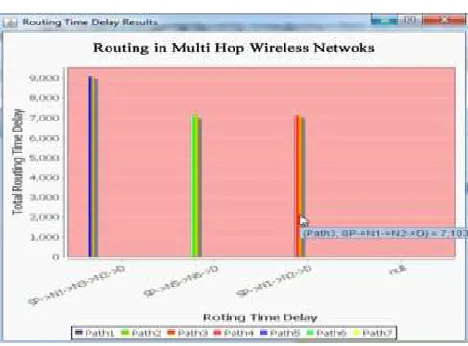
In this graph shows the routing time delay of
the network and identify the highest time delay path.
6. Conclusion
Evaluation results show that LRED algorithms can achieve more significant end-to-end throughput gains under higher data rates and
Congestion avoidance. As for the future work, one direction is to further explore Opportunities to improve the performance of our routing algorithms by analysing special Underperforming cases identified in the evaluation. Another direction is to investigate inter-flow spatial reusability, and to optimize System-wide performance.
7. Reference
[01]TongMeng,FanWu,Zheng Yang,”Spatial
reusability-aware routing in multi-hop wireless network,” INFOCOM, 2016.
[01]W. Hu, J. Xie, and Z. Zhang, “Practical opportunistic routing in high-speed multi-rate wireless mesh networks,” in MOBIHOC, 2013. [02] N. M. Jones, B. Shrader, and E. Modiano, “Optimal routing and scheduling for a simple network coding scheme,” in INFOCOM, 2012. [03] S. Zhao, L. Fu, X. Wang, and Q. Zhang, “Fundamental relationship between node density and delay in wireless ad hoc networks with unreliable links,” in MOBICOM, 2011.
[04] M. Pan, C. Zhang, P. Li, and Y. Fang, “Joint routing and link scheduling for cognitive radio networks under uncertain spectrum supply,” in INFOCOM, 2011.
[05] H. Rahul, H. Hassanieh, and D. Katabi, “Sourcesync: a distributed wireless architecture for exploiting sender diversity,” in SIGCOMM, 2010.
[06] E. Rozner, J. Seshadri, Y. A. Mehta, and L. Qiu, “Soar: Simple opportunistic adaptive routing protocol for wireless mesh networks,” IEEE Transactions on Mobile Computing, vol. 8, no. 12, pp. 1622–1635, 2009.
[07] R. P. Laufer, H. Dubois-Ferriere, and L. Kleinrock, “Multirate anypath ` routing in wireless mesh networks,” in INFOCOM, 2009
[08] G. Jakllari, S. Eidenbenz, N. W. Hengartner, S. V. Krishnamurthy, and M.
Faloutsos, “Link positions matter: A
noncommutative routing metric for wireless mesh network,” in INFOCOM, 2008.
[09] Y. Lin, B. Li, and B. Liang, “Codeor: Opportunistic routing in wireless mesh networks with segmented network coding,” in ICNP, 2008.
[10] B. Radunovic, C. Gkantsidis, P. B. Key, and P. Rodriguez, “An optimization framework for opportunistic multipath routing in wireless mesh networks,” in INFOCOM, 2008.
[11] Y. Yang and J. Wang, “Design guidelines for routing metrics in multi hop wireless networks,” in INFOCOM, 2008
[12] S. Chachulski, M. Jennings, S. Katti, and D. Katabi, “Trading structure for randomness in wireless opportunistic routing,” in SIGCOMM, 2007.
[13] T.-S. Kim, J. C. Hou, and H. Lim, “Improving spatial reuse through tuning transmit power, carrier sense threshold, and data rate in multihop wireless networks,” in MOBICOM, 2006.