A Digital Signal Processing Method for Gene Prediction
with Improved Noise Suppression
Trevor W. Fox
Research and Development Department, Intelligent Engines Corporation, 903 42 St. SW, Calgary, Alberta, Canada T3C-1Y9 Email:[email protected]
Alex Carreira
Department of Electrical and Computer Engineering, University of Calgary, 2500 University Drive N.W., Calgary, Alberta, Canada T2N 1N4
Email:[email protected]
Received 1 March 2003; Revised 15 September 2003
It has been observed that the protein-coding regions of DNA sequences exhibit period-three behaviour, which can be exploited to predict the location of coding regions within genes. Previously, discrete Fourier transform (DFT) and digital filter-based methods have been used for the identification of coding regions. However, these methods do not significantly suppress the noncoding regions in the DNA spectrum at 2π/3. Consequently, a noncoding region may inadvertently be identified as a coding region. This paper introduces a new technique (a single digital filter operation followed by a quadratic window operation) that suppresses nearly all of the noncoding regions. The proposed method therefore improves the likelihood of correctly identifying coding regions in such genes.
Keywords and phrases:gene prediction, digital filter, DNA.
1. INTRODUCTION
Finding coding regions (exons) in a DNA strand involves searching amongst the many nucleotides that comprise a DNA strand. Typically a DNA molecule contains millions to hundreds of millions of elements [1]. The problem of finding exons in a DNA sequence is well suited to computers because DNA sequences can be represented by data that is easily pro-cessed by a computer. DNA strands can be represented by sequences of letters from a four-character alphabet. Conven-tion dictates the use of the letters A, T, C, and G in each el-ement to represent each of the four distinct nucleotides [1]. A nucleotide has two distinct ends: a 3end and a 5end. A covalent chemical bond links the 5end of one nucleotide to the 3end of another nucleotide. A DNA strand is comprised of many nucleotides linked in this fashion [1]. The DNA se-quence representing a DNA strand consists of the letters A, T, C, and G listed in a left-to-right fashion corresponding to the nucleotides that make up the strand arranged left to right from their 5to 3ends [1].
A DNA strand can be divided into genes and intergenic spaces. Genes are responsible for protein synthesis. A gene can be further subdivided into exons and introns for cells with a nucleus (eukaryotes) [2]. Cells without a nucleus are
called prokaryotes and do not contain introns [2]. The exons, coding regions within genes, are denoted by start and stop codons. Codons are a subsequence of three letters within the DNA sequence. Because codons are comprised of three letters from the four-letter alphabet that makes up a DNA sequence, there are 64 possible codons [1]. Of the 64 possible codons, there are one start codon and three stop codons, and the re-mainder of the codons correspond to one of the twenty pos-sible amino acids of a protein [1]. The relationship between DNA sequences, genes, intergenic spaces, exons, introns, and codons is illustrated inFigure 1.
Some exons within the protein-coding regions of DNA sequences of eukaryotes tend to exhibit a period-three pat-tern [2,3,4,5]. The period-three pattern of the exons can be exploited to predict gene locations and even predict specific exons within the genes of eukaryotic cells [2,3,4,5].
5
DNA sequence
3
Gene Gene
Intergenic spaces (a) Gene
Intron Intron
Exons (b)
Stop codon Exon
A T G G T G C A C . . . GCT . . . T A T C A C T A A
Intron Exon
Start
codon Codon
(c)
Figure1: (a) An abstraction to illustrate the genes and intergenic spaces which comprise a DNA sequence. (b) An abstraction of a gene to illustrate the subdivision of a gene into exons and introns. (c) Various subsequences that comprise exons and introns in a gene (each three-letter grouping is a codon). The start codon is always ATG. However, one of the three possible stop codons is illustrated as (TAA).
they are significantly faster than the DFT method and they can be used to suppress more of the DNA background noise than it is possible by using the DFT method [2,6].
DSP methods that only exploit period-three behaviour have many shortcomings. These methods are unable to reli-ably locate coding regions that do not have strong period-three characteristics. Methods based on hidden Markov models [7, 8,9] provide superior results in these circum-stances. The models used in these methods are also suffi -ciently accurate to account for exon and intron length dis-tributions [10]. Alternatively, computational methods that exploit the heterogeneous statistical properties of DNA se-quences to recursively segment homogeneous subsese-quences from their heterogeneous supersequences can be used for the identification of the borders between coding and noncod-ing regions [11,12,13]. The accuracy of these segmentation methods for coding region identification in DNA sequences surpasses the method presented in this paper and other DSP methods when applied to DNA sequences that do not have coding regions exhibiting a periodicity of three.
The method presented in this paper is an extension of DSP methods that exploit period-three behaviour. Previous DSP methods that exploit period-three behaviour do not en-tirely suppress the noncoding regions in the DNA spectrum at 2π/3. As a result, a noncoding region may be incorrectly identified as a coding region. Also the methods presented in
[2,6] require four digital filter operations. In contrast, this paper presents a method that requires only one digital fil-ter operation followed by a quadratic windowing operation. The quadratic window produces a signal that has almost zero energy in the noncoding regions. The proposed method can therefore improve the likelihood of correctly identifying cod-ing regions over previous digital filtercod-ing methods. However, the accuracy of the proposed method suffers when dealing with coding regions that do not exhibit strong period-three behaviour. Also the methods presented in [7,8,9] are able to accurately model structures in genes, whereas the proposed method cannot. Despite these limitations, the method pro-posed in this paper can be used to generate one of the signals of a more complex gene finding method.
This paper is organized as follows.Section 2reviews pre-vious DSP methods for the identification of coding regions in DNA sequences. In particular, the DFT and digital filter methods are discussed.Section 3presents a new computa-tionally efficient one-step digital filter method for the identi-fication of coding regions.Section 4presents a new quadratic window operation that improves the suppression of noncod-ing regions from the DNA spectrum at frequency 2π/3. In the example presented, noise suppression is improved by almost three orders of magnitude.Section 5presents the conclusions of this research.
2. PREVIOUS DIGITAL SIGNAL PROCESSING METHODS FOR IDENTIFYING CODING REGIONS
Strands of DNA consist of four nucleotides (or bases), which are designated by the characters A, T, C, and G [1]. A char-acter string composed of these four bases can be mapped to four signals [1]. The signaluA(n) takes the value of either 1 if A is present in the DNA sequence at indexn, or 0 if A is ab-sent at indexn. For example,uA(n) for the DNA segment AT-GCTGAA is 10000011. The signalsuT(n),uC(n), anduG(n) can be obtained in a similar fashion.
The DFT ofuA(n) overNsamples is defined [14] as 3pt
UA(k)=
N−1
n=0
uA(n)e−j2πkn/N, 0≤k≤N−1. (1)
In a similar fashion, the DFT of uT(n), uC(n), and uG(n) can be obtained. For many genes, period-three behaviour has been observed and is useful for identifying coding regions [2,3,4,5]. Specifically, the (k=N/3)-DFT coefficient mag-nitude is often significantly larger than the surrounding DFT coefficient magnitudes and corresponds to a coding region within the gene [1,3,4]. This effect varies and can be quite pronounced or quite weak, depending upon the gene [2].
A figure that can be used to measure the total spectral content of a DNA character string at frequencykis defined as [1,4,15]
SA+C+T+G(k)=UA(k)2+UT(k)2 +UC(k)2+UG(k)2.
0.016 0.014 0.012 0.01 0.008 0.006 0.004 0.002 0
S
(
N/
3)
0 1000 2000 3000 4000 5000 6000 7000 8000 Relative base locationn
Figure 2: The signalSA+C+T+G(N/3) for gene F56F11.4 in the C-eleganschromosome III (N=351).
The subscript of SA+C+T+G(k) indicates that all four nu-cleotide signals are considered. Corresponding to the pre-viously described period-three behaviour, the value of
SA+C+T+G(k) is large at k = N/3 when a coding region is present. The progression of SA+C+T+G(N/3) can be plotted by evaluatingSA+C+T+G(N/3) over a window of N samples, sliding the window by one or more sample, and recalcu-lating SA+C+T+G(N/3) [1]. This process can be carried out over the entire DNA sequence. As an example, consider the gene F56F11.4 in theC-eleganschromosome III. The value of
SA+C+T+G(N/3) usingN=351 is plotted over the base num-bers 7021 to 15080 inFigure 2.
The four dominant peaks inFigure 2clearly indicate cod-ing regions. However, a fifth codcod-ing region is present from 929 to 1135 but its small peak is obscured by 1/ f DNA back-ground noise. (The work presented in [15,16,17] observes the presence of 1/ f background noise in DNA sequences.)
The DFT method for the identification of coding regions can be interpreted as a bandpass digital filter operation fol-lowed by a decimation operation [2]. The bandpass digi-tal filter associated with the DFT method is centered at fre-quency 2π/3 and has a minimum stopband attenuation of only 13 dB. High frequency selective bandpass digital filters for the identification of coding regions can be used instead of the DFT and have been presented in [2,6] by Vaidyanathan and Yoon. The digital filter presented in [6] is a second-order antinotch filter. The digital filter presented in [2] is an eleventh-order bandpass digital filter with a minimum stop-band attenuation of 60 dB.
The digital filter method for the identification of coding regions does not require the use of a sliding window [2,6]. Instead, the signals uA(n),uC(n), uT(n), anduG(n) are in-dividually processed using the same digital filter to produce the signalsyA(n),yC(n),yT(n), andyG(n). A pseudomeasure of the total spectral content of a DNA sequence at frequency 2π/3,yA+C+T+G(n), is given by [2,6]
yA+C+T+G(n)=yA(n)2+yC(n)2
+yT(n)2+yG(n)2. (3) The signal yA+C+T+G(n) produces large values in coding re-gions that exhibit strong period-three behaviour [2,6] and is therefore an indicator for coding regions.
The digital filter method is much faster than the DFT method. For example, processing gene F56F11.4 in the C-eleganschromosome III using the DFT method requires 264 seconds on a 400 MHz Pentium II computer. In contrast, the digital filter method presented in [2] requires only 0.36 sec-onds, which is 733 times faster than the DFT method.
3. GENE PREDICTION USING A SINGLE DIGITAL FILTER
The methods presented by Vaidyanathan and Yoon in [2,6] require a digital filtering operation for each of the fouruA(n),
uC(n),uT(n), anduG(n) signals for a total of four separate filtering operations. We now introduce a method that only requires one application of a digital filtering operation by fil-tering a single signal composed ofuT(n) anduG(n). This new approach also removes much more of the DNA background noise than it is possible by using the methods presented in [2,6]. In the following two sections, the optimization prob-lem for creating this new signal is described and solved for a specific example.
3.1. Optimized signal construction
The number of digital filter operations can be reduced from four to one with the creation of a new signal that encapsulates the entire DNA sequence
uA+C+T+G(n)=auA(n) +cuC(n) +tuT(n) +guG(n), (4) wherea,c,t, andg are real-valued parameters. Strand sym-metry [18, 19, 20] can be exploited to further reduce the complexity of (4) to the sum of two terms. A long DNA se-quence can be approximated using a two-symbol representa-tion, where one symbol is either A or T and the other symbol is either C or G. In this case, the signal becomes
uT+G(n)=tuT(n) +guG(n). (5) Strand symmetry may not hold for shorter DNA sequences (on the order of 100 bases) and therefore strand symme-try should be verified before using (5) on short sequences.
Section 3.2compares the use of (4) and (5) for a test DNA sequence.
2
0 1000 2000 3000 4000 5000 6000 7000 8000 Relative base locationn
0 1000 2000 3000 4000 5000 6000 7000 8000 Relative base locationn
(b)
Figure3: The signalsyT+G(n) andyA+C+T+G(n) for gene F56F11.4
in theC-eleganschromosome III using the proposed single digital filter method.
of the total spectral content of a DNA sequence at 2π/3 is given by
yT+G(n)=v2
T+G(n). (6)
The ratio of yT+G2 (n) accumulated over all of the coding
re-gions to yT+G2 (n) accumulated over all of the noncoding re-gions is maximized by choosing thetandgparameters:
Maximize
n0∈[coding region]y
2 T+G
n0
n1∈[noncoding region]y
2 T+G
n1. (7) 3.2. Applying the signal optimization
As an example, consider the use of the digital filter presented in [2] and the chromosome XVI ofS. cerevisiaedataset. The quasi-Newton optimization method [21] is used to solve the above optimization problem for a two-symbol signal and for a four-symbol signal. The method proposed in this section is then used to process gene F56F11.4 in theC-elegans chromo-some III over the base numbers 7021 to 15080 (seeFigure 3).
Figure 3demonstrates thatyT+G(n) andyA+C+T+G(n) are very similar due to the strand symmetry. The use of yT+G(n) is preferred because of its simplicity.
All five exons in Figure 3 are clearly visible in both
yT+G(n) andyA+C+T+G(n). The remaining peaks do not have sufficient magnitude to obscure any of the coding regions. The total energy of yT+G(n) in the noncoding regions is de-fined asn∈[noncoding region]yT+G2(n). This is a useful
perfor-mance measure to gauge the effectiveness of a DSP gene pdiction method for the suppression of the noncoding re-gions inyT+G(n). The total energy ofyT+G(n) using the single digital filter method is 56.6. In contrast, the total energy of
2.5
0 1000 2000 3000 4000 5000 6000 7000 8000 Relative base locationn
Figure4: The signalyT+G0(n) for gene F56F11.4 in theC-elegans
chromosome III.
yT+G(n) in the noncoding regions using the multiple digital filter method as presented in [2] is 273.7, which is almost five times larger than the proposed single digital filter method. Clearly in this example, the proposed method improves the likelihood of correctly identifying the coding regions by re-ducing the total energy ofyT+G(n) in the noncoding regions. The initial coding region for gene F56F11.4 in the C-eleganschromosome III has a weak period-three characteris-tic, which is evident in Figures2and3. InFigure 2, the initial coding region is obscured by noise. Optimizing the param-eterstandginuT+G(n) over a training sequence consisting of initial, internal, and terminal coding regions can be used to suppress a significant portion of this noise (seeFigure 3). However, the relative height of the peak inyT+G(n) associated with the initial coding region is almost unchanged.
Our experiments indicate that the method proposed in this paper cannot be used to increase the relative height of the peaks in yT+G(n) associated with coding regions with-out also increasing the energy in the noncoding regions. We have attempted to optimize a new signal,uT+G0(n), that, when filtered, produces larger peaks for initial coding re-gions. A training dataset composed only of initial coding regions in XVI of S. cerevisiaewas used to obtain tandg.
Figure 4showsyT+G0(n) for gene F56F11.4 in theC-elegans
2
Figure 5: The quadratic window nonlinearity plotted for Maxvalue=2.
4. A QUADRATIC WINDOW OPERATION TO SUPPRESS NONCODING REGIONS
The single digital filter method for the identification of cod-ing regions does not always suppress all of the peaks found in the noncoding regions of yT+G(n) (seeFigure 3). Conse-quently, the noncoding regions may obscure the coding re-gions in some datasets. To reduce uncertainty in the identi-fication of coding regions, a new quadratic windowing oper-ation is now introduced that can be used to effectively sup-press the noncoding regions while preserving the coding re-gions. This quadratic windowing operation is performed af-ter the single digital filaf-ter operation onyT+G(n).
The maximum value ofyT+G(n) in a coding region is al-most always greater than the maximum value ofyT+G(n) in a noncoding region although the difference in magnitude be-tween the two may be small. It is desirable to exaggerate the difference in magnitude between the coding and noncoding regions so that the coding regions can be more easily identi-fied. To this end, a window ofMsamples is processed using the following operation:
where p is the window sample index,M is the number of samples in the window, yw(p) is the pth windowed sample value, and Maxvalue is the largest value of yT+G(p) in the window.
The quadratic windowing operation defined in (8) mul-tipliesyT+G(p) by a value that approaches zero in a quadratic fashion as yT+G(p) approaches zero. Noncoding regions in the window that have sample values less than Maxvalue are effectively suppressed. Consider a window of samples that has maximum sample value of 2. The quadratic window op-eration producesyw(p) values of 0.0313 and 0.25 foryT+G(p) values that equal 0.5 and 1, respectively, as shown inFigure 5. To preserve the coding regions inyT+G(n), the size of the
15
0 1000 2000 3000 4000 5000 6000 7000 8000 Relative base locationn
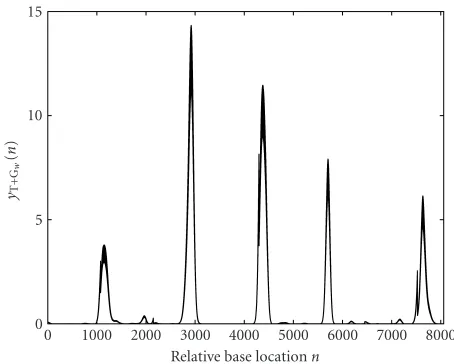
Figure6: The signal yT+Gw(n) for gene F56F11.4 in theC-elegans
chromosome III using the quadratic window (8).
window should not contain more than one coding region. In this case, the sole coding region in the window is not sup-pressed because the value of the largest sample, which be-longs to the coding region, is not changed when using (8). A DNA sequence, where all of the coding regions are known, can be used to select the window size. The window size is set to a value less than the minimum number of samples be-tween adjacent coding regions and greater than the number of samples of the widest coding region.
After a window ofM samples has been processed, the window is then movedMsamples, which prevents the suc-cessive windowing operations from overlapping.
The quadratic windowing operation is now applied to the gene F56F11.4 in the C-elegans chromosome III over the base numbers 7021 to 15080.Figure 3shows the origi-nal yT+G(n) signal obtained using the method discussed in
Section 3.2. The quadratic window of (8) is used to obtain the signalyw(p), as shown inFigure 6. The window size is set toM=1100 samples. The five coding regions (exons) domi-nate the signalyw(n). In the coding regions, the signalyw(n)
has been suppressed to near-zero values, which improves the certainty of correctly identifying the coding regions.
Table 1compares the suppression of the noncoding re-gions by comparing the total energy in these rere-gions for the multiple digital filter gene prediction method presented in [2], the single digital filter method presented inSection 3, and the single digital filter method followed by the quadratic window operation presented in this section. This numeri-cal experiment used gene F56F11.4 in theC-elegans chromo-some III over the base numbers 7021 to 15080.
The multiple digital filter method does not effectively minimize the total energy in the noncoding regions. The to-tal energy in the noncoding regions for the multiple digito-tal filter method is 720 times greater than the total energy in noncoding regions for the method proposed in this section and almost five times greater than the method presented in
Table 1: A comparison of the performance between competing gene prediction methods.
Gene prediction method Total energy in the noncoding regions Single digital filter method followed
by the quadratic window operation 0.38 Single digital filter method 56.6 Multiple digital filter method [2] 273.7
Table2: A comparison of SNR values between competing gene pre-diction methods.
be identified as a coding region when using the multiple digi-tal filter method. In contrast, all five coding regions can easily be identified using the methods presented in this section.
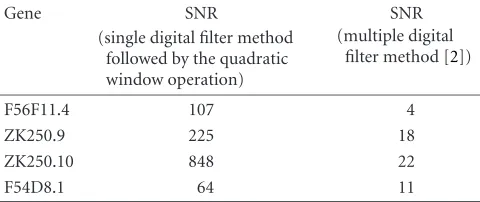
The quadratic windowing method (single digital filter method followed by a quadratic window operation) is now compared in more depth with Vaidyanathan and Yoon’s mul-tiple digital filter method [2].Table 2compares the signal-to-noise ratio (SNR), see (9), for the following test genes: F56F11.4 in the C-elegans chromosome III, ZK250.9 and ZK250.10 in theC-eleganschromosome II, and F54D8.1 in theC-eleganschromosome III.
The SNR performance measure considers both the en-ergy in the coding and noncoding regions. High SNR signals have low energy levels in the noncoding regions and high en-ergy levels in the coding regions. For high SNR signals, the task of identifying coding regions is greatly simplified be-cause the coding regions dominate over the noncoding re-gions
SNR=
n0∈[coding region]y
2 T+G
n0
n1∈[noncoding region]y
2 T+G
n1. (9)
Table 2shows that the multiple digital filter method con-sistently generates significant lower SNR signals than does the method proposed in this paper. Consequently, the task of identifying coding regions in signals generated by the multi-ple digital filter method is more problematic.
5. CONCLUSION
Methods for the identification of coding regions that solely rely on digital filters [2,6] are unable to significantly attenu-ate the noncoding regions in yT+G(n). Consequently, a
non-coding region may inadvertently be identified as a non-coding re-gion. This paper introduced a new DSP technique (a single digital filter operation followed by a quadratic window op-eration) that can be used to suppress nearly all of the non-coding regions inyT+G(n). This paper demonstrated that the total energy in the noncoding regions ofyT+G(n) can be re-duced by a factor of 720 compared to the previous digital filter techniques for gene F56F11.4 in theC-elegans chromo-some III. As a result, the proposed method can improve the likelihood of correctly identifying coding regions.
ACKNOWLEDGMENTS
The authors wish to thank the anonymous reviewers for their comments and valuable suggestions which helped in improv-ing this paper.
REFERENCES
[1] D. Anastassiou, “Genomic signal processing,” IEEE Signal Processing Magazine, vol. 18, no. 4, pp. 8–20, 2001.
[2] P. P. Vaidyanathan and B.-J. Yoon, “Digital filters for gene pre-diction applications,” inProc. Asilomar Conference on Signals, Systems, and Computers, pp. 306–310, Pacific Grove, Calif, USA, November 2002.
[3] D. Anastassiou, “DSP in genomics,” inProc. IEEE Int. Conf. Acoustics, Speech, Signal Processing, pp. 1053–1056, Salt Lake City, Utah, USA, May 2001.
[4] S. Tiwari, S. Ramachandran, A. Bhattacharya, S. Bhat-tacharya, and R. Ramaswamy, “Prediction of probable genes by Fourier analysis of genomic sequences,” Comput. Appl. Biosci., vol. 13, no. 3, pp. 263–270, 1997.
[5] J. W. Fickett, “Recognition of protein coding regions in DNA sequences,”Nucleic Acids Res., vol. 10, no. 17, pp. 5303–5318, 1982.
[6] P. P. Vaidyanathan and B.-J. Yoon, “Gene and exon prediction using allpass-based filters,” inWorkshop on Genomic Signal Processing and Statistics, Raleigh, NC, USA, October 2002. [7] J. Henderson, S. Salzberg, and K. H. Fasman, “Finding genes
in DNA with a hidden Markov model,” J. Comput Biol., vol. 4, no. 2, pp. 127–141, 1997.
[8] D. Kulp, D. Haussler, M. G. Reese, and F. H. Eeckman, “A gen-eralized hidden Markov model for the recognition of human genes in DNA,” inProc. of the 4th International Conference on Intelligent Systems for Molecular Biology, Menlo Park, Calif, USA, 1996.
[9] A. Krogh, I. S. Mian, and D. Haussler, “A hidden Markov model that finds genes in E. coli DNA,” Nucleic Acids Res., vol. 22, no. 22, pp. 4768–4778, 1994.
[10] C. B. Burge and S. Karlin, “Finding the genes in genomic DNA,” Curr. Opin. Struct. Biol., vol. 8, no. 3, pp. 346–354, 1998.
[11] P. D. Cristea, “Large scale features in DNA genomic signals,”
Signal Processing, vol. 83, no. 4, pp. 871–888, 2003.
[12] W. Li, P. Bernaola-Galvan, F. Haghighi, and I. Grosse, “Ap-plications of recursive segmentation to the analysis of DNA sequences,” Computers & Chemistry, vol. 26, no. 5, pp. 491– 510, 2002.
[13] W. Li, G. Stolovitzky, P. Bernaola-Galvan, and J. L. Oliver, “Compositional heterogeneity within, and uniformity be-tween, DNA sequences of yeast chromosomes,” Genome Re-search, vol. 8, no. 9, pp. 916–928, 1998.
[15] R. F. Voss, “Evolution of long-range fractal correlations and 1/ f noise in DNA base sequences,” Phys. Rev. Lett., vol. 68, no. 25, pp. 3805–3808, 1992.
[16] W. Li, “The study of correlation structures of DNA sequences: a critical review,” Computers & Chemistry, vol. 21, no. 4, pp. 257–271, 1997.
[17] W. Li and K. Kaneko, “Long-range correlation and partial 1/ fαspectrum in a non-coding DNA sequence,” Europhys. Lett., vol. 17, no. 7, pp. 655–660, 1992.
[18] D. R. Forsdyke and J. R. Mortimer, “Chargaff’s legacy,”Gene, vol. 261, no. 1, pp. 127–137, 2000.
[19] W. Li, “The study of correlation structures of DNA sequences: a critical review,” Computers & Chemistry, vol. 21, no. 4, pp. 257–272, 1997.
[20] J. W. Fickett, D. C. Torney, and D. R. Wolf, “Base compo-sitional structure of genomes,” Genomics, vol. 13, no. 4, pp. 1056–1064, 1992.
[21] J. E. Dennis and R. B. Schnabel, Numerical Methods for Un-constrained Optimization and Nonlinear Equations, SIAM, Philadelphia, Pa, USA, 1996.
Trevor W. Foxreceived his B.S. and Ph.D. degrees in electrical engineering from the University of Calgary in 1999 and 2002, re-spectively. Currently, he is working at the Intelligent Engines in Calgary, Canada. His main research interests include digital fil-ter design, reconfigurable digital signal pro-cessing, and genomic signal processing.