Open Access
Research article
Survey of knowledge and perception on the access to
evidence-based practice and clinical practice change among
maternal and infant health practitioners in South East Asia
Ruth Martis*
1, Jacqueline J Ho
2, Caroline A Crowther
1for The SEA-ORCHID
Study Group
Address: 1Discipline of Obstetrics and Gynaecology, The University of Adelaide, Women's and Children's Hospital, King William Road, North
Adelaide, South Australia, SA 5006, Australia and 2Department of Paediatrics, Penang Medical College, Penang 10450, Malaysia
Email: Ruth Martis* - [email protected]; Jacqueline J Ho - [email protected]; Caroline A Crowther - [email protected]; The SEA-ORCHID Study Group - [email protected]
* Corresponding author
Abstract
Background: Evidence-based practice (EBP) can provide appropriate care for women and their babies; however implementation of EBP requires health professionals to have access to knowledge, the ability to interpret health care information and then strategies to apply care. The aim of this survey was to assess current knowledge of evidence-based practice, information seeking practices, perceptions and potential enablers and barriers to clinical practice change among maternal and infant health practitioners in South East Asia.
Methods: Questionnaires about IT access for health information and evidence-based practice were administered during August to December 2005 to health care professionals working at the nine hospitals participating in the South East Asia Optimising Reproductive and Child Health in Developing countries (SEA-ORCHID) project in Indonesia, Malaysia, Thailand and The Philippines.
Results: The survey was completed by 660 staff from six health professional groups. Overall, easy IT access for health care information was available to 46% of participants. However, over a fifth reported no IT access was available and over half of nurses and midwives never used IT health information. Evidence-based practice had been heard of by 58% but the majority did not understand the concept. The most frequent sites accessed were Google and PubMed. The Cochrane Library had been heard of by 47% of whom 51% had access although the majority did not use it or used it less than monthly. Only 27% had heard of the WHO Reproductive Health Library and 35% had been involved in a clinical practice change and were able to identify enablers and barriers to change. Only a third of participants had been actively involved in practice change with wide variation between the countries. Willingness to participate in professional development workshops on evidence-based practice was high.
Conclusion: This survey has identified the need to improve IT access to health care information and health professionals' knowledge of evidence-based health care to assist in employing evidence base practice effectively.
Published: 5 August 2008
BMC Pregnancy and Childbirth 2008, 8:34 doi:10.1186/1471-2393-8-34
Received: 2 April 2008 Accepted: 5 August 2008
This article is available from: http://www.biomedcentral.com/1471-2393/8/34 © 2008 Martis et al; licensee BioMed Central Ltd.
Background
Evidence-based practice (EBP) has been defined as the 'conscientious, judicious and explicit use of current best evidence available in making decisions about the care of individual patients', integrating individual clinical exper-tise, the needs and values of the individual patient and the best available research [1,2].
The understanding, accessing and implementing of EBP can provide appropriate and effective care in pregnancy, childbirth and the postnatal period for women and their babies [1]. However the wider application of EBP depends on the progress made in educating health professionals on accessing evidence-based research [3], evaluating and correctly interpreting research studies, the provision of quick, easy and free access to evidence [4] and an under-standing on how to implement the findings into clinical practice [5].
Each year there are over half a million maternal deaths world-wide with 98% of these occurring in low and mid-dle income countries. For women in Asia the lifetime risk of maternal death is one in 65 compared with one in 1,800 for women in high income countries [6]. Access to scientifically valid and up-to-date information is a prereq-uisite for providing evidenced-based care [4].
In the South East Asia Optimising Reproductive and Child Health In Developing countries (SEA-ORCHID) project, the three phases of the study included audit of the base-line rates and clinical care practice, an educational inter-vention to improve evidence-based care followed by an audit of change of rates and quality of clinical practice [7]. As part of the initial data collection in the four South East Asian (SEA) countries; Malaysia, Indonesia, Thailand and The Philippines, all clinical staff at the maternity, child health and newborn services of the nine participating hos-pitals were invited to participate in a survey of current knowledge, perceptions, activities, enablers and barriers to evidence-based practice.
Methods
Eligibility, sampling and time frame
The EBP survey was conducted among staff in the nine hospitals participating in the SEA-ORCHID project. These hospitals were situated in four South East Asian countries; Malaysia, Indonesia, Thailand and the Philippines. Of the nine hospitals, seven were tertiary referral institutions with regional referrals of women with a high risk preg-nancy, one was a provincial institution and one was a dis-trict institution. The SEA-ORCHID project settings and methods have been published elsewhere [[7] and see Additional file 1].
All maternal and child health staff working on roster at
were invited to participate in the EBP survey during August to December 2005. The EBP survey was approved by all relevant Ethics Committees at the SEA-ORCHID participating sites.
The SEA-ORCHID project was interested in obtaining information about the knowledge and access of on-line evidence-based information. The Cochrane Library [8] is one such on-line resource, reliable for obtaining evidence-based clinical information and up-to-date systematic reviews in health care. The World Health Organization (WHO) Reproductive Health Library (RHL) [9] is another on-line evidence-based resource. It aims to put the best available evidence into a practical context so that it can be used to improve health outcomes. RHL started in 1997 and is prepared by an editorial team based in the WHO department of reproductive health and research and other international partner institutions. The audit sought detail on the involvement of participants with clinical practice change and possible barrier and enabler identification in their clinical area.
At each site the distribution of the questionnaires was managed by the local SEA-ORCHID study researcher. Instructions on how to administer the survey and how the data was to be entered on-line were emailed to all local study researchers, who instructed the field workers as to the correct on-line data entry. The instructions were also posted on-line for easy access on the SEA-ORCHID web site (please see Availability & requirements for more infor-mation) that was protected by a password for access. Zoo-merang software (please see Availability & requirements for more information) was used for on-line data entry and entered data was converted into Excel for data checking and analyses.
The survey questionnaire
The survey consisted of 39 questions and was developed and piloted by one of the SEA-ORCHID clinical educators (RM) with feedback from SEA and Australian investigators [see Additional file 2]. The pilot data were not included in the analyses. The survey development was assisted by hav-ing access to and permission for use of a WHO RHL survey tool [10].
the participant was an author of a systematic review. Sec-tion four and five sought informaSec-tion about participant's knowledge of the Reproductive Health Library (RHL) [9] and The Cochrane Library [8]. Section six explored partic-ipant's involvement and experiences with clinical practice change including barrier identification and how to over-come these. Finally participants identified workshops they would like to attend for enhancing their understand-ing of EBP and what would prevent them from attendunderstand-ing such workshops.
Statistical analysis
Data analysis was conducted using pivotTables in Micro-soft Office Excel 2003 calculating frequency and corre-sponding percentages to describe the responses to the survey questions for all participating health professionals and combining the data for all four SEA countries. Two response questions were presented as a list and frequency of occurrence rather than linked to health professionals or given as percentages.
Ethical approval
The SEA-ORCHID project was approved by the local eth-ics committees of each hospital and by the etheth-ics commit-tee of the University of Sydney, the administering institution in Australia.
Results
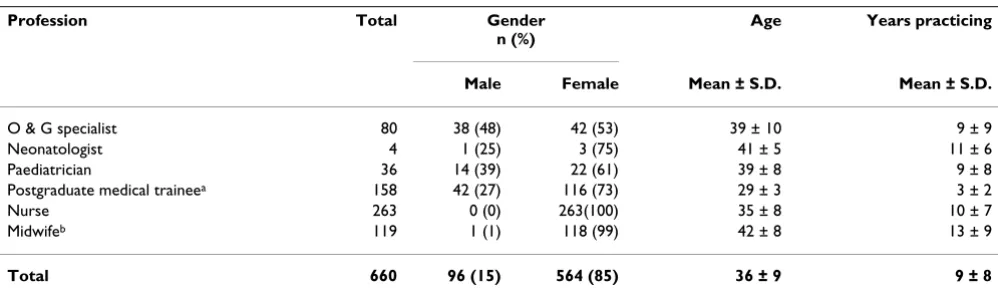
DemographicsA total of 660 staff across the four SEA-ORCHID countries were surveyed. Professions represented included 80 obstetrics and gynaecology (O&G) specialists, four neona-tologists, 36 paediatricians, 158 postgraduate medical trainees, 263 nurses, and 119 midwives (nurses with mid-wifery qualifications included).
The participants were identified as 564 (85%) female and 96 (15%) male across the four participating SEA countries
(Table 1). The female gender dominated for all profes-sions surveyed, with nurses represented by 263 (100%) females, closely followed by midwives with 118 (99%). The age range varied among the professions with an over-all mean age of 36 ± 9 years. A mean of 9 ± 8 years prac-ticing in participants' respective profession was represented (Table 1).
In-service training
Of the overall participants, 368 (56%) commented that the type of in-service training usually offered at their insti-tution was of technical or professional nature, rather than managerial or administrative. No in-service training was indicated by 66 (10%) and 13 (2%) did not know if train-ing was offered. However, 201 (30%) indicated that both types (managerial or administrative and technical or pro-fessional) of in-service training were offered at their insti-tution.
Access to IT services
In answer to the question of easy access to a computer at the workplace, 301 participants across all four SEA coun-tries (46%) responded that they had access with broad-band internet connection while 139 (21%) indicated that they had no access. However there were great variations between the countries. In Indonesia, 63 (50%) of all ticipants reported no access to computers and of the par-ticipants that did, 26 (21%) could not access the internet through their computer. Thailand had the highest reported access where 127 (84%) participants had easy access to a computer at work with broadband connection (Table 2).
[image:3.612.55.554.553.700.2]Of all the SEA participants with no easy access to a com-puter at their workplace, 114 (50%) indicated that the greatest difficulty was a limited supply of computers. The 'other' option was chosen by 14 (6%) participants where 7 (50%) described that the difficulty they had was due to
Table 1: Demographics: gender, age range and years practicing in profession across all four SEA countries (n = 660)
Profession Total Gender n (%)
Age Years practicing
Male Female Mean ± S.D. Mean ± S.D.
O & G specialist 80 38 (48) 42 (53) 39 ± 10 9 ± 9
Neonatologist 4 1 (25) 3 (75) 41 ± 5 11 ± 6
Paediatrician 36 14 (39) 22 (61) 39 ± 8 9 ± 8
Postgraduate medical traineea 158 42 (27) 116 (73) 29 ± 3 3 ± 2
Nurse 263 0 (0) 263(100) 35 ± 8 10 ± 7
Midwifeb 119 1 (1) 118 (99) 42 ± 8 13 ± 9
Total 660 96 (15) 564 (85) 36 ± 9 9 ± 8
aIdentified as Resident or RMO in Thailand, Indonesia, The Philippines and Medical Officer in Malaysia
bNurse with midwifery training included
their limited knowledge of how to use the computer or the available software on the computer.
Health Information and Resources
Participants across all four SEA countries indicated that the reason for consulting health information sources 'fre-quently' were for patient care (377, 57%), for teaching (216, 33%), for personal study (219, 33%) and for research (179, 27%).
Resources 'frequently' used for health information were text books (359, 54%), colleagues (212, 32%), journals
(157, 24%) and resources from pharmaceutical compa-nies (30, 5%). Resources 'sometimes' used were resources from pharmaceutical companies (438, 66%), journals (380, 57%), colleagues (347, 52%) and textbooks (278, 42%).
[image:4.612.56.552.100.357.2]The internet was used as a resource for gaining health information by 409 participants (62%), who listed 46 websites, with the most popular website being http:// www.google.com 129 (20%), closely followed by http:// www.pubmed.nl 69 (10%), then http://www.pubmed central.nih.gov 62 (9%) and http://www.yahoo.com 50 Table 2: Access to computers and IT services by participating SEA countries and by profession (n = 660)
No access n (%)
Yes, without internet connection n (%)
Yes, with phone internet connection n (%)
*Yes, with broadband internet connection n (%) Country
Malaysia 42 (15) 83 (30) 41 (15) 110 (40)
Indonesia 63 (50) 26 (21) 5 (4) 32 (25)
Thailand 6 (4) 8 (5) 10 (7) 127 (84)
Philippines 28 (26) 15 (14) 32 (30) 32 (30)
Total 139 (21) 132 (20) 88 (13) 301 (46) Profession
O&G Specialist 5 (6) 9 (11) 10 (13) 56 (70)
Neonatologist 0 (0) 0 (0) 0 (0) 4 (100)
Paediatrician 2 (6) 0 (0) 5 (14) 29 (81)
Postgraduate medical traineea 19 (12) 22 (14) 43 (27) 74 (47)
Nurse 76 (29) 58 (22) 23 (9) 106 (40)
Midwifeb 37 (31) 43 (36) 7 (6) 32 (27)
Total 139 (21) 132 (20) 88 (13) 301 (46)
*Identified as easy access
aIdentified as Resident or RMO in Thailand, Indonesia and The Philippines and Medical Officer in Malaysia
bNurse with midwifery training included
All figures are rounded to the nearest whole number
Table 3: The four web sites used mostly for health information access by profession across SEA (n = 660)
*Profession Google n (%)
PubMednl n (%)
PubMed Central n (%)
Yahoo n (%)
O&G Specialist 18 (23) 17 (21) 14 (18) 11 (14)
Neonatologist 3 (75) 4(100) 4(100) 0 (0)
Paediatrician 14 (39) 11 (31) 11 (31) 4 (11)
Postgraduate medical traineea 32 (20) 33 (21) 30 (19) 13 (8)
Nurse 54 (21) 3 (1) 2 (1) 18 (7)
Midwifeb 8 (7) 1 (1) 1 (1) 4 (3)
Total 129 (20) 69 (10) 62 (9) 50 (8)
*Please note that some professions might have indicated more than one option
aIdentified as Resident or RMO in Thailand, Indonesia and The Philippines and Medical Officer in Malaysia
[image:4.612.55.553.576.700.2](8%) (Table 3). Across SEA, nurses were the least likely to use the internet for health information with 136 (52%) indicating 'never', followed by nurse-midwives and post-graduate medical trainees. When asked how much time participants actually spent reading health information on an average weekly basis, 180 (27%) indicated less than one hour, 290 (44%) 1–2 hours and 195 (29%) indicated 3 or more hours a week.
Evidence-Based Practice
All participants were asked if they had ever heard about evidence-based practice, evidence-based medicine or evi-dence-based care. Of the total number of survey partici-pants, 385 (58%) had heard about the concept. This result differed considerably between countries and the health professions, with the data from individual countries showing that 114 (75%) of Thailand's clinicians had heard about EBP, 71 (66%) from the Philippines, 142 (51%) from Malaysia and 60 (48%) from Indonesia.
Among SEA health professionals the different groups who identified that they had heard about EBP were 94 (36%) nurses, 48 (40%) midwives, 134 (85%) postgraduate medical trainees, 71 (90%) O&G specialists, 34 (97%) paediatricians and 4 (100%) neonatologists (Table 4). Of the participants that had heard about EBP, 291 (76%) opted to write down their personal definition. The answers varied considerably between participants; how-ever the majority of responses indicated a lack of under-standing of the EBP concept identifying it as clinical practice guidelines or something to do with research.
The Cochrane Library
In relation to having heard about The Cochrane Library, 307 (47%) participants indicated that they had (Table 4) with 156 (51%) of these having access to it. This is obvi-ously related to on-line computer access and whether a subscription had been paid. However, of the participants that had access to The Cochrane Library, 28 (18%)
indi-cated that they never used it, 30 (19%) used it once a year, 65 (42%) used it once a month, 28 (18%) used it once a week and 12 (8%) used it more than once a week. This was a consistent result across all four SEA countries. A question relating to whether participants found The Cochrane Library helpful was answered by 140 partici-pants with 83 (59%) indicating they found it a helpful tool. The usefulness related to accessing systematic reviews (29, 47%) and to retrieving information for clini-cal practice guideline development (11, 18%). Of all the survey participants 311 (70%) indicated they had not attended a Cochrane Library workshop and 571 (81%) expressed interest in attending such a workshop. This was consistent across all four countries with a range of 79– 85%.
The Reproductive Health Library (RHL)
Within the survey participants 177 (27%) had heard about the RHL and of these 83 (47%) had access to it (Table 4). Knowing about the RHL varied considerably between countries. In Indonesia, 6 (5%) health profes-sionals had heard about this on-line resource, in the Phil-ippines 23 (21%), in Malaysia 25 (9%) and in Thailand 46 (30%). RHL is a free resource to low and middle income countries.
[image:5.612.55.553.575.700.2]Only 70 participants answered the question on whether RHL tool is helpful in their practices of which 57% answered that it is useful but 43% answered it is useful sometimes. Both groups indicated the most useful section in the RHL were the systematic reviews (42, 60%). Of these 70 participants, 28 (40%) had attended a RHL work-shop, mainly in Thailand. No participants in the Philip-pines or Malaysia and only two from Indonesia had attended a RHL workshop. Overall 572 (87%) of health professionals across SEA indicated an interest in attending a RHL workshop. This was consistent in all four countries with a range of 80–89%.
Table 4: Heard about EBP, The Reproductive Health Library and The Cochrane Library by profession across SEA (n = 660)
Profession Reproductive Health Library The Cochrane Library EBP n (%) n (%) n (%)
O&G Specialist 46 (82) 71 (89) 71 (90)
Neonatologist 4(100) 4(100) 4(100)
Paediatrician 9 (35) 32 (89) 34 (97)
Postgraduate medical traineea 69 (83) 121 (77) 134 (85)
Nurse 44 (32) 63 (24) 94 (36)
Midwifeb 5 (4) 16 (13) 48 (40)
Total 177 (27) 307 (47) 385 (58)
aIdentified as Resident or RMO in Thailand, Indonesia and The Philippines and Medical Officer in Malaysia
bNurse with midwifery training included
Clinical Practice Change
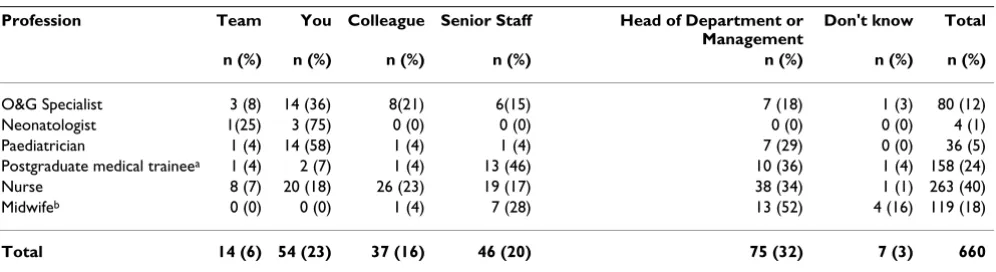
Of the survey participant 230 (35%) responded as having been involved in changing an established clinical practice. These results varied between the four SEA countries how-ever with participant from Thailand indicating 112 (74%) had been involved, 36 (29%) in Indonesia, 72 (26%) in Malaysia and 10 (9%) in The Philippines. These partici-pants were then asked to identify who initiated this change with 75 (33%) identifying that the change was ini-tiated by the Head of the Department, followed by the respondent themselves (54, 23%), senior staff (46, 20%) and colleagues (37, 16%) (Table 5).
Participants were asked about their understanding of why the change was made. Across SEA, 125 (54%) participants responded that the change was initiated because of new evidence, 70 (30%) identified the change was made because new health technology was made available, 15 (7%) indicated the change was made due to a new phar-maceutical drug and 16 (7%) did not know the reason for the initiated clinical practice change. Minor and major resistance to changing clinical practice was reported by 158 (69%) participants with the major reason being no discussion at implementation stage (67, 42%). This was followed by identifying additional resistance to change as no or little consultation (39, 25%), difficulty in accessing new clinical guidelines (28, 18%) and the observation that people did not like change or held on to their differ-ent clinical opinions and beliefs (15, 9%).
Participants were invited to identify possible enablers to overcome the barriers that were identified in the previous question. The major recommended action was discussion groups within professional groups (76, 48%) from incep-tion right through to implementaincep-tion. Easy access to clin-ical practice guidelines were identified by 31 (20%) participants and multidisciplinary workshops by 30 (19%). Overall, a local language was not identified as needed for enabling change or overcoming barriers.
How-ever, 16 (10%) of Thailand's participants indicated that translation of clinical practice guidelines would be useful.
Professional Development Indication
Participants were invited to indicate their interest in attending workshops on evidence-based health care and to provide suggestions for workshop topics as this could assist their professional development. Across all four SEA countries the majority of health professionals surveyed were interested in attending such workshops with a range from 550 (83%) to 578 (88%) (Table 6). Additional top-ics for workshops were suggested by 9 participants, mainly related to computing skills and internet searching.
It is of interest to the SEA-ORCHID project to understand if there are reasons that would prevent participants from attending the workshops for professional development. The survey data showed that 211 (32%) participants had no concerns, 353 (53%) had concerns and 101 (15%) indicated that maybe there were concerns. Of those that identified concerns, 271 (41%) indicated they needed financial support but none was available, 260 (39%) felt they were too busy with their clinical workload and 182 (28%) indicated language as a barrier. Other barriers were indicated by 14 people with the two main reasons being difficulty in obtaining permission from Head of Depart-ment and difficulty in changing shifts.
Discussion
[image:6.612.58.556.565.701.2]Our findings provide a useful foundation from which to plan future interventions and directions for EBP among maternal and child health professionals in SEA. The sur-vey adds to the hospital data available from South East Asian countries on EBP knowledge amongst health pro-fessionals. The sample size of the study was limited to sites participating in the SEA-ORCHID project that may not be representative of all hospitals within each of the countries. Investigators at the hospitals that were chosen for the study were interested in EBP, so it is likely that
Table 5: Who initiated changing an established clinical practice by profession across four SEA countries (n = 660)
Profession Team You Colleague Senior Staff Head of Department or Management
Don't know Total n (%) n (%) n (%) n (%) n (%) n (%) n (%)
O&G Specialist 3 (8) 14 (36) 8(21) 6(15) 7 (18) 1 (3) 80 (12)
Neonatologist 1(25) 3 (75) 0 (0) 0 (0) 0 (0) 0 (0) 4 (1)
Paediatrician 1 (4) 14 (58) 1 (4) 1 (4) 7 (29) 0 (0) 36 (5)
Postgraduate medical traineea 1 (4) 2 (7) 1 (4) 13 (46) 10 (36) 1 (4) 158 (24)
Nurse 8 (7) 20 (18) 26 (23) 19 (17) 38 (34) 1 (1) 263 (40)
Midwifeb 0 (0) 0 (0) 1 (4) 7 (28) 13 (52) 4 (16) 119 (18)
Total 14 (6) 54 (23) 37 (16) 46 (20) 75 (32) 7 (3) 660
aIdentified as Resident or RMO in Thailand, Indonesia and The Philippines and Medical Officer in Malaysia
bNurse with midwifery training included
these sites had more exposure to EBP. The survey results, therefore, would be likely to over-estimate EBP, knowl-edge and clinical change in reference to South East Asia as a whole.
IT Access
Less than half of participants had easy access to computers with broadband internet connections although an addi-tional 13% were able to access the internet via a dial-in (telephone) connection. Across the participating SEA countries dial-in can be difficult to access on-line informa-tion, as the phone connections experience frequent inter-ruptions. IT access varied widely between participating countries. Easy internet access is fundamental to inform EBP and to access EBP resources. It is an important tool to use for up-to-date information and latest research find-ings. Easy on-line access ensures busy clinicians are able to inform their practice through accessing peer-reviewed journals and updated research summary evidence such as those available through The Cochrane Library and The RHL [11].
Major barriers to accessing knowledge include difficulties with internet access, high costs of mailing and subscrip-tions [12]. These difficulties are greater for health workers outside research settings involved mainly in routine care [13].
Our data shows the more senior the health professional the more likely it was for the IT access to be easy. For all the SEA participants that indicated they had no easy access to a computer at their workplace, half indicated that the greatest difficulty was a limited supply of computers. For some participants the difficulty they had was due to their limited knowledge of how to use the computer. This indi-cates an area where resources, training and assistance need to be allocated and planned in the workplace. Similar indications were found in an EBP survey among American physical therapists [14] where physical therapists that had
easy access to online resources were likely to perform data searches more frequently and tended to read more articles [14].
Health Information, Resources and EBP understanding
EBP resources are growing fast. For health professionals to access these not only do they need to be able to have easy online access but also a knowledge about databases and how to search, as well as critical appraisal skills to inter-pret the information. Survey participants were asked how often and how much time they would spend consulting health information resources. Overall, the participants indicated that they consult any health information prima-rily for patient care. Textbooks were almost universally used with other highly used sources to inform clinical practice including colleagues, journals and information from pharmaceutical companies. Text books however, are quickly outdated, colleagues, while well experienced staff may be more opinion-based in their care rather then evi-dence-based and information from pharmaceutical com-panies may be biased towards their own research and products.
The internet was used by two thirds of participants with the most popular URL being http://www.google.com, which is not necessarily an evidenced-based database. Nurses and nurse-midwives were the least likely to use the internet for health information, followed by postgraduate medical trainees. All this information is useful in shaping future education programs within the SEA-ORCHID hos-pitals.
Wider application of EBP in clinical practice will largely depend on the progress made in the area of educating health professionals in accessing peer reviewed evidence and the provision of quick and easy access to evidence, in particular if the evidence is formatted into clinical sum-maries [11,15]. The lack of awareness of databases of pre-Table 6: Workshops interested in attending by health professionals across four SEA countries (n = 660)
Profession RHL Cochrane EBP CPG Use of evidence n (%) n (%) n (%) n (%) n (%)
O&G Specialist 74 (93) 71 (88) 72 (90) 69 (88) 72 (90)
Neonatologist 3 (75) 3 (75) 3 (75) 3 (75) 3 (75)
Paediatrician 25 (69) 30 (83) 31 (86) 30 (83) 31 (86)
Postgraduate medical traineea 141 (89) 135 (85) 137 (87) 138 (87) 137 (87)
Nurse 228 (87) 211 (80) 210 (80) 227 (86) 229 (87)
Midwifeb 97 (82) 97 (82) 95 (80) 100 (84) 102 (87)
Total 568 (86) 547 (83) 548 (83) 567 (86) 574 (87)
aIdentified as Resident or RMO in Thailand, Indonesia and The Philippines and Medical Officer in Malaysiam
bNurse with midwifery training included
[image:7.612.53.562.99.226.2]appraised evidence and the lack of access to these data-bases are recognized as barriers to practicing EBP [16].
Although half of the survey participants were aware of The Cochrane Library and one third of RHL, less than one-third actually used them on a regular basis. However the majority of participants were unaware of the existence of The Cochrane Library or RHL.
The majority of participants indicated that they read health information for 1–2 hours a week. This level of attention to reading literature may not necessarily mean substandard care. Experienced health professionals who provide care frequently on a daily basis for a similar patient population may not need to refer to the literature as often. Three quarters of our participants consulted jour-nals for informing their clinical practice. Most peer reviewed journals are published monthly or less frequent and maybe this level of reading on a weekly basis could be adequate. This of course relates to the actual material read and whether it is evidence-based [14,2].
Only half of our participants had heard about the concept of EBP. This significant finding highlights the importance of readily accessible resources and opportunities for pro-fessional development workshops on EBP for busy health professionals.
Involvement in and Barrier and Enabler Identification for Clinical Practice Change
Over one third of participants had been involved in changing an established clinical practice. Relatively few participants did not know the reason for the change indi-cating good communication when implementing clinical practice change across the surveyed SEA sites. However, many participants reported resistance of differing degrees, with the main reason being no discussion at the imple-mentation stage. Eccles and Grimshaw [17] indicated there are 'no magic bullets' but involving people to change clinical behaviour rather than 'telling people to change' is an important factor for success.
Barrier analysis can assist people with the planning and implementation of clinical practice change. Efforts can then be focused on interventions tailored to address spe-cific barriers and identified enablers [18] and is a recom-mended practice. In the literature it has been noted that barriers to change can occur across different levels of health care and analysis therefore needs to include policy makers and other stake holders, such as patients [5,19,20].
Enablers for clinical practice change were identified by participants. Overwhelmingly participants stated that dis-cussion groups within professional groups from inception
tive way of ensuring sustainable clinical practice change. Easy access to evidence-based clinical practice guidelines was also identified. It is known that the 'barriers' reported as preventing implementation are less important than the context and underlying social relations that have given cause to them [21]. While it was difficult to assess from our survey what the context of clinical practice change was and what the underlying social relations were, partici-pants indicated that they wanted to have discussions within their individual professional groups rather than multidisciplinary groups. This may be because of impor-tant underlying social relations.
Identified Professional Development Needs and Identified Challenges
Participants were able to identify their professional devel-opment needs and how these might be met. The majority requested training in the use of RHL and The Cochrane Library, Clinical Practice Guideline development and how to implement evidence into clinical practice. Other work-shop suggestions were computer skill courses and how to search the internet. This was fairly consistent across all countries and among all health professional groups sur-veyed. Difficulty in attending workshops or training pro-grammes, such as due to lack of available financial support and busy clinical workload would need to be overcome. These are echoed in the literature [22,23] and are always a challenge to overcome.
Conclusion
In conclusion, this EBP survey across four SEA countries indicates that a concerted effort by those promoting EBP are needed to ensure all clinicians, including nurses, mid-wives and other allied health professionals, are able to practice EBP. This will raise their awareness of evidence-based clinical practice guidelines and access to EBP resources on-line. In particular the lack of awareness of databases of pre-appraised evidence and the lack of access to these databases highlights some of the issues of practic-ing EBP effectively.
Competing interests
The authors declare that they have no competing interests.
Availability & requirements
SEA-ORCHID web site: http://www.seaorchid.org
Zoomerang software: http://www.zoomerang.com
Google: http://www.google.com
PubMed NL: http://www.pubmed.nl
Authors' contributions
All authors contributed to the study design, interpretation of the data and preparation of the drafts of the manu-script. In addition all authors coordinated the trial and the collection of data. All authors read and approved the final manuscript.
Funding
The SEA-ORCHID study is jointly funded by an Interna-tional Collaborative Research Grant from the NaInterna-tional Health and Medical Research Council of Australia (No. 307703) and Wellcome Trust, United Kingdom (071672/ Z/03/Z). All authors were funded individually by their respective university/institution for the preparation of the project proposal.
Additional material
Acknowledgements
We would like to acknowledge the following persons and institutions par-ticipated in the SEA-ORCHID Project Evidence-based Practice Staff Survey:
Writing committee:
R. Martis, JJ. Ho, CA. Crowther.
Data management and administration:
R. Martis, V. Ball, H. Dent, M. Thomas, N. Narash, M. Ewens.
SEA-ORCHID Evidence Based Practice Staff Survey Group:
Indonesia
Country Investigator: M. Hakimi.
Dr. Sardjito Hospital and Sleman District Hospital: Detty Nurdiati for adminis-tering the survey and for data entry.
Malaysia
Country Investigator: JJ. Ho.
Universiti Sains Malaysia and Hospital Ipoh: Hans Van Rostenberghe and Japaraj Robert Peter for administering the survey and Sivasangari Subrama-niam for data entry.
Thailand
Country Investigator: P. Lumbiganon.
Sinagarind Hospital (Khon Kaen University), Khon Kaen Regional Hospital and Kalasin Hospital: Jadsada Thinkhamrop, Piangjit Tharnprisan, Ussanee Swad-panich, Janyaporn Ratanakosol, Bunpode Suwannachat and Bussarin Khian-man for administering the survey and Natthaleeya Narash and Rabieb Poombankor for data entry.
The Philippines
Country Investigator: MR. Festin.
Philippine General Hospital and Dr. Jose Fabella Memorial Hospital: Mario Fes-tin, Geraldine Assumption Castillo-Torralba and Cynthia Ubaldo-Anzures for administering the survey and Jacelyn Magsipoc for data entry.
Australia
Country Investigators: D. Henderson-Smart, S. Green, CA. Crowther.
Project Coordinator: SJ. McDonald.
References
1. Enkin MW, Keirse MJNC, Neilson JP, Crowther CA, Duley L, Hod-nett E, Hofmeyr J: A guide to effective care in pregnancy and childbirth. 3rd edition. Oxford: Oxford University Press; 2004:4. 2. Sackett DL, Rosenberg WMC, Gary JAM, Haynes RB, Richardson SS:
Evidence-based Medicine: What it is and what it isn't. British Medical Journal 1996, 312:71-2.
3. Muir Gray JA: Evidence-based healthcare. How to make health policy and management decisions. 2nd edition. Edinburgh: Churchill Livingstone; 2001.
4. Venness M, Rikard-Bell G, Ward J: Views of Australian and New Zealand radiation oncologists and registrars about evidence-based medicine and their access to Internet evidence-based sources of evidence. Australasian Radiology 2003, 47:409-15.
5. Grol R, Wensing M: What drives change? Barriers to and incen-tives for achieving evidence-based practice. Medical Journal of Australia 2004, 180:S57-60.
6. Global Health Council: Making Childbirth Safer Through Pro-moting Evidence-Based Care. Technical Report 2002 [http:// www.globalhealth.org/assets/publications/MakingChildbirthSafer.pdf]. 7. Henderson-Smart D, Lumbiganon P, Festin M, Ho J, Mohammad H, McDonald S, Green S, Crowther CA: Optimising reproductive and child health outcomes by building evidence-based research and practice in South East Asia (SEA-ORCHID): study protocol. BMC Medical Research Methodology 2007, 7(43):. 8. The Cochrane Library 2008): [http://www3.inter
sci-ence.wiley.com/cgi-bin/mrwhome/106568753/HOME]. Chichester. Wiley
9. The WHO Reproductive Health Library 2008 [http://
www.who.int/reproductive-health/rhl/index.html].
10. Gülmezoglu AM, Villar J, Grimshaw J, Piaggio G, Lumbiganon P, Langer A: Cluster randomized trial of an active, multifaceted infor-mation dissemination intervention based on The WHO Reproductive health library to change obstetric practices: methods and design issues [ISRCTN14055385]. BMC Med Res Methodol 2004, 4(1):2.
11. Rubin GL, Frommer MS: Evidence-based medicine – time for a reality check. Med J Aust 2001, 174:214-15.
12. Godlee F, Pakenham-Walsh N, Ncayiyana D, Cohen B, Packer A: Can we achieve health information for all by 2015? Lancet 2004,
364:295-300.
Additional file 1
Sea-orchid protocol. Optimizing reproductive and child health outcomes by building evidence-based research and practice in South East Asia (SEA-ORCHID): study protocol
Click here for file
[http://www.biomedcentral.com/content/supplementary/1471-2393-8-34-S1.pdf]
Additional file 2
Staff survey. Evidence-Based Practice Survey
Click here for file
Publish with BioMed Central and every scientist can read your work free of charge "BioMed Central will be the most significant development for disseminating the results of biomedical researc h in our lifetime."
Sir Paul Nurse, Cancer Research UK
Your research papers will be:
available free of charge to the entire biomedical community
peer reviewed and published immediately upon acceptance
cited in PubMed and archived on PubMed Central
yours — you keep the copyright
Submit your manuscript here: BioMedcentral
13. Gülmezoglu AM, Langer A, Piaggio G, Lumbiganon , Villar J, Grimshaw J: Cluster randomized trial of an active, multifaceted educa-tional intervention based on the WHO Reproductive Health Library to improve obstetrics practices. BJOG 2007,
114(1):16-23.
14. Jette DU, Bacon K, Batty C, Carlson M, Ferland A, Hemingway RD, Hill JC, Ogilvie L, Volk D: Evidence-based practice: beliefs, atti-tudes, knowledge, and behaviors of physical therapists. Phys-ical Therapy 2003, 83(9):786-805.
15. Sackett DL, Strauss SE: Finding and applying evidence during clinical rounds: the 'evidence cart'. Journal of American Medical Association 1998, 280:1336-8.
16. McColl A, Smith H, White P, Field J: General practitioners' per-ceptions of the route to evidence-based medicine: a ques-tionnaire survey. British Medical Journal 1998, 316:361-6. 17. Eccles MP, Grimshaw JM: Selecting, presenting and delivering
clinical guidelines: are there any "magic bullets"? Medical Jour-nal of Australia 2004, 180:S52-4.
18. Simpson F, Doig GS: The relative effectiveness of practice change interventions in overcoming common barriers to change: a survey of 14 hospitals with experience implement-ing evidence-based guidelines. Journal of Evaluation in Clinical Prac-tice 2007, 13(5):709-15.
19. Grol R, Grimshaw J: From best evidence to best practice: effec-tive implementation of change in patients' care. Lancet 2003,
362(9391):1225-30.
20. Michie S, Johnston M: Changing clinical behaviour by making guidelines specific. British Medical Journal 2004, 328:343-45. 21. Checkland K, Harrison S, Marshall M: Is the metaphor of 'barriers
to change' useful in understanding implementation? Evi-dence from general medical practice. Journal of Health Service Research Policy 2007, 12(2):95-100.
22. Wensing M, Grol R: Methods to identify implementation prob-lems. In Improving patient care: The implementation of change in clinical practice Edited by: Grol R, Wensing M , Eccles M. Edinburgh: Elsevier Butterworth Heineman; 2005:109-120.
23. Bridges PH, Bierema LL, Valentine T: The propensity to adopt evi-dence-based practice among physical therapists. BMC Health Services Research 2007, 7:103.
Pre-publication history
The pre-publication history for this paper can be accessed here: