R E S E A R C H
Open Access
Robust transceiver design for reciprocal
M
×
N
interference channel based on
statistical linearization approximation
Ali D. Mayvan
*, Hassan Aghaeinia and Mohammad Kazemi
Abstract
This paper focuses on robust transceiver design for throughput enhancement on the interference channel (IC), under imperfect channel state information (CSI). In this paper, two algorithms are proposed to improve the throughput of the multi-input multi-output (MIMO) IC. Each transmitter and receiver has, respectively,MandN
antennas and IC operates in a time division duplex mode. In the first proposed algorithm, each transceiver adjusts its filter to maximize the expected value of signal-to-interference-plus-noise ratio (SINR). On the other hand, the second algorithm tries to minimize the variances of the SINRs to hedge against the variability due to CSI error. Taylor expansion is exploited to approximate the effect of CSI imperfection on mean and variance. The proposed robust algorithms utilize the reciprocity of wireless networks to optimize the estimated statistical properties in two different working modes. Monte Carlo simulations are employed to investigate sum rate performance of the proposed algorithms and the advantage of incorporating variation minimization into the transceiver design.
Keywords:Approximation, Channel state information, Reciprocity, Robust, Statistical linearization
1 Introduction
Normally, wireless network scenarios, such as interfer-ence channel (IC), share the channel among the users, resulting in multi-user interference. A new method, termed interference alignment (IA), leads to the efficient use of communication resources, since it successfully achieves the theoretical bound on the multiplexing gain [1–3]. In this scheme, unwanted signals from other users are fitted into a small part of the signal space observed by each receiver, called interference subspace. The other signal subspace is left free of interference for the desir-able signal. The performance of IA scheme is sensitive to channel state information (CSI) inaccuracies. In [4] and [5], the performance of IA under CSI error was quantified. Asymptotic mean loss in sum rate compared to the perfect CSI case was derived [4]. Multiplexing gain is fully achievable when the variance of the CSI measurement error is inversely proportional to the SNR [4]. Performance of IA for SISO and input multi-output (MIMO) IC where the transmitters are provided
with the quantized CSI via feedback can be found in [6, 7]. Other feedback strategies have been presented in [8]. The IA problem has been studied for the cognitive radio net-works in [9–11]. The performance of ad-hoc networks using the IA has been evaluated in [12].
1.1 Motivation
In order to maximize sum rate of the MIMO interfer-ence network, a beamforming strategy based on the interference alignment is used. Such algorithms have been established by progressive minimization of the leakage interference ([13], Algorithm 1) and [14]. The Max-SINR algorithm ([13], Algorithm 2), minimum mean square error [15], and joint signal and interference alignment [16] are other algorithms. These schemes are established based on availability of perfect CSI. The per-formance of transceivers is degraded by the CSI error. Different algorithms are proposed to improve the throughput of the IC, under imperfect CSI. In the litera-ture, precoder-decorrelator optimization is proposed for broadcast and point-to-point systems [17–20]. Specific-ally, in [17] and [20], the authors consider precoding de-sign for multi-input single-output (MISO) broadcast
* Correspondence:[email protected]
Department of Electrical Engineering, Amirkabir University of Technology (Tehran Polytechnic), Tehran, Iran
channel, where it is shown that the precoder optimization problem is always convex. In [19], the authors consider precoder-decorrelator design for MIMO broadcast chan-nel using an iterative algorithm based on solving convex sub-problems. On the other hand, in [18] the authors con-sider a space-time coding scheme for the point-to-point channel with imperfect channel knowledge. However, these existing works cannot be extended to robust trans-ceiver design for the MIMO IC [21].
Researchers have utilized minimum mean square error criterion to design robust transceiver for the MIMO IC [22]. They improved robustness in presence of the channel uncertainty. Authors in [21] proposed a transceiver design that enforces robustness against imperfect CSI as well as providing a fair performance among the users in the inter-ference channel. They adopted worst-case optimization approach to improve robustness and fairness.
1.2 Contributions
This paper focused on sum rate improvement of the Max-SINR algorithm under CSI error. In the first proposed scheme, each transceiver adjusts its filter by maximizing the expected value of the signal-to-interference-plus-noise ratio (SINR). Realized SINRs for different realizations of the CSI error matrices, are sam-ples of the SINR random variable. In some cases, this random variable may have large variance. Therefore, the realized SINRs could be very far from the expected value. In the second proposed algorithm, each node ad-justs its transmit/receive filter to minimize the variance. This design hedges against variability.
Two robust algorithms are designed based on the reci-procity of wireless propagation. There is a high correl-ation between the original and reciprocal channel’s gains in communication systems working in a time division duplex (TDD) mode. Reciprocity has been exploited by
researchers in [23–25]. Algorithms are implemented in a distributed manner with only local channel knowledge required. In other words, each user only needs to esti-mate the channel between its transmitter and receiver.
Monte Carlo simulations demonstrate that the first pro-posed algorithm, i.e., expectation maximization (EM), achieves higher sum rates compared to the existing algo-rithms in [21], and [22]. The second proposed algorithm, that is variation minimization (VM), provides a SINR with low variance. Moreover, VM helps to mitigate the effect of the CSI error, but not as satisfactory as EM scheme. Taylor series expansion is exploited to approximate the influence of CSI imperfection on the statistical properties, e.g., mean and variance. Numerical results show that more accurate approximation can be achieved with less error variance/ signal power. For practical applications, when estimated mean/variance is used for maximization/minimization, the proposed transceivers will lead to sum rate improve-ment/SINR with low variance.
1.3 Organization
The rest of this paper is organized as follows. System model is studied in section 2. Sections 3 and 4 propose robust transceivers based on expectation maximization and variation minimization, respectively. Simulation re-sults are presented in section 5 and concluding remarks are drawn in section 6.
2 System model
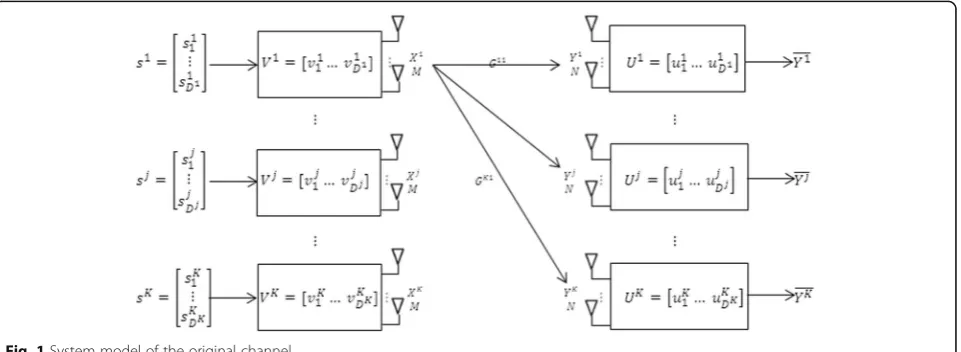
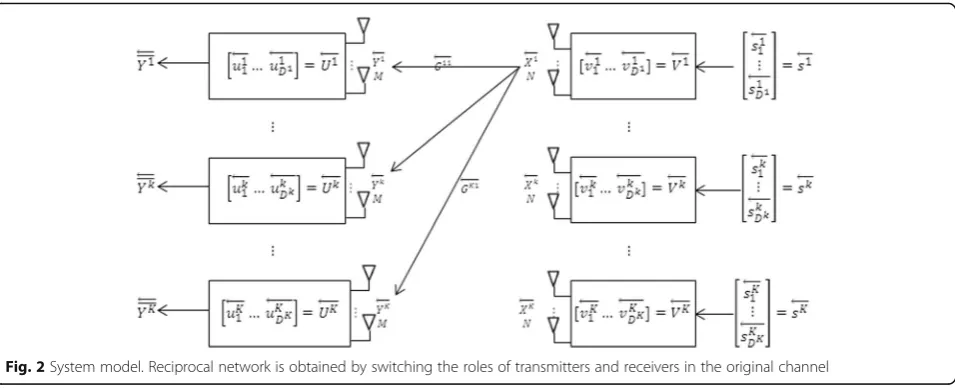
In the system model under study, each node works in a TDD mode. At the first time slot, nodes on the left hand side send the data to the right hand side nodes, shown in Fig. 1. At the next time slot, nodes on the left-hand side re-ceive the data, indicating a change in the roles of the nodes. (This is clear in Fig. 2 following where the reciprocal net-work is described). The terms, original and reciprocal
channels, are used to distinguish between two time slots. Hence, a transmitter in the reciprocal channel plays the role of an original network’s receiver and vice versa.
MIMO IC withKtransmitter-receiver pairs is considered in this paper. Thejth∈Ktransmitter and thekth∈K ¼f1;…;Kg receiver are equipped with MandNantennas, respect-ively, as shown in Fig. 1. The jth transmitter sends Dj
independent data streams sj¼ sj
1 … s
j Dj
h it
to its
intended receiver. Symbol vector has circularly sym-metric complex Gaussian distribution with zero mean and covariance matrix PI, sj~CN(0,PI). True and esti-mated channel coefficients between transmitter j and receiver k are denoted by Gkj and Hkj, respectively. In practical scenarios, there is a mismatch between true and estimated channels, as stated below:
Error Model:Gkj¼HkjþEkj;
Error Matrix:Ekjwith i:i:d CNð0;σ2Þelements: ð1Þ
The received signal at receiverkis:
Received Signal:Yk¼PK
j¼1 HkjþEkj
XjþZk;
Transmitted Signal Vector:Xj;
AWGN Vector:Zk
eCNð0;N0IÞ:
ð2Þ
In order to maximize system throughput, a beam-forming strategy based on the interference alignment is used.
Precoding Model:Xj¼Vjsj;
Precoder :MDjmatrix Vj¼ vj
1…v
j Dj
h i
;
Columns of Precoder:vjdwith unit norms:
ð3Þ
Receiver k decodes the transmitted symbol vector sk using the interference suppression matrix.
Decoding Model:Yk ¼Uk†Yk;
Decoder:NDkmatrix Uk¼ uk1…ukDk
:
ð4Þ
For the K-user MIMO IC, reciprocal channel is obtained by switching the role of transmitters and re-ceivers. True and estimated channels indicated byG←jkand H←jk, are M×N matrices. Error matrix is denoted by E←jk with element distributionCN(0,σ2). The relation between the original and reciprocal channels’gains is G←jk¼Gkj†. The V←kis precoder and U←j indicates receive interference suppression matrices on the reciprocal channel. Since the receivers of the reciprocal channel play the role of the ori-ginal network’s transmitters and vice versa, therefore V←k¼Uk and U←j¼Vj. Figure 2 shows the reciprocal network.
According to the system model, the SINR value for the dthdata stream atkthreceiver is expressed by
SINRk d¼
P uk
d
†
Gkkvk d
2
PPKj¼1 PDj
m¼1 ukd
†
Gkjvj m
2−P uk
d
†
Gkkvk d
2þN0 ukd 2:
ð5Þ
where‖.‖denotes the Euclidian norm.
3 Robust transceiver design I
In this section, the first algorithm is formulated. The algorithm starts with arbitrary transmit and receive filters and then iteratively updates these filters to yield solution. The goal is to achieve robust transceiver by optimization problem maxuk
dE SINR½ . The iterative
al-gorithm alternates between the original and reciprocal networks max
uj d
←E SINRh←i. Within each network, only
the receivers update their filters.
In the following, first, approximate expression for the mean value is computed and then the optimization problem is solved.
3.1 Estimate the mean of SINRkd
In (6)E SINR kdis computed in terms of the function SINRkd¼num
den and the probability density function f(num,den)1
Unfortunately, a closed form solution cannot be de-rived for the integration in (6). Hence, the approximate mean should be found. If f(num,den) is concentrated near its mean, then estimation of the mean value can be expressed by
Hkk† denote, respectively, the estimated
covari-ance matrix of all data streams observed by the receiver k and estimated covariance matrix of the dth desirable data stream. Since the estimation of mean is common in two algorithms, it is provided in Appendix 1.
3.2 Iterative solution
To obtain columns of Uk, the derivative of (7) with re-spect to uk
d should be obtained and then set equal to zero. Thus, uk
d should satisfy the following vector equa-tion (i.e., the derivative of the numerator multiplied by
μ2 should be equal to the derivative of denominator multiplied byμ1).
The above vector equation is rearranged as follow by moving the terms involving Skuk
d and ukd to left and Tkd
where the scalar coefficient isΩkd.
According to the definition, Tkdukd is the product of scalar valuevk
d†Hkk the directions are important. Hence, the scalar factors
μ1, ðμ1þμ2Þvkd†Hkk †
uk
d can be removed from (9). Then, the unit vector maximizes (7) is given by
ukd¼ S
Now, consider the reciprocal network. The transmit precoding matrices, V←k, are the receive interference sup-pression matrices Uk from the original network, whose columns are given by (11). The optimaldth unit column ofU←jis given by
Now, the receive interference suppression matrices in the reciprocal network replace Vj∀j∈K, and thenUk∀k∈
K are updated based on them. It is seen from (10) and (11) thatΩk
dand ukdare interdependent. Therefore, prior to repeat steps, Ωk
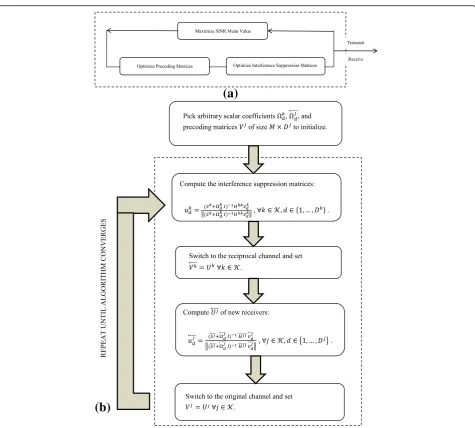
d should be computed at the end of each iteration. To summarize the iterative procedure, the steps are given in Fig. 3.
It can be proved that EM filters for the special caseσ2= 0, are transmit/receive matrices of the Max-SINR algo-rithm (Proof is provided in Appendix 2.).
In order to implement the algorithm in a distributed manner, receiver k needs to know about Hkk and Sk which are locally available. The covariance matrixSkcan be estimated from the autocorrelation of the received signalYk. SubstitutingXj¼PDd¼j1v
j ds
j
dinto (2) yields
E Yh kYk†i¼Skþ Pσ2XK
3.3 Proof of convergence
Now, the convergence of the proposed EM algorithm is demonstrated. Equivalent problem is considered. EM can be written as follows
maxu
k d
†
Quk d
uk d
†
Fuk d
; ð14Þ
where Q¼Q†¼TkdþPσ2I≥0 , and F¼F† ¼Sk−Tk d
þ Pσ2PK
j¼1Dj−Pσ2þN0
I>0 are matrices and uk d
in-dicates optimization variable. It is shown in [26] that (14) is equivalent to
maxuk d
†
Quk d;
s:t:uk d
†
Fuk d¼1:
ð15Þ
For the equivalent problem, the Lagrangian function
is given by l u kd;λ¼ukd†Qukdþλ 1−ukd†Fukd
. The
solution uk d
is the eigenvector corresponding to the maximal eigenvalue of F−1Q, and the Lagrange multi-plier isλ¼uk
d
† Quk
d
.
The metric is defined in (16). It is proved here that each step in the algorithm increases the metric. Since it cannot increase unboundedly, this implies that equivalent problem converges and consequently algorithm Fig. 3 also converges. It is important to note that the metric is the same for both original and reciprocal networks.
maxVjand UK
∀j and k∈K
metric¼XK
k¼1 XDk
d¼1l u k d;λ
: ð16Þ
Accordingly: max UK
∀k∈K
metric¼XK
k¼1 XDk
d¼1maxuk dl u
k d;λ
In other words, given Vj∀j∈K, Step 1 increases the value of (16) over all possible choices of Uk∀k∈K. The filter U←j computed in Step 3, based on V←k¼Uk, also maximizes the metric in the reciprocal channel (18).
max ← unchanged in the original and reciprocal networks, ac-cording to following equation:
metric
Therefore, Step 3 also can increase the value of (16). Since the value of (16) is monotonically increased after every iteration, convergence of the algorithm is guaranteed.
4 Robust transceiver design II
Realized SINRs for different realizations of the CSI error matrices, are samples of the SINR random variable. This random variable can has large variance. Hence, the real-ized SINR, depending on the particular realization of the CSI error matrix, could be very far from the expected value. Therefore, to hedge against such variability, each receiver adjusts its receive interference suppression matrix based on minimizing SINR variance [27]:
minuk These two terms may not attain their best values for the same transceivers in some MIMO IC system model, due to the contradiction between them. It will be shown that the VM scheme presents sum data rate (maximizeE(x)) lower than the Max-SINR algorithm but it enables trans-ceivers to hedge against variability for the primary sce-nario in simulation results. For the second scesce-nario, the VM improves sum data rate superior to the Max-SINR and provides SINR with low variance, simultaneously.
In section 4.1, the value of VAR SINRlbkd
is approxi-mated by using statistical linearization argument. The it-erative solution is similar to Algorithm I.
4.1 Estimating the variance of SINRlbk d
Lower bound on the SINR is derived in terms of norms of error matrices in [21]. Lower bound is
SINRlbkd¼
‖Ekj‖2 is the Euclidian norm of error matrix between transmitter j and receiver k, denotes by ekj in equation
(21). E
independent Gaussians, each having a unit variance. Therefore, it has a Chi-square distribution with 2NM degrees of freedom, χ22NM. Hence, one can conclude E[ekj] =NMσ2andVAR[ekj] =NMσ4[28].
Equation (21), SINRlbkd, is a function of random vector ek¼ek1…ekKt . It is clear from covariance matrix,
5, that the variance of each
element is sufficiently small for practical applications. Besides, the covariance between each two components is zero. It is concluded that the PDF of ek is concentrated near its mean and it is negligible outside a neighborhood around the mean value. Again, by using the statistical linearization argument, first order Taylor series expan-sion ofSINRlbkdaround the mean value.
θ¼E ek ¼MNσ2 … MNσ2t is employed to yield2
Using (22) for approximating the variance, following equation is obtained.
VAR SINRklbd
Since exact computation of E SINRlbkd
is not feasible, approximate mean SINRlbkdð Þθ is used (estimation of mean is provided in Appendix 1). Therefore, estimation of variance leads to3
VAR SINRk
4.2 Iterative solution Briefly, uk
d should satisfy the following vector equation: To obtain columns of Uk, the equation ∂VAR SINR½ lbkd
∂uk
d ¼
0
should be solved. Thus, uk
d should satisfy the following vector equation (The terms involving Skuk
d and ukd are
In the above vector equation, αk d, β
k d, and ζ
k d denote scalar coefficients and are expanded as follows
αk
In (28), the parameters of the scalar coefficients (a, b, andc) should be substituted by:
a¼uk
The unit vector that minimizes (26) is given by
ukd¼ S
The iterative procedure, Fig. 4, is algorithmically iden-tical to the Algorithm I. Moreover, the distributed imple-mentation explained previously can be applied again.
5 Simulation results
In this section, simulation results for the sum data rate and variance of SINR are presented. Also, the influence of the mean value approximation, and other influential parameters on the accuracy of the approximation are de-termined via Monte Carlo simulations. The proposed ro-bust transceiver design algorithms are evaluated through comparison to the following algorithms:
1. Leakage interference minimization [13] 2. Max-SINR algorithm [13]
3. Minimum mean square error (MMSE) [15] 4. Robust MMSE [22]
5. Worst-case optimization approach [21].
The use of [13, 15] for comparison is not actually fair because these papers design filter with perfect CSI. The reason is that, their sum-rates do not in-crease linearly with SNR, and they achieve lower sum-rates compared to our proposed algorithm. Mean loss in sum rate compared to perfect CSI is shown in Fig. 7 e.g., for Max-SINR algorithm [21, 22] design robust transceiver for MIMO interference network, under imperfect CSI.
The channel is modeled as Rayleigh fading. Channel coefficients [Gkj]nm are i.i.d. zero mean unit variance
circularly symmetric complex Gaussian. MIMO IC has K= 4 users with N=M= 3 antennas at transmit-ters and receivers and each user transmits d= 1 data stream denoted by (3 × 3, 1)4. Simulation results are also presented for (4 × 4, 2)3MIMO IC.
Twenty error matrices are generated for a true channel and numerical results are averaged over them. Averaging process over the error is repeated for 20 true channels to eliminate the dependence of the numerical results on the true channel, randomly created; In other words, the results are obtained after 400 Monte Carlo simulations. The stopping criterion for the convergence of the pro-posed iterative algorithms is 100 iterations. All numer-ical results are based on the SINR associated with the imperfect CSI.4
5.1 Throughput enhancement
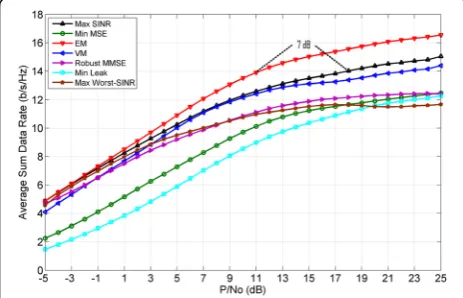
Figure 5 represents the sum rate comparison between the proposed and basic algorithms for (3 × 3, 1)4 MIMO IC. The filters are designed with the error variance of σ2= 0.1. It can be observed that the EM scheme achieves higher sum rates compared to all the other schemes over the entire considered SNR5 range. Proposed EM scheme achieves 7 dB SNR gain over the Max-SINR algorithm at providing 14 b/s/Hz sum data rate and etc. Though it does not seem that the VM algorithm improves the overall sum data rate as satisfactory as the EM scheme, it can be roughly be concluded that the VM algorithm achieves data rate as much as (slightly lower than) Max-SINR. Sum rate of algorithm 5 is shown in Fig. 5. It presents sum data rate performance as robust MMSE.
Figure 6 shows sum rate for (4 × 4, 2)3 MIMO IC. Again, the EM scheme achieves higher sum rates compared to all the other schemes. In comparison with Max-SINR, it cannot achieve data rate higher than 12 b/s/Hz, while the EM scheme improves data rate up to 16 b/s/Hz. Compared to the Max-SINR, the VM helps to mitigate the effect of the CSI error more effectively, as shown in Fig. 6. The algorithm 5 achieves a data rate only superior to the leakage interference minimization. It should be noted that,
Fig. 5Average sum data rate versus SNR.K= 4, N=M= 3, d= 1,σ2= 0.1
Fig. 4Schematic view of Algorithm II
this scheme guaranties to provide better worst-case data rate.
The better performances of the proposed schemes compared to other algorithms are accountable to suitably: 1- Both proposed schemes improve the re-silience against SINR degradation due to the CSI error. 2- Approximation (when approximate mean or variance is used for maximization or minimization, the proposed transceivers will lead to sum rate improvement).
5.2 Hedge against variability
Average SINR variance in (3 × 3, 1)4 and (4 × 4, 2)3 MIMO ICs are reported in Tables 1 and 2, respect-ively. It can be observed that proposed VM scheme achieves lower variance compared to other schemes, when the amount of SNR (>10 dB) is significant. In case of small SNR (<10 dB), the algorithms have vari-ance close to each other.
By Considering Fig. 5 and Table 1 jointly, it is con-cluded that VM cannot achieve data rate higher than and SINR variance lower than Max-SINR simultan-eously. This is due to the contradiction between minim-izingE(x2) and maximizingE(x)2in VM algorithm.
The comparative improvement in SINR variance level becomes negligible in (4 × 4, 2)3 MIMO IC, since vari-ance of the VM approaches other algorithms, as pre-sented in Table 2. On the other hand, VM achieves data rate better than Max-SINR as seen in Fig. 6. Therefore, VM presents a balance between minimizing E(x2) and maximizingE(x)2in this scenario.
The cost of the proposed robust design methods compared with the contrast schemes is the complex-ity since the MMSE ([15], equation 11), and Robust MMSE ([22], equation 4) need the inverse operation of an N-by-N matrix only once to update Vk (or Uk)
at each user per iteration, whereas the proposed algo-rithms (equations 11 and 30) require d times. In the SINR maximizing algorithm ([13], equation 30), con-trast Scheme 5 ([21], equation 13), the transmit and receive filters are column-wise updated, as complex as the proposed algorithms.
5.3 Conformity with performance evaluation in [4] Based on equation 21 in [4], it is expected that mean loss in sum rate compared to perfect CSI case increases unboundedly as SNR increases. In addition, based on equation 22 in [4], the achievable multiplexing gain should be equal to zero. These are confirmed in Fig. 7, where for the larger SNR, the wider gap between curves representing perfect CSI and imperfect CSI can be noticed. Slope of the curves or multiplexing gain when
σ2
= 0.1 is zero, too.
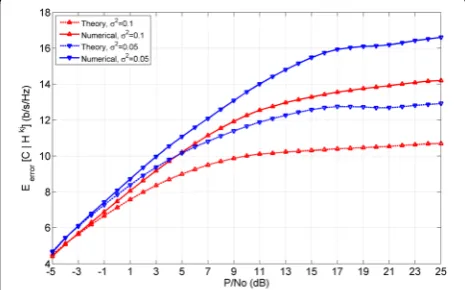
5.4 Accuracy of approximation
It is straightforward to say asσ2decreases, the impact of any error in approximating average mutual information diminishes. On the other hand, signal power P scales withσ2as it is obvious from (7). Therefore, any approxi-mation error will be attenuated asPdecreases. But here, the impact of loss due to the mean approximation and other influential parameters on the accuracy of approxi-mation are studied via Monte Carlo simulations. The EM algorithm is used by (3 × 3, 1)4MIMO IC to compute pre-coding and interference suppression matrices. The filters are designed with two CSI error variances σ2
1¼0:05 and σ2
2¼0:1. The numerical and theoretical values of average
mutual information6 of the MIMO IC versus SNR are depicted in Fig. 8.
For σ2
1 ¼0:05, the proposed approximation is within
15 and 18% of the true value when SNR≤10dB and
Table 1Average SINR variance in (3 × 3, 1)4interference network with error varianceσ2= 0.1 SNR (dB)
Algorithm 2 5 8 12 14 16 18 20 22 24
VARerror sinrkdjHkj
Max-SINR 3.8 11.6 32.3 120.2 216.9 375.5 599.1 998.6 1593.3 2285.3
EM 4.0 13.6 43.0 153.3 273.8 438.7 642.8 963.6 1429.9 2112.4
VM 5.0 14.6 37.4 102.1 151.6 203.6 261.3 325.9 403.6 428.7
Table 2Average SINR variance in (4 × 4, 2)3interference network withσ2= 0.1 SNR (dB)
Algorithm 2 6 10 12 14 16 18 20 22 24
VARerror sinrkdjHkj
Max-SINR 2.4 5.6 10.8 13.7 16.7 19.0 22.4 27.3 32.3 33.7
EM 2.9 8.6 19.4 25.5 32.0 39.6 49.7 58.9 65.9 72.1
SNR≤14dB. Forσ22¼0:1 similar statement stands when SNR≤7dBandSNR≤9dB. The proposed approximation is within 22.16 and 24.81% of the true value, respectively for σ2
1 and σ22, over the entire considered SNR range.
Therefore, by decreasing SNR and σ2 the theoretical approximation will approach the true value of average mutual information.
5.5 Convergence of VM algorithm
Since it is hard to prove convergence of this problem theoretically (it is mathematically intractable), it is in-vestigated numerically. Convergence of the iterative al-gorithm is shown numerically by considering fraction of interference leakage to the received signal parameter [22]. Figure 9 shows parameter for the proposed schemes versus iterations. In (3 × 3, 1)4MIMO IC, EM and VM converge after 10 and 50 iterations as Fig. 9 shows. Proposed algorithms converge after 20 iterations in (4 × 4, 2)3MIMO IC.
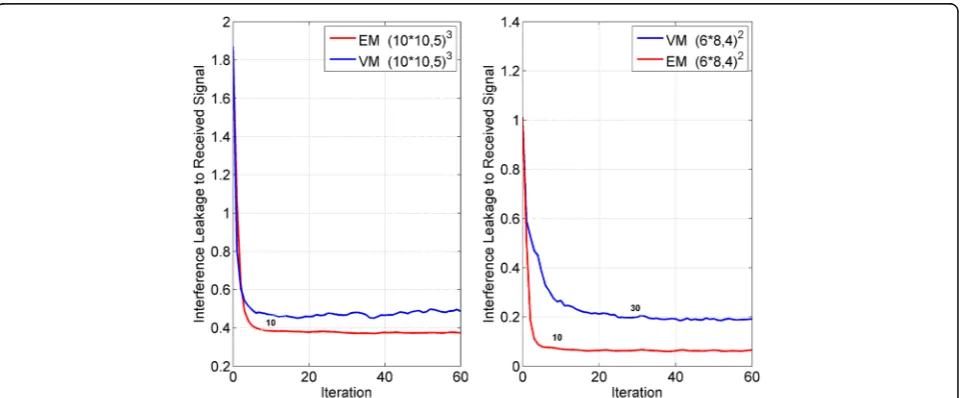
The stopping criterion for the convergence of the iterative algorithms is 100 iterations. Further results re-garding the convergence of the VM in larger MIMO ICs are provided for (10 × 10, 5)3 and (6 × 8, 4)2 in Fig. 10. Proposed algorithms converge after 10 iterations (left-hand figure). EM and VM converge after 10 and 30 iterations in (6 × 8, 4)2MIMO IC.
6 Conclusions
In this paper, two robust algorithms were proposed. In the EM scheme, filters were adjusted based on the prob-lem of expectation maximization of SINR. The other de-sign minimized the variance of SINR to hedge against variability due to the CSI error. Taylor series expansion was exploited to approximate the effect of imperfection in CSI on statistical properties. Proposed robust algo-rithms utilized the reciprocity of wireless networks to optimize estimated statistical properties in two different working modes. Monte Carlo simulations demonstrated that the EM scheme improves data rate of MIMO IC under imperfect CSI. The VM algorithm provided SINR with low variance. Moreover, it improved sum rate, but not as satisfactory as the EM scheme.
7 Endnotes 1
The random variables, num and den, are used to represent signal-to-interference-plus-noise ratio as a rational function SINRkd¼num
den and are defined by: num¼Puk
d
†
Gkkvk dvkd
†Gkk†
h i
uk d;
den¼uk d
†PPK
j¼1
PDj
m¼1 Gkjvjmvjm
†Gkj†
−P Gkkvk dvkd
†Gkk†
þN0I
h i
uk d:
2
The ∂SINRlbkd
∂ek is a K× 1 random vector whose j th
com-ponent is the derivative ofSINRlbkd with respect toekj.
3
In estimating variance, both mean vector and covari-ance matrix are required [29]; hence, lower bound on SINR is chosen because covariance matrix of random vector is known.
4
Average data rate is defined as the average through-put (i.e., the bits/s/Hz successfully delivered to the re-ceiver). Specifically, the throughput ofdth data stream at kth receiver is given by Rkd (Rkd≤Ckd), where Rkd¼ log
1þsinrk d
andsinrk d¼
P uk d
†Hkkvk d k k2
PPKj¼
1
PDj m¼1 u
k d
†Hkjvj m k k2
−P uk d
†Hkkvk d k k2
þN0k kukd 2;
and Ck
d¼ log 1þSINRkd
is the actual instantaneous mutual information. The overall sum rate of the system is given byR¼PKk¼1PdD¼k1Rkd.
5P
N0is SNR in the network, since all data streams are of powerPandN0is noise power at all receivers.
6
Theoretical or approximate capacity curve are found by substituting (7) into C¼PKk¼1
PDk
d¼1log 1þSINRkd
. Fig. 7Average sum rates achieved by the EM and Max-SINR algorithms
for (3 × 3, 1)4and (4 × 4, 2)3interference networks withσ2= 0.1
Fig. 8Theoretical prediction ofE[C|Hkj] and numerical value for (3 × 3, 1)4MIMO IC is shown versus SNR. The filters are designed with EM algorithm and two CSI error variancesσ2
E CjH kj≅PK k¼1
PDk
d¼1log 1þ
uk d
†Tk dþPσ2I ½ uk
d uk
d †
Sk−Tk dþ Pσ2
PK j¼1D
j−Pσ2þN 0
I
h i
uk d 0
@
1 A:
7
In (31) and (32), the following equality has been used
E Ekjvj mvjm†Ekj
†
h i
¼σ2 vj m†vjm
I¼σ2I:
8 Appendix 1
8.1 Estimate the Mean ofSINRkd
If f(num,den) is concentrated near its mean, then E SINRkd¼numden
can be expressed in terms of μ1and μ2,
as the mean values of num and den, respectively. μ1 represents the conditional expected value ofnum
μ1¼E numjHkj
¼uKd†TkdþPσ2Iukd; ð31Þ
andμ2denotes the conditional expected value ofden7
μ2¼E denjHkj
¼uk† d S
k−Tk dþ Pσ2
Xk j¼1D
j−Pσ2þN 0
I
h i
uk d: ð32Þ
According to the statistical linearization argument [29],SINRkdis approximated by a first order Taylor series expansion around mean value (μ1,μ2):
Fig. 9Sum of fraction of interference leakage to received signal for two interference networks withσ2= 0.1,and P
N0¼10dB.Convergence behavior of VM is like other algorithms in two considered MIMO IC scenarios. Parameter decreases and then remains within a neighborhood of final value
Fig. 10Sum of fraction of interference leakage to received signal in (10 × 10, 5)3and (6 × 8, 4)2MIMO ICs withσ2= 0.1, and P
SINRkdðnum;denÞ≅SINR
In this case, (6) yields
E SINRk
The value of integrations in (34) is zero. Therefore, estimation of the mean value can be expressed by E
SINRk d
≅μ1
μ2.
9 Appendix 2
9.1 Max-SINR: Special Case of Proposed EM Algorithm This appendix starts with a relation which is needed to proof Max-SINR is a special case of proposed EM algorithm. Searle identity [30] for matrixBand column vectorbis
B−bb′
−1
b¼ B
−1b
1−b′B−1b: ð35Þ
This identity is applied to the column of receive inter-ference suppression matrix of the Max-SINR algorithm (relation 22 in [13]) and it is simplified as follows
uk
where bb′ is covariance matrix of dth desired data stream at receiver k and Bk is the covariance matrix of all data streams heard. Matrices are with respect to perfect CSI.
Bk¼PPKj¼1XD
can be concluded that receive filters of EM design are receive matrices of Max-SINR.
Acknowledgements
There is not anyone who contributed towards the article to be acknowledged by authors.
Funding
There are not any sources of funding for the research to be declared.
Authors’contributions
AD carried out the preliminary studies, participated in the proposed algorithm, and drafted the manuscript. Dr. MK carried out the figure design and
adjustment parameters. DR. HA conceived of the study and participated in its design and coordination and helped in drafting the manuscript. All authors read and approved the final manuscript.
Competing interests
The authors declare that they have no competing interests.
Publisher’s Note
Springer Nature remains neutral with regard to jurisdictional claims in published maps and institutional affiliations.
Received: 20 October 2016 Accepted: 10 July 2017
References
1. T. Gou, S.A. Jafar, Degrees of freedom of the K user M × N MIMO Interference Channel. IEEE Trans. Inf. Theory56(12), 6040–6057 (2010) 2. S. Jafar, M. Fakhereddin, Degrees of freedom for the MIMO Interference
Channel. IEEE Trans. Inf. Theory53(7), 2637–2642 (2007)
3. V. Cadambe, S.A. Jafar, Interference alignment and the degrees of freedom of the K user Interference Channel. IEEE Trans. Inf. Theory
54(8), 3425–3441 (2008)
4. S.M. Razavi, T. Ratnaraiah, inProc. WCNC. Asymptotic performance analysis of interference alignment under imperfect CSI (2014), pp. 532–537 5. R.F. Guiazon, K. Wong, D. Wisely, Capacity analysis of interference
alignment with bounded CSI uncertainty. IEEE Wireless Communication Letters3(5), 505–508 (2014)
6. H. Bolcskei, J. Thukral, inProc. ISIT. Interference alignment with limited feedback (2009), pp. 1759–1763
7. R.T. Krishnamachari, M.K. Varanasi, inProc. ISIT. Interference alignment under limited feedback for MIMO interference channels (2010), pp. 619–623 8. O.E. Ayach, R.W. Heath Jr., Interference alignment with Analog Channel
state feedback. IEEE Trans. Wirel. Commun.11(2), 626–636 (2012) 9. S. Ma, H. Du, T. Ratnarajah, L. Dong, Robust joint signal and interference
alignment in cognitive radio networks with ellipsoidal channel state information uncertainties. IET Commun.7(13), 1360–1366 (2013) 10. J. Tang, S. Lambotharan, S. Pomeroy, Interference cancellation and
alignment techniques for multiple-input and multiple-output cognitive relay networks. IET Signal Processing7(3), 188–200 (2013)
11. F. Rezaei, A. Tadaion, Interference alignment in cognitive radio network. IET Commun.8(10), 1769–1777 (2014)
12. Y. Luo, H. Du, J. Xue, T. Ratnarajah, D. Wilcox, On the performance of asynchronous ad-hoc networks using interference alignment with renewal process. IET Commun.7(15), 1628–1637 (2013)
13. K. Gomadam, V.R. Cadambe, S.A. Jafar, A distributed numerical approach to interference alignment and applications to wireless interference networks. IEEE Trans. Inf. Theory57(6), 3309–3322 (2011)
14. S.W. Peters, R.W. Heath Jr., inProc. ICASSP. Interference alignment via alternating minimization (2009), pp. 2445–2448
15. D. Schmidt, C. Shi, R. Berry, M. Honig, W. Utschick, inProc. Asilomar. Minimum mean squared error interference alignment (2009), pp. 1106–1110 16. K. Kumar, F. Xue, inProc. ISIT. An iterative algorithm for joint signal and
interference alignment (2010), pp. 2293–2297
17. M. Botros, T.N. Davidson, Convex conic formulations of robust downlink precoder designs with quality of service constraints. IEEE J. Sel. Areas Signal Process1, 714–724 (2007)
18. A. Pascual-Iserte, D.P. Palomar, A.I. Prez-Neira, M.A. Lagunas, A robust maximin approach for MIMO communications with partial channel state information based on convex optimization. IEEE Trans. Signal Process.
54, 346–360 (2006)
19. N. Vucic, H. Boche, S. Shi, inProc. IEEE ICC’08. Robust transceiver optimization in downlink multiuser MIMO systems with channel uncertainty (2008) 20. M. Payaro, A. Pascual-Iserte, M.A. Lagunas, Robust power allocation designs
for multiuser and multiantenna downlink communication systems through convex optimization. IEEE J. Sel. Areas Commun.25, 1392–1401 (2007) 21. Chiu, E., Lau, V. K. N., Huang, H., Wu, T., Liu, S..“Robust Transceiver Design
for푘-pairs Quasi-Static MIMO Interference Channels via Semi-Definite Relaxation”, [Online] 2010. Available: http://arxiv.org/abs/1009.4300 22. H. Shen, B. Li, M. Tao, Y. Luo, inProc. WCNC. The new interference alignment
23. F. Rashid-Farrokhi, K.J.R. Liu, L. Tassiulas, Transmit Beamforming and power control for cellular wireless systems. IEEE J. Sel. Areas Commun
16(8), 1437–1450 (1998)
24. B. Song, R. Cruz, B. Rao, inProc. ICC. Network duality and its application to multi-user MIMO wireless networks with SINR constraints (2005), pp. 2684–2689 25. Babadi, B., Tarokh, V..“A Distributed Dynamic Frequency Allocation Algorithm
for ad-hoc Networks”, [Online] 2007. Available: http://arxiv.org/abs/0711.3247 26. E.K.P. Chong, S.H. Zak,An Introduction to Optimization(John Wiley & Sons,
2001), pp. 382–383
27. A. J. Kleywegt, A. Shapiro, inHandbook of Industrial Engineering: Technology and Operations Management, Third Edition, ed. by G. Salvendy. Stochastic Optimization, (Wiley, Hoboken, 2001)
28. A. Papoulis, S.U. Pillai,Probability, Random Variables and Stochastic Processes
(McGraw-Hill, 2002), pp. 162–163
29. S.M. Kay,Fundamentals of Statistical Signal Processing: Estimation Theory
(Prentice Hall), pp. 294–299