Enhancing the TED-LIUM Corpus with
Selected Data for Language Modeling and More TED Talks
Anthony Rousseau, Paul Deléglise, Yannick Estève
Laboratoire Informatique de l’Université du Maine (LIUM)University of Le Mans, France
Abstract
In this paper, we present improvements made to the TED-LIUM corpus we released in 2012. These enhancements fall into two categories. First, we describe how we filtered publicly available monolingual data and used it to estimate well-suited language models (LMs), using open-source tools. Then, we describe the process of selection we applied to new acoustic data from TED talks, providing additions to our previously released corpus. Finally, we report some experiments we made around these improvements.
Keywords:Corpus, Speech Recognition, Language Modeling
1.
Introduction
Back in May 2012, we presented at LREC a new corpus dedicated to Automatic Speech Recognition we developed to participate to the IWSLT2011 campaign (Federico et al., 2011) on the Spoken Language Translation task (spoken English to written French). This corpus is composed with segments of public talks extracted from the TED website1 in order to be as close as possible to the content of the evaluation sets from the aforementioned task. We believe this helped us to propose the best-ranked system during this campaign, while the great diversity of speakers also ensure a reasonable generalization for other tasks.
In this paper, we propose enhancements we made to this corpus in a new release which will be made publicly available later this year. These improvements are of two kinds:
• addition of monolingual text data aimed at language modeling, filtered with data selection techniques, well-suited for decoding tasks using our TED-LIUM corpus and, in our experiments, leading to interesting WER reductions,
• addition of new acoustic data extracted from TED talks, along with corresponding automatically aligned transcripts and an updated training dictionary, also leading to a decrease in the word error rate of our sys-tem.
The remainder of this paper is organized as follows: first, in section 2., we briefly summarize the original release of the TED-LIUM corpus. Then, in section 3., we describe the data selection experiments we made in order to improve the language modeling part of our system using only open-source tools and publicly available data. Finally, in section 4., we present the segment selection process we used for new TED Talks inclusion and the characteristics of this new acoustic data for our corpus. We also discuss the improvements obtained using this new data in our system.
1http://www.ted.com
2.
The TED-LIUM corpus
The TED-LIUM corpus was initially released in May 2012, during the LREC’12 conference in Istanbul, Turkey (Rousseau et al., 2012). It was developed within the context of the LIUM’s participation to the IWSLT 2011 evaluation campaign. All its raw data (acoustic signals and closed cap-tions) was extracted from the TED website, and automatic transcriptions obtained from decoding the acoustic signals were aligned with the raw closed captions text in order to get automatically aligned references for the audio data. Development and test sets, manually segmented and tran-scribed, were also proposed inside this initial release, which is found at http://www-lium.univ-lemans.fr/ en/content/ted-lium-corpus.
The table 1 summarizes the characteristics of the data found inside the initial release of the TED-LIUM corpus.
Characteristic Train Dev
Number of talks 774 19
Total duration 118h 4m 48s 4h 12m 55s - Male 81h 53m 7s 3h 13m 57s - Female 36h 11m 41s 58m 58s
Mean duration 9m 9s 13m 18s
Number of
666 19
unique speakers
Number of segments 56.8k 2k
Number of words 1.7M 47k
Table 1: The TED-LIUM corpus release 1 characteristics.
3.
Selecting data for language modeling
In this section, we describe the experiments we made re-garding data selection for language modeling. These exper-iments lead to the inclusion of well-suited selected mono-lingual data in our corpus. This data comes from publicly available corpora distributed within the WMT 2013 ma-chine translation evaluation campaign2.
3.1.
The XenC tool
In order to select relevant data to the task of perform-ing Automatic Speech Recognition on TED Talks, we used a data selection approach described in (Moore and Lewis, 2010), which we implemented in an open-source tool named XenC we developed and released last year (Rousseau, 2013). This approach, which is becoming commonly used in the Statistical Machine Translation field, generally helps achieving better BLEU scores and can be used both with monolingual (language model estimation) or bilingual (translation model estimation) data. In the Automatic Speech Recognition field, more than a WER or perplexity reduction (which are still usually observed), we aim at reducing the size of the training data, thus estimating smaller LMs and consequently optimizing decoding speed and disk usage.
The XenC tool filtering framework consists of the following: from an in-domain corpus and one out-of-domain corpus, we first estimate two language models. The first LM is estimated from the whole in-domain corpus. The second LM is estimated from a random subset of the out-of-domain one, with a number of tokens equal to the in-domain one. These two models are then used to compute two scores for each sentence of the out-of-domain corpus, so the difference between these scores would provide an estimation of the closeness of each out-of-domain sentence regarding the in-domain subject. Finally, the out-of-domain corpus is sorted by score, and evaluation then threshold decision are performed by computing perplexity of language models estimated from parts of various sizes of the sorted corpus. In other terms, our tool will extract cumulative parts based on a fixed step size (usually ten percent), estimate LMs on them, then compute the perplexity against a development corpus or the in-domain one.
3.2.
Data selection for TED Talks
The data selected for language modeling using our XenC tool comes from corpora distributed within the WMT 2013 evaluation campaign. Each individual corpus from WMT13 is considered as out-of-domain, while our in-domain corpus consists of all the text from the transcrip-tion files of our corpus TED-LIUM release 1. The table 2 presents the characteristics of the original and selected data, in terms of number of sentences. Regarding the UN corpus, the number of selected sentences is equal to zero as this cor-pus seems totally out-of-domain according to our tool (very high perplexity, even when keeping only one percent).
3.3.
Experiments
For these experiments, we made baseline acoustic models for the Kaldi decoder (Povey et al., 2011) by only using training data available in the TED-LIUM corpus first re-lease, briefly described in section 2.. These models have first been trained using linear discriminant analysis (LDA) and maximum likelihood linear transform (MLLT) fea-ture transformations, then speaker adaptive training (SAT) and feature space maximum mutual information (fMMI) (Povey et al., 2008) estimation were performed.
Corpus # Sent. # Sent. % of
original selected original
Common Crawl 8 528 785 1 194 029 14
Europarl v7 2 268 659 180 541 8
109FR-EN 22 520 400 900 530 4
News-com. v8 247 966 32 234 13
News 68 521 621 9 593 018 14
UN 14 126 730 0 0
Yandex 1M 1 000 000 350 000 35
Total 117 214 161 12 250 352 10.45
Table 2: Original and selected monolingual data character-istics.
In order to achieve a good comparison, we made three sets of quadrigram language models (4G LMs). The first one is composed of a language model estimated of the text ex-tracted from the TED-LIUM transcriptions only a the lan-guage model which was used during the IWSLT 2011 cam-paign. The second set is composed of language models es-timated from the whole monolingual data presented in table 2, while the third set corresponds to language models esti-mated from the selected data. For each of these two sets, two language models have been produced:
• the first one is estimated from a linear interpolation of individual language models for each data source,
• the second one is estimated using a single corpus where all data sources are concatenated.
The coefficients used for linear interpolations were automatically computed against the development set tran-scriptions from the TED-LIUM corpus. The vocabulary is the same as the one we used during the IWSLT 2011 evaluation campaign (Rousseau et al., 2011) which consists of about 150k both manually and automatically phone-tized words. All language models have been estimated using the SRILM toolkit (Stolcke, 2002) with a modified Kneser-Ney discounting method and no cut-offs. The table 3 summarizes, for each language model, the number of bigrams, trigrams and quadrigrams (in millions), as well as, for 4G LMs, the perplexity obtained on the development set and the LM size on disk (in gigabytes).
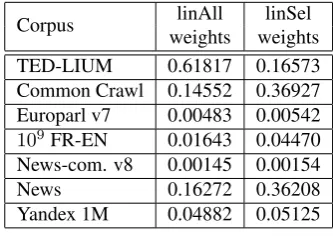
We can see that data selection leads to an important reduction of both perplexity and LM size, thus improving decoding time and memory usage. We can also observe that there is almost no difference in perplexity between linear interpolation and concatenation, except a tiny reduction for the linear interpolation of all the models, compared to the concatenation. The table 4 details the different interpolation weights that were calculated for 4G LMs estimation, for both datasets (All and Selected).
LM # 2G # 3G # 4G PPL Size
TED 0.4M 0.9M 1.1M 263 0.03G
IWSLT 35.8M 192.2M 392.7M 212 6.3G
catAll 29.1M 209.5M 573.9M 184 7.9G
linAll 29.1M 209.5M 573.9M 183 7.9G
catSel 17.2M 71M 124.1M 113 2.3G
linSel 17.2M 71M 124.1M 113 2.3G
Table 3: Characteristics of each language model: TED is TED-LIUM transcriptions data only, IWSLT is original LM from IWSLT 2011 campaign, catAll and catSel are con-catenation of All and Selected data respectively, linAll and linSel are linear interpolation of All and Selected data re-spectively.
Corpus linAll linSel
weights weights
TED-LIUM 0.61817 0.16573
Common Crawl 0.14552 0.36927 Europarl v7 0.00483 0.00542
109FR-EN 0.01643 0.04470
News-com. v8 0.00145 0.00154
News 0.16272 0.36208
Yandex 1M 0.04882 0.05125
Table 4: Interpolation weights of the various corpora in fi-nal 4G LM estimation, for both All and Selected datasets.
more than half the total weights. We also see that Eu-roparl and News-commentary weights are very weak and that large corpora like Common Crawl or News (with po-tentially many domain-related sentences) are underrepre-sented. The distribution of weights seems suboptimal. Conversely, when using filtered data, the weight for TED-LIUM is much lower but still of some importance, while the weights for other significant corpora like Common Crawl or News seems smoother. Weights for less significant corpora, while not very different, are at least a little stronger, mean-ing that the selected sentences are closer to the considered task.
3.4.
Evaluation of the language models
Using each of these language models, we then performed a decoding on our development and test sets. The table 5 presents the word-error rate (WER) we obtained on each set for each language model.
In this table, we can observe that using automatically se-lected data with our open-source tool XenC leads to in-teresting word-error rate reductions. When comparing the “catSel” LM WER with the IWSLT 2011 LM WER, we report a reduction of 2.0 points (11.3% relative) on the de-velopment set and 1.0 point (5.3% relative) on the test set. When comparing the same LM WER with the “catAll” LM WER (thus indicating the impact of data selection), we can see a reduction of 0.9 point (5.4% relative) on the devel-opment set and 0.2 point (1,1% relative) on the test set. It is noticeable that the LM estimated from concatenated
se-LM Dev WER Test WER
TED 20.9% 21.5%
Table 5: Results in terms of word-error rate (WER) ob-tained on TED-LIUM development and test sets for each considered language model.
lected data reaches a lower WER than the LM computed from interpolated selected data. This behavior is observed because using individual corpora for selection induces in-clusion of some unrelated sentences, while processing all data at once allows a better score estimation, relegating un-wanted sentences altogether.
4.
Enhancing the corpus with new talks
In this section we describe the second enhancement we propose for the TED-LIUM corpus, which is the addition of many new TED Talks, under the form of speech seg-ments: acoustic data and corresponding transcriptions with timings.4.1.
Selection of new segments
We extracted 753 new talks from the TED website, ac-counting for 158 hours of raw acoustic data, compared to the 818 talks representing 216 hours of raw acoustic data extracted for the first release of TED-LIUM. This acoustic data has been automatically segmented using our in-house tool (Meignier and Merlin, 2010) to produce 61699 speech segments. We also extracted the corresponding closed captions, representing about 1,4 million words of raw textual data.
during the network training with stochastic gradient descent in order to minimize cross-entropy between the training data and network output. To speed up the learning process, we used a GPU and the CUDA toolkit for our computations.
The process of segment alignment and selection can be split up into several steps:
1. first, we use the neural network and the 4G LM to de-code the whole set of new segments;
2. then, we align, for each individual talk, the resulting output of the ASR system with the raw closed captions text using an algorithm based on WER minimization. The system output is considered as the reference;
3. at this step, it is advisable to remove the worst aligned talks according to their alignement WER to skip pro-cessing unwanted talks, like ones in foreign language, made of songs or spoken by non-native english speak-ers with very strong accents;
4. select all segments where the closed captions text per-fectly matches the system’s transcriptions and update the training set of segments;
5. estimate new acoustic models and neural network us-ing the updated set of trainus-ing data.
This process can be iterated several times, each time enhancing the training data with new segments. When the improvement of the system’s WER starts to become too low and stability is reached, one last iteration can be done in order to select the final set of added segments to the training database. We use the same process as described above, except that we select segments where only the first and last word match between the transcriptions and the closed captions, keeping the text from the closed captions.
The table 6 summarizes the characteristics of the newly added data through each iteration.
Iteration
WER
# of Speech Dev Test
seg. hours fMMI DNN
Baseline 56803 118h 15.7 12.4 13.5
1 71474 144h 15.5 11.4 12.4
2 75747 154h 14.0 11.2 11.9
3 77142 157h 13.9 11.0 11.8
Final 92976 207h 13.6 10.4 11.3
Table 6: TED-LIUM release 2 acoustic data statistics and scores by iteration. Baseline is using TED-LIUM release 1 only as training data.
After the final iteration, we end up adding more than 35000 useful segments (36173, i.e. 41.4% of the new talks seg-ments) to our corpus, effectively reducing the word-error
rate by 2.0 points (16.1% relative) when decoding with the neural network and 2.1 points (13.4% relative) when de-coding with the fMMI models.
4.2.
Characteristics of the enhanced corpus
The table 7 summarizes the characteristics of the textual and audio data of the new release of the TED-LIUM cor-pus. Statistics for both releases are presented, as well as the evolution between the two.Characteristic Corpus Evolution
v1 v2
Total duration 118h 207h 75.4%
- Male 82h 141h 72%
- Female 36h 66h 83.3%
Mean duration 9m 9s 10m 12s 11.5%
Number of
666 1242 86.5%
unique speakers
Number of talks 774 1495 93.1%
Number of segments 56803 92976 63.7%
Number of words 1.7M 2.6M 52.9%
Table 7: TED-LIUM release 2 corpus audio and text char-acteristics.
4.3.
Updating the language model
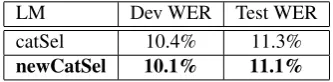
In order to propose a complete experiments, we made a sec-ond and last experiment regarding the data selection for lan-guage modeling. As described in section 3., we used our XenC tool to select data from the same corpora sets than before, but considering the text from the new training set as our in-domain corpus. We also used the updated vocabulary mentioned in section 4.1. to perform the selection and esti-mate the new language models. The tables 8 and 9 presents respectively the differences in data selection between the first and updated language models and the characteristics of the updated one compared to the “catSel” one described in section 3..
Corpus % of original
1st selection 2nd selection
Common Crawl 14 9
Europarl v7 8 6
109FR-EN 4 4
News-com. v8 13 9
News 14 18
UN 0 0
Yandex 1M 35 31
Total 10.45 12.34
Table 8: Differences in selection between the first and sec-ond language models.
LM # 2G # 3G # 4G PPL Size
catSel 17.2M 71M 124.1M 113 2.3G
newCatSel 18.8M 80.6M 144.2M 111 2.6G
Table 9: Characteristics of the updated “catSel” language model compared to the one described in section 3..
LM Dev WER Test WER
catSel 10.4% 11.3%
newCatSel 10.1% 11.1%
Table 10: Results in terms of word-error rate (WER) ob-tained on TED-LIUM development and test sets for first and second version 4G language models.
In the end, our final system lead to an interesting reduction in WER of 2.3 points (18.5% relative) with our updated acoustic models and neural network on the new training set plus our updated language model.
4.4.
Availability of the second release
This second release of TED-LIUM will be made available later this year, on our local website in the same place as the first one (see URL in section 2.). It will be composed of the following:
• 1 495 TED talks acoustic signal in NIST Sphere for-mat (SPH) as training for-material,
• 1 495 accompanying reference transcriptions in STM format,
• 14 469 724 lines of selected text for language model-ing,
• an updated phonetized dictionary of 159 849 words with variants (152 213 unique words),
• 19 TED talks in SPH format with corresponding man-ual transcriptions to divide into development and test sets.
5.
Conclusion
In this paper, we presented the improvements we made to our previously released TED-LIUM corpus. We first showed that interesting word-error rate reductions can be obtained with language models composed of filtered data using cross-entropy difference; as well as reductions in size, thus improving the decoding time and memory us-age. Then, we presented the additions made to the updated TED-LIUM corpus. We described the ASR system trained to perform the segment selection process and reported the results obtained on each iteration, as well as results using an updated language model.
6.
References
Federico, M., Bentivogli, L., Paul, M., and Stüker, S. (2011). Overview of the IWSLT 2011 evaluation cam-paign. In Proceedings of International Workshop on
Spoken Language Translation, pages 11–27, Décembre.
Kingsbury, B. (2009). Lattice-based optimization of se-quence classification criteria for neural-network acoustic modeling. InIEEE International Conference on
Acous-tics, Speech and Signal Processing, 2009, pages 3761–
3764, April.
Meignier, S. and Merlin, T. (2010). LIUM SpkDiarization: an open source toolkit for diarization. InProceedings of
the CMU SPUD Workshop, Mars.
Moore, R. C. and Lewis, W. (2010). Intelligent selection of language model training data. InProceedings of the ACL Conference Short Papers, pages 220–224, Juillet. Povey, D., Kanevsky, D., Kingsbury, B., Ramabhadran, B.,
Saon, G., and Visweswariah, K. (2008). Boosted mmi for model and feature-space discriminative training. In
IEEE International Conference on Acoustics, Speech and
Signal Processing, 2008. ICASSP 2008., pages 4057–
4060, March.
Povey, D., Ghoshal, A., Boulianne, G., Burget, L., Glem-bek, O., Goel, N., Hannemann, M., Motlicek, P., Qian, Y., Schwarz, P., Silovsky, J., Stemmer, G., and Vesely, K. (2011). The kaldi speech recognition toolkit. InIEEE 2011 Workshop on Automatic Speech Recognition and
Understanding. IEEE Signal Processing Society,
De-cember.
Rousseau, A., Bougares, F., Deléglise, P., Schwenk, H., and Estève, Y. (2011). LIUM’s systems for the IWSLT 2011 speech translation tasks. InProceedings of International
Workshop on Spoken Language Translation, pages 79–
85, Décembre.
Rousseau, A., Deléglise, P., and Estève, Y. (2012). TED-LIUM: an automatic speech recognition dedi-cated corpus. In Proceedings of the Eight Interna-tional Conference on Language Resources and
Evalua-tion (LREC’12), pages 125–129, Mai.
Rousseau, A. (2013). Xenc: An open-source tool for data selection in natural language processing. The Prague Bulletin of Mathematical Linguistics, 100(1):73–82, Oc-tober.